To Become a Super Learner, Avoid These Common Mistakes — from learntrepreneurs.com by Eva Keiffenheim

Excerpt:

Learning is a journey, not a destination. And to learn more effectively, here’s what you might want to keep in mind:

  • Use space repetition instead of mass learning.
  • Embed new facts into context.
  • Experiment with diverse learning methods.
  • Seek test situations and embrace mistakes.

Also from Eva:


10 things you didn’t know you could do with Google Arts and Culture — from ditchthattextbook.com

Excerpt:

Google Arts and Culture is a massive collection of videos and images of cultural artifacts from over 2,000 museums around the world. But virtually visiting art exhibits is just one of the many things you can do with Google Arts and Culture. From virtually displaying life-sized art inside your house to playing in a blob opera, Google Arts and Culture runs an impressive gamut of ways to explore culture from your own home or classroom.


Rethinking the Faculty Role in Students’ Career Readiness — from insidehighered.com by Rachel Toor; with thanks to Ryan Craig for this solid, well-written resource
It’s time for all of us on campuses, not just the people in career services, to step up and help offer the competencies employers say they’re looking for, Rachel Toor writes.

Excerpts:

Career centers on campuses can offer students coaching, resources and connections. But, as Angle points out, they tend to be a just-in-time service. They are also, he says, “scary places for a lot of students.” Many young people don’t want to face the reality of life after graduation. Often, it’s a case of too little, too late.

Instead, they come to people they know—professors like me—for help with cover letters and résumés. And while I can comment on language, until recently I had no idea about how most résumés are read first by a version of R2-D2 and his little robot friends who make up automated tracking systems. If an applicant doesn’t include the right keywords in a résumé or cover letter, into the trash bin they go.

The truth is, I have not applied for a job in 15 years; for many of my colleagues it’s been even longer, and some of them have never worked outside academe. It’s not surprising that employers are seeing recent college grads—smart students, hard workers—who don’t know how to present themselves as potential employees.


From DSC:
I can relate to that part about R2-D2 reading the resumes first (i.e., trying to get by the Applicant Tracking Systems before one’s resume ever makes it in front of the eyes of a fellow human being). Many faculty/staff members and members of administrations haven’t been out interviewing in a long while. So it can be a rude awakening when they/we need to do that.

Also, I wanted to say that it’s not fair to assess the learners coming out of higher education using a different set of learning objectives:

  • That is, faculty members within higher ed have one set of learning objectives and their students work hard to learn and meet those learning objectives. Unfortunately, those students did what was asked of them, and then they…
  • …come to find out that the corporate/business/legal/etc. worlds have different ideas about what they should know and be able to do. That is, these other organizations and communities of practice are assessing them on different sets of learning objectives that these same students didn’t cover. Some (many?) of these graduates leave their interviews discouraged and think, “Well, it must be me.” Or they can leave frustrated and angry at their former institutions who didn’t prepare them for this new assessment.

As I’ve said on this blog before, this disconnect is not fair to the students/graduates. We need more mechanisms by which faculty and staff members within higher ed can work more collaboratively with those within the corporate world to better align the learning objectives and the curriculum being covered. If this doesn’t occur more frequently, the constant appearance and growth of new alternatives will likely continue to build further momentum (as they should, given the incredibly steep price of obtaining a degree these days!).

P.S. This disconnect of learning objectives can also be found in what happens with legal education — including having to pass today’s Bar Exams — and then these graduates get out into the real world to find employers who are frustrated that these graduates don’t have the “right”/necessary skills.

“The incentive structure is for law schools to teach students how to pass the bar exam, not necessarily to do the things that employers expect,” Gallini said.

A quote from this article, which I also
want to thank Ryan Craig for.


How to manage slow-working students in your classroom — from blog.neolms.com by Diana Z

Excerpt:

If you have slow-working students in your classroom and want to help them catch up and reach milestones, you should first make sure to rule out any possible psychological barriers that could affect their processing speed or other cognitive issues.

Next, you should devise an intervention scheme that is structured on the three A’s principle:

  • Accepting means that the students need to feel accepted in the learning environment and teachers can provide them a safe place for growth;
  • Accommodating refers to the due diligence a teacher has to exercise to provide a suitable learning environment for all students;
  • Advocating implies the support teachers offer slow-working students throughout their learning journey. It also involves other stakeholders, such as parents and the community, who can also support students.

From DSC:
This is an important topic, because not everyone can work with the (often) fast pace of the current train. One of our daughters has experienced this first hand, and I continue to learn from/through her experience.

K-12 education in America is a like a quickly moving train that stops for no one.


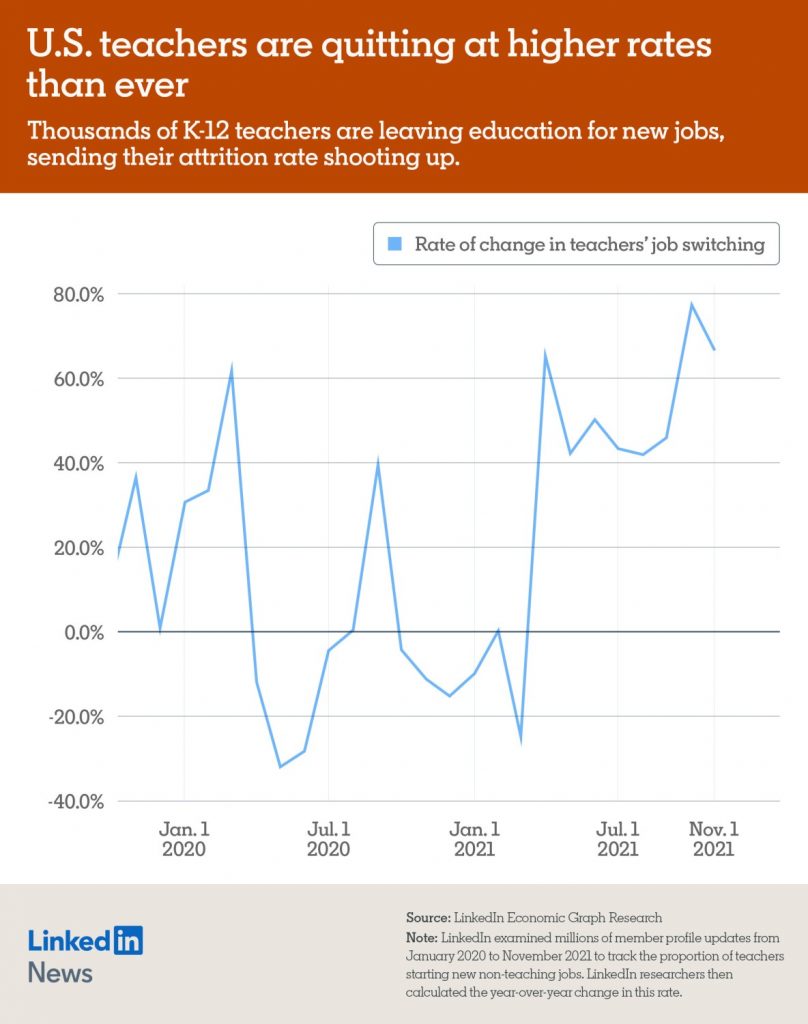
Teachers sprint into new careers, amid a 66% rise in school-job departures — from linkedin.com by George Anders

Excerpt:

Across the United States, thousands of other long-time teachers are walking away from the field they loved for a long time, in favor of fresh starts in areas ranging from healthcare to software engineering.

Thousands of K-12 teachers are leaving education for new jobs, sending their attrition rate shooting up.

Also related/see:

  • NEA Survey Shows Big Jump in Educators Planning to Leave Teaching Sooner Than Planned — from thejournal.com by Kristal Kuykendall
    Excerpt:
    The National Education Association, the nation’s largest union representing nearly 3 million educators, on Tuesday released its latest survey conducted last month showing 90% of educators responded that burnout is a “serious problem” for them.Also notable: more than half, 55%, of the 3,621 educators surveyed said the pandemic has made them “more likely to retire or leave education earlier than planned” — representing a significant increase from the 37% with this response to the same question in an August 2021 NEA survey.
  • When Toxic Positivity Seeps Into Schools, Here’s What Educators Can Do — from edweek.org by Arianna Prothero
    Excerpt:
    “Look on the bright side” and “it could be worse” are statements we hear all the time, and likely even more so during the pandemic.On the surface, these remarks might seem to inject much-needed optimism into a tough situation. But rather than motivating students or teachers to push through stressful times, experts say statements like these have the opposite effect.


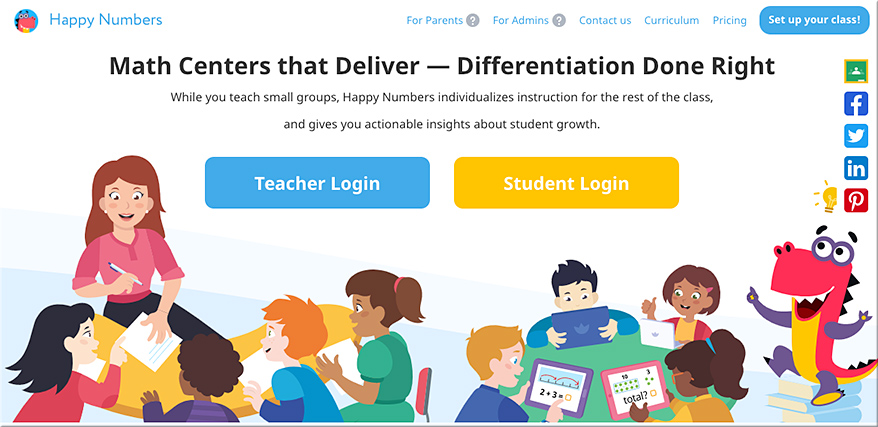
Happy Numbers

Check out the Happy Numbers site for teaching kids math

What Are The Best Websites For Teaching Math Online? — from teachthought.com by Jennifer Smith

70+ Awesome Websites for Teaching and Learning Math — from weareteachers.com
Learning math can sometimes be a challenge. Especially if you’re doing virtual or distance learning. Math websites to the rescue! We’ve gathered a list of teacher-recommended sites that includes resources, games, freebies, and innovative programs for teaching math. These will help keep students engaged, learning, and having fun.

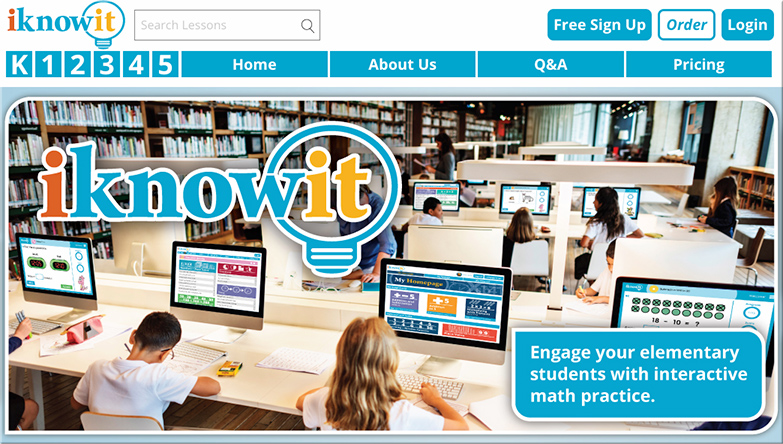
iknowit.com

i know it dot com -- engage your elementary students with interactive math practice

Top Websites Ranking for Math in the world — from similarweb.com

Also, check out the public media resources in your state/area/region. For example, here in Michigan:

Check out the public media resources in your state -- Michigan has math as one of their topics on their Learning Channel


Addendum on 1/30/22:

ctcmath.com -- for gifted K through 12ers and homeschoolers


What Could Web3 Mean for Education? — from edsurge.com by Rebecca Koenig

Excerpts:

It’s an ecosystem that could transform schools—sites for teaching and learning—into marketplaces—sites for buying and selling.

That includes higher education. In the vein of MOOC platforms, Web3 systems could make it easier to “unbundle” college courses from degree programs and universities, enabling individuals to sign up for whatever classes they want and instructors to market their courses to consumers directly, says Vriti Saraf, a former charter school teacher and administrator and Teach for America alumna who founded a startup called k20 Educators.


Tech & Learning Magazine Names the Winners of the Best of 2021 — from techlearning.com
Tech & Learning’s judges deemed these products as standouts for supporting teaching and learning in 2021

Excerpt:

Tech & Learning magazine has named the winners of the Awards of Excellence: Best of 2021 contest, which recognizes educational technology that exceptionally supported teachers and students last year.

 The contest focused on outstanding products that supported education this past year no matter the learning environment, whether face-to-face, remote, or anything in between. Eligible products included hardware, software, curriculum, and more, all divided by grade levels to make it easier to find the solutions you need.

 Each nominee answered the following questions: What specific problem does this product solve? How did your product exceptionally support teaching and learning in 2021? How does your product address the challenges facing education today?


6 Ed Tech Tools to Try in 2022 — from cultofpedagogy.com by Jennifer Gonzalez

Excerpts:

This year, for the very first time, I hired a team of ed tech experts to help me with the update. The task was becoming overwhelming and I knew if I was going to keep it up, I had to have some help. Here they are below: Marnie Diem, Brandie Wright, Lucia Hassell, and Kim Darche.
…

5. EVERFI
everfi.com/k-12

Originally a site that offered free financial literacy courses to students, EVERFI has expanded its course offerings to include career exploration (including one specific to STEM careers), social and emotional learning, diversity and inclusion, and health and wellness. Their newest additions are courses in healthcare literacy, data science and banking fraud, and compassion and empathy.


Tip of the week: Make websites more readable — from fastcompany.com by Jared Newman
How to easily hide ads, auto-play videos, and other clutter in every major browser.

Excerpt:

Ever get annoyed by the intolerable reading experience on certain websites? By activating your browser’s reader mode, you can make web pages more reader-friendly by hiding ads, menus, pop-ups, and other distractions. Some web browsers even let you switch to reader mode automatically on specific websites. Here’s how:


Also see:

1 Million More Tutors in the US — from typeshare.co by Kevin Zhang

Excerpt:

There are roughly 17M US high school students across public and private schools. If the top 6% of US high school students were tutors, we would have 1M more tutors.

Imagine what that would do for our US K12 education system and our society.

There are 1M high school teachers currently in the US. We would have an additional tutor per teacher.

So how do we incentivize students?


From DSC:
These ideas are specially meant for you entrepreneurs and vendors out there! Including such vendors and products such as Zoom, Cisco Webex, Microsoft Teams, Adobe Connect, and others!

This idea could also be profitable and fun for CMS/LMS vendors and products such as Instructure/Canvas, Blackboard Learn, D2L, Google Classroom and others!


How might we take engagement within an online-based learning environment to an entirely different level? Well, check out these ideas!

What if learning could feature more personality? Be more fun? Have shades of game shows even!? Yet at the same time, if you are a learner who ventures into the ideas that I’m about to suggest, you had better be ready to back up and explain your perspective/position!

Here’s what I’m getting at. You know when you are messaging you can insert some fun motion graphics into your message?


Well, what about if we could select from a bank of very short video clips during a live/synchronous discussion — or during an asynchronous-based discussion board posting — that contained a famous movie clip/message? Then, if you choose to do that, you are then required to explain your perspective/position.  


Video What the video could mean
“Beam me up Scotty! There’s no intelligent life down here.” This is ridiculous. No one’s making any sense here. 
“You meddling kids.”
 From various bad guys on Scooby-Doo.
 You’re messing with me. I don’t agree with your perspective, and here’s why.
“That does not compute.”
Spock from Star Trek. 
I don’t agree with your answer. That doesn’t make any sense and here’s why.
“You can’t handle the truth.”
Jack Nicholson in “A Few Good Men.”
Are you sure you want to know the truth about this topic? Can you handle such a truth? This is about to get real in here.
“Do. Or do not. There is no try.”
Yoda. Star Wars
 Take action on something; do something.
“I’ll be back.”
Arnold Schwarzenegger in various films.
I’m stepping away from my desk…but I’ll be back soon.
or
You may have one this round, but I’ll be back for another round.

Learners within a learning community could use entertainment and have some fun while also having to backup their position/perspective! Talk about engagement! Shooooot.

And/or…learners could be like DJ’s at radio stations — and, on the fly, select from a bank of songs, audio-based noises and sounds!

The danger here is that humor can sometimes backfire and/or offend someone. So we would need to watch the content that’s available to choose from within the repositories of media. We would want to do some serious beta testing here to make sure things stay on the fun, entertaining, and educational sides of things.

Such an approach could introduce opportunities for creativity and for honing one’s ability to think on one’s feet. Also, learners could work on their communication skills as well as their ability to debate or persuade, or to practice some critical thinking.

While more gameshow-like on the surface, if you use such media, you have to explain why you used that media.


Exemplar of successful implementation of tech in schools — from donaldclarkplanb.blogspot.com by Donald Clark

Excerpts:

It was impressive to find a school network that took technology as seriously as Curro, in South Africa. They had invited me to give a keynote on AI for Learning, based on my book and experience but I hung around as the teacher sessions were so damn good. This is what I learnt, as I think it is a recipe for success.
…
This was the big surprise. There were glowing testimonials from teachers about the power of adaptive learning, using AI, to personalise learning for students. It was described as a ‘gamechanger’ by the teacher who presented, with clear targeting, so that efficient and relevant, individual interventions could be made for students. It was clear that they knew why they wanted this technology, had implemented it well and were using teacher feedback to spread the word internally.

I was giving a talk as part of that process. The day’s activities were under the banner of ‘Imagining 2022’. It’s hard enough to Imagine what any year will bring these days but it was clear that this was a learning organisation, willing to learn from their mistakes and make the effort to plan forward.

Also see:


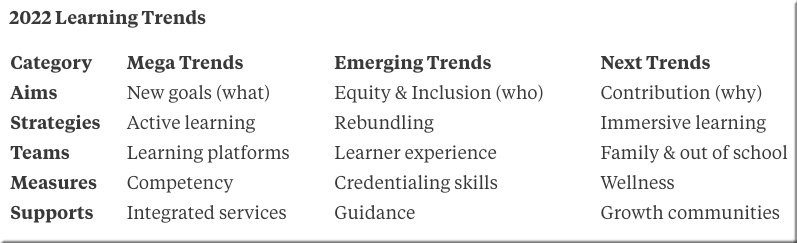
Trends Shaping Education in 2022 — from gettingsmart.com by Tom Vander Ark

Key Points:

  • It’s hard to see trends in a crisis.
  • Around the edges and behind the scenes three important shifts accelerated: new learning goals, team tools and staffing, and active learning.


2022 Learning Trends


Google Slides here


© 2025 | Daniel Christian