How Art Class Became a Rare Bright Spot for Students and Families During the Pandemic — from edsurge.com by Daniel Lempres

Excerpt:

When schools went remote two years ago, the National Art Education Association (NAEA) was quick to offer guidance on how best to reach students who have experienced trauma. They offered strategies for remote learning, as well as mental and emotional wellbeing.

Now more than ever, art educators must employ the tenets of social emotional learning, the NAEA says. In a recent report, the association recommended trauma-informed teaching strategies to promote mental health through self-expression—for their students’ sake and their own.

But with asynchronous lessons and virtual events, the amount of parental participation skyrocketed, she says.


Power Lesson: Poetry Gallery Walk — from cultofpedagogy.com by Marcus Luther

Excerpt:

So three months into the school year, it was time to “pay the piper” in our AP Literature classroom in a major way. This meant veering away from normal processes of literary analysis and having students not only write their own reflective narrative poems, but spend time in an incredible, silent space moving around the library and writing notes of affirmation on each other’s writing.

Here is “how” we made it happen, then, as well as “why.”


Why the World’s First Virtual Reality High School Changes Everything — from steve-grubbs.medium.com by Steve Grubs

Excerpts:

The recipe required key ingredients to happen. In addition to an accredited school to manage students, admissions and the for-credit learning, it also needed a platform. That’s where EngageVR comes in. There are other platforms that will ultimately host schools, perhaps AltSpace, Horizon or others, but the first is on Engage.
…
The bottom line is this: creators, coders, educators, entrepreneurs, investors, corporations, parents and students all played a role in finally bringing the first global virtual reality high school to life. It won’t be the last school to open in the metaverse, but to all those involved in this inaugural launch — the Neil Armstrongs of your age — a special tip of the hat today for having the vision and the willingness to launch a better and more equitable era of education.

Also see:

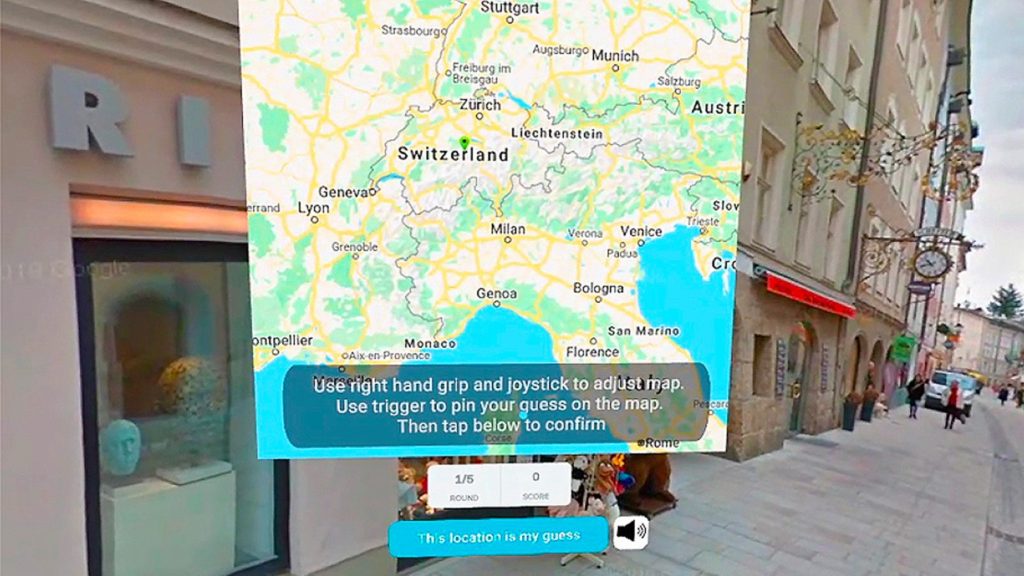
This is a snapshot from the Geo Guesser VR game


Why some teams boost motivation while others totally sap it — from psyche.co by Ann-Kathrin Torka, Jens Mazei, Joachim Hüffmeieris, and edited by Matt Huston. With thanks to Mr. Tom Barrett for this resource via his weekly newsletter.

Excerpts:

In contrast, when people perceive their contribution to the team’s outcome as indispensable, they tend to show greater effort than they would when working alone. These ‘effort gains’ can be due to team members aiming to be prosocial: they care about others and want to make a difference to the team. By helping their team succeed, members also feel better about themselves – they can see themselves as helpful and competent human beings.
…
Managers, instructors, coaches, and other leaders can use this knowledge to design teamwork that boosts team members’ efforts. Remember the student from the introduction: maybe she felt that she could not contribute much to the academic team because the project did not include a specific (sub-)taskfor her to work on and to feel responsible for. If the instructor or a teammate had broken down the project into subtasks for each member, she might have felt that her efforts were indispensable.


I’m a college president. Teaching a 101-level course reminded me how important compassion is right now. — from highereddive.com by Marvin Krislov
Kindness is key in helping students succeed during the pandemic, Pace University’s president writes. Faculty and staff need compassion, too.

Those of us who choose to work in education know that we need to be kind and empathetic. The experience of teaching last semester drove home to me that kindness isn’t just nice; it’s crucial for enabling our students to succeed.


From “Summarize” to “Synthesize” — from byrdseed.com by Ian Byrd

Excerpt:

Here’s how you can take a plain ol’ “summarize this story/book/article” task, raise the thinking, and (yes) make it actually interesting.

We’re going to use my favorite Bloom’s Taxonomy sequence. We use Analyze to set up Evaluate and then let it naturally flow into Synthesis.

The criteria is so important when we ask students to form an opinion! Dull and predictable criteria will lead to dull thinking. Unexpected criteria will lead to unexpected thinking.


ADHD and your homeschool: An overview — from raisinglifelonglearners.com by Colleen Kessler

Excerpt:

This series is all about homeschooling a child with ADHD. Today, we kick it off with an overview of ADHD, and how it impacts your child and your homeschool.


Is there a skills gap in learning design? — from neilmosley.com by Neil Mosley

Excerpt:

Another deficiency in higher education has also been the dearth of support there is for learning design. Roles such as Learning Designer or Instructional Designer have been relatively niche in UK higher education, they have tended to exist only in online or distance education settings.

This seems to be changing a little and there’s been more of these roles created over the past two years. Hopefully, as a result of growing recognition of the design and planning work that’s needed in higher education as the teaching and study experience grows in complexity.

Whilst broadly positive, this has thrown up another problem – the inconsistency and variability of skills amongst those that might refer to themselves as a Learning or Instructional Designer.

From DSC:
Though this is from the UK, these perspectives and the issues Neil raises are also very much present here in the United States. Neil raises some important questions, such as:

  • Aare the Learning Designers and/or Instructional Designers getting the training that they need?
  • What’s expected of them?
  • Are they utilized properly?
  • How do you scale their work?
  • How do you get professors and teachers to think of *designing* their learning experiences?

Addendum on 2/19/22:

And if the last two years have taught us anything, it’s that this collective movement toward learning experience design will be essential to help striving students go on better, more productive, and personally meaningful educational journeys. Indeed, we must help spread the word that education is more than a collection of classes. It may include classes, but it is so much more. At its best, it is a carefully and thoughtfully crafted and curated family of experiences that can help striving students change their lives!  


Watching A Lecture Twice At Double Speed Can Benefit Learning Better Than Watching It Once At Normal Speed — from digest.bps.org.uk by Emma Young ; with thanks to the Learning Now TV Newsletter – February 2022 for this resource

Excerpt (emphasis DSC):

So, a student could just watch videos at 2x speed and halve their time spent on lectures….Or, according to the results of other studies reported in the paper, they could watch a video at 2x normal speed twice, and do better on a test than if they’d watched it once at normal speed. The timing mattered, though: only those who’d watched the 2x video for a second time immediately before a test, rather than right after the first viewing, got this advantage.


A whole new world: Education meets the metaverse — from brookings.edu by Kathy Hirsh-Pasek, Jennifer M. Zosh, Helen Shwe Hadani, Roberta Michnick Golinkoff, Kevin Clark, Chip Donohue, and Ellen Wartella

Excerpt:

The metaverse is upon us. Soon it will be as omnipresent as TikTok, Instagram, and Facebook (now Meta). As technology advances to bring us new immersive and imaginary worlds, how we educate children and prepare teachers must also advance to meet these new opportunities. When education lags the digital leaps, the technology rather than educators defines what counts as educational opportunity. This is largely what happened with the introduction of “educational” apps designed to be used on smartphones and tablets meant for adults. Today, as the metaverse infrastructure is still under construction, researchers, educators, policymakers, and digital designers have a chance to lead the way rather than get caught in the undertow. To leverage the potential of the metaverse as a 3D, global, interconnected, immersive, and real-time online space, we need new ways to connect the physical world with augmented and virtual reality (VR) experiences.

In the end, we challenge those creating educational products for the metaverse to partner with educators and scientists to ensure that children experience real human social interaction as they navigate virtual spaces, children’s agency is supported as they explore these spaces, and there is a real eye to diversity in the representation and access to what is created.  

Also relevant/see:

The metaverse can provide a whole new opportunity for education. Here’s what to consider — from fastcompany.com by Stephen Fromkin
The cofounder of Talespin looks at an existing immersive learning program that delivers results and says our next priority should be getting it into the hands of as many learners as possible through the metaverse.


5 Tips for Online Tutoring Based on New Research — from techlearning.com by Erik Ofgang
Matthew Kraft, a professor at Brown University, shares some best practices for implementing online tutoring programs based on his recent research.

Excerpt:

While in-person high-dosage tutoring has been shown to improve student learning in multiple studies, the extent that this translates to online tutoring is not as well researched. However, a recent pilot study of online tutoring in which college students volunteered as tutors and were paired with middle school students in Illinois found consistently positive effects of online tutoring on student achievement, though these effects were smaller than had been seen for in-person tutoring.


Exploring Virtual Reality [VR] learning experiences in the classroom — from blog.neolms.com by Rachelle Dene Poth

Excerpt:

With the start of a new year, it is always a great time to explore new ideas or try some new methods that may be a bit different from what we have traditionally done. I always think it is a great opportunity to stretch ourselves professionally, especially after a break or during the spring months.

Finding ways to boost student engagement is important, and what I have found is that by using tools like Augmented Reality (AR) and Virtual Reality (VR), we can immerse students in unique and personalized learning experiences. The use of augmented and virtual reality has increased in K-12 and Higher Ed, especially during the past two years, as educators have sought new ways to facilitate learning and give students the chance to connect more with the content. The use of these technologies is increasing in the workplace, as well.

With all of these technologies, we now have endless opportunities to take learning beyond what has been a confined classroom “space” and access the entire world with the right devices.


L&D Go Beyond Podcast: Writing Better Multiple-Choice Questions to Assess Learning — from upsidelearning.com by Amit Garg and Patti Shank

Excerpt:

In this episode of the L&D Go Beyond podcast, Amit Garg interacts with Patti Shank, President Learning Peaks LLC. They talk about a very interesting topic – Writing Better Multiple-Choice Questions (MCQs) to Assess Learning.


Jenna Mancini Rufo on Reimagining Special Education — from gettingsmart.com

Excerpts:

On this episode of the Getting Smart Podcast, Rebecca Midles is joined by Jenna Mancini Rufo, co-author of Reimagining Special Education: Using Inclusion as a Framework to Build Equity and Support All Students alongside Julie Causton.

Jenna is the CEO of empowerED, an education consulting firm specializing in inclusion, special education, and equity.

What if, instead of focusing on the challenges our students face, we focus on their strengths? We call this re-storying our students.

Jenna Mancini Rufo

Also from gettingsmart.com, see:


What It Takes to Recruit Future Teachers During the Pandemic — from edsurge.com by Rebecca Koenig

Excerpts:

“Efforts that seem to be working have had a common ingredient: close ties between colleges and local K-12 school districts.”

“Taking out loans to earn a college degree, then entering a profession where they can’t pay those loans off—that’s a challenge,” she explains.

So for the first time, this academic year education students are eligible to receive a stipend during their student-teaching internships. Based on a recommendation made in 2019 by a “teacher shortage task force” commissioned by the Oklahoma department of education, the state allocated some of its COVID-relief money to pay student-teachers a total of $3,250—half up front, and half after they’re hired into a teaching job by a school district.

#highereducation #K12 #education #studentteaching
#learningecosystems #teachingandlearning

 
© 2025 | Daniel Christian