College Inside - a biweekly newsletter about the future of postsecondary education in prisons

The future of computer programming in prison – College Inside; written by Open Campus national reporter Charlotte West.
A biweekly newsletter about the future of postsecondary education in prisons.

Excerpt:

Participant Leonard Bishop hadn’t touched technology in the 17 years he served in the federal system prior to transferring to the D.C. Jail in 2018. When he first got a tablet, he said it took him a few days to figure out how to navigate through it, but then “I couldn’t put it down.”

Bishop said he was surprised by how easy it was to learn the skills he needed to earn the AWS certification. “It helps you transition back into society, especially for someone who has been gone so long,” he said.


Also relevant/see:

This AWS Cloud certification program opens new paths for inmates — from amazon.com; with thanks to Paul Fain for this resource
A jail-based program aims to expand career opportunities through cloud-skills training.

Excerpt:

Julian Blair knew nothing about cloud computing when he became incarcerated in a Washington, D.C. jail more than two years ago.

“I’d never done anything with a computer besides video games, typing papers in college, and downloading music on an iPad,” said Blair.

Now, after three months of work with an educational program led by APDS and Amazon Web Services (AWS) inside the jail, Blair and 10 other residents at the facility have successfully passed the AWS Certified Cloud Practitioner exam.


Preparing Today’s Students for the Future Workforce — from rdene915.com by Rachelle Dené Poth

Excerpt:

Today’s high school students are the future of our workforce. Before long they will be in college or starting full-time jobs of their own. But how are today’s students preparing for their futures? What will the workforce look like when these students move on to the next stage of their lives?

Schools, districts, and even state education departments provide various programs for students to gain relevant work experience and gain necessary skills outside of the classroom.

What Are These Programs?
There are a number of school-based programs that support student growth through work such as…


Also relevant/see:


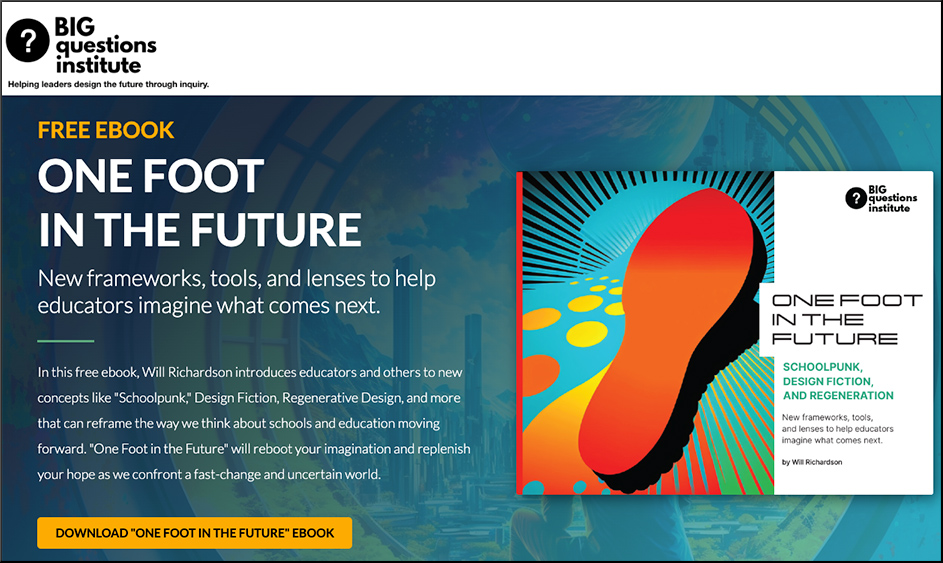
One Foot in the Future — from the BIG questions institute

As an excerpt from an email describing this new/free ebook, Homa Tavangar and Will Richardson write:

We need a fresh set of tools, frameworks, and lenses if we are to meet the future effectively.

With this new ebook, “One Foot in the Future,” we’re charting a different path forward, introducing readers to things like:

  • Design Fiction – A tool to help us become “archeologists of the future” and help us
  • Regenerative Learning – A lens that helps us see our work as it impacts all living things
  • Schoolpunk – A movement and a community to help imagine the future of education together.

And much more.

Our sense is that there is growing appetite to get out of the traditional school box and to design a more aspirational future. This new ebook is a great starting point for anyone who wants to do just that.

ONE FOOT IN THE FUTURE -- a free ebook from the BIG questions institute regarding new frameworks, tools, and lenses to help educators imagine what comes next


Brandon Busteed (emphasis DSC):

This is a Titanic moment. The iceberg is right in front of us and there just isn’t enough time to turn the massive U.S. education/higher education/employer training ship. Unless… We all go to work on work.

From DSC:
My comment on that string from Brandon was:

And I can’t help but think that part of that work involves Design Thinking…reinventing what lifelong learning looks/acts like.


What can work colleges teach the rest of higher ed? — from highereddive.com by Laura Spitalniak
Amid high worries about higher ed’s value in the job market, work colleges offer lessons on integrating classroom learning with employment opportunities.

Excerpt:

To qualify as a work college, an institution must be nonprofit, offer four-year degrees and provide students with employment through a work-learning-service program that will contribute to their education.

It found work colleges’ strengths — reduced or free tuition, job experience and mentorship from college faculty and staff — address student concerns over the cost and real-world applicability of a college degree. Work colleges can also make adult learners’ lives logistically easier by combining academics and work, the report found.

The intentional connection of learning, work and service is the most compelling part of the model, according to Louis Soares, chief learning and innovation officer at ACE and one of the report’s authors.


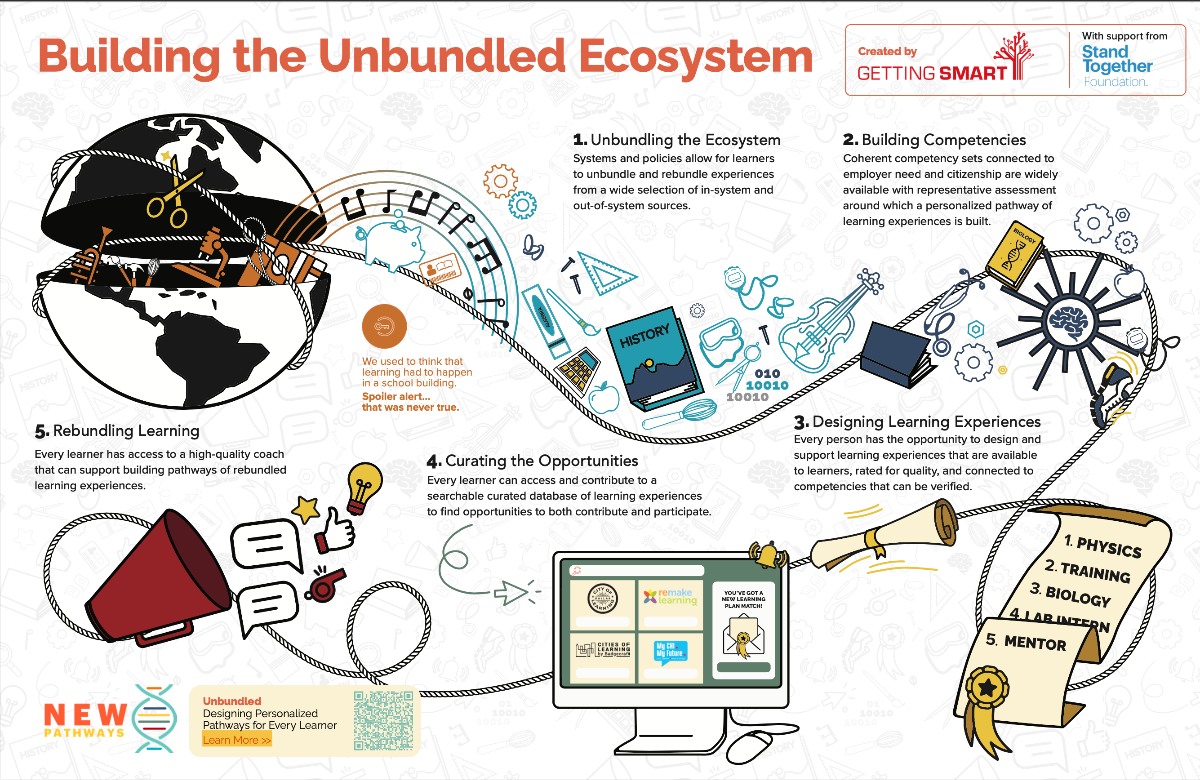
Unbundled: Designing Personalized Pathways for Every Learner — from gettingsmart.com by Nate McClennen “with contributions from the Getting Smart team and numerous friends and partners in the field”

Excerpts:

In this publication, we articulate the critical steps needed to unbundle the learning ecosystem, build core competencies, design learning experiences, curate new opportunities, and rebundle these experiences into coherent pathways.
.

Building the Unbundled Ecosystem

Vision

Every learner deserves an unlimited number of unbundled opportunities to explore, engage, and define experiences that advance their progress along a co-designed educational pathway. Each pathway provides equitable and personalized access to stacked learning experiences leading to post-secondary credentials and secure family-sustaining employment. Throughout the journey, supportive coaches focus on helping learners build skills to navigate with agency. In parallel, learners develop foundational skills (literacy, math), technical skills, and durable skills and connect these to challenging co-designed experiences. The breadth and depth of experiences increase over time, and, in partnership, learners and coaches map progress towards reaching community-defined goals. This vision is only enabled by an unbundled learning ecosystem.

Recommendations

Solutions already exist in the ecosystem and need to be combined and scaled. Funding models (like My Tech High), badging/credentialing at the competency level (like VLACS), coaching models (like Big Thought), and open ecosystems (like NH Learn Everywhere) provide an excellent foundation. Thus, building unbundled systems has already begun but needs systemic changes to become widely available and accepted.

      1. Build a robust competency-based system.
      2. Create a two-way marketplace for unbundled learning.
      3. Implement policy to support credit for out-of-system experiences.
      4. Invest in technology infrastructure for Learning and Employment Records.
      5. Design interoperable badging systems that connect to credentials.
 

What is college for? Gov. Shapiro raises the question. Higher ed leaders are listening. — from The Philadelphia Inquirer by Will Bunch; with thanks to Ray Schroeder out on LinkedIn for the resource
Pa.’s new governor Josh Shapiro’s first move was to question the need of a college diploma as a job credential. U.S. universities, pay attention.

Excerpt:

NEW HAVEN, Conn. — What is college actually for?

No one expected this to be the initial question raised by Pennsylvania’s new governor, Josh Shapiro, in his first full day on the job. While he may not have stated it explicitly, this was the essence of the Democrat’s very first executive order, which opened up some 92% of job listings in state government — about 65,000 in all — to applicants who don’t have a four-year college degree.

In branding degree requirements for many jobs as “arbitrary” and declaring “there are many different pathways to success,” the Keystone State’s new chief executive was tugging at the shaky Jenga block that has undergirded the appalling rise of a $1.75 trillion student debt bomb in the U.S. and led, arguably, to a college/non-college divide driving our nation’s bitter politics. The notion is this: You can’t make it in 21st-century America without that most expensive piece of sheepskin: the college diploma.

So the $64,000 question (OK, $80,000 … for one year on some elite private campuses) is this: If you don’t need the credential, do you actually need college?

Something is clearly gained by giving America’s young people more career options that won’t contribute to that $1.75 trillion college debt bomb. But are we talking enough about what could be lost in a new system that not only devalues the university but also seems to ratify a dubious idea — that higher education is almost solely about careerism, and not the wider knowledge and critical-thinking skills that come from liberal arts learning?

From DSC:
To me — and to many other parents and families — it all boils down to the price tag of obtaining a liberal arts education. It’s one thing to get a liberal arts education at $5K per year. It’s another thing when the pricetag runs at $40K and above (per year)! Most people ARE FORCED to question the ROI of a liberal arts education. They simply have to.

On a relevant tangent here…many inside the academy have traditionally looked with disdain at the corporate world. The thinking went something like this:

Business! Ha! We are not a business! Students are not customers. Don’t ever compare us to the corporate world.

Having spent half of my career in the corporate world, I do not subscribe to that perspective. In fact, I’d like to ask those who still hold this point of view:
  • Where else can you pay tens of thousands of dollars for something and not be treated as a customer?! Don’t you typically expect value on your own purchases and positive returns on your investments?
  • How will you collaborate with the corporate world if you look upon them with disdain?!

But now that colleges and universities enrollments are not doing so well, perhaps there will be more openness to change and towards developing more impactful collaborations.


Instructional Designer: Tools of the Trade Webinar 3/8 (from Teaching: A Path to L&D) and tools of the trade

Teaching: A Path to L&D aims to provide free guidance to teachers looking to move into the world of Learning and Development, specifically Instructional Design. Check out our website at www.teachlearndev.org for free coaching, webinars, and resources to help you on your journey!

And if you want to freelance to begin making the shift, see:

Freelance Income Projection: Free Template— from christytuckerlearning.com by Christy Tucker
As a freelancer or consultant, your income can vary widely from month to month. Use this free template to project your freelance income.

How to Become an Instructional Designer – The Grind is not Glamorous — from linkedin.com by Taruna Goel

Excerpt:

A few weeks ago, I stumbled across a powerful 4-minute lesson on filmmaking where, Casey Neistat, a YouTube personality, filmmaker, and co-founder of the multimedia company, Beme, said: “The grind is not glamorous.”

It isn’t anything new or something others haven’t said before. But these five words say more than their worth when it comes to understanding and managing expectations around building expertise.

Job Titles: It’s Not Only Instructional Design — from idolcourses.com by Ivett Csordas

Excerpt:

When I first came across the title “Instructional Designer” while looking for alternative career options, I was just as confused as anybody would be hearing about our job for the first time. I remember asking questions like: What does an Instructional Designer do? Why is it called Instructional Design? Wouldn’t a title such as Learning Experience Designer or Training Content Developer suit them better? How are their skill sets different from curriculum developers like teachers’? etc.


On a somewhat related note, see:

7 middle school career exploration tips — from edcircuit.com

Table of Contents

Introducing Careers to Middle Schoolers

  • Career Exploration Tip #1: Invite guest speakers
  • Career Exploration Tip #2: Create career-themed projects
  • Career Exploration Tip #3: Host A Career Fair
  • Career Exploration Tip #4: Offer Job Shadowing
  • Career Exploration Tip #5: Encourage Students to Explore Subjects
  • Career Exploration Tip #6: Provide Resources and Guidance
  • Career Exploration Tip #7: Encourage Parent Participation


From DSC:
Below is another example of the need for Design Thinking as we rethink a cradle-to-grave learning ecosystem.


The United States Needs a Comprehensive Approach to Youth Policy — from cew.georgetown.edu

Excerpt (emphasis DSC):

On the education front, federal legislation serves as an umbrella for many state and local policies and programs. Education policy is further fragmented into K–12 and postsecondary silos.

An all-one-system approach to youth policy would support young people along the entire continuum of their journey from school to work. It would help them attain both postsecondary education and quality work experience to support their transitions from education to good jobs. In this modernized approach, preschools, elementary and secondary schools, community colleges, four-year universities, employers, and governments would all follow an integrated playbook, helping to smooth out young people’s path from pre-K–12 to college and work. To transform youth policy, systemic reforms should incorporate the following:


What Can We Learn from Barnes & Noble’s Surprising Turnaround? — from tedgioia.substack.com by Ted Gioia
Digital platforms are struggling, meanwhile a 136-year-old book retailer is growing again. But why?

Excerpts (emphasis DSC):

Daunt refused to play this game. He wanted to put the best books in the window. He wanted to display the most exciting books by the front door. Even more amazing, he let the people working in the stores make these decisions.

This is James Daunt’s super power: He loves books.

But I almost hate to say it, because the lesson is so simple.

If you want to sell music, you must love those songs. If you want to succeed in journalism, you must love those newspapers. If you want to succeed in movies, you must love the cinema.

But this kind of love is rare nowadays. I often see record labels promote new artists for all sorts of gimmicky reasons—even labels I once trusted such as Deutsche Grammophon or Concord. I’ve come to doubt whether the people in charge really love the music.


Top challenges for L&D leaders in 2023 — from chieflearningofficer.com by Ken Blanchard

Excerpts:

From an HR perspective, survey respondents reported that the biggest challenges they expect as HR and L&D leaders in 2023, in ranked order, are:

  1. Capacity and resources
  2. Turnover and attrition
  3. Improving engagement and experience
  4. Adapting to a hybrid culture

From DSC:
I wonder if many in higher education might respond similarly…? Perhaps some even in the K-12 space as well.

Also see:

This posting from William Kennedy-Long (re: instructional design) out on LinkedIn:

Excerpt (emphasis DSC):

I read Clark Quinn’s outstanding article which I highly recommend reading, entitled Performance Focus For Deeper Learning Design.

Immediately, I was captivated by what it and he had to say, such that I wrote a short piece to follow up on it.

What are on-ramps? Here’s how to build them for all adult learners to reach their academic potential — from chieflearningofficer.com by Michelle Westfort

Excerpt:

This may come as a surprise — adult learners over 25 make up nearly 40 percent of today’s U.S. undergraduate population at colleges and universities. However, these learners often find themselves treated as outliers by institutions designed for traditional students, which leads to poorer learner outcomes and, as a result, barriers to social mobility.

To ensure adult learners can meaningfully participate in your workforce education program, organizations can build on-ramps capable of accommodating all learners.

On-ramps provide employees access to high-quality academic programs, enable them to continue their educational journey toward a degree or certification by meeting them where they are, and hold a key role in paving the way for successful learner outcomes.

Leveraging 2022’s future-forward lessons to improve L&D — from chieflearningofficer.com by Keith Keating

Excerpts:

Top 4 future-forward lessons from 2022:

  1. The world changes rapidly — prepare for it
  2. Anticipate trends, events and the skills you’ll need in the future
  3. Continuously adopt new capabilities and expand your knowledge
  4. Use tech to your advantage
 

How Skills Are Disrupting Work: The Transformational Power of Fast-Growing, In-Demand Skills — from burningglassinstitute.org by Nik Dawson, Alexandra Martin, Matt Sigelman, Gad Levanon, Stephanie Blochinger, Jennifer Thornton, and Janet Chen
A “State of Skills” Report from the Burning Glass Institute, the Business-Higher Education Forum, and Wiley

On average, 37% of the top 20 skills requested for the average U.S. job have changed since 2016.

Excerpt:
By analyzing hundreds of millions of recent U.S. job postings, the Burning Glass Institute and the Business–Higher Education Forum (BHEF) identified four of the fastest-growing, highest-demand emerging skill sets:

  • Artificial Intelligence/Machine Learning
  • Cloud Computing
  • Product Management
  • Social Media

These four skill sets serve as a laboratory for understanding what business and education leaders can do to prepare workers and students for skills disruption. To illustrate how programs can help learners and workers acquire essential skills, this report includes profiles of recent innovations from the BHEF network.

The future belongs to those who seek to understand, anticipate, and harness the power of emerging skills, rather than maintain a posture of reaction/response.

The prospect of helping all those who are challenged by skill disruption hinges on the readiness of business and higher education to engage in understanding and planning for skill disruption over the long term.

From DSC:
“On average, 37% of the top 20 skills requested for the average U.S. job have changed since 2016.” That’s what I’m talking about when I talk about the exponential pace of change. It’s hard to deal with. Our institutions of education are not used to this pace of change. Our legal system isn’t used to this pace of change. And there are other industries struggling to keep up.

Should the pace of change be an element of our design when we think about using Design Thinking to create a new lifelong learning ecosystem?


Skills, Skills, Skills Now is the time. — from by Katelyn Donnelly and Eric Scott Lavin
Skills matter more than ever.

Excerpt:

For years, the importance of building demonstrable skills has been growing. The research is clear: skills acquired through work experience increase lifetime earnings. Yet, a massive shift in how learners, educators, and employers think about skills is just beginning.

Three subtrends set the stage for a massive inflection point in how we think about skills…

Learning will be the only constant throughout a career.  Success in the modern workforce is learning experiences to build skills, and the best way to build skills is to do real-world projects.

Below is a sampling of organizations and companies pushing the boundaries. Some of these are established players with mature businesses and tested business models.

Also relevant/see:

The Job Skills of 2023 — from Coursera

The job skills of 2023 -- from Coursera

Excerpt from the Executive Summary Section

  1. The fastest-growing skills are digital skills
    The top ten overall fastest-growing skills are digital skills. The ongoing evolution of technology means employers are regularly seeking new digital competencies from potential hires while also reskilling existing workers.
  2. The fastest-growing digital skills are changing more significantly than the fastest-growing human skills
    The top ten digital skills vary significantly from last year—only two have carried over year-on-year: data visualization and user experience. The human skills in demand remain steadier, suggesting an evergreen demand for skills like change management and communication.

The job skills of 2023 -- from Coursera


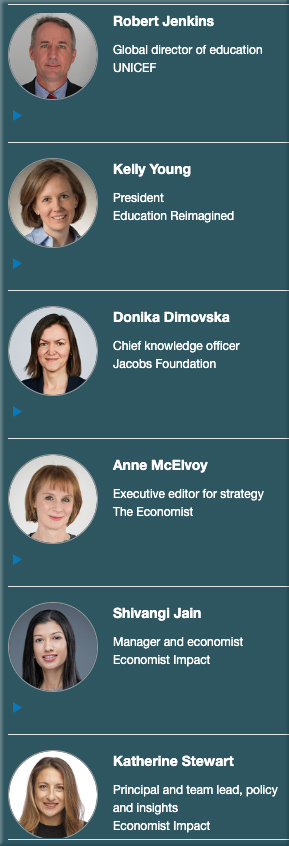
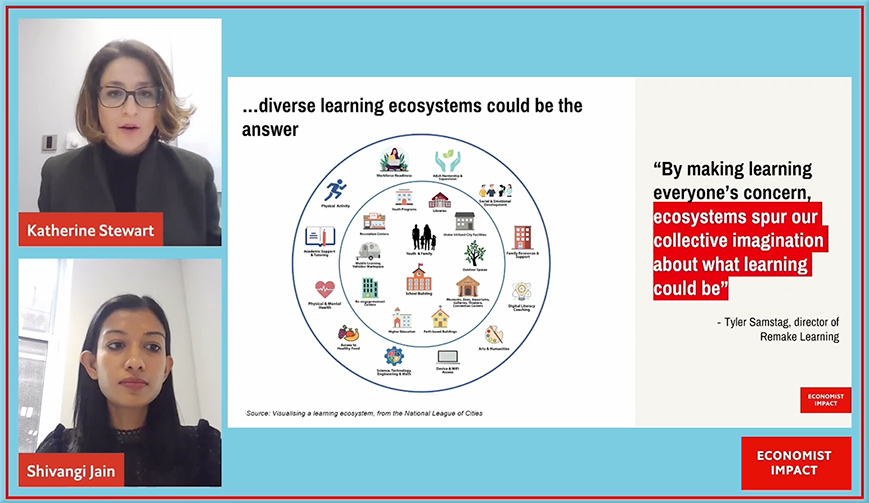
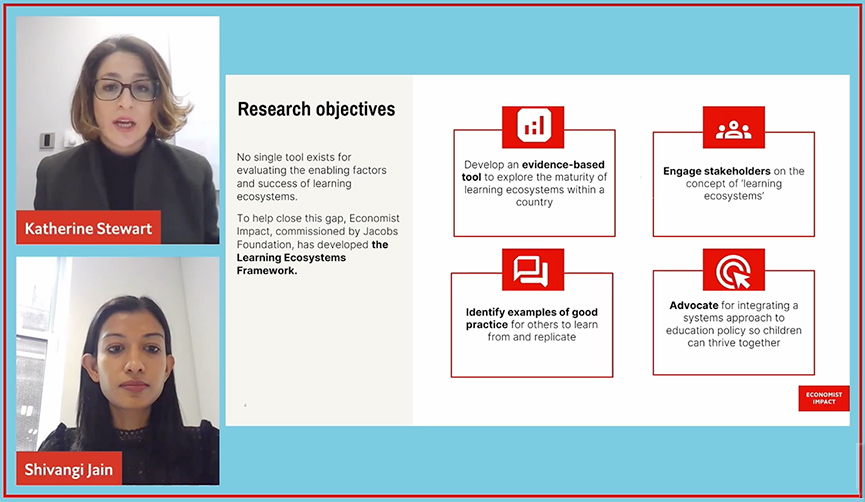
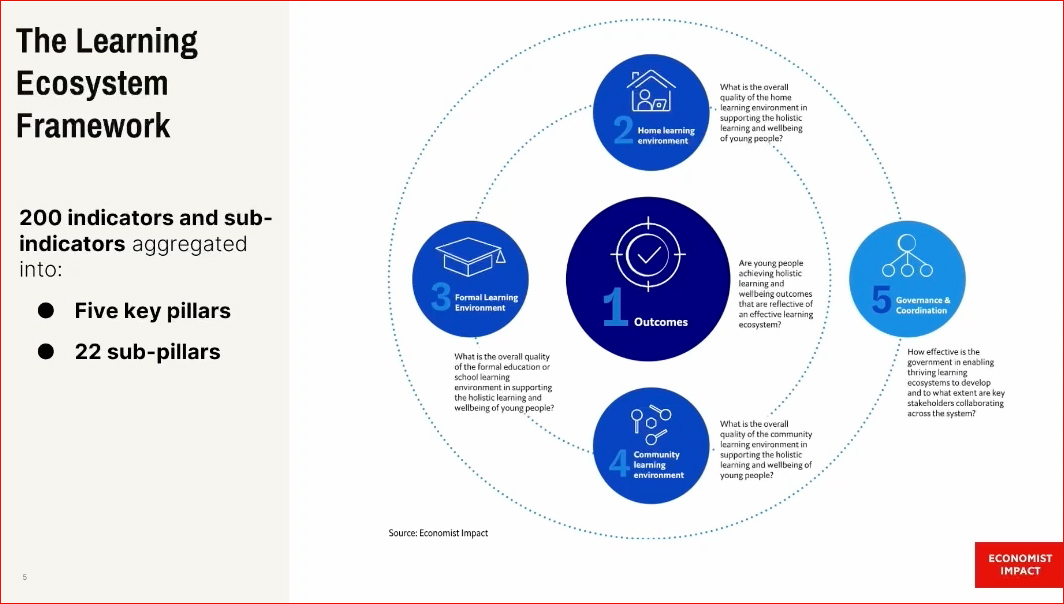
Thriving education systems, thriving youth — from events.economist.com by Economist Impact

Some of the key topics to be discussed include:

  • What are the challenges in how we measure learning outcomes today, and how does this need to transform?
  •  What is a learning ecosystem? What does a successful learning ecosystem look like?  
  • What factors enable the development of thriving learning ecosystems?  
  • Who are the key stakeholders that make up the learning ecosystem? How do different stakeholders see their role in the learning ecosystem?
  • Which national policies need to be in place to support effective education ecosystems?
  • What information and data do we need to assess how well learning ecosystems are performing?
  • What data do we need to collect so that we don’t perpetuate traditional approaches to defining and measuring success? 


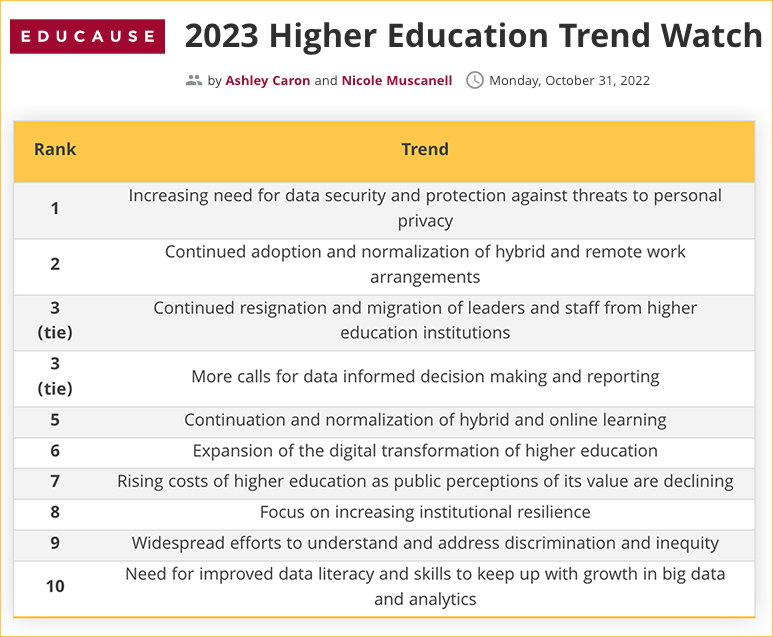
2023 Higher Education Trend Watch — from educause.edu

2023 Higher Education Trend Watch

Also see:

2023 Strategic Trends Glossary — from educause.edu

Excerpts:

  • Closer alignment of higher education with workforce needs and skills-based learning
  • Continuation and normalization of hybrid and online learning
  • Continued adoption and normalization of hybrid and remote work arrangements
  • Continued resignation and migration of leaders and staff from higher education institutions
  • Declining public funding for higher education
  • …and more
 
© 2025 | Daniel Christian