My Favorite Book about Teaching and Learning is…33 Books to Inspire You! — from linkedin.com by Barbi Honeycutt

Excerpt:

…I recently posted this fill-in-the-blank question to all of my social media pages:

My favorite book about teaching and learning is ______________.

The response has been fantastic! Professors, instructors, teachers, educators, and faculty development professionals from a variety of disciplines from around the world responded with their favorite book about teaching and learning.

I’ve compiled the list and here are the 33 books recommended by colleagues throughout my network (many books were recommended more than once).
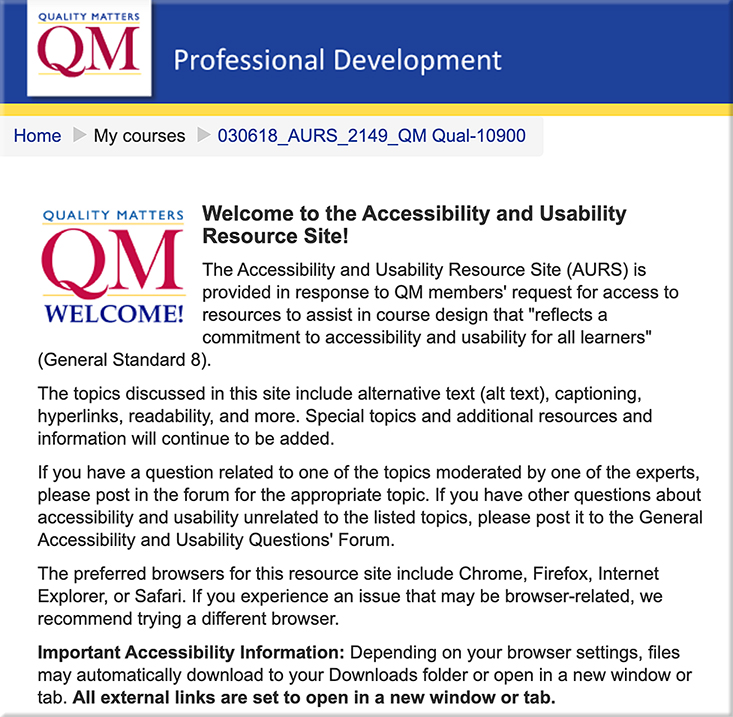

 

Accessibility and Usability Resource site from Quality Matters


Meet AURS — Your go-to resource for addressing accessibility challenges — from wcetfrontiers.org and Quality Matters

Excerpt:

Accessibility is not only one of the main areas of focus for WCET, but a consistent issue and opportunity for higher education institutions. In order to support faculty, instructional designers, and others who work in the area, Quality Matters, a WCET member, created a new resource site for educators to get information on how to address key accessibility and usability concerns. Today’s post introduces the new website, AURS, and reviews the development process for the site and the resources.


Kansas City high schools add real-world learning — from gettingsmart.com by Tom Vander Ark

Excerpt:

The good news is that more young people are graduating from high school than ever. The bad news? High school is often less relevant to them and their futures than ever.

The largest effort to make high school more valuable—to young people and their communities— is underway in the six-county two-state Kansas City metro area.

About 60 schools in 15 districts from Kansas and Missouri are spending this school year investigating ways they can make high school more valuable to young people by incorporating more real-world learning.


From DSC:
I know that by the end of his junior year, our son was so tired of having information crammed down his throat. He viewed so much of the content of his courses as irrelevant and unimportant. This year, he is immersed in what he wants to do — acting. And now he is soooooo much more motivated to learn and to grow now that he is able to pursue his passion.


How augmented reality will overhaul our most crucial industries — from singularityhub.com by Peter Diamandis

Excerpts:

Healthcare
(1) Surgeons and physicians
(2) Assistance for those with disabilities
(3) Biometric displays

Retail & Advertising
(1) Virtual shopping
(2) Advertising

Education & Travel
(1) Customized, continuous learning

Within the classroom, Magic Leap One’s Lumin operating system allows multiple wearers to share in a digital experience, such as a dissection or historical map. And from a collaborative creation standpoint, students can use Magic Leap’s CAD application to join forces on 3D designs.

In success, AR’s convergence with biometric sensors and AI will give rise to an extraordinarily different education system: one comprised of delocalized, individually customizable, responsive, and accelerated learning environments.

(2) Training
(3) Travel

Manufacturing
(1) Design
(2) Supply chain optimization
(3) Quality assurance & accessible expertise

Transportation & Navigation
(1) Autonomous vehicles
(2) Navigation

Entertainment
(1) Gaming
(2) Art


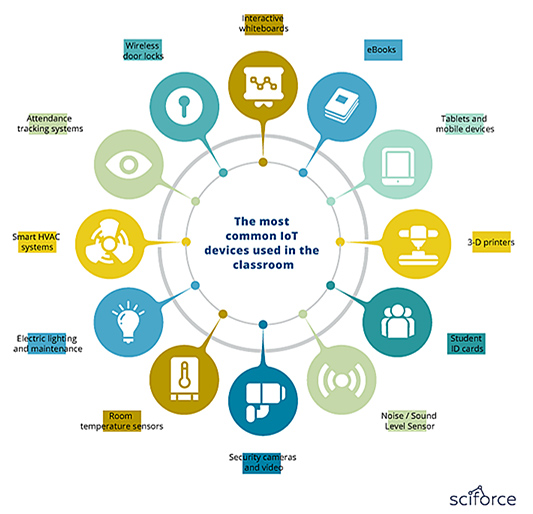
Internet of Things in the World of School— from datafloq.com

Excerpt:

In this blog post, we’ll discuss the benefits of the IoT for education — the sphere that remains farther to the background in terms of the IoT application but can benefit from it at all stages. Besides, schools are meant to prepare students for entry into the adult world. As the IoT changes the landscape of their futures, it is crucial to change the space where students spend their formative years.


A new curriculum that helps children understand how algorithms are designed will keep them safe and motivate them to help shape the technology’s future.


Is virtual reality the future of online learning? — from builtin.com by Stephen Gossett; with thanks to Dane Lancaster for his tweet on this (see below)
Education is driving the future of VR more than any other industry outside of gaming. Here’s why virtual reality gets such high marks for tutoring, STEM development, field trips and distance education.


Podcast: Susan Patrick on Transforming Education Systems for Equitable High-Quality Learning — from gettingsmart.com by Tom Vander Ark & Susan Patrick

Excerpts:

5 Global Trends

  1. Ensuring education systems are fit for purpose.
  2. Modernizing educator workforce and professional learning.
  3. Innovating education for equity, prioritizing diversity, equity and inclusion.
  4. Aligning pathways from early childhood, K-12, college and workforce.
  5. Redesigning schools based on the learning sciences.
    In Fit for Purpose, Patrick and colleagues said, “A school redesign informed by learning sciences puts student success at its center. It incorporates youth development theory, culturally responsive teaching, and evidence-based approaches.” She added, “We must ensure we are designing for equity using research on how students learn best, youth development theory and evidence-based approaches.”


From DSC:

Below are the comments that I relayed back to Tom and Susan on Twitter:

“We need to keep asking– how do we design a system fit for the world we live in?” I thought that this was a great point from Susan. I would just add that not only do we need to look around at the current landscapes, but also what’s coming down the pike (i.e. the world that we will be living in). With the new pace of exponential change, our graduates will need to be able to pivot/adapt frequently and quickly.

Also, watching my wife’s experiences over the last few years, only one of the three school systems offered solid training and development. The other two school systems needed to pay much more attention to their onboarding and training programs. They needed to be far more supportive — working to establish a more team-oriented teaching and learning environment. While the corporate world can learn from the K-12 world often times, this is where the K-12 world could learn a lot to learn from the corporate world.


Lessons in learning — from news.harvard.edu by Peter Reuell; with thanks to Jason Findley for this resource out on Twitter
Study shows students in ‘active learning’ classrooms learn more than they think

Excerpts:

The question of whether students’ perceptions of their learning matches with how well they’re actually learning is particularly important, Deslauriers said, because while students eventually see the value of active learning, initially it can feel frustrating.

“Deep learning is hard work. The effort involved in active learning can be misinterpreted as a sign of poor learning,” he said. “On the other hand, a superstar lecturer can explain things in such a way as to make students feel like they are learning more than they actually are.”

When the results were tallied, the authors found that students felt as if they learned more from the lectures, but in fact scored higher on tests following the active learning sessions. “Actual learning and feeling of learning were strongly anticorrelated,” Deslauriers said, “as shown through the robust statistical analysis by co-author Kelly Miller, who is an expert in educational statistics and active learning.”


A quick tip from RetrievalPractice.org’s e-newsletter today:

#1: Remember your lesson plan with a 1-minute reflection
Can’t remember how a lesson from last semester or last year went? On the bottom or back of a lesson plan, include two questions:
What went well? What should I do differently next time? 
As soon as you’re done with the lesson, take just one minute to write down a note to your future self. Stuff all your lesson plans/reflections into a folder. The next time you teach the lesson, future-you will be glad that past-you retrieved!


Analysis: Teachers’ out-of-pocket supply expenses highest in California, Michigan — from educationdive.com by Linda Jacobson

Dive brief:

  • At $664, California teachers spend more of their own money on supplies for their classrooms than their colleagues in any other states, closely followed by teachers in Michigan, who spend $628 for which they are not reimbursed by their school districts, according to an analysis by the Economic Policy Institute.
  • Nationally, teachers spend an average of $459, with those in North Dakota spending the least at $327. The state-by-state data is drawn from the National Center for Education Statistics’ 2011–12 Schools and Staffing Survey and adjusted for inflation.
  • The data also shows teachers in high-poverty schools spend more of their own money on supplies for their students than those in low-poverty schools, and that this amount has increased over time, from $481 in 2011-12 to $523 in the 2015-16 school year.
 

Google brings AI to studying with Socratic — from zdnet.com by Stephanie Condon
Ahead of the new school year, Google is re-launching a mobile learning app it acquired last year.

Excerpt:

Google this week started rolling out a revamped version of a mobile learning app, called Socratic, that the tech giant acquired last year. The updated app, with new machine learning-powered features, coincides with the start of the school year, as well as other Google for Education initiatives.

Socratic aims to help both high school and university students in their studies outside of the classroom. If students need help answering a study question, they can now use the Socratic app to ask a question with their voice, or to take a picture of a question in their study materials. The app will then find relevant material from across the web.


Also see:

  • The School of Tomorrow Will Revolve Around AI — from datafloq.com
    Excerpt:
    We live in exponential times, and merely having a digital strategy focused on continuous innovation is no longer enough to thrive in a constantly changing world. To transform an organisation and contribute to building a secure and rewarding networked society, collaboration among employees, customers, business units and even things is increasingly becoming key.Especially with the availability of new technologies such as artificial intelligence, organisations now, more than ever before, need to focus on bringing together the different stakeholders to co-create the future. Big data empowers customers and employees, the Internet of Things will create vast amounts of data and connects all devices, while artificial intelligence creates new human-machine interactions. In today’s world, every organisation is a data organisation, and AI is required to make sense of it all.

Addendum on 8/23/19


6 basic Youtube tips everyone should know — from hongkiat.com by Kelvon Yeezy

Example tips:

1. Share video starting at a specific point . <– A brief insert from DSC: This is especially helpful to teachers, trainers, and professors
If you want to share a YouTube video in a way that it starts from a certain point, you can do so in a couple of simple steps.

Just pause the video at the point from where you want the other user to start watching it and right-click on the video screen. A menu will appear from which you can choose Copy video URL at the current time. The copied link will open the video starting from that specific time.


4. More accurate video search
There are millions of videos on Youtube. So trying to find that specific Youtube video you want to watch is an adventure in itself. In this quest, you might find yourself crawling through dozens of pages hoping to find the video you actually want to watch.

If you don’t want to go through all this hassle, then simply add allintitle: before the keywords you are using to search for the video. This basically gives you only those videos that include the chosen keywords.


From DSC:
After reviewing the item below — and after trying to limit the screen time of our youngest daughter these days — I am again reflecting on how difficult it is to raise kids today. I’m not going to get on the technology bashing train, but I’m just going to say that — at least in this area of life — my parents had it much easier!  🙂  It’s not easy to cut off the kids’ access to the Internet these days…as the article below illustrates!

Teen goes viral for tweeting from LG smart fridge after mom confiscates all electronics — from cbsnews.com by Caitlin O’Kane

Excerpt (emphasis DSC):

Dorothy said she was boiling rice one night and was too preoccupied by her phone, so the stove burst into flames. “So my mom took all my tech so i’d pay more attention to my surroundings,” she said.

Then she explained that both the DS and Wii allow image share, so she could send images from those devices to Twitter, adding messages.

Sometime after finding her DS, it was taken again, so Dorothy started tweeting from yet another connected device: her fridge. “My mom uses it to google recipes for baking so I just googled Twitter,” she told CBS News.

 
© 2025 | Daniel Christian