From DSC:
Below are some resources for teaching at home. And some of this (much of this?) is not typical homeschooling, just as much of what’s being done out there isn’t necessarily typical online-based learning. And some out there may not like such lists, and would prefer a detailed report on just one tool. But this last week was incredibly busy — and time is not a luxury I have right now. And these resources might provide someone out there with just the right tool or pedagogy that they’ve been looking for.

Also, I might suggest:

  • Creating a Google alert (google.com/alerts) on HSLDA, on homeschooling, on homeschoolers, and/or on related searches.
  • Create a Keyword Alert on an RSS aggregator such as Feedly
  • Follow relevant hashtags on Twitter such as #homeschooling

Some analog ideas:

  • Reading a book together
  • Watching a play, drama, or another type of program together
  • Taking a walk out in nature together
  • Gather together as a family and/or lingering over breakfast or dinner
  • Drawing
  • Painting
  • Taking pictures

And now is a great time to see what your child or children WANT TO LEARN ABOUT! Turn over the control to them for a while — and watch what happens when intrinsic motivation takes hold! 


Not a teacher but find yourself homeschooling? These educational apps are free — from parade.com by Stephanie Osmanski

  • This posting covers 25 Free Learning Apps

We are all homeschoolers now (podcast) — from cato.org featuring Kerry McDonald and Caleb Brown
Thanks to COVID-19, many parents find themselves with kids at home all day. What’s the best way to keep them engaged in their educations? Kerry McDonald, author of Unschooled, comments.

Getting Smart’s Getting Through

Free, Online Learning Resources When Coronavirus Closes Schools — from cato.org by Kerry McDonald

Homeschooling Mother and Author: 6 Ideas For Parents While Schools Are Closed — from fee.org by Kerry McDonald
Amid the Covid-19 lockdown, there are steps parents can take to make time at home with their children more rewarding and tolerable.

Apps for Special Needs Students—As School Buildings Shutter — from edutopia.org by Janey Clare
The coronavirus creates a unique challenge for special needs students—educators share recommendations for apps to support learning at home.

How to Support Home Learning in Elementary Grades — from edutopia.org by John Thomas
A first and second grade teacher shares his home learning plan for his students and how he is engaging their families.

6 Lessons Learned About Remote Learning During the Coronavirus Outbreak — from blogs.edweek.org by Mark Lieberman
 

Coursera, EdX offer free access to courses for universities impacted by Coronavirus
— from campustechnology.com by Rhea Kelly
With universities all over the world looking to quickly move face-to-face classes online, massive open online course companies Coursera and edX have stepped in to offer access to their vast portfolios of course content.

Excerpt:

Coursera announced today it will provide the Coursera for Campus platform free to higher education institutions impacted by coronavirus. “Universities can sign up to provide their enrolled students with access to more than 3,800 courses and 400 specializations from Coursera’s top university and industry partners,” explained Coursera CEO Jeff Maggioncalda, in a blog post. The access will last through the end of July….

Also see:

  • Updated list of statewide school closures with closure dates — from thejournal.com by David Nagel
  • Getting Smart has launched the Getting Through series to support educators, leaders and families on the path forward during such an uncertain time.
    Excerpt:
    Getting Smart has launched the Getting Through series to support educators, leaders and families on the path forward during such an uncertain time. This series will provide resources and inspiration as we face long term school closures, new learning environments, and address equity and access from a new lens. Whether you are just getting started with distance or online learning, or you’ve had plans in place and have the opportunity to share your work and guidance with others, there is a place for your voice and an opportunity to learn.
 

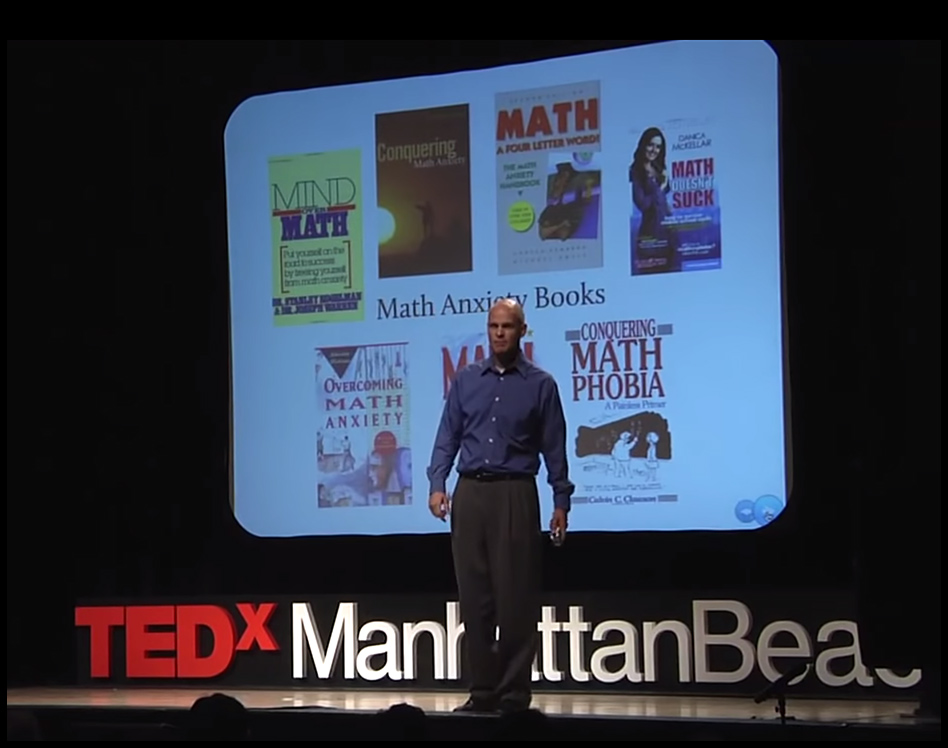
My wife sent me this video from John Bennett, a math teacher. This was posted to YouTube back on 11/8/11.

In fact, if it were up to me, I’d would no longer require math to be taught…in middle school and high school.

NOTES:

  • 300 million people in the U.S. (as John mentioned back in October 2011)
    • 1.5 million engineers
    • 1/2 of a percent; and you can add another 1/2 of a percent for other kinds of jobs that require that kind of math
    • That leaves 99% of us in the United States who don’t use what we learned about in middle school and high school math classes. But the problem is, math has caused major stress for people in the last 40 years.
  • John Bennett had some major cognitive dissonance to the reasons WHY he was suggesting his students know the math concepts that he was trying to relay.
  • He came to ask, “When do most of us use math in real life?”
    • Money. Financial stuff. Balancing checkbook. Tipping. Cooking and carpentry.
  • Why are we still teaching algebra? Because it teaches us about inductive and deductive reasoning. Math helps us develop that kind of reasoning.
  • So a better plan would be to:
    • Let people who want to take math in middle school and high school take it.
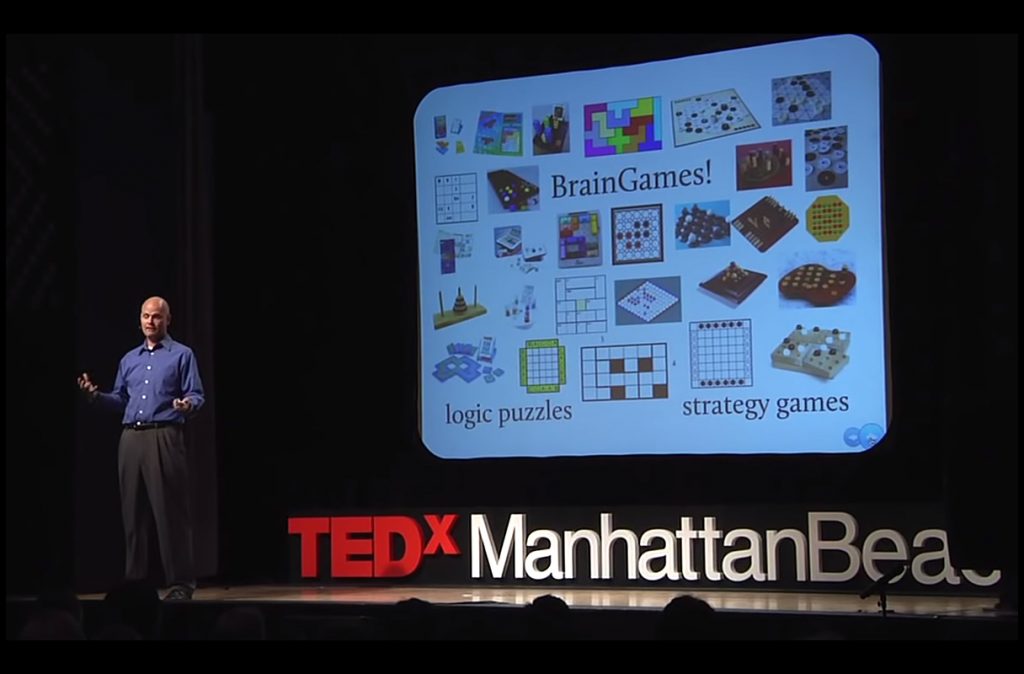
    • For the rest of the students, provide strategy games and logic puzzles that help develop those cognitive reasoning skills.

From DSC:
When this math teacher meets people out in society, people confess how much stress math brought to them in school….and they’re aren’t joking.

Given that we are all required to be lifelong learners these days, I love what John Bennett is saying here…because we really aren’t serving society at large by requiring math be taught in middle school and high school.

  • It causes stress and very negative learning experiences for many people.
  • We don’t use it. (By the way, I could plug and chug ok, but I had no idea what I was doing. No real understanding. I haven’t used algebra and/or calculus since my youth.)

What does it take to change our curricula like that?! Is it possible? I sure hope so.


 Coronavirus has led to a rush of online teaching. Here’s some advice for newly remote instructors — from edsurge.com by Jeff Young & Bonni Stachowiak

Excerpt:

The simplest way to go online is to shift to a video conference platform
Stachowiak says that just lecturing to a webcam instead of an in-person class isn’t the best way to teach online, but it is the easiest way to switch. Under the circumstances, it is better than nothing. “I’d rather that you do that for your students, for yourself than to cancel all the classes,” she argues.

Think shorter
If it’s hard to hold students’ attention in person, it’s even harder online, says Stachowiak: “You’ll want to think about shortening that experience. The online environment tends to have shorter, more-compact opportunities and then other things to do that are more engaging than just sitting and listening.”


From DSC:
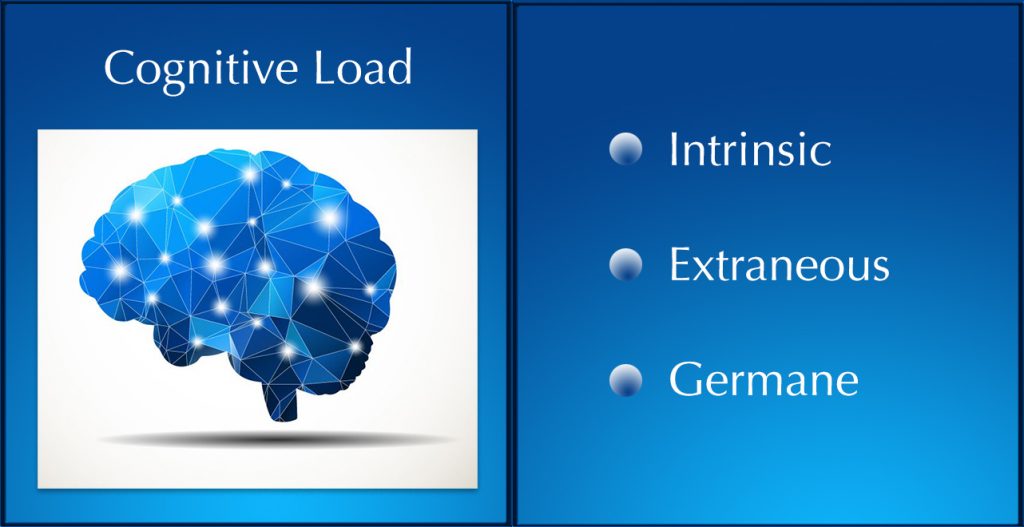
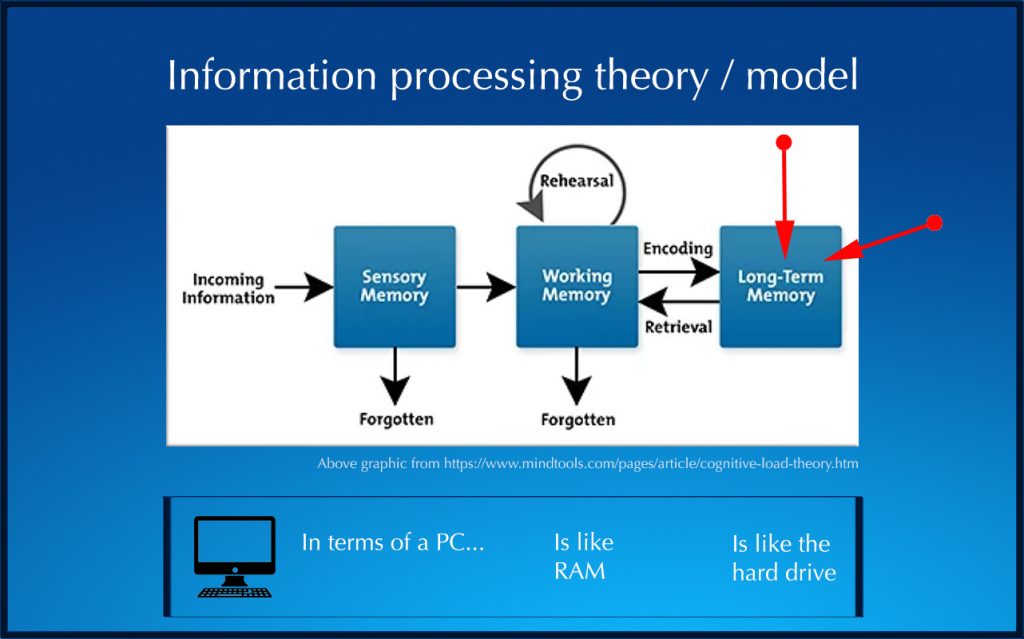
For those of you who teach and/or give presentations, you might be interested in a new video that I put together regarding cognitive load. It addresses at least two main questions:

  1. What is cognitive load?
    and
  2. Why should I care about it?


What is cognitive load? And why should I care about it?

What is cognitive load? And why should I care about it?

Transcript here.


How do I put it into practice?

  • Simplify the explanations of what you’re presenting as much as possible and break down complex tasks into smaller parts
  • Don’t place a large amount of text on a slide and then talk about it at the same time — doing so requires much more processing than most people can deal with.
  • Consider creating two versions of your PowerPoint files:
    • A text-light version that can be used for presenting that content to students
    • A text-heavy version — which can be posted to your LMS for the learners to go through at their own pace — and without trying to process so much information (voice and text, for example) at one time.
  • Design-wise:
    • Don’t use decorative graphics — everything on a slide should be there for a reason
    • Don’t use too many fonts or colors — this can be distracting
    • Don’t use background music when you are trying to explain something
 

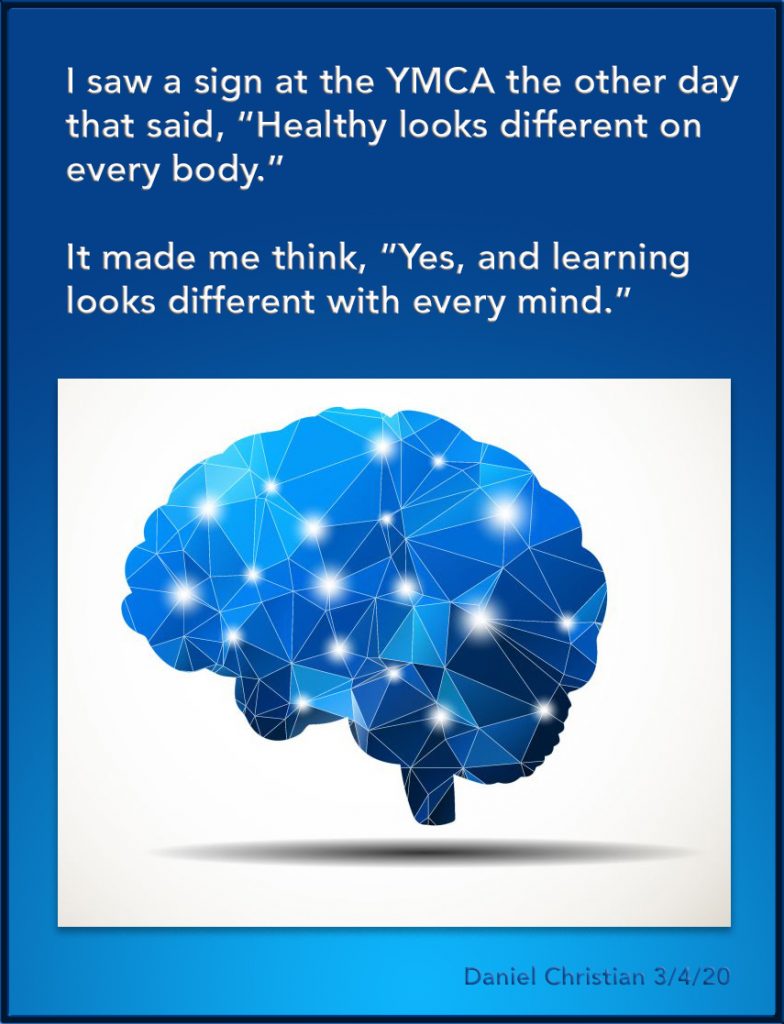
Healthy looks different on every body...and learning looks different with every mind.

From DSC:
What I mean by this is this:

While I certainly agree that research has produced excellent, proven, effective pedagogies that work with many students (the majority even), the fact is, learning is messy. When a child walks into a classroom, there isn’t even one other child with the exact same neural situation.

Nor is there even one other student with the exact same experiences, background, passions, motivations, interests, etc. I’ve experienced this with our daughter who isn’t a part of the 80% that the typical education train addresses. Look out if you are part of the 10% of either side of the bell curve! As your learning experiences are too costly to address and likely won’t be addressed in many cases.

All that said, I still agree that the teaching and learning strategies are still highly relevant across the masses. My point is that there is still a lot of diversity out there. They say that learning is messy for a reason. If you doubt that, go sit in on an IEP sometime.


Toward Inclusive Learning Spaces: Physiological, Cognitive, and Cultural Inclusion and the Learning Space Rating System — from er.educause.edu by Richard Holeton
Inclusive learning space design should be based on a tripartite framework addressing the diverse physiological, cognitive, and cultural needs of learners.

Excerpt:

Students with learning disabilities may have specific limitations in auditory perception and processing, visual perception and processing, information processing speed, abstract reasoning, long-term or short-term memory, spoken and written language ability, mathematical calculation, or executive functioning (e.g., planning and time management). Those with autism spectrum disorder (ASD) may suffer from impaired social interaction, diminished communication abilities, and sensory processing problems that may lead to agoraphobia or difficulty moving through spaces. Applying universal design and UDL principles, designers can and should go beyond the legal requirements to design truly inclusive spaces. Learning space design features that can help those with ASD include providing ordered and comprehensible spatial structures, a mix of large and small spaces, and some user control of environmental conditions, such as the amount of stimulation from light and bold colors.

The three main principles of UDL—to provide learners with multiple means of representation, multiple means of expression, and multiple means of engagement—address cognitive diversity primarily through pedagogical design. Instructors applying UDL may provide course materials in multiple media, offer students different options for demonstrating their understanding and mastery, and build various ways for students to engage with instructors and one another.

Size and Space for Approach and Use: Accommodate diverse physical attributes by providing furnishings and equipment that fit various body sizes and shapes and by allowing appropriate space to permit the use of assistive devices and to accommodate reach and manipulation regardless of body size, posture, mobility, or hand and grip size.


From DSC:
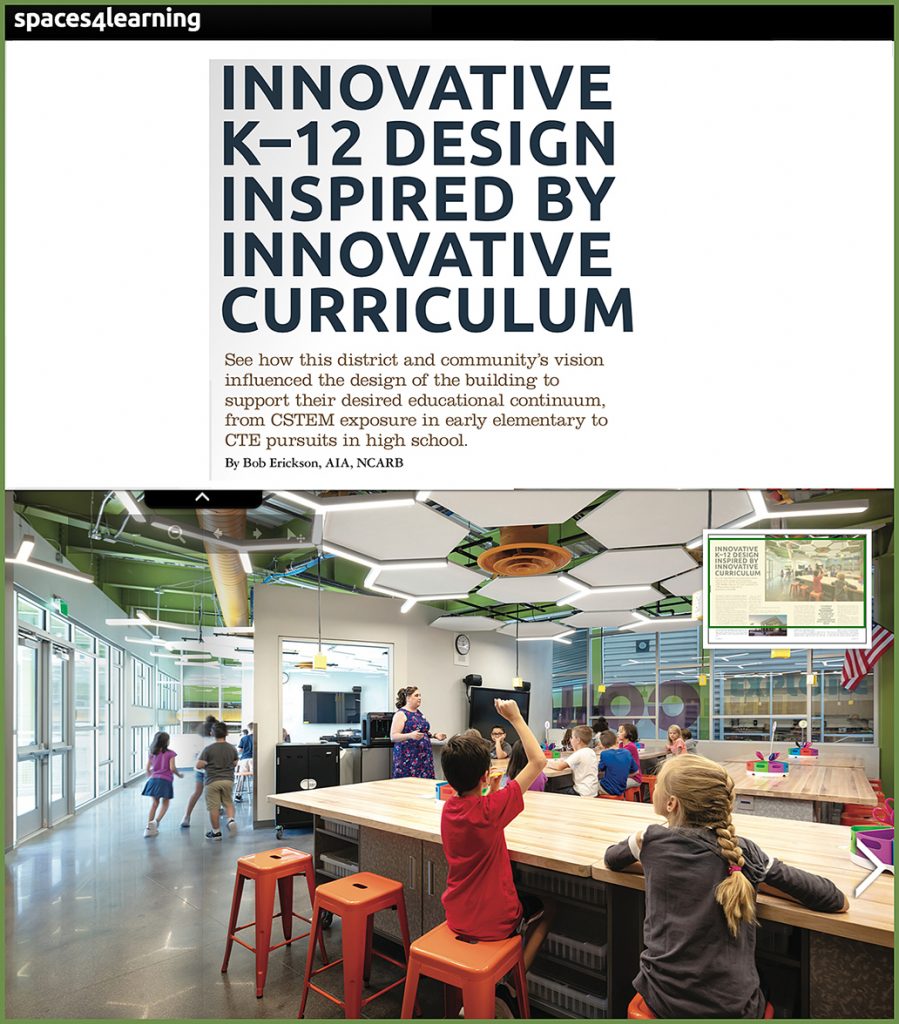
When I saw the learning space as pictured below, I couldn’t help but ask a couple of questions:

  • Doesn’t this look like a colorful, fun, engaging active learning space?
  • One that encourages communication and collaboration?

The natural light is wonderful. And the physical setup seems to let the students know that they will be collaborating with each other the second they walk into this learning space…and it does so without saying a word. 

This type of learning setup seems like learning could be very fun and collaborative!


Notes from Stewart Hase’s keynote (Feb 2020) — with thanks to Dr. Lisa Marie Blaschke in Germany for her Tweet on this

  • The commodification of education – turns out sausages
    or
  • Are we creating more Greta Thunbergs?

Creating learning experiences where people are not sausages. Policymakers don’t get it. Practitioners do.

~11:00 mark –> Learner agency; have control over what they can learn about (inserted graphic from DSC below)

Heutagogy (self-determined learning)

  • …the learner is a partner (agent) in designing and realizing their own learning (Hase & Kenyon, 2000)

PAH continuum – Pedagogy –> Andragogy –>  Heutagogy

Hobby – learned to do it but didn’t go to school for it. How did you go about learning it?

  • Listened to radio, watched YouTube videos, watched other people, trial and error, repeated activity, conversations/reflections/group learning, read books, break things down into smaller parts, seek out a mentor, exploring, testing hypothesis, fail, get stuck and find a way through

Kids know how to do heutagogy – very natural; self-determined learning.

~21:45 To what extent do we incorporate heutagogy into our classrooms?

  • Context and experience – the neurons you bring to the learning table
  • Competence and capability
  • Negotiated learning; let the learner contextualize stuff for you
  • Experiential learning
  • Flexible assessment
  • Chunking the learning
  • Chunk the assessment
  • Flipped classroom
  • Project-based learning

The learning leader: New skills

  • Happy with ambiguity – have to give up control and power
  • Have to trust people
  • Relationship oriented
  • Process not content oriented
  • Coach and guide
  • Scientist
  • Facilitator
 

Guides to help kids learn coding — from educatorstechnology.com

Excerpt:

Below is a collection of some of the best books to help your kids learn coding. Kids will get to learn the basics of computer coding through a wide variety of interactive visuals, engaging games and project-based  activities. They will also get to experiment with different softwares and programming languages such as Python, Java, Scratch and many more. Links to the books are under the visual.

From DSC:
I don’t subscribe to the idea/expectation that every student should become a programmer and have extensive exposure to it. Why? Because:

  1. It’s been my experience that programming requires a different kind of passion, a different way of thinking and processing information, a different way of problem-solving, a different disposition/makeup that many people (including myself) don’t have. This is one of the reasons why coders are often in such demand and are often paid so much — because the vast majority of people don’t want to do it (at least as programming exists today).
  2. I’d like to see our students enjoy their learning. In fact, I’d like to see more emphasis on students enjoying their learning, and far less on grades. Given the new reality of lifelong learning, folks’ quality of life would increase if that were the case. To expect everyone to be able to code applications of some significance is an entirely different matter.

All that said, I do think it’s helpful for students to at least have some exposure to how to program — a basic understanding of coding and what are some of the things that are involved in that space. To have an appreciation of the process, some basic syntax, what’s possible, etc. would be helpful. 

Introduction to programming classes should explain why programming is relevant, list some of the various languages out there, list some different kinds of applications that we use today, and provide some basic elements of programming. Perhaps students could create some very basic, fun things. This could wet some students’ whistles big-time, while helping other students come to the conclusion of, “Well, I tried it, but I don’t want to do this for a living.”


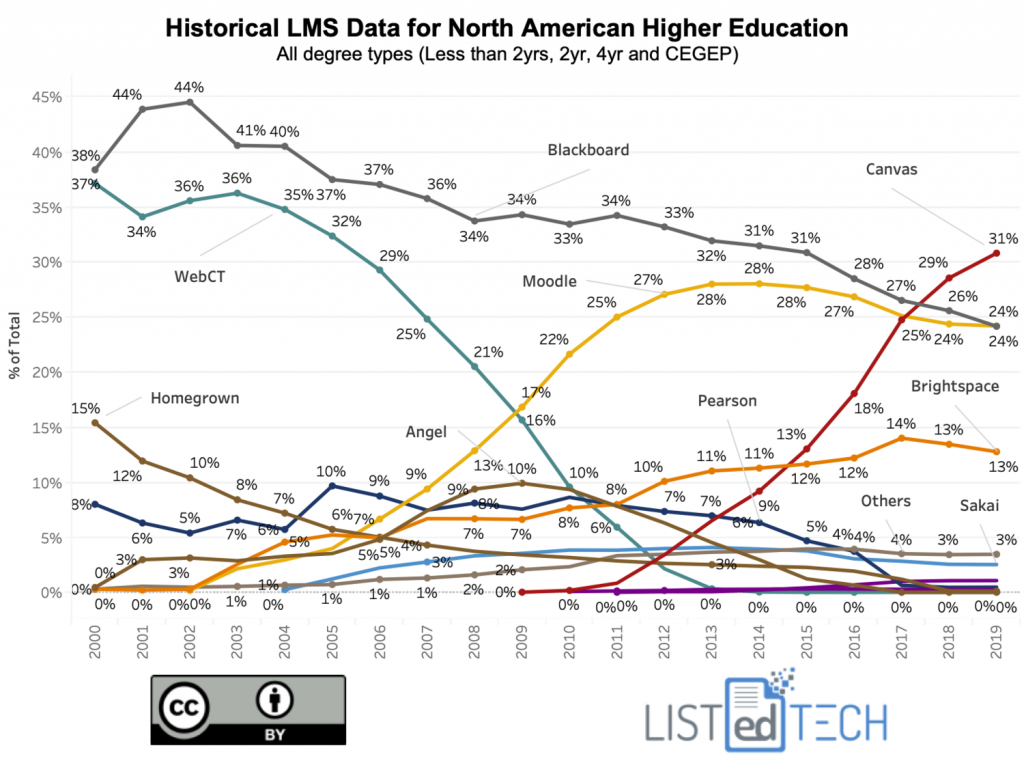
Higher Ed LMS Market for US and Canada: Year-End 2019 Edition — from listedtech-com.cdn.ampproject.org by Justin Menard

Excerpt:

With the release this week of MindWires’ Year-End 2019 report to subscribers (powered by our data), I thought it was time for us to look at updates on the institutional LMS market for North America’s higher education US and Canada). Note that MindWire’s coverage for the market analysis includes Europe, Latin America, Oceania (Australia, New Zealand, and surrounding island countries) as well as new coverage of the Middle East.


ACE receives ED funds to explore blockchain’s potential — from campustechnology.com by Rhea Kelly

Excerpt:

“This work is about exploring the potential of blockchain technology to give learners greater control over their educational records,” said Ted Mitchell, president of ACE, in a statement. “It’s about enabling more seamless transitions between and across K-12, higher education and the workforce. This initiative will explore how this nascent technology can break down barriers for opportunity seekers to fully unlock their learning and achievement.”


Helping grads tell their story: The case for extended transcripts — from gettingsmart.com by Rebecca Midles

Excerpt:

What is an extended transcript?
An extended transcript supplements a traditional list of course credits and grades. It could be as simple as a one-page addendum to the official transcript that includes additional endorsements such as certifications, badges earned and scholarships awarded.

An extended transcript can also include critical competencies demonstrated. ACT has assessments for cross-cutting capabilities like information literacy, collaborative problem solving, thinking and metacognition, and studying and learning, as well as behavioral skills such as self-regulatory and interpersonal skills. Adding recognized measures of certified work-ready skills to a transcript can differentiate a candidate.


Three thoughts on active learning and self-teaching — from rtalbert.org Robert Talbert
“The teacher isn’t teaching and I’m having to teach myself the material” has three embedded misconceptions that need to be addressed.

Excerpts:

First: Learning is a process, not an action that one person performs on another.
…
But in the end, an outside person cannot cause you to learn. This isn’t how learning works. Learning instead is a process that moves back and forth, sometimes focused on an instructor but other times focused on the learner or a group of learners together.
…
Second: Not being lectured to all the time is not the same thing as having to teach yourself.
…
Third: In any event, the skill of self-teaching is essential in college and needs to be developed.

But in general, we need to see — and we have work to do in communicating this to students — that self-teaching is a feature, not a bug.

 
© 2025 | Daniel Christian