From DSC:
The article below is meant as fodder for thought for us now…until we get back to holding class in physical learning spaces again. But it caught my attention because I’d like to see us give students “More choice. More Control.” in all areas of their learning — whether that be in the physical realm or in the digital/virtual realm.


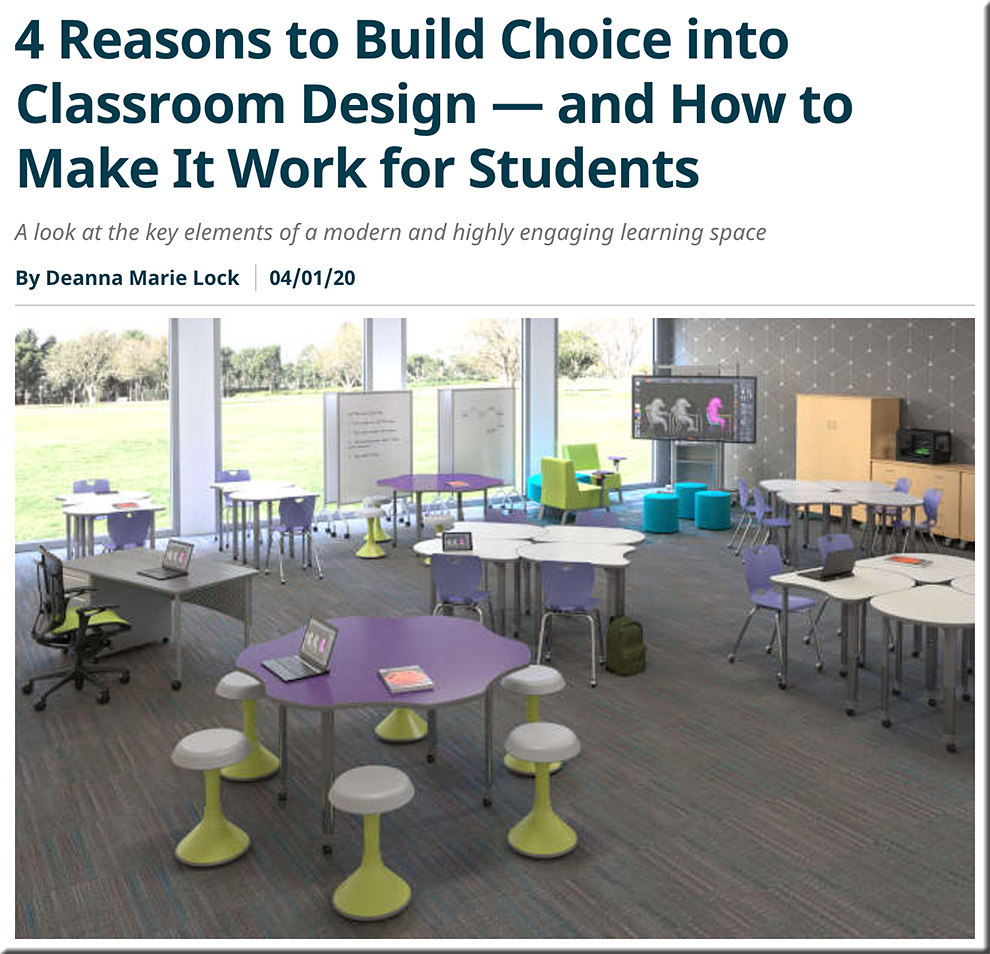
4 reasons to build choice into classroom design — and how to make it work for students — from spaces4learning.com by Deanna Marie Lock
A look at the key elements of a modern and highly engaging learning space


providing more choice and more control to students within the physcial classroom


Q: For those who prefer or need to handwrite their essays, what are some ways/methods that students can use to scan in — and then submit — their essays into Canvas?

A:  Below are a few different options, potential solutions, and resources:


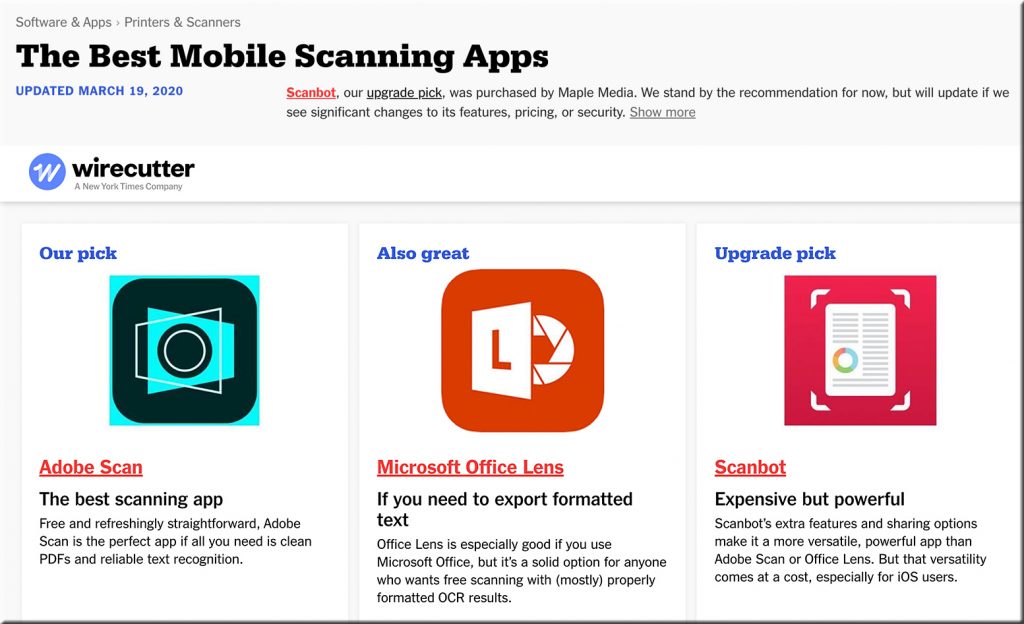
The Best Mobile Scanning Apps -- 2020


  • Students can also scan in their essays via most combination printers/scanners these days. Then they can insert those scans into a Word doc and submit it.
  • A Google search presents many different ways to scan in items into a Word document. That Word doc can then be submitted or saved as a PDF file (and then be submitted as as PDF file).
  • Also see How to create a PDF of handwritten assignments — from Canvas @ Yale. Yale recommended the following apps:

Yale recommends Scannable


Yale recommends Genius Scan for Android devices -- i.e., for scanning documents


Also see:

  • The new Office app now generally available for Android and iOS — from microsoft.com by the Microsoft 365 team
    Excerpt:
    Integrating our Lens technology to unlock the power of the camera with capabilities like converting images into editable Word and Excel documents, scanning PDFs, and capturing whiteboards with automatic digital enhancements to make the content easier to read.
 

From DSC:
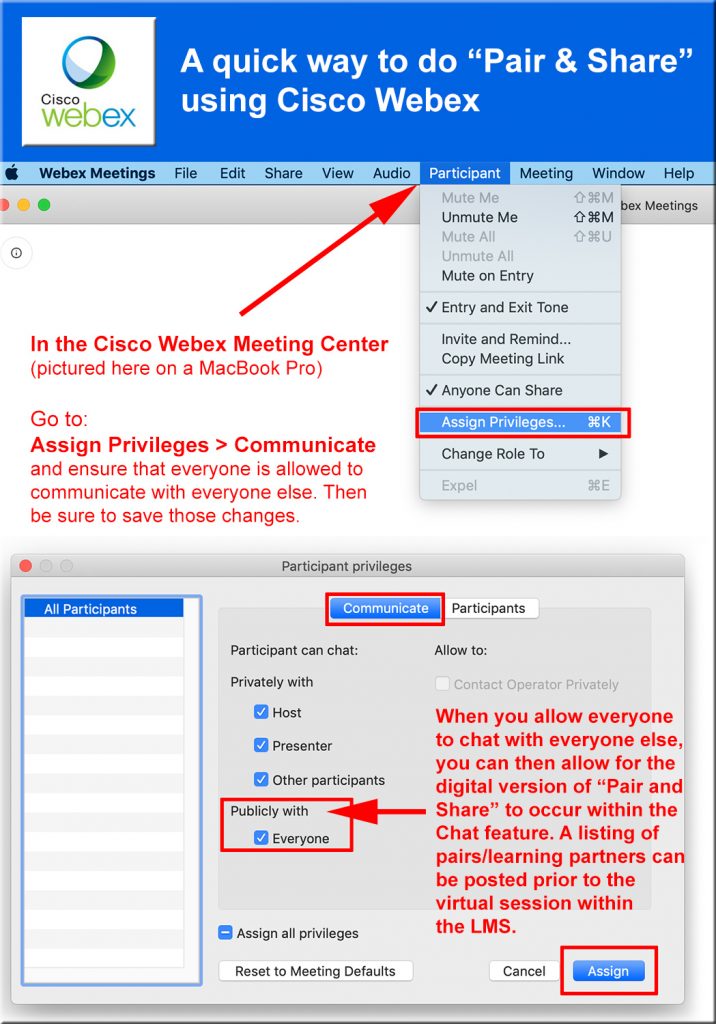
The “Pair & Share” method allows students to find a fellow student to talk about the question/topic at hand. Then, depending upon time and your learning objectives/lesson plans, some students can report back to the larger classroom about what they discussed. In the digital, synchronous realm, one can achieve this with private chat rooms — given that you’ve changed a setting to allow this to occur. Posting the pairings ahead of time should help establish a quick, smooth transition.

(The graphic below is for the Cisco Webex Meeting Center on a MacBook Pro).

Providing a quick pair and share method using the Cisco Webex Meeting Center product


NYC classrooms cancel Zoom after trolls make ‘Zoombombing’ a thing — from thenextweb.com by Bryan Clark

From DSC:
I’m a sinner. I know that all too well. But I’m tagging this with ethics, morals, and matters of the heart because I don’t have a tag for “I’m bumbed out that a solid technology gets ruined by a few bad apples.” It’s not the technology’s fault, per se. It has everything to do with the human heart….whether we like to admit/recognize it or not.

Also see:

“Zoombombing problems are more likely to occur for online events for which the link is circulated widely, or even posted on a public website.” (source)
 

7 guiding principles for parents teaching from home — from edutopia.org by Laura Lee
Understanding the “why” behind teaching practices can help parents create meaningful and effective at-home learning opportunities during the pandemic. 

7 guiding principles for parents teaching from home -- by Laura Lee

Excerpts:

One misconception about teaching is that its primary function is to help students retain information, but retention is just the first step. Effective learning requires that students retrieve information frequently and then make new meaning of it. This process, called consolidation, is often reinforced in traditional classrooms through reviews and quizzes, or through multi-sensory practices like drawing, composing a song, or building a model about what has recently been learned.

At home, prioritize opportunities to engage in active learning through discussion, writing, or producing art, over more passive practices such as re-reading or rote note-taking. Learning requires repeated, active manipulation of the materials being learned.

Finally, many studies reveal that teaching what you’ve learned to someone else—to a parent or to another sibling—is also a highly effective way to consolidate learning and make it stick.


In many parts of the world, schooling at home will continue for at least several months. Help students move beyond a compliance mindset—”I’ve completed my work, can I go now?”— by building in time for passion projects and fun. 


An Educator’s Guide to Virtual Learning: 4 Actions to Support Students With Disabilities and Their Families — from ncld.org / National Center for Learning Disabilities

Excerpt:

Begin implementing best practices in online special education. Most of the best practices in online instruction are the same as for in-person, in-school instruction. This includes using multiple ways to present content, assess progress, provide feedback, and engage students (the hallmark of Universal Design for Learning). Students will still need explicit instruction, and providing what amounts to virtual 1:1 or small group instruction to so many students will take creativity, planning, and flexibility. Here are some helpful resources:


A Parent’s Guide to Virtual Learning: 4 Actions to Improve Your Child’s Experience With Online Learning — from ncld.org / National Center for Learning Disabilities

Excerpt:

Here are some resources that will help you be an effective partner with school personnel and an informed advocate for your child during this challenging time:


Homeschooling During the COVID-19 Pandemic — from cato.org by Kerry McDonald

Excerpt:

In a recent three-part Cato Daily Podcast series, I spoke with host Caleb Brown about this unprecedented educational moment, including sharing strategies and resources for overcoming the challenges of unexpected, unchosen homeschooling, as well as possible outcomes as more parents seek alternatives to conventional schooling post-pandemic.


More Free Resources For New Homeschoolers — from forbes.com by Nick Morrison

Excerpt:

Last month I highlighted some of the free resources available for parents — and teachers — during the pandemic, but since then a number of other organizations have offered their resources, expertise and support for free, so here is another selection, for the benefit of ordinary homeschoolers in these extraordinary times.


From DSC:
Below are excerpts from a recent email that I received as a cc: to our son and am passing it along in case it helps others out there.

I would like to share with you important guidance on how to get the most out of your online learning experience.

ORGANIZING YOUR SPACE
Set up your home classroom space. This is important. Be sure you have a space that is comfortable and where you can focus on your studies, your practice, your craft and your learning. This can be private or shared, whatever works for you and your family.

WHAT YOU WILL NEED

  • Computer
  • Internet Access, preferably high-speed broadband, is required for video conferencing and class assignments. Most of the expected work will not require streaming, but a secure internet connection will help a lot.
  • Headphones help minimize extraneous noise. They can also help signal to others in your home that you are online and on-task.
  • Zoom, our preferred video conferencing software, can be downloaded here. 

SCHEDULE
You will complete your work and engage in your lessons in two ways. Some assignments are laid out in your Canvas class and can be completed at your own pace, turning work in when due. And some of your classes and lessons will require you to connect with faculty and students in real time. When a real-time option is possible, be sure to take it. 

STAYING CONNECTED
Again, be sure to connect in real time as often as possible. There are lots of opportunities to connect with faculty and students every day.
…
Join in as many real time experiences as you can. These human connections, across the internet, are so important during this time when we are all separated physically.

NORMS FOR VIDEO-CONFERENCING

  • Log in on time, and be fully prepared with any necessary materials, notebooks, etc.
  • Wear clothes like what you would wear to school.
  • Remain present and engaged throughout the session. Do not open additional windows or use other technology during the session, unless it is part of class.
  • Join sessions in a quiet space, if you can, where you will not distract others and not be distracted. 
  • Mute your microphone when not speaking.

SUMMARY OF STUDENT RESPONSIBILITIES

  • Establish a daily routine for your school work.
  • Find a comfortable, distraction-free place in your home where you can work.
  • Check email and Canvas each day to learn about the expectations for your work.
  • Perform tasks as outlined by instructors in Canvas and seek clarification from teachers on any assignments where you need it.
  • For classes meeting “live,” login to real-time video services (Zoom) for dialogue with teachers and members of your class. Attend faculty office hours. They want to see you!
  • Put forth your best effort.
  • Communicate with your instructors, your advisor, your residence life coordinator, and/or Academic and College Counseling.
  • If you need anything, let us know.

Under the Table and Teaching: 11 Expert Tips for Schooling Kids with ADHD from Home — from additudemag.com
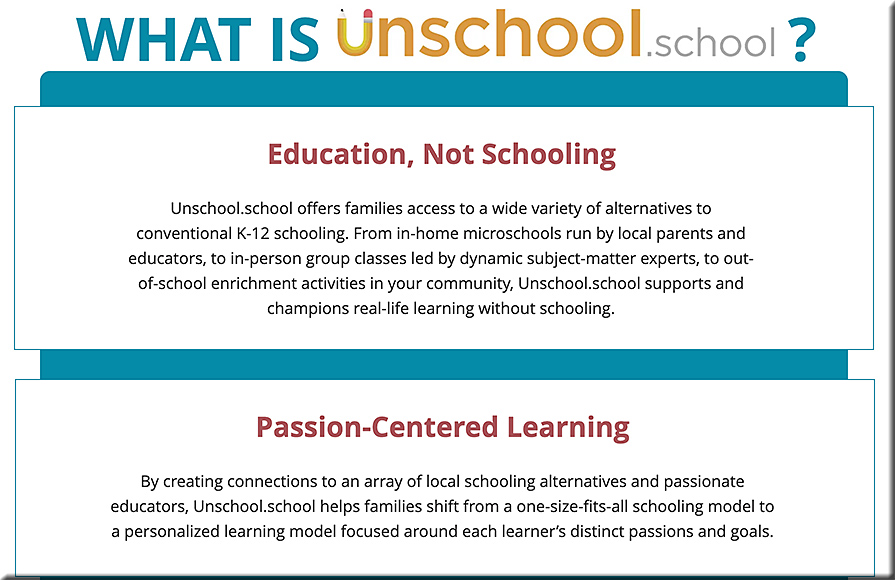
Unschooling. Homeschooling. Crisis schooling. What is the difference? And what are the best learning strategies for your child with ADHD at this stressful time? Here are tips and strategies from education experts who understand the distinctions and today’s inescapable realities.

Excerpts:

11 Ways to Support Learning at Home

    1. Focus learning on your child’s natural interests.
    2. If your child gets stressed, take a break.
    3. Make learning a game.
    4. Embrace Minecraft.
    5. Add movement to promote learning.
    6. Build focus with busy hands and feet.
    7. Tap into online tutors.
    8. Ditch the worksheets. Use educational videos, phone apps, educational podcasts, or other media to introduce or expand on a subject.
    9. Take things one day at a time.
    10. Follow your child’s lead.
    11. Accept that homeschooling may not work for you.
 

unschool


Research Quest Live sign up
Though the museum is currently closed, the Natural History Museum of Utah is allowing kids around the globe the opportunity to transport back in time to a past where dinosaurs roamed the world. With the recently launched Research Quest Live, offering a taste of the world with virtual tours and free access to daily online science classes taught by museum educators.


Common Sense Launches Wide Open School to Help Families and Educators Transition to Students Learning from Home — from commonsensemedia.org
As Schools Continue to Close as a Result of the Coronavirus Pandemic, Some of the Most Respected Companies in Education, Media, and Tech Join Forces to Offer a Free and Open Collection of Quality Online Learning Resources to Educators and Families. 

Excerpt:

SAN FRANCISCO, March 31, 2020—Common Sense, the leading nonprofit organization whose mission is to help kids, families, and educators thrive in a world of media and technology, has convened a group of education, media, and tech partners to launch WideOpenSchool.org, a free online resource to support families and educators who are transitioning to remote learning as a result of the coronavirus.

Wide Open School features the very best resources from publishers, nonprofits, and education companies, including the American Federation of Teachers, Amplify, Boys & Girls Clubs of America, Head Start, Khan Academy, National Geographic, Noggin, PBS, Scholastic, Sesame Workshop,Time for Kids, XQ Institute, and YouTube. Find the full site at WideOpenSchool.org.


Per Techcrunch article:

The world is vulnerable to a new type of trolling as people turn to Zoom video calls to feel connected amidst quarantines. Jerks are using Zoom’s screensharing feature to blast other viewers with the most awful videos from across the internet, from violence to shocking pornography.


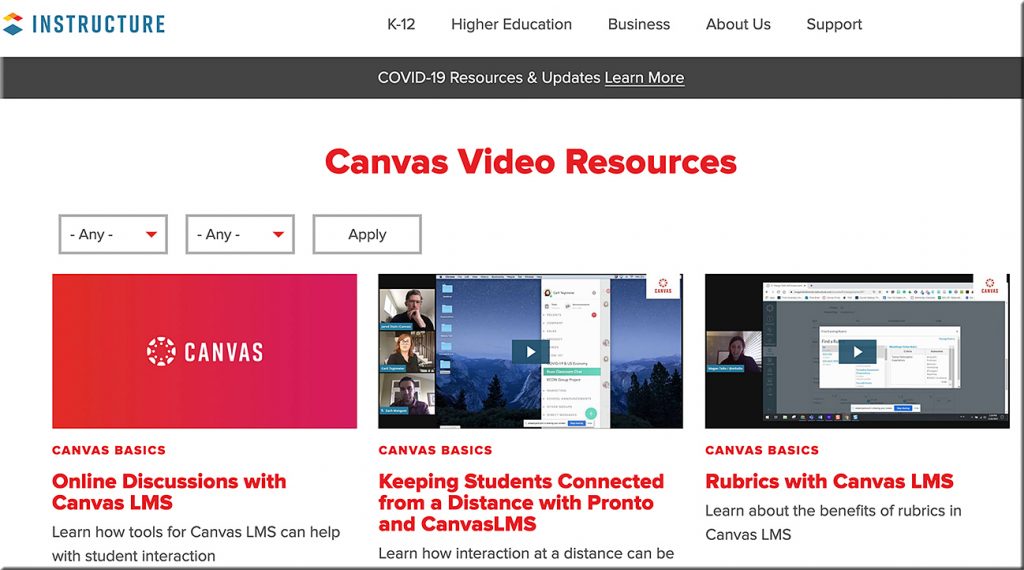
Canvas Video Resources — from instructure.com

Are you in the middle of #remotelearning, and could you use a refresher on how to do certain things w/Canvas LMS? Don’t worry, a group of community members came together & produced videos about key features to help you get moving.  


#edtech #onlinelearning #coronavirus #education #highered #k12 #CMS #LMS #Canvas


Updated: Free Resources for Schools During COVID-19 Outbreak — from thejournal.com by Dian Schaffhauser

Excerpt:

(Updated March 26; originally published March 13) In response to the number of states, districts and schools that are shuttering schools to students over the next several weeks in response to fears about the Novel Coronavirus (COVID-19), education technology companies have stepped forward to help educators reach students in virtual ways. In many cases, the companies are making their paid services free through the rest of the school year; in other cases, they’re lifting limits to services and/or adding premium features to what’s free. The following list will be updated regularly as announcements are made.

Also see:


Growth-Minded Pivot to Online Teaching— from scholarlyteacher.com by Kathryn Smith and Todd Zakrajsek

Excerpt:

What is essential when one starts to teach in an unfamiliar arena is to keep an open mind, be open to change, and expect some mistakes.

Now is the perfect time to embrace a growth mindset regarding teaching online. Carol Dweck, author of Mindset: The New Psychology of Success, states, “… growth mindset is based on the belief that your basic qualities are things you can cultivate through your efforts. Although people may differ in every which way in their initial talents and aptitudes, interests, or temperaments, everyone can change and grow through application and experience.”

Having this growth mindset allows for a different definition of success, and that definition can change daily. Right now, you are likely in a position that requires you to reassess your educational practices, your teaching, and your content delivery method. You are facing challenges in learning a new skill set and an opportunity to model for your students how to grow as well.

Discussion Question:
When a pandemic arrives, few people are asked how they would like to proceed. Online learning was a global health decision. When you first started to think about moving your courses online, did your first inclination feel more growth minded or fix minded? Explain.


From DSC:
I’d like to thank Mr. Eric Osterberg — a fraternity brother and friend of mine — for sending me the following article. I wrote back to him. After thanking Eric for the article, I said:

Such an article makes me reflect on things — which is always a good thing for me to try to see my blindspots and/or to think about the good and bad of things. Technologies are becoming more powerful and integrated into our lives — for better at times and for worse at other times.

I’m wondering how the legal realm can assist and/or help create a positive future for societies throughout the globe…any thoughts?


Can computers ever replace the classroom? — from theguardian.com by Alex Beard
With 850 million children worldwide shut out of schools, tech evangelists claim now is the time for AI education. But as the technology’s power grows, so too do the dangers that come with it. 

Excerpts:

But it’s in China, where President Xi Jinping has called for the nation to lead the world in AI innovation by 2030, that the fastest progress is being made. In 2018 alone, Li told me, 60 new AI companies entered China’s private education market. Squirrel AI is part of this new generation of education start-ups. The company has already enrolled 2 million student users, opened 2,600 learning centres in 700 cities across China, and raised $150m from investors.
…
The supposed AI education revolution is not here yet, and it is likely that the majority of projects will collapse under the weight of their own hype.

The point, in short, is that AI doesn’t have to match the general intelligence of humans to be useful – or indeed powerful. This is both the promise of AI, and the danger it poses.

It was a reminder that Squirrel AI’s platform, like those of its competitors worldwide, doesn’t have to be better than the best human teachers – to improve people’s lives, it just needs to be good enough, at the right price, to supplement what we’ve got. The problem is that it is hard to see technology companies stopping there. For better and worse, their ambitions are bigger. “We could make a lot of geniuses,” Li told me.


From DSC:
Yes! Perhaps teachers will gain some ***very well-deserved respect*** from this whole thing!!!

Eric Chilton talks about how homeschooling his own children has given him a deeper understanding and respect for what teachers do daily.


Moving to remote instruction immediately: Where to get started — from thejournal.com by Dian Schaffhauser
To help schools make the transition as quickly and comprehensively as possible, THE Journal reached out to education technology experts across the country to answer the questions we believe nearly every educator is rushing to answer right now.


Learning ecosystems across the globe are going through massive changes! [Christian]

Learning ecosystems are going through massive changes!


From DSC:

Due to the impacts of the Coronavirus, learning ecosystems across the globe are going through massive changes!

Each of us has our own learning ecosystem, and the organizations that we work for have their own learning ecosystems as well. Numerous teachers, professors, and trainers around the world are now teaching online. Their toolboxes are expanding with the addition of several new tools and some new knowledge. I believe that will be one of the silver linings from the very tough situations/times that we find ourselves in.

Expanding our teaching toolboxes


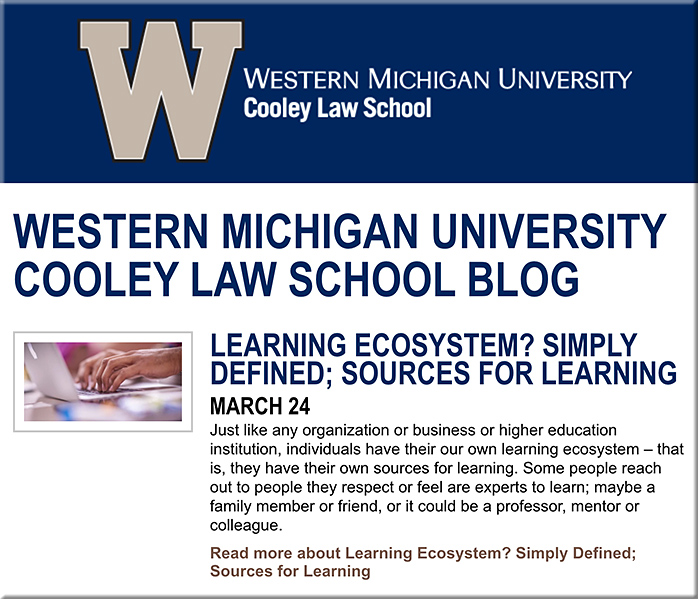
At the WMU-Cooley Law School, our learning ecosystem is also fluid and continues to morph.
This blog posting speaks to those changes.

https://info.cooley.edu/blog/learning-ecosystem-simply-defined-sources-for-learning


Learning from the Living [Class] Room: Due to the impacts from the Coronavirus, this is happening today across many countries. But this vision is just beginning to develop. We haven’t seen anything yet.

 
© 2025 | Daniel Christian