With thanks to my sister, Sue Ellen Christian, for forwarding me Jeremy Caplan’s site/newsletter.

Also see:

…and this one as well:

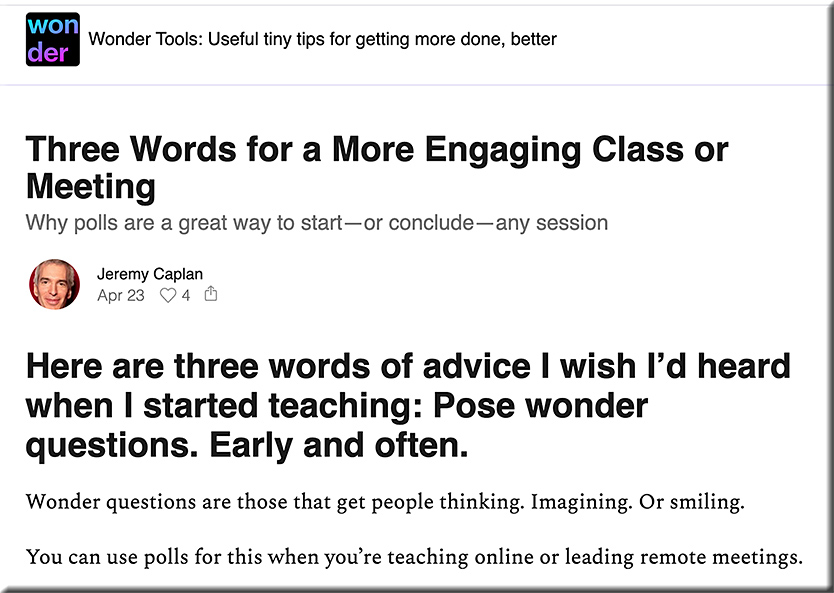
Three words of advice that I wish I had heard when I first started teaching


From DSC:

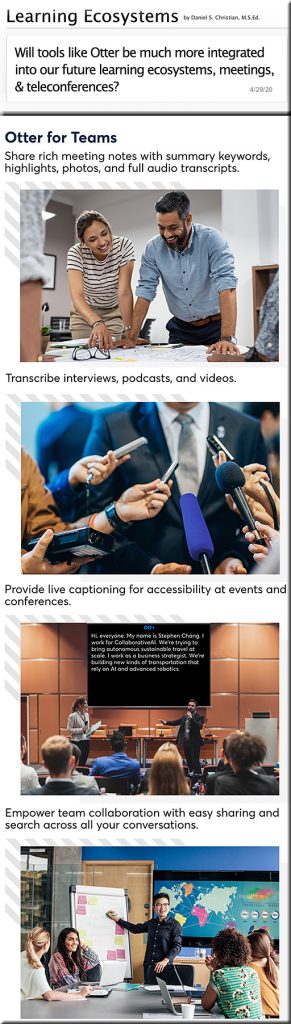
Will tools like Otter be much more integrated into our future learning ecosystems, meetings, & teleconferences?


From DSC:
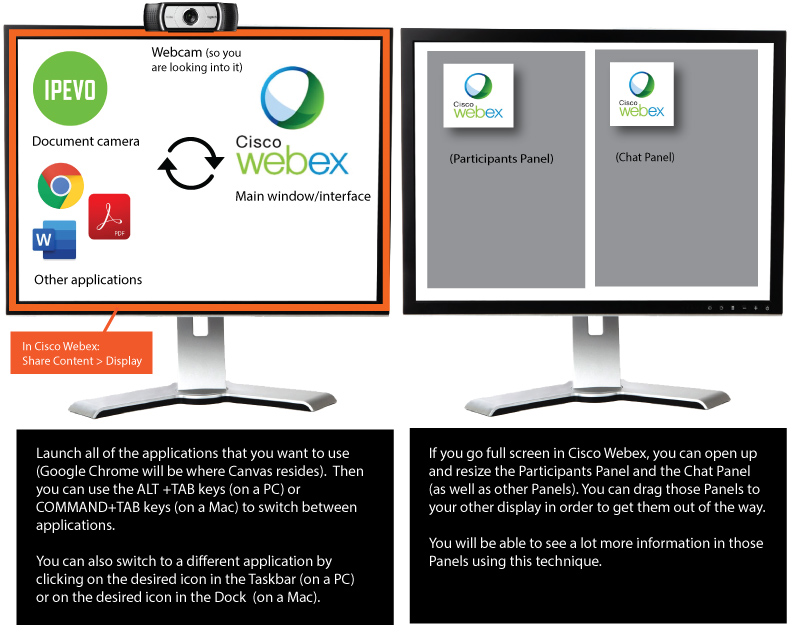
If you are teaching from home and you have two displays (which is highly recommended)… 

The link to the PDF file (below) presents a printable graphic that relays a great way to organize your applications as well as the panels within Cisco Webex. The printable graphic also relays two quick, easy, and effective methods of switching between applications. 


Setting up your apps with two displays (printable graphic in this PDF file).


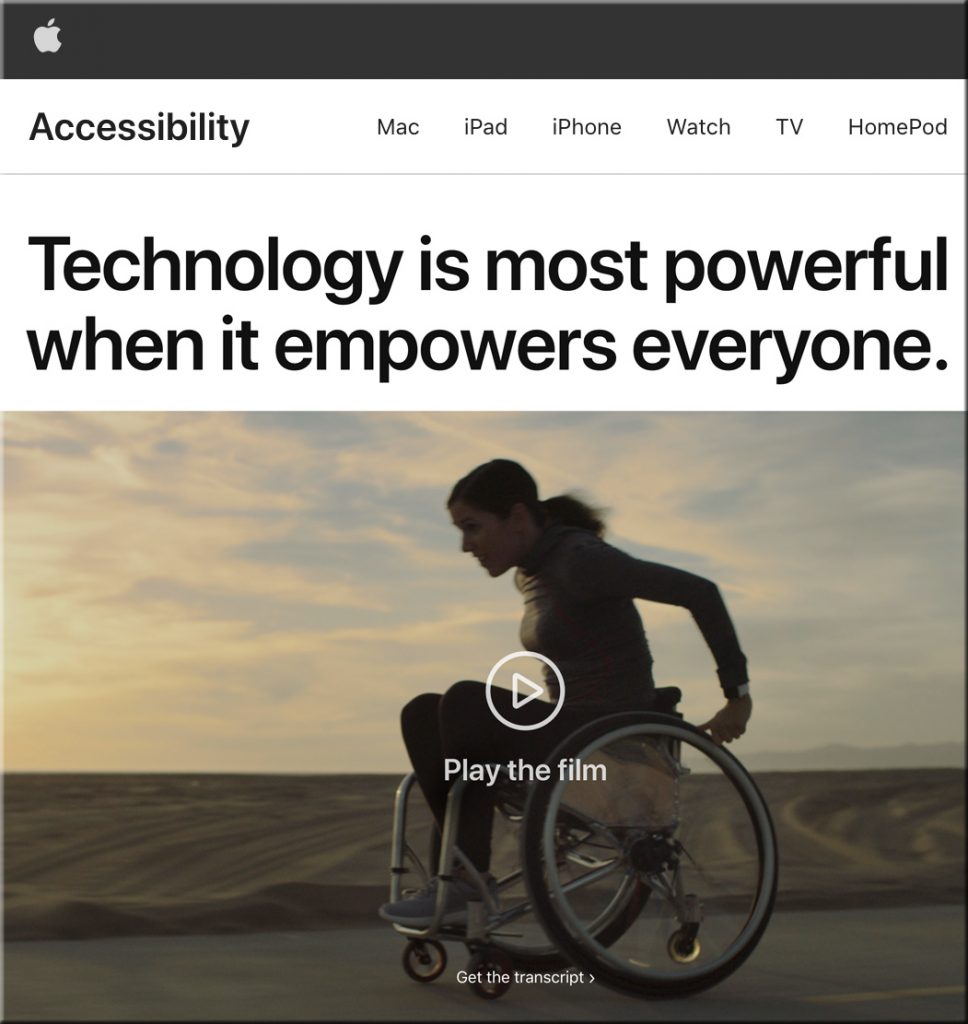
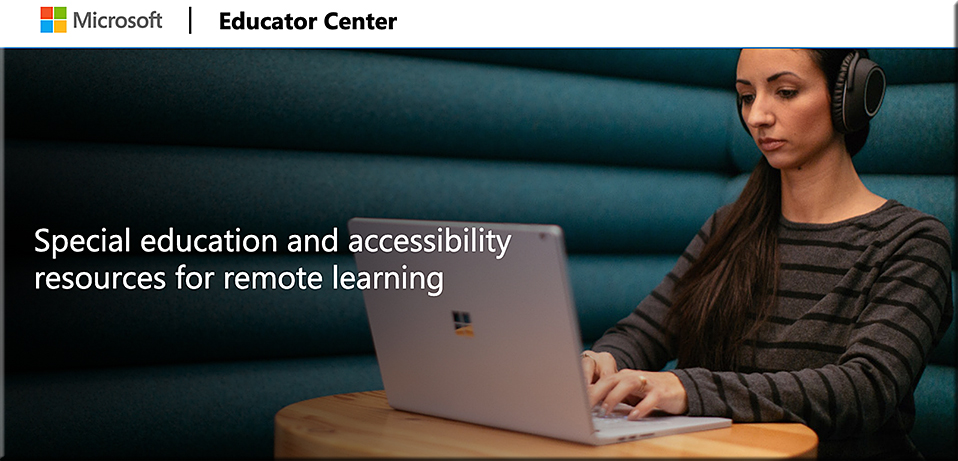
Special education and accessibility resources for remote learning — from education.microsoft.com

Excerpt:

For special educators, diversity demands they provide inclusive, accessible learning environments that inspire confidence and encourage independence differently for each student. Learn about how to create a personalized and engaging remote learning experience for all of your students through the resources provided in these pages.

These resources are intended for all educators, but will be especially helpful for educators and support staff who work in the following areas: special education, assistive technology, blind and visually impaired, deaf and hard of hearing, occupational therapy, physical therapy, speech language pathology, early childhood special education, behavior, counseling, school psychology, language interpretation, literacy, autism, and many other areas that assist students who need specially designed instruction.


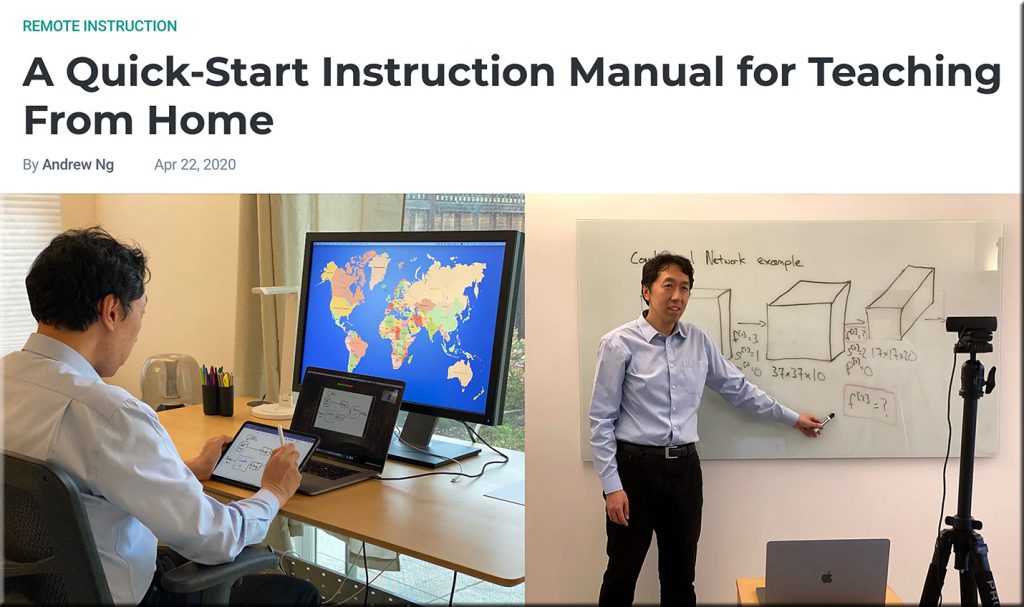
A quick-start instruction manual for teaching from home -- from edsurge.com by Andrew Ng

A quick-start instruction manual for teaching from home — from edsurge.com by Andrew Ng

Excerpt:

How can you migrate a live, in-person class to an online setting quickly, without needing to redesign the class? If you have time to redesign the class into five-minute videos and auto-graded homework, that’s great! But if you don’t, here’s what you can do.

We will go through three quick options with increasing levels of complexity and equipment/setup needed. I recommend using the most sophisticated of these options that you feel comfortable with.

Also, see this PDF file for the full guide.


From DSC:
NOTE: The K-12 education system that I’m talking about in this posting is the pre-COVID-19 education system.


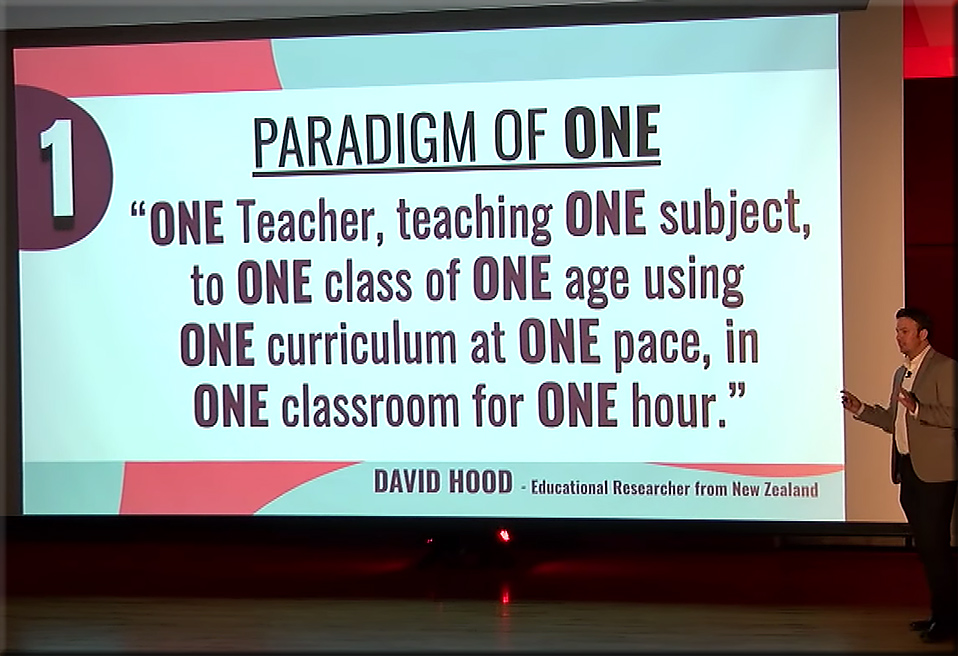
What Cory Henwood describes here…

The paradigm of one -- as described by Cory Henwood

…is what I describe as the quickly moving K-12 education train that stops for no one!

K-12 education in America is a like a quickly moving train that stops for no one.

(image source)


This becomes especially troublesome for those on either side of the 80% bell curve.
I know about this, as one of our daughters has been living through this phenomenon for years. We are seriously considering homeschooling for her as we want her learning experiences to be more positive ones for her. We want to provide more choice, more control for what she wants to learn about — and the pace at which she can go through those experiences. We want there to be more joy in her learning experiences. This will hopefully help her build more positive perspectives about learning in general.

This is not a mute issue…nor is this a topic that’s focused on just students with special needs. In fact, this topic is relevant to every single student in America — as everyone is now required to be lifelong learners these days. Grades need to diminish in importance. The enjoyment of learning needs to rise.

Note: There were some times in public and charter schools that provided courses and topics of great interest to her, and provided some great joy to her. Plus, there were some incredibly-dedicated teachers and staff that created a team around our daughter. I’m very grateful for them and for their efforts. But positive learning experiences were becoming too few and too far between. The train left the station *for everyone* at such-and-such a time, and stopped *for everyone* at such and such a time. The education system required that she and her classmates move at a certain (high) speed — regardless of their mastery of the content. Teachers know what I’m talking about here…big time.

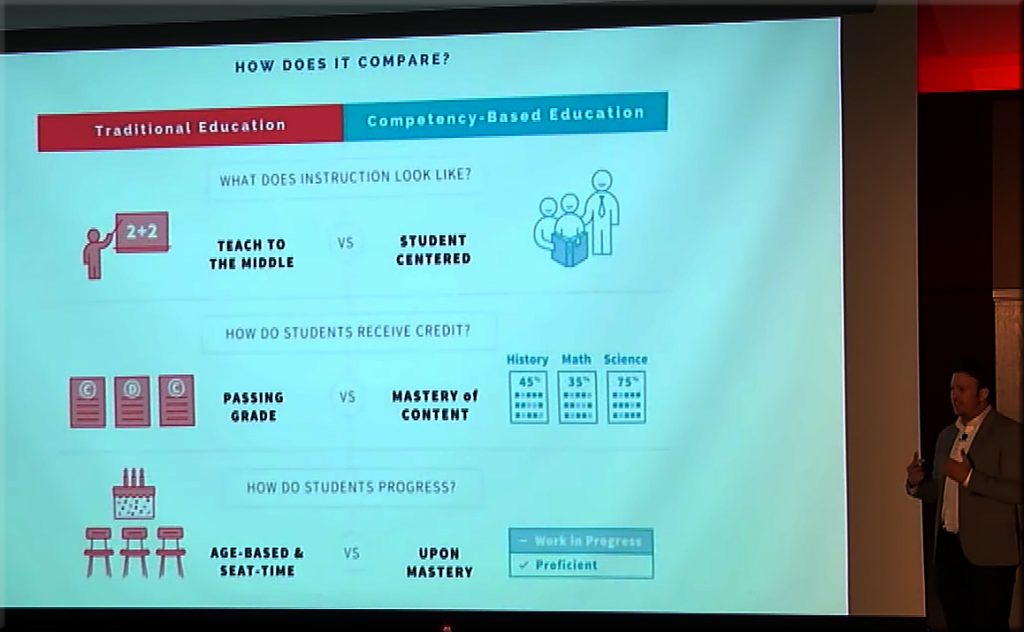
We need to get to what Cory discusses about when he discusses competency-based education.

We need to get to what Cory discusses about competency-based education.

Plus, we need to get to a place where there is:


Silver Lining for Learning, Episode 05: Rethinking school with Will Richardson — from dangerouslyirrelevant.org by Scott McLeod; joined by Chris Dede and Curt Bonk as well

Per Scott:

I was fortunate to be the primary host for Episode 05 of Silver Lining for Learning on April 18. Our guest was Will Richardson and we had a fantastic discussion about both the realities and possibilities of school transformation.

Will has been talking about how to rethink learning, teaching, and schooling for decades. He is the author of multiple books and has launched major collaboration initiatives such as the change.school, Modern Learners, and Powerful Learning Practice networks. If you weren’t able to join us, the archived video is well worth it!


Educating all learners during COVID-19: An alliance emerges to provide support for virtual special education services — from gettingsmart.com by Rachelle Dene Poth

Excerpt:

One group that is developing a supportive space for educators looking to support students with disabilities during this time is the Educating All Learners Alliance (EALA), a group dedicated to equity and aimed at providing resources that students with disabilities need. The EALA is a collaborative project between a number of education groups to curate education resources specifically for schools that serve the nearly 7.5 million special needs students in America. Lauren Morando Rhim, co-founder and executive director of founding partner the National Center for Special Education in Charter Schools, explains the motivation for the project: “We’re already seeing schools finding creative and innovative ways to ensure teachers and students with disabilities can engage in teaching and learning remotely—our goal is to help educators share those strategies broadly with their peers.”


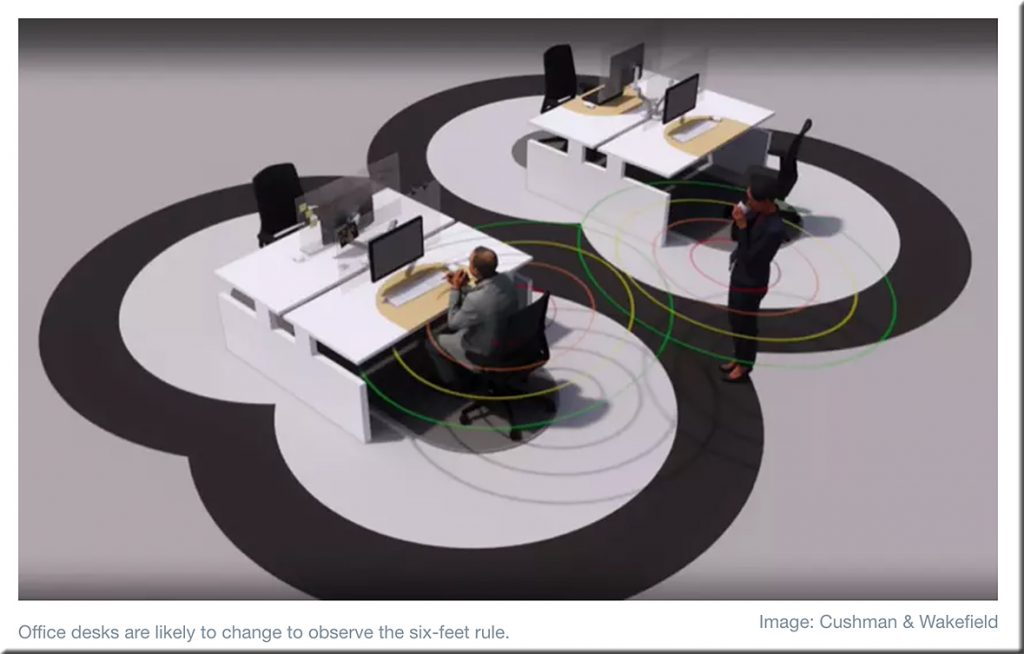
10 ways COVID-19 could change office design — from weforum.org by Harry Kretchmer

“Think road markings, but for offices. From squash-court-style lines in lobbies to standing spots in lifts, and from circles around desks to lanes in corridors, the floors and walls of our offices are likely to be covered in visual instructions.”


From DSC:
After reading the above article and quote, I wondered..rather than marking up the floors and walls of spaces, perhaps Augmented Reality (AR) will provide such visual instructions for navigating office spaces in the future.  Then I wondered about other such spaces as:

  • Learning spaces
  • Gyms
  • Retail outlets 
  • Grocery stores
  • Restaurants
  • Small businesses
  • Other common/public spaces
 

4 items on Instructure’s to-do list after the sale of the Canvas LMS provider — from edsurge.com by Wade Tyler Millward

Excerpt:

Even without a pandemic, Instructure faced a transformative 2020. The learning management system provider—best known for its Canvas product popular among colleges—is officially under private equity ownership.


Excerpts from Living on Curves — from gettingsmart.com by Tom Vander Ark

Almost all of us maintain a normality bias where we assume things will go on about the same as they always have.
…
Young people are growing up on a jostling set of curves that will bring waves of dislocations to their lives. And even though we don’t fully understand the questions, much less the answers, it’s a good time to start this conversation with our children.


5 easy ways to infuse learning science into remote teaching — from campustechnology.com by Andrea Hendricks
These practices will help engage students and improve outcomes throughout the online learning process.

Excerpt:

Here again, good organization is essential. I organize my content by units that are aligned to tests, so my students always have a clear learning goal in mind. If I have six tests in a semester, I divide the content into six units. Each unit contains an overview for the module, a submodule for each section, a review of the key concepts from the unit, a set of review problems for the unit, and a test. Within section submodules, I give an overview of the objectives, activities for students to engage with and learn the content (reading assignments, videos, animations, homework problems), and a discussion question. I also include modules on getting started with the course, the technology we’ll be using as well as tutoring information and resources.


From DSC:
Let’s hope that Cisco Webex learns from Zoom, Blackboard Collaborate, and likely other products/vendors as well — in terms of providing easy-to-setup and use, seamless breakout rooms.

The breakout rooms in the Cisco Webex’ Training Center product are audio-only, which represents a major gap/disadvantage for numerous courses out there. (And, last I knew, there aren’t breakout rooms in the Cisco WebEx Meeting Center product.) The idea of community, presence, and collaboration is supported by providing audio and video. Video is critically important in certain courses.

Plus we are finding at WMU-Cooley that we need to create main rooms PLUS additional breakout rooms and assign students to each breakout room. But then, audio and video issues abound. Such a complex setup requires that the faculty member (i.e., the host) of such meetings needs to be pretty savvy in order to make things work well. 

The transitions of going from the main meeting room to breakout rooms needs to be quick and easy. Bb Collaborate did a great job with this, and I hear Zoom does a good job with this as well. Cisco Webex does not.

Cisco — if you’re going to be in the world of higher ed and in the K-12 world, you need to fix this ASAP. 

Flipping things around…Zoom, you had better learn from Cisco Webex if you want to play in the worlds of education as well. Your “Zoombombing” and security-related issues are not good.

Also see:


From DSC:
On the positive side…

What I appreciate about ‘s article is that it’s asking us to think about future scenarios in regards to higher education. Then, it’s proposing some potential action steps to take now to address those potential scenarios if they come to fruition. It isn’t looking at the hood when we’re traveling 180 mph. Rather, it’s looking out into the horizon to see what’s coming down the pike. 

6 Steps to Prepare for an Online Fall Semester — from chronicle.com b

Excerpt (emphasis DSC):

Plan for a multiyear impact. If colleges are forced to maintain online-only instruction in the fall and to defer reopening their campuses to in-person instruction to January 2021, the impact will be felt for years. College leaders should start thinking now about how to manage and potentially adjust spring-2021 (and beyond) course offerings, course sequencing, and degree requirements to avoid saddling students with graduation delays and the accompanying direct and indirect financial costs. In addition, colleges should anticipate a smaller-than-normal entering first-year class in fall 2020 (and thus a larger-than-normal enrollment a year later) and devise strategies to help mitigate the resulting stresses on admission rates and classroom and dorm capacity for first-year students entering in fall 2021 and beyond.

If instruction remains online-only in the fall, colleges won’t be able to afford that sort of inefficiency. College departments should start now to identify opportunities for collaborations that would draw on the collective wisdom and labor of faculty members from multiple institutions who are teaching similar courses. This would lessen the burden of migrating teaching materials and techniques to an online format.

From DSC:
I’ve often wondered about the place of consortiums within higher ed…i.e., pooling resources. Will the impacts of the Coronavirus change this area of higher ed? Not sure. Perhaps.

On the negative side…

I take issue with some of John’s perspectives, which are so common amongst the writers and academics out there. For example:

Conversely, an entire generation of current college students is now learning that it can be pretty boring to be one of several hundred people simultaneously watching a Zoom lecture.

You know what? I did that very same thing — over and over again — at Northwestern University (NU), but in a face-to-face format. And quite frankly, it’s a better view on videoconferencing. It’s far more close up, more intimate online. I agree it’s a different experience. But our auditoriums were large and having 100-200+ students in a classroom was common. There was no interaction amongst the students. There were no breakout groups. The faculty members didn’t know most of our names and I highly doubt that the well-paid researchers at Northwestern — who were never taught how to teach in the first place nor did they or NU regard the practice of teaching and learning highly anyway — gave a rat’s ass about body language. Reading the confusion in the auditorium? Really? I highly doubt it. And those TA’s that we paid good money for? Most likely, they were never taught how to teach either. The well-paid researchers often offloaded much of the teaching responsibilities onto the teacher assistants’ backs. 

Bottom line:
Face-to-face learning is getting waaaay more credit than it sometimes deserves — though sometimes it IS warranted. And online-based learning — especially when it’s done right — isn’t getting nearly enough credit. 


Addendum: Another example of practicing futures thinking in higher ed:

 
© 2025 | Daniel Christian