ChatGPT is changing the game, and I want to share real things you can do with this AI system today.
Please save this thread and start testing this technology NOW so you’re ahead of the curve.
— Allie K. Miller (@alliekmiller) December 13, 2022
ChatGPT is changing the game, and I want to share real things you can do with this AI system today.
Please save this thread and start testing this technology NOW so you’re ahead of the curve.
— Allie K. Miller (@alliekmiller) December 13, 2022
AI bot ChatGPT stuns academics with essay-writing skills and usability — from theguardian.com by Alex Hern
Latest chatbot from Elon Musk-founded OpenAI can identify incorrect premises and refuse to answer inappropriate requests
Excerpt:
Professors, programmers and journalists could all be out of a job in just a few years, after the latest chatbot from the Elon Musk-founded OpenAI foundation stunned onlookers with its writing ability, proficiency at complex tasks, and ease of use.
The system, called ChatGPT, is the latest evolution of the GPT family of text-generating AIs. Two years ago, the team’s previous AI, GPT3, was able to generate an opinion piece for the Guardian, and ChatGPT has significant further capabilities.
In the days since it was released, academics have generated responses to exam queries that they say would result in full marks if submitted by an undergraduate, and programmers have used the tool to solve coding challenges in obscure programming languages in a matter of seconds – before writing limericks explaining the functionality.
Also related/see:
AI and the future of undergraduate writing — from chronicle.com by Beth McMurtrie
Excerpts:
Is the college essay dead? Are hordes of students going to use artificial intelligence to cheat on their writing assignments? Has machine learning reached the point where auto-generated text looks like what a typical first-year student might produce?
And what does it mean for professors if the answer to those questions is “yes”?
…
Scholars of teaching, writing, and digital literacy say there’s no doubt that tools like ChatGPT will, in some shape or form, become part of everyday writing, the way calculators and computers have become integral to math and science. It is critical, they say, to begin conversations with students and colleagues about how to shape and harness these AI tools as an aide, rather than a substitute, for learning.
“Academia really has to look at itself in the mirror and decide what it’s going to be,” said Josh Eyler, director of the Center for Excellence in Teaching and Learning at the University of Mississippi, who has criticized the “moral panic” he has seen in response to ChatGPT. “Is it going to be more concerned with compliance and policing behaviors and trying to get out in front of cheating, without any evidence to support whether or not that’s actually going to happen? Or does it want to think about trust in students as its first reaction and building that trust into its response and its pedagogy?”
ChatGPT is incredibly limited, but good enough at some things to create a misleading impression of greatness.
it’s a mistake to be relying on it for anything important right now. it’s a preview of progress; we have lots of work to do on robustness and truthfulness.
— Sam Altman (@sama) December 11, 2022
fun creative inspiration; great! reliance for factual queries; not such a good idea.
we will work hard to improve!
— Sam Altman (@sama) December 11, 2022
1/Large language models like Galactica and ChatGPT can spout nonsense in a confident, authoritative tone. This overconfidence – which reflects the data they’re trained on – makes them more likely to mislead.
— Andrew Ng (@AndrewYNg) December 13, 2022
ChatGPT Could Be AI’s iPhone Moment — from bloomberg.com by Vlad Savov; with thanks to Dany DeGrave for his Tweet on this
Excerpt:
The thing is, a good toy has a huge advantage: People love to play with it, and the more they do, the quicker its designers can make it into something more. People are documenting their experiences with ChatGPT on Twitter, looking like giddy kids experimenting with something they’re not even sure they should be allowed to have. There’s humor, discovery and a game of figuring out the limitations of the system.
And on the legal side of things:
In the legal education context, I’ve been playing around with generating fact patterns and short documents to use in exercises.
— Rebecca Fordon (@theFordon) December 9, 2022
Understanding the Overlap Between UDL and Digital Accessibility — from boia.org
Excerpt:
Implementing UDL with a Focus on Accessibility
UDL is a proven methodology that benefits all students, but when instructors embrace universal design, they need to consider how their decisions will affect students with disabilities.
Some key considerations to keep in mind:
Resources for Computer Science Education Week (December 5-11, 2022) — with thanks to Mark Adams for these resources
Per Mark, here are a few resources that are intended to show students how computers can become part of their outside interests as well as in their future careers.
Educating Engineers
Maryville University
Fullstack Academy
Also see:
MADE Podcast on Branching Scenarios — from christytuckerlearning.com by Christy Tucker
My interview for the MADE podcast on branching scenarios: when to use them, challenges, tools, planning, and getting started.
Excerpt:
MADE is the Media and Design in Education team for the University of Toronto. Inga Breede from this educational technology group recently interviewed me for their podcast. We talked about scenario-based learning and specifically about branching scenarios.
What we discussed
We covered several topics in our 20-minute conversation.
TL;DR: Women prefer text contributions over talk in remote classes — from highereddive.com by Laura Spitalniak (BTW, TL;DR: is short for “too long; didn’t read”)
Dive Brief (emphasis DSC):
10 Must Read Books for Learning Designers — from linkedin.com by Amit Garg
Excerpt:
From the 45+ #books that I’ve read in last 2 years here are my top 10 recommendations for #learningdesigners or anyone in #learninganddevelopment
Speaking of recommended books (but from a more technical perspective this time), also see:
10 must-read tech books for 2023 — from enterprisersproject.com by Katie Sanders (Editorial Team)
Get new thinking on the technologies of tomorrow – from AI to cloud and edge – and the related challenges for leaders
This Copyright Lawsuit Could Shape the Future of Generative AI — from wired.com by Will Knight
Algorithms that create art, text, and code are spreading fast—but legal challenges could throw a wrench in the works.
Excerpts:
A class-action lawsuit filed in a federal court in California this month takes aim at GitHub Copilot, a powerful tool that automatically writes working code when a programmer starts typing. The coder behind the suit argues that GitHub is infringing copyright because it does not provide attribution when Copilot reproduces open-source code covered by a license requiring it.
…
Programmers have, of course, always studied, learned from, and copied each other’s code. But not everyone is sure it is fair for AI to do the same, especially if AI can then churn out tons of valuable code itself, without respecting the source material’s license requirements. “As a technologist, I’m a huge fan of AI ,” Butterick says. “I’m looking forward to all the possibilities of these tools. But they have to be fair to everybody.”
Whatever the outcome of the Copilot case, Villa says it could shape the destiny of other areas of generative AI. If the outcome of the Copilot case hinges on how similar AI-generated code is to its training material, there could be implications for systems that reproduce images or music that matches the style of material in their training data.
Also legal-related, see:
Also related to AI and art/creativity from Wired.com, see:
Best Webcams for Teachers and Students — from techlearning.com by Luke Edwards
Get the best webcams for teachers and students to help with hybrid learning and more

Best Wireless Keyboard and Mouse for Teachers 2022 — from techlearning.com by Luke Edwards
The best wireless keyboard and mouse for teachers keep you connected to devices while staying mobile

How AI will change Education: Part I | Transcend Newsletter #59 — from transcend.substack.com by Alberto Arenaza; with thanks to GSV’s Big 10 for this resource
Excerpt:
You’ve likely been reading for the last few minutes my arguments for why AI is going to change education. You may agree with some points, disagree with others…
Only, those were not my words.
An AI has written every single word in this essay up until here.
The only thing I wrote myself was the first sentence: Artificial Intelligence is going to revolutionize education. The images too, everything was generated by AI.
Using Virtual Reality for Career Training — from techlearning.com by Erik Ofgang
The Boys & Girls Clubs of Indiana have had success using virtual reality simulations to teach students about career opportunities.

Excerpts:
Virtual reality can help boost CTE programs and teach students about potential careers in fields they may know nothing about, says Lana Taylor from the Indiana Alliance of Boys & Girls Clubs of America.
…
One of those other resources has been a partnership with Transfer VR to provide students access to headsets to participate in career simulations that can give them a tactile sense of what working in certain careers might be like.
“Not all kids are meant to go to college, not all kids want to do it,” Taylor says. “So it’s important to give them some exposure to different careers and workforce paths that maybe they hadn’t thought of before.”
AI interviews in VR prepare students for real jobseeking — from inavateonthenet.net

Get Ready to Relearn How to Use the Internet — from bloomberg.com by Tyle Cowen; with thanks to Sam DeBrule for this resource
Everyone knows that an AI revolution is coming, but no one seems to realize how profoundly it will change their day-to-day life.
Excerpts:
This year has brought a lot of innovation in artificial intelligence, which I have tried to keep up with, but too many people still do not appreciate the import of what is to come. I commonly hear comments such as, “Those are cool images, graphic designers will work with that,” or, “GPT-3 is cool, it will be easier to cheat on term papers.” And then they end by saying: “But it won’t change my life.”
This view is likely to be proven wrong — and soon, as AI is about to revolutionize our entire information architecture. You will have to learn how to use the internet all over again.
…
Change is coming. Consider Twitter, which I use each morning to gather information about the world. Less than two years from now, maybe I will speak into my computer, outline my topics of interest, and somebody’s version of AI will spit back to me a kind of Twitter remix, in a readable format and tailored to my needs.
The AI also will be not only responsive but active. Maybe it will tell me, “Today you really do need to read about Russia and changes in the UK government.” Or I might say, “More serendipity today, please,” and that wish would be granted.
Of course all this is just one man’s opinion. If you disagree, in a few years you will be able to ask the new AI engines what they think.
Some other recent items from Sam DeBrule include:
Natural Language Assessment: A New Framework to Promote Education — from ai.googleblog.com by Kedem Snir and Gal Elidan
Excerpt:
In this blog, we introduce an important natural language understanding (NLU) capability called Natural Language Assessment (NLA), and discuss how it can be helpful in the context of education. While typical NLU tasks focus on the user’s intent, NLA allows for the assessment of an answer from multiple perspectives. In situations where a user wants to know how good their answer is, NLA can offer an analysis of how close the answer is to what is expected. In situations where there may not be a “correct” answer, NLA can offer subtle insights that include topicality, relevance, verbosity, and beyond. We formulate the scope of NLA, present a practical model for carrying out topicality NLA, and showcase how NLA has been used to help job seekers practice answering interview questions with Google’s new interview prep tool, Interview Warmup.
How AI could help translate extreme weather alerts — from axios.com by Ayurella Horn-Muller
Excerpt:
A startup that provides AI-powered translation is working with the National Weather Service to improve language translations of extreme weather alerts across the U.S.
Using GPT-3 to augment human intelligence — from escapingflatland.substack.com by Henrik Karlsson
Excerpt:
When I’ve been doing this with GPT-3, a 175 billion parameter language model, it has been uncanny how much it reminds me of blogging. When I’m writing this, from March through August 2022, large language models are not yet as good at responding to my prompts as the readers of my blog. But their capacity is improving fast and the prices are dropping.
Soon everyone can have an alien intelligence in their inbox.
How Long Should a Branching Scenario Be?— from christytuckerlearning.com by Christy Tucker
How long should a branching scenario be? Is 45 minutes too long? Is there an ideal length for a branching scenario?
Excerpt:
Most of the time, the branching scenarios and simulations I build are around 10 minutes long. Overall, I usually end up at 5-15 minutes for branching scenarios, with interactive video scenarios being at the longer end.
From DSC:
This makes sense to me, as (up to) 6 minutes turned out to be an ideal length for videos.
Excerpt from Optimal Video Length for Student Engagement — from blog.edx.org
The optimal video length is 6 minutes or shorter — students watched most of the way through these short videos. In fact, the average engagement time of any video maxes out at 6 minutes, regardless of its length. And engagement times decrease as videos lengthen: For instance, on average students spent around 3 minutes on videos that are longer than 12 minutes, which means that they engaged with less than a quarter of the content. Finally, certificate-earning students engaged more with videos, presumably because they had greater motivation to learn the material. (These findings appeared in a recent Wall Street Journal article, An Early Report Card on Massive Open Online Courses and its accompanying infographic.)
The take-home message for instructors is that, to maximize student engagement, they should work with instructional designers and video producers to break up their lectures into small, bite-sized pieces.
From DSC:
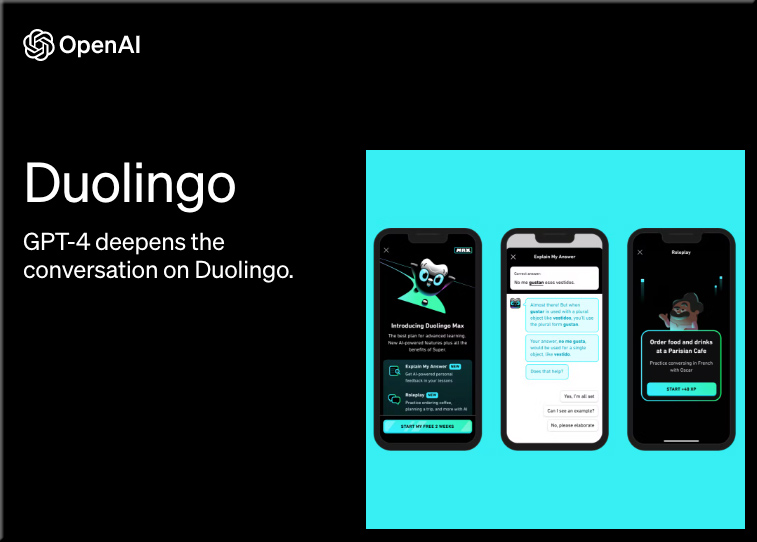
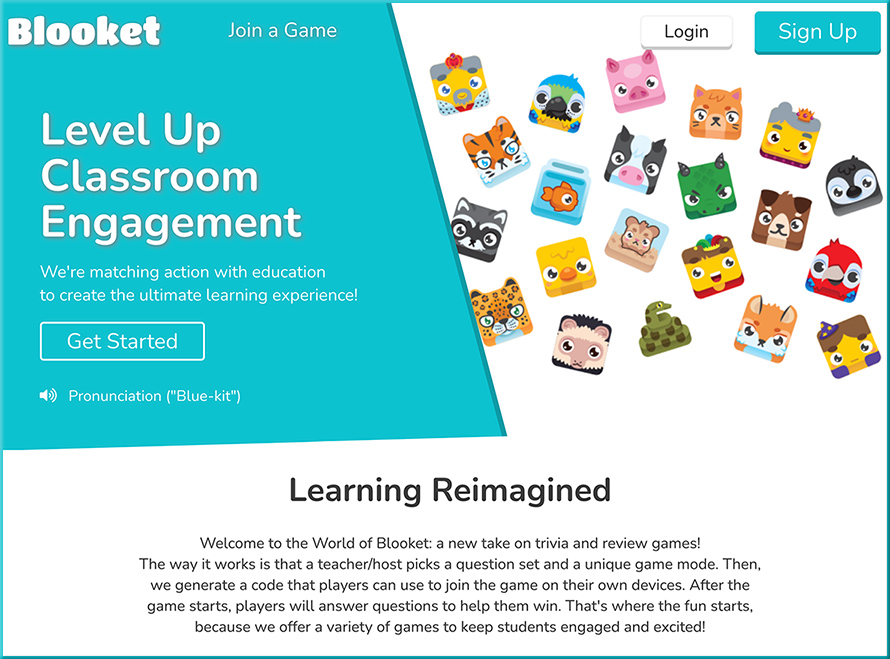
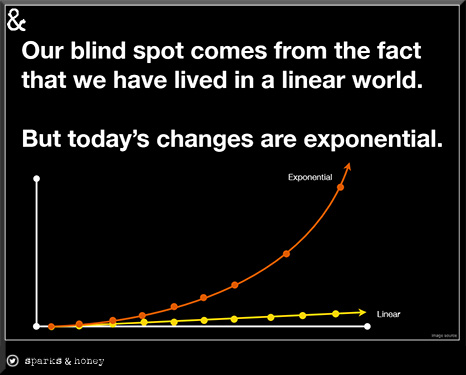
Allie Miller’s posting on LinkedIn (see below) pointed these things out as well — along with several other things.
This raises some ideas/questions for me:
Hmmm….interesting times ahead.
3D Scanner Lets You Capture The Real World In VR — from vrscout.com by Kyle Melnick
Excerpt:
VR is about to get a whole lot more real.
Imagine having the power to capture your real-world environment as a hyper-realistic 3D model from the palm of your hand. Well, wonder no more, as peel 3d, a developer of professional-grade 3D scanners, today announced the launch of peel 3 and peel 3.CAD, two new easy-to-use 3D scanners capable of generating high-quality 3D scans for a wide variety of digital mediums, including VR and augmented reality (AR).

NASA & Google Partner To Create An AR Solar System — from vrscout.com by Kyle Melnick

Excerpt:
[On 9/14/22], Google Arts & Culture announced that is has partnered with NASA to further extend its virtual offerings with a new online exhibit featuring a collection of new-and-improved 3D models of our universe brought to life using AR technology.
These 3D models are for more than just entertainment, however. The virtual solar system exhibit features historical annotations that, when selected, display valuable information. Earth’s moon, for example, features landing sites for Apollo 11 and China’s Chang’e-4.