From DSC:
I’m told by a reliable source (i.e., our oldest daughter, who is now a third-grade teacher) that Blooket is an effective, highly-engaging tool! She said students find these online-based games to be fun. She said it’s competitive, so you may want to make a note of that as well.
Introducing Q-Chat, the world’s first AI tutor built with OpenAI’s ChatGPT — from quizlet.com by Lex Bayer
Excerpt:
Modeled on research demonstrating that the most effective form of learning is one-on-one tutoring1, Q-Chat offers students the experience of interacting with a personal AI tutor in an effective and conversational way. Whether they’re learning French vocabulary or Roman History, Q-Chat engages students with adaptive questions based on relevant study materials delivered through a fun chat experience. Pulling from Quizlet’s massive educational content library and using the question-based Socratic method to promote active learning, Q-Chat has the ability to test a student’s knowledge of educational content, ask in-depth questions to get at underlying concepts, test reading comprehension, help students learn a language and encourage students on healthy learning habits.
DC: Perhaps we’ll get to a point where AI can help here. (Perhaps we’re already there…?) https://t.co/kRguHmXw42
— Daniel Christian (he/him/his) (@dchristian5) March 1, 2023
Speaking of AI-related items, also see:
OpenAI just released both Whisper and ChatGPT as APIs!
Among the 3 infinity stones to make voice assistants great again, we’ve got 2 on the cloud now.https://t.co/boAP0yOK9p https://t.co/rkWGu5wGbP
— Jim Fan (@DrJimFan) March 1, 2023
OpenAI debuts Whisper API for speech-to-text transcription and translation — from techcrunch.com by Kyle Wiggers
Excerpt:
To coincide with the rollout of the ChatGPT API, OpenAI today launched the Whisper API, a hosted version of the open source Whisper speech-to-text model that the company released in September.
Priced at $0.006 per minute, Whisper is an automatic speech recognition system that OpenAI claims enables “robust” transcription in multiple languages as well as translation from those languages into English. It takes files in a variety of formats, including M4A, MP3, MP4, MPEG, MPGA, WAV and WEBM.
Introducing ChatGPT and Whisper APIs — from openai.com
Developers can now integrate ChatGPT and Whisper models into their apps and products through our API.
Excerpt:
ChatGPT and Whisper models are now available on our API, giving developers access to cutting-edge language (not just chat!) and speech-to-text capabilities.
Love this! Assigning collaborative annotation can help students engage with texts and the writing process and help prevent ChatGPT misuse. We can also invite students to critically annotate ChatGPT outputs. #ChatGPTedu #AItextedu #AIED #socialannotation https://t.co/wh2OkrAvL7
— Anna Mills, amills@mastodon.oeru.org, she/her (@EnglishOER) February 28, 2023
Everything you wanted to know about AI – but were afraid to ask — from theguardian.com by Dan Milmo and Alex Hern
From chatbots to deepfakes, here is the lowdown on the current state of artificial intelligence
Excerpt:
Barely a day goes by without some new story about AI, or artificial intelligence. The excitement about it is palpable – the possibilities, some say, are endless. Fears about it are spreading fast, too.
There can be much assumed knowledge and understanding about AI, which can be bewildering for people who have not followed every twist and turn of the debate.
So, the Guardian’s technology editors, Dan Milmo and Alex Hern, are going back to basics – answering the questions that millions of readers may have been too afraid to ask.
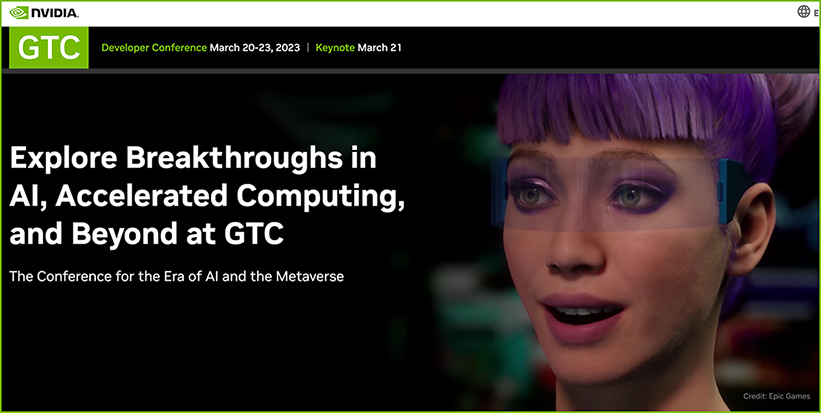
Nvidia CEO: “We’re going to accelerate AI by another million times” — from
In a recent earnings call, the boss of Nvidia Corporation, Jensen Huang, outlined his company’s achievements over the last 10 years and predicted what might be possible in the next decade.
Excerpt:
Fast forward to today, and CEO Jensen Huang is optimistic that the recent momentum in AI can be sustained into at least the next decade. During the company’s latest earnings call, he explained that Nvidia’s GPUs had boosted AI processing by a factor of one million in the last 10 years.
“Moore’s Law, in its best days, would have delivered 100x in a decade. By coming up with new processors, new systems, new interconnects, new frameworks and algorithms and working with data scientists, AI researchers on new models – across that entire span – we’ve made large language model processing a million times faster,” Huang said.
From DSC:
NVIDA is the inventor of the Graphics Processing Unit (GPU), which creates interactive graphics on laptops, workstations, mobile devices, notebooks, PCs, and more. They are a dominant supplier of artificial intelligence hardware and software.
ChatGPT sets record for fastest-growing user base – analyst note — from reuters.com by Krystal Hu
Excerpt (emphasis DSC):
Feb 1 (Reuters) – ChatGPT, the popular chatbot from OpenAI, is estimated to have reached 100 million monthly active users in January, just two months after launch, making it the fastest-growing consumer application in history, according to a UBS study on Wednesday.
The report, citing data from analytics firm Similarweb, said an average of about 13 million unique visitors had used ChatGPT per day in January, more than double the levels of December.
“In 20 years following the internet space, we cannot recall a faster ramp in a consumer internet app,” UBS analysts wrote in the note.
From DSC:
This reminds me of the current exponential pace of change that we are experiencing…

..and how we struggle with that kind of pace.

ChatGPT can’t be credited as an author, says world’s largest academic publisher — from theverge.com by James Vincent; with thanks to Robert Gibson on LinkedIn for the resource
But Springer Nature, which publishes thousands of scientific journals, says it has no problem with AI being used to help write research — as long as its use is properly disclosed.
Excerpt:
Springer Nature, the world’s largest academic publisher, has clarified its policies on the use of AI writing tools in scientific papers. The company announced this week that software like ChatGPT can’t be credited as an author in papers published in its thousands of journals. However, Springer says it has no problem with scientists using AI to help write or generate ideas for research, as long as this contribution is properly disclosed by the authors.
On somewhat-related notes:
Uplevel your prompt craft in ChatGPT with the CREATE framework — from edte.ch by Tom Barrett
Excerpt:
The acronym “CREATE” is a helpful guide for crafting high-quality prompts for AI tools. Each letter represents an important step in the process.
The first four CREA are all part of prompt writing, where TE, the final two are a cycle of reviewing and editing your prompts.
Let’s look at each in more detail, with some examples from ChatGPT to help.
BuzzFeed to Use ChatGPT Creator OpenAI to Help Create Quizzes and Other Content — from wsj.com by Alexandra Bruell (behind paywall)
CEO Jonah Peretti intends for artificial intelligence to play a larger role in the company this year
Closing the digital divide in Black America — from mckinsey.com
Five steps could help to bring broadband and digital equity to every Black household in the United States—urban and rural—while bolstering efforts to create a more inclusive economy.
Excerpt:
But broadband access is only part of a much bigger picture. Ensuring all Americans can fully participate in civic life and the digital economy requires affordable subscriptions, internet-enabled devices, applications, digital skills, and high-quality technical support. For example, while smartphone and tablet penetration are approximately equal among White, Black, and Hispanic and Latino adults in the United States, only 69 percent of Black Americans and 67 percent of Hispanic Americans have desktop or laptop computers, compared with 80 percent of White Americans (Exhibit 1).5 A 2020 OECD survey found that roughly half of Black workers had the advanced or proficient digital skills needed to thrive in our increasingly tech-driven economy, compared with 77 percent of White workers.6
A learning ecosystem is composed of people, tools, technologies, content, processes, culture, strategies, and any other resource that helps one learn. Learning ecosystems can be at an individual level as well as at an organizational level.
Some example components:
- Subject Matter Experts (SMEs) such as faculty, staff, teachers, trainers, parents, coaches, directors, and others
- Fellow employees
- L&D/Training professionals
- Managers
- Instructional Designers
- Librarians
- Consultants
- Types of learning
- Active learning
- Adult learning
- PreK-12 education
- Training/corporate learning
- Vocational learning
- Experiential learning
- Competency-based learning
- Self-directed learning (i.e., heutagogy)
- Mobile learning
- Online learning
- Face-to-face-based learning
- Hybrid/blended learning
- Hyflex-based learning
- Game-based learning
- XR-based learning (AR, MR, and VR)
- Informal learning
- Formal learning
- Lifelong learning
- Microlearning
- Personalized/customized learning
- Play-based learning
- Cloud-based learning apps
- Coaching & mentoring
- Peer feedback
- Job aids/performance tools and other on-demand content
- Websites
- Conferences
- Professional development
- Professional organizations
- Social networking
- Social media – Twitter, LinkedIn, Facebook/Meta, other
- Communities of practice
- Artificial Intelligence (AI) — including ChatGPT, learning agents, learner profiles,
- LMS/CMS/Learning Experience Platforms
- Tutorials
- Videos — including on YouTube, Vimeo, other
- Job-aids
- E-learning-based resources
- Books, digital textbooks, journals, and manuals
- Enterprise social networks/tools
- RSS feeds and blogging
- Podcasts/vodcasts
- Videoconferencing/audio-conferencing/virtual meetings
- Capturing and sharing content
- Tagging/rating/curating content
- Decision support tools
- Getting feedback
- Webinars
- In-person workshops
- Discussion boards/forums
- Chat/IM
- VOIP
- Online-based resources (periodicals, journals, magazines, newspapers, and others)
- Learning spaces
- Learning hubs
- Learning preferences
- Learning theories
- Microschools
- MOOCs
- Open courseware
- Portals
- Wikis
- Wikipedia
- Slideshare
- TED talks
- …and many more components.
These people, tools, technologies, etc. are constantly morphing — as well as coming and going in and out of our lives.
Top edtech trends in 2023 and the ASU example — from news.asu.edu
Excerpt:
In spite of our tendency to break things down into tidy time frames, like a new year or academic semester, change constantly turns over the status quo. Especially in the world of technology, where disruptive innovation may evolve rapidly from the fringe to the mainstream.
“At ASU’s Enterprise Technology, we work in spaces where technology is not just revolutionizing higher education, but the world at large,” said Lev Gonick, chief information officer at Arizona State University. “We strive to be proactive, not reactive, to new paradigms changing the ways in which we work, learn and thrive.”
As referenced by the above article:
- Technology Trends in Higher Education 2023 — from fierceeducation.com
Thus, the top higher education technology trends to watch out for in 2023 include Artificial Intelligence (AI), Virtual Reality (VR), Augmented Reality (AR), Digital Twins, the Metaverse (including digital avatars and NFT art for use in the Metaverse and other Web3-based virtual environments), Internet of Things (IoT), Blockchain, Cloud, Gamification, and Chatbots. These technologies will support the expansion of the Digital Transformation of higher education going forward.
Also relevant/see:
- Virtual Reality: Trends in Higher Ed for 2023 and Beyond — from fierceeducation.com by Susan Fourtané
14 Technology Predictions for Higher Education in 2023 — from campustechnology.com by Rhea Kelly
How will technologies and practices like artificial intelligence, predictive analytics, digital transformation, and change management impact colleges and universities this year? Here’s what the experts told us.
Excerpt:
In an open call on LinkedIn, we asked higher education and ed tech industry leaders to forecast the most important trends to watch in the coming year. Their responses reflect both the challenges on the horizon — persistent cyber attacks, the disruptive force of emerging technologies, failures in project management — as well as the opportunities that technology brings to better serve students and support the institutional mission. Here are 14 predictions to help steer your technology efforts in 2023.
Education is about to radically change: AI for the masses — from gettingsmart.com by Nate McClennen and Rachelle Dené Poth
Key Points:
- AI already does and will continue to impact education – along with every other sector.
- Innovative education leaders have an opportunity to build the foundation for the most personalized learning system we have ever seen.
Action
Education leaders need to consider these possible futures now. There is no doubt that K-12 and higher ed learners will be using these tools immediately. It is not a question of preventing “AI plagiarism” (if such a thing could exist), but a question of how to modify teaching to take advantage of these new tools.
From DSC:
They go on to list some solid ideas and experiments to try out — both for students and for teachers. Thanks Nate and Rachelle!
Also from Rachelle, see:
- How Can We Prepare K-12 Students for the Future? — from rdene915.com by Rachelle Dené Poth
From DSC:
A few items re: ChatGPT — with some items pro-chat and other items against the use of ChatGPT (or at least to limit its use).
How About We Put Learning at the Center? — from insidehighered.com by John Warner
The ongoing freak-out about ChatGPT sent me back to considering the fundamentals.
Excerpt:
So, when people express concern that students will use ChatGPT to complete their assignments, I understand the concern, but what I don’t understand is why this concern is so often channeled into discussions about how to police student behavior, rather than using this as an opportunity to exam the kind of work we actually ask students (and faculty) to do around learning.
If ChatGPT can do the things we ask students to do in order to demonstrate learning, it seems possible to me that those things should’ve been questioned a long time ago. It’s why I continue to believe this technology is an opportunity for reinvention, precisely because it is a threat to the status quo.
Top AI conference bans use of ChatGPT and AI language tools to write academic papers — from theverge.com by James Vincent; with thanks to Anna Mills for this resource
AI tools can be used to ‘edit’ and ‘polish’ authors’ work, say the conference organizers, but text ‘produced entirely’ by AI is not allowed. This raises the question: where do you draw the line between editing and writing?
Excerpt:
The International Conference on Machine Learning (ICML) announced the policy earlier this week, stating, “Papers that include text generated from a large-scale language model (LLM) such as ChatGPT are prohibited unless the produced text is presented as a part of the paper’s experimental analysis.” The news sparked widespread discussion on social media, with AI academics and researchers both defending and criticizing the policy. The conference’s organizers responded by publishing a longer statement explaining their thinking. (The ICML responded to requests from The Verge for comment by directing us to this same statement.)
I am protective of my organic writing process, but when it’s time to edit, ChatGPT sometimes helps me notice which sentences aren’t quite put together as they should be. When I ask it why it suggested a revision, it sometimes describes a word choice nuance I hadn’t thought of.
— Anna Mills, amills@mastodon.oeru.org, she/her (@EnglishOER) January 5, 2023
How to… use AI to teach some of the hardest skills — from oneusefulthing.substack.com by Ethan Mollick
When errors, inaccuracies, and inconsistencies are actually very useful
Excerpt:
Instead, I want to discuss the opportunity provided by AI, because it can help us teach in new ways. The very things that make AI scary for educators — its tedency to make up facts, its lack of nuance, and its ability to make excellent student essays — can be used to make education better.
This isn’t for some future theoretical version of AI. You can create assignments, right now, using ChatGPT, that we will help stretch students in knew ways. We wrote a paper with the instructions. You can read it here, but I also want to summarize our suggestions. These are obviously not the only ways to use AI to educate, but they solve some of the hardest problems in education, and you can start experimenting with them right now.
NYC education department blocks ChatGPT on school devices, networks — from ny.chalkbeat.org by Michael Elsen-Rooney
Excerpt:
New York City students and teachers can no longer access ChatGPT — the new artificial intelligence-powered chatbot that generates stunningly cogent and lifelike writing — on education department devices or internet networks, agency officials confirmed Tuesday.
Teachers v ChatGPT: Schools face new challenge in fight against plagiarism — from straitstimes.com by Osmond Chia; with thanks to Stephen Downes for this resource
Excerpt:
SINGAPORE – Teachers in Singapore say they will likely have to move from assignments requiring regurgitation to those that require greater critical thinking, to stay ahead in the fight against plagiarism.
This comes on the back of the rise of ChatGPT, an intelligent chatbot that is able to spin essays and solve mathematical equations in seconds.
ChatGPT Is Not Ready to Teach Geometry (Yet) — from educationnext.org by Paul T. von Hippel
The viral chatbot is often wrong, but never in doubt. Educators need to tread carefully.
Excerpt:
Can ChatGPT provide feedback and answer questions about math in a more tailored and natural way? The answer, for the time being, is no. Although ChatGPT can talk about math superficially, it doesn’t “understand” math with real depth. It cannot correct mathematical misconceptions, it often introduces misconceptions of its own; and it sometimes makes inexplicable mathematical errors that a basic spreadsheet or hand calculator wouldn’t make.
Here, I’ll show you.
Addendum on 1/9/23:
9 ways ChatGPT saves me hours of work every day, and why you’ll never outcompete those who use AI effectively. — from .linkedin.com by Santiago Valdarrama
A list for those who write code:
- 1. Explaining code…
- Improve existing code…
- Rewriting code using the correct style…
- Rewriting code using idiomatic constructs…
- Simplifying code…
- Writing test cases…
- Exploring alternatives…
- Writing documentation…
- Tracking down bugs…
From DSC:
Check out the items below. As with most technologies, there are likely going to be plusses & minuses regarding the use of AI in digital video, communications, arts, and music.
DC: What?!? Wow. I should have seen this coming. I can see positives & negatives here. Virtual meetings could become a bit more creative/fun. But apps could be a bit scarier in some instances, such as with #telelegal.
xpression camera https://t.co/ygM1OUOGxd via @YouTube
— Daniel Christian (he/him/his) (@dchristian5) January 4, 2023
Also see:
Some more experimentation with #stablediffusion Driving video (https://t.co/6xzS1OvVUw) pic.twitter.com/QolpfASg4u
— Carlos E. Perez (@IntuitMachine) January 4, 2023
Also somewhat relevant, see:
GoogleAI just released “Muse”, a text-to-image generation/editing model via Masked Generative Transformers:
– Achieves new SOTA
– Zero-shot, Mask-free editing
– Zero-shot Inpainting/Outpainting
– 900M params? Paper: https://t.co/dYxscoaSku
?? Project: https://t.co/aIdEQuG8B0 pic.twitter.com/uTbSrlzZYF— Lior? (@AlphaSignalAI) January 3, 2023
Here are 6 companies that are currently defining the future of [AI-based] content creation [Bardeen]
In 2023, we are going to a huge increase in content creation generated by AI avatars. The use cases the infinite – from demos and tutorials to billboards and even ads.
? Here are 6 companies that are currently defining the future of content creation:
— Bardeen (@bardeenai) December 30, 2022
What’s next for AI — from technologyreview.com by Melissa Heikkilä and Will Douglas Heaven
Get a head start with our four big bets for 2023.
Excerpts:
But take the conversational skills of ChatGPT and mix them up with image manipulation in a single model and you’d get something a lot more general-purpose and powerful. Imagine being able to ask a chatbot what’s in an image, or asking it to generate an image, and have these interactions be part of a conversation so that you can refine the results more naturally than is possible with DALL-E.
10 AI Predictions For 2023 — from forbes.com by Rob Toews
Excerpts (emphasis DSC):
- GPT-4 will be released in the next couple months—and yes, it will be a big deal.
- We are going to start running out of data to train large language models.
- For the first time, some members of the general public will begin using fully driverless cars as their day-to-day mode of transportation.
- Midjourney will raise venture capital funding.
- Search will change more in 2023 than it has since Google went mainstream in the early 2000s.
AI Trends For 2023: Industry Experts (And ChatGPT AI) Make Their Predictions — from forbes.com by Ganes Kesari
Excerpt:
To understand the top AI trends, I asked industry leaders and academic experts five questions. It’s the age of human-machine collaboration, so what better way to demonstrate this than by asking AI software about the 2023 AI trends it’s excited about? I did that too.
…
-
- What do you think was the biggest achievement in the AI space in 2022?
- What’s the most exciting AI trend that you look forward to materializing in 2023?
- What’s a fad in this space that you wish would go away next year?
- To get value from AI, what’s one thing that leaders can start doing today that doesn’t take big effort or money?
- What’s one thing that leaders should stop doing immediately to realize benefits from AI?
Is A.I. the Future of Test Prep? — from nytimes.com by Craig S. Smith (NOTE: Paywall)
Excerpt:
Riiid is one of a handful of companies that believe that A.I.’s algorithms are perfectly suited to track student performance and give individualized attention.
“Education is a complex field deeply related to cognition, motivation, peer interaction, etc.,” Mr. Jang wrote in an email. “We draw insights from learning science, cognitive biology, data science, and other related areas of research for an iterative experimentation process that is challenging and time consuming — that’s why there are only a few players in the market.”
Artificial intelligence predictions 2023 — from information-age.com by Tim Adler
2023 could be the year that artificial intelligence moves from the fringes into the mainstream, as AI becomes widely adopted by healthcare, travel and banking. Five experts give their predictions
Excerpt:
Worldwide spending on artificial intelligence will hit half a billion dollars this year, according to IDC. Five artificial intelligence experts give Information Age their predictions as to how adoption of AI will accelerate in 2023.
.
The AI explosion is warping our sense of time. Can you believe Stable Diffusion is only 4 months old, and ChatGPT <4 weeks old ?? If you blink, you miss a whole new industry. Here are my TOP 10 AI spotlights, from a breathtaking 2022 in rewind ?: a long thread ? pic.twitter.com/5k8Q6VQ0tD
— Jim Fan (@DrJimFan) December 27, 2022
ChatGPT and The Professional’s Guide to Using AI — from linkedin.com by Allie K. Miller
Excerpt:
Real Ways Professionals Can Use ChatGPT to Improve Job Performance
Let’s dive into some real examples of how professionals across sales, marketing, product management, project management, recruiting, and teaching can take advantage of this new tool and leverage it for even more impact in their careers.
Teachers and ChatGPT
- Help with grading and feedback on student work.
Example prompt: “Tell me every grammar rule that’s been violated in this student’s essay: [paste in essay]” - Create personalized learning materials.
Example prompt: “Help me explain photosynthesis to a 10th grade student in a way similar to sports.” - Generate lesson plans and activities.
Example prompt: “Create an activity for 50 students that revolves around how to learn the different colors of the rainbow.” or “Generate a lesson plan for a high school English class on the theme of identity and self-discovery, suitable for a 45-minute class period.” - Write fake essays several reading levels below your class, then print them out, and have your students review and edit the AI’s work to make it better.
Example prompt: “Generate a 5th grade level short essay about Maya Angelou and her work.” - Providing one-on-one support to students.
Example prompt: “How can I best empower an introverted student in my classroom during reading time?”
From DSC:
I haven’t tried these prompts. Rather I post this because I’m excited about the potential of Artificial Intelligence (AI) to help people teach and to help people to learn.