Higher Education in Motion: The Digital and Cultural Transformations Ahead — from er.educause.edu by John O’Brien
Excerpts (emphasis DSC):

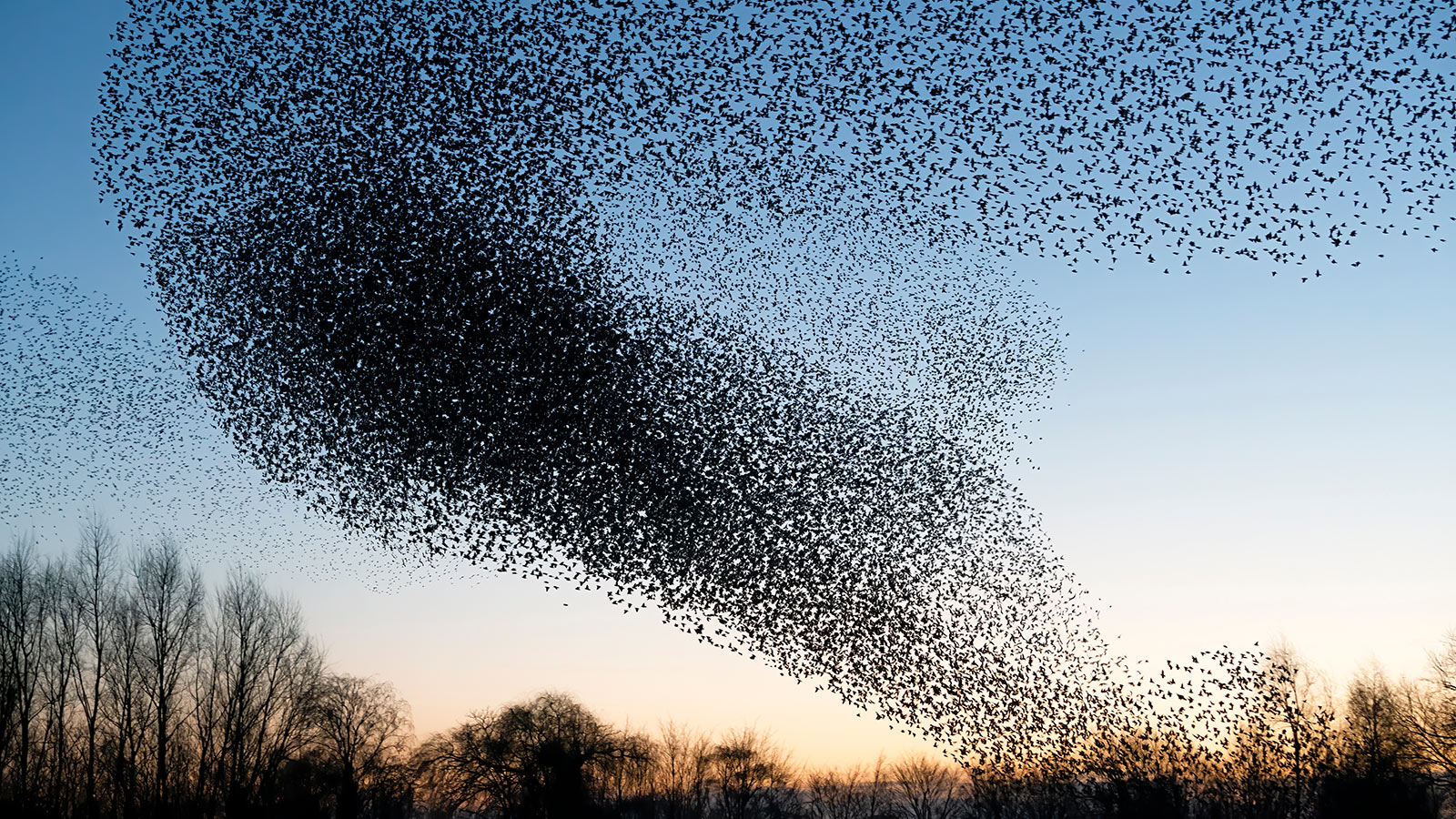
In 2015 when Janet Napolitano, then president of the University of California, responded to what she saw as a steadily growing “chorus of doom” predicting the demise of higher education, she did so with a turn of phrase that captured my imagination and still does. She said that higher education is not in crisis. “Instead, it is in motion, and it always has been.”

A brief insert by DSC:
Yes. In other words, it’s a learning ecosystem — with constant morphing & changing going on.

“We insisted then, and we continue to insist now, that digital transformation amounts to deep and coordinated change that substantially reshapes the operations, strategic directions, and value propositions of colleges and universities and that this change is enabled by culture, workforce, and technology shifts.

The tidal movement to digital transformation is linked to a demonstrably broader recognition of the strategic role and value of technology professionals and leaders on campus, another area of long-standing EDUCAUSE advocacy. For longer than we have talked about digital transformation, we have insisted that technology must be understood as a strategic asset, not a utility, and that senior IT leaders must be part of the campus strategic decision-making. But the idea of a strategic role for technology had disappointing traction among senior campus leaders before 2020.

From DSC:
The Presidents, Provosts, CIO’s, board members, influential faculty members, and other members of institutions’ key leadership positions who didn’t move powerfully forward with online-based learning over the last two+ decades missed the biggest thing to hit societies’ ability to learn in 500+ years — the Internet. Not since the invention of the printing press has learning had such an incredible gust of wind put in its sails. The affordances have been staggering, with millions of people now being educated in much less expensive ways (MOOCs, YouTube, LinkedIn Learning, other). Those who didn’t move forward with online-based learning in the past are currently scrambling to even survive. We’ll see how many close their doors as the number of effective alternatives increases.

Instead of functioning as a one-time fix during the pandemic, technology has become ubiquitous and relied upon to an ever-increasing degree across campus and across the student experience.

Moving forward, best of luck to those organizations who don’t have their CIOs at the decision-making table and reporting directly to the Presidents — and hopefully those CIO’s are innovative and visionary to begin with. Best of luck to those institutions who refuse to look up and around to see that the world has significantly changed from the time they got their degrees.

The current mix of new realities creates an opportunity for an evolution and, ideally, a synchronized reimagination of higher education overall. This will be driven by technology innovation and technology professionals—and will be made even more enduring by a campus culture of care for students, faculty, and staff.

Time will tell if the current cultures within many traditional institutions of higher education will allow them to adapt/change…or not.


Along the lines of transformations in our learning ecosystems, also see:


OPINION: Let’s use the pandemic as a dress-rehearsal for much-needed digital transformation — from hechingerreport.org by Jean-Claude Brizard
Schools must get ready for the next disruption and make high-quality learning available to all

Excerpts:

We should use this moment to catalyze a digital transformation of education that will prepare schools for our uncertain future.

What should come next is an examination of how schools can more deeply and deliberately harness technology to make high-quality learning accessible to every learner, even in the wake of a crisis. That means a digital transformation, with three key levers for change: in the classroom, in schools and at the systems level.

Platforms like these help improve student outcomes by enhancing teachers’ ability to meet individual students’ needs. They also allow learners to master new skills at their own pace, in their own way.

As Digital Transformation in Schools Continues, the Need for Enterprising IT Leaders Grows — from edtechmagazine.com by Ryan Petersen

K-12 IT leaders move beyond silos to make a meaningful impact inside and outside their schools.According to Korn Ferry’s research on enterprise leadership, “Enterprise leaders envision and grow; scale and create. They go beyond by going across the enterprise, optimizing the whole organization and its entire ecosystem by leading outside what they can control. These are leaders who see their role as being a participant in diverse and dynamic communities.”




If We’re Serious About Student Well-Being, We Must Change the Systems Students Learn In — from highereddive.com by Tim Klein and Belle Liang
Here are five steps high schools can take to support students’ mental health.

Excerpt:

The truth is, the best school systems in the world succeed without homework, standardized test scores or an obsession with rigorous courses. And many U.S. schools have found creative and empowering ways to showcase student merit beyond rankings and test scores.

If we aren’t willing to change policies and practices that have been shown to harm students’ well-being, we have to ask ourselves: Do we really value mental health?

Thankfully, it doesn’t have to be an either/or scenario: We can design school systems that help students thrive academically and psychologically.


Disabled Americans Reap Remote-Work Reward in Record Employment — from bloomberg.com by Molly Smith
Adults with disabilities have rarely been employed in such high numbers

Excerpt:

Anardi is part of the second-largest minority group in the US — adults with disabilities. The 42.5 million disabled Americans make up 13% of the civilian population, compared with the nearly 19% that is Hispanic and the almost 12% that’s African American, according to 2021 Census data released on Sept. 15. After suffering some of the worst job losses during the initial phase of the pandemic, people with disabilities are now benefiting from the remote-work trend it triggered. Advocates hope they will continue to reap such rewards, even as companies demand that employees return to the office.


California Moves Forward to Allow Vital Records to be Issued on Blockchain — from coindesk.com by Jesse Hamilton
Governor Gavin Newsom signed a law [last] week that establishes a blockchain option for delivering individuals’ records, such as birth and marriage certificates


Speaking of blockchain, these next two resources comes from Roberto Ferraro’s weekly enewsletter:

Blockchain 101 – A Visual Demo — from andersbrownworth.com

Blockchain 101 – Part 2 – Public / Private Keys and Signing


This Uncensored AI Art Tool Can Generate Fantasies—and Nightmares — from wired.com by Will Knight
Open source project Stable Diffusion allows anyone to conjure images with algorithms, but some fear it will be used to create unethical horrors.

Excerpt:

Image generators like Stable Diffusion can create what look like real photographs or hand-crafted illustrations depicting just about anything a person can imagine. This is possible thanks to algorithms that learn to associate the properties of a vast collection of images taken from the web and image databases with their associated text labels. Algorithms learn to render new images to match a text prompt in a process that involves adding and removing random noise to an image.

Also relevant/see:

There’s a text-to-image AI art app for Mac now—and it will change everything — from fastcompany.com by Jesus Diaz
Diffusion Bee harnesses the power of the open source text-to-image AI Stable Diffusion, turning it into a one-click Mac App. Brace yourself for a new creativity Big Bang.


Speaking of AI, also see:


Nurses to trial VR to free up time with patients — from inavateonthenet.net

Excerpt:

UK nurses are set to trial “virtual reality style” goggles to free up time with patients in home visits, transcribing appointments in real time and sharing footage for second opinions.

Nurses from the Northern Lincolnshire and Goole NHS Foundation Trust will trial the technology and be able to transcribe appointment notes directly to electronic records. This will allow nurses to cut down on administrative paperwork and free up more time for home visits.

From DSC:
I wonder if AR will be used in applications like these in the near future…?


Radar Trends to Watch: August 2022 — from oreilly.com by Mike Loukides
Developments in Security, Quantum Computing, Energy, and More

Excerpt:

The large model train keeps rolling on. This month, we’ve seen the release of Bloom, an open, large language model developed by the BigScience collaboration, the first public access to DALL-E (along with a guide to prompt engineering), a Copilot-like model for generating regular expressions from English-language prompts, and Simon Willison’s experiments using GPT-3 to explain JavaScript code.

On other fronts, NIST has released the first proposed standard for post-quantum cryptography (i.e., cryptography that can’t be broken by quantum computers). CRISPR has been used in human trials to re-engineer a patient’s DNA to reduce cholesterol. And a surprising number of cities are paying high tech remote workers to move there.


25 Best Parks In The United States — from htownbest.com by Anna Smith; with thanks to Apple Smith for this resource

Excerpt:

There’s something about national parks that make you feel so in touch with nature. It’s also a fantastic place to bond and spend time with friends and family over fun activities like hiking, swimming, fishing, and biking.

In this article, we listed down the best parks you can find in the country along with helpful descriptions to help you find the best ones for your needs and preferences.

This guide is for couples looking for a grand adventure, families that are looking for a fun vacation, hikers in search of their next trail, and just anyone who’s curious and wants to know more about the top national parks you can find here in the United States.


Bryce Canyon National Park; Image from: Utah National Park Trips Image from: Utah National Park Trips
 

Why Infosys’s cofounder Nilekani is urging leaders to use tech for good

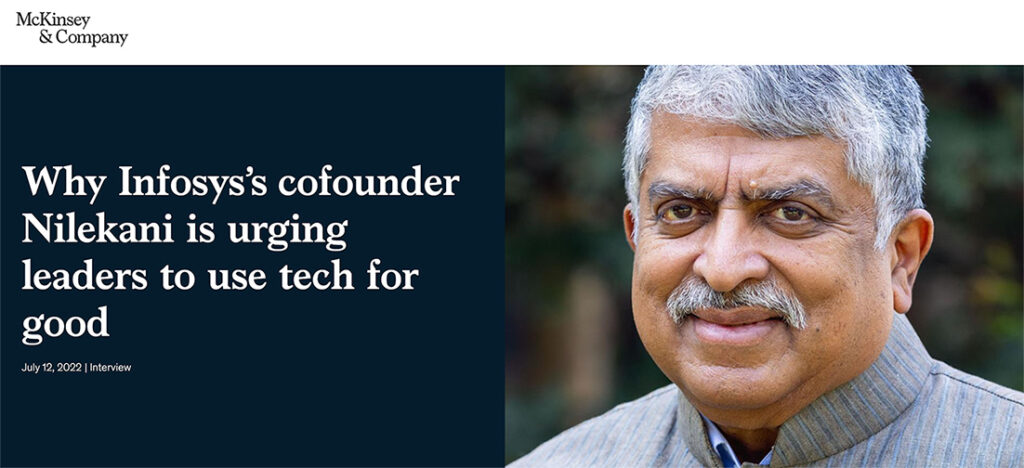
Why Infosys’s cofounder Nilekani is urging leaders to use tech for good  — from mckinsey.com by Gautam Kumra
The cofounder of the multinational IT company believes Indian start-ups will soon develop technologies to transform education, healthcare, and other social challenges.

Excerpts:

McKinsey: The world has also become a more complex place, with recent geopolitics, inflation complexity, rocketing energy prices, excessive liquidity, and digitization challenges. How do you personally keep adapting and learning?

Nandan Nilekani: In the last 40 years, I think we have gone through every transition: mainframes to minicomputers to LANs [local area networks] to internet to smartphones to AI. It has been fun understanding and riding these waves.

In my view, if a billion people can use something, then that’s a benefit. A billion people can learn using technology. A billion people can get better healthcare using technology. A billion people can move around and change jobs using technology.

From DSC:
I hope I can meet Nandan Nilekani someday. I feel that he is a kindred spirit. Several things that he said really resonated with me.


Ways that artificial intelligence is revolutionizing education — from thetechedvocate.org by Matthew Lynch

Excerpt:

I was speaking with an aging schoolteacher who believes that AI is destroying education. They challenged me to come up with 26 ways that artificial intelligence (AI) is improving education, and instead, I came up with. They’re right here.


AI Startup Speeds Healthcare Innovations To Save Lives — from by Geri Stengel

Excerpt:

This project was a light-bulb moment for her. The financial industry had Bloomberg to analyze content and data to help investors uncover opportunities and minimize risk, and pharmaceutical, biotech, and medical device companies needed something similar.


Just Because You Can Doesn’t Mean You Should: What Genetic Engineers Can Learn From ‘Jurassic World’ — from singularityhub.com by Andrew Maynard

Excerpt:

Maybe this is the abiding message of Jurassic World: Dominion—that despite incredible advances in genetic design and engineering, things can and will go wrong if we don’t embrace the development and use of the technology in socially responsible ways.

The good news is that we still have time to close the gap between “could” and “should” in how scientists redesign and reengineer genetic code. But as Jurassic World: Dominion reminds moviegoers, the future is often closer than it might appear.


‘Hologram patients’ and mixed reality headsets help train UK medical students in world first — from uk.news.yahoo.com

Excerpts:

Medical students in Cambridge, England are experiencing a new way of “hands-on learning” – featuring the use of holographic patients.

Through a mixed reality training system called HoloScenarios, students at Addenbrooke’s Hospital, part of the Cambridge University Hospitals NHS Foundation Trust, are now being trained via immersive holographic patient scenarios in a world first.

The new technology is aimed at providing a more affordable alternative to traditional immersive medical simulation training involving patient actors, which can demand a lot of resources.

Developers also hope the technology will help improve access to medical training worldwide.

 
© 2025 | Daniel Christian