Blackboard Partners with IBM and Amazon Web Services (AWS) – North America Customer Announcement

Date Published: Jun 27,2016
Product: Collaborate, ANGEL, Learn, CE/Vista, Xythos, Moodlerooms, Analytics, Open Content
Article No.: 000042385

Announcement Details:
We are excited to share some news with you about Blackboard’s new partnership with IBM and Amazon Web Services (AWS) which will have far-reaching and lasting impacts for the education technology industry.  This communication will provide details on how this will benefit our customers and other business partners.

This partnership will enable us to accelerate our focus on developing innovative educational products and services that serve the needs of our customers. And it will open the door for us to develop novel solutions benefiting the education ecosystem.  There are two parts to this partnership that will benefit you:

Selection of AWS as our strategic cloud platform and partnership with IBM for operations and infrastructure management

We will partner with IBM in the operations and infrastructure management of Blackboard’s data centers.  We have also selected AWS as our cloud services provider and entered into an agreement with IBM to manage our cloud services environments. This partnership will enable Blackboard to focus on what we do best – developing innovative educational products and services – while relying on the world-class data hosting and operational capabilities of IBM and AWS.

This partnership does not affect our Transact customers.

This partnership offers customers many benefits. It will enable us to accelerate our focus on developing innovative educational products and services that serve the needs of our customers. Furthermore, we will leverage IBM’s experience, scale, and tools with the goal of  delivering the highest quality of service possible to our customers. This includes stringent service level agreements intended to ensure that Blackboard customers receive the most reliable and resilient hosting services available in the marketplace.  In addition, this partnership allows for enhanced technical, organizational and physical security measures to safeguard Blackboard customer data.  We will also leverage the power of the AWS ecosystem to accelerate product development and deployment; further improving customer experience in the future.

Our relationship with Amazon and IBM is integrated. There are no gaps in accountability for delivering reliable services to our clients.  And its backed by a comprehensive and robust set of service level commitments to deliver highly available and responsive services for you.

Exclusive partnership to co-develop cognitive education solutions utilizing Watson

Blackboard and IBM have entered into an exclusive agreement to develop cognitive educational solutions for the K-12 and higher education markets.  The partnership will combine Blackboard’s expertise in developing innovative education products in use by millions around the world, with the power of IBM Watson’s cognitive computing technology to create exclusive solutions to address some of the most pressing problems in education.

IBM Watson is a technology platform that uses natural language processing and machine learning to reveal insights from large amounts of unstructured data. In short, it can help to ‘hyper personalize’ the educational experience.

To sum it up, we’re tremendously excited about partnering with IBM and Amazon to deliver extraordinary capability to our customers. And we’re excited by what’s on the horizon for Blackboard and our customers as we continue to focus on delivering innovative products that address some of the most pressing challenges in education.

To learn more about our partnership, check out our press release on Blackboard.com. We’ll also provide further details in the weeks ahead through webinars and at BbWorld.


Frequently Asked Questions (FAQs)


1.  Why did Blackboard select IBM and AWS as their partners?
We spent considerable time selecting our partners, and we’re confident in what both IBM and Amazon will deliver for our customers. IBM is one of the world’s top infrastructure management organizations, and is uniquely positioned because of its experience and work in the education space. AWS is the clear leader in cloud services, with the largest global cloud infrastructure footprint, the most well-developed ecosystem, tremendous momentum and rate of innovation.Both companies share our values and dedication to maintaining the privacy of customer data, and both have invested heavily in world-class security programs to keep your data safe in accordance with global standards and regulations.

2.  Will the partnership extend to infrastructure provision and management for Blackboard’s Transact customers?
No.  Transact will continue to operate as today with no changes.

3.  How can I learn more about this partnership between Blackboard and IBM and the benefits to me?
In order to provide you with an opportunity to ask questions and learn more about this partnership and how it will benefit you, we have planned for several sessions at BbWorld, and have scheduled a series of customer webinars.  BbWorld is scheduled for July 12-14 and the webinars will be scheduled  in July and August.

4.  Will this change in responsibility affect who I call if I have a question or issue?
No.  Your support will continue to be handled by the same Blackboard team that exists today.

5.  Will I see any changes as a result of the partnership?  Yes.  We expect that you will see operational improvements starting in the 3-6 month timeframe.  These include improved system availability and accelerated response time to issues.

6.  What does this mean for Security and Privacy?
IBM and AWS share our focus on providing highly secure environments and experiences. This partnership will provide an enhanced data security program and robust technical, organizational and physical security measures to protect customer data, including student data.  Further, our agreement with IBM and AWS contains detailed provisions intended to safeguard data in North American markets in specific consideration of applicable privacy laws and regulations.   These provisions include geographic restrictions on the location and transfer of customer data, and encryption standards, to comply with applicable law.

7.  Does this partnership mean that I will need to move out of my existing Learn hosted environment?
No.  While in time many customers are planning to transition their Learn deployment to our cloud environment, customers who are currently running Learn 9.1 in our managed hosting datacenters will not be required to move.

8.  What about other Blackboard applications besides Learn?
Many other Blackboard applications are already delivered in a software-as-a-service model using Blackboard-managed datacenters. Over the coming years, IBM and Blackboard will work together to move these applications from Blackboard datacenters to AWS. Any migration plan will be developed in full consideration of giving customers an uninterrupted service and user experience.

9.  What about the current SaaS deployment for Blackboard Learn?
There is no impact.  Learn SaaS already runs on AWS.

10.  What is IBM Watson?
IBM Watson is a technology platform that uses natural language processing and machine learning to reveal insights from large amounts of unstructured data. In short, it can help to ‘hyper personalize’ the educational experience.

Watson gained a level of fame in 2011 when the team put their technology up against two of Jeopardy’s greatest champions in the history of the game. It was an exciting two-day match that resulted in Watson beating out the competition – not just from right answers, but also from using the right strategy for wagers to win the game.

See how Watson beat the Jeopardy leaders in this short video.

How does Watson work? Watch this educational video.

11.  Are there any definitive plans for the cognitive education solutions developed with Watson that I need to plan for at my institution?
We are in the early stages of this relationship. Blackboard and the Watson Education team are starting the process of scoping out the solutions that will bring the most value to K-12 and higher education.  We plan to communicate our progress and solicit your input as we move forward.

12.  What if I have more questions about this partnership?
There are three ways you can get answers to your questions:

  • Attend one of the multiple sessions planned for BbWorld.
  • Attend one of the online webinars will be schedule in the coming weeks.
  • Contact your Account Executive or Customer Success Advocate.


Addendum on 6/29/16:

  • Blackboard Inc. and IBM Enter Strategic Relationship to Develop Cognitive Solutions and Manage Infrastructure Operations
    Excerpt:
    IBM and Blackboard will work collaboratively to develop cognitive educational solutions utilizing the capabilities of both companies to advance learner success. The companies will combine Blackboard’s expertise in developing innovative education products used by millions of people around the world with the power of IBM Watson’s cognitive computing technology. The new solutions will offer greater support for teachers and students to address their collaborative needs in the classroom and help students complete and achieve their educational goals.


Amazon unveils online education service for teachers — from nytimes.com by Natasha Singer

Excerpt:

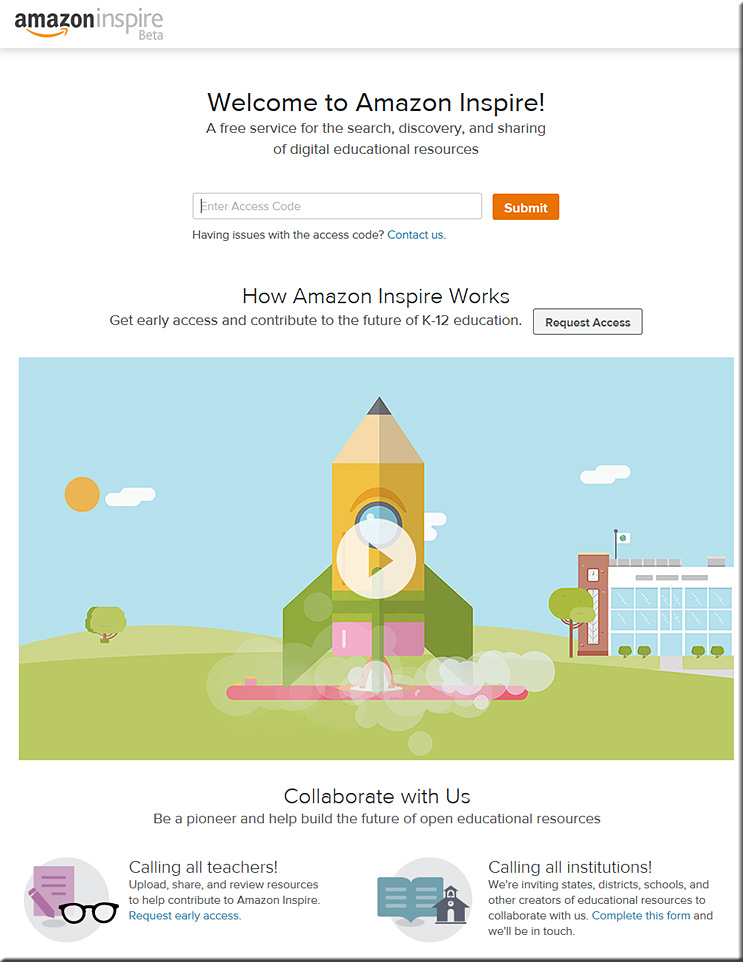
Just ahead of the back-to-school season, Amazon is making a major foray into the education technology market for primary and secondary schools, a territory that Apple, Google and Microsoft have heavily staked out.

On Monday morning, Amazon said that it would introduce an online marketplace with tens of thousands of free lesson plans, worksheets and other instructional materials for teachers in late August or early September.

Called Amazon Inspire, the education site has features that may seem quite familiar to frequent Amazon shoppers. Search bar at the top of the page? Check. User reviews? Check. Star ratings for each product? Check.


AmazonInspire-6-27-16


What the bot revolution could mean for online learning — from huffingtonpost.com by Daily Bits Of

Excerpt:

We’re embracing the bot revolution
With these limitations in mind, we embrace the bot movement. In short, having our bite-sized courses delivered via messaging platforms will open up a lot of new benefits for our users.

  1. The courses will become social.
  2. It will become easier to consume a course via a channel that fits best for the course.
  3. The courses will become more interactive.
  4. Bots will remove some of the friction


The future of online learning will happen via messaging services.


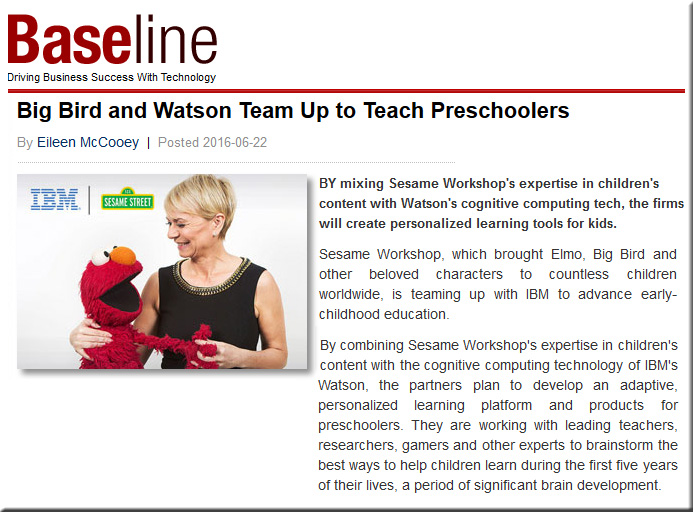
Also relevant here:


WatsonTrainPreSchoolers-June2016


From DSC:
By posting such items, I’m not advocating that we remove teachers, professors, trainers, coaches, etc. from the education/training equations.  Rather, I am advocating that we use technology as tools for educating and training people — and using technologies to help people of all ages grow, and reinvent themselves when necessary.  Such tools should be used to help our overworked teachers, professors, trainers, etc. of the world in delivering excellent, effective elearning experiences for our students/employees.


UX to LX: The Rise of Learner Experience Design — from edsurge.com by Whitney Kilgore

Excerpt:

Instructional design is now approaching a similar transition. Most student consumers have yet to experience great learning design, but the commoditization of online learning is forcing colleges and universities to think differently about how they construct digital courses. Courseware is enabling the development of new modalities and pedagogical shifts. An abundance of data now enables instructional designers to decode learning patterns. As a result, we are witnessing the growth of a new field: Learner Experience Design.

Parse higher-education job postings and descriptions, and it’s evident that LX design is, as a discipline, among the fastest growing fields in education. But what exactly makes for great learning design, and how can instructional designers ensure they remain competitive in this new era of student-centric education?
…
The transition to digital content has made entirely new layers of student data available. Learners now leave a digital footprint that allows designers to understand how students are interacting with course materials and for how long. LX designers can develop course pathways that connect student challenges to specific sections of content. For the first time, faculty have insights into time on task—before, during and after class. Ready access to student behavior data is helping institutions develop powerful predictive analytics, and LX designers are leading the field to make more and better informed choices on content delivery to help students better understand the critical concepts.

The groundswell of data and learning technology shows no sign of slowing down, and a LX designer’s job will grow more complex alongside it. Learner experience designers must rise to the challenge, so universities can deliver online courses that captivate and resonate with each unique student.


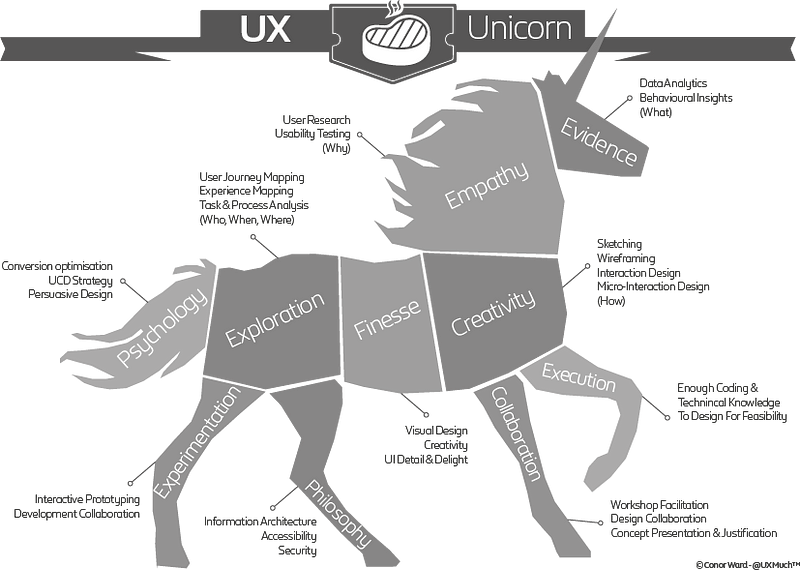
Ten skills you need to be a UX unicorn — from medium.com by Conor Ward

Excerpt:

So if the discipline of UX is not about improving how things LOOK, but instead how they WORK, then of course UX Design includes a multitude of varied deep specialisms and expertise. How could it not?

Well, thats where the mythical part of this discussion comes in, many UX designers out there still believe very strongly (and for good reason) that this multi skilled ‘specialist-generalist’ cannot exist.

They could well be correct in their current circumstances. For example if their company does not work like this, then how could they? Especially if their company is an agency, and their access to users is limited or non-existent.

My own experience is that we must strive towards unicorn-ism. I have created and curated a fantastic team of UX Unicorns (yes a group of unicorns is called a blessing, Google says so) and more importantly together with my colleagues and bosses we have created the environment for them to survive and thrive.


From DSC:
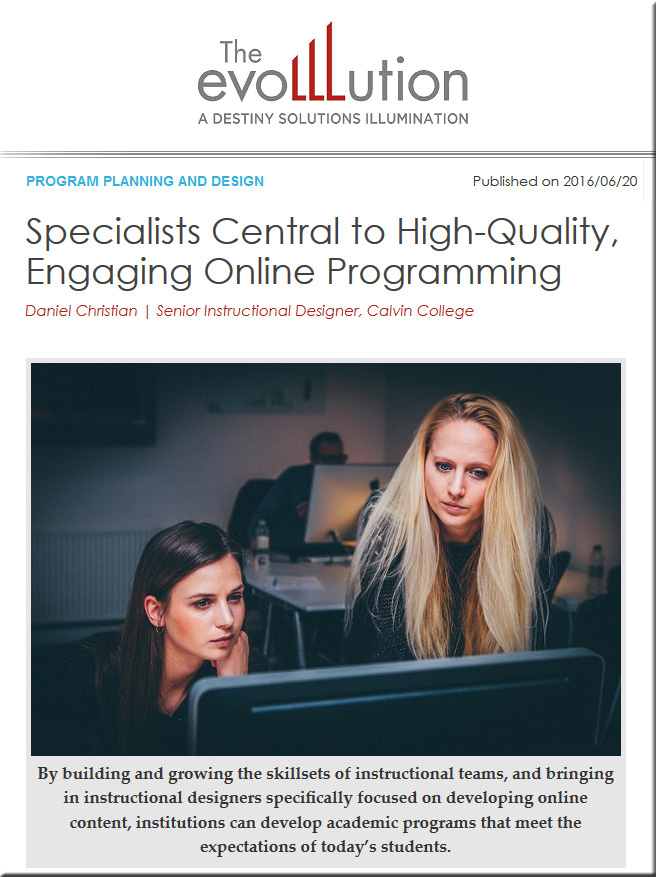
The above two articles get at a piece of what I was trying to relay out at The EvoLLLution.com. And that is, the growing complexities of putting digitally-based materials online — with a high degree of engagement, professionalism, and quality — require the use of specialists.  One person simply can’t do it all anymore. In fact, User Experience Designers and Learner Experience Designers are but a couple of the potential players at the table.


Specialists central to high-quality, engaging online programming [Christian]

DanielChristian-TheEvoLLLution-TeamsSpecialists-6-20-16


Specialists central to high-quality, engaging online programming — from EvoLLLution.com (where the LLL stands for lifelong learning) by Daniel Christian

Excerpts:

Creating high-quality online courses is getting increasingly complex—requiring an ever-growing set of skills. Faculty members can’t do it all, nor can instructional designers, nor can anyone else.  As time goes by, new entrants and alternatives to traditional institutions of higher education will likely continue to appear on the higher education landscape—the ability to compete will be key.

…

For example, will there be a need for the following team members in your not-too-distant future?

  • Human Computer Interaction (HCI) Specialists: those with knowledge of how to leverage Virtual Reality (VR), Augmented Reality (AR), and Mixed Reality (MR) in order to create fun and engaging learning experiences (while still meeting the learning objectives)
  • Data Scientists
  • Artificial Intelligence Integrators
  • Cognitive Computing Specialists
  • Intelligent Tutoring Developers
  • Learning Agent Developers
  • Algorithm Developers
  • Personalized Learning Specialists
  • Cloud-based Learner Profile Administrators
  • Transmedia Designers
  • Social Learning Experts


From DSC:
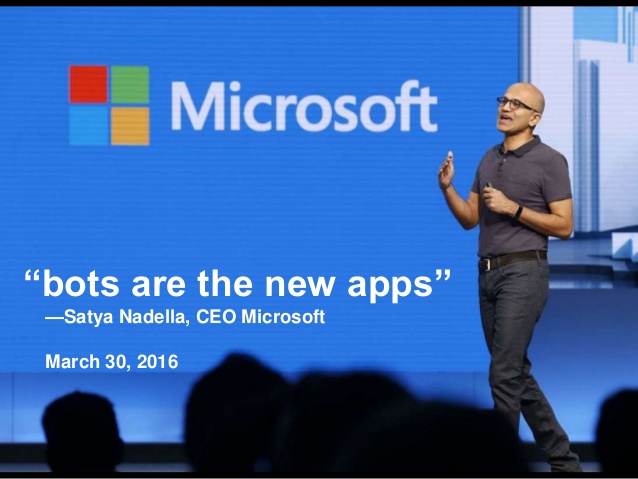
If the future of TV is apps > and if bots are the new apps > does that mean that the future of TV is bots…?


SAN FRANCISCO, CA - SEPTEMBER 9: Apple CEO Tim Cook introduces the New Apple TV during a Special Event at Bill Graham Civic Auditorium September 9, 2015 in San Francisco, California. Apple Inc. is expected to unveil latest iterations of its smart phone, forecasted to be the 6S and 6S Plus. The tech giant is also rumored to be planning to announce an update to its Apple TV set-top box. (Photo by Stephen Lam/ Getty Images)


bots-are-loving-you-9-638


chatbots-wharton-june2016

The rise of the chatbots: Is it time to embrace them? — from knowledge.wharton.upenn.edu

Excerpt:

The tech world is all agog these days about chatbots. These are automated computer programs that simulate online conversations with people to answer questions or perform tasks. While chatbots have been around in various rudimentary forms for years — think of Clippy, Microsoft’s paper clip virtual assistant — they have been taking off lately as advances in machine learning and artificial intelligence make them more versatile than ever. Among the most well-known chatbots: Apple’s Siri.

In rapid succession over the past few months, Microsoft, Facebook and Google have each unveiled their chatbot strategies, touting the potential for this evolving technology to aid users and corporate America with its customer-service capabilities as well as business utility features like organizing a meeting. Yahoo joined the bandwagon recently, launching its first chatbots on a chat app called Kik Messenger.


Bill Gates says the next big thing in tech can help people learn like he does — from businessinsider.com by Matt Weinberger

Excerpt (emphasis DSC):

In a new interview with The Verge, Microsoft cofounder and richest man in the world Bill Gates explained the potential for chatbots — programs you can text with like they’re human — in education.

Gates lauds the potential for what he calls “dialogue richness,” where an chatbot can really hold a conversation with a student, essentially making it into a tutor that can walk them through even the toughest, most subjective topics. 

It’s actually similar to how Gates himself likes to learn, he tells The Verge…


The complete beginner’s guide to chatbots — from chatbotsmagazine.com by Matt Schlicht
Everything you need to know.

Excerpt (emphasis DSC):

What are chatbots? Why are they such a big opportunity? How do they work? How can I build one? How can I meet other people interested in chatbots?

These are the questions we’re going to answer for you right now.
…
What is a chatbot?
A chatbot is a service, powered by rules and sometimes artificial intelligence, that you interact with via a chat interface. The service could be any number of things, ranging from functional to fun, and it could live in any major chat product (Facebook Messenger, Slack, Telegram, Text Messages, etc.).
…

A chatbot is a service, powered by rules and sometimes artificial intelligence, that you interact with via a chat interface.

Examples of Chat Bots
Weather bot. Get the weather whenever you ask.
Grocery bot. Help me pick out and order groceries for the week.
News bot. Ask it to tell you when ever something interesting happens.
Life advice bot. I’ll tell it my problems and it helps me think of solutions.
Personal finance bot. It helps me manage my money better.
Scheduling bot. Get me a meeting with someone on the Messenger team at Facebook.
A bot that’s your friend. In China there is a bot called Xiaoice, built by Microsoft, that over 20 million people talk to.


Chatbots explained: Why Facebook and other tech companies think they’re the biggest thing since the iPhone — from businessinsider.com by Biz Carson

Excerpt:

Chatbots are the future, whether we’re ready for them or not.

On Tuesday (April 5, 2016) , Facebook launched Bots for Messenger, a step that could define the next decade in the same way that the Apple App Store launch paved the path for companies like Uber to build a business off your phone. Its new messaging platform will help businesses build intelligent chatbots to let them communicate in Messenger.

“Today could be the beginning of a new era,” said Facebook Messenger chief David Marcus.

So what are these chatbots, and why is everyone obsessed?


Facebook wants to completely revolutionize the way you talk to businesses — from businessinsider.com by Jillian D’Onfro


Bot wars: Why big tech companies want apps to talk back to you — from fastcompany.com by Jared Newman
Can a new wave of chatbots from Facebook and Microsoft upend apps as we know them, or is that just wishful thinking?

Excerpt:

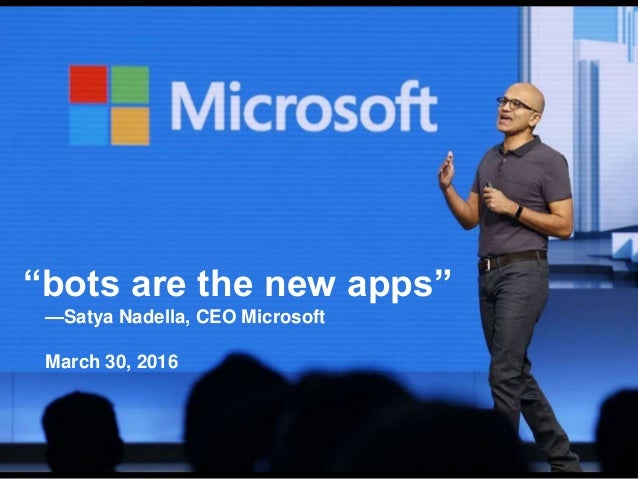
The rise of conversational “chatbots” begins with a claim you might initially dismiss as preposterous. “Bots are the new apps,” Microsoft CEO Satya Nadella declared during the company’s Build developers conference last month. “People-to-people conversations, people-to-digital assistants, people-to-bots, and even digital assistants-to-bots. That’s the world you’re going to get to see in the years to come.”


Microsoft CEO Nadella: ‘Bots are the new apps’

Excerpt:

SAN FRANCISCO – Microsoft CEO Satya Nadella kicked off the company’s Build developers conference with a vision of the future filled with chatbots, machine learning and artificial intelligence.

“Bots are the new apps,” said Nadella during a nearly three-hour keynote here that sketched a vision for the way humans will interact with machines. “People-to-people conversations, people-to-digital assistants, people-to-bots and even digital assistants-to-bots. That’s the world you’re going to get to see in the years to come.”

Onstage demos hammered home those ideas. One involved a smartphone conversing with digital assistant Cortana about planning a trip to Ireland, which soon found Cortana bringing in a Westin Hotels chatbot that booked a room based on the contents of the chat.


Addendums on 6/17/16:


HolographicStorytellingJWT-June2016

HolographicStorytellingJWT-2-June2016


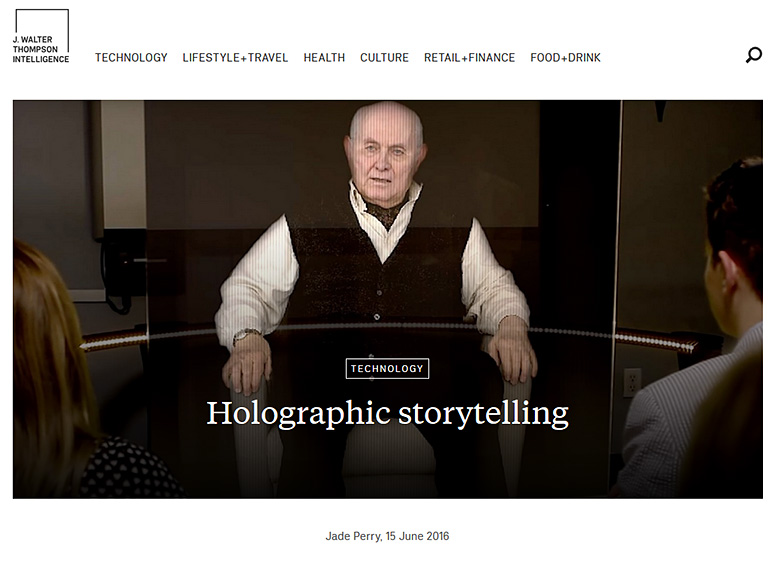
Holographic storytelling — from jwtintelligence.com by Jade Perry

Excerpt (emphasis DSC):

The stories of Holocaust survivors are brought to life with the help of interactive 3D technologies.

‘New Dimensions in Testimony’ is a new way of preserving history for future generations. The project brings to life the stories of Holocaust survivors with 3D video, revealing raw first-hand accounts that are more interactive than learning through a history book.

Holocaust survivor Pinchas Gutter, the first subject of the project, was filmed answering over 1000 questions, generating approximately 25 hours of footage. By incorporating natural language processing from Conscience Display, viewers were able to ask Gutter’s holographic image questions that triggered relevant responses.


From DSC:
I wonder…is this an example of a next generation, visually-based chatbot*?

With the growth of artificial intelligence (AI), intelligent systems, and new types of human computer interaction (HCI), this type of concept could offer an on-demand learning approach that’s highly engaging — and accessible from face-to-face settings as well as from online-based learning environments. (If it could be made to take in some of the context of a particular learner and where a learner is in the relevant Zone of Proximal Development (via web-based learner profiles/data), it would be even better.)

As an aside, is this how we will obtain
customer service from the businesses of the future? See below.


*The complete beginner’s guide to chatbots — from chatbotsmagazine.com by Matt Schlicht
Everything you need to know.

Excerpt (emphasis DSC):

What are chatbots? Why are they such a big opportunity? How do they work? How can I build one? How can I meet other people interested in chatbots?

These are the questions we’re going to answer for you right now.
…
What is a chatbot?
A chatbot is a service, powered by rules and sometimes artificial intelligence, that you interact with via a chat interface. The service could be any number of things, ranging from functional to fun, and it could live in any major chat product (Facebook Messenger, Slack, Telegram, Text Messages, etc.).
…

A chatbot is a service, powered by rules and sometimes artificial intelligence, that you interact with via a chat interface.

Examples of chatbots
Weather bot. Get the weather whenever you ask.
Grocery bot. Help me pick out and order groceries for the week.
News bot. Ask it to tell you when ever something interesting happens.
Life advice bot. I’ll tell it my problems and it helps me think of solutions.
Personal finance bot. It helps me manage my money better.
Scheduling bot. Get me a meeting with someone on the Messenger team at Facebook.
A bot that’s your friend. In China there is a bot called Xiaoice, built by Microsoft, that over 20 million people talk to.


From Microsoft and LinkedIn:

Microsoft and LinkedIn: Together changing the way the world works — from blog.linkedin.com

Excerpt:

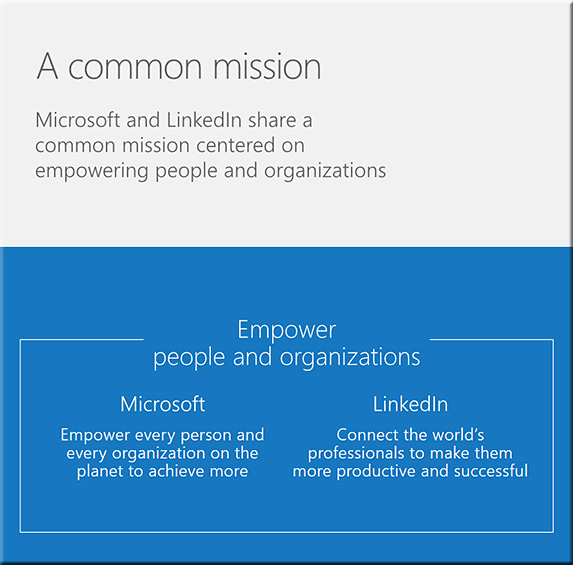
Today [6/13/16] we are excited to share that LinkedIn has entered into an agreement to be acquired by Microsoft. We are joining forces with Microsoft to realize a common mission to empower people and organizations. LinkedIn’s vision – to create economic opportunity for every member of the global workforce – is not changing and our members still come first.

Our companies are the world’s leading professional cloud and network. This deal will allow us to keep growing, investing in and innovating on LinkedIn to drive value for our members and our customers. Our members will continue to develop their skills, find a job and be great at that job, using our platform. We will continue to help our customers hire top talent, market their brand, and sell to their customers.


From DSC:
It’s interesting to reflect upon what this acquisition could mean and what it could bring to the workplace/career development table.

LinkedIn.com purchased/acquired Lynda.com (announced in April 2015), a growing/thriving (online-based learning) training and development company who can deliver lifelong learning and credentials to people…which continues to help people reinvent themselves.

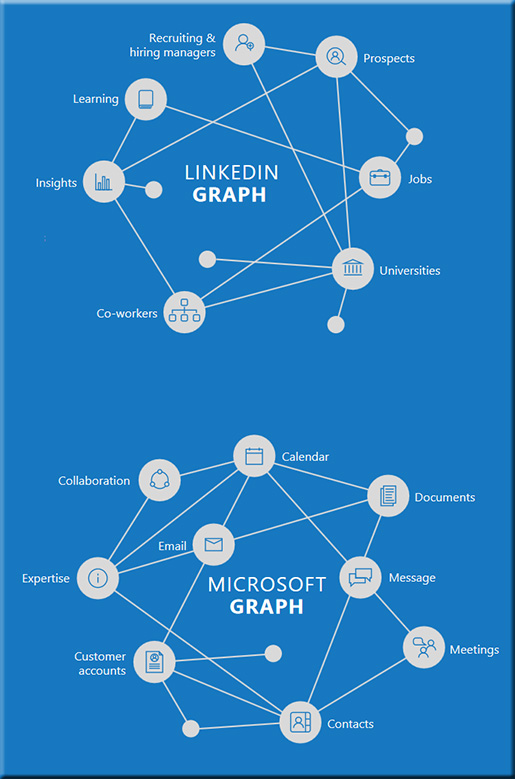
LinkedIn.com is working on an economic graph, a digital mapping of the global economy…building a database/marketplace of job openings and people who can fill those jobs.

What is the Economic Graph?
The Economic Graph is, in short, a digital mapping of the global economy. It will include a profile for every one of the 3 billion members of the global workforce, enabling them to represent their professional identity and subsequently find and realize their most valuable opportunities. It will include a profile for every company in the world, who you know at those companies up to three degrees to help you get your foot in the door, and the product and services those companies offer to enable you to be more productive and successful. It will digitally represent every economic opportunity offered by those companies, full-time, temporary and volunteer, and every skill required to obtain those opportunities. It will include a digital presence for every higher education organization in the world that can help members obtain those skills. And it will overlay the professionally relevant knowledge of every one of those individuals, companies, and universities to the extent that they want to publicly share it. Learn more about the Economic Graph and join the discussion.

Now Microsoft is purchasing/acquiring LinkedIn.com and the data/endeavors/technologies/platforms LinkedIn.com has been working on.

(Add to that the fact that Microsoft has been working on artificial intelligence (AI), personal assistants (i.e., Cortana).  It has been working on other forms of HCI as well, such as HoloLens.)

Therefore, some questions come to my mind:

  • Will the purchase of LinkedIn.com now add a potentially huge new reason to choose their platform/ecosystem as well?  In fact, Microsoft could be expanding their platform/ecosystem — or creating a new platform — to take advantage of using AI, personal assistants, and big data to play the ultimate match maker in the workplace.
  • Will freelancers utilize their services to find work? (The use of freelancing continues to grow; already in the mid-30 percents of the American workforce now.)
  • Will Microsoft be a source of cloud-based learner profiles?
  • Will Microsoft now get into the credentialing business?  Will Microsoft employ blockchain-based technologies? (Higher ed, take note if so.)
  • How will badges/badging play into this platform?
  • Will Microsoft work with companies to offer assessments into whether person A can be successful in position B?
  • What will this mean for lifelong learning?

Hmmmm….time will tell.


Addendums later on 6/13/16

Excerpt from this article:

Nadella explained it in a sentence to Business Insider’s Matt Rosoff Monday morning.

He said that buy buying LinkedIn’s professional network:

“It helps us differentiate our CRM product with social selling. It helps us take Dynamics into new spaces like human capital management with recruiting, and learning, and talent management.”

He later told analysts that connecting LinkedIn data with Dynamics [Microsoft’s suite of business management software] is “where the magic starts to happen.”


MicrosoftPurchasesLinkedIn-June2016

MicrosoftPurchasesLinkedIn-2-June2016


MicrosoftPurchasesLinkedIn-3-June2016


Excerpt from this article:

Think about it: How people find jobs, build skills, sell, market and get work done and ultimately find success requires a connected professional world. It requires a vibrant network that brings together a professional’s information in LinkedIn’s public network with the information in Office 365 and Dynamics. This combination will make it possible for new experiences such as a LinkedIn newsfeed that serves up articles based on the project you are working on and Office suggesting an expert to connect with via LinkedIn to help with a task you’re trying to complete. As these experiences get more intelligent and delightful, the LinkedIn and Office 365 engagement will grow. And in turn, new opportunities will be created for monetization through individual and organization subscriptions and targeted advertising.


Campus Technology Announces 2016 Innovators Award Honorees

The categories for the 2016 Campus Technology Innovators include:

  • Teaching and Learning
  • Student Systems and Services
  • Administration
  • IT Infrastructure and Systems
  • Education Futurists


From DSC:
As one of the Judges for this year’s awards, I congratulate these award honorees on jobs that were well done!  There were some solid submissions this year.


Sony’s canvas redefines the giant display landscape.


Sony-Canvas-HUGE-6-2016


SonyCanvas-June2016

The bigger your giant display, the more important viewing angle becomes.
In this example, we’re showing an 8K x 2K (7680 x 2160) screen.


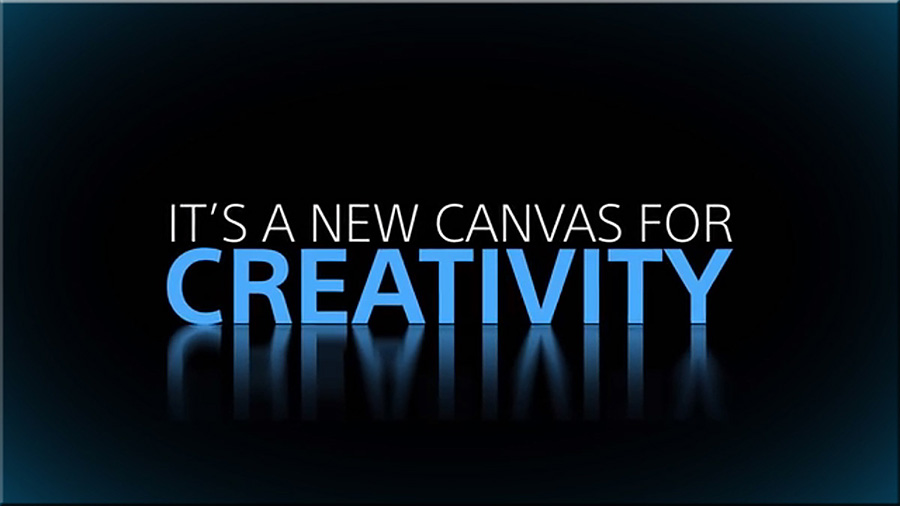
Sony-CanvasForCreativity


Sony redefines high-end visual display with new canvas for creativity — from blog.sony.com

Excerpt:

The scalable system is made up of multiple display units (each measuring 18 x 16 inches) that can be joined together with no bezels to create a limitless and seamless large-screen display.


Also see:

Excerpt:
Sony is literally blowing people away with their new Crystal LED technology. Sony’s new Canvas display system is a high-end visual display that re-defines the landscape for large-scale visual entertainment. The new technology, Crystal Light Emitting Diode Integrated Structure (CLEDIS), uses Sony’s ultrafine LEDs in a unique surface mounting structure as its light source to deliver a visual experience not possible with even the highest end conventional LED array. This scalable new type of canvas delivers an unmatched viewing experience, offering 99 percent black surface area, for high contrast, high resolution and immersive visuals.

This new type of canvas enables limitless flexibility and creativity in public spaces and high-end visual entertainment.  It is far more advanced when compared to the technologies currently available for large-scale display, offering a leap forward in depth, contrast, color, resolution and impact.


From DSC:
Leveraging the power of the BYOD phenomenon along with the increased usage of active learning-based classrooms, if students could “upload” their content to such enormous screens, one could easily imagine some highly-engaging discussions — providing students with excellent opportunities to create and share their own content.  Numerous windows and applications could be simultaneously displayed on such a video wall, providing/hosting some serious Jigsaw teaching techniques!


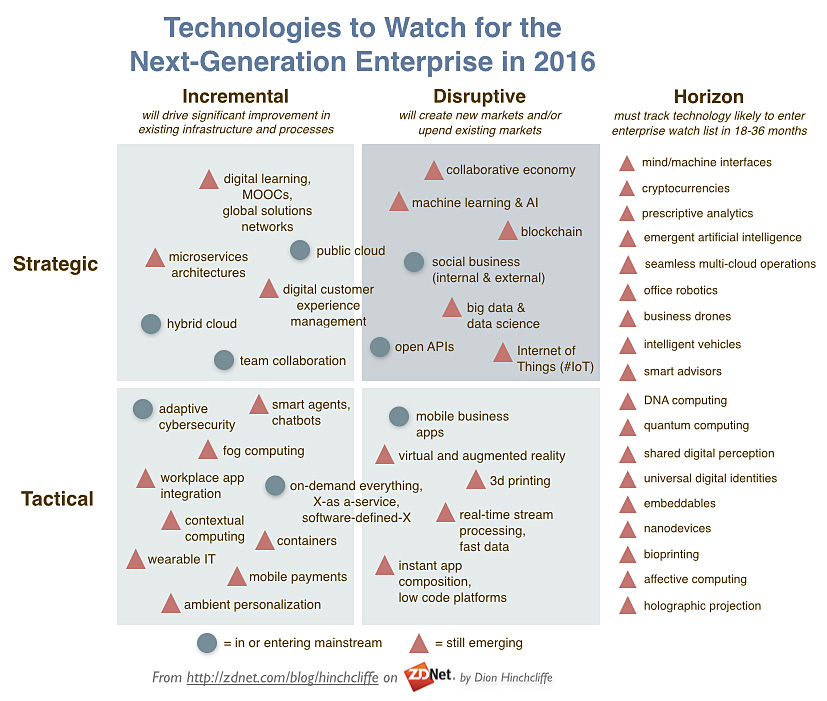
The enterprise technologies to watch in 2016 — from zdnet.com by Dion Hinchcliffe
While enterprise technology has always been somewhat a breed apart from consumer tech, this year we see that consumer tech will definitively set the agenda for businesses like never before in this year’s list of tech to watch.


EnterpriseTechs2Watch2016


Excerpts:

This year’s round-up of enterprise technologies to watch in 2016 is more crowded than ever. This is partly due to the fact that there’s just more new tech this year, and partly because the consumer-focused side of the technology industry is creating ever more disruptive advances that enterprises are simply required to face more quickly to maintain their relevancy in the market.

There are several new additions to the list this year that — despite rampant overuse of the term these days — hold the potential to be genuinely disruptive in the short term. These include blockchain, digital/customer experience management, and real-time stream processing, or fast data.
…
The enterprise technologies to watch in 2016:

  • Microservices architectures
  • Digital learning, MOOCs, global solutions networks
  • Public cloud
  • Digital, customer experience management (DX, CEM)
  • Team collaboration
  • Hybrid cloud
  • Social business (internal and external)
  • Machine learning and artificial intelligence
  • Collaborative economy
  • Blockchain
  • Big data and data science
  • Internet of Things (IoT)
  • Virtual and augmented reality
  • …and several more


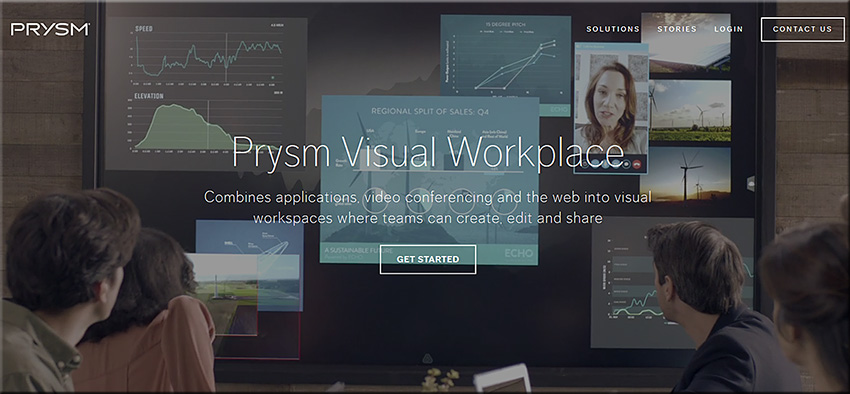
Will “class be in session” soon on tools like Prysm & Bluescape? If so, there will be some serious global interaction, collaboration, & participation here! [Christian]

From DSC:
Below are some questions and thoughts that are going through my mind:

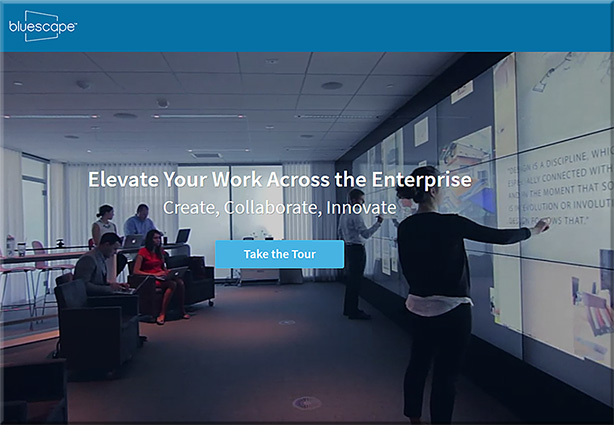
  • Will “class be in session” soon on tools like Prysm & Bluescape?
  • Will this type of setup be the next platform that we’ll use to meet our need to be lifelong learners? That is, will what we know of today as Learning Management Systems (LMS) and Content Management Systems (CMS) morph into this type of setup?
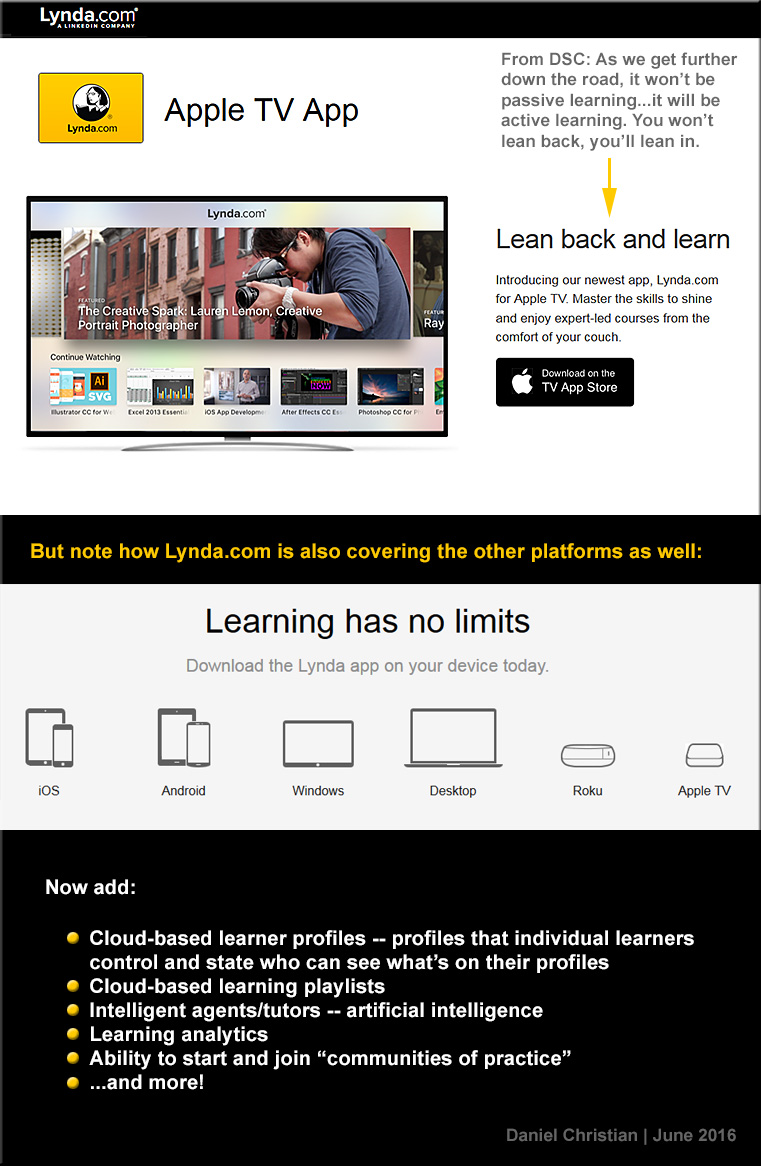
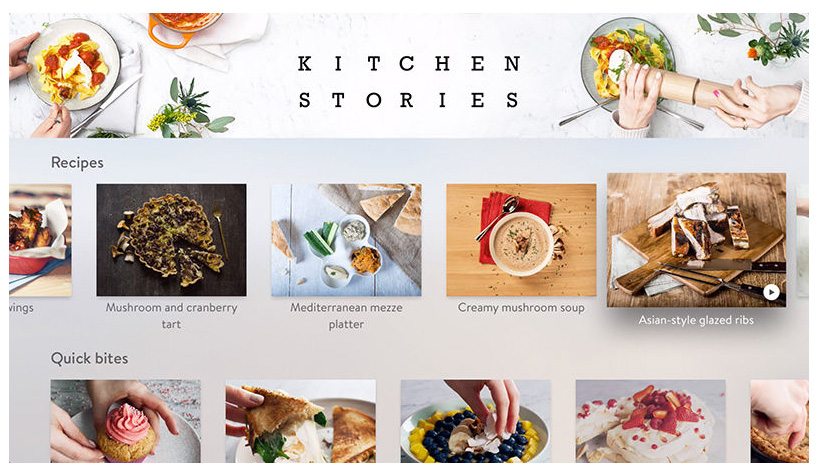
  • Via platforms/operating systems like tvOS, will our connected TVs turn into much more collaborative devices, allowing us to contribute content with learners from all over the globe?
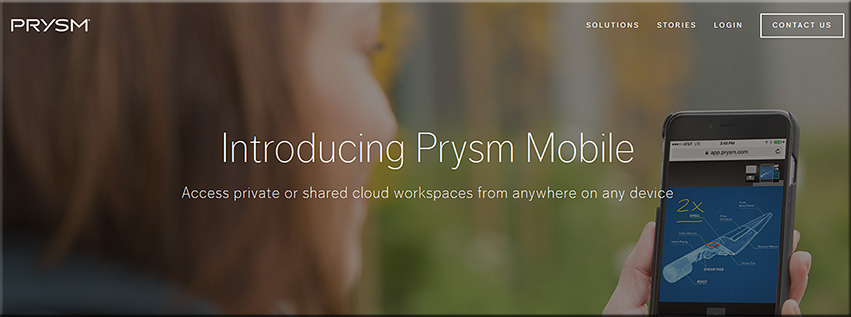
  • Prysm is already available on mobile devices and what we consider a television continues to morph
  • Will second and third screens be used in such setups? What functionality will be assigned to the main/larger screens? To the mobile devices?
  • Will colleges and universities innovate into such setups?  Or will organizations like LinkedIn.com/Lynda.com lead in this space? Or will it be a bit of both?
  • How will training, learning and development groups leverage these tools/technologies?
  • Are there some opportunities for homeschoolers here?

Along these lines, are are some videos/images/links for you:


PrysmVisualWorkspace-June2016


PrysmVisualWorkspace2-June2016


BlueScape-2016


BlueScape-2015


DSC-LyndaDotComOnAppleTV-June2016


The Living [Class] Room -- by Daniel Christian -- July 2012 -- a second device used in conjunction with a Smart/Connected TV


Also see:

kitchenstories-AppleTV-May2016


Also see:


Prysm Adds Enterprise-Wide Collaboration with Microsoft Applications — from ravepubs.com by Gary Kayye

Excerpt:

To enhance the Prysm Visual Workplace, Prysm today announced an integration with Microsoft OneDrive for Business and Office 365. Using the OneDrive for Business API from Microsoft, Prysm has made it easy for customers to connect Prysm to their existing OneDrive for Business environments to make it a seamless experience for end users to access, search for, and sync with content from OneDrive for Business. Within a Prysm Visual Workplace project, users may now access, work within and download content from Office 365 using Prysm’s built-in web capabilities.


Questions from DSC:

  • Which jobs/positions are being impacted by new forms of Human Computer Interaction (HCI)?
  • What new jobs/positions will be created by these new forms of HCI?
  • Will it be necessary for instructional technologists, instructional designers, teachers, professors, trainers, coaches, learning space designers, and others to pulse check this landscape?  Will that be enough? 
  • Or will such individuals need to dive much deeper than that in order to build the necessary skillsets, understandings, and knowledgebases to meet the new/changing expectations for their job positions?
  • How many will say, “No thanks, that’s not for me” — causing organizations to create new positions that do dive deeply in this area?
  • Will colleges and universities build and offer more courses involving HCI?
  • Will Career Services Departments get up to speed in order to help students carve out careers involving new forms of HCI?
  • How will languages and language translation be impacted by voice recognition software?
  • Will new devices be introduced to our classrooms in the future?
  • In the corporate space, how will training departments handle these new needs and opportunities?  How will learning & development groups be impacted? How will they respond in order to help the workforce get/be prepared to take advantage of these sorts of technologies? What does it mean for these staffs personally? Do they need to invest in learning more about these advancements?

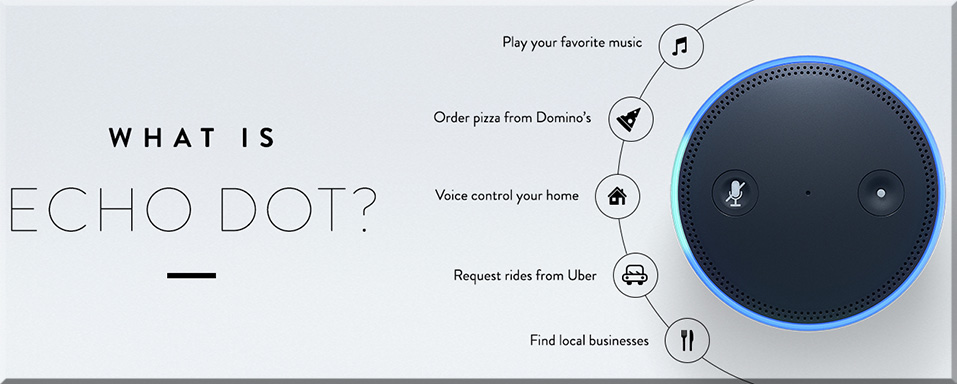
As an example of what I’m trying to get at here, who all might be involved with an effort like Echo Dot?  What types of positions created it? Who all could benefit from it?  What other platforms could these technologies be integrated into?  Besides the home, where else might we find these types of devices?


WhatIsEchoDot-June2016

Echo Dot is a hands-free, voice-controlled device that uses the same far-field voice recognition as Amazon Echo. Dot has a small built-in speaker—it can also connect to your speakers over Bluetooth or with the included audio cable. Dot connects to the Alexa Voice Service to play music, provide information, news, sports scores, weather, and more—instantly.

Echo Dot can hear you from across the room, even while music is playing. When you want to use Echo Dot, just say the wake word “Alexa” and Dot responds instantly. If you have more than one Echo or Echo Dot, you can set a different wake word for each—you can pick “Amazon”, “Alexa” or “Echo” as the wake word.


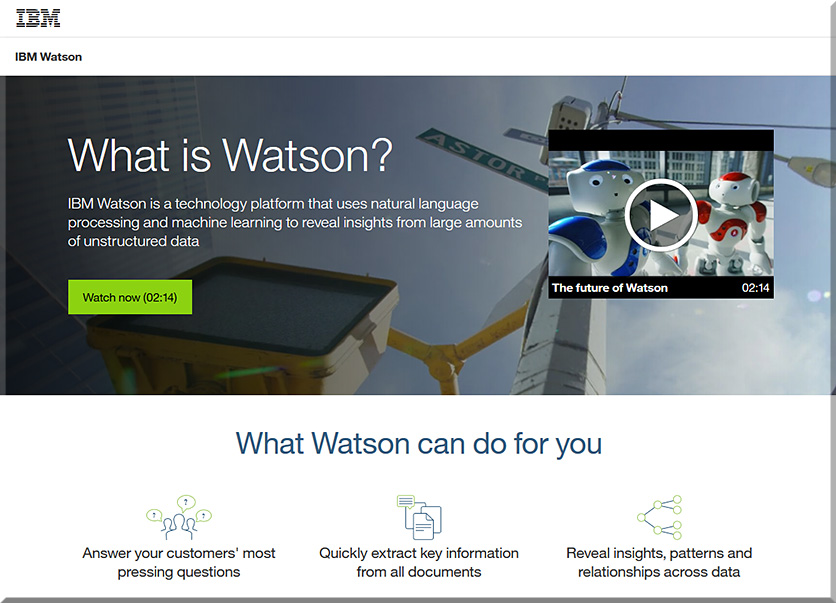
Or how might students learn about the myriad of technologies involved with IBM’s Watson?  What courses are out there today that address this type of thing?  Are more courses in the works that will address this type of thing? In which areas (Computer Science, User Experience Design, Interaction Design, other)?


WhatIsIBMWatson-June2016


Lots of questions…but few answers at this point. Still, given the increasing pace of technological change, it’s important that we think about this type of thing and become more responsive, nimble, and adaptive in our organizations and in our careers.


© 2025 | Daniel Christian