Small, Rural Central California High School Continues To Defy Standardized Education — from gettingsmart.com by Michael Niehoff

Key Points

  • Minarets High School prioritizes student-centered learning with innovative programs like project-based learning, digital tools, and unique offerings.
  • Emphasis on student voice and personalized learning fosters engagement, creativity, and real-world preparation, setting a benchmark for educational innovation.

Let High Schoolers Do Less? Let High Schoolers Experience More — from gettingsmart.com by Tom Vander Ark and Nate McClennen

Key Points

  • High school should focus on personalized and purposeful learning experiences that engage students and build real-world skills.
  • Traditional transcripts should be replaced with richer learning and experience records to better communicate students’ skills to higher education and employers.

“Americans want to grant more control to students themselves, prioritizing a K-12 education where all students have the option to choose the courses they want to study based on interests and aspirations.”  

Research on motivation and engagement supports personalized and purposeful learning. Students are more motivated when they see relevance and have some choice. We summarize this in six core principles to which schools should strive.


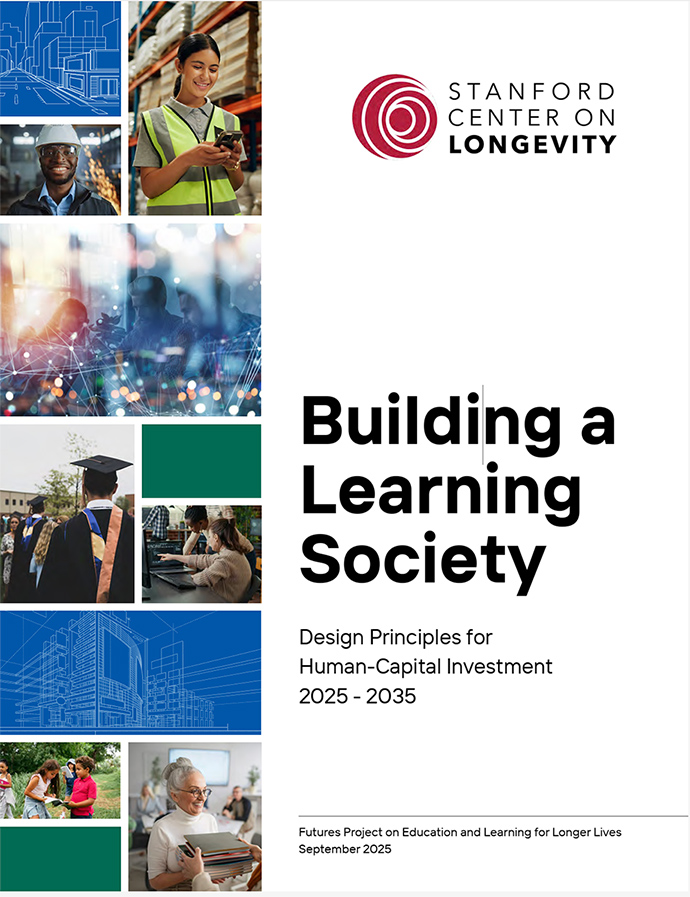
New Effort Pushes the U.S. to Stop Getting ‘Schooled’ and Start Learning — from workshift.org by Elyse Ashburn

The Big Idea: A new collaborative effort led out of the Stanford center aims to tackle that goal—giving clearer shape to what it would mean to truly build a new “learning society.” As a starting point, the collaborative released a report and set of design principles this week, crafted through a year of discussion and debate among about three dozen fellows in leadership roles in education, industry, government, and research.

The fellows landed on nine core principles—including that working is learning and credentials are a means, not an end—designed to transition the United States from a “schooled society” to a “learning society.”

“Universal access to K-12 education and the massification of access to college were major accomplishments of 20th century America,” Stevens says. “But all that schooling also has downsides that only recently have come into common view. Conventional schooling is expensive, bureaucratic, and often inflexible.”
.


How Substitute Teachers Can Connect With Their Students — from edutopia.org by Zachary Shell
Five enriching strategies to help subs stay involved and make a difference in the classroom.

I’ve since found enrichment in substitute teaching. Along the way, I’ve compiled a handful of strategies that have helped me stay involved and make a difference, one day at a time. Those strategies—which are useful for new substitutes still learning the ropes, as well as full-time teachers who are scaling back to substitute duties—are laid out below.


A Quiet Classroom Isn’t Always an Ideal Classroom — from edutopia.org by Clementina Jose
By rethinking what a good day in the classroom looks and sounds like, new teachers can better support their students.

If your classroom hums with the energy of students asking questions, debating ideas, and working together, you haven’t failed. You’ve succeeded in building a space where learning isn’t about being compliant, but about being alive and present.


The 2025 Changing Landscape of Online Education (CHLOE) 10 Report — from qualitymatters.org; emphasis below from DSC

Notable findings from the 73-page report include: 

  • Online Interest Surges Across Student Populations: 
  • Institutional Preparedness Falters Amid Rising Demand: Despite accelerating demand, institutional readiness has stagnated—or regressed—in key areas.
  • The Online Education Marketplace Is Increasingly Competitive: …
  • Alternative Credentials Take Center Stage: …
  • AI Integration Lacks Strategic Coordination: …

Just 28% of faculty are considered fully prepared for online course design, and 45% for teaching. Alarmingly, only 28% of institutions report having fully developed academic continuity plans for future emergency pivots to online.


Also relevant, see:


Great Expectations, Fragile Foundations — from onedtech.philhillaa.com by Glenda Morgan
Lessons about growth from the CHLOE & BOnES reports

Cultural resistance remains strong. Many [Chief Online Learning Officers] COLOs say faculty and deans still believe in-person learning is “just better,” creating headwinds even for modest online growth. As one respondent at a four-year institution with a large online presence put it:

Supportive departments [that] see the value in online may have very different levels of responsiveness compared to academic departments [that] are begrudgingly online. There is definitely a growing belief that students “should” be on-ground and are only choosing online because it’s easy/ convenient. Never mind the very real and growing population of nontraditional learners who can only take online classes, and the very real and growing population of traditional-aged learners who prefer online classes; many faculty/deans take a paternalistic, “we know what’s best” approach.


Ultimately, what we need is not just more ambition but better ambition. Ambition rooted in a realistic understanding of institutional capacity, a shared strategic vision, investments in policy and infrastructure, and a culture that supports online learning as a core part of the academic mission, not an auxiliary one. It’s time we talked about what it really takes to grow online learning , and where ambition needs to be matched by structure.

From DSC:
Yup. Culture is at the breakfast table again…boy, those strategies taste good.

I’d like to take some of this report — like the graphic below — and share it with former faculty members and members of a couple of my past job families’ leadership. They strongly didn’t agree with us when we tried to advocate for the development of online-based learning/programs at our organizations…but we were right. We were right all along. And we were LEADING all along. No doubt about it — even if the leadership at the time said that we weren’t leading.

The cultures of those organizations hurt us at the time. But our cultivating work eventually led to the development of online programs — unfortunately, after our groups were disbanded, they had to outsource those programs to OPMs.


Arizona State University — with its dramatic growth in online-based enrollments.


How to build trust in digital credentials? We offer some insights — from eddesignlab.org

Three key insights emerge:

Trust requires simplicity. Users need clear visual indicators (like the lock icon for secure websites) that their credentials meet technical standards without understanding the complexity behind them.

Standards matter for real people. Technical compliance with open standards directly impacts whether someone can access their own achievements and share them where needed.

Human experience drives adoption. Even the most sophisticated technical infrastructure fails if people can’t easily understand and use it.

Our insights and recommendations provide a roadmap for building credential systems that serve real human needs while meeting rigorous technical requirements.


The 2025 Global Skills Report — from coursera.org
Discover in-demand skills and credentials trends across 100+ countries and six regions to deliver impactful industry-aligned learning programs.

Access trusted insights on:

  • [NEW] Countries leading AI innovation in our AI Maturity Index
  • Skill proficiency rankings for 100+ countries in business, data, and technology
  • How people are building essential skills with micro-credentials
  • Enrollment trends in cybersecurity, critical thinking, and human skills
  • Women’s learning trends in GenAI, STEM, and Professional Certificates

AI Agents Are Rewriting The Playbook For Upskilling In 2025 — from forbes.com by Aytekin Tank

Staying competitive now depends on fast, effective training and upskilling—not just for business owners themselves, but for their teams, new and existing employees alike. AI agents are poised to change the corporate training landscape, helping businesses close skills gaps created by rapid technological change.

Traditional corporate training programs, which lean on passive content, often fall short of their goals. Companies like Uplimit are rolling out educational AI agents that promise significantly higher completion rates (upwards of 90 percent) and better results. It boils down to engagement—the active learning, with role playing and personalized feedback, is more stimulating than merely watching a video and completing a quiz. Agents can provide 24/7 assistance, responding to questions as soon as they pop up. What’s more, education and training with agents can be highly personalized.

Agents can train a higher volume of employees in the same amount of time. Employees will gain skills more efficiently, giving them more time to apply what they’ve learned—and likely boosting engagement in the process. They’ll be better prepared to stay competitive.


The 2025 Global Skills Report— from coursera.org
Discover in-demand skills and credentials trends across 100+ countries and six regions to deliver impactful industry-aligned learning programs.

GenAI adoption fuels global skill demands
In 2023, early adopters flocked to GenAI, with approximately one person per minute enrolling in a GenAI course on Coursera —a rate that rose to eight per minute in 2024.  Since then, GenAI has continued to see exceptional growth, with global enrollment in GenAI courses surging 195% year-over-year—maintaining its position as one of the most rapidly growing skill domains on our platform. To date, Coursera has recorded over 8 million GenAI enrollments, with 12 learners per minute signing up for GenAI content in 2025 across our catalog of nearly 700 GenAI courses.

Driving this surge, 94% of employers say they’re likely to hire candidates with GenAI credentials, while 75% prefer hiring less-experienced candidates with GenAI skills over more experienced ones without these capabilities.8 Demand for roles such as AI and Machine Learning Specialists is projected to grow by up to 40% in the next four years.9 Mastering AI fundamentals—from prompt engineering to large language model (LLM) applications—is essential to remaining competitive in today’s rapidly evolving economy.

Countries leading our new AI Maturity Index— which highlights regions best equipped to harness AI innovation and translate skills into real-world applications—include global frontrunners such as Singapore, Switzerland, and the United States.

Insights in action

Businesses
Integrate role-specific GenAI modules into employee development programs, enabling teams to leverage AI for efficiency and innovation.

Governments
Scale GenAI literacy initiatives—especially in emerging economies—to address talent shortages and foster human-machine capabilities needed to future-proof digital jobs.

Higher education
Embed credit-eligible GenAI learning into curricula, ensuring graduates enter the workforce job-ready.

Learners
Focus on GenAI courses offering real-world projects (e.g., prompt engineering) that help build skills for in-demand roles.


Also relevant/see:


Report: 93% of Students Believe Gen AI Training Belongs in Degree Programs — from campustechnology.com by Rhea Kelly

The vast majority of today’s college students — 93% — believe generative AI training should be included in degree programs, according to a recent Coursera report. What’s more, 86% of students consider gen AI the most crucial technical skill for career preparation, prioritizing it above in-demand skills such as data strategy and software development. And 94% agree that microcredentials help build the essential skills they need to achieve career success.

For its Microcredentials Impact Report 2025, Coursera surveyed more than 1,200 learners and 1,000 employers around the globe to better understand the demand for microcredentials and their impact on workforce readiness and hiring trends.


1 in 4 employers say they’ll eliminate degree requirements by year’s end — from hrdive.com by Carolyn Crist
Companies that recently removed degree requirements reported a surge in applications, a more diverse applicant pool and the ability to offer lower salaries.

A quarter of employers surveyed said they will remove bachelor’s degree requirements for some roles by the end of 2025, according to a May 20 report from Resume Templates.

In addition, 7 in 10 hiring managers said their company looks at relevant experience over a bachelor’s degree while making hiring decisions.

In the survey of 1,000 hiring managers, 84% of companies that recently removed degree requirements said it has been a successful move. Companies without degree requirements also reported a surge in applications, a more diverse applicant pool and the ability to offer lower salaries.


Why AI literacy is now a core competency in education — from weforum.org by Tanya Milberg

  • Education systems must go beyond digital literacy and embrace AI literacy as a core educational priority.
  • A new AI Literacy Framework (AILit) aims to empower learners to navigate an AI-integrated world with confidence and purpose.
  • Here’s what you need to know about the AILit Framework – and how to get involved in making it a success.

Also from Allison Salisbury, see:


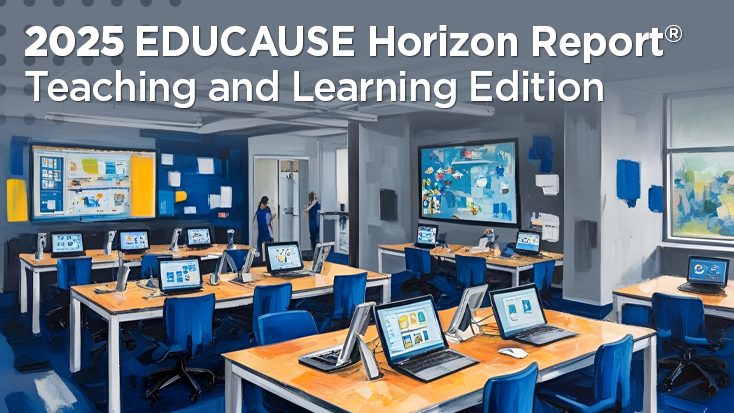
2025 EDUCAUSE Horizon Report | Teaching and Learning Edition — from library.educause.edu

Higher education is in a period of massive transformation and uncertainty. Not only are current events impacting how institutions operate, but technological advancement—particularly in AI and virtual reality—are reshaping how students engage with content, how cognition is understood, and how learning itself is documented and valued.

Our newly released 2025 EDUCAUSE Horizon Report | Teaching and Learning Edition captures the spirit of this transformation and how you can respond with confidence through the lens of emerging trends, key technologies and practices, and scenario-based foresight.

#teachingandlearning #highereducation #learningecosystems #learning #futurism #foresight #trends #emergingtechnologies #AI #VR #gamechangingenvironment #colleges #universities #communitycolleges #faculty #staff #IT


MOOC-Style Skills Training — from the-job.beehiiv.com by Paul Fain
WGU and tech companies use Open edX for flexible online learning. Could community colleges be next?

Open Source for Affordable Online Reach
The online titan Western Governors University is experimenting with an open-source learning platform. So are Verizon and the Indian government. And the platform’s leaders want to help community colleges take the plunge on competency-based education.

The Open edX platform inherently supports self-paced learning and offers several features that make it a good fit for competency-based education and skills-forward learning, says Stephanie Khurana, Axim’s CEO.

“Flexible modalities and a focus on competence instead of time spent learning improves access and affordability for learners who balance work and life responsibilities alongside their education,” she says.

“Plus, being open source means institutions and organizations can collaborate to build and share CBE-specific tools and features,” she says, “which could lower costs and speed up innovation across the field.”

Axim thinks Open edX’s ability to scale affordably can support community colleges in reaching working learners across an underserved market. 


Micro-Credentials Impact Report — from coursera.org
Get exclusive insights on how industry-aligned micro- credentials are bridging skill gaps, driving career outcomes, and building a future-ready workforce—with data from 2,000+ students and employers across six regions.

See how micro-credentials are driving student success, meeting industry demand, and transforming higher education institutions. Deliver industry-aligned learning with confidence—whether you’re leading a university or designing workforce development programs.

Our data shows that 90% of employers are willing to offer higher starting salaries to those with micro-credentials. Most offer 10–15% more for credit-bearing vs. non-credit credentials—even higher for GenAI. Help your graduates earn more by integrating micro-credentials into your programs.

Students are 2x as likely to choose programs with micro-credentials—even more if credentials are credit-bearing, the report finds. Higher education leaders echo this trend, with 7 in 10 saying students are more likely to enroll in programs that offer micro-credentials for academic credit.


Undergraduate Degree Earners for Academic Year 2023-24 — from nscresearchcenter.org; via Ryan Craig

The number of learners earning certificates continued its record-breaking growth, reaching a new 10-year high for the third consecutive year. Both first-time certificate earners (+12.6%, +41,500) and those with a prior award returning to earn a certificate (+8.0%, +11,500) saw significant increases.

In contrast, both bachelor’s degree and associate degree earners declined for the third consecutive year. Fewer students earned an associate degree this year than in any of the last ten years, and bachelor’s degree earners declined to their lowest level since 2015-16. As a result of ongoing certificate growth and associate and bachelor’s decline, the proportion of first-time completers who earn a certificate has risen from about 1 in 9 (11.3%) in 2014-15 to about 1 in 7 (15.4%) in 2023-24.

The 2023-24 academic year marks the first time that certificate completers aged 24 and younger outnumbered those 25 and older. Certificate completers 18-20 years old grew by 19,400 (17.8%) and those under 18 (likely dual enrolled high school students) grew by 7,100 (27.2%) in 2023-24.


Do I Need a Degree in Instructional Design? It Depends. — from teamedforlearning.com

It’s a common question for those considering a career in instructional design: Do I need a degree to land a job? The answer? It depends.

Hiring managers aren’t just looking for a degree—they want proof that you have the knowledge, skills, and abilities to succeed. In fact, most employers focus on 3 key factors when assessing candidates. You typically need at least 2 of these to be considered:

  1. A Credential – A degree or certification in instructional design, learning experience design, or a related field.
  2. Relevant Work Experience – Hands-on experience designing and developing learning solutions.
  3. Proof of Abilities – A strong portfolio showcasing eLearning modules, course designs, or learning strategies.

The good news? You don’t have to spend years earning a degree to break into the field. If you’re resourceful, you can fast-track your way in through volunteer projects, contract work, and portfolio building.

Whether you’re a recent graduate, a career changer, or a working professional looking for your next opportunity, focusing on these key factors can help you stand out and get hired.


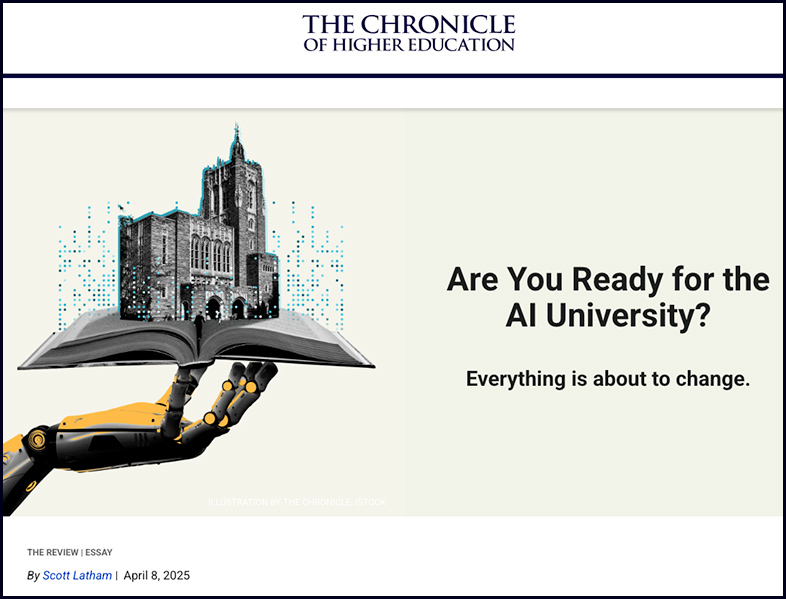
Reflections on “Are You Ready for the AI University? Everything is about to change.” [Latham]

.
Are You Ready for the AI University? Everything is about to change. — from chronicle.com by Scott Latham

Over the course of the next 10 years, AI-powered institutions will rise in the rankings. US News & World Report will factor a college’s AI capabilities into its calculations. Accrediting agencies will assess the degree of AI integration into pedagogy, research, and student life. Corporations will want to partner with universities that have demonstrated AI prowess. In short, we will see the emergence of the AI haves and have-nots.

What’s happening in higher education today has a name: creative destruction. The economist Joseph Schumpeter coined the term in 1942 to describe how innovation can transform industries. That typically happens when an industry has both a dysfunctional cost structure and a declining value proposition. Both are true of higher education.

Out of the gate, professors will work with technologists to get AI up to speed on specific disciplines and pedagogy. For example, AI could be “fed” course material on Greek history or finance and then, guided by human professors as they sort through the material, help AI understand the structure of the discipline, and then develop lectures, videos, supporting documentation, and assessments.

In the near future, if a student misses class, they will be able watch a recording that an AI bot captured. Or the AI bot will find a similar lecture from another professor at another accredited university. If you need tutoring, an AI bot will be ready to help any time, day or night. Similarly, if you are going on a trip and wish to take an exam on the plane, a student will be able to log on and complete the AI-designed and administered exam. Students will no longer be bound by a rigid class schedule. Instead, they will set the schedule that works for them.

Early and mid-career professors who hope to survive will need to adapt and learn how to work with AI. They will need to immerse themselves in research on AI and pedagogy and understand its effect on the classroom. 

From DSC:
I had a very difficult time deciding which excerpts to include. There were so many more excerpts for us to think about with this solid article. While I don’t agree with several things in it, EVERY professor, president, dean, and administrator working within higher education today needs to read this article and seriously consider what Scott Latham is saying.

Change is already here, but according to Scott, we haven’t seen anything yet. I agree with him and, as a futurist, one has to consider the potential scenarios that Scott lays out for AI’s creative destruction of what higher education may look like. Scott asserts that some significant and upcoming impacts will be experienced by faculty members, doctoral students, and graduate/teaching assistants (and Teaching & Learning Centers and IT Departments, I would add). But he doesn’t stop there. He brings in presidents, deans, and other members of the leadership teams out there.

There are a few places where Scott and I differ.

  • The foremost one is the importance of the human element — i.e., the human faculty member and students’ learning preferences. I think many (most?) students and lifelong learners will want to learn from a human being. IBM abandoned their 5-year, $100M ed push last year and one of the key conclusions was that people want to learn from — and with — other people:

To be sure, AI can do sophisticated things such as generating quizzes from a class reading and editing student writing. But the idea that a machine or a chatbot can actually teach as a human can, he said, represents “a profound misunderstanding of what AI is actually capable of.” 

Nitta, who still holds deep respect for the Watson lab, admits, “We missed something important. At the heart of education, at the heart of any learning, is engagement. And that’s kind of the Holy Grail.”

— Satya Nitta, a longtime computer researcher at
IBM’s Watson
Research Center in Yorktown Heights, NY
.

By the way, it isn’t easy for me to write this. As I wanted AI and other related technologies to be able to do just what IBM was hoping that it would be able to do.

  • Also, I would use the term learning preferences where Scott uses the term learning styles.

Scott also mentions:

“In addition, faculty members will need to become technologists as much as scholars. They will need to train AI in how to help them build lectures, assessments, and fine-tune their classroom materials. Further training will be needed when AI first delivers a course.”

It has been my experience from working with faculty members for over 20 years that not all faculty members want to become technologists. They may not have the time, interest, and/or aptitude to become one (and vice versa for technologists who likely won’t become faculty members).

That all said, Scott relays many things that I have reflected upon and relayed for years now via this Learning Ecosystems blog and also via The Learning from the Living [AI-Based Class] Room vision — the use of AI to offer personalized and job-relevant learning, the rising costs of higher education, the development of new learning-related offerings and credentials at far less expensive prices, the need to provide new business models and emerging technologies that are devoted more to lifelong learning, plus several other things.

So this article is definitely worth your time to read, especially if you are working in higher education or are considering a career therein!


Addendum later on 4/10/25:

U-M’s Ross School of Business, Google Public Sector launch virtual teaching assistant pilot program — from news.umich.edu by Jeff Karoub; via Paul Fain

Google Public Sector and the University of Michigan’s Ross School of Business have launched an advanced Virtual Teaching Assistant pilot program aimed at improving personalized learning and enlightening educators on artificial intelligence in the classroom.

The AI technology, aided by Google’s Gemini chatbot, provides students with all-hours access to support and self-directed learning. The Virtual TA represents the next generation of educational chatbots, serving as a sophisticated AI learning assistant that instructors can use to modify their specific lessons and teaching styles.

The Virtual TA facilitates self-paced learning for students, provides on-demand explanations of complex course concepts, guides them through problem-solving, and acts as a practice partner. It’s designed to foster critical thinking by never giving away answers, ensuring students actively work toward solutions.


2025 College Hopes & Worries Survey Report — from princetonreview.com
We surveyed 9,317 college applicants and parents about their dream schools and their biggest college admission and financial aid challenges.
.


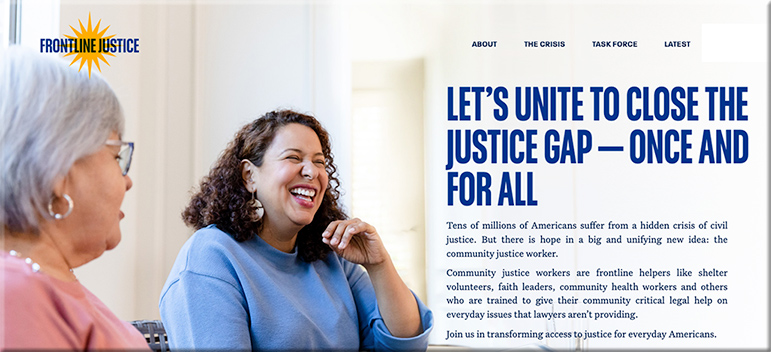
Frontline Justice — from the-job.beehiiv.com by Paul Fain
Campaign seeks to create training standards and certification for a new type of legal job.


Market scan: What’s possible in the current skills validation ecosystem? — from eddesignlab.org
Education Design Lab provides an overview of emerging practices + tools in this 2025 Skills Validation Market Scan.

Employers and opportunity seekers are excited about the possibilities of a skills-based ecosystem, but this new process for codifying a person’s experiences and abilities into skills requires one significant, and missing, piece: Trust. Employers need to trust that the credentials they receive from opportunity seekers are valid representations of their skills. Jobseekers need to trust that their digital credentials are safe, accurate, and will lead to employment and advancement.

Our hypothesis
We posit that the trust needed for the validation of skills to be brought into a meaningful reality is established through a network of skills validation methods and opportunities. We also recognize that the routes through which an individual can demonstrate skills are as varied as the individuals themselves. Therefore, in order to equitably create a skills-based employment ecosystem, the routes by which skills are validated must be held together with common standards and language, but flexible enough to accommodate a multitude of validation practices.

 
© 2025 | Daniel Christian