Organizing Teams for Continuous Learning: A Complete Guide — from intelligenthq.com

In today’s fast-paced business world, continuous learning has become a vital element for both individual and organizational growth. Teams that foster a culture of learning remain adaptable, innovative, and competitive. However, simply encouraging learning isn’t enough; the way teams are structured and supported plays a huge role in achieving long-term success. In this guide, we’ll explore how to effectively organize teams for continuous learning, leveraging tools, strategies, and best practices.


Reflections on “Are You Ready for the AI University? Everything is about to change.” [Latham]

.
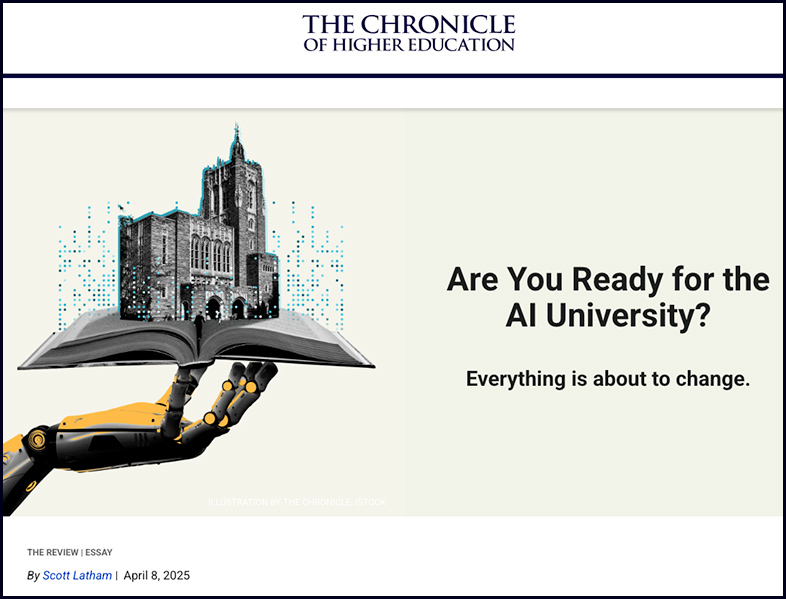
Are You Ready for the AI University? Everything is about to change. — from chronicle.com by Scott Latham

Over the course of the next 10 years, AI-powered institutions will rise in the rankings. US News & World Report will factor a college’s AI capabilities into its calculations. Accrediting agencies will assess the degree of AI integration into pedagogy, research, and student life. Corporations will want to partner with universities that have demonstrated AI prowess. In short, we will see the emergence of the AI haves and have-nots.

What’s happening in higher education today has a name: creative destruction. The economist Joseph Schumpeter coined the term in 1942 to describe how innovation can transform industries. That typically happens when an industry has both a dysfunctional cost structure and a declining value proposition. Both are true of higher education.

Out of the gate, professors will work with technologists to get AI up to speed on specific disciplines and pedagogy. For example, AI could be “fed” course material on Greek history or finance and then, guided by human professors as they sort through the material, help AI understand the structure of the discipline, and then develop lectures, videos, supporting documentation, and assessments.

In the near future, if a student misses class, they will be able watch a recording that an AI bot captured. Or the AI bot will find a similar lecture from another professor at another accredited university. If you need tutoring, an AI bot will be ready to help any time, day or night. Similarly, if you are going on a trip and wish to take an exam on the plane, a student will be able to log on and complete the AI-designed and administered exam. Students will no longer be bound by a rigid class schedule. Instead, they will set the schedule that works for them.

Early and mid-career professors who hope to survive will need to adapt and learn how to work with AI. They will need to immerse themselves in research on AI and pedagogy and understand its effect on the classroom. 

From DSC:
I had a very difficult time deciding which excerpts to include. There were so many more excerpts for us to think about with this solid article. While I don’t agree with several things in it, EVERY professor, president, dean, and administrator working within higher education today needs to read this article and seriously consider what Scott Latham is saying.

Change is already here, but according to Scott, we haven’t seen anything yet. I agree with him and, as a futurist, one has to consider the potential scenarios that Scott lays out for AI’s creative destruction of what higher education may look like. Scott asserts that some significant and upcoming impacts will be experienced by faculty members, doctoral students, and graduate/teaching assistants (and Teaching & Learning Centers and IT Departments, I would add). But he doesn’t stop there. He brings in presidents, deans, and other members of the leadership teams out there.

There are a few places where Scott and I differ.

  • The foremost one is the importance of the human element — i.e., the human faculty member and students’ learning preferences. I think many (most?) students and lifelong learners will want to learn from a human being. IBM abandoned their 5-year, $100M ed push last year and one of the key conclusions was that people want to learn from — and with — other people:

To be sure, AI can do sophisticated things such as generating quizzes from a class reading and editing student writing. But the idea that a machine or a chatbot can actually teach as a human can, he said, represents “a profound misunderstanding of what AI is actually capable of.” 

Nitta, who still holds deep respect for the Watson lab, admits, “We missed something important. At the heart of education, at the heart of any learning, is engagement. And that’s kind of the Holy Grail.”

— Satya Nitta, a longtime computer researcher at
IBM’s Watson
Research Center in Yorktown Heights, NY
.

By the way, it isn’t easy for me to write this. As I wanted AI and other related technologies to be able to do just what IBM was hoping that it would be able to do.

  • Also, I would use the term learning preferences where Scott uses the term learning styles.

Scott also mentions:

“In addition, faculty members will need to become technologists as much as scholars. They will need to train AI in how to help them build lectures, assessments, and fine-tune their classroom materials. Further training will be needed when AI first delivers a course.”

It has been my experience from working with faculty members for over 20 years that not all faculty members want to become technologists. They may not have the time, interest, and/or aptitude to become one (and vice versa for technologists who likely won’t become faculty members).

That all said, Scott relays many things that I have reflected upon and relayed for years now via this Learning Ecosystems blog and also via The Learning from the Living [AI-Based Class] Room vision — the use of AI to offer personalized and job-relevant learning, the rising costs of higher education, the development of new learning-related offerings and credentials at far less expensive prices, the need to provide new business models and emerging technologies that are devoted more to lifelong learning, plus several other things.

So this article is definitely worth your time to read, especially if you are working in higher education or are considering a career therein!


Addendum later on 4/10/25:

U-M’s Ross School of Business, Google Public Sector launch virtual teaching assistant pilot program — from news.umich.edu by Jeff Karoub; via Paul Fain

Google Public Sector and the University of Michigan’s Ross School of Business have launched an advanced Virtual Teaching Assistant pilot program aimed at improving personalized learning and enlightening educators on artificial intelligence in the classroom.

The AI technology, aided by Google’s Gemini chatbot, provides students with all-hours access to support and self-directed learning. The Virtual TA represents the next generation of educational chatbots, serving as a sophisticated AI learning assistant that instructors can use to modify their specific lessons and teaching styles.

The Virtual TA facilitates self-paced learning for students, provides on-demand explanations of complex course concepts, guides them through problem-solving, and acts as a practice partner. It’s designed to foster critical thinking by never giving away answers, ensuring students actively work toward solutions.


The 2025 AI Index Report — from Stanford University’s Human-Centered Artificial Intelligence Lab (hai.stanford.edu); item via The Neuron

Top Takeaways

  1. AI performance on demanding benchmarks continues to improve.
  2. AI is increasingly embedded in everyday life.
  3. Business is all in on AI, fueling record investment and usage, as research continues to show strong productivity impacts.
  4. The U.S. still leads in producing top AI models—but China is closing the performance gap.
  5. The responsible AI ecosystem evolves—unevenly.
  6. Global AI optimism is rising—but deep regional divides remain.
  7. …and several more

Also see:

The Neuron’s take on this:

So, what should you do? You really need to start trying out these AI tools. They’re getting cheaper and better, and they can genuinely help save time or make work easier—ignoring them is like ignoring smartphones ten years ago.

Just keep two big things in mind:

  1. Making the next super-smart AI costs a crazy amount of money and uses tons of power (seriously, they’re buying nuclear plants and pushing coal again!).
  2. Companies are still figuring out how to make AI perfectly safe and fair—cause it still makes mistakes.

So, use the tools, find what helps you, but don’t trust them completely.

We’re building this plane mid-flight, and Stanford’s report card is just another confirmation that we desperately need better safety checks before we hit major turbulence.


Addendum on 4/16:


Job hunting and hiring in the age of AI: Where did all the humans go? — from washingtonpost.com by Taylor Telford
The proliferation of artificial intelligence tools and overreliance on software such as ChatGPT is making the job market increasingly surreal.

The speedy embrace of AI tools meant to make job hunting and hiring more efficient is causing headaches and sowing distrust in these processes, people on both sides of the equation say. While companies embrace AI recruiters and application scanning systems, many job seekers are trying to boost their odds with software that generates application materials, optimizes them for AI and applies to hundreds of jobs in minutes.

Meanwhile, recruiters and hiring managers are fielding more applicants than they can keep up with, yet contend that finding real, qualified workers amid the bots, cheaters and deepfakes is only getting tougher as candidates use AI to write their cover letters, bluff their way through interviews and even hide their identities.

“I’m pro-AI in the sense that it allows you to do things that were impossible before … but it is being misused wildly,” Freire said. The problem is “when you let it do the thinking for you, it goes from a superpower to a crutch very easily.”


Uplimit raises stakes in corporate learning with suite of AI agents that can train thousands of employees simultaneously — from venturebeat.com by Michael Nuñez|

Uplimit unveiled a suite of AI-powered learning agents today designed to help companies rapidly upskill employees while dramatically reducing administrative burdens traditionally associated with corporate training.

The San Francisco-based company announced three sets of purpose-built AI agents that promise to change how enterprises approach learning and development: skill-building agents, program management agents, and teaching assistant agents. The technology aims to address the growing skills gap as AI advances faster than most workforces can adapt.

“There is an unprecedented need for continuous learning—at a scale and speed traditional systems were never built to handle,” said Julia Stiglitz, CEO and co-founder of Uplimit, in an interview with VentureBeat. “The companies best positioned to thrive aren’t choosing between AI and their people—they’re investing in both.”


Introducing Claude for Education — from anthropic.com

Today we’re launching Claude for Education, a specialized version of Claude tailored for higher education institutions. This initiative equips universities to develop and implement AI-enabled approaches across teaching, learning, and administration—ensuring educators and students play a key role in actively shaping AI’s role in society.

As part of announcing Claude for Education, we’re introducing:

  1. Learning mode: A new Claude experience that guides students’ reasoning process rather than providing answers, helping develop critical thinking skills
  2. University-wide Claude availability: Full campus access agreements with Northeastern University, London School of Economics and Political Science (LSE), and Champlain College, making Claude available to all students
  3. Academic partnerships: Joining Internet2 and working with Instructure to embed AI into teaching & learning with Canvas LMS
  4. Student programs: A new Claude Campus Ambassadors program along with an initiative offering API credits for student projects

A comment on this from The Rundown AI:

Why it matters: Education continues to grapple with AI, but Anthropic is flipping the script by making the tech a partner in developing critical thinking rather than an answer engine. While the controversy over its use likely isn’t going away, this generation of students will have access to the most personalized, high-quality learning tools ever.


Should College Graduates Be AI Literate? — from chronicle.com by Beth McMurtrie (behind a paywall)
More institutions are saying yes. Persuading professors is only the first barrier they face.

Last fall one of Jacqueline Fajardo’s students came to her office, eager to tell her about an AI tool that was helping him learn general chemistry. Had she heard of Google NotebookLM? He had been using it for half a semester in her honors course. He confidently showed her how he could type in the learning outcomes she posted for each class and the tool would produce explanations and study guides. It even created a podcast based on an academic paper he had uploaded. He did not feel it was important to take detailed notes in class because the AI tool was able to summarize the key points of her lectures.


Showing Up for the Future: Why Educators Can’t Sit Out the AI Conversation — from marcwatkins.substack.com with a guest post from Lew Ludwig

The Risk of Disengagement
Let’s be honest: most of us aren’t jumping headfirst into AI. At many of our institutions, it’s not a gold rush—it’s a quiet standoff. But the group I worry most about isn’t the early adopters. It’s the faculty who’ve decided to opt out altogether.

That choice often comes from a place of care. Concerns about data privacy, climate impact, exploitative labor, and the ethics of using large language models are real—and important. But choosing not to engage at all, even on ethical grounds, doesn’t remove us from the system. It just removes our voices from the conversation.

And without those voices, we risk letting others—those with very different priorities—make the decisions that shape what AI looks like in our classrooms, on our campuses, and in our broader culture of learning.


Turbocharge Your Professional Development with AI — from learningguild.com by Dr. RK Prasad

You’ve just mastered a few new eLearning authoring tools, and now AI is knocking on the door, offering to do your job faster, smarter, and without needing coffee breaks. Should you be worried? Or excited?

If you’re a Learning and Development (L&D) professional today, AI is more than just a buzzword—it’s transforming the way we design, deliver, and measure corporate training. But here’s the good news: AI isn’t here to replace you. It’s here to make you better at what you do.

The challenge is to harness its potential to build digital-ready talent, not just within your organization but within yourself.

Let’s explore how AI is reshaping L&D strategies and how you can leverage it for professional development.


5 Recent AI Notables — from automatedteach.com by Graham Clay

1. OpenAI’s New Image Generator
What Happened: OpenAI integrated a much more powerful image generator directly into GPT-4o, making it the default image creator in ChatGPT. Unlike previous image models, this one excels at accurately rendering text in images, precise visualization of diagrams/charts, and multi-turn image refinement through conversation.

Why It’s Big: For educators, this represents a significant advancement in creating educational visuals, infographics, diagrams, and other instructional materials with unprecedented accuracy and control. It’s not perfect, but you can now quickly generate custom illustrations that accurately display mathematical equations, chemical formulas, or process workflows — previously a significant hurdle in digital content creation — without requiring graphic design expertise or expensive software. This capability dramatically reduces the time between conceptualizing a visual aid and implementing it in course materials.
.


The 4 AI modes that will supercharge your workflow — from aiwithallie.beehiiv.com by Allie K. Miller
The framework most people and companies won’t discover until 2026


Investigating Informal Learning with Technology — from learningguild.com by Katie Belle (Curry) Nelson

Informal learning is having a moment right now, and it’s about time.

As learning professionals, we can often get caught up in designing, developing, and implementing formal learning experiences, which can cause informal learning to fall to the wayside and easily be overlooked. However, informal learning experiences can have major, long-term effects on learning and business outcomes, so finding creative ways to track them can be valuable for L&D departments.

Start small
These three methods are small steps to understanding the informal learning environment and its impact on your organization. The assuring thing about informal learning is that you can start small and incorporate more methods later because formal learning is always taking place. Start with one area and begin to explore what you can find out the content your learners want to know more about, how they are learning about things, and how others in the organization are solving problems.


It’s the end of work as we knew it
and I feel…

powerless to fight the technology that we pioneered
nostalgic for a world that moved on without us
after decades of paying our dues
for a payday that never came
…so yeah
not exactly fine.


The Gen X Career Meltdown — from nytimes.com by Steeven Kurutz (DSC: This is a gifted article for you)
Just when they should be at their peak, experienced workers in creative fields find that their skills are all but obsolete.

If you entered media or image-making in the ’90s — magazine publishing, newspaper journalism, photography, graphic design, advertising, music, film, TV — there’s a good chance that you are now doing something else for work. That’s because those industries have shrunk or transformed themselves radically, shutting out those whose skills were once in high demand.

“I am having conversations every day with people whose careers are sort of over,” said Chris Wilcha, a 53-year-old film and TV director in Los Angeles.

Talk with people in their late 40s and 50s who once imagined they would be able to achieve great heights — or at least a solid career while flexing their creative muscles — and you are likely to hear about the photographer whose work dried up, the designer who can’t get hired or the magazine journalist who isn’t doing much of anything.

In the wake of the influencers comes another threat, artificial intelligence, which seems likely to replace many of the remaining Gen X copywriters, photographers and designers. By 2030, ad agencies in the United States will lose 32,000 jobs, or 7.5 percent of the industry’s work force, to the technology, according to the research firm Forrester.


From DSC:
This article reminds me of how tough it is to navigate change in our lives. For me, it was often due to the fact that I was working with technologies. Being a technologist can be difficult, especially as one gets older and faces age discrimination in a variety of industries. You need to pick the right technologies and the directions that will last (for me it was email, videoconferencing, the Internet, online-based education/training, discovering/implementing instructional technologies, and becoming a futurist).

For you younger folks out there — especially students within K-16 — aim to develop a perspective and a skillset that is all about adapting to change. You will likely need to reinvent yourself and/or pick up new skills over your working years. You are most assuredly required to be a lifelong learner now. That’s why I have been pushing for school systems to be more concerned with providing more choice and control to students — so that students actually like school and enjoy learning about new things.


Students and folks looking for work may want to check out:

Also relevant/see:


Cultivating Speaking and Listening Skills in the Primary Grades — from edutopia.org by Rachel Scheer
Early elementary teachers can use these strategies to help students improve their oral communication skills.

The good news? There are many engaging and effective strategies to develop these interpersonal skills, and most are easy to incorporate into daily classroom routines. I use the strategies below to directly teach, model, and practice these essential communication skills at a developmentally appropriate level: turn-taking, small group speaking and listening, whole group speaking and listening, and accountable talk.

From DSC:
I love the parts about practicing how to LISTEN. We need more of that in our communications with one another…as well as when we are praying to God.


Teaching Students About Corporate Influences in a Curriculum — from edutopia.org by Elaine Alvey
By uncovering any hidden interests in a curriculum, teachers can open important discussions about media literacy with students.

These instances underscore the need for educators to be vigilant in vetting materials, recognizing that even seemingly reputable sources can harbor hidden agendas, necessitating a robust approach to media and information literacy both for ourselves and for students.

How to Spot Corporate Influences in Your Curriculum
So, how do we, as educators, navigate this minefield? Media literacy strategies offer important tools to equip ourselves and our students to analyze information landscapes intentionally, including the curricular resources we evaluate for use in our classrooms.
.

From DSC:
I would encourage you to take a look at the work my sister Sue Ellen Christian has been doing re: media literacy, news literacy, and more. She created the Wonder Media website to discuss those topics. Plus she collaborated with several other people and organizations to develop a large, professionally-done exhibit re: these important topics.
.


Boosting Engagement in World Language Classes With Games — from edutopia.org by Rachelle Dené Poth
Middle school teachers can use a variety of tech and no-tech games to help students build skills in the target language.

As a world language educator, I’ve always sought innovative ways to engage my students through meaningful learning experiences as they build their language skills. One way we do this is through gameplay. The benefits of games go far beyond simply learning and increased retention of vocabulary or grammar. Games can also foster collaboration, critical thinking, creativity, and problem-solving skills, making learning fun for students.


How Administrators Can Respond—Instead of React—in Tough Situations — from edutopia.org by Jessica Cabeen
These strategies can help school leaders stay self-regulated in the middle of frustrating and stressful moments.

Conversations That Might Be Better Left for Later
Not every conversation needs to happen in the heat of the moment. Some of the most productive conversations happen after we’ve given ourselves time to regulate. Here are a few categories of conversations that might benefit from a pause:

  • Difficult feedback conversations. If emotions are running high, it might be best to wait until you can approach the discussion with clarity and empathy. A rushed or reactive conversation can shut down dialogue rather than encourage growth.
  • Conflict resolution. When two parties are upset, stepping in immediately to mediate can sometimes escalate tensions. A brief pause allows for perspective-taking and a calmer, solution-oriented approach.
  • Big-picture decisions. When stress is high, it’s easy to make decisions based on immediate pressures rather than long-term goals. Giving yourself space to step back ensures that decisions align with your leadership vision.
  • Personal or emotional responses. If you feel personally triggered by a comment, criticism, or situation, take time to process before responding. Self-awareness in these moments can prevent regretful words or actions.

So the next time frustration creeps in, take a breath. Pause before you speak, type, or react. Because more often than not, the best response isn’t the fastest one—it’s the one that comes from a place of clarity, patience, and purpose.


8 Weeks Left to Prepare Students for the AI-Enhanced Workplace — from insidehighered.com by Ray Schroeder
We are down to the final weeks left to fully prepare students for entry into the AI-enhanced workplace. Are your students ready?

The urgent task facing those of us who teach and advise students, whether they be degree program or certificate seeking, is to ensure that they are prepared to enter (or re-enter) the workplace with skills and knowledge that are relevant to 2025 and beyond. One of the first skills to cultivate is an understanding of what kinds of services this emerging technology can provide to enhance the worker’s productivity and value to the institution or corporation.

Given that short period of time, coupled with the need to cover the scheduled information in the syllabus, I recommend that we consider merging AI use into authentic assignments and assessments, supplementary modules, and other resources to prepare for AI.


Learning Design in the Era of Agentic AI — from drphilippahardman.substack.com by Dr Philippa Hardman
Aka, how to design online async learning experiences that learners can’t afford to delegate to AI agents

The point I put forward was that the problem is not AI’s ability to complete online async courses, but that online async courses courses deliver so little value to our learners that they delegate their completion to AI.

The harsh reality is that this is not an AI problem — it is a learning design problem.

However, this realisation presents us with an opportunity which we overall seem keen to embrace. Rather than seeking out ways to block AI agents, we seem largely to agree that we should use this as a moment to reimagine online async learning itself.


8 Schools Innovating With Google AI — Here’s What They’re Doing — from forbes.com by Dan Fitzpatrick

While fears of AI replacing educators swirl in the public consciousness, a cohort of pioneering institutions is demonstrating a far more nuanced reality. These eight universities and schools aren’t just experimenting with AI, they’re fundamentally reshaping their educational ecosystems. From personalized learning in K-12 to advanced research in higher education, these institutions are leveraging Google’s AI to empower students, enhance teaching, and streamline operations.


Essential AI tools for better work — from wondertools.substack.com by Jeremy Caplan
My favorite tactics for making the most of AI — a podcast conversation

AI tools I consistently rely on (areas covered mentioned below)

  • Research and analysis
  • Communication efficiency
  • Multimedia creation

AI tactics that work surprisingly well 

1. Reverse interviews
Instead of just querying AI, have it interview you. Get the AI to interview you, rather than interviewing it. Give it a little context and what you’re focusing on and what you’re interested in, and then you ask it to interview you to elicit your own insights.”

This approach helps extract knowledge from yourself, not just from the AI. Sometimes we need that guide to pull ideas out of ourselves.


From DSC:
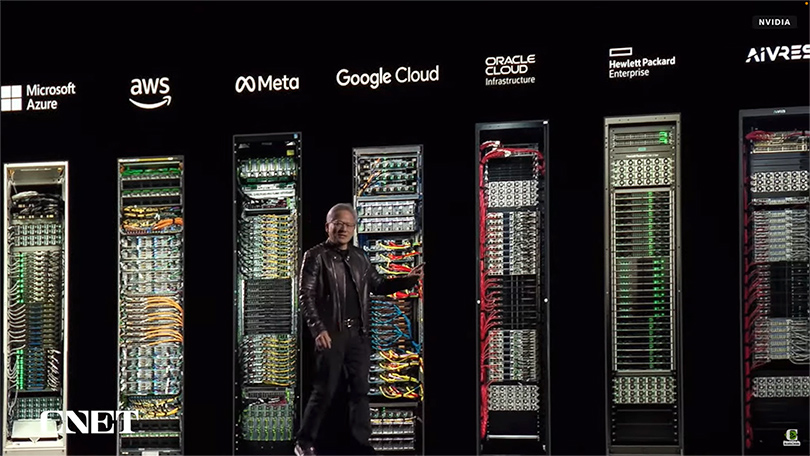
Look out Google, Amazon, and others! Nvidia is putting the pedal to the metal in terms of being innovative and visionary! They are leaving the likes of Apple in the dust.

The top talent out there is likely to go to Nvidia for a while. Engineers, programmers/software architects, network architects, product designers, data specialists, AI researchers, developers of robotics and autonomous vehicles, R&D specialists, computer vision specialists, natural language processing experts, and many more types of positions will be flocking to Nvidia to work for a company that has already changed the world and will likely continue to do so for years to come. 


NVIDIA’s AI Superbowl — from theneurondaily.com by Noah and Grant
PLUS: Prompt tips to make AI writing more natural

That’s despite a flood of new announcements (here’s a 16 min video recap), which included:

  1. A new architecture for massive AI data centers (now called “AI factories”).
  2. A physics engine for robot training built with Disney and DeepMind.
  3. partnership with GM to develop next-gen vehicles, factories and robots.
  4. A new Blackwell chip with “Dynamo” software that makes AI reasoning 40x faster than previous generations.
  5. A new “Rubin” chip slated for 2026 and a “Feynman” chip set for 2028.

For enterprises, NVIDIA unveiled DGX Spark and DGX Station—Jensen’s vision of AI-era computing, bringing NVIDIA’s powerful Blackwell chip directly to your desk.


Nvidia Bets Big on Synthetic Data — from wired.com by Lauren Goode
Nvidia has acquired synthetic data startup Gretel to bolster the AI training data used by the chip maker’s customers and developers.


Nvidia, xAI to Join BlackRock and Microsoft’s $30 Billion AI Infrastructure Fund — from investopedia.com by Aaron McDade
Nvidia and xAI are joining BlackRock and Microsoft in an AI infrastructure group seeking $30 billion in funding. The group was first announced in September as BlackRock and Microsoft sought to fund new data centers to power AI products.


Nvidia CEO Jensen Huang says we’ll soon see 1 million GPU data centers visible from space — from finance.yahoo.com by Daniel Howley
Nvidia CEO Jensen Huang says the company is preparing for 1 million GPU data centers.


Nvidia stock stems losses as GTC leaves Wall Street analysts ‘comfortable with long term AI demand’ — from finance.yahoo.com by Laura Bratton
Nvidia stock reversed direction after a two-day slide that saw shares lose 5% as the AI chipmaker’s annual GTC event failed to excite investors amid a broader market downturn.


Microsoft, Google, and Oracle Deepen Nvidia Partnerships. This Stock Got the Biggest GTC Boost. — from barrons.com by Adam Clark and Elsa Ohlen


The 4 Big Surprises from Nvidia’s ‘Super Bowl of AI’ GTC Keynote — from barrons.com by Tae Kim; behind a paywall

AI Super Bowl. Hi everyone. This week, 20,000 engineers, scientists, industry executives, and yours truly descended upon San Jose, Calif. for Nvidia’s annual GTC developers’ conference, which has been dubbed the “Super Bowl of AI.”


20 AI Agent Examples in 2025 — from autogpt.net

AI Agents are now deeply embedded in everyday life and?quickly transforming industry after industry. The global AI market is expected to explode up to $1.59 trillion by 2030! That is a?ton of intelligent agents operating behind the curtains.

That’s why in this article, we explore?20 real-life AI Agents that are causing a stir today.


Top 100 Gen AI apps, new AI video & 3D — from eatherbcooper.substack.com by Heather Cooper
Plus Runway Restyle, Luma Ray2 img2vid keyframes & extend

?In the latest edition of Andreessen Horowitz’s “Top 100 Gen AI Consumer Apps,” the generative AI landscape has undergone significant shifts.

Notably, DeepSeek has emerged as a leading competitor to ChatGPT, while AI video models have advanced from experimental stages to more reliable tools for short clips. Additionally, the rise of “vibecoding” is broadening the scope of AI creators.

The report also introduces the “Brink List,” highlighting ten companies poised to enter the top 100 rankings.?


AI is Evolving Fast – The Latest LLMs, Video Models & Breakthrough Tools — from heatherbcooper.substack.com by Heather Cooper
Breakthroughs in multimodal search, next-gen coding assistants, and stunning text-to-video tech. Here’s what’s new:

I do these comparisons frequently to measure the improvements in different models for text or image to video prompts. I hope it is helpful for you, as well!

I included 6 models for an image to video comparison:

  • Pika 2.1 (I will do one with Pika’s new 2.2 model soon)
  • Adobe Firefly Video
  • Runway Gen-3
  • Kling 1.6
  • Luma Ray2
  • Hailuo I2V-01


Why Smart Companies Are Granting AI Immunity to Their Employees — from builtin.com by Matt Almassian
Employees are using AI tools whether they’re authorized or not. Instead of cracking down on AI usage, consider developing an AI amnesty program. Learn more.

But the smartest companies aren’t cracking down. They’re flipping the script. Instead of playing AI police, they’re launching AI amnesty programs, offering employees a safe way to disclose their AI usage without fear of punishment. In doing so, they’re turning a security risk into an innovation powerhouse.

Before I dive into solutions, let’s talk about what keeps your CISO or CTO up at night. Shadow AI isn’t just about unauthorized tool usage — it’s a potential dirty bomb of security, compliance and operational risks that could explode at any moment.

6 Steps to an AI Amnesty Program

  1. Build your AI governance foundation.
  2. Transform your IT department from gatekeeper to innovation partner.
  3. Make AI education easily accessible.
  4. Deploy your technical safety net.
  5. Create an AI-positive culture.
  6. Monitor, adapt and evolve.

A first-ever study on prompts… — from theneurondaily.com
PLUS: OpenAI wants to charge $20K a month to replace you?!

What they discovered might change how you interact with AI:

  • Consistency is a major problem. The researchers asked the same questions 100 times and found models often give different answers to the same question.
  • Formatting matters a ton. Telling the AI exactly how to structure its response consistently improved performance.
  • Politeness is… complicated. Saying “please” helped the AI answer some questions but made it worse at others. Same for being commanding (“I order you to…”).
  • Standards matter. If you need an AI to be right 100% of the time, you’re in trouble.

That’s also why we think you, an actual human, should always place yourself as a final check between whatever your AI creates and whatever goes out into the world.


Leave it to Manus
“Manus is a general AI agent that bridges minds and actions: it doesn’t just think, it delivers results. Manus excels at various tasks in work and life, getting everything done while you rest.”

From DSC:
What could possibly go wrong?!


AI Search Has A Citation Problem — from cjr.org (Columbia Journalism Review) by Klaudia Ja?wi?ska and Aisvarya Chandrasekar
We Compared Eight AI Search Engines. They’re All Bad at Citing News.

We found that…

Chatbots were generally bad at declining to answer questions they couldn’t answer accurately, offering incorrect or speculative answers instead.

  • Premium chatbots provided more confidently incorrect answers than their free counterparts.
  • Multiple chatbots seemed to bypass Robot Exclusion Protocol preferences.
  • Generative search tools fabricated links and cited syndicated and copied versions of articles.
  • Content licensing deals with news sources provided no guarantee of accurate citation in chatbot responses.

Our findings were consistent with our previous study, proving that our observations are not just a ChatGPT problem, but rather recur across all the prominent generative search tools that we tested.


5 new AI tools you’ll actually want to try — from wondertools.substack.com by Jeremy Kaplan
Chat with lifelike AI, clean up audio instantly, and reimagine your career

Hundreds of AI tools emerge every week. I’ve picked five new ones worth exploring. They’re free to try, easy to use, and signal new directions for useful AI.

Example:

Career Dreamer
A playful way to explore career possibilities with AI


Are Entry-Level Jobs Going Away? The Hidden Workforce Shift — from forbes.com by Dr. Diane Hamilton; via Ryan Craig

The problem is that these new roles demand a level of expertise that wasn’t expected from entry-level candidates in the past. Where someone might have previously learned on the job, they are now required to have relevant certifications, AI proficiency, or experience with digital platforms before they even apply.

Some current and emerging job titles that serve as entry points into industries include:

  • Digital marketing associate – This role often involves content creation, social media management, and working with AI-driven analytics tools.
  • Junior AI analyst – Employees in this role assist data science teams by labeling and refining machine learning datasets.
  • Customer success associate – Replacing traditional customer service roles, these professionals help manage AI-enhanced customer support systems.
  • Technical support specialist – While this role still involves troubleshooting software, it now often includes AI-driven diagnostics and automation oversight.
 

Blind Spot on AI — from the-job.beehiiv.com by Paul Fain
Office tasks are being automated now, but nobody has answers on how education and worker upskilling should change.

Students and workers will need help adjusting to a labor market that appears to be on the verge of a historic disruption as many business processes are automated. Yet job projections and policy ideas are sorely lacking.

The benefits of agentic AI are already clear for a wide range of organizations, including small nonprofits like CareerVillage. But the ability to automate a broad range of business processes means that education programs and skills training for knowledge workers will need to change. And as Chung writes in a must-read essay, we have a blind spot with predicting the impacts of agentic AI on the labor market.

“Without robust projections,” he writes, “policymakers, businesses, and educators won’t be able to come to terms with how rapidly we need to start this upskilling.”

 
© 2025 | Daniel Christian