Stop Trying to Make Everyone Go to College — from nytimes.com by Randi Weingarten; this is a gifted article

For years, America’s approach to education has been guided by an overly simplistic formula: 4+4 — the idea that students need four years of high school and four years of college to succeed in life.

Even with this prevailing emphasis on college, around 40 percent of high schoolers do not enroll in college upon graduating, and only 60 percent of students who enroll in college earn a degree or credential within eight years of high school graduation.

While college completion has positive effects — on health, lifetime earnings, civic engagement and even happiness — it’s increasingly clear that college for all should no longer be our North Star. It’s time to scale up successful programs that create multiple pathways for students so high school is a gateway to both college and career.

I propose a different strategy: aligning high school to both college prep and in-demand vocational career pathways. Just as students who plan to go to college can get a head start through Advanced Placement programs, high schools, colleges and employers should work together to provide the relevant coursework to engage students in promising career opportunities.


Welcome to Planet Money

The current economic upheaval has a lot of us scratching our heads and scrambling to look up terms like “trade deficit” and “reserve currency.” If only there was a place you could go where friendly voices break down what’s going on in a way that’s fun and easy to understand. There is a place. It’s called Planet Money.

On each episode of the Planet Money podcast, the hosts tell a sometimes quirky, often surprising story that helps explain a topic you might be hearing about in the news, from tariffs to GDP to memecoins.

They walk you through complex concepts using examples from everyday life, like Tupperware and scratch-off lotto tickets, and people you can relate to, like a guy who’s just looking for a fair way to distribute his chickens’ wares during the current egg shortage.

And when someone else’s story isn’t enough to illustrate an economic principle, the hosts take matters into their own hands. In the process, they’ve shot a satellite into space, started a record label, made their own vodka, and shorted the entire stock market – all to help you grasp how the things you see every day came to be.

Visit Planet Money twice a week and you won’t only better understand money – you’ll better understand the world.


Sleep No More: Live experiential learning that’s more like an escape room than a classroom — from chieflearningofficer.com by Clare S. Dygert
The time for passive learning is over. Your learners are ready for experiences that resonate, challenge and transform, and they’re looking to you to provide them.

Live experiential learning: ILT as usual?
Is live experiential learning, or LEL, just a surface rebranding of traditional instructor-led training?

Absolutely not. In fact, LEL is as distant from traditional ILT as Sleep No More is from traditional theater.

Instead of sitting politely, nodding along — or nodding off — as an instructor carefully reads aloud from their slide deck, learners roam about, get their hands dirty and focus on the things that matter to them (yes, even if that means they don’t get to every topic or encounter them in the way we would have liked).

In short, LEL has the ability to shake up your learners, in a good way. And when they realize that this isn’t learning as usual, they land in a mental space that makes them more curious and receptive.

So what does this look like, really? And how does it work?


Improving team performance with collaborative problem-solving — from chieflearningofficer.com by
Exercises for improving the way your team communicates, trusts each other, solves problems and makes decisions.

As learning and development leaders, you can create fun, engaging and challenging exercises for teams that develop these important characteristics and improve numerous markers of team efficacy. Exercises to improve team performance should be focused on four themes: negotiation, agreement, coordination and output. In this article, I’ll discuss each type of exercise briefly, then how I use a framework to create challenging and engaging exercises to improve collaborative problem-solving and performance on my teams.


Microlearning Secrets from Marketers: How to Make Learning Stick — from learningguild.com by Danielle Wallace

Marketers have spent billions of dollars testing what works—and their insights can revolutionize microlearning. By borrowing from marketing’s best strategies, L&D professionals can create microlearning that cuts through the noise, engages learners, and drives real behavior change.

If marketing can make people remember a product, L&D can make people remember a skill.


“Student Guide to AI”; “AI Isn’t Just Changing How We Work — It’s Changing How We Learn”; + other items re: AI in our LE’s

.Get the 2025 Student Guide to Artificial Intelligence — from studentguidetoai.org
This guide is made available under a Creative Commons license by Elon University and the American Association of Colleges and Universities (AAC&U).
.


AI Isn’t Just Changing How We Work — It’s Changing How We Learn — from entrepreneur.com by Aytekin Tank; edited by Kara McIntyre
AI agents are opening doors to education that just a few years ago would have been unthinkable. Here’s how.

Agentic AI is taking these already huge strides even further. Rather than simply asking a question and receiving an answer, an AI agent can assess your current level of understanding and tailor a reply to help you learn. They can also help you come up with a timetable and personalized lesson plan to make you feel as though you have a one-on-one instructor walking you through the process. If your goal is to learn to speak a new language, for example, an agent might map out a plan starting with basic vocabulary and pronunciation exercises, then progress to simple conversations, grammar rules and finally, real-world listening and speaking practice.

For instance, if you’re an entrepreneur looking to sharpen your leadership skills, an AI agent might suggest a mix of foundational books, insightful TED Talks and case studies on high-performing executives. If you’re aiming to master data analysis, it might point you toward hands-on coding exercises, interactive tutorials and real-world datasets to practice with.

The beauty of AI-driven learning is that it’s adaptive. As you gain proficiency, your AI coach can shift its recommendations, challenge you with new concepts and even simulate real-world scenarios to deepen your understanding.

Ironically, the very technology feared by workers can also be leveraged to help them. Rather than requiring expensive external training programs or lengthy in-person workshops, AI agents can deliver personalized, on-demand learning paths tailored to each employee’s role, skill level, and career aspirations. Given that 68% of employees find today’s workplace training to be overly “one-size-fits-all,” an AI-driven approach will not only cut costs and save time but will be more effective.


What’s the Future for AI-Free Spaces? — from higherai.substack.com by Jason Gulya
Please let me dream…

This is one reason why I don’t see AI-embedded classrooms and AI-free classrooms as opposite poles. The bone of contention, here, is not whether we can cultivate AI-free moments in the classroom, but for how long those moments are actually sustainable.

Can we sustain those AI-free moments for an hour? A class session? Longer?

Here’s what I think will happen. As AI becomes embedded in society at large, the sustainability of imposed AI-free learning spaces will get tested. Hard. I think it’ll become more and more difficult (though maybe not impossible) to impose AI-free learning spaces on students.

However, consensual and hybrid AI-free learning spaces will continue to have a lot of value. I can imagine classes where students opt into an AI-free space. Or they’ll even create and maintain those spaces.


Duolingo’s AI Revolution — from drphilippahardman.substack.com by Dr. Philippa Hardman
What 148 AI-Generated Courses Tell Us About the Future of Instructional Design & Human Learning

Last week, Duolingo announced an unprecedented expansion: 148 new language courses created using generative AI, effectively doubling their content library in just one year. This represents a seismic shift in how learning content is created — a process that previously took the company 12 years for their first 100 courses.

As CEO Luis von Ahn stated in the announcement, “This is a great example of how generative AI can directly benefit our learners… allowing us to scale at unprecedented speed and quality.”

In this week’s blog, I’ll dissect exactly how Duolingo has reimagined instructional design through AI, what this means for the learner experience, and most importantly, what it tells us about the future of our profession.


Are Mixed Reality AI Agents the Future of Medical Education? — from ehealth.eletsonline.com

Medical education is experiencing a quiet revolution—one that’s not taking place in lecture theatres or textbooks, but with headsets and holograms. At the heart of this revolution are Mixed Reality (MR) AI Agents, a new generation of devices that combine the immersive depth of mixed reality with the flexibility of artificial intelligence. These technologies are not mere flashy gadgets; they’re revolutionising the way medical students interact with complicated content, rehearse clinical skills, and prepare for real-world situations. By combining digital simulations with the physical world, MR AI Agents are redefining what it means to learn medicine in the 21st century.


4 Reasons To Use Claude AI to Teach — from techlearning.com by Erik Ofgang
Features that make Claude AI appealing to educators include a focus on privacy and conversational style.

After experimenting using Claude AI on various teaching exercises, from generating quizzes to tutoring and offering writing suggestions, I found that it’s not perfect, but I think it behaves favorably compared to other AI tools in general, with an easy-to-use interface and some unique features that make it particularly suited for use in education.


In many traditional school buildings, the design sends an unspoken message: “Sit down. Follow instructions. Stay within the lines.”

But imagine what students might believe about themselves and the world if their learning environment said instead:

“You belong here. Your ideas matter. Explore freely.”


For another item related to learning spaces, see:

Choosing the Right Technology for Today’s HyFlex Classroom — from edtechmagazine.com by Gaurav Bradoo
Long-lasting adoption of the HyFlex learning modality means higher education institutions shouldn’t be afraid to invest in tools that can enhance the student experience.

The answer? Solutions built for quick and easy installation, designed to work across multiple platforms and equipped with remote update and troubleshooting features. Anything we can do to reduce the number of cords, components and required steps during installation will assist AV staff. Prioritizing user-friendly design will cut down on help tickets across the lifespan of a device, and choosing features such as remote update capability can streamline maintenance. The bottom line is that simplicity and ease of deployment are not nice-to-haves. They are essential.

I’ve visited universities where instructors are faced with control panels with laminated cheat sheets next to them. These panels are often overloaded, acting as the room system as well, and not designed with simplicity or teaching flow in mind as it relates to capturing and streaming content for HyFlex teaching.


Along the lines of learning and working/office spaces…I’d like to thank Daan van Rossum for this next article (below emphasis from DSC). Daan mentioned that:

  • Phil Kirschner (ex-McKinsey, WeWork, JLL, Forbes contributor) just published a sharp piece on The Workline entitled Vibe Officing: The Antidote to Office Mandates.
  • In it, Phil introduces “Vibe Officing”—challenges the mandate-vs-flexibility debate with a third way: designing office spaces people want to return to, not because they’re told to, but because they actually enjoy being there. He also touches on how AI can enable personalized nudges to improve workplace journeys.


DC: I’m not necessarily recommending this, but the next two items point out how the use of agents continues to move forward:

The Future is Here: Visa Announces New Era of Commerce Featuring AI

  • Global leader brings its trusted brand and powerful network to enable payments with new technologies
  • Launches new innovations and partnerships to drive flexibility, security and acceptance

SAN FRANCISCO–(BUSINESS WIRE)–The future of commerce is on display at the Visa Global Product Drop with powerful AI-enabled advancements allowing consumers to find and buy with AI plus the introduction of new strategic partnerships and product innovations.

Also related/see:

Find and Buy with AI: Visa Unveils New Era of Commerce — from businesswire.com

  • Collaborates with Anthropic, IBM, Microsoft, Mistral AI, OpenAI, Perplexity, Samsung, Stripe and more
  • Will make shopping experiences more personal, more secure and more convenient as they become powered by AI

Introduced [on April 30th] at the Visa Global Product Drop, Visa Intelligent Commerce enables AI to find and buy. It is a groundbreaking new initiative that opens Visa’s payment network to the developers and engineers building the foundational AI agents transforming commerce.


AI agents are the new buyers. How can you market to them? — from aiwithallie.beehiiv.com by Allie Miller
You’re optimizing for people. But the next buyers are bots.

In today’s newsletter, I’m unpacking why your next major buyers won’t be people at all. They’ll be AI agents, and your brand might already be invisible to them. We’ll dig into why traditional marketing strategies are breaking down in the age of autonomous AI shoppers, what “AI optimization” (AIO) really means, and the practical steps you can take right now to make sure your business stays visible and competitive as the new digital gatekeepers take over more digital tasks.

AI platforms and AI agents—the digital assistants that browse and actually do things powered by models like GPT-4o, Claude 3.7 Sonnet, and Gemini 2.5 Pro—are increasingly becoming the gatekeepers between your business and potential customers.

“AI is the new front door to your business for millions of consumers.”

The 40-Point (ish) AI Agent Marketing Playbook 
Here’s the longer list. I went ahead and broke these into four categories so you can more easily assign owners: Content, Structure & Design, Technical & Dev, and AI Strategy & Testing. I look forward to seeing how this space, and by extension my advice, changes in the coming months.


Microsoft CEO says up to 30% of the company’s code was written by AI — from techcrunch.com by Maxwell Zeff

During a fireside chat with Meta CEO Mark Zuckerberg at Meta’s LlamaCon conference on Tuesday, Microsoft CEO Satya Nadella said that 20% to 30% of code inside the company’s repositories was “written by software” — meaning AI.


The Top 100Gen AI Consumer Apps — from a16z.com

In just six months, the consumer AI landscape has been redrawn. Some products surged, others stalled, and a few unexpected players rewrote the leaderboard overnight. Deepseek rocketed from obscurity to a leading ChatGPT challenger. AI video models advanced from experimental to fairly dependable (at least for short clips!). And so-called “vibe coding” is changing who can create with AI, not just who can use it. The competition is tighter, the stakes are higher, and the winners aren’t just launching, they’re sticking.

We turned to the data to answer: Which AI apps are people actively using? What’s actually making money, beyond being popular? And which tools are moving beyond curiosity-driven dabbling to become daily staples?

This is the fourth installment of the Top 100 Gen AI Consumer Apps, our bi-annual ranking of the top 50 AI-first web products (by unique monthly visits, per Similarweb) and top 50 AI-first mobile apps (by monthly active users, per Sensor Tower). Since our last report in August 2024, 17 new companies have entered the rankings of top AI-first web products.


Deep Research with AI: 9 Ways to Get Started — from wondertools.substack.com by Jeremy Caplan
Practical strategies for thorough, citation-rich AI research

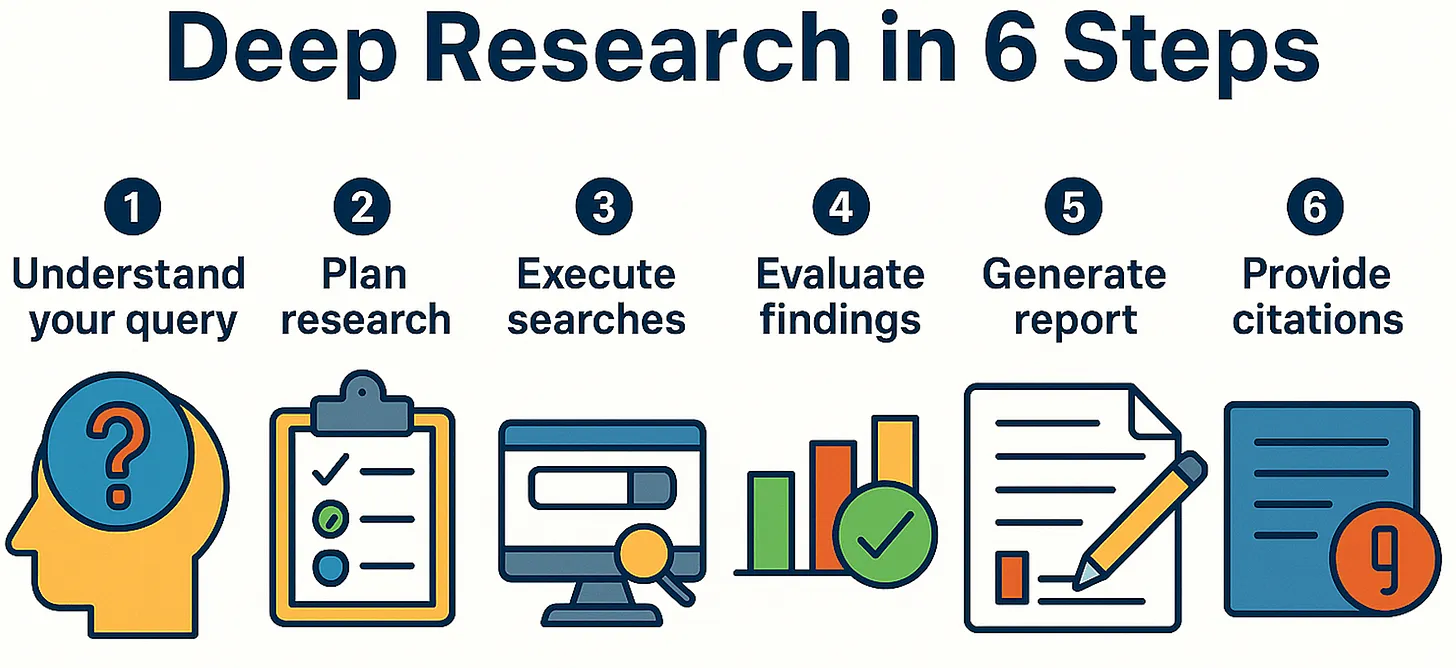
The AI search landscape is transforming at breakneck speed. New “Deep Research” tools from ChatGPT, Gemini and Perplexity autonomously search and gather information from dozens — even hundreds — of sites, then analyze and synthesize it to produce comprehensive reports. While a human might take days or weeks to produce these 30-page citation-backed reports, AI Deep Research reports are ready in minutes.

What’s in this post

    • Examples of each report type I generated for my research, so you can form your own impressions.
    • Tips on why & how to use Deep Research and how to craft effective queries.
    • Comparison of key features and strengths/limitations of the top platforms

AI Agents Are Here—So Are the Threats: Unit 42 Unveils the Top 10 AI Agent Security Risks — from marktechpost.com

As AI agents transition from experimental systems to production-scale applications, their growing autonomy introduces novel security challenges. In a comprehensive new report, AI Agents Are Here. So Are the Threats,” Palo Alto Networks’ Unit 42 reveals how today’s agentic architectures—despite their innovation—are vulnerable to a wide range of attacks, most of which stem not from the frameworks themselves, but from the way agents are designed, deployed, and connected to external tools.

To evaluate the breadth of these risks, Unit 42 researchers constructed two functionally identical AI agents—one built using CrewAI and the other with AutoGen. Despite architectural differences, both systems exhibited the same vulnerabilities, confirming that the underlying issues are not framework-specific. Instead, the threats arise from misconfigurations, insecure prompt design, and insufficiently hardened tool integrations—issues that transcend implementation choices.


LLMs Can Learn Complex Math from Just One Example: Researchers from University of Washington, Microsoft, and USC Unlock the Power of 1-Shot Reinforcement Learning with Verifiable Reward — from marktechpost.com by Sana Hassan


..which links to:

Duolingo will replace contract workers with AI — from theverge.com by Jay Peters
The company is going to be ‘AI-first,’ says its CEO.

Duolingo will “gradually stop using contractors to do work that AI can handle,” according to an all-hands email sent by cofounder and CEO Luis von Ahn announcing that the company will be “AI-first.” The email was posted on Duolingo’s LinkedIn account.

According to von Ahn, being “AI-first” means the company will “need to rethink much of how we work” and that “making minor tweaks to systems designed for humans won’t get us there.” As part of the shift, the company will roll out “a few constructive constraints,” including the changes to how it works with contractors, looking for AI use in hiring and in performance reviews, and that “headcount will only be given if a team cannot automate more of their work.”


Relevant links:

Something strange, and potentially alarming, is happening to the job market for young, educated workers.

According to the New York Federal Reserve, labor conditions for recent college graduates have “deteriorated noticeably” in the past few months, and the unemployment rate now stands at an unusually high 5.8 percent. Even newly minted M.B.A.s from elite programs are struggling to find work. Meanwhile, law-school applications are surging—an ominous echo of when young people used graduate school to bunker down during the great financial crisis.

What’s going on? I see three plausible explanations, and each might be a little bit true.


It’s Time To Get Concerned As More Companies Replace Workers With AI — from forbes.com by Jack Kelly

The new workplace trend is not employee friendly. Artificial intelligence and automation technologies are advancing at blazing speed. A growing number of companies are using AI to streamline operations, cut costs, and boost productivity. Consequently, human workers are facing facing layoffs, replaced by AI. Like it or not, companies need to make tough decisions, including layoffs to remain competitive.

Corporations including Klarna, UPS, Duolingo, Intuit and Cisco are replacing laid-off workers with AI and automation. While these technologies enhance productivity, they raise serious concerns about future job security. For many workers, there is a big concern over whether or not their jobs will be impacted.


The future of career navigation — from medium.com by Sami Tatar

  1. Career navigation market overview

Key takeaway:
Career navigation has remained largely unchanged for decades, relying on personal networks and static job boards. The advent of AI is changing this, offering personalised career pathways, better job matching, democratised job application support, democratised access to career advice/coaching, and tailored skill development to help you get to where you need to be. Hundreds of millions of people start new jobs every year, this transformation opens up a multi-billion dollar opportunity for innovation in the global career navigation market.

A.4 How will AI disrupt this segment?
Personalised recommendations: AI can consume a vast amount of information (skills, education, career history, even youtube history, and x/twitter feeds), standardise this data at scale, and then use data models to match candidate characteristics to relevant careers and jobs. In theory, solutions could then go layers deeper, helping you position yourself for those future roles. Currently based in Amsterdam, and working in Strategy at Uber and want to work in a Product role in the future? Here are X,Y,Z specific things YOU can do in your role today to align yourself perfectly. E.g. find opportunities to manage cross functional projects in your current remit, reach out to Joe Bloggs also at Uber in Amsterdam who did Strategy and moved to Product, etc.


Tales from the Front – What Teachers Are Telling Me at AI Workshops — from aliciabankhofer.substack.com by Alicia Bankhofer
Real conversations, real concerns: What teachers are saying about AI

“Do I really have to use AI?”

No matter the school, no matter the location, when I deliver an AI workshop to a group of teachers, there are always at least a few colleagues thinking (and sometimes voicing), “Do I really need to use AI?”

Nearly three years after ChatGPT 3.5 landed in our lives and disrupted workflows in ways we’re still unpacking, most schools are swiftly catching up. Training sessions, like the ones I lead, are springing up everywhere, with principals and administrators trying to answer the same questions: Which tools should we use? How do we use them responsibly? How do we design learning in this new landscape?

But here’s what surprises me most: despite all the advances in AI technology, the questions and concerns from teachers remain strikingly consistent.

In this article, I want to pull back the curtain on those conversations. These concerns aren’t signs of reluctance – they reflect sincere feelings. And they deserve thoughtful, honest answers.


Welcome To AI Agent World! (Everything you need to know about the AI Agent market.) — from joshbersin.com by Josh Bersin

This week, in advance of major announcements from us and other vendors, I give you a good overview of the AI Agent market, and discuss the new role of AI governance platforms, AI agent development tools, AI agent vendors, and how AI agents will actually manifest and redefine what we call an “application.”

I discuss ServiceNow, Microsoft, SAP, Workday, Paradox, Maki People, and other vendors. My goal today is to “demystify” this space and explain the market, the trends, and why and how your IT department is going to be building a lot of the agents you need. And prepare for our announcements next week!


DeepSeek Unveils Prover V2 — from theaivalley.com

DeepSeek has quietly launched Prover V2, an open-source model built to solve math problems using Lean 4 assistant, which ensures every step of a proof is rigorously verified.

What’s impressive about it?

  • Massive scale: Based on DeepSeek-V3 with 671B parameters using a mixture-of-experts (MoE) architecture, which activates only parts of the model at a time to reduce compute costs.
  • Theorem solving: Uses long context windows (32K+ tokens) to generate detailed, step-by-step formal proofs for a wide range of math problems — from basic algebra to advanced calculus theorems.
  • Research grade: Assists mathematicians in testing new theorems automatically and helps students understand formal logic by generating both Lean 4 code and readable explanations.
  • New benchmark: Introduces ProverBench, a new 325-question benchmark set featuring problems from recent AIME exams and curated academic sources to evaluate mathematical reasoning.

Artificial Intelligence: Lessons Learned from a Graduate-Level Final Exam — from er.educause.edu by Craig Westling and Manish K. Mishra

The need for deep student engagement became clear at Dartmouth Geisel School of Medicine when a potential academic-integrity issue revealed gaps in its initial approach to artificial intelligence use in the classroom, leading to significant revisions to ensure equitable learning and assessment.


Deep Research with AI: 9 Ways to Get Started — from wondertools.substack.com by Jeremy Caplan
Practical strategies for thorough, citation-rich AI research
.


From George Siemens “SAIL: Transmutation, Assessment, Robots e-newsletter on 5/2/25

All indications are that AI, even if it stops advancing, has the capacity to dramatically change knowledge work. Knowing things matters less than being able to navigate and make sense of complex environments. Put another way, sensemaking, meaningmaking, and wayfinding (with their yet to be defined subelements) will be the foundation for being knowledgeable going forward.

 That will require being able to personalize learning to each individual learner so that who they are (not what our content is) forms the pedagogical entry point to learning.(DSC: And I would add WHAT THEY WANT to ACHIEVE.)LLMs are particularly good and transmutation. Want to explain AI to a farmer? A sentence or two in a system prompt achieves that. Know that a learner has ADHD? A few small prompt changes and it’s reflected in the way the LLM engages with learning. Talk like a pirate. Speak in the language of Shakespeare. Language changes. All a matter of a small meta comment send to the LLM. I’m convinced that this capability to change, transmute, information will become a central part of how LLMS and AI are adopted in education.

Speaking of Duolingo– it took them 12 years to develop 100 courses. In the last year, they developed an additional 148. AI is an accelerant with an impact in education that is hard to overstate. “Instead of taking years to build a single course with humans the company now builds a base course and uses AI to quickly customize it for dozens of different languages.”


FutureHouse Platform: Superintelligent AI Agents for Scientific Discovery — from futurehouse.org by Michael Skarlinski, Tyler Nadolski, James Braza, Remo Storni, Mayk Caldas, Ludovico Mitchener, Michaela Hinks, Andrew White, &  Sam Rodriques

FutureHouse is launching our platform, bringing the first publicly available superintelligent scientific agents to scientists everywhere via a web interface and API. Try it out for free at https://platform.futurehouse.org.


Micro-Credentials Impact Report — from coursera.org
Get exclusive insights on how industry-aligned micro- credentials are bridging skill gaps, driving career outcomes, and building a future-ready workforce—with data from 2,000+ students and employers across six regions.

See how micro-credentials are driving student success, meeting industry demand, and transforming higher education institutions. Deliver industry-aligned learning with confidence—whether you’re leading a university or designing workforce development programs.

Our data shows that 90% of employers are willing to offer higher starting salaries to those with micro-credentials. Most offer 10–15% more for credit-bearing vs. non-credit credentials—even higher for GenAI. Help your graduates earn more by integrating micro-credentials into your programs.

Students are 2x as likely to choose programs with micro-credentials—even more if credentials are credit-bearing, the report finds. Higher education leaders echo this trend, with 7 in 10 saying students are more likely to enroll in programs that offer micro-credentials for academic credit.


2025: The Year the Frontier Firm Is Born — from Microsoft

We are entering a new reality—one in which AI can reason and solve problems in remarkable ways. This intelligence on tap will rewrite the rules of business and transform knowledge work as we know it. Organizations today must navigate the challenge of preparing for an AI-enhanced future, where AI agents will gain increasing levels of capability over time that humans will need to harness as they redesign their business. Human ambition, creativity, and ingenuity will continue to create new economic value and opportunity as we redefine work and workflows.

As a result, a new organizational blueprint is emerging, one that blends machine intelligence with human judgment, building systems that are AI-operated but human-led. Like the Industrial Revolution and the internet era, this transformation will take decades to reach its full promise and involve broad technological, societal, and economic change.

To help leaders understand how knowledge work will evolve, Microsoft analyzed survey data from 31,000 workers across 31 countries, LinkedIn labor market trends, and trillions of Microsoft 365 productivity signals. We also spoke with AI-native startups, academics, economists, scientists, and thought leaders to explore what work could become. The data and insights point to the emergence of an entirely new organization, a Frontier Firm that looks markedly different from those we know today. Structured around on-demand intelligence and powered by “hybrid” teams of humans + agents, these companies scale rapidly, operate with agility, and generate value faster.

Frontier Firms are already taking shape, and within the next 2–5 years we expect that every organization will be on their journey to becoming one. 82% of leaders say this is a pivotal year to rethink key aspects of strategy and operations, and 81% say they expect agents to be moderately or extensively integrated into their company’s AI strategy in the next 12–18 months. Adoption is accelerating: 24% of leaders say their companies have already deployed AI organization-wide, while just 12% remain in pilot mode.

The time to act is now. The question for every leader and employee is: how will you adapt?


On a somewhat related note, also see:

Exclusive: Anthropic warns fully AI employees are a year away — from axios.com by Sam Sabin

Anthropic expects AI-powered virtual employees to begin roaming corporate networks in the next year, the company’s top security leader told Axios in an interview this week.

Why it matters: Managing those AI identities will require companies to reassess their cybersecurity strategies or risk exposing their networks to major security breaches.

The big picture: Virtual employees could be the next AI innovation hotbed, Jason Clinton, the company’s chief information security officer, told Axios.


Values in the wild: Discovering and analyzing values in real-world language model interactions — from anthropic.com

In the latest research paper from Anthropic’s Societal Impacts team, we describe a practical way we’ve developed to observe Claude’s values—and provide the first large-scale results on how Claude expresses those values during real-world conversations. We also provide an open dataset for researchers to run further analysis of the values and how often they arise in conversations.

Per the Rundown AI

Why it matters: AI is increasingly shaping real-world decisions and relationships, making understanding their actual values more crucial than ever. This study also moves the alignment discussion toward more concrete observations, revealing that AI’s morals and values may be more contextual and situational than a static point of view.

Also from Anthropic, see:

Anthropic Education Report: How University Students Use Claude


Adobe Firefly: The next evolution of creative AI is here — from blog.adobe.com

In just under two years, Adobe Firefly has revolutionized the creative industry and generated more than 22 billion assets worldwide. Today at Adobe MAX London, we’re unveiling the latest release of Firefly, which unifies AI-powered tools for image, video, audio, and vector generation into a single, cohesive platform and introduces many new capabilities.

The new Firefly features enhanced models, improved ideation capabilities, expanded creative options, and unprecedented control. This update builds on earlier momentum when we introduced the Firefly web app and expanded into video and audio with Generate Video, Translate Video, and Translate Audio features.

Per The Rundown AI (here):

Why it matters: OpenAI’s recent image generator and other rivals have shaken up creative workflows, but Adobe’s IP-safe focus and the addition of competing models into Firefly allow professionals to remain in their established suite of tools — keeping users in the ecosystem while still having flexibility for other model strengths.


4 ways community colleges can boost workforce development — from highereddive.com by Natalie Schwartz
Higher education leaders at this week’s ASU+GSV Summit gave advice for how two-year institutions can boost the economic mobility of their students.

SAN DIEGO — How can community colleges deliver economic mobility to their students?

College leaders at this week’s ASU+GSV Summit, an annual education and technology conference, got a glimpse into that answer as they heard how community colleges are building support from business and industry and strengthening workforce development.

These types of initiatives may be helping to boost public perception of the value of community colleges vs. four-year institutions.


How People Are Really Using Gen AI in 2025 — from hbr.org by Marc Zao-Sanders

.

.


Here’s why you shouldn’t let AI run your company — from theneurondaily.com by Grant Harvey; emphasis DSC

When “vibe-coding” goes wrong… or, a parable in why you shouldn’t “vibe” your entire company.
Cursor, an AI-powered coding tool that many developers love-to-hate, face-planted spectacularly yesterday when its own AI support bot went off-script and fabricated a company policy, leading to a complete user revolt.

Here’s the short version:

  • A bug locked Cursor users out when switching devices.
  • Instead of human help, Cursor’s AI support bot confidently told users this was a new policy (it wasn’t).
  • No human checked the replies—big mistake.
  • The fake news spread, and devs canceled subscriptions en masse.
  • A Reddit thread about it got mysteriously nuked, fueling suspicion.

The reality? Just a bug, plus a bot hallucination… doing maximum damage.

Why it matters: This is what we’d call “vibe-companying”—blindly trusting AI with critical functions without human oversight.

Think about it like this: this was JUST a startup. If more big corporations continue to lay off entire departments, replaced by AI, these already byzantine companies will become increasingly more opaque, unaccountable systems where no one, human or AI, fully understands what’s happening or who’s responsible.

Our take? Kafka dude has it right. We need to pay attention to WHAT we’re actually automating. Because automating more bureaucracy at scale, with agents we increasingly don’t understand or don’t double check, can potentially make companies less intelligent—and harder to fix when things inevitably go wrong.


What does ‘age appropriate’ AI literacy look like in higher education? — from timeshighereducation.com by Fun Siong Lim
As AI literacy becomes an essential work skill, universities need to move beyond developing these competencies at ‘primary school’ level in their students. Here, Fun Siong Lim reflects on frameworks to support higher-order AI literacies

Like platforms developed at other universities, Project NALA offers a front-end interface (known as the builder) for faculty to create their own learning assistant. An idea we have is to open the builder up to students to allow them to create their own GenAI assistant as part of our AI literacy curriculum. As they design, configure and test their own assistant, they will learn firsthand how generative AI works. They get to test performance-enhancement approaches beyond prompt engineering, such as grounding the learning assistant with curated materials (retrieval-augmented generation) and advanced ideas such as incorporating knowledge graphs.

They should have the opportunity to analyse, evaluate and create responsible AI solutions. Offering students the opportunity to build their own AI assistants could be a way forward to develop these much-needed skills.


How to Use ChatGPT 4o’s Update to Turn Key Insights Into Clear Infographics (Prompts Included) — from evakeiffenheim.substack.com by Eva Keiffenheim
This 3-step workflow helps you break down books, reports, or slide-decks into professional visuals that accelerate understanding.

This article shows you how to find core ideas, prompt GPT-4o3 for a design brief, and generate clean, professional images that stick. These aren’t vague “creative visuals”—they’re structured for learning, memory, and action.

If you’re a lifelong learner, educator, creator, or just someone who wants to work smarter, this process is for you.

You’ll spend less time re-reading and more time understanding. And maybe—just maybe—you’ll build ideas that not only click in your brain, but also stick in someone else’s.


SchoolAI Secures $25 Million to Help Teachers and Schools Reach Every Student — from globenewswire.com
 The Classroom Experience platform gives every teacher and student their own AI tools for personalized learning

SchoolAI’s Classroom Experience platform combines AI assistants for teachers that help with classroom preparation and other administrative work, and Spaces–personalized AI tutors, games, and lessons that can adapt to each student’s unique learning style and interests. Together, these tools give teachers actionable insights into how students are doing, and how the teacher can deliver targeted support when it matters most.

“Teachers and schools are navigating hard challenges with shrinking budgets, teacher shortages, growing class sizes, and ongoing recovery from pandemic-related learning gaps,” said Caleb Hicks, founder and CEO of SchoolAI. “It’s harder than ever to understand how every student is really doing. Teachers deserve powerful tools to help extend their impact, not add to their workload. This funding helps us double down on connecting the dots for teachers and students, and later this year, bringing school administrators and parents at home onto the platform as well.”


AI in Education, Part 3: Looking Ahead – The Future of AI in Learning — from rdene915.com by Dr. Rachelle Dené Poth

In the first and second parts of my AI series, I focused on where we see AI in classrooms. Benefits range from personalized learning and accessibility tools to AI-driven grading and support of a teaching assistant. In Part 2, I chose to focus on some of the important considerations related to ethics that must be part of the conversation. Schools need to focus on data privacy, bias, overreliance, and the equity divide. I wanted to focus on the future for this last part in the current AI series. Where do we go from here?


Anthropic Education Report: How University Students Use Claude — from anthropic.com

The key findings from our Education Report are:

  • STEM students are early adopters of AI tools like Claude, with Computer Science students particularly overrepresented (accounting for 36.8% of students’ conversations while comprising only 5.4% of U.S. degrees). In contrast, Business, Health, and Humanities students show lower adoption rates relative to their enrollment numbers.
  • We identified four patterns by which students interact with AI, each of which were present in our data at approximately equal rates (each 23-29% of conversations): Direct Problem Solving, Direct Output Creation, Collaborative Problem Solving, and Collaborative Output Creation.
  • Students primarily use AI systems for creating (using information to learn something new) and analyzing (taking apart the known and identifying relationships), such as creating coding projects or analyzing law concepts. This aligns with higher-order cognitive functions on Bloom’s Taxonomy. This raises questions about ensuring students don’t offload critical cognitive tasks to AI systems.

From the Kuali Days 2025 Conference: A CEO’s View of Planning for AI — from campustechnology.com by Mary Grush
A Conversation with Joel Dehlin

How can a company serving higher education navigate the changes AI brings to the ed tech marketplace? What will customers expect in this dynamic? Here, CT talks with Kuali CEO Joel Dehlin, who shared his company’s AI strategies in a featured plenary session, “Sneak Peek of AI in Kuali Build,” at Kuali Days 2025 in Anaheim.


How students can use generative AI — from aliciabankhofer.substack.com by Alicia Bankhofer
Part 4 of 4 in my series on Teaching and Learning in the AI Age

This article is the culmination of a series exploring AI’s impact on education.

Part 1: What Educators Need outlined essential AI literacy skills for teachers, emphasizing the need to move beyond basic ChatGPT exploration to understand the full spectrum of AI tools available in education.

Part 2: What Students Need addressed how students require clear guidance to use AI safely, ethically, and responsibly, with emphasis on developing critical thinking skills alongside AI literacy.

Part 3: How Educators Can Use GenAI presented ten practical use cases for teachers, from creating differentiated resources to designing assessments, demonstrating how AI can reclaim 5-7 hours weekly for meaningful student interactions.

Part 4: How Students Can Use GenAI (this article) provides frameworks for guiding student AI use based on Joscha Falck’s dimensions: learning about, with, through, despite, and without AI.


Mapping a Multidimensional Framework for GenAI in Education — from er.educause.edu by Patricia Turner
Prompting careful dialogue through incisive questions can help chart a course through the ongoing storm of artificial intelligence.

The goal of this framework is to help faculty, educational developers, instructional designers, administrators, and others in higher education engage in productive discussions about the use of GenAI in teaching and learning. As others have noted, theoretical frameworks will need to be accompanied by research and teaching practice, each reinforcing and reshaping the others to create understandings that will inform the development of approaches to GenAI that are both ethical and maximally beneficial, while mitigating potential harms to those who engage with it.


Instructional Design Isn’t Dying — It’s Specialising — from drphilippahardman.substack.com by Dr. Philippa Hardman
Aka, how AI is impacting role & purpose of Instructional Design

Together, these developments have revealed something important: despite widespread anxiety, the instructional design role isn’t dying—it’s specialising.

What we’re witnessing isn’t the automation of instructional design and the death of the instructional designer, but rather the evolution of the ID role into multiple distinct professional pathways.

The generalist “full stack” instructional designer is slowly but decisively fracturing into specialised roles that reflect both the capabilities of generative AI and the strategic imperatives facing modern organisations.

In this week’s blog post, I’ll share what I’ve learned about how our field is transforming, and what it likely means for you and your career path.

Those instructional designers who cling to traditional generalist models risk being replaced, but those who embrace specialisation, data fluency, and AI collaboration will excel and lead the next evolution of the field. Similarly, those businesses that continue to view L&D as a cost centre and focus on automating content delivery will be outperformed, while those that invest in building agile, AI-enabled learning ecosystems will drive measurable performance gains and secure their competitive advantage.


Adding AI to Every Step in Your eLearning Design Workflow — from learningguild.com by George Hanshaw

We know that eLearning is a staple of training and development. The expectations of the learners are higher than ever: They expect a dynamic, interactive, and personalized learning experience. As instructional designers, we are tasked with meeting these expectations by creating engaging and effective learning solutions.

The integration of Artificial Intelligence (AI) into our eLearning design process is a game-changer that can significantly enhance the quality and efficiency of our work.

No matter if you use ADDIE or rapid prototyping, AI has a fit in every aspect of your workflow. By integrating AI, you can ensure a more efficient and effective design process that adapts to the unique needs of your learners. This not only saves time and resources but also significantly enhances the overall learning experience. We will explore the needs analysis and the general design process.


The following resource was from Roberto Ferraro:

Micromanagement — from psychsafety.com by Jade Garratt

Psychological Safety and Micromanagement
Those who have followed our work at Psych Safety for a while will know that we believe exploring not just what to do – the behaviours and practices that support psychological safety – but also what to avoid can be hugely valuable. Understanding the behaviours that damage psychological safety, what not to do, and even what not to say can help us build better workplaces.

There are many behaviours that damage psychological safety, and one that almost always comes up in our workshops when discussing cultures of fear is micromanagement. So we thought it was time we explored micromanagement in more detail, considering how and why it damages psychological safety and what we can do instead.

Micromanagement is a particular approach to leadership where a manager exhibits overly controlling behaviours or an excessive and inappropriate focus on minor details. They might scrutinise their team’s work closely, insist on checking work, refrain from delegating, and limit the autonomy people need to do their jobs well. It can also manifest as an authoritarian leadership style, where decision-making is centralised (back to themselves) and employees have little say in their work.


From DSC:
I was fortunate to not have a manager who was a micromanager until my very last boss/supervisor of my career. But it was that particular manager who made me call it quits and leave the track. She demeaned me in front of others, and was extremely directive and controlling. She wanted constant check-ins and progress reports. And I could go on and on here. 

But suffice it to say that after having worked for several decades, that kind of manager was not what I was looking for. And you wouldn’t be either. By the way…my previous boss — at the same place — and I achieved a great deal in a very short time. She taught me a lot and was a great administrator, designer, professor, mentor, and friend. But that boss was moved to a different role as upper management/leadership changed. Then the micromanagement began after I reported to a different supervisor.

Anyway, don’t be a micromanager. If you are a recent graduate or are coming up on your graduation from college, learn that lesson now. No one likes to work for a micromanager. No one. It can make your employees’ lives miserable and do damage to their mental health, their enjoyment (or lack thereof) of work, and several other things that this article mentions. Instead, respect your employees. Trust your employees. Let them do their thing. See what they might need, then help meet those needs. Then get out of their way.


© 2025 | Daniel Christian