Building a learning ecosystem that drives business results — from chieflearningofficer.com by Nick Romanowski
How SAX combined adaptive e-learning and experiential workshops to accelerate capability development and impact the bottom line.

At SAX, we know that to succeed in today’s market, we need professionals who can learn quickly, apply that learning effectively and continuously adapt as client needs evolve.

Yet traditional training methods were no longer enough. Our firm faced familiar challenges: helping staff meet continuing professional education requirements efficiently, uncovering knowledge gaps to guide development and building a more capable, more client-ready workforce.

We found our solution in a flipped learning model that blends adaptive e-learning with live, experiential workshops. The results were transformative. We accelerated CPE credit completion by more than 50 percent, reclaimed 173 billable hours and equipped our people with deeper capabilities.

Here’s how we did it, and what we learned along the way.

Blend technology and human touch: Adaptive e-learning addresses individual knowledge gaps efficiently. Live workshops enable skill development through practice and feedback. Together, they drive both learning efficiency and behavior change.


From DSC:
Read through the article below. It’s an excellent example of a learning ecosystem, one that has been developed and practiced by Tiago Forte.

My 4-Stage System for Learning Anything New — from fortelabs.com by Tiago Forte

  • Stage 1: Immersion – Get Maximum Exposure
  • Stage 2: Building – Make Something Real
  • Stage 3: Structured Learning – Find Your Mentors
  • Stage 4: Connection – Build Real Relationships
  • The Secret Ingredient: Cultivating Play in Learning
 

On blogging (again) — from by Martin Weller

I also pondered what functions blogging has provided for me over the years.

  • Continuity – as an individual you persist across multiple organisations, roles and jobs. Although I stayed in one institution, I had many roles and the blog wasn’t associated with one specific project. Now I have left it continues.
  • Holistic – you can blog about one topic, but over time I think some personality will creep in. You are not just one thing, you have a personal life, tastes, interests etc which will all feed into what you do. A blog allows this more rounded representation.
  • Experimentation – there is relatively low cost and risk for much of it (this may not be the case for many people online, we need to acknowledge), so you can try things, and if they don’t work, so what? Also you can try formats that conventional outlets might not be appropriate for.
  • Development – the blog has been both an intentional and unintentional vehicle for working up ideas, documenting the process and getting feedback, which have led to more substantial outputs, such as books, project proposals and papers. Most importantly though it has been the means through which I have continually developed writing.
  • Connecting – particularly in those halcyon early days, it was a good way of finding others, working on ideas together, sharing something of yourself. A lot of my career related personal friendships have resulted from blogging.
  • Publicity – I became at one point (the OU crisis of 2018) something of a public voice of the OU, and have often used the blog for projects such as GO-GN

That’s not a bad return for a lil’ ol’ blog. I couldn’t say the same for academic journals.


Is graduate employability a core university priority? — from timeshighereducation.com by Katherine Emms and Andrea Laczik
Universities, once judged primarily on the quality of their academic outcomes, are now also expected to prepare students for the workplace. Here’s how higher education is adapting to changing pressures

A clear, deliberate shift in priorities is under way. Embedding employability is central to an Edge Foundation report, carried out in collaboration with UCL’s Institute of Education, looking at how English universities are responding. In placing employability at the centre of their strategies – not just for professional courses but across all disciplines – the two universities that were analysed in this research show how they aim to prepare students for the labour market overall. Although the employability strategy is initialled by the universities’ senior leaders, the research showed that realising this employability strategy must be understood and executed by staff at all levels across departments. The complexity of offering insights into industry pathways and building relevant skills involves curricula development, student-centred teaching, careers support, partnership work and employer engagement.


Every student can benefit from an entrepreneurial mindset — from timeshighereducation.com by Nicolas Klotz
To develop the next generation of entrepreneurs, universities need to nurture the right mindset in students of all disciplines. Follow these tips to embed entrepreneurial education

This shift demands a radical rethink of how we approach entrepreneurial mindset in higher education. Not as a specialism for a niche group of business students but as a core competency that every student, in every discipline, can benefit from.

At my university, we’ve spent the past several years re-engineering how we embed entrepreneurship into daily student life and learning.

What we’ve learned could help other institutions, especially smaller or resource-constrained ones, adapt to this new landscape.

The first step is recognising that entrepreneurship is not only about launching start-ups for profit. It’s about nurturing a mindset that values initiative, problem-solving, resilience and creative risk-taking. Employers increasingly want these traits, whether the student is applying for a traditional job or proposing their own venture.


Build foundations for university-industry partnerships in 90 days— from timeshighereducation.com by Raul Villamarin Rodriguez and Hemachandran K
Graduate employability could be transformed through systematic integration of industry partnerships. This practical guide offers a framework for change in Indian universities

The most effective transformation strategy for Indian universities lies in systematic industry integration that moves beyond superficial partnerships and towards deep curriculum collaboration. Rather than hoping market alignment will occur naturally, institutions must reverse-engineer academic programmes from verified industry needs.

Our six-month implementation at Woxsen University demonstrates this framework’s practical effectiveness, achieving more than 130 industry partnerships, 100 per cent faculty participation in transformation training, and 75 per cent of students receiving industry-validated credentials with significantly improved employment outcomes.


Some serious timing and teamwork here!


Live Your Creed, Langston Hughes — via a recent e-newsletter from Getting Smart

I’d rather see a sermon than to hear one any day.
I’d rather one walk with me than just to show the way.
The eye is a better pupil and more willing than the ear.
Advice may be misleading but examples are always clear.
And the very best of teachers are the ones who live their
creed,
For to see good put into action is what everybody needs.
I can soon learn to do it if you let me see it done.
I can watch your hand in motion but your tongue too fast
may run
And the lectures you deliver may be very fine and true
But I’d rather get my lesson by observing what you do.
For I may misunderstand you and the fine advice you give
But there’s no misunderstanding how you act and how
you live.


How Do You Build a Learner-Centered Ecosystem? — from gettingsmart.com by Bobbi Macdonald and Alin Bennett

Key Points

  • It’s not just about redesigning public education—it’s about rethinking how, where and with whom learning happens. Communities across the United States are shaping learner-centered ecosystems and gathering insights along the way.
  • What does it take to build a learner-centered ecosystem? A shared vision. Distributed leadership. Place-based experiences.  Repurposed resources. And more. This piece unpacks 10 real-world insights from pilots in action.
    .

We believe the path forward is through the cultivation of learner-centered ecosystems — adaptive, networked structures that offer a transformed way of organizing, supporting, and credentialing community-wide learning. These ecosystems break down barriers between schools, communities, and industries, creating flexible, real-world learning experiences that tap into the full range of opportunities a community has to offer.

Last year, we announced our Learner-Centered Ecosystem Lab, a collaborative effort to create a community of practice consisting of twelve diverse sites across the country — from the streets of Brooklyn to the mountains of Ojai — that are demonstrating or piloting ecosystemic approaches. Since then, we’ve been gathering together, learning from one another, and facing the challenges and opportunities of trying to transform public education. And while there is still much more work to be done, we’ve begun to observe a deeper pattern language — one that aligns with our ten-point Ecosystem Readiness Framework, and one that, we hope, can help all communities start to think more practically and creatively about how to transform their own systems of learning.

So while it’s still early, we suspect that the way to establish a healthy learner-centered ecosystem is by paying close attention to the following ten conditions:


Cultivating a responsible innovation mindset among future tech leaders — from timeshighereducation.com by Andreas Alexiou from the University of Southampton
The classroom is a perfect place to discuss the messy, real-world consequences of technological discoveries, writes Andreas Alexiou. Beyond ‘How?’, students should be asking ‘Should we…?’ and ‘What if…?’ questions around ethics and responsibility

University educators play a crucial role in guiding students to think about the next big invention and its implications for privacy, the environment and social equity. To truly make a difference, we need to bring ethics and responsibility into the classroom in a way that resonates with students. Here’s how.

Debating with industry pioneers on incorporating ethical frameworks in innovation, product development or technology adoption is eye-opening because it can lead to students confronting assumptions they hadn’t questioned before.

Students need more than just skills; they need a mindset that sticks with them long after graduation. By making ethics and responsibility a key part of the learning process, educators are doing more than preparing students for a career; they’re preparing them to navigate a world shaped by their choices.


Talk to Me: NVIDIA and Partners Boost People Skills and Business Smarts for AI Agents  — from blogs.nvidia.com by Adel El Hallak
NVIDIA Enterprise AI Factory validated design and latest NVIDIA AI Blueprints help businesses add intelligent AI teammates that can speak, research and learn to their daily operations.

Call it the ultimate proving ground. Collaborating with teammates in the modern workplace requires fast, fluid thinking. Providing insights quickly, while juggling webcams and office messaging channels, is a startlingly good test, and enterprise AI is about to pass it — just in time to provide assistance to busy knowledge workers.

To support enterprises in boosting productivity with AI teammates, NVIDIA today introduced a new NVIDIA Enterprise AI Factory validated design at COMPUTEX. IT teams deploying and scaling AI agents can use the design to build accelerated infrastructure and easily integrate with platforms and tools from NVIDIA software partners.

NVIDIA also unveiled new NVIDIA AI Blueprints to aid developers building smart AI teammates. Using the new blueprints, developers can enhance employee productivity through adaptive avatars that understand natural communication and have direct access to enterprise data.


NVIDIA CEO Envisions AI Infrastructure Industry Worth ‘Trillions of Dollars’ — from blogs.nvidia.com by Brian Caulfield
In his COMPUTEX keynote, Huang unveiled a sweeping vision for an AI-powered future, showcasing new platforms and partnerships.

“AI is now infrastructure, and this infrastructure, just like the internet, just like electricity, needs factories,” Huang said. “These factories are essentially what we build today.”

“They’re not data centers of the past,” Huang added. “These AI data centers, if you will, are improperly described. They are, in fact, AI factories. You apply energy to it, and it produces something incredibly valuable, and these things are called tokens.”

More’s coming, Huang said, describing the growing power of AI to reason and perceive. That leads us to agentic AI — AI able to understand, think and act. Beyond that is physical AI — AI that understands the world. The phase after that, he said, is general robotics.


Everything Revealed at Nvidia’s 2025 Computex Press Conference in 19 Minutes — from mashable.com
Nvidia is creating Omniverse Digital Twins of factories including humanoid robots

Watch all the biggest announcements from Nvidia’s keynote address at Computex 2025 in Taipei, Taiwan.


Dell unveils new AI servers powered by Nvidia chips to boost enterprise adoption — from reuters.com

May 19 (Reuters) – Dell Technologies (DELL.N), opens new tab on Monday unveiled new servers powered by Nvidia’s (NVDA.O), opens new tab Blackwell Ultra chips, aiming to capitalize on the booming demand for artificial intelligence systems.

The servers, available in both air-cooled and liquid-cooled variations, support up to 192 Nvidia Blackwell Ultra chips but can be customized to include as many as 256 chips.


Nvidia announces humanoid robotics, custom AI infrastructure tech at Computex 2025 — from finance.yahoo.com by Daniel Howley

Nvidia (NVDA) rolled into this year’s Computex Taipei tech expo on Monday with several announcements, ranging from the development of humanoid robots to the opening up of its high-powered NVLink technology, which allows companies to build semi-custom AI servers with Nvidia’s infrastructure.

During the event on Monday, Nvidia revealed its Nvidia Isaac GR00T-Dreams, which the company says helps developers create enormous amounts of training data they can use to teach robots how to perform different behaviors and adapt to new environments.


Addendums on 5/22/25:


Stop Trying to Make Everyone Go to College — from nytimes.com by Randi Weingarten; this is a gifted article

For years, America’s approach to education has been guided by an overly simplistic formula: 4+4 — the idea that students need four years of high school and four years of college to succeed in life.

Even with this prevailing emphasis on college, around 40 percent of high schoolers do not enroll in college upon graduating, and only 60 percent of students who enroll in college earn a degree or credential within eight years of high school graduation.

While college completion has positive effects — on health, lifetime earnings, civic engagement and even happiness — it’s increasingly clear that college for all should no longer be our North Star. It’s time to scale up successful programs that create multiple pathways for students so high school is a gateway to both college and career.

I propose a different strategy: aligning high school to both college prep and in-demand vocational career pathways. Just as students who plan to go to college can get a head start through Advanced Placement programs, high schools, colleges and employers should work together to provide the relevant coursework to engage students in promising career opportunities.


2025: The Year the Frontier Firm Is Born — from Microsoft

We are entering a new reality—one in which AI can reason and solve problems in remarkable ways. This intelligence on tap will rewrite the rules of business and transform knowledge work as we know it. Organizations today must navigate the challenge of preparing for an AI-enhanced future, where AI agents will gain increasing levels of capability over time that humans will need to harness as they redesign their business. Human ambition, creativity, and ingenuity will continue to create new economic value and opportunity as we redefine work and workflows.

As a result, a new organizational blueprint is emerging, one that blends machine intelligence with human judgment, building systems that are AI-operated but human-led. Like the Industrial Revolution and the internet era, this transformation will take decades to reach its full promise and involve broad technological, societal, and economic change.

To help leaders understand how knowledge work will evolve, Microsoft analyzed survey data from 31,000 workers across 31 countries, LinkedIn labor market trends, and trillions of Microsoft 365 productivity signals. We also spoke with AI-native startups, academics, economists, scientists, and thought leaders to explore what work could become. The data and insights point to the emergence of an entirely new organization, a Frontier Firm that looks markedly different from those we know today. Structured around on-demand intelligence and powered by “hybrid” teams of humans + agents, these companies scale rapidly, operate with agility, and generate value faster.

Frontier Firms are already taking shape, and within the next 2–5 years we expect that every organization will be on their journey to becoming one. 82% of leaders say this is a pivotal year to rethink key aspects of strategy and operations, and 81% say they expect agents to be moderately or extensively integrated into their company’s AI strategy in the next 12–18 months. Adoption is accelerating: 24% of leaders say their companies have already deployed AI organization-wide, while just 12% remain in pilot mode.

The time to act is now. The question for every leader and employee is: how will you adapt?


On a somewhat related note, also see:

Exclusive: Anthropic warns fully AI employees are a year away — from axios.com by Sam Sabin

Anthropic expects AI-powered virtual employees to begin roaming corporate networks in the next year, the company’s top security leader told Axios in an interview this week.

Why it matters: Managing those AI identities will require companies to reassess their cybersecurity strategies or risk exposing their networks to major security breaches.

The big picture: Virtual employees could be the next AI innovation hotbed, Jason Clinton, the company’s chief information security officer, told Axios.


Thomson Reuters Survey: Over 95% of Legal Professionals Expect Gen AI to Become Central to Workflow Within Five Year — from lawnext.com by Bob Ambrogi

Thomson Reuters today released its 2025 Generative AI in Professional Services Report, and it reveals that legal professionals have become increasingly optimistic about generative AI, with adoption rates nearly doubling over the past year and a growing belief that the technology should be incorporated into legal work.

According to the report, 26% of legal organizations are now actively using gen AI, up from 14% in 2024. While only 15% of law firm respondents say gen AI is currently central to their workflow, a striking 78% believe it will become central within the next five years.


AI-Powered Legal Work Redefined: Libra Launches Major Update for Legal Professionals — from lawnext.com by Bob Ambrogi

Berlin, April 14, 2025 – Berlin-based Legal Tech startup Libra is launching its most comprehensive update to date, leveraging AI to relieve law firms and legal departments of routine tasks, accelerate research, and improve team collaboration. “Libra v2” combines highly developed AI, a modern user interface, and practical tools to set a new standard for efficient and precise work in all legal areas.

“We listened intently to feedback from law firms and in-house teams,” said Viktor von Essen, founder of Libra. “The result is Libra v2: an AI solution that intelligently supports every step of daily legal work – from initial research to final contract review. We want legal experts to be able to fully concentrate on what is essential: excellent legal advice.”


The Three Cs of Teaching Technology to Law Students — from lawnext.com by Bob Ambrogi

In law practice today, technology is no longer optional — it’s essential. As practicing attorneys increasingly rely on technology tools to serve clients, conduct research, manage documents and streamline workflows, the question is often debated: Are law schools adequately preparing students for this reality?

Unfortunately, for the majority of law schools, the answer is no. But that only begs the question: What should they be doing?

A coincidence of events last week had me thinking about law schools and legal tech, chief among them my attendance at LIT Con, Suffolk Law School’s annual conference to showcase legal innovation and technology — with a portion of it devoted to access-to-justice projects developed by Suffolk Law students themselves.


While not from Bob, I’m also going to include this one here:

Your AI Options: 7 Considerations Before You Buy — from artificiallawyer.com by Liza Pestillos-Ocat

But here’s the problem: not all AI is useful and not all of it is built for the way your legal team works.

Most firms aren’t asking whether they should use AI because they already are. The real question now is what comes next? How do you expand the value of AI across more teams, more matters, and more workflows without introducing unnecessary risk, complexity, or cost?

To get this right, legal professionals need to understand which tools will solve real problems and deliver the most value to their team. That starts with asking better questions, including the ones that follow, before making your next investment in AI for lawyers.


Organizing Teams for Continuous Learning: A Complete Guide — from intelligenthq.com

In today’s fast-paced business world, continuous learning has become a vital element for both individual and organizational growth. Teams that foster a culture of learning remain adaptable, innovative, and competitive. However, simply encouraging learning isn’t enough; the way teams are structured and supported plays a huge role in achieving long-term success. In this guide, we’ll explore how to effectively organize teams for continuous learning, leveraging tools, strategies, and best practices.


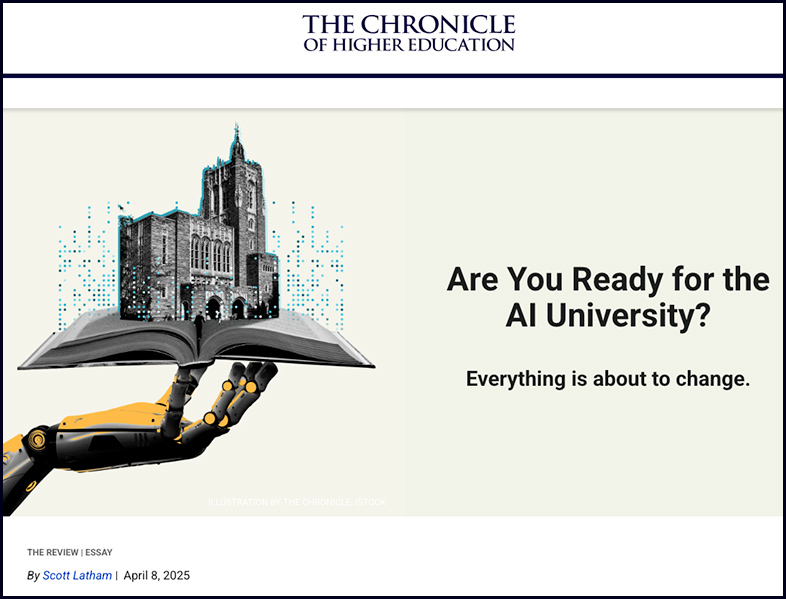
Reflections on “Are You Ready for the AI University? Everything is about to change.” [Latham]

.
Are You Ready for the AI University? Everything is about to change. — from chronicle.com by Scott Latham

Over the course of the next 10 years, AI-powered institutions will rise in the rankings. US News & World Report will factor a college’s AI capabilities into its calculations. Accrediting agencies will assess the degree of AI integration into pedagogy, research, and student life. Corporations will want to partner with universities that have demonstrated AI prowess. In short, we will see the emergence of the AI haves and have-nots.

What’s happening in higher education today has a name: creative destruction. The economist Joseph Schumpeter coined the term in 1942 to describe how innovation can transform industries. That typically happens when an industry has both a dysfunctional cost structure and a declining value proposition. Both are true of higher education.

Out of the gate, professors will work with technologists to get AI up to speed on specific disciplines and pedagogy. For example, AI could be “fed” course material on Greek history or finance and then, guided by human professors as they sort through the material, help AI understand the structure of the discipline, and then develop lectures, videos, supporting documentation, and assessments.

In the near future, if a student misses class, they will be able watch a recording that an AI bot captured. Or the AI bot will find a similar lecture from another professor at another accredited university. If you need tutoring, an AI bot will be ready to help any time, day or night. Similarly, if you are going on a trip and wish to take an exam on the plane, a student will be able to log on and complete the AI-designed and administered exam. Students will no longer be bound by a rigid class schedule. Instead, they will set the schedule that works for them.

Early and mid-career professors who hope to survive will need to adapt and learn how to work with AI. They will need to immerse themselves in research on AI and pedagogy and understand its effect on the classroom. 

From DSC:
I had a very difficult time deciding which excerpts to include. There were so many more excerpts for us to think about with this solid article. While I don’t agree with several things in it, EVERY professor, president, dean, and administrator working within higher education today needs to read this article and seriously consider what Scott Latham is saying.

Change is already here, but according to Scott, we haven’t seen anything yet. I agree with him and, as a futurist, one has to consider the potential scenarios that Scott lays out for AI’s creative destruction of what higher education may look like. Scott asserts that some significant and upcoming impacts will be experienced by faculty members, doctoral students, and graduate/teaching assistants (and Teaching & Learning Centers and IT Departments, I would add). But he doesn’t stop there. He brings in presidents, deans, and other members of the leadership teams out there.

There are a few places where Scott and I differ.

  • The foremost one is the importance of the human element — i.e., the human faculty member and students’ learning preferences. I think many (most?) students and lifelong learners will want to learn from a human being. IBM abandoned their 5-year, $100M ed push last year and one of the key conclusions was that people want to learn from — and with — other people:

To be sure, AI can do sophisticated things such as generating quizzes from a class reading and editing student writing. But the idea that a machine or a chatbot can actually teach as a human can, he said, represents “a profound misunderstanding of what AI is actually capable of.” 

Nitta, who still holds deep respect for the Watson lab, admits, “We missed something important. At the heart of education, at the heart of any learning, is engagement. And that’s kind of the Holy Grail.”

— Satya Nitta, a longtime computer researcher at
IBM’s Watson
Research Center in Yorktown Heights, NY
.

By the way, it isn’t easy for me to write this. As I wanted AI and other related technologies to be able to do just what IBM was hoping that it would be able to do.

  • Also, I would use the term learning preferences where Scott uses the term learning styles.

Scott also mentions:

“In addition, faculty members will need to become technologists as much as scholars. They will need to train AI in how to help them build lectures, assessments, and fine-tune their classroom materials. Further training will be needed when AI first delivers a course.”

It has been my experience from working with faculty members for over 20 years that not all faculty members want to become technologists. They may not have the time, interest, and/or aptitude to become one (and vice versa for technologists who likely won’t become faculty members).

That all said, Scott relays many things that I have reflected upon and relayed for years now via this Learning Ecosystems blog and also via The Learning from the Living [AI-Based Class] Room vision — the use of AI to offer personalized and job-relevant learning, the rising costs of higher education, the development of new learning-related offerings and credentials at far less expensive prices, the need to provide new business models and emerging technologies that are devoted more to lifelong learning, plus several other things.

So this article is definitely worth your time to read, especially if you are working in higher education or are considering a career therein!


Addendum later on 4/10/25:

U-M’s Ross School of Business, Google Public Sector launch virtual teaching assistant pilot program — from news.umich.edu by Jeff Karoub; via Paul Fain

Google Public Sector and the University of Michigan’s Ross School of Business have launched an advanced Virtual Teaching Assistant pilot program aimed at improving personalized learning and enlightening educators on artificial intelligence in the classroom.

The AI technology, aided by Google’s Gemini chatbot, provides students with all-hours access to support and self-directed learning. The Virtual TA represents the next generation of educational chatbots, serving as a sophisticated AI learning assistant that instructors can use to modify their specific lessons and teaching styles.

The Virtual TA facilitates self-paced learning for students, provides on-demand explanations of complex course concepts, guides them through problem-solving, and acts as a practice partner. It’s designed to foster critical thinking by never giving away answers, ensuring students actively work toward solutions.


The 2025 AI Index Report — from Stanford University’s Human-Centered Artificial Intelligence Lab (hai.stanford.edu); item via The Neuron

Top Takeaways

  1. AI performance on demanding benchmarks continues to improve.
  2. AI is increasingly embedded in everyday life.
  3. Business is all in on AI, fueling record investment and usage, as research continues to show strong productivity impacts.
  4. The U.S. still leads in producing top AI models—but China is closing the performance gap.
  5. The responsible AI ecosystem evolves—unevenly.
  6. Global AI optimism is rising—but deep regional divides remain.
  7. …and several more

Also see:

The Neuron’s take on this:

So, what should you do? You really need to start trying out these AI tools. They’re getting cheaper and better, and they can genuinely help save time or make work easier—ignoring them is like ignoring smartphones ten years ago.

Just keep two big things in mind:

  1. Making the next super-smart AI costs a crazy amount of money and uses tons of power (seriously, they’re buying nuclear plants and pushing coal again!).
  2. Companies are still figuring out how to make AI perfectly safe and fair—cause it still makes mistakes.

So, use the tools, find what helps you, but don’t trust them completely.

We’re building this plane mid-flight, and Stanford’s report card is just another confirmation that we desperately need better safety checks before we hit major turbulence.


Addendum on 4/16:

 
© 2025 | Daniel Christian