Is collaboration the key to digital accessibility? — from timeshighereducation.com by Sal Jarvis and George Rhodes
Digital accessibility is ethically important, and a legal requirement, but it’s also a lot of work. Here’s how universities can collaborate and pool their expertise to make higher education accessible for all

How easy do you find it to navigate your way around your university’s virtual estate – its websites, virtual learning environment and other digital aspects? If the answer is “not very”, we suspect you may not be alone. And for those of us who might access it differently – without a mouse, for example, or through a screen reader or keyboard emulator – the challenge is multiplied. Digital accessibility is the wide-ranging work to make these challenges a thing of the past for everyone. It is a legal requirement and a moral imperative.

Make Things Accessible is the outcome of a collaboration, initially between the University of Westminster and UCL, but now incorporating many other universities. It is a community of practice, a website and an archive of resources. It aims to make things accessible for all.


Essential AI tools for better work — from wondertools.substack.com by Jeremy Caplan
My favorite tactics for making the most of AI — a podcast conversation

AI tools I consistently rely on (areas covered mentioned below)

  • Research and analysis
  • Communication efficiency
  • Multimedia creation

AI tactics that work surprisingly well 

1. Reverse interviews
Instead of just querying AI, have it interview you. Get the AI to interview you, rather than interviewing it. Give it a little context and what you’re focusing on and what you’re interested in, and then you ask it to interview you to elicit your own insights.”

This approach helps extract knowledge from yourself, not just from the AI. Sometimes we need that guide to pull ideas out of ourselves.


OpenAI’s Deep Research Agent Is Coming for White-Collar Work — from wired.com by Will Knight
The research-focused agent shows how a new generation of more capable AI models could automate some office tasks.

Isla Fulford, a researcher at OpenAI, had a hunch that Deep Research would be a hit even before it was released.

Fulford had helped build the artificial intelligence agent, which autonomously explores the web, deciding for itself what links to click, what to read, and what to collate into an in-depth report. OpenAI first made Deep Research available internally; whenever it went down, Fulford says, she was inundated with queries from colleagues eager to have it back. “The number of people who were DMing me made us pretty excited,” says Fulford.

Since going live to the public on February 2, Deep Research has proven to be a hit with many users outside the company too.


Nvidia to open quantum computing research center in Boston — from seekingalpha.com by Ravikash Bakolia

Nvidia (NASDAQ:NVDA) will open a quantum computing research lab in Boston which is expected to start operations later this year.

The Nvidia Accelerated Quantum Research Center, or NVAQC, will integrate leading quantum hardware with AI supercomputers, enabling what is known as accelerated quantum supercomputing, said the company in a March 18 press release.

Nvidia’s CEO Jensen Huang also made this announcement on Thursday at the company’s first-ever Quantum Day at its annual GTC event.


French quantum computer firm Pasqal links up with NVIDIA — from reuters.com

PARIS, March 21 (Reuters) – Pasqal, a fast-growing French quantum computer start-up company, announced on Friday a partnership with chip giant Nvidia (NVDA.O), opens new tab whereby Pasqal’s customers would gain access to more tools to develop quantum applications.

Pasqal said it would connect its quantum computing units and cloud platform onto NVIDIA’s open-source platform called CUDA-Q.


Introducing next-generation audio models in the API — from openai.com
A new suite of audio models to power voice agents, now available to developers worldwide.

Today, we’re launching new speech-to-text and text-to-speech audio models in the API—making it possible to build more powerful, customizable, and intelligent voice agents that offer real value. Our latest speech-to-text models set a new state-of-the-art benchmark, outperforming existing solutions in accuracy and reliability—especially in challenging scenarios involving accents, noisy environments, and varying speech speeds. These improvements increase transcription reliability, making the models especially well-suited for use cases like customer call centers, meeting note transcription, and more.


AI Can’t Fix Bad Learning — from nafez.substack.com by Nafez Dakkak
Why pedagogy and good learning design still come first, and why faster isn’t always better.

I’ve followed Dr. Philippa Hardman’s work for years, and every time I engage with her work, I find it both refreshing and deeply grounded.

As one of the leading voices in learning design, Philippa has been able to cut through the noise and focus on what truly matters: designing learning experiences that actually work.

In an era where AI promises speed and scale, Philippa is making a different argument: faster isn’t always better. As the creator of Epiphany AI—figma for learning designers—Philippa is focused on closing the gap between what great learning design should look like and what’s actually being delivered.

While many AI tools optimize for the average, she believes the future belongs to those who can leverage AI without compromising on expertise or quality. Philippa wants learning designers to be more ambitious using AI to achieve what wasn’t possible before.

In this conversation, we explore why pedagogy must lead technology, how the return on expertise is only increasing in an AI-driven world, and why building faster doesn’t always mean building better.

An excerpted graphic:


Pearson, AWS Collaborate to Enhance AI-Powered Learning Functionality — from cloudwars.com

Pearson, the global educational publisher, and AWS have expanded their existing partnership to enhance AI-driven learning. AWS will help Pearson to deliver AI-powered lesson generation and more for educators, support workforce skilling initiatives, and continue an ongoing collaboration with Pearson VUE for AWS certification.


Introducing NextGenAI: A consortium to advance research and education with AI — from openai.com; via Claire Zau
OpenAI commits $50M in funding and tools to leading institutions.

Today, we’re launching NextGenAI, a first-of-its-kind consortium with 15 leading research institutions dedicated to using AI to accelerate research breakthroughs and transform education.

AI has the power to drive progress in research and education—but only when people have the right tools to harness it. That’s why OpenAI is committing $50M in research grants, compute funding, and API access to support students, educators, and researchers advancing the frontiers of knowledge.

Uniting institutions across the U.S. and abroad, NextGenAI aims to catalyze progress at a rate faster than any one institution would alone. This initiative is built not only to fuel the next generation of discoveries, but also to prepare the next generation to shape AI’s future.


 ‘I want him to be prepared’: why parents are teaching their gen Alpha kids to use AI — from theguardian.com by Aaron Mok; via Claire Zau
As AI grows increasingly prevalent, some are showing their children tools from ChatGPT to Dall-E to learn and bond

“My goal isn’t to make him a generative AI wizard,” White said. “It’s to give him a foundation for using AI to be creative, build, explore perspectives and enrich his learning.”

White is part of a growing number of parents teaching their young children how to use AI chatbots so they are prepared to deploy the tools responsibly as personal assistants for school, work and daily life when they’re older.


ABA Tech Survey Finds Growing Adoption of AI in Legal Practice, with Efficiency Gains as Primary Driver — from lawnext.com by Bob Ambrogi

There has been a significant increase in the adoption of artificial intelligence-based tools among law firms, with 30% of respondents now using AI technology compared to just 11% in 2023, according to the just-released 2024 edition of the American Bar Association’s Legal Technology Survey Report.

It finds that time savings and increased efficiency remain the dominant perceived benefits of AI implementation in legal practice.

The report, published Wednesday by the ABA’s Legal Technology Resource Center, is based on a survey that gathered responses from 512 attorneys in private practice across various firm sizes.


Also re: the legal world:

Why The GC-Legal Ops Partnership Is More Critical Than Ever — from abovethelaw.com by Stephanie Corey
The future of in-house legal isn’t about working in silos — it’s about working together.

AI is rapidly changing the way legal work gets done. Legal Ops can help GCs navigate this shift — identifying the right tools, ensuring responsible AI adoption, and optimizing processes so legal teams can focus on high-value work.
 

All of the articles listed below are from edutopia.org


4 Ways to Boost Students’ Self-Efficacy — by Tyler Rablin
These strategies help students see what they have learned so they believe they can be successful in school in the future.

Self-efficacy, on the other hand, focuses on outcomes to drive beliefs. In essence, self-efficacy involves intentionally providing students with evidence of early success to help them build the belief that they can be successful in the future.

Self-efficacy has been a powerful focus for me because it helps me to be more intentional as a teacher. It requires me to be mindful of how I structure assessments, feedback, etc., to provide students with evidence of their successes early on to help them see potential future successes.

Maintaining Students’ Focus in the Spring — by Miriam Plotinsky
Teachers can use these small ‘upgrades’ or tweaks to their regular practices to help keep students focused and involved.

As a recent MindShift article notes, “The second semester brings a lot of potential challenges to teachers’ regularly scheduled programming because of standardized testing, graduation events, and student burnout.” These challenges may be complex, but they are not insurmountable. With subtle shifts in practice, classrooms can remain safe and productive spaces—even in the spring.

She recommends a “coping jar” to help students identify moments of angst and manage their feelings. Fagell explains that when students find an effective coping mechanism, they write their idea on one side of a Popsicle stick and explain how it works on the other side. As students add ideas to the jar, they have an increased awareness of coping strategies and the importance of helping one another.

10 Picture Books That Showcase Collaboration — by Kristin Rydholm
These entertaining stories feature collaboration and social-emotional skills to highlight the benefit of working together to accomplish a goal.

Are you an early childhood teacher in search of relationship-building resources to help unify your classroom? Have I got a book list for you! In the verbiage of 1970s infomercials: “This collection has everything!” The main characters are early childhood students, the setting is the school, and each plot requires the class to work collaboratively. The characters are united in curiosity, determination, and mission to work on accomplishing projects together that they couldn’t possibly do alone.

What a 30-Day Break From AI Taught Me About My Teaching — by James Bedford
Using AI became second nature for this educator. A month without the tools gave him an opportunity to pause, reflect, and recalibrate.

My goal is to try to preserve the messy, creative core of what it means to be an educator: curiosity, critical thinking, and the grit and energy to solve problems without always resorting to shortcuts—technological or otherwise. My hope is that my students will do the same.

Unplug and reconnect: Challenge yourself and your students to embark on an AI detox. Step away from AI tools where possible, and rediscover the power of human creativity and independent thought. Start a journal to document the journey, exploring questions like “How does it feel to rely solely on my own intellect?” or “What challenges arise when AI isn’t there to assist? This activity can foster resilience, raise self-awareness, and cultivate a deeper appreciation for the human capacity to think, create, problem-solve, and innovate.


Drive Continuous Learning: AI Integrates Work & Training — from learningguild.com by George Hanshaw

Imagine with me for a moment: Training is no longer confined to scheduled sessions in a classroom, an online module or even a microlearning you click to activate during your workflow. Imagine training being delivered because the system senses what you are doing and provides instructions and job aids without you having to take an action.

The rapid evolution of artificial intelligence (AI) and wearable technology has made it easier than ever to seamlessly integrate learning directly into the workflow. Smart glasses, earpieces, and other advanced devices are redefining how employees gain knowledge and skills by delivering microlearning moments precisely when and where they are needed.

AI plays a crucial role in this transformation by sensing the optimal moment to deliver the training through augmented reality (AR).


These Schools Are Banding Together to Make Better Use of AI in Education — from edsurge.com by Emily Tate Sullivan

Kennelly and Geraffo are part of a small team at their school in Denver, DSST: College View High School, that is participating in the School Teams AI Collaborative, a year-long pilot initiative in which more than 80 educators from 19 traditional public and charter schools across the country are experimenting with and evaluating AI-enabled instruction to improve teaching and learning.

The goal is for some of AI’s earliest adopters in education to band together, share ideas and eventually help lead the way on what they and their colleagues around the U.S. could do with the emerging technology.

“Pretty early on we thought it was going to be a massive failure,” says Kennelly of last semester’s project. “But it became a huge hit. Students loved it. They were like, ‘I ran to second period to build this thing.’”


Transactional vs. Conversational Visions of Generative AI in Teaching — from elmartinsen.substack.com by Eric Lars Martinsen
AI as a Printer, or AI as a Thought Partner

As writing instructors, we have a choice in how we frame AI for our students. I invite you to:

  1. Experiment with AI as a conversation partner yourself before introducing it to students
  2. Design assignments that leverage AI’s strengths as a thought partner rather than trying to “AI-proof” your existing assignments
  3. Explicitly teach students how to engage in productive dialogue with AI—how to ask good questions, challenge AI’s assumptions, and use it to refine rather than replace their thinking
  4. Share your experiences, both positive and negative, with colleagues to build our collective understanding of effective AI integration


2025 Survey of College and University Presidents
Learn about presidents’ takes on topics such as financial confidence, the 2024 election’s impact on higher ed & more.

Inside Higher Ed’s 2025 Survey of College and University Presidents was conducted by Hanover Research. The survey asked presidents from 298 public and private, largely nonprofit two- and four-year institutions timely questions on the following issues:

  • General financial and economic confidence, plus mergers and acquisitions
  • Politics, policy and the 2024 election’s impact on higher education
  • Public perceptions of higher ed and the value of a degree
  • Campus speech
  • Race on campus
  • Artificial intelligence
  • Environmental sustainability goals
  • Campus health and wellness, including student mental health
  • Management, governance and the hardest part about being a president
 

You can now use Deep Research without $200 — from flexos.work


Accelerating scientific breakthroughs with an AI co-scientist — from research.google by Juraj Gottweis and Vivek Natarajan

We introduce AI co-scientist, a multi-agent AI system built with Gemini 2.0 as a virtual scientific collaborator to help scientists generate novel hypotheses and research proposals, and to accelerate the clock speed of scientific and biomedical discoveries.


Now decides next: Generating a new future — from Deloitte.com
Deloitte’s State of Generative AI in the Enterprise Quarter four report

There is a speed limit. GenAI technology continues to advance at incredible speed. However, most organizations are moving at the speed of organizations, not at the speed of technology. No matter how quickly the technology advances—or how hard the companies producing GenAI technology push—organizational change in an enterprise can only happen so fast.

Barriers are evolving. Significant barriers to scaling and value creation are still widespread across key areas. And, over the past year regulatory uncertainty and risk management have risen in organizations’ lists of concerns to address. Also, levels of trust in GenAI are still moderate for the majority of organizations. Even so, with increased customization and accuracy of models—combined with a focus on better governance— adoption of GenAI is becoming more established.

Some uses are outpacing others. Application of GenAI is further along in some business areas than in others in terms of integration, return on investment (ROI) and expectations. The IT function is most mature; cybersecurity, operations, marketing and customer service are also showing strong adoption and results. Organizations reporting higher ROI for their most scaled initiatives are broadly further along in their GenAI journeys.


5 Legal Tech Trends Set to Impact Law Firms in 2025 — from programminginsider.com by Marc Berman

The legal industry is experiencing swift changes, with technology becoming an ever more crucial factor in its evolution. As law firms respond to shifting client demands and regulatory changes, the pace of change is accelerating. Embracing legal tech is no longer just an advantage; it’s a necessity.

According to a Forbes report, 66% of legal leaders acknowledge this trend and intend to boost their investments in legal tech moving forward. From artificial intelligence streamlining workflows to cloud computing enabling globalized legal services, the legal landscape is undergoing a digital revolution.

In this article, we’ll explore five key legal tech trends that will define how law firms operate in 2025.


GenAI, Legal Ops, and The Future of Law Firms: A Wake-Up Call? — from echlawcrossroads.com by Stephen Embry

A new study from the Blickstein Group reveals some distributing trends for law firms that represent businesses, particularly large ones. The Study is entitled  Legal Service Delivery in the Age of AI. The Study was done jointly by FTI Technologies, a consulting group, and Blickstein. It looks at law department legal operations.

The Findings

GenAI Use by Legal Ops Personnel

The responses reflect a bullish view of what GenAI can do in the legal marketplace but also demonstrate GenAi has a ways to go:

  • Almost 80% of the respondents think that GenAI will become an “essential part of the legal profession.
  • 81% believe GenAi will drive improved efficiencies
  • Despite this belief, only some 30% have plans to purchase GenAI tools. For 81%, the primary reason for obtaining and using GenAI tools is the efficiencies these tools bring.
  • 52% say their GenAI strategy is not as sophisticated as they would like or nonexistent.

The biggest barrier to the use of GenAI among the legal ops professions is cost and security concerns and the lack of skilled personnel available to them.


Voting Is Closed, Results Are In: Here are the 15 Legal Tech Startups Selected for the 2025 Startup Alley at ABA TECHSHOW — from lawnext.com by Bob Ambrogi

Voting has now closed and your votes have been tallied to pick the 15 legal tech startups that will get to participate as finalists in the ninth-annual Startup Alley at ABA TECHSHOW 2025, taking place April 2-5 in Chicago.

These 15 finalists will face off in an opening-night pitch competition that is the opening event of TECHSHOW, with the conference’s attendees voting at the conclusion of the pitches to pick the top winners.


Balancing innovation and ethics: Applying generative AI in legal work — from legal.thomsonreuters.com

Generative artificial intelligence (GenAI) has brought a new wave of opportunities to the legal profession, opening doors to greater efficiency and innovation. Its rapid development has also raised questions about its integration within the legal industry. As legal professionals are presented with more options for adopting new technologies, they now face the important task of understanding how GenAI can be seamlessly — and ethically — incorporated into their daily operations.


Emerging Trends in Court Reporting for 2025: Legal Technology and Advantages for Law Firms — from jdsupra.com

The court reporting industry is evolving rapidly, propelled by technological advancements and the increasing demand for efficiency in the legal sector. For 2025, trends such as artificial intelligence (AI), real-time transcription technologies, and data-driven tools are reshaping how legal professionals work. Here’s an overview of these emerging trends and five reasons law firms should embrace these advancements.


Google Workspace enables the future of AI-powered work for every business  — from workspace.google.com

The following AI capabilities will start rolling out to Google Workspace Business customers today and to Enterprise customers later this month:

  • Get AI assistance in Gmail, Docs, Sheets, Meet, Chat, Vids, and more: Do your best work faster with AI embedded in the tools you use every day. Gemini streamlines your communications by helping you summarize, draft, and find information in your emails, chats, and files. It can be a thought partner and source of inspiration, helping you create professional documents, slides, spreadsheets, and videos from scratch. Gemini can even improve your meetings by taking notes, enhancing your audio and video, and catching you up on the conversation if you join late.
  • Chat with Gemini Advanced, Google’s next-gen AI: Kickstart learning, brainstorming, and planning with the Gemini app on your laptop or mobile device. Gemini Advanced can help you tackle complex projects including coding, research, and data analysis and lets you build Gems, your team of AI experts to help with repeatable or specialized tasks.
  • Unlock the power of NotebookLM PlusWe’re bringing the revolutionary AI research assistant to every employee, to help them make sense of complex topics. Upload sources to get instant insights and Audio Overviews, then share customized notebooks with the team to accelerate their learning and onboarding.

And per Evelyn from the Stay Ahead newsletter (at FlexOS)

Google’s Gemini AI is stepping up its game in Google Workspace, bringing powerful new capabilities to your favorite tools like Gmail, Docs, and Sheets:

  • AI-Powered Summaries: Get concise, AI-generated summaries of long emails and documents so you can focus on what matters most.
  • Smart Reply: Gemini now offers context-aware email replies that feel more natural and tailored to your style.
  • Slides and images generation: Gemini in Slides can help you generate new images, summarize your slides, write and rewrite content, and refer to existing Drive files and/or emails.
  • Automated Data Insights: In Google Sheets, Gemini helps create a task tracker, conference agenda, spot trends, suggest formulas, and even build charts with simple prompts.
  • Intelligent Drafting: Google Docs now gets a creativity boost, helping you draft reports, proposals, or blog posts with AI suggestions and outlines.
  • Meeting Assistance: Say goodbye to the awkward AI attendees to help you take notes, now Gemini can natively do that for you – no interruption, no avatar, and no extra attendee. Meet can now also automatically generate captions to lower the language barrier.

Eveyln (from FlexOS) also mentions that CoPilot is getting enhancements too:

Copilot is now included in Microsoft 365 Personal and Family — from microsoft.com

Per Evelyn:

It’s exactly what we predicted: stand-alone AI apps like note-takers and image generators have had their moment, but as the tech giants step in, they’re bringing these features directly into their ecosystems, making them harder to ignore.


Announcing The Stargate Project — from openai.com

The Stargate Project is a new company which intends to invest $500 billion over the next four years building new AI infrastructure for OpenAI in the United States. We will begin deploying $100 billion immediately. This infrastructure will secure American leadership in AI, create hundreds of thousands of American jobs, and generate massive economic benefit for the entire world. This project will not only support the re-industrialization of the United States but also provide a strategic capability to protect the national security of America and its allies.

The initial equity funders in Stargate are SoftBank, OpenAI, Oracle, and MGX. SoftBank and OpenAI are the lead partners for Stargate, with SoftBank having financial responsibility and OpenAI having operational responsibility. Masayoshi Son will be the chairman.

Arm, Microsoft, NVIDIA, Oracle, and OpenAI are the key initial technology partners. The buildout is currently underway, starting in Texas, and we are evaluating potential sites across the country for more campuses as we finalize definitive agreements.


Your AI Writing Partner: The 30-Day Book Framework — from aidisruptor.ai by Alex McFarland and Kamil Banc
How to Turn Your “Someday” Manuscript into a “Shipped” Project Using AI-Powered Prompts

With that out of the way, I prefer Claude.ai for writing. For larger projects like a book, create a Claude Project to keep all context in one place.

  • Copy [the following] prompts into a document
  • Use them in sequence as you write
  • Adjust the word counts and specifics as needed
  • Keep your responses for reference
  • Use the same prompt template for similar sections to maintain consistency

Each prompt builds on the previous one, creating a systematic approach to helping you write your book.


Adobe’s new AI tool can edit 10,000 images in one click — from theverge.com by  Jess Weatherbed
Firefly Bulk Create can automatically remove, replace, or extend image backgrounds in huge batches.

Adobe is launching new generative AI tools that can automate labor-intensive production tasks like editing large batches of images and translating video presentations. The most notable is “Firefly Bulk Create,” an app that allows users to quickly resize up to 10,000 images or replace all of their backgrounds in a single click instead of tediously editing each picture individually.


A Community College’s Guide to Building Strong Partnerships — from eddesignlab.org

This November 2024 guidebook offers higher education practitioners actionable strategies for building and sustaining partnerships that both meet regional needs and support students, families, and communities. This work was based on the design and delivery of dual enrollment pathways as part of the Lab’s Designers in Residence 2.0: Accelerating Pathways project.

The practices and case studies shared here are informed by higher education leaders across six community colleges as part of the Lab’s Designers in Residence program.

We have organized the guidebook based on core elements of a strong partnerships strategy, alongside how to establish a strong foundation and sustain and maintain the partnerships you’ve built. Through our research, we’ve identified four key elements of strong partnerships:

+ Communication and collaboration
+ Shared vision
+ Adaptive and responsive
+ Action-oriented

You will find guiding questions, tools, and case studies within each of the four elements.
.


Also from The Education Design Lab:


The Rise of the Heretical Leader — from ditchthattextbook.com; a guest post by Dan Fitzpatrick

Now is the time for visionary leadership in education. The era of artificial intelligence is reshaping the demands on education systems. Rigid policies, outdated curricula, and reliance on obsolete metrics are failing students. A recent survey from Resume Genius found that graduates lack skills in communication, collaboration, and critical thinking. Consequently, there is a growing trend in companies hiring candidates based on skills instead of traditional education or work experience. This underscores the urgent need for educational leaders to prioritize adaptability and innovation in their systems. Educational leaders must embrace a transformative approach to keep pace.

[Heretical leaders] bring courage, empathy, and strategic thinking to reimagine education’s potential. Here are their defining characteristics:

  • Visionary Thinking: They identify bold, innovative paths to progress.
  • Courage to Act: These leaders take calculated risks to overcome resistance and inertia.
  • Relentless Curiosity: They challenge assumptions and seek better alternatives.
  • Empathy for Stakeholders: Understanding the personal impact of change allows them to lead with compassion.
  • Strategic Disruption: Their deliberate actions ensure systemic improvements.
    These qualities enable Heretical leaders to reframe challenges as opportunities and drive meaningful change.

From DSC:
Readers of this blog will recognize that I believe visionary leadership is extremely important — in all areas of our society, but especially within our learning ecosystems. Vision trumps data, at least in my mind. There are times when data can be used to support a vision, but having a powerful vision is more lasting and impactful than relying on data to drive the organization.

So while I’d vote for a different term other than “heretical leaders,” I get what Dan is saying and I agree with him. Such leaders are going against the grain. They are swimming upstream. They are espousing perspectives that others often don’t buy into (at least initially or for some time). 

Such were the leaders who introduced online learning into the K-16 educational systems back in the late ’90s and into the next two+ decades. The growth of online-based learning continues and has helped educate millions of people. Those leaders and the people who worked for such endeavors were going against the grain.

We haven’t seen the end point of online-based learning. I think it will become even more powerful and impactful when AI is used to determine which jobs are opening up, and which skills are needed for those jobs, and then provide a listing of sources of where one can obtain that knowledge and develop those skills. People will be key in this vision. But so will AI and personalized learning. It will be a collaborative effort.

By the way, I am NOT advocating for using AI to outsource our thinking. Also, having basic facts and background knowledge in a domain is critically important, especially to use AI effectively. But we should be teaching students about AI (as we learn more about it ourselves). We should be working collaboratively with our students to understand how best to use AI. It’s their futures at stake.


Students Pushback on AI Bans, India Takes a Leading Role in AI & Education & Growing Calls for Teacher Training in AI — from learningfuturesdigest.substack.com by Dr. Philippa Hardman
Key developments in the world of AI & Education at the turn of 2025

At the end of 2024 and start of 2025, we’ve witnessed some fascinating developments in the world of AI and education, from from India’s emergence as a leader in AI education and Nvidia’s plans to build an AI school in Indonesia to Stanford’s Tutor CoPilot improving outcomes for underserved students.

Other highlights include Carnegie Learning partnering with AI for Education to train K-12 teachers, early adopters of AI sharing lessons about implementation challenges, and AI super users reshaping workplace practices through enhanced productivity and creativity.

Also mentioned by Philippa:


ElevenLabs AI Voice Tool Review for Educators — from aiforeducation.io with Amanda Bickerstaff and Mandy DePriest

AI for Education reviewed the ElevenLabs AI Voice Tool through an educator lens, digging into the new autonomous voice agent functionality that facilitates interactive user engagement. We showcase the creation of a customized vocabulary bot, which defines words at a 9th-grade level and includes options for uploading supplementary material. The demo includes real-time testing of the bot’s capabilities in defining terms and quizzing users.

The discussion also explored the AI tool’s potential for aiding language learners and neurodivergent individuals, and Mandy presented a phone conversation coach bot to help her 13-year-old son, highlighting the tool’s ability to provide patient, repetitive practice opportunities.

While acknowledging the technology’s potential, particularly in accessibility and language learning, we also want to emphasize the importance of supervised use and privacy considerations. Right now the tool is currently free, this likely won’t always remain the case, so we encourage everyone to explore and test it out now as it continues to develop.


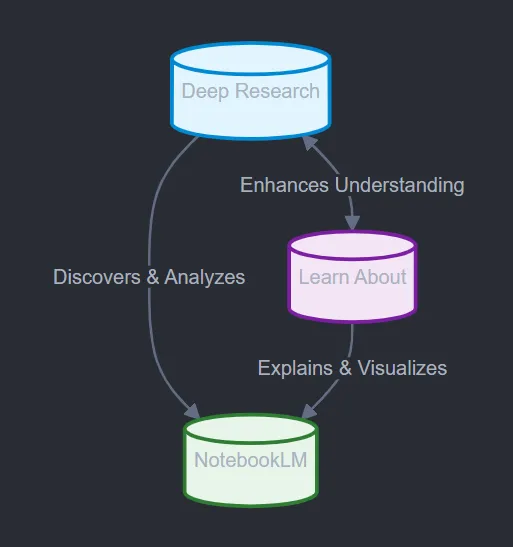
How to Use Google’s Deep Research, Learn About and NotebookLM Together — from ai-supremacy.com by Michael Spencer and Nick Potkalitsky
Supercharging your research with Google Deepmind’s new AI Tools.

Why Combine Them?
Faster Onboarding: Start broad with Deep Research, then refine and clarify concepts through Learn About. Finally, use NotebookLM to synthesize everything into a cohesive understanding.

Deeper Clarity: Unsure about a concept uncovered by Deep Research? Head to Learn About for a primer. Want to revisit key points later? Store them in NotebookLM and generate quick summaries on demand.

Adaptive Exploration: Create a feedback loop. Let new terms or angles from Learn About guide more targeted Deep Research queries. Then, compile all findings in NotebookLM for future reference.
.

Getting to an AI Policy Part 1: Challenges — from aiedusimplified.substack.com by Lance Eaton, PH.D.
Why institutional policies are slow to emerge in higher education

There are several challenges to making policy that make institutions hesitant to or delay their ability to produce it. Policy (as opposed to guidance) is much more likely to include a mixture of IT, HR, and legal services. This means each of those entities has to wrap their heads around GenAI—not just for their areas but for the other relevant areas such as teaching & learning, research, and student support. This process can definitely extend the time it takes to figure out the right policy.

That’s naturally true with every policy. It does not often come fast enough and is often more reactive than proactive.

Still, in my conversations and observations, the delay derives from three additional intersecting elements that feel like they all need to be in lockstep in order to actually take advantage of whatever possibilities GenAI has to offer.

  1. Which Tool(s) To Use
  2. Training, Support, & Guidance, Oh My!
  3. Strategy: Setting a Direction…

Prophecies of the Flood — from oneusefulthing.org by Ethan Mollick
What to make of the statements of the AI labs?

What concerns me most isn’t whether the labs are right about this timeline – it’s that we’re not adequately preparing for what even current levels of AI can do, let alone the chance that they might be correct. While AI researchers are focused on alignment, ensuring AI systems act ethically and responsibly, far fewer voices are trying to envision and articulate what a world awash in artificial intelligence might actually look like. This isn’t just about the technology itself; it’s about how we choose to shape and deploy it. These aren’t questions that AI developers alone can or should answer. They’re questions that demand attention from organizational leaders who will need to navigate this transition, from employees whose work lives may transform, and from stakeholders whose futures may depend on these decisions. The flood of intelligence that may be coming isn’t inherently good or bad – but how we prepare for it, how we adapt to it, and most importantly, how we choose to use it, will determine whether it becomes a force for progress or disruption. The time to start having these conversations isn’t after the water starts rising – it’s now.


© 2025 | Daniel Christian