Entrepreneurship education fosters resilience, creativity, and financial literacy—skills critical for success in an unpredictable, tech-driven world.
Programs like NFTE, Junior Achievement, and Uncharted Learning empower students by offering real-world entrepreneurial experiences and mentorship.
“Entrepreneurship is the job of the future.”
— Charles Fadel, Education for the Age of AI
This shift requires a radical re-evaluation of what we teach. Education leaders across the country are realizing that the most valuable skill we can impart is not accounting or marketing, but the entrepreneurial mindset. This mindset—built on resilience, creative problem-solving, comfort with ambiguity, and the ability to pivot—is essential in startups, as an intrapreuer in big organizations, or as a citizen working for the common good.
Experience AI: A new architecture of learning
Experience AI represents a new architecture for learning — one that prioritizes continuity, agency and deep personalization. It fuses three dimensions into a new category of co-intelligent systems:
Agentic AI that evolves with the learner, not just serves them
Persona-based AI that adapts to individual goals, identities and motivations
Multimodal AI that engages across text, voice, video, simulation and interaction
Experience AI brings learning into context. It powers personalized, problem-based journeys where students explore ideas, reflect on progress and co-create meaning — with both human and machine collaborators.
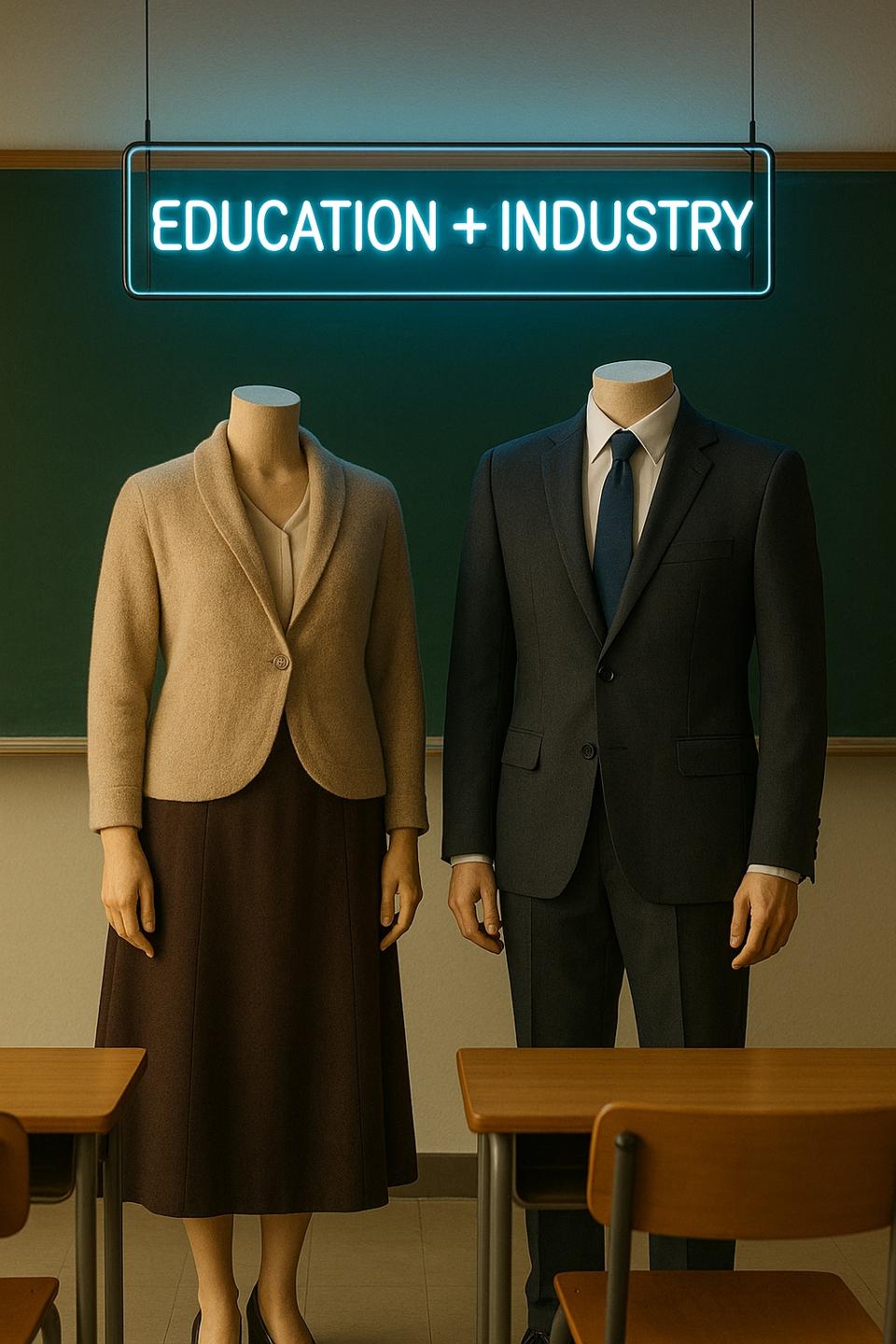
When it comes to innovation in higher education, most bets are being placed on technology platforms and AI. But the innovation students, faculty and industry need most can be found in a much more human dimension: co-teaching. And specifically, a certain kind of co-teaching – between industry experts and educators.
While higher education has largely embraced the value of interdisciplinary teaching across different majors or fields of study, it has yet to embrace the value of co-teaching between industry and academia. Examples of co-teaching through industry-education collaborations are rare and underutilized across today’s higher ed landscape. But they may be the most valuable and relevant way to prepare students for success. And leveraging these collaborations can help institutions struggling to satisfy unfulfilled student demand for immersive work experiences such as internships.
From DSC: It’s along these lines that I think that ADJUNCT faculty members should be highly sought after and paid much better — as the up-to-date knowledge and experience they bring into the classroom is very valuable. They should have equal say in terms of curriculum/programs and in the way a college or university is run.
The 4 Rs framework Salesforce has developed what Holt Ware calls the “4 Rs for AI agent success.” They are:
Redesign by combining AI and human capabilities. This requires treating agents like new hires that need proper onboarding and management.
Reskilling should focus on learning future skills. “We think we know what they are,” Holt Ware notes, “but they will continue to change.”
Redeploy highly skilled people to determine how roles will change. When Salesforce launched an AI coding assistant, Holt Ware recalls, “We woke up the next day and said, ‘What do we do with these people now that they have more capacity?’ ” Their answer was to create an entirely new role: Forward-Deployed Engineers. This role has since played a growing part in driving customer success.
Rebalance workforce planning. Holt Ware references a CHRO who “famously said that this will be the last year we ever do workforce planning and it’s only people; next year, every team will be supplemented with agents.”
Our latest video generation model is more physically accurate, realistic, and more controllable than prior systems. It also features synchronized dialogue and sound effects. Create with it in the new Sora app.
The Rundown: OpenAI just released Sora 2, its latest video model that now includes synchronized audio and dialogue, alongside a new social app where users can create, remix, and insert themselves into AI videos through a “Cameos” feature.
… Why it matters: Model-wise, Sora 2 looks incredible — pushing us even further into the uncanny valley and creating tons of new storytelling capabilities. Cameos feels like a new viral memetic tool, but time will tell whether the AI social app can overcome the slop-factor and have staying power past the initial novelty.
OpenAI Just Dropped Sora 2 (And a Whole New Social App) — from heneuron.ai by Grant Harvey OpenAI launched Sora 2 with a new iOS app that lets you insert yourself into AI-generated videos with realistic physics and sound, betting that giving users algorithm control and turning everyone into active creators will build a better social network than today’s addictive scroll machines.
What Sora 2 can do
Generate Olympic-level gymnastics routines, backflips on paddleboards (with accurate buoyancy!), and triple axels.
Follow intricate multi-shot instructions while maintaining world state across scenes.
Create realistic background soundscapes, dialogue, and sound effects automatically.
Insert YOU into any video after a quick one-time recording (they call this “cameos”).
The best video to show what it can do is probably this one, from OpenAI researcher Gabriel Peters, that depicts the behind the scenes of Sora 2 launch day…
Sora 2: AI Video Goes Social — from getsuperintel.com by Kim “Chubby” Isenberg OpenAI’s latest AI video model is now an iOS app, letting users generate, remix, and even insert themselves into cinematic clips
Technically, Sora 2 is a major leap. It syncs audio with visuals, respects physics (a basketball bounces instead of teleporting), and follows multi-shot instructions with consistency. That makes outputs both more controllable and more believable. But the app format changes the game: it transforms world simulation from a research milestone into a social, co-creative experience where entertainment, creativity, and community intersect.
Also along the lines of creating digital video, see:
What used to take hours in After Effects now takes just one text prompt. Tools like Google’s Nano Banana, Seedream 4, Runway’s Aleph, and others are pioneering instruction-based editing, a breakthrough that collapses complex, multi-step VFX workflows into a single, implicit direction.
The history of VFX is filled with innovations that removed friction, but collapsing an entire multi-step workflow into a single prompt represents a new kind of leap.
For creators, this means the skill ceiling is no longer defined by technical know-how, it’s defined by imagination. If you can describe it, you can create it. For the industry, it points toward a near future where small teams and solo creators compete with the scale and polish of large studios.
Something big shifted this week. OpenAI just turned ChatGPT into a platform – not just a product.With apps now running inside ChatGPT and a no-code Agent Builder for creating full AI workflows, the line between “using AI” and “building with AI” is fading fast. Developers suddenly have a new playground, and for the first time, anyone can assemble their own intelligent system without touching code. The question isn’t what AI can do anymore – it’s what you’ll make it do.
K-12 to Career — from the-job.beehiiv.com by Paul Fain Ohio eases eligibility rules for high school students to pursue college-level coursework in high-demand fields.
Three Ohio community colleges offer free industry-recognized credentials in manufacturing to more high school students. Also, new career-connected AP courses designed with industry input, a partnership on skilled trade prep for K-12 students, and essays on the race to define the future of credentials and how data and research can inform Workforce Pell.
Strategic partnership enables OpenAI to build and deploy at least 10 gigawatts of AI datacenters with NVIDIA systems representing millions of GPUs for OpenAI’s next-generation AI infrastructure.
To support the partnership, NVIDIA intends to invest up to $100 billion in OpenAI progressively as each gigawatt is deployed.
The first gigawatt of NVIDIA systems will be deployed in the second half of 2026 on NVIDIA’s Vera Rubin platform.
Why this matters: The partnership kicks off in the second half of 2026 with NVIDIA’s new Vera Rubin platform. OpenAI will use this massive compute power to train models beyond what we’ve seen with GPT-5 and likely also power what’s called inference (when you ask a question to chatGPT, and it gives you an answer). And NVIDIA gets a guaranteed customer for their most advanced chips. Infinite money glitch go brrr am I right? Though to be fair, this kinda deal is as old as the AI industry itself.
This isn’t just about bigger models, mind you: it’s about infrastructure for what both companies see as the future economy. As Sam Altman put it, “Compute infrastructure will be the basis for the economy of the future.”
… Our take: We think this news is actually super interesting when you pair it with the other big headline from today: Commonwealth Fusion Systems signed a commercial deal worth more than $1B with Italian energy company Eni to purchase fusion power from their 400 MW ARC plant in Virginia. Here’s what that means for AI…
AI filmmaker Dinda Prasetyo just released “Skyland,” a fantasy short film about a guy named Aeryn and his “loyal flying fish”, and honestly, the action sequences look like they belong in an actual film…
SKYLAND | AI Short Film Fantasy
Skyland is an AI-powered fantasy short film that takes you on a breathtaking journey with Aeryn Solveth and his loyal flying fish. From soaring above the futuristic city of Cybryne to returning to his homeland of Eryndor, Aeryn’s adventure is… https://t.co/Lz6UUxQvExpic.twitter.com/cYXs9nwTX3
What’s wild is that Dinda used a cocktail of AI tools (Adobe Firefly, MidJourney, the newly launched Luma Ray 3, and ElevenLabs) to create something that would’ve required a full production crew just two years ago.
The Era of Prompts Is Over. Here’s What Comes Next. — from builtin.com by Ankush Rastogi If you’re still prompting your AI, you’re behind the curve. Here’s how to prepare for the coming wave of AI agents.
Summary: Autonomous AI agents are emerging as systems that handle goals, break down tasks and integrate with tools without constant prompting. Early uses include call centers, healthcare, fraud detection and research, but concerns remain over errors, compliance risks and unchecked decisions.
The next shift is already peeking around the corner, and it’s going to make prompts look primitive. Before long, we won’t be typing carefully crafted requests at all. We’ll be leaning on autonomous AI agents, systems that don’t just spit out answers but actually chase goals, make choices and do the boring middle steps without us guiding them. And honestly, this jump might end up dwarfing the so-called “prompt revolution.”
A new way to get things done with your AI browsing assistant Imagine you’re a student researching a topic for a paper, and you have dozens of tabs open. Instead of spending hours jumping between sources and trying to connect the dots, your new AI browsing assistant — Gemini in Chrome1 — can do it for you. Gemini can answer questions about articles, find references within YouTube videos, and will soon be able to help you find pages you’ve visited so you can pick up exactly where you left off.
Rolling out to Mac and Windows users in the U.S. with their language set to English, Gemini in Chrome can understand the context of what you’re doing across multiple tabs, answer questions and integrate with other popular Google services, like Google Docs and Calendar. And it’ll be available on both Android and iOS soon, letting you ask questions and summarize pages while you’re on the go.
We’re also developing more advanced agentic capabilities for Gemini in Chrome that can perform multi-step tasks for you from start to finish, like ordering groceries. You’ll remain in control as Chrome handles the tedious work, turning 30-minute chores into 3-click user journeys.
Provosts Are a ‘Release Valve’ for Campus Controversy — from insidehighered.com by Emma Whitford According to former Western Michigan provost Julian Vasquez Heilig, provosts are stuck driving change with few, if any, allies, while simultaneously playing crisis manager for the university.
After two years, he stepped down, and he now serves as a professor of educational leadership, research and technology at Western Michigan. His frustrations with the provost role had less to do with Western Michigan and more to do with how the job is designed, he explained. “Each person sees the provost a little differently. The faculty see the provost as administration, although, honestly, around the table at the cabinet, the provost is probably the only faculty member,” Heilig said. “The trustees—they see the provost as a middle manager below the president, and the president sees [the provost] as a buffer from issues that are arising.”
Inside Higher Ed sat down with Heilig to talk about the provost job and all he’s learned about the role through years of education leadership research, conversations with colleagues and his own experience.
Levine unveiled “The Brandeis Plan to Reinvent the Liberal Arts,” a sweeping redesign of academic structures, curricula, degree programs, teaching methods, career education, and student support systems. Developed in close partnership with Brandeis faculty, the plan responds to a rapidly shifting landscape in which the demands on higher education are evolving at unprecedented speed in a global, digital economy.
“We are living through a time of extraordinary change across technology, the economy, and society,” Levine said. “Today’s students need more than knowledge. They need the skills, experiences, and confidence to lead in a world we cannot yet predict. We are advancing a new model. We need reinvention. And that’s exactly what Brandeis is establishing.”
The Brandeis Plan transforms the student experience by integrating career preparation into every stage of a student’s education, requiring internships or apprenticeships, sustaining career counseling, and implementing a core curriculum built around the skills that employers value most. The plan also reimagines teaching. It will be more experiential and practical, and introduce new ways to measure and showcase student learning and growth over time.
GRAND RAPIDS, MI — A new course at Grand Rapids Community College aims to help students learn about artificial intelligence by using the technology to solve real-world business problems.
…
In a release, the college said its grant application was supported by 20 local businesses, including Gentex, TwistThink and the Grand Rapids Public Museum. The businesses have pledged to work with students who will use business data to develop an AI project such as a chatbot that interacts with customers, or a program that automates social media posts or summarizes customer data.
“This rapidly emerging technology can transform the way businesses process data and information,” Kristi Haik, dean of GRCC’s School of Science, Technology, Engineering and Mathematics, said in a statement. “We want to help our local business partners understand and apply the technology. We also want to create real experiences for our students so they enter the workforce with demonstrated competence in AI applications.”
As Patrick Bailey said on LinkedIn about this article:
Nice to see a pedagogy that’s setting a forward movement rather than focusing on what could go wrong with AI in a curriculum.
As a 30 year observer and participant, it seems to me that previous technology platform shifts like SaaS and mobile did not fundamentally change the LMS. AI is different. We’re standing at the precipice of LMS 2.0, where the branding change from Course Management System to Learning Management System will finally live up to its name. Unlike SaaS or mobile, AI represents a technology platform shift that will transform the way participants interact with learning systems – and with it, the nature of the LMS itself.
Given the transformational potential of AI, it is useful to set the context and think about how we got here, especially on this 30th anniversary of the LMS.
Where AI is disruptive is in its ability to introduce a whole new set of capabilities that are best described as personalized learning services. AI offers a new value proposition to the LMS, roughly the set of capabilities currently being developed in the AI Tutor / agentic TA segment. These new capabilities are so valuable given their impact on learning that I predict they will become the services with greatest engagement within a school or university’s “enterprise” instructional platform.
In this way, by LMS paradigm shift, I specifically mean a shift from buyers valuing the product on its course-centric and course management capabilities, to valuing it on its learner-centric and personalized learning capabilities.
This anthology reveals how the integration of AI in education poses profound philosophical, pedagogical, ethical and political questions. As this global AI ecosystem evolves and becomes increasingly ubiquitous, UNESCO and its partners have a shared responsibility to lead the global discourse towards an equity- and justice-centred agenda. The volume highlights three areas in which UNESCO will continue to convene and lead a global commons for dialog and action particularly in areas on AI futures, policy and practice innovation, and experimentation.
As guardian of ethical, equitable human-centred AI in education.
As thought leader in reimagining curriculum and pedagogy
As a platform for engaging pluralistic and contested dialogues
AI, copyright and the classroom: what higher education needs to know — from timeshighereducation.com by Cayce Myers As artificial intelligence reshapes teaching and research, one legal principle remains at the heart of our work: copyright. Understanding its implications isn’t just about compliance – it’s about protecting academic integrity, intellectual property and the future of knowledge creation. Cayce Myers explains
Why It Matters A decade from now, we won’t say “AI changed schools.” We’ll say: this was the year schools began to change what it means to be human, augmented by AI.
This transformation isn’t about efficiency alone. It’s about dignity, creativity, and discovery, and connecting education more directly to human flourishing. The industrial age gave us schools to produce cookie-cutter workers. The digital age gave us knowledge anywhere, anytime. The AI age—beginning now—gives us back what matters most: the chance for every learner to become infinitely capable.
This fall may look like any other—bells ringing, rows of desks—but beneath the surface, education has begun its greatest transformation since the one-room schoolhouse.
Transactional and transformational leaderships’ combined impact on AI and trust Given the volatile times we live in, a leader may find themselves in a situation where they know how they will use AI, but they are not entirely clear on the goals and journey. In a teaching context, students can be given scenarios where they must lead a team, including autonomous AI agents, to achieve goals. They can then analyse the situations and decide what leadership styles to apply and how to build trust in their human team members. Educators can illustrate this decision-making process using a table (see above).
They may need to combine transactional leadership with transformational leadership, for example. Transactional leadership focuses on planning, communicating tasks clearly and an exchange of value. This works well with both humans and automated AI agents.
Despite modern technological advancements in classroom tools, many educational settings still center around a traditional model where the teacher is the primary source of information and students passively receive content.
Slowly, learning environments are inviting students to actively participate and take ownership of their learning through collaborative projects, inquiry-based experiences, and real-world problem-solving, thereby transforming traditional educational roles and practices.
The Online Education Marketplace Is Increasingly Competitive: …
Alternative Credentials Take Center Stage: …
AI Integration Lacks Strategic Coordination: …
Just 28% of faculty are considered fully prepared for online course design, and 45% for teaching. Alarmingly, only 28% of institutions report having fully developed academic continuity plans for future emergency pivots to online.
Cultural resistance remains strong. Many [Chief Online Learning Officers] COLOs say faculty and deans still believe in-person learning is “just better,” creating headwinds even for modest online growth. As one respondent at a four-year institution with a large online presence put it:
Supportive departments [that] see the value in online may have very different levels of responsiveness compared to academic departments [that] are begrudgingly online. There is definitely a growing belief that students “should” be on-ground and are only choosing online because it’s easy/ convenient. Never mind the very real and growing population of nontraditional learners who can only take online classes, and the very real and growing population of traditional-aged learners who prefer online classes; many faculty/deans take a paternalistic, “we know what’s best” approach.
… Ultimately, what we need is not just more ambition but better ambition. Ambition rooted in a realistic understanding of institutional capacity, a shared strategic vision, investments in policy and infrastructure, and a culture that supports online learning as a core part of the academic mission, not an auxiliary one. It’s time we talked about what it really takes to grow online learning , and where ambition needs to be matched by structure.
From DSC: Yup. Culture is at the breakfast table again…boy, those strategies taste good.
I’d like to take some of this report — like the graphic below — and share it with former faculty members and members of a couple of my past job families’ leadership. They strongly didn’t agree with us when we tried to advocate for the development of online-based learning/programs at our organizations…but we were right. We were right all along. And we were LEADING all along. No doubt about it — even if the leadership at the time said that we weren’t leading.
The cultures of those organizations hurt us at the time. But our cultivating work eventually led to the development of online programs — unfortunately, after our groups were disbanded, they had to outsource those programs to OPMs.
Arizona State University — with its dramatic growth in online-based enrollments.
Disney alum Paul Williams once shared the brainstorming method developed by Walt Disney. Disney used to separate the act of coming up with and executing ideas into three distinct steps (and associated mindsets): The Dreamer, The Realist, and The Spoiler.
As Paul wrote:
“By compartmentalizing the stages, Walt didn’t let reality get in the way of the dream step. The realist was allowed to work without the harsh filter of a spoiler. And, the spoiler spends time examining a well-thought idea… something with a bit more structure.
“When we brainstorm alone and in groups – too often – we tend to fill the room with a dreamer or two, a few realists, and a bunch of spoilers. In these conditions, dream ideas don’t stand a chance.”
The Dreamer mentality specializes in blue sky thinking without constraints, the Realist mentality puts practical structure to the ideas, and the Spoiler asks the hard questions and kicks the tires. We need all three mindsets. But we need those mindsets at the right time and in the right way.
From DSC: How true this is! I’m the Dreamer in the room…and have been shut down more times than I can count. For all of you Visionaries and Dreamers out there, keep trying! And consider establishing something like Walt Disney did.
To rise above the threshold, consider the skills that our board member and Northeastern University President Joseph Aoun outlines as essential literacies in Robot-Proof: Higher Education in the Age of Artificial Intelligence. In addition to technical and data literacies, he shares two key components of human literacy.
First, a set of “catalytic capacities” that include:
Initiative and self-reliance
Comfort with risk
Flexibility and adaptability
Second, a set of “creative capacities” that include:
Opportunity recognition, or the ability to see and experience problems as opportunities to create solutions
Creative innovation, or the ability to create solutions without clearly defined structures
Future innovation, or the disposition to orient toward future developments in society
The most effective approach to achieve these outcomes? Interdisciplinary models that embed skills flexibly across curriculum, that engage learners as part of networks, teams, and exploration, and that embed applied experiences in real-world contexts. Scott Carlson and Ned Laff have laid out some great examples of what this looks like in action in Hacking College.
The bottom line: the expectations of entry-level talent are rising while the systems to achieve that level of context and understanding are not necessarily keeping pace.
“Where generative AI creates, agentic AI acts.” That’s how my trusted assistant, Gemini 2.5 Pro deep research, describes the difference.
…
Agents, unlike generative tools, create and perform multistep goals with minimal human supervision. The essential difference is found in its proactive nature. Rather than waiting for a specific, step-by-step command, agentic systems take a high-level objective and independently create and execute a plan to achieve that goal. This triggers a continuous, iterative workflow that is much like a cognitive loop. The typical agentic process involves six key steps, as described by Nvidia:
Our 2025 national survey of over 650 respondents across 49 states and Puerto Rico reveals both encouraging trends and important challenges. While AI adoption and optimism are growing, concerns about cheating, privacy, and the need for training persist.
Despite these challenges, I’m inspired by the resilience and adaptability of educators. You are the true game-changers in your students’ growth, and we’re honored to support this vital work.
This report reflects both where we are today and where we’re headed with AI. More importantly, it reflects your experiences, insights, and leadership in shaping the future of education.
This groundbreaking collaboration represents a transformative step forward in education technology and will begin with, but is not limited to, an effort between Instructure and OpenAI to enhance the Canvas experience by embedding OpenAI’s next-generation AI technology into the platform.
IgniteAI announced earlier today, establishes Instructure’s future-ready, open ecosystem with agentic support as the AI landscape continues to evolve. This partnership with OpenAI exemplifies this bold vision for AI in education. Instructure’s strategic approach to AI emphasizes the enhancement of connections within an educational ecosystem comprising over 1,100 edtech partners and leading LLM providers.
“We’re committed to delivering next-generation LMS technologies designed with an open ecosystem that empowers educators and learners to adapt and thrive in a rapidly changing world,” said Steve Daly, CEO of Instructure. “This collaboration with OpenAI showcases our ambitious vision: creating a future-ready ecosystem that fosters meaningful learning and achievement at every stage of education. This is a significant step forward for the education community as we continuously amplify the learning experience and improve student outcomes.”
Faculty Latest Targets of Big Tech’s AI-ification of Higher Ed— from insidehighered.com by Kathryn Palmer A new partnership between OpenAI and Instructure will embed generative AI in Canvas. It may make grading easier, but faculty are skeptical it will enhance teaching and learning.
The two companies, which have not disclosed the value of the deal, are also working together to embed large language models into Canvas through a feature called IgniteAI. It will work with an institution’s existing enterprise subscription to LLMs such as Anthropic’s Claude or OpenAI’s ChatGPT, allowing instructors to create custom LLM-enabled assignments. They’ll be able to tell the model how to interact with students—and even evaluate those interactions—and what it should look for to assess student learning. According to Instructure, any student information submitted through Canvas will remain private and won’t be shared with OpenAI.
… Faculty Unsurprised, Skeptical
Few faculty were surprised by the Canvas-OpenAI partnership announcement, though many are reserving judgment until they see how the first year of using it works in practice.
Partnerships to make higher education work for the workforce — from timeshighereducation.com by Brooke Wilson Fostering long-term industry partners can enhance student outcomes and prepare them for the workplace of the future. Here’s how to get the best out of them
As the pace of change accelerates across all industries, higher education institutions face increasing pressure to ensure their graduates are prepared for the workplace demands of today – and tomorrow. Cultivating meaningful partnerships with industry is no longer optional; it’s necessary.
From curriculum co-design to experiential learning, universities can collaborate with businesses and industries in several ways to enhance student outcomes and strengthen regional economies.
The keys to strong university–non-profit partnerships — from timeshighereducation.com by Mariana Leyva, Martha Sáenz, and Itzel Eguiluz Collaborative projects between universities and non-profits nurture empathy and allow students to make a real-world impact. Here, three educators share their tips for building meaningful partnerships that benefit students and communities alike
Collaborative projects between universities and non-profits nurture empathy and allow students to make a real-world impact. Here, three educators share their tips for building meaningful partnerships that benefit students and communities alike.