2020 Top 10 IT Issues — from educause.edu
The Drive to Digital Transformation Begins | EDUCAUSE Review Special Report

Excerpt:

Colleges and universities are working to unmake old practices and structures that have become inefficient and are preparing to use technology and data to better understand and support students and to become more student-centric.

They are working to fund technology and to sustainably manage and secure data and privacy. Higher education institutions are applying data and technology to innovate student outcomes and experiences.

The role of the CIO is undergoing its own transformation in order to advance institutional priorities through the use of technology.

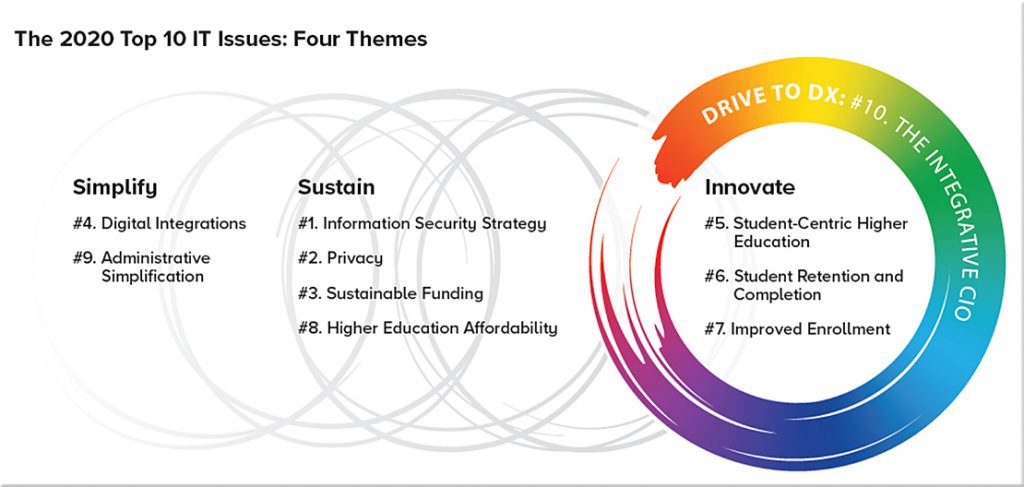
The focus in 2020, then, is to simplify, sustain, innovate, and drive to Dx in all of our institutions and places of higher learning.


From DSC:
To me, one of the key roles of today’s collegiate CIO should be to collaborate with the academic side of the house to identify ways to strategically use technologies to significantly lower the cost of obtaining a degree. Higher education affordability is listed as #8. That’s waaaaaay underestimating the issue and another key reason the backlash continues to build against traditional higher education. If things don’t change and a much cheaper — but still effective — means comes along, look out. Students and families are feeling the weight of the gorillas of debt on their back — weight that lasts for decades for many people today. Along these lines, issues involving privacy and data security — while also important to students — are mainly a CYA for colleges and universities. They don’t address the gorillas of debt as much as other solutions might.

Sorry if you don’t want to hear it, but one of the best solutions involves offering a significant amount of 100% online-based offerings. While this was mentioned, you can still get major pushback about this strategy. But you can’t tell me for one second that offering online-based classes is more expensive than offering traditional, face-to-face based classes. Why? What?! How could I possibly assert this?! The answer is quite simple. One just needs to request to review the budget of your Physical Plant Department. That’s why. Check it out if you can — you’ll see what I mean.

Also, though data is important, it won’t save colleges and universities from closing. What are some things that stand a better chance of doing that?! Here are some:

  • Vision
  • Developing a culture that supports innovation and a willingness to experiment/change 
  • Finding ways to significantly lower the price of obtaining a degree
  • Scanning the horizons to see what’s coming down the pike and how that will impact our students’ futures. Then, develop the curriculum to best help our students prepare for their future.

“The CIO’s ‘role at the table’ has evolved to be one that is less about the mechanics of the IT organization and more about how IT can serve as a strategic partner in helping the institution execute its mission.”(source)



5 lessons from the 2020 US Department of Education Blockchain Summit — from linkedin.com by Johanna Maaghul

Excerpts:

1. Interoperability is the Word of the Day
2. My Diploma is on the Blockchain! Now What?
3. Who Owns My Data? Well, it’s Not Just You
4. It’s only Legit if I am Legit
5. Consensus is Good, but Action is Better


The cost of college increased by more than 25% in the last 10 years—here’s why — from cnbc.com by Abigail Hess

Excerpt:

During the 1978 – 1979 school year, it cost the modern equivalent of $17,680 per year to attend a private college and $8,250 per year to attend a public college. By the 2008 – 2009 school year those costs had grown to $38,720 at private colleges and $16,460 at public colleges.

Today, those costs are closer to $48,510 and $21,370, respectively. That means costs increased by roughly 25.3% at private colleges and about 29.8% at public colleges.

Also see:

How affordable are public colleges in your state for low-income students?

Students from low-income backgrounds should be able to attend college without shouldering a debt burden or having to work so many hours that they jeopardize their chances of completing a degree. But that’s just not possible today.

Think students today can work their way through college? Think again.

For millions of college-going students, one of the most urgent concerns is the rising cost of college and how to pay for it — and not just for tuition but other necessities like textbooks, housing, food, and transportation. The idea that one can work one’s way through college with a minimum-wage job is, in most cases, a myth. In the vast majority of states, students at public four-year institutions would have to work an excessive number of hours per week to cover such costs. The same goes for students at many public community and technical colleges. In one of the costliest scenarios, students would have to work 45 hours a week to be exact, leaving nearly no time to focus on academics.

Overall, students from low-income backgrounds, despite access to financial aid, are being asked to pay well beyond their means for a college degree. In the following analysis, we look closely at just how much beyond their means.

Also see:

Also see:


Stepping Back from the Cliff: Facing New Realities of Changing Student Demographics — from evoLLLution.com by Jim Shaeffer
Most universities that plan to stick to the status quo and serve exclusively traditional learners are facing a cliff. CE divisions can help their institutions avoid a potential drop, but only if they’re empowered.

Excerpt:

Demographics of students enrolling at colleges and universities are evolving. And students’ expectations are evolving as well. As the numbers of 18-22 year olds fresh out of high school drop, the recruitment of non-traditional students is becoming more important than ever. In this interview, James Shaeffer discusses the role continuing education (CE) departments can play as drivers of innovation and reflects on how CE leaders can help their main campus colleagues embrace transformational change.

Addendum on 1/4/20:


Get Smart About Going Online: Choosing the Right Model to Deliver Digital Programming — from evolllution.com by Charles Kilfoye
A veteran online educator looks at the benefits and pitfalls for each of the three main ways to launch an online program.

Excerpt:

Online learning is making headlines again with big players such as University of Massachusetts and California Community College Online launching high profile online initiatives recently. Some would argue that if you haven’t made it in online education already, you’ve missed your opportunity.

However, my sense is it’s never too late. You just have to be smart about it. It all boils down to asking yourself the basic problem-solving questions of Why, What and How to determine if online education is right for your institution. To illustrate my point, I will briefly discuss major considerations you should make when exploring an online strategy and I will examine the pros and cons of the three most common models of delivering online programs in higher education today.

Be aware that differentiated pricing may indicate to prospective students that one format is more valuable or better than another. My personal opinion is that a degree earned online should be considered the same degree as one earned on-ground. It is the same program, same faculty, same admissions requirements, same relevance and rigor, so why not the same cost?


From DSC:
Regarding the topic of pricing, it would be my hope that we could offer online-based programs at significantly discounted prices. This is why I think it will be the larger higher education providers that ultimately win out — or a brand new player in the field that uses a next gen learning platform along with a different business model (see below article) — as they can spread their development costs over a great number of students/courses/program offerings.

If the current players in higher ed don’t find a way to do this (and some players have already figured this out and are working on delivering it), powerful alternatives will develop — especially as the public’s perspective on the value of higher education continues to decline.


Learning from the living class room

I’d also like to hear Charles’ thoughts about pricing after reading Brandon’s article below:

If it’s more expensive, it must be better. That, of course, has been the prevailing wisdom among parents and students when it comes to college. But that wisdom has now been exposed as an utter myth according to a new study published in The Journal of Consumer Affairs. It turns out the cost of a college does not predict higher alumni ratings about the quality of their education. In fact, the opposite is true: total cost of attendance predicts lower ratings.

Quality matters. Price does not. Quality and price are not the same things. And this all has enormous implications for the industry and its consumers.


Coming down the pike: A next generation, global learning platform [Christian]

From DSC:
Though we aren’t quite there yet, the pieces continue to come together to build a next generation learning platform that will help people reinvent themselves quickly, efficiently, constantly, and cost-effectively.

Learning from the living class room


Learning from the living class room


Learning from the living class room


Redefining Norms Critical to Sustained Relevance in the Changing Postsecondary Environment — from evolllution.com by Hunt Lambert
Sticking to the status quo will end in disaster for most postsecondary institutions. To stay relevant, institutions have to rethink all aspects of the higher education product, from programming to student support to organizational models.

Excerpt (emphasis DSC):

Higher education has existed for over a millennium in an effectively unchanged state, but the impetus to transform has arrived. Fast-changing labor demands, evolving learner expectations and transformed market realities are forcing college and university leaders to rethink the traditional postsecondary model and find ways to serve the growing numbers of lifelong learners. This idea has been broadly articulated as the 60-Year Curriculum (60YC), and executing on this vision demands a fundamental change in how higher education institutions must operate to serve students. In this interview, Hunt Lambert expands on the 60YC vision and shares his insights into how the organizational models of postsecondary institutions need to evolve to adapt to this approach.

The 60YC proposes that higher education providers, who happen to be best in the world at knowledge creation and dissemination through well-designed curriculum, expand that curricula concept from the current two-year AA, four-year BA, two-year master’s and seven-year PhD learning models into a 60-year model inclusive of 15- to 75-year-old learners and, most likely, beyond.


AI and smart campuses are among higher ed tech to watch in 2020 — from edtechmagazine.com by Adam Stone
Early adopters tap emerging tools to achieve cost savings and improve learning outcomes.

Excerpt:

In parallel with the rise of municipal smart cities, higher education continues to push toward the smart campus, a vision of a digitally interconnected learning space in which data and devices combine to enhance the student experience. Colleges need to get smart to stay competitive.

Below is an excerpt from Deloitte’s report — Smart campus: The next-generation connected campus — which the above article links to.

Innovations used in smart banking, smart retail, smart digital workplaces, and smart venues like hospitals and stadiums could be extended to higher education campuses. These smart environments are enabling an easy and seamless experience by leveraging the most advanced and next-generation technologies available to them. And more importantly, they continually
modernize and adjust their practices to meet the needs of their constituents. To stay sustainable and relevant, institutions should employ technology and analytics-based insights to enhance the well-being of the communities in which they are rooted.


‘Academic capitalism’ is reshaping faculty life. What does that mean? — from edsurge.com by Rebecca Koenig

Excerpt:

Professors have long savored their position outside of commercial systems. But these days, there’s plenty of signs of capitalism within the academy—scholars seek support from funders in hopes that the findings will lead to commercial applications, departments market their courses to students as pathways to lucrative careers and universities replace tenure-track positions with adjunct jobs to cut costs.

Last week on the latest installment of EdSurge Live, our monthly online discussion forum, we dug into the topic, often referred to as “academic capitalism.”


6 reasons why higher education needs to be disrupted — from hbr.org by Tomas Chamorro-Premuzic and Becky Frankiewicz

In our view, until the entire higher educational system prioritizes the classroom over the research lab, it will be a challenge for this dynamic to change.

Excerpts:

  1. Employers need skills, not just knowledge or titles:
  2. Students want jobs, not knowledge or titles:
  3. Students are paying more and more to get less and less:
  4. Students have unrealistic expectations (understandably) about college:
  5. Many elite universities prioritize research, often at the expense of teaching:
  6. Instead of boosting meritocracy, universities reinforce inequality:

The fundamental question we see is this: If a university claims to be a top educational institution, shouldn’t it admit the people with the lowest test scores, and turn them into the leader of tomorrow (as opposed to admitting the people with the highest income and test scores, who would probably rule the world tomorrow regardless of those three or four years in college)?

From DSC:
My hat’s off to those who teach in those institutions who “open wide” the gates of entry!!! They are the professors who have to work their tails off to help their students. 

And shame on the elite institutions who continue to value research/grant $$ waaaaaay over teaching — all while charging more and more for less and less…and while many graduates students end up teaching a lot of the undergraduate students. Those graduate students most likely haven’t been taught how to teach either!

And what higher ed pays adjunct faculty members is a complete disgrace — while many coaches make millions of $’s. Full-time faculty members — and administrators/provosts/other members of leadership — who were suddenly put into the adjunct faculty member’s role/wages would be outraged and demand immediate change.


Report: College leaders not confident they can beat new competition — from educationdive.com by Hallie Busta, with thanks to Ray Schroeder for posting this out on LinkedIn

Excerpt:

While they say their institutions are prepared to meet students’ changing needs, they are less confident in their ability to address new forms of competition or change how the public views higher ed.

The report comes as higher ed stares down potentially fewer traditional students, more competition online, less state funding, and concerns over public perceptions of higher ed. These pressures have made smaller public and private institutions vulnerable to consolidation and even closure.


2020 Top 10 Issues: Simplify, Sustain, Innovate: The Drive to Digital Transformation Begins — from Educause by Susan Grajek

  1. Information security strategy
  2. Privacy
  3. Sustainable funding
  4. Digital integrations
  5. Student retention and completion
  6. Student-centric higher education
  7. Improved enrollment
  8. Higher education affordability
  9. Administrative simplification
  10. The integrative CIO

Also see:

The 30th National Survey of eLearning and Information Technology in US Higher Education — from campuscomputing.net
Hiring and Retaining Campus IT Talent Are Challenges; Many Campus Leaders Are Not Well-Informed About nor Engaged with Digital Issues

Excerpt:

New data from the fall 2019 Campus Computing Survey highlight the challenges that IT leaders across all sectors of US higher education confront in hiring and retaining IT talent. More than three-fourths (77 percent) of the CIOs and senior campus officials participating 2019 survey cite “hiring and retaining IT talent” as a top institutional IT priority. Similarly, 78 percent point to uncompetitive campus salaries and benefits as a major problem in the quest to hire and retain IT talent. And reflecting the campus financial challenges that affect hiring and staff retention efforts, fully two-thirds (67 percent) agree/strongly agree that institutional IT funding “has not recovered from the budget cuts” experienced by colleges and universities across all sectors of higher education since the “Great Recession of 2008.”


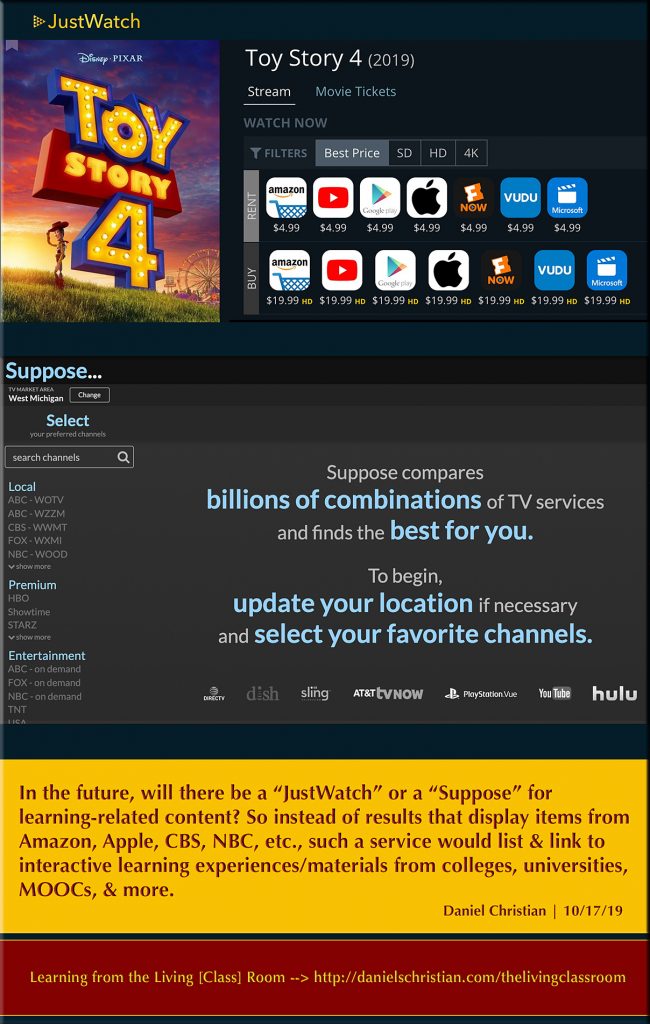
DC: In the future…will there be a “JustWatch” or a “Suppose” for learning-related content?

DC: In the future...will there be a JustWatch or a Suppose for learning-related content?


From DSC:
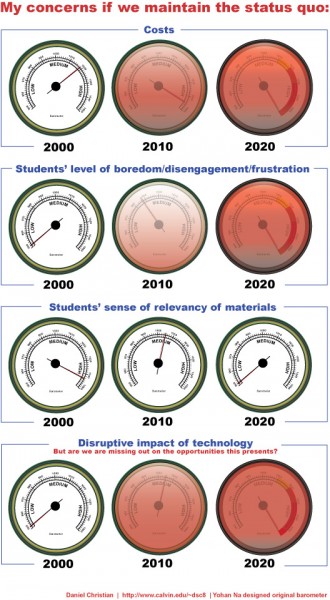
Regular readers of this blog will know that for years, I’ve made it one of my goals to try and raise awareness of the need for institutions of higher education to lower their tuitions! For example, Yohan Na and I designed the graphic below way back in 2009.


Daniel S. Christian: My concerns with just maintaining the status quo


Through those years, I cringed when I kept hearing various Boards say, “We only increased our tuition by ___ % — the lowest percentage increase in our state.” The direction was completely wrong! It needed to go down, not up. If you work in higher ed, I encourage you to find a way for that to happen at your own institution.

So I’m very pleased to report that the WMU-Thomas M. Cooley Law School — where I work — was able to reduce tuition by 21%!!! 

Don’t get me wrong, some tough decisions were made to pave the way for that to occur. But this will be the case no matter which institution of higher education that you look at. An institution will have to make some tough choices to reduce their tuition. But it HAS to occur. We can’t keep this upward trajectory going.

If we don’t change this trajectory, we will continue to put enormous gorillas (of debt) on our graduates’ backs! Such debt will take our graduates decades to pay off. 

We need to be aware of these invisible gorillas of debt. That is, our students move on…and we don’t see them. But their gorillas remain.


Addendum on 10/18/19:

Victoria Vuletich, the assistant dean at the Grand Rapids, Michigan campus of Western Michigan University Cooley Law School, was interviewed by the State Bar of Michigan’s Legal Talk Network to discuss what the law school experience is like for the current generation of students. 


© 2025 | Daniel Christian