A growing repository of useful design tools, from accessibility and AR to wireframing and 3D modeling software.
? Awesome Design Toolshttps://t.co/qo5wAU9D4d pic.twitter.com/THIYPLmH0c
— Smashing Magazine (@smashingmag) April 10, 2019
A growing repository of useful design tools, from accessibility and AR to wireframing and 3D modeling software.
? Awesome Design Toolshttps://t.co/qo5wAU9D4d pic.twitter.com/THIYPLmH0c
— Smashing Magazine (@smashingmag) April 10, 2019
The finalized 2019 Horizon Report Higher Education Edition (from library.educause.edu) was just released on 4/23/19.
Excerpt:
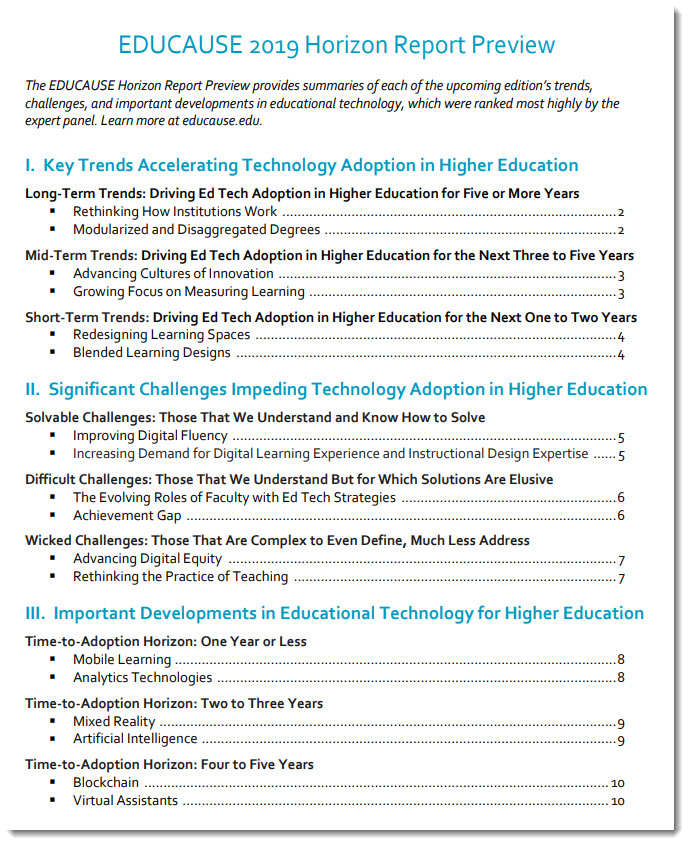
Key Trends Accelerating Technology Adoption in Higher Education:
Short-Term—Driving technology adoption in higher education for the next one to two years
Mid-Term—Driving technology adoption in higher education for the next three to five years
Long-Term—Driving technology adoption in higher education for five or more years
In the last 10 years, I have written over 2000 provincial certification exam questions and reviewed more than 10000 questions written by tech writers. This resource is the best I have seen and I endorse every tip. What an excellent job by @caranorth11 and @mshEducation https://t.co/1nTpOaU6xt
— Taruna Goel (@write2tg) April 2, 2019
If you missed our presentation (@mshEducation) at #LSCon about writing better multiple-choice test items, you can get the resources here: https://t.co/I4k6Vxa0Rk
We've also been asked to do an encore via webinar to dive into this again. Once we have it finalized, we will share. pic.twitter.com/WlkGU9Pjlr— Cara North #ATD2019 (@caranorth11) April 1, 2019
From DSC:
First of all, an article:
The four definitive use cases for AR and VR in retail — from forbes.com by Nikki Baird
Excerpt (emphasis DSC):
AR is the go-to engagement method of choice when it comes to product and category exploration. A label on a product on a shelf can only do so much to convey product and brand information, vs. AR, which can easily tap into a wealth of digital information online and bring it to life as an overlay on a product or on the label itself.
From DSC:
Applying this concept to the academic world…what might this mean for a student in a chemistry class who has a mobile device and/or a pair of smart goggles on and is working with an Erlenmeyer flask? A burette? A Bunsen burner?
Along these lines...what if all of those confused students — like *I* was struggling through chem lab — could see how an experiment was *supposed to be done!?*
That is, if there’s only 30 minutes of lab time left, the professor or TA could “flip a switch” to turn on the AR cloud within the laboratory space to allow those struggling students to see how to do their experiment.
I can’t tell you how many times I was just trying to get through the lab — not knowing what I was doing, and getting zero help from any professor or TA. I hardly learned a thing that stuck with me…except the names of a few devices and the abbreviations of a few chemicals. For the most part, it was a waste of money. How many students experience this as well and feel like I did?
Will the terms “blended learning” and/or “hybrid learning” take on whole new dimensions with the onset of AR, MR, and VR-related learning experiences?
#IntelligentTutoring #IntelligentSystems #LearningExperiences
#AR #VR #MR #XR #ARCloud #AssistiveTechnologies
#Chemistry #BlendedLearning #HybridLearning #DigitalLearning
Also see:
“It is conceivable that we’re going to be moving into a world without screens, a world where [glasses are] your screen. You don’t need any more form factor than [that].”
(AT&T CEO)
From a fairly recent e-newsletter from edsurge.com — though I don’t recall the exact date (emphasis DSC):
New England is home to some of the most famous universities in the world. But the region has also become ground zero for the demographic shifts that promise to disrupt higher education.
This week saw two developments that fit the narrative. On Monday, Southern Vermont College announced that it would shut its doors, becoming the latest small rural private college to do so. Later that same day, the University of Massachusetts said it would start a new online college aimed at a national audience, noting that it expects campus enrollments to erode as the number of traditional college-age students declines in the coming years.
“Make no mistake—this is an existential threat to entire sectors of higher education,” said UMass president Marty Meehan in announcing the online effort.
The approach seems to parallel the U.S. retail sector, where, as a New York Times piece outlines this week, stores like Target and WalMart have thrived by building online strategies aimed at competing with Amazon, while stores like Gap and Payless, which did little to move online, are closing stores. Of course, college is not like any other product or service, and plenty of campuses are touting the richness of the experience that students get by actually coming to a campus. And it’s not clear how many colleges can grow online to a scale that makes their investments pay off.
“It’s predicted that over the next several years, four to five major national players with strong regional footholds will be established. We intend to be one of them.”
University of Massachusetts President Marty Meehan
From DSC:
That last quote from UMass President Marty Meehan made me reflect upon the idea of having one or more enormous entities that will provide “higher education” in the future. I wonder if things will turn out to be that we’ll have more lifelong learning providers and platforms in the future — with the idea of a 60-year curriculum being an interesting idea that may come into fruition.
Long have I predicted that such an enormous entity would come to pass. Back in 2008, I named it the Forthcoming Walmart of Education. But then as the years went by, I got bumbed out on some things that Walmart was doing, and re-branded it the Forthcoming Amazon.com of Higher Education. We’ll see how long that updated title lasts — but you get the point. In fact, the point aligns very nicely with what futurist Thomas Frey has been predicting for years as well:
“I’ve been predicting that by 2030 the largest company on the internet is going to be an education-based company that we haven’t heard of yet,” Frey, the senior futurist at the DaVinci Institute think tank, tells Business Insider. (source)
I realize that education doesn’t always scale well…but I’m thinking that how people learn in the future may be different than how we did things in the past…communities of practice comes to mind…as does new forms of credentialing…as does cloud-based learner profiles…as does the need for highly efficient, cost-effective, and constant opportunities/means to reinvent oneself.
Also see:
Addendum:
74% of consumers go to Amazon when they’re ready to buy something. That should be keeping retailers up at night. — from cnbc.com
Key points (emphasis DSC)
“In New England, there will be between 32,000 and 54,000 fewer college-aged students just seven years from now,” Meehan said. “That means colleges and universities will have too much capacity and not enough demand at a time when the economic model in higher education is already straining under its own weight.” (Marty Meehan at WBUR)
Huge study finds professors’ attitudes affect students’ grades — and it’s doubly true for minority students. — from arstechnica.com by Scott Johnson
Excerpt:
Instead, the researchers think the data suggests that—in any number of small ways—instructors who think their students’ intelligence is fixed don’t keep their students as motivated, and perhaps don’t focus as much on teaching techniques that can encourage growth. And while this affects all students, it seems to have an extra impact on underrepresented minority students.
The good news, the researchers say, is that instructors can be persuaded to adopt more of a growth mindset in their teaching through a little education of their own. That small attitude adjustment could make them a more effective teacher, to the significant benefit of a large number of students.
Along these lines, also see:
Horizon Report Preview 2019 — from library.educause.edu
Analytics, Artificial Intelligence (AI), Badges and Credentialing, Blended Learning, Blockchain, Digital Learning, Digital Literacy, Extended Reality (XR), Instructional Design, Instructional Technologies, Learning Analytics, Learning Space, Mobile Learning, Student Learning Support, Teaching and Learning
Abstract
The EDUCAUSE Horizon Report Preview provides summaries of each of the upcoming edition’s trends, challenges, and important developments in educational technology, which were ranked most highly by the expert panel. This year’s trends include modularized and disaggregated degrees, the advancing of digital equity, and blockchain.
For more than a decade, EDUCAUSE has partnered with the New Media Consortium (NMC) to publish the annual Horizon Report – Higher Education Edition. In 2018, EDUCAUSE acquired the rights to the NMC Horizon project.
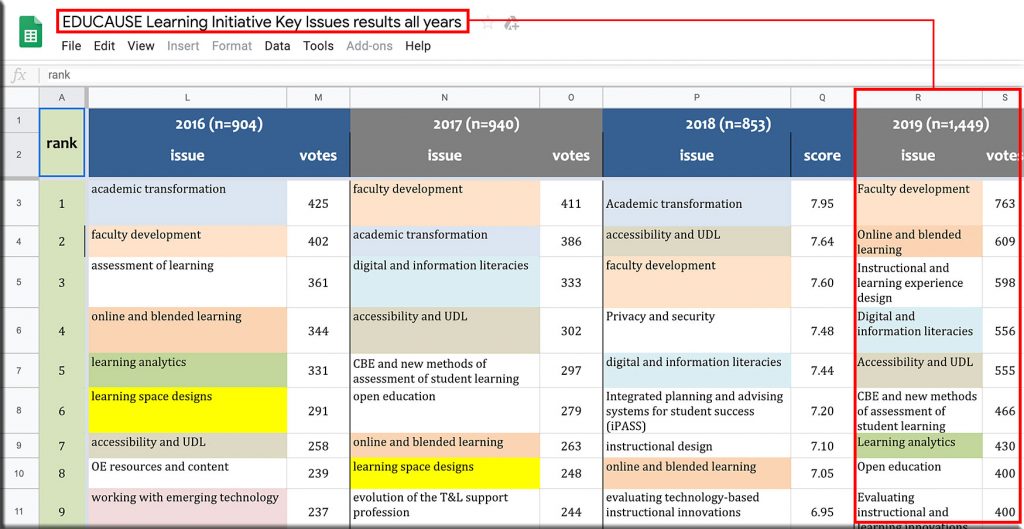
Learning and Student Success: Presenting the Results of the 2019 Key Issues Survey — from er.educause.edu by Malcolm Brown
Excerpts:
Here are some results that caught (Malcolm’s) eye, with a few speculations tossed in:
Is Teaching an Art or a Science? New Book Takes a Fresh Look at ‘How Humans Learn.’ — from edsurge.com by Jeff Young
Excerpts:
Eyler: That is the perennial question. We actually wrote a post for our Teaching Center’s blog with that title, “Is teaching an art or a science?” It has by far been read more than any other blog post that we’ve written.
My answer might be a little unfulfilling because I think it’s actually both. I think there is a scientific element to teaching. The book is about understanding the science of how we learn, how learning has evolved over time, and the social interactions that shape teaching. And the best teachers also often approach teaching and teaching issues scientifically. They have a hypothesis of what they think will help students learn, and they’re going to test it out and then learn from it and revise.
But if we focus too much on the science, we lose the human element of teaching—what I think of as the art of teaching.
…
What’s the thing that surprised you most in your research or putting this book together?
Much of what surprised me most makes up a lot of the final chapter, which is on failure. As teachers, we don’t get trained to think of failure as a positive thing in any way, even though as researchers we know that failure is a part of the learning process. No one walks into a lab right away and comes up with the Nobel Prize-winning discovery. It’s an iterative cycle.
We have these educational systems that are set up to move in exactly the opposite way. We give students really high-stakes assignments and assessments with very few opportunities to do them.
6 key trends to 21st century teaching — from edsurge.com
Excerpt:
It’s popular these days to complain that college teaching hasn’t changed in hundreds of years. And sure, it’s possible to find some professors on any campus holding yellowed lecture notes, or clinging to dusty chalk. But the reality is that the internet and digital technologies have already brought profound changes to instructional styles and tools in higher education.
So what are the new teaching approaches catching on at today’s campuses? And what are the broader cultural changes around college teaching?
We set out to answer those questions over the past year, with a series of articles and interviews exploring what teaching in the 21st century looks like. Some show the nuances of the challenges of teaching with technology by telling stories of innovative professors, including how a water agency official who teaches an online community college course got started in creating open educational resources when her class was incorporated into a zero-cost textbook degree program. Others dive into research on the culture of teaching, like a talk with an anthropologist studying how professors react to (and sometimes resist) research on teaching practices.
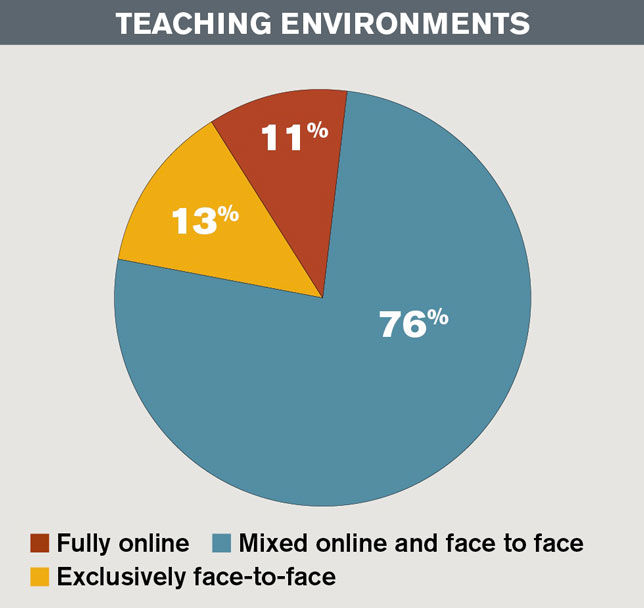
Survey: Online, Blended Dominate Today’s Learning Environments — from campustechnology.com by Rhea Kelly
In our latest Teaching with Technology Survey, the vast majority of faculty members said they teach in either a fully online or blended format.
However, that doesn’t mean those instructors blend every course. When we asked faculty how many of their classes are blended, 29 percent said they teach all blended classes, while 45 percent blend some of their classes. Six percent said they plan to use the blended model in the next year or are exploring the option.
From DSC:
I have often reflected on differentiation or what some call personalized learning and/or customized learning. How does a busy teacher, instructor, professor, or trainer achieve this, realistically?
It’s very difficult and time-consuming to do for sure. But it also requires a team of specialists to achieve such a holy grail of learning — as one person can’t know it all. That is, one educator doesn’t have the necessary time, skills, or knowledge to address so many different learning needs and levels!
Educators and trainers have so many things on their plates that it’s very difficult to come up with _X_ lesson plans/agendas/personalized approaches, etc. On the other side of the table, how do students from a vast array of backgrounds and cognitive skill levels get the main points of a chapter or piece of text? How can they self-select the level of difficulty and/or start at a “basics” level and work one’s way up to harder/more detailed levels if they can cognitively handle that level of detail/complexity? Conversely, how do I as a learner get the boiled down version of a piece of text?
Well… just as with the flipped classroom approach, I’d like to suggest that we flip things a bit and enlist teams of specialists at the publishers to fulfill this need. Move things to the content creation end — not so much at the delivery end of things. Publishers’ teams could play a significant, hugely helpful role in providing customized learning to learners.
Some of the ways that this could happen:
Use an HTML like language when writing a textbook, such as:
<MainPoint> The text for the main point here. </MainPoint>
<SubPoint1>The text for the subpoint 1 here.</SubPoint1>
<DetailsSubPoint1>More detailed information for subpoint 1 here.</DetailsSubPoint1>
<SubPoint2>The text for the subpoint 2 here.</SubPoint2>
<DetailsSubPoint2>More detailed information for subpoint 2 here.</DetailsSubPoint2>
<SubPoint3>The text for the subpoint 3 here.</SubPoint3>
<DetailsSubPoint3>More detailed information for subpoint 3 here.</DetailsSubPoint1>
<SummaryOfMainPoints>A list of the main points that a learner should walk away with.</SummaryOfMainPoints>
<BasicsOfMainPoints>Here is a listing of the main points, but put in alternative words and more basic ways of expressing those main points. </BasicsOfMainPoints>
<Conclusion> The text for the concluding comments here.</Conclusion>
<BasicsOfMainPoints> could be called <AlternativeExplanations>
Bottom line: This tag would be to put things forth using very straightforward terms.
Another tag would be to address how this topic/chapter is relevant:
<RealWorldApplication>This short paragraph should illustrate real world examples
of this particular topic. Why does this topic matter? How is it relevant?</RealWorldApplication>
On the students’ end, they could use an app that works with such tags to allow a learner to quickly see/review the different layers. That is:
It’s like the layers of a Microsoft HoloLens app of the human anatomy:

Or it’s like different layers of a chapter of a “textbook” — so a learner could quickly collapse/expand the text as needed:
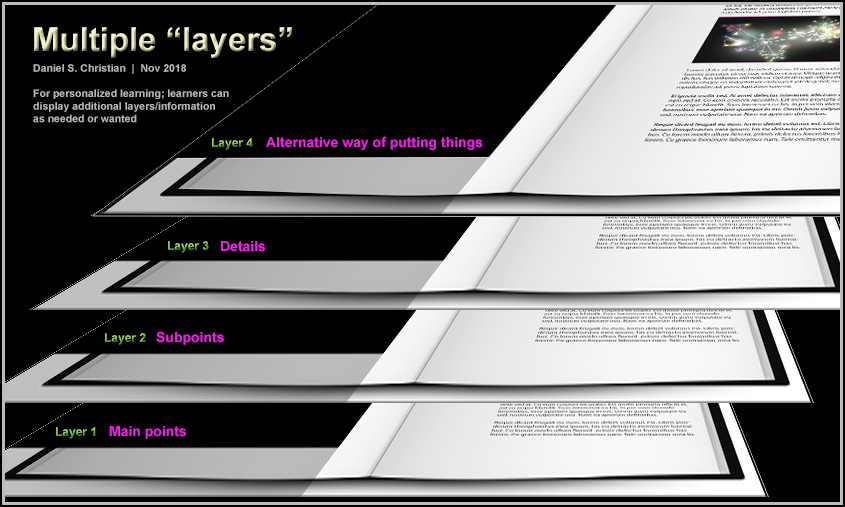
This approach could be helpful at all kinds of learning levels. For example, it could be very helpful for law school students to obtain outlines for cases or for chapters of information. Similarly, it could be helpful for dental or medical school students to get the main points as well as detailed information.
Also, as Artificial Intelligence (AI) grows, the system could check a learner’s cloud-based learner profile to see their reading level or prior knowledge, any IEP’s on file, their learning preferences (audio, video, animations, etc.), etc. to further provide a personalized/customized learning experience.
To recap:
Top Trends in Active and Collaborative Learning — from thesextantgroup.com by Joe Hammett
Excerpts:
My daughter is a maker. She spends hours tinkering with sewing machines and slime recipes, building salamander habitats and the like. She hangs out with her school friends inside apps that teach math and problem solving through multi-player games. All the while, they are learning to communicate and collaborate in ways that are completely foreign to their grandparent’s generation. She is 10 years old and represents a shift in human cognitive processing brought about by the mastery of technology from a very young age. Her generation and those that come after have never known a time without technology. Personal devices have changed the shared human experience and there is no turning back.
The spaces in which this new human chooses to occupy must cater to their style of existence. They see every display as interactive and are growing up knowing that the entirety of human knowledge is available to them by simply asking Alexa. The 3D printer is a familiar concept and space travel for pleasure will be the norm when they have children of their own.
Current trends in active and collaborative learning are evolving alongside these young minds and when appropriately implemented, enable experiential learning and creative encounters that are changing the very nature of the learning process. Attention to the spaces that will support the educators is also paramount to this success. Lesson plans and teaching style must flip with the classroom. The learning space is just a room without the educator and their content.
…
8. Flexible and Reconfigurable
With floor space at a premium, classrooms need to be able to adapt to a multitude of uses and pedagogies. Flexible furniture will allow the individual instructor freedom to set up the space as needed for their intended activities without impacting the next person to use the room. Construction material choices are key to achieving an easily reconfigurable space. Raised floors and individually controllable lighting fixtures allow a room to go from lecture to group work with ease. Whiteboard paints and rail mounting systems make walls reconfigurable too!.
Active Learning, Flipped Classroom, SCALE-UP, TEAL Classroom, whatever label you choose to place before it, the classroom, learning spaces of all sorts, are changing. The occupants of these spaces demand that they are able to effectively, and comfortably, share ideas and collaborate on projects with their counterparts both in person and in the ether. A global shift is happening in the way humans share ideas. Disruptive technology, on a level not seen since the assembly line, is driving a change in the way humans interact with other humans. The future is collaborative.
Are ‘smart’ classrooms the future? — from campustechnology.com by Julie Johnston
Indiana University explores that question by bringing together tech partners and university leaders to share ideas on how to design classrooms that make better use of faculty and student time.
Excerpt:
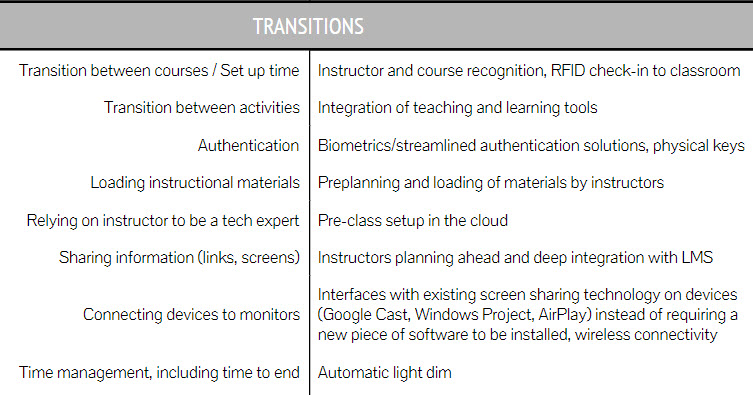
To achieve these goals, we are investigating smart solutions that will:
…
Activities included collaborative brainstorming focusing on these questions:
From DSC:
Though many peoples’ — including faculty members’ — eyes gloss over when we start talking about learning spaces and smart classrooms, it’s still an important topic. Personally, I’d rather be learning in an engaging, exciting learning environment that’s outfitted with a variety of tools (physically as well as digitally and virtually-based) that make sense for that community of learners. Also, faculty members have very limited time to get across campus and into the classroom and get things setup…the more things that can be automated in those setup situations the better!
I’ve long posted items re: machine-to-machine communications, voice recognition/voice-enabled interfaces, artificial intelligence, bots, algorithms, a variety of vendors and their products including Amazon’s Alexa / Apple’s Siri / Microsoft’s Cortana / and Google’s Home or Google Assistant, learning spaces, and smart classrooms, as I do think those things are components of our future learning ecosystems.
From DSC:
Ever notice how effective Ted Talks begin? They seek to instantly grab your attention with a zinger question, a somewhat shocking statement, an interesting story, a joke, an important problem or an issue, a personal anecdote or experience, a powerful image/photo/graphic, a brief demonstration, and the like.
Grabbing someone’s attention is a key first step in getting a piece of information into someone’s short-term memory — what I call getting through “the gate.” If we can’t get through the gate into someone’s short-term memory, we have zero (0) chance of having them actually process that information and to think about and engage with that piece of content. If we can’t make it into someone’s short-term memory, we can’t get that piece of information into their long-term memory for later retrieval/recall. There won’t be any return on investment (ROI) in that case.

So why not try starting up one of your classes this week with a zinger question, a powerful image/photo/video, or a story from your own work experience? I’ll bet you’ll grab your students’ attentions instantly! Then you can move on into the material for a greater ROI. From there, offering frequent, low-stakes quizzes will hopefully help your students slow down their forgetting curves and help them practice recalling/retrieving that information. By the way, that’s why stories are quite powerful. We often remember them better. So if you can weave an illustrative story into your next class, your students might really benefit from it come final test time!
Also relevant/see:
Ready, set, speak: 5 strong ways to start your next presentation — from abovethelaw.com by Olga Mack, with thanks to Mr. Otto Stockmeyer for this resource
No matter which of these five ways you decide to launch your presentation, ensure that you make it count, and make it memorable.
Excerpts: