NEW: The Top Tools for Learning 2018 [Jane Hart]

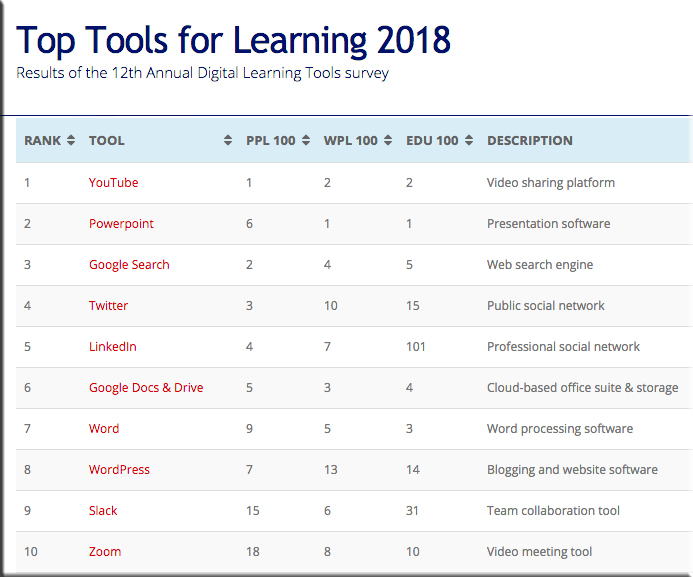
The Top Tools for Learning 2018 from the 12th Annual Digital Learning Tools Survey -- by Jane Hart


The above was from Jane’s posting 10 Trends for Digital Learning in 2018 — from modernworkplacelearning.com by Jane Hart

Excerpt:

[On 9/24/18],  I released the Top Tools for Learning 2018 , which I compiled from the results of the 12th Annual Digital Learning Tools Survey.

I have also categorised the tools into 30 different areas, and produced 3 sub-lists that provide some context to how the tools are being used:

  • Top 100 Tools for Personal & Professional Learning 2018 (PPL100): the digital tools used by individuals for their own self-improvement, learning and development – both inside and outside the workplace.
  • Top 100 Tools for Workplace Learning (WPL100): the digital tools used to design, deliver, enable and/or support learning in the workplace.
  • Top 100 Tools for Education (EDU100): the digital tools used by educators and students in schools, colleges, universities, adult education etc.


3 – Web courses are increasing in popularity.
Although Coursera is still the most popular web course platform, there are, in fact, now 12 web course platforms on the list. New additions this year include Udacity and Highbrow (the latter provides daily micro-lessons). It is clear that people like these platforms because they can chose what they want to study as well as how they want to study, ie. they can dip in and out if they want to and no-one is going to tell them off – which is unlike most corporate online courses which have a prescribed path through them and their use is heavily monitored.


5 – Learning at work is becoming personal and continuous.
The most significant feature of the list this year is the huge leap up the list that Degreed has made – up 86 places to 47th place – the biggest increase by any tool this year. Degreed is a lifelong learning platform and provides the opportunity for individuals to own their expertise and development through a continuous learning approach. And, interestingly, Degreed appears both on the PPL100 (at  30) and WPL100 (at 52). This suggests that some organisations are beginning to see the importance of personal, continuous learning at work. Indeed, another platform that underpins this, has also moved up the list significantly this year, too. Anders Pink is a smart curation platform available for both individuals and teams which delivers daily curated resources on specified topics. Non-traditional learning platforms are therefore coming to the forefront, as the next point further shows.


From DSC:
Perhaps some foreshadowing of the presence of a powerful, online-based, next generation learning platform…?


Production Values for Audio Podcasts, Part I — from learningsolutionsmag.com by Jeff D’Anza

Excerpts:

There are a number of production values that narrative podcasters find effective for grabbing listener attention and keeping their audiences engaged in the story; you could think of these as technical elements of professional audio quality. They range from techniques for improving content when applied to script writing to methods applied to audio recording and editing. The most successful professional podcasters use these elements to create immersion in the audio environment and to eliminate audio distraction. The result is the creation of a kind of audio theater. Here are four basic practices to embrace while creating your narrative podcasts.

  1. Set the scene first
  2. Hook the audience
  3. Vary character voices
  4. Talk like real people


Production Values for Audio Podcasts, Part II — from learningsolutionsmag.com by Jeff D’Anza

Excerpts:

In this article, I will continue with more production tricks that can substantially increase the quality of your narrative podcasts.

Use music to reset scenes
It’s not revolutionary to suggest that learners tend to have short attention spans, and the case is no different when it comes to narrative podcasts. Every so often you need to reset your learners’ brains in order to keep their attention level high.

One excellent way to accomplish this is through the use of musical breaks. Music breaks can function as a type of auditory palate cleanser, allowing the brain a few moments to stop focusing on information that is being presented and prepare the learner to be ready for the next section of content.

Also:

  • Host/producer structure
  • Get out of the studio
  • Don’t fear insignificant details


From DSC:

Seems to me there’s some wisdom here for instructional designers as well as professors, teachers, and trainers who are creating learning/training related content and/or who are flipping their classrooms.


Despite increase in Instructional Designers, there is no ‘universal profile’ for the role — from campustechnology.com by Dian Schaffhauser

Excerpt:

In higher education, one 2016 estimate pegged the “minimum” number of instructional designers employed by colleges and universities at some 13,000. But, as a new report from the Online Learning Consortium pointed out, “There is still a certain mystery surrounding who instructional designers are.”

Instructional Design in Higher Education: Defining an Evolving Field seeks to clear up the mystery. The report is the second in a series to examine aspects of the digital learning landscape by doing a literature survey of existing research. The first report looked at accessibility. The series is being produced by OLC’s Research Center for Digital Learning & Leadership.


2018 NMC Horizon Report: The trends, challenges, and developments likely to influence ed tech

2018 NMC Horizon Report — from library.educause.edu

Excerpt:

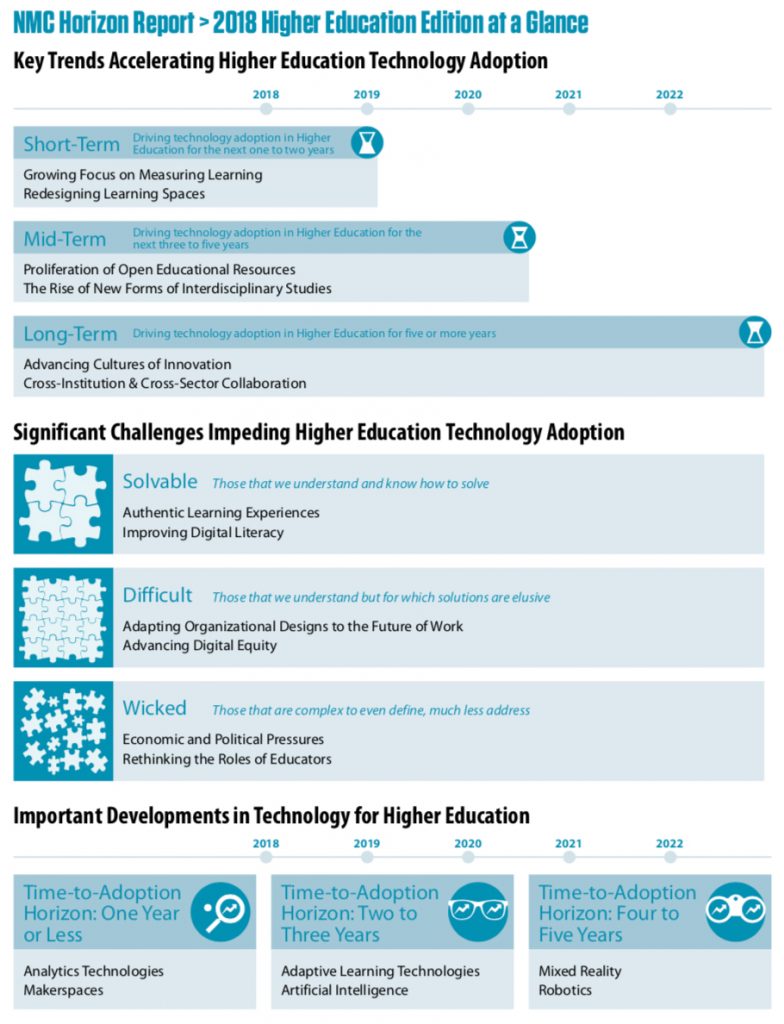
What is on the five-year horizon for higher education institutions? Which trends and technology developments will drive educational change? What are the critical challenges and how can we strategize solutions? These questions regarding technology adoption and educational change steered the discussions of 71 experts to produce the NMC Horizon Report: 2018 Higher Education Edition brought to you by EDUCAUSE. This Horizon Report series charts the five-year impact of innovative practices and technologies for higher education across the globe. With more than 16 years of research and publications, the Horizon Project can be regarded as one of education’s longest-running explorations of emerging technology trends and uptake.

Six key trends, six significant challenges, and six developments in educational technology profiled in this higher education report are likely to impact teaching, learning, and creative inquiry in higher education. The three sections of this report constitute a reference and technology planning guide for educators, higher education leaders, administrators, policymakers, and technologists.


2018 NMC Horizon Report -- a glance at the trends, challenges, and developments likely to influence ed tech -- visual graphic


Also see:


You’re already harnessing the science of learning (you just don’t know it) — from edsurge.com by Pooja Agarwal

Excerpt (emphasis DSC):

Now, a decade later, I see the same clicker-like trend: tools like Kahoot, Quizlet, Quizizz and Plickers are wildly popular due to the increased student engagement and motivation they can provide. Meanwhile, these tech tools continue to incorporate powerful strategies for learning, which are discussed less often. Consider, for example, four of the most robust research-based strategies from the science of learning:

  1. Retrieval practice
  2. Spaced practice
  3. Interleaving
  4. Feedback

Sound familiar? It’s because approaches that encourage students to use what they know, revisit it over time, mix it up and learn about their own learning are core elements in many current edtech tools. Kahoot and Quizlet, for example, provide numerous retrieval formats, reminders, shuffle options and instant feedback. A century of scientific researchdemonstrates that these features don’t simply increase engagement—they also improve learning, higher order thinking and transfer of knowledge.


From DSC:
Pastors should ask this type of question as well: “What did we talk about the last time we met?” — then give the congregation a minute to write down what they can remember.


Also from Pooja Agarwal and RetrievalPractice.org

For teachers, here’s what we share in a minute or less about retrieval practice:

And when it comes to students, the first thing we share are Retrieval Warm Ups. These quick, fun questions engage students in class discussion and start a conversation about how retrieval is something we do every day. Try one of these with a teacher to start a conversation about retrieval practice, too!


Get started with rubrics — from thecreativeeducator.com by Melinda Kolk
Make assessment a classroom conversation

Excerpt:

A rubric is an assessment tool that clearly outlines expectations for student work. A rubric describes which performances will be assessed and specifies the criteria for assessing them. Rubrics can be used throughout the process of student work, making them useful for project-based learning implementations.

Because rubrics describe what high performance looks like, they are great tools to help students gauge their work and provide an opportunity for conversation between students and teachers about high-quality work.

Creating a rubric for the final product and various components of project work can ensure a more accurate, specific, and useful assessment.

A rubric is an authentic assessment tool that:

  • Provides clear expectations for a project.
  • Considers the product as well as the entire project-building process.
  • Enumerates the performances on which students will be evaluated.
  • Explains what constitutes excellence for each performance.
  • Helps students understand what they need to do to excel.
  • Prevents subjectivity and bias during the evaluation process.


Also see:


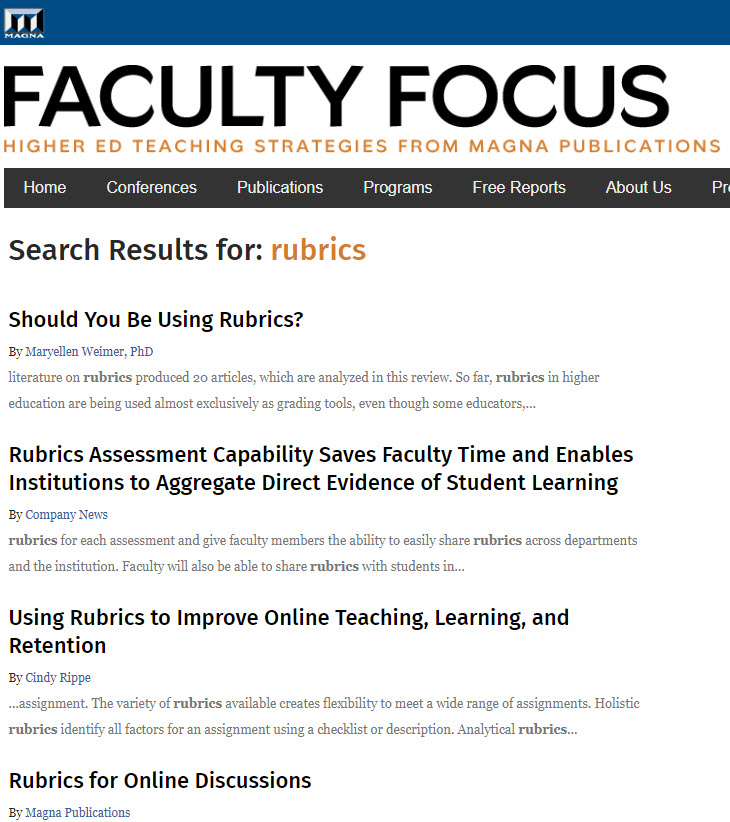
this graphic links to a search for rubrics out at FacultyFocus.com


From DSC:
Rubrics need to be very carefully designed/constructed though; otherwise rubrics can spoon-feed students the answers in an age where problem solving capabilities are really needed.


What is a learning ecosystem? And how does it support corporate strategy? — from ej4.com by Ryan Eudy

Excerpt:

learning ecosystem is a system of people, content, technology, culture, and strategy, existing both within and outside of an organization, all of which has an impact on both the formal and informal learning that goes on in that organization.

The word “ecosystem” is worth paying attention to here. It’s not just there to make the term sound fancy or scientific. A learning ecosystem is the L&D equivalent of an ecosystem out in the wild. Just as a living ecosystem has many interacting species, environments, and the complex relationships among them, a learning ecosystem has many people and pieces of content, in different roles and learning contexts, and complex relationships.

Just like a living ecosystem, a learning ecosystem can be healthy or sick, nurtured or threatened, self-sustaining or endangered. Achieving your development goals, then, requires an organization to be aware of its own ecosystem, including its parts and the internal and external forces that shape them.


From DSC:
Yes, to me, the concept/idea of a learning ecosystem IS important. Very important. So much so, I named this blog after it.

Each of us as individuals have a learning ecosystem, whether we officially recognize it or not. So do the organizations that we work for. And, like an ecosystem out in nature, a learning ecosystem is constantly morphing, constantly changing.

We each have people in our lives that help us learn and grow, and the people that were in our learning ecosystems 10 years ago may or may not still be in our current learning ecosystems. Many of us use technologies and tools to help us learn and grow. Then there are the spaces where we learn — both physical and virtual spaces. Then there are the processes and procedures we follow, formally and/or informally. Any content that helps us learn and grow is a part of that ecosystem. Where we get that content can change, but obtaining up-to-date content is a part of our learning ecosystems. I really appreciate streams of content in this regard — and tapping into blogs/websites, especially via RSS feeds and Feedly (an RSS aggregator that took off when Google Reader left the scene).

The article brings up a good point when it states that a learning ecosystem can be “healthy or sick, nurtured or threatened, self-sustaining or endangered.” That’s why I urge folks to be intentional about maintaining and, better yet, consistently enhancing their learning ecosystems. In this day and age where lifelong learning is now a requirement to remain in the workforce, each of us needs to be intentional in this regard.


U.S. L&D Report – Benchmark Your Workplace Learning  — from findcourses.com, via Alexander Caplan

Topics covered include:

  • L&D Benchmarking Survey: 2018
  • Virtual Reality: A New Reality for L&D
  • How to Promote a Learning Culture in Your Organization
  • How to Calculate Meaningful ROI for Workplace Learning


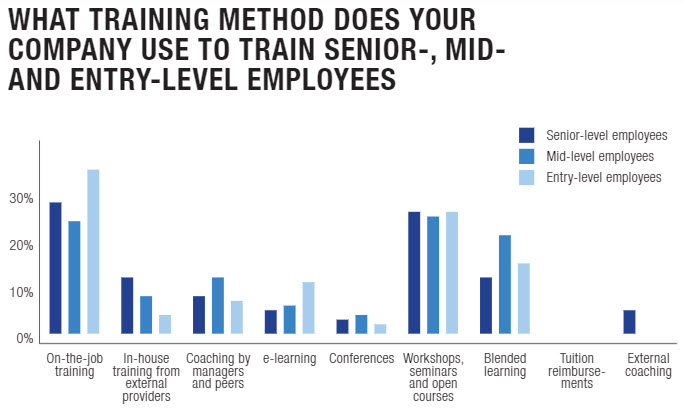
types of training offered to entry level, mid- and senior- level employees


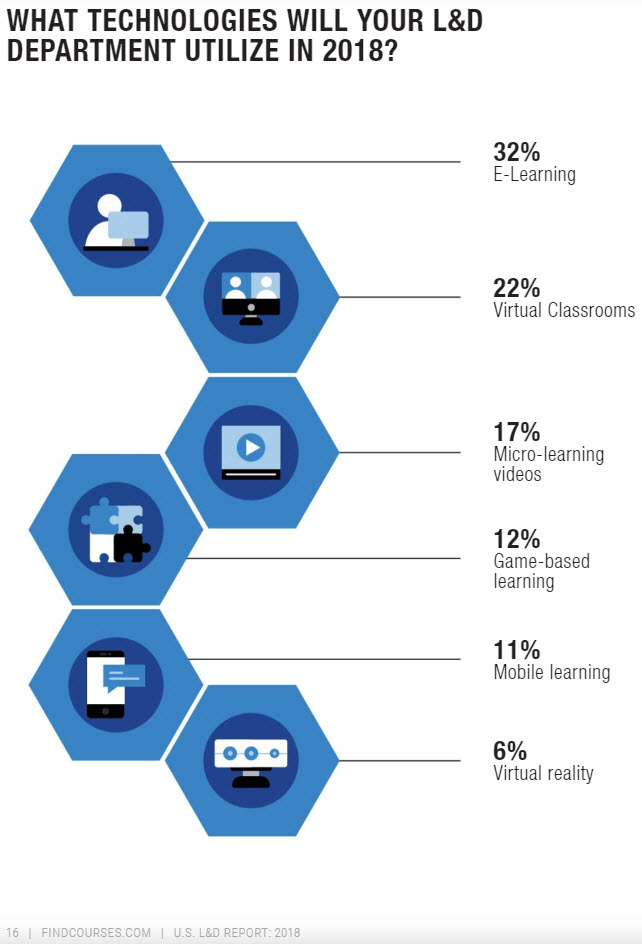
types of technologies the learning and development group will use in 2018


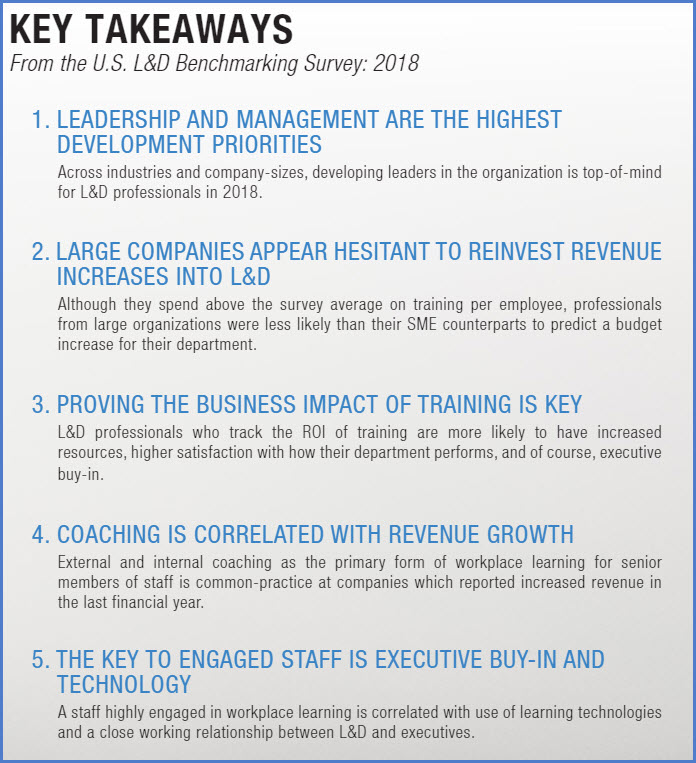
Key takeaways from the U.S. L&D Report


Also see:


6 Reasons Blended Learning Works — from campustechnology.com by Rhea Kelly

Excerpts:

6 reasons why blended learning is so effective in higher education:

  1. Improved instructional design
  2. Increased guidance & triggers
  3. Easier access to learning activities
  4. Individualized learning opportunities
  5. Increased engagement through social interaction
  6. Time on task


From DSC:
Notice the use of teams of specialists in the improved instructional design section:

  1. Improved instructional design. Blended courses (like online courses) may be more intentionally designed than face-to-face counterparts, if only because institutional initiatives for blended courses often involve instructional designers or educational technologists who support the faculty in a scheduled redesign process.


“Retrieval practice” is a learning strategy where we focus on getting information out. Through the act of retrieval, or calling information to mind, our memory for that information is strengthened and forgetting is less likely to occur. Retrieval practice is a powerful tool for improving learning without more technology, money, or class time.

On this website (and in our free Retrieval Practice Guide), we discuss how to use retrieval practice to improve learning. Established by nearly 100 years of research, retrieval practice is a simple and powerful technique to transform teaching and learning.

In order to improve learning, we must approach it through a new lens – let’s focus not on getting information “in,” but on getting information “out.”


What is retrieval practice?
Retrieval practice is a strategy in which bringing information to mind enhances and boosts learning. Deliberately recalling information forces us to pull our knowledge “out” and examine what we know.

For instance, recalling an answer to a science question improves learning to a greater extent than looking up the answer in a textbook. And having to actually recall and write down an answer to a flashcard improves learning more than thinking that you know the answer and flipping the card over prematurely.

Often, we think we’ve learned some piece of information, but we come to realize we struggle when we try to recall the answer. It’s precisely this “struggle” or challenge that improves our memory and learning – by trying to recall information, we exercise or strengthen our memory, and we can also identify gaps in our learning.

Note that cognitive scientists used to refer to retrieval practice as “the testing effect.” Prior research examined the fascinating finding that tests (or short quizzes) dramatically improve learning. More recently, researchers have demonstrated that more than simply tests and quizzes improve learning: flashcards, practice problems, writing prompts, etc. are also powerful tools for improving learning. 

Whether this powerful strategy is called retrieval practice or the testing effect, it is important to keep in mind that the act of pulling information “out” from our minds dramatically improves learning, not the tests themselves. In other words retrieval is the active process we engage in to boost learning; tests and quizzes are merely methods to promote retrieval.


Also on that site:


Learn more about this valuable book with our:


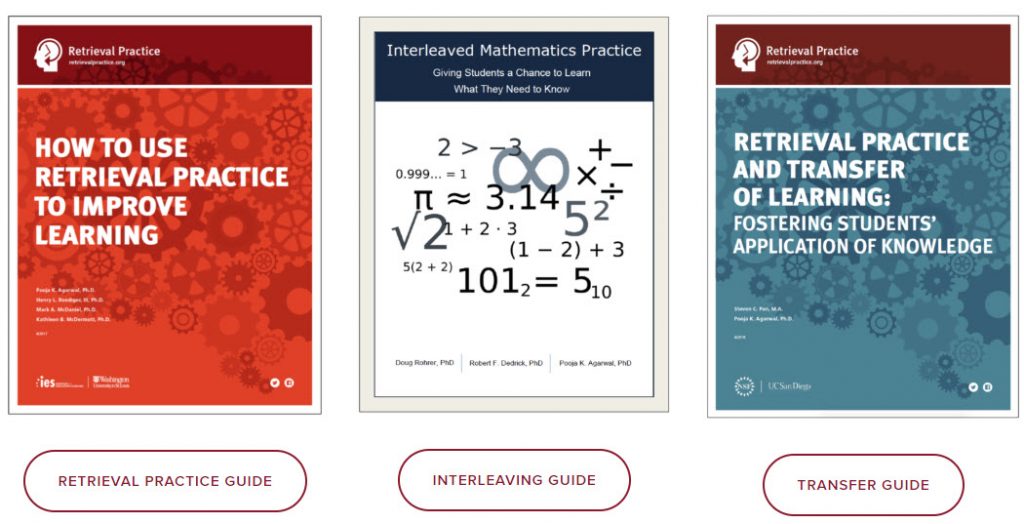
Also on that site:


Excerpt from the Interleaved Mathematics Practice guide (on page 8 of 13):

Interleaved practice gives students a chance to choose a strategy.
When practice problems are arranged so that consecutive problems cannot be solved by the same strategy, students are forced to choose a strategy on the basis of the problem itself. This gives students a chance to both choose and use a strategy.

Interleaved practice works.
In several randomized control studies, students who received mostly interleaved practice scored higher on a final test than did students who received mostly blocked practice.


From DSC:
Speaking of resources regarding learning…why don’t we have posters in all of our schools, colleges, community colleges, universities, vocational training centers, etc. that talk about the most effective strategies to learn about new things?


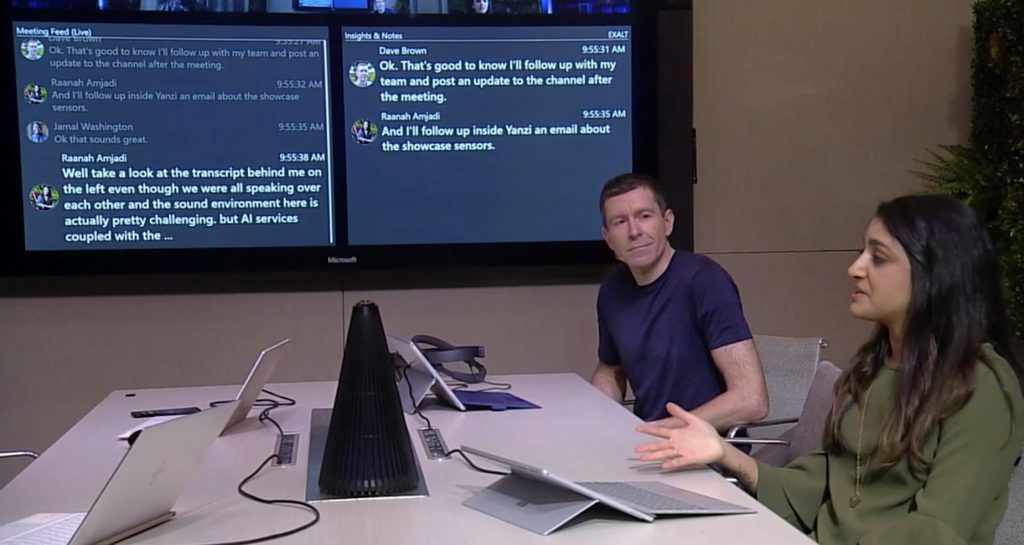
Microsoft’s meeting room of the future is wild — from theverge.com by Tom Warren
Transcription, translation, and identification

Excerpts:

Microsoft just demonstrated a meeting room of the future at the company’s Build developer conference.

It all starts with a 360-degree camera and microphone array that can detect anyone in a meeting room, greet them, and even transcribe exactly what they say in a meeting regardless of language.

Microsoft takes the meeting room scenario even further, though. The company is using its artificial intelligence tools to then act on what meeting participants say.


From DSC:
Whoa! Many things to think about here. Consider the possibilities for global/blended/online-based learning (including MOOCs) with technologies associated with translation, transcription, and identification.


Research roundup: 4 new reports on what’s working for blended-learning practitioners — from christenseninstitute.org by Luis Flores

Excerpt:

At the start of the year, we published a blog post on interesting research from 2017 related to innovative approaches to school design. Even though we aren’t even half-way through 2018, there are already several insightful reports on blended and personalized learning from this year that are worth highlighting.

These reports examined various tools and approaches to implement blended and personalized learning models, as well as the potential impact these models could have on students and teachers. From examining how schools implemented their models sustainably to recommending methods to best support teachers, these are informative reports for anyone interested in implementing blended and personalized learning models in their schools.

1. Digital math tool produces gains in student achievement
2. Personalized learning can be implemented sustainably
3. PD-rich blended-learning plans increase chances of success
4. Ensure that teachers create, and design strategies for, their goals


From DSC:
The simpler something is, the greater chance that it will be adopted. Think of HTML and how simple it was years ago for people to create and post their own web pages. I would argue that it was that level of simplicity that lead to the explosive growth of the World Wide Web. 

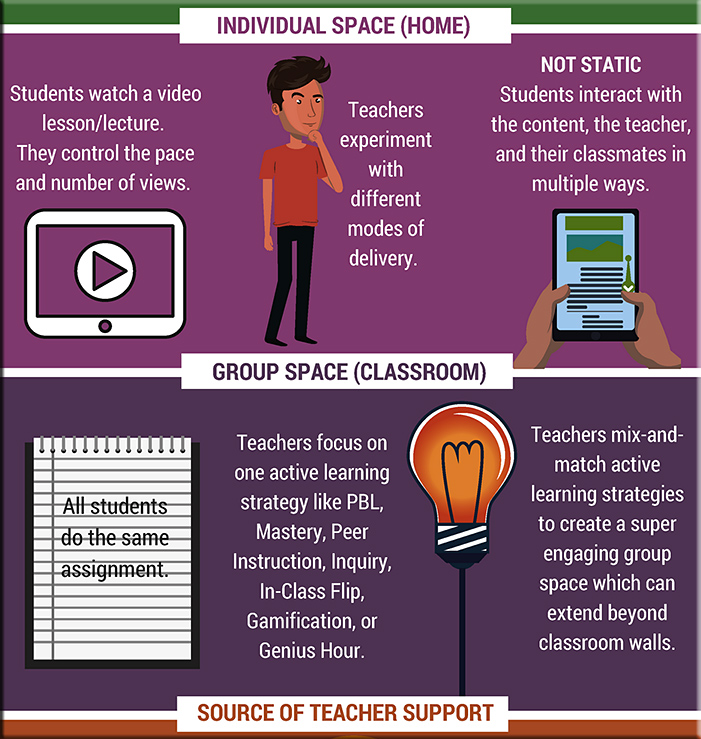
So when we look at what the term “flipped learning” or the “flipped classroom” is all about these days, I think we need to be careful that things don’t get too complex. Consider the growing complexity of the flipped classroom out at flr.flglobal.org/?p=417

Version 1.0 was easy to understand and therefore to implement. But Version 3.0 looks far less clear as to what we’re even talking about now. We need to find ways to keep it simple, if that’s possible. I realize that teaching and learning is messy, so I’m not sure it’s always possible to practice the KISS principle when we’re talking about pedagogies. But if we don’t try, we’ll have a harder time getting adoption in the future — because Instructional Designers, Teachers, Trainers, and Professors won’t even know what we’re talking about.


Robert Talbert gets at some of this too in his posting entitled, “Four challenges for flipped learning for the next five years.”  Below is an excerpt from that posting:

1. Build a standard operational definition of flipped learning.
One of the biggest challenges facing flipped learning is simply defining what it is. Several competing definitions, all with some overlap but also with nagging differences, are in use today, and this is making it all but impossible to conduct or interpret research on flipped learning or practice it with students. It’s to the point that if you hear an instructor say she uses “flipped learning”, you have to dig deeper to know what she really means.

So as the first challenge, and as a prerequisite to the others, I propose that somehow, we all come up with an operational definition of flipped learning that can serve as the standard for research and practice. I’ve already proposed my own. I’m not saying this should be the standard, but I think something like this could be the starting point. How will “we” decide on a standard, and who’s the “we”? I don’t know, but I think it will involve some group of people a high profile to lead the discussion and decide on one, and then start using it and labeling it as “the standard definition”.

Can other people use models of flipped learning, such as the in-class flipped model, that don’t conform to a standard definition? Sure. Who’s going to stop them? But we need a starting point


FLGI Publishes the Top 100 Educators Leading Flipped Learning in 2018
The Flipped Learning Global Initiative identifies the movement’s leading educators, administrators, and technologists worldwide

CHICAGO, April 16, 2018 /PRNewswire/ — Today, the Flipped Learning Global Initiative (FLGI), a worldwide coalition of educators, researchers, technologists, professional development providers and education leaders, announced the publication of the FLGI 100. The annual list identifies the top 100 K-12 educators who are driving the adoption of the flipped classroom around the world.  The list is compiled by the FLGI executive committee – led by Jon Bergmann, Chief Academic Officer and one of the pioneers of the flipped classroom movement. Educators from around the globe are represented, including Flipped Learning practitioners from Brazil, Australia, New Zealand, Italy, China, Taiwan, Spain, the United Kingdom, Turkey, Italy, Korea, Argentina, Iceland, Sweden, India and the United States. FLGI also identified the top 50 Flipped Learning leaders in higher education and the top 50 Flipped Learning administrators and tech coaches worldwide.

“The global Flipped Learning community continues to grow, introducing us to fresh ideas, new innovations, and emerging leaders. The 2018 FLGI Flipped Learning leaders lists include veterans from prior years, and many new names and faces. The FLGI 100 list, along with the two FLGI 50 lists, represent the practitioners who are showing us the connection between Flipped Learning, active learning, and world-class learners,” said Jon Bergmann.

The FLGI Flipped Learning leaders lists are updated annually, and all three lists are published in the April issue of Flipped Learning Review (FLR): the Flipped Learning 3.0 magazine. FLR is the first digital magazine dedicated to covering the ideas and people driving the global Flipped Learning movement. The issue features an insightful interview with one of the leading voices in the Flipped Learning community: Dr. Eric Mazur at Harvard University. Bergmann and Mazur discuss how Flipped Learning has evolved over the last decade and why group space mastery is the next frontier for this instructional model.  The April issue also includes the full list of global delegates participating in the project to establish international standards for Flipped Learning. The 2018 FLGI 100 list, the Bergmann/Mazur interview, and the global delegates lists are accessible at http://flr.flglobal.org/

About the Flipped Learning Global Initiative
The Flipped Learning Global Initiative, (FLGI), was created to support the rapidly expanding adoption of Flipped Learning all over the world in countries including China, Taiwan, Spain, UAE, the United Kingdom, Turkey, Italy, Korea, Argentina, Iceland, Sweden, India and the United States. FLGI aims to fill the growing global need for collaboration across borders in three domains: evolving best practices in Flipped Learning, research curation and distribution, and technology selection and implementation.

FLGI serves as a global hub for coordinating, orchestrating and scaling the key elements required to expand Flipped Learning successfully around the world.  FLGI is home to the Flipped Learning International Faculty, the Flipped Learning Innovation Center, the Flipped Learning Global Standards project, and Flipped Learning Review (FLR).

For more information, contact: Errol St.Clair Smith, Director of Global Development at 949-677-7381, 193454@email4pr.com or go to www.flglobal.org.


Also see this page, which states:

On Monday, April 16, 2018 The Flipped Learning Global Initiative (FLGI) will publish the 2018 FLGI 100. The annual list identifies the top 100 K-12 educators who are driving the adoption of Flipped Learning around the world.  The list is compiled by the FLGI executive committee, led by Jon Bergmann, Chief Academic Officer. Educators from around the globe are represented, including Flipped Learning practitioners from Italy, China, Taiwan, Spain, UAE, the United Kingdom, Turkey, Italy, Korea, Argentina, Iceland, Sweden, India, and the United States. The initiative also identified the top 50 Flipped Learning leaders in higher education and the top 50 Flipped Learning administrators and tech coaches.


© 2025 | Daniel Christian