FLGI Publishes the Top 100 Educators Leading Flipped Learning in 2018
The Flipped Learning Global Initiative identifies the movement’s leading educators, administrators, and technologists worldwide

CHICAGO, April 16, 2018 /PRNewswire/ — Today, the Flipped Learning Global Initiative (FLGI), a worldwide coalition of educators, researchers, technologists, professional development providers and education leaders, announced the publication of the FLGI 100. The annual list identifies the top 100 K-12 educators who are driving the adoption of the flipped classroom around the world.  The list is compiled by the FLGI executive committee – led by Jon Bergmann, Chief Academic Officer and one of the pioneers of the flipped classroom movement. Educators from around the globe are represented, including Flipped Learning practitioners from Brazil, Australia, New Zealand, Italy, China, Taiwan, Spain, the United Kingdom, Turkey, Italy, Korea, Argentina, Iceland, Sweden, India and the United States. FLGI also identified the top 50 Flipped Learning leaders in higher education and the top 50 Flipped Learning administrators and tech coaches worldwide.

“The global Flipped Learning community continues to grow, introducing us to fresh ideas, new innovations, and emerging leaders. The 2018 FLGI Flipped Learning leaders lists include veterans from prior years, and many new names and faces. The FLGI 100 list, along with the two FLGI 50 lists, represent the practitioners who are showing us the connection between Flipped Learning, active learning, and world-class learners,” said Jon Bergmann.

The FLGI Flipped Learning leaders lists are updated annually, and all three lists are published in the April issue of Flipped Learning Review (FLR): the Flipped Learning 3.0 magazine. FLR is the first digital magazine dedicated to covering the ideas and people driving the global Flipped Learning movement. The issue features an insightful interview with one of the leading voices in the Flipped Learning community: Dr. Eric Mazur at Harvard University. Bergmann and Mazur discuss how Flipped Learning has evolved over the last decade and why group space mastery is the next frontier for this instructional model.  The April issue also includes the full list of global delegates participating in the project to establish international standards for Flipped Learning. The 2018 FLGI 100 list, the Bergmann/Mazur interview, and the global delegates lists are accessible at http://flr.flglobal.org/

About the Flipped Learning Global Initiative
The Flipped Learning Global Initiative, (FLGI), was created to support the rapidly expanding adoption of Flipped Learning all over the world in countries including China, Taiwan, Spain, UAE, the United Kingdom, Turkey, Italy, Korea, Argentina, Iceland, Sweden, India and the United States. FLGI aims to fill the growing global need for collaboration across borders in three domains: evolving best practices in Flipped Learning, research curation and distribution, and technology selection and implementation.

FLGI serves as a global hub for coordinating, orchestrating and scaling the key elements required to expand Flipped Learning successfully around the world.  FLGI is home to the Flipped Learning International Faculty, the Flipped Learning Innovation Center, the Flipped Learning Global Standards project, and Flipped Learning Review (FLR).

For more information, contact: Errol St.Clair Smith, Director of Global Development at 949-677-7381, 193454@email4pr.com or go to www.flglobal.org.


Also see this page, which states:

On Monday, April 16, 2018 The Flipped Learning Global Initiative (FLGI) will publish the 2018 FLGI 100. The annual list identifies the top 100 K-12 educators who are driving the adoption of Flipped Learning around the world.  The list is compiled by the FLGI executive committee, led by Jon Bergmann, Chief Academic Officer. Educators from around the globe are represented, including Flipped Learning practitioners from Italy, China, Taiwan, Spain, UAE, the United Kingdom, Turkey, Italy, Korea, Argentina, Iceland, Sweden, India, and the United States. The initiative also identified the top 50 Flipped Learning leaders in higher education and the top 50 Flipped Learning administrators and tech coaches.


Implications of Learning Theories on Instructional Design — from elearningindustry.com by Jon-Erik Oleyar-Reynolds
Are you interested in becoming an Instructional Designer? Or are you just starting out in the world of learning theories? The focus of this article is to inform the reader of 3 unique learning theories while discussing the implications they have had in the field of Instructional Design (ID).

Excerpt:

Behaviorist Learning Theory
Behavioral learning theory can be summarized as learning that occurs through the behavioral response to environmentally sourced stimuli. The foundation of this theory is built upon assumptions that “have little regard for the cognitive processing of the learner involved in the task”.
…
The focus of behavioral learning theory resides in the use of reinforcement to drive behavior. Instructional Design can benefit from the use of reinforcement as a means to train learners to complete instructional objectives that are presented to them.

Cognitive Learning Theory
The primary focus of learning is on the development of knowledge by the creation of schemas. Schemas are like catalogs of information that can be used to identify concepts or experiences through a complex set of relationships that are connected to one another. In short, the catalogs act like a database of knowledge for the learner. 2 prominent theories that will be discussed are Gestalt theory and information processing theory; these 2 have paved the way for cognitivism and its impact on the field of Instructional Design.
…
Information processing theory further supports cognitive learning theory. Similar to Gestalt theory, the focus of learning is on the individual. The processing of information by the learner is similar to the way a computer processes information. The memory system is broken into 3 stages based on this approach:

  • Sensory memory
  • Working memory
  • Long-term memory

…

…the working memory may require more rehearsal to establish a clear connection to the concept and store it in long-term.
…
One of the most widely used strategies could arguably be a rehearsal. The expression “practice makes perfect” may seem cliché, but it does fit very well when discussing cognition and development. As one rehearses, the working memory is exercised.

While working memory has a limit of 7 (plus or minus 2), creating a chunk of information increases the amount that can be worked with.

Instructional Design shifted in the presence of cognitivism and includes a more system-like design approach with a focus on the learners.


Social Learning Theory
Social learning theory focuses on the impact of learning based on factors related to the social environment. In other words, learning occurs in the context of a social situation that the learner is placed in.
…
Self-Efficacy
Think of the expression “perhaps it rubbed off on me”. This has a direct relationship to social learning theory. Self-efficacy can be influenced by the design of lessons that allow for learners to view others of similar ability succeeding at instructional tasks. This could be achieved in a number of creative ways, but generally is most effective in collaborative activities where learners work in small groups. Overall, self-efficacy is the belief that one can be successful at particular tasks.
…
Collaborative learning groups and the use of peer review are widely used in many settings in which learning occurs.


From DSC:
I wanted to briefly relay an example that relates to the Cognitive Learning/Processing Theory — and more specifically to a concept known as Cognitive Load.  The other day I was sitting at the kitchen table, trying to read an interesting blog posting. But at the very same time, the radio was (loudly) relaying an item re: Virtual Reality (VR) — which also caught my ear and interest.

Which “channel” do I focus on? My visual channel or my auditory channel?

For me, I can’t do both well — perhaps some people can, but our visual and auditory channels can only handle so much at one time. Both channels request our attention and processing resources. I ended up getting up and shutting off the radio so that I could continue reading the blog posting. But for me, I think of it like a traffic jam. There are only so many cars that can simultaneously get through that busy highway that leads downtown.

So another application of this is that it’s helpful NOT to have a lot of auditory information going on at the same time as a lot of visual information. If you have PowerPoint slides, use graphics, photos, and/or graphs and use your audio voiceover to speak to them…but don’t list a long paragraph of text and then simply read that text and then also ask the learner to absorb other visual information at the same time. 


PD is getting so much better!! — from cultofpedagogy.com by Jennifer Gonzalez

Excerpts:


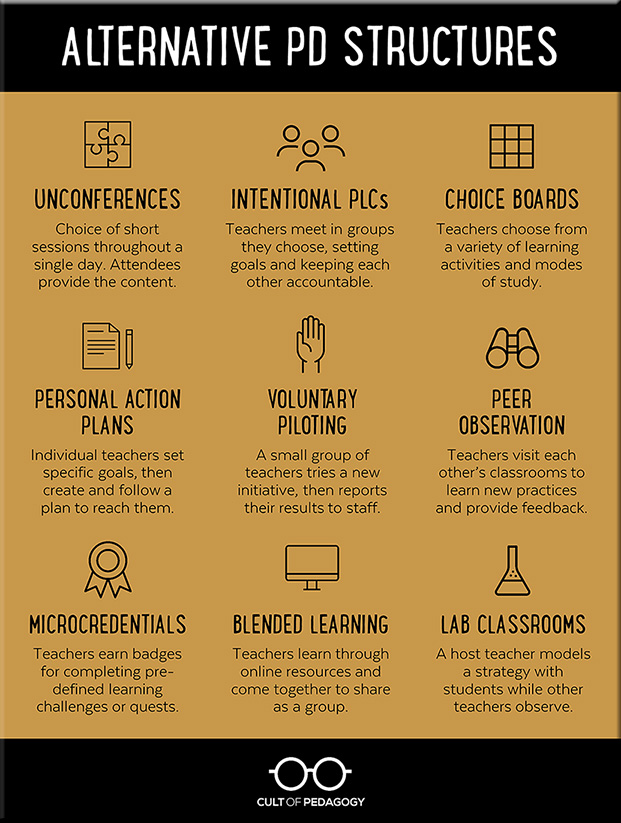
1. Unconferences
2. Intentional professional learning communities (PLCs)
3. Choice Boards
4. Personal Action Plans
5. Voluntary Piloting
6. Peer Observation
7. Microcredentials
8. Blended Learning
9. Lab Classrooms


From DSC:
After reviewing the article below, I wondered...if we need to interact with content to learn it…how might mixed reality allow for new ways of interacting with such content? This is especially intriguing when we interact with that content with others as well (i.e., social learning).

Perhaps Mixed Reality (MR) will bring forth a major expansion of how we look at “blended learning” and “hybrid learning.”


Mixed Reality Will Transform Perceptions — from forbes.com by Alexandro Pando


Excerpts (emphasis DSC):

Changing How We Perceive The World One Industry At A Time
Part of the reason mixed reality has garnered this momentum within such short span of time is that it promises to revolutionize how we perceive the world without necessarily altering our natural perspective. While VR/AR invites you into their somewhat complex worlds, mixed reality analyzes the surrounding real-world environment before projecting an enhanced and interactive overlay. It essentially “mixes” our reality with a digitally generated graphical information.

…

All this, however, pales in comparison to the impact of mixed reality on the storytelling process. While present technologies deliver content in a one-directional manner, from storyteller to audience, mixed reality allows for delivery of content, then interaction between content, creator and other users. This mechanism cultivates a fertile ground for increased contact between all participating entities, ergo fostering the creation of shared experiences. Mixed reality also reinvents the storytelling process. By merging the storyline with reality, viewers are presented with a wholesome experience that’s perpetually indistinguishable from real life.


Mixed reality is without a doubt going to play a major role in shaping our realities in the near future, not just because of its numerous use cases but also because it is the flag bearer of all virtualized technologies. It combines VR, AR and other relevant technologies to deliver a potent cocktail of digital excellence.


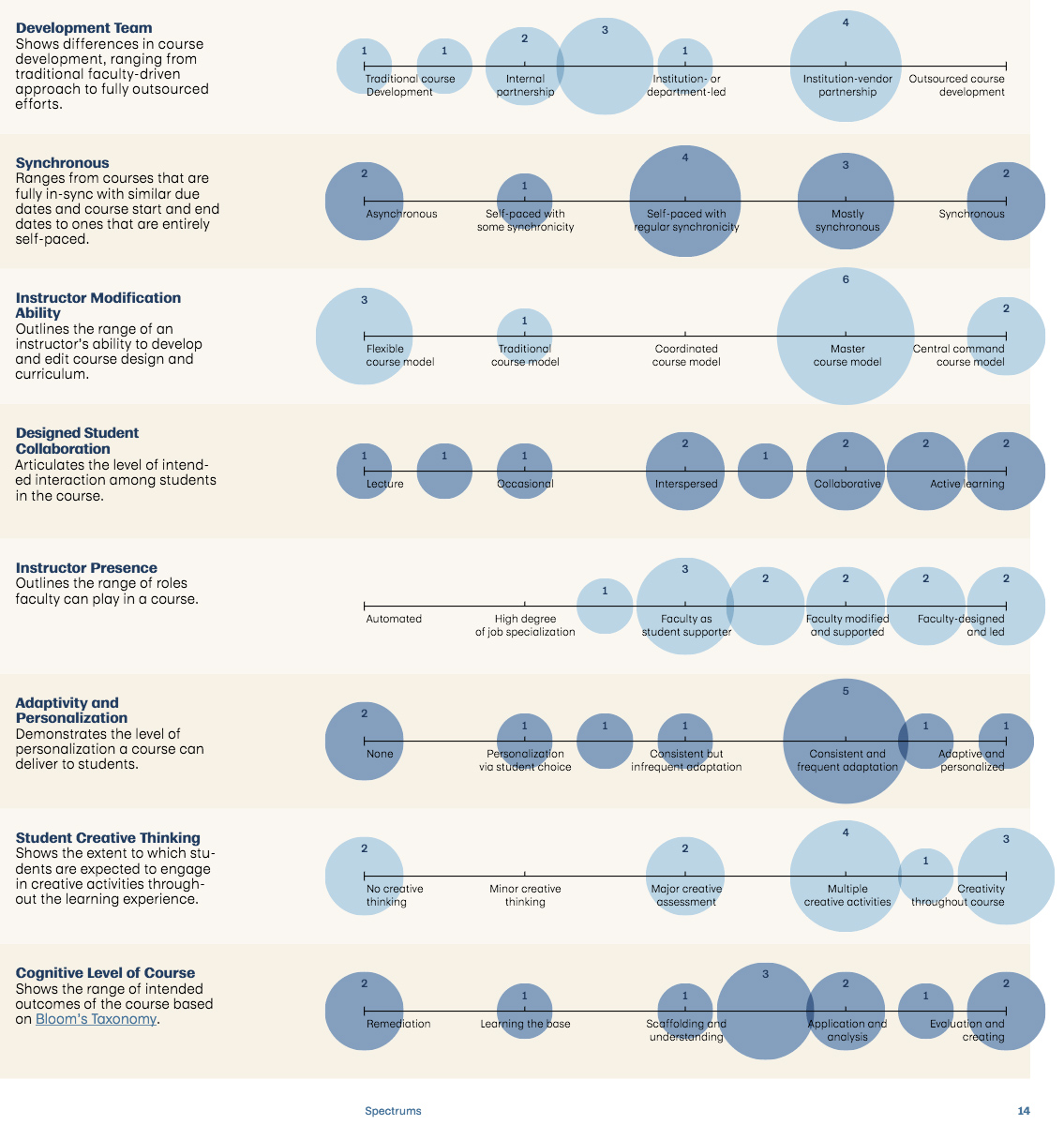
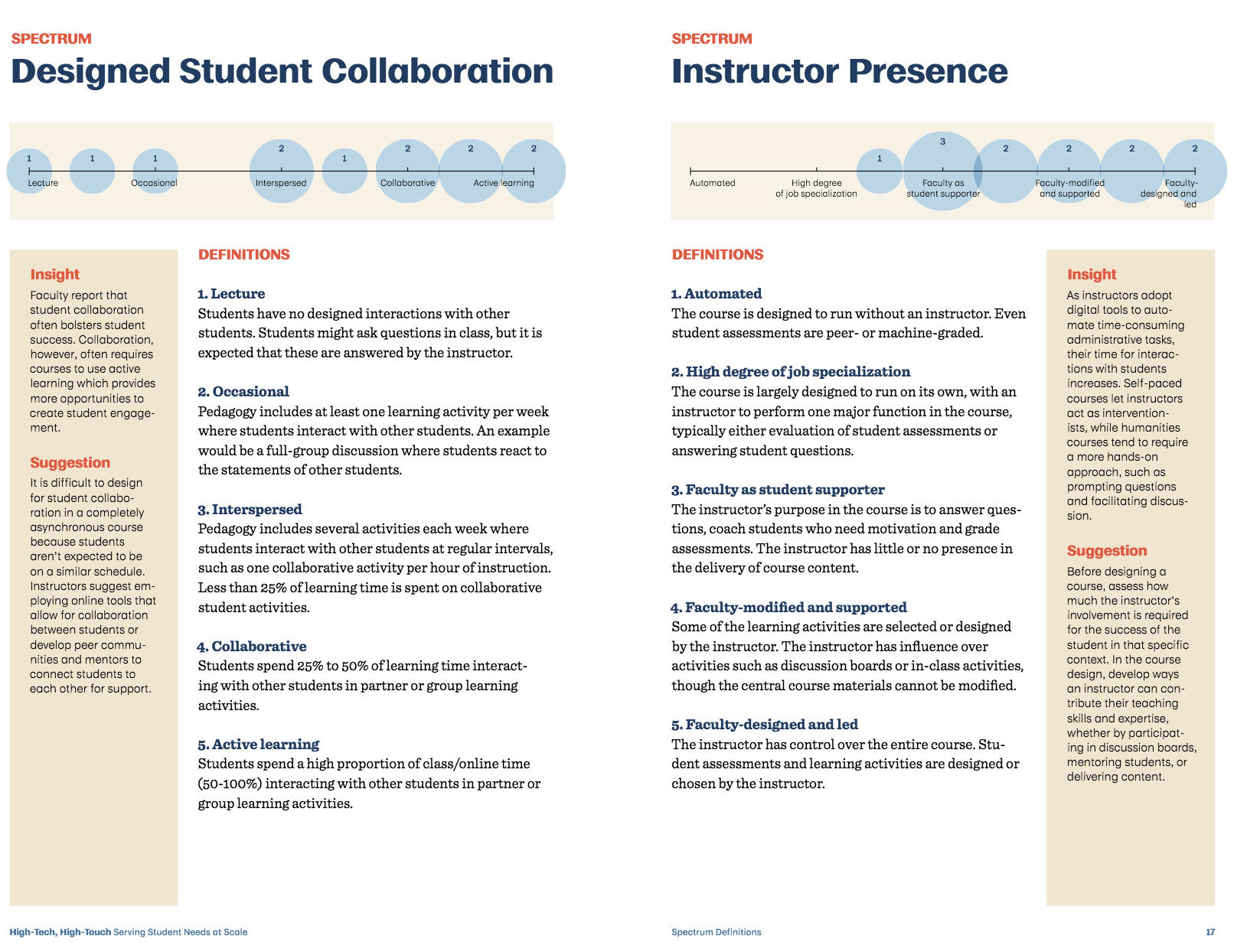
High-Tech, High Touch: Digital Learning Report and Workbook, 2017 Edition — from Intentional Futures, with thanks to Maria Andersen on Linkedin for her posting therein which was entitled, “Spectrums to Measure Digital Learning”
Excerpt (emphasis DSC):

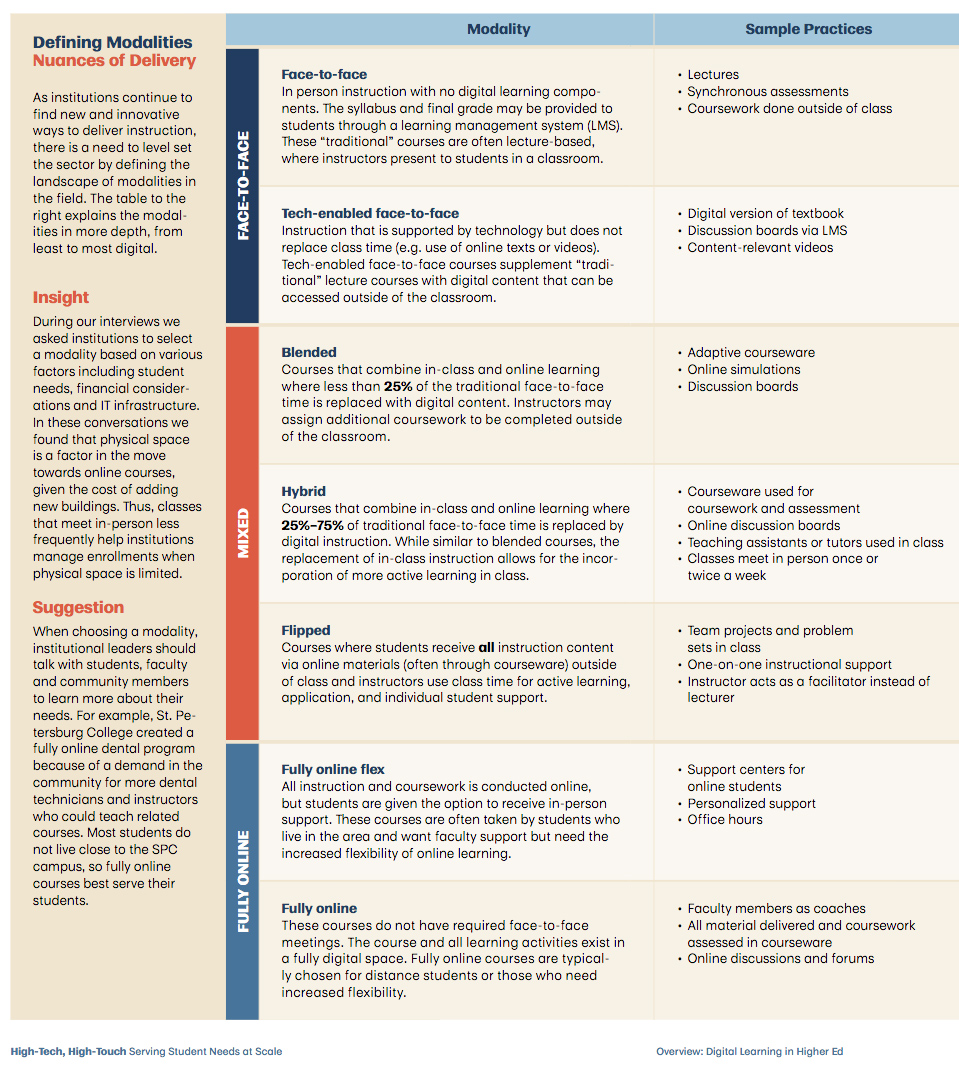
Our work uncovered five high-tech strategies employed by institutions that have successfully implemented digital learning at scale across a range of modalities. The strategies that underscore the high-tech, high-touch connection are customizing through technology, leveraging adaptive courseware, adopting cost-efficient resources, centralizing course development and making data-driven decisions.

Although many of the institutions we studied are employing more than one of these strategies, in this report we have grouped the institutional use cases according to the strategy that has been most critical to achieving digital learning at scale. As institutional leaders make their way through this document, they should watch for strategies that target challenges similar to those they hope to solve. Reading the corresponding case studies will unpack how institutions employed these strategies effectively.

…

Digital learning in higher education is becoming more ubiquitous as institutions realize its ability to support student success and empower faculty. Growing diversity in student demographics has brought related changes in student needs, prompting institutions to look to technology to better serve their students. Digital courseware gives institutions the ability to build personalized, accessible and engaging content. It enables educators to provide relevant content and interventions for individual students, improve instructional techniques based on data and distribute knowledge to a wider audience (MIT Office of Digital Learning, 2017).

PARTICIPATION IN DIGITAL LEARNING IS GROWING
Nationally, the number of students engaged in digital learning is growing rapidly. One driver of this growth is rising demand for distance learning, which often relies on digital learning environments. Distance learning programs saw enrollment increases of approximately 4% between 2015 and 2016, with nearly 30% of higher education students taking at least one digital distance learning course (Allen, 2017). Much of this growth is occurring at the undergraduate level (Allen, 2017). The number of students who take distance learning courses exclusively is growing as well. Between 2012 and 2015, both public and private nonprofit institutions saw an increase in students taking only distance courses, although private, for-profit institutions have seen a decrease (Allen, 2017).


Online learning in Michigan, as delivered by Michigan Virtual and others, has exploded in recent years.

  • The number of K-12 students taking at least 1 virtually delivered course jumped from just over 36,000 in 2010-11 to ~91,000 in 2015-16 | page 9
  • Total # of virtual courses taken by Michigan K-12 students soared from ~90,000 in 2010-11 to 453,000+ in ’15-16 | page 9
  • In 2011, approximately 650 schools had at least one student take a virtual course. By 2015-16, more than 1,000 Michigan schools had at least one student enroll in an online course. | page 9
  • This growth highlights the success that Michigan Virtual and others have had in promoting online learning across Michigan, yet underscores the work that still needs to be done. Thirty-seven percent of Michigan districts did not have a single student take a virtual class in 2015-16, and only 6% of all K-12 students in the state took a virtual course. The statewide completion rate for all virtual enrollments has dropped from 66% in 2010-11 to 58% in 2015-16. So while online course participation has increased, it is still a small share of the overall market. Further, educational outcomes have declined, leaving opportunity for improvements in quality and online learning program implementation. This, combined with statewide efforts to make Michigan a leading education state, provides new opportunities for Michigan Virtual to advance K-12 digital learning and teaching through research, practice, and partnerships.


This strategic plan began with an extensive research and stakeholder outreach effort. This was designed to enhance our understanding of demographic and economic conditions, education policies and priorities, competitors and technology trends, stakeholder wants and needs, and views and perceptions of Michigan Virtual.

We interviewed or surveyed more than 425 individual stakeholders, including Michigan Virtual teachers, staff, students, and board members; the leadership and membership of leading educational organizations such as the Education Alliance of Michigan, the Virtual School Leadership Alliance, MASA, MAISA, MEMPSA, MASSP; and other leaders in education across Michigan. We also consulted research and data on technology trends, K-12 enrollment projections, state and national economic forecasts, education policies and priorities, and the competitive landscape.

KEY FINDINGS INCLUDE (emphasis DSC):

  • It is expected that the Michigan economy will see modest growth in coming years. This will help state  revenues remain relatively stable, but it is not expected that there will be significant growth in tax revenues available for increased spending on programs including K-12 education.
  • The Michigan Department of Education’s Top 10 in 10 strategic plan was developed with input from a broad group of stakeholders and is expected to remain a guiding document, along with the state’s ESSA plan and the 21st Century Education Commission’s report “The Best Education System for Michigan’s Success,” in coming years. Education priorities at the federal level are not as clear, though we expect an expanded focus on choice and options for parents and their students.
  • Technology infrastructure is built out to extend high-speed Internet access to the majority of schools and citizens in Michigan, though in-home access is still not fully available in some lower income or rural areas.
  • Users of online programs and websites have come to expect instant access and user-friendly designs and interfaces that they can access on any device.
  • There is growing acceptance and use of online courses across Michigan, though there remains a need to identify and demonstrate best practices, communicate benefits, and ensure quality standards are adopted to improve student outcomes.
  • There is growing competition among online course providers, with many focusing on low-cost solutions that are appealing to budget-constrained schools, but that may not adhere to best practices and quality standards that are demonstrated to improve student outcomes.
  • The false perception persists among some that Michigan Virtual is a for-profit organization that competes with traditional schools.
  • Poverty and related issues, including mental health and behavior, were cited by educators from across the state as being the most significant student-related issues facing their schools. (*insert DSC)
  • The need for, and adoption of, online and blended professional development will increase as educators increasingly see the value of integrating digital resources into their traditional classrooms.
  • While educators see the value of integrating digital resources into their traditional classrooms, many do not know how or where to start. Most schools and districts also lack the expertise to develop and implement blended learning programs on their own.

…

Today’s digital-learning landscape could not have been predicted when Michigan Virtual was founded in 1998, or even when our last strategic plan was developed in 2014. Some areas of digital learning have been frustratingly slow to advance, while others have perhaps grown too quickly at the expense of effectiveness and student outcomes.

This plan was intentionally designed with an unpredictable landscape in mind. The plan printed here is static, but the actions to implement the plan are dynamic. Tactics for each strategy and goal will be evaluated at least annually to stay aligned with ever-evolving challenges and opportunities. However, the goals, when taken together, provide a formula for success regardless of how the landscape evolves. We will provide an awesome experience for internal and external stakeholders alike, build partnerships to scale and grow our success, and operate efficiently and as good stewards of our resources to ensure our financial viability. Doing this, in alignment with our mission to advance K-12 digital learning and teaching through research, practice, and partnerships will bring us to a point where our vision (every person can use digital learning to reach his or her full potential) is a reality.


* In teaching, “You can’t do the Bloom stuff until you take care of the Maslow stuff.” [Beck]


Myths and Facts About Flipped Learning — from er.educause.edu by Robert Talbert

Key Takeaways

  • The combination of rapidly-accumulating research on the effectiveness of active learning combined with improvements in technology have created an ideal environment for almost any instructor to move their courses from a traditional to a flipped model.
  • Many articles on flipped learning contain misconceptions that can lead potential practitioners into error or away from using flipped learning entirely, to the detriment of their students and themselves.
  • This article looks at some of the myths about flipped learning and provides contradictory facts about this pedagogical approach.


Flipped learning, sometimes called the “flipped classroom,” is a pedagogical approach which uses time and space in a different way from the way courses are typically taught. In traditional instruction, students’ first contact with new ideas happens in class, usually through direct instruction from the professor; after exposure to the basics, students are turned out of the classroom to tackle the most difficult tasks in learning — those that involve application, analysis, synthesis, and creativity — in their individual spaces. Flipped learning reverses this, by moving first contact with new concepts to the individual space and using the newly-expanded time in class for students to pursue difficult, higher-level tasks together, with the instructor as a guide.

Flipped learning is a pedagogical approach whose time has come. The combination of rapidly-accumulating research on the effectiveness of active learning combined with improvements in technology have created an ideal environment for almost any instructor to move their courses from a traditional to a flipped model. At the same time, despite its popularity and the efforts of groups like the Flipped Learning Network to explain and operationalize flipped learning, it remains a somewhat poorly-understood concept among many. Many published articles on flipped learning contain misconceptions that can lead potential practitioners into error or away from using flipped learning entirely, to the detriment of their students and themselves.

Let’s take a look at some of the myths about flipped learning and try to find the facts.


Video on Its Way to Becoming Education Norm — from campustechnology.com by Dian Schaffhauser

Excerpt:

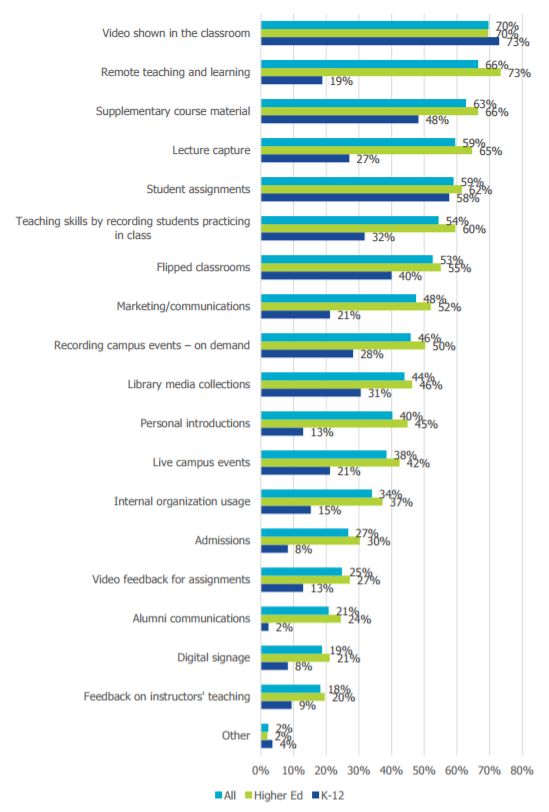
Video has become as ubiquitous in higher education classrooms as big screens in the fitness center and Hulu in residential halls. The use cases abound. The most popular use right now is to help with remote teaching and learning; 73 percent of institutions in a recent survey report the use of video for that purpose. That’s followed by the showing of video in classrooms (70 percent), as supplementary course material (66 percent) and for lecture capture (65 percent). But video is also gaining steam in student assignments, teaching skills and recording students as they practice them, recording campus events for on-demand viewing, as part of library media collections, to deliver personal introductions and to give feedback on student assignments and instructor teaching practices.

These examples aren’t the only ones cited in the latest results of Kaltura’s “The State of Video in Education.” The 2017 survey, done in May and June 2017, drew responses from more than a thousand people, 81 percent of whom work in higher ed (the rest from K–12 and other educational organizations). Most of the survey respondents hold one of four primary roles: instructional design, IT, faculty and media. Kaltura is a company that sells video products and services.


Also see:

Survey: Blended Learning on the Rise — from campustechnology.com by Rhea Kelly
Most faculty in our second annual Teaching with Technology Survey said they employ a mix of online and face-to-face instruction, and many are using the flipped model in their courses.

Excerpt:

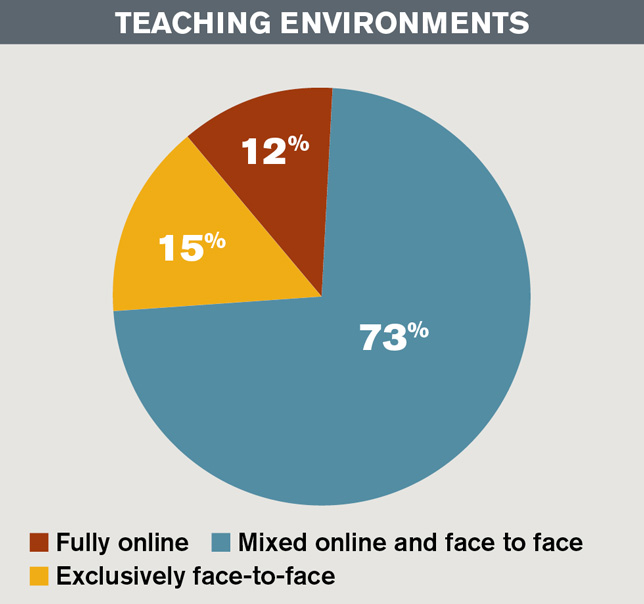
In a nationwide survey on the use of technology for teaching and learning, an increasing number of higher education faculty members said they employ a mix of online and face-to-face learning in their courses. A full 73 percent of respondents said they use the blended model — that’s up from 71 percent in 2016. And while 15 percent of faculty are still teaching exclusively face-to-face, 12 percent have gone fully online (an increase from 10 percent teaching online in 2016).

Those findings came out of Campus Technology‘s 2017 Teaching with Technology Survey, in which we asked faculty to dish on their approach to teaching, use of technology, views of the future and more.


Lessons From Flipped Classrooms and Flipped Failures — from edsurge.com by Jeff Young, with Robert Talbert

Excerpt:

So a few years ago Talbert, a math professor at Grand Valley State University, tried a new approach, known as flipped learning—a method catching on these days in college classrooms. He describes it as a new philosophy of teaching. Unlike the lecture model, in which students first encountering new material in the classroom, in the flipped model the students’ first encounter with the material happens outside of class, usually in the form of video lectures. And class time is used for more interactive activities that encourage students to apply what they’re learning while the professor is there to step in and help if necessary.

It isn’t foolproof though, and in a new book Talbert gives a frank look into his classroom experiences, and his tips on how to avoid flipped failure. It’s called “Flipped Learning: A Guide for Higher Education Faculty.” Talbert has long shared the ups and downs of his teaching experiments with his colleagues through his blog.


What I often tell faculty is, if you’re interested in using flipped learning, you’ve got to give yourself a lot of time to ease into it. I try to suggest a one-year plan between the moment you become interested in flipped learning and the moment you actually use it in the classroom. Take a solid year to plan, to develop materials, to test things out and so forth. Don’t try to jump straight into it.


A Starter Kit for Instructional Designers — from edsurge.com by Amy Ahearn

Excerpts:

A 2016 report funded by the Gates Foundation found that in the U.S. alone, there are 13,000 instructional designers. Yet, when I graduated from college in 2008, I didn’t know this field existed. Surely a lot has changed!

Instructional design is experiencing a renaissance. As online course platforms proliferate, institutions of all shapes and sizes realize that they’ll need to translate content into digital forms. Designing online learning experiences is essential to training employees, mobilizing customers, serving students, building marketing channels, and sustaining business models.

The field has deep roots in distance education, human computer interaction, and visual design. But I’ve come to believe that contemporary instructional design sits at the intersection of three core disciplines: learning science, human-centered design, and digital marketing. It requires a deep respect for the pedagogical practices that teachers have honed for decades, balanced with fluency in today’s digital tools.
…
Below are some of the lessons and resources that I wish I knew of when I first went on the job market—a combination of the academic texts you read in school along with practical tools that have been essential to practicing instructional design in the real world. This is not a complete or evergreen list, but hopefully it’s a helpful start.


So You Want to Be an Instructional Designer? — from edsurge.com by Marguerite McNeal

Excerpt:

Good listener. People person. Lifelong learner. Sound like you? No, we’re not trying to arrange a first date. These are some common traits of people with successful careers in a booming job market: instructional design.

Colleges, K-12 schools and companies increasingly turn to instructional designers to help them improve the quality of teaching in in-person, online or blended-learning environments.


The Classroom of Tomorrow: A Panel Discussion — sponsored by Kaltura

Description:
Technology is changing the way we approach education, rapidly. But what will tomorrow’s classroom actually look like? We’ve invited some leading experts for a spirited debate about what the future holds for educational institutions. From personalization to predictive analytics to portable digital identities, we’ll explore the biggest changes coming. We’ll see how new technologies might interact with changing demographics, business models, drop out rates, and more.

Panelists:

  • David Nirenberg – Dean of the Division of the Social Sciences, University of Chicago
  • Rick Kamal – Chief Technology Officer, Harvard Business School, HBX
  • Gordon Freedman – President, National Laboratory for Education Transformation
  • Michael Markowitz – Entrepreneur and Investor, Education
  • Dr Michal Tsur – Co-founder and President, Kaltura


Also see:

  • Roadmap to the Future — by Dr Michal Tsur – Co-founder and President, Kaltura
    What are some of the leading trends emerging from the educational technology space? Michal Tsur takes you on a quick tour of big trends you should be aware of. Then, get a glimpse of Kaltura’s own roadmap for lecture capture and more.


Regarding the above items, some thoughts from DSC:
Kaltura did a nice job of placing the focus on a discussion about the future of the classroom as well as on some trends to be aware of, and not necessarily on their own company (this was especially the case in regards to the panel discussion). They did mention some things about their newest effort, Kaltura Lecture Capture, but this was kept to a very reasonable amount.


The Higher Education Technology Paradox — from edtechmagazine.com by Hank Lucas
The academic rewards system will continue to stymie technology adoption unless higher ed administrators promote organizational change.

Excerpts:

The number one paradox in higher education is that technology is both transforming and disrupting universities around the world. Institutions that adapt to the technology and become content producers will survive and flourish; those confined to being content consumers will struggle to stay in business.
…
What does it take for a university to develop the kind of materials described above? Obviously, it requires money, but more than money it needs a motivated and committed faculty. The reward system in most institutions and the inherent conservatism of faculty members create a huge barrier to adopting new technologies for education. (Many faculty members are in denial that the technology can improve student learning and that it will be widely implemented.)

How does the reward system impact technology adoption?

  • Assistant professors at research universities are rewarded for publishing scholarly articles and books, which they must do to be granted tenure. They cannot risk the time needed to master the new technologies.
  • Tenured faculty can largely do what they want, and by the time they have received tenure have fallen into a rhythm of research and teaching; once tenured they are expected to undertake more service to the institution. Where does the time come from to adopt a new approach to the classroom?
  • Non-tenure track instructors are employed because they are good, or at least adequate, teachers. Adopting new technology in the classroom is risky and could result in lower student evaluations, which in turn could affect their employment status.


From DSC:
This is one of the reasons why I believe that a new organization will arise in the future that uses a solid, team-based approach from day 1. They will have teams of experts from a variety of fields/disciplines — and they will have the types of incentive systems that one would expect to see in startup companies. They will value innovation and will see to it that ideas can be grown and supported.

Anybody come to mind? How about Amazon.com? 

Also, faculty members — like all of us — have a limited amount of time and energy. The current workplace has loaded up faculty members’ job plates — they don’t have much time to experiment with new technologies. Also — again, like all of us — they have a variety of skills and interests. Many times, those skills and interest don’t involve working with technology. 

Look for more team-based approaches to dominate the future of higher education.


From DSC:
After seeing the postings below, it made me wonder:

  • Will Starbucks, Apple Stores, etc. be “learning hubs” of the future?
    i.e., places that aren’t really what we think of as a school, college, or university, but where people can go to learn something with others in the same physical space; such locations will likely tie into online or blended-based means of learning as well.

“Today at Apple” bringing new experiences to every Apple Store

Excerpt:

Cupertino, California — Apple today announced plans to launch dozens of new educational sessions next month in all 495 Apple stores ranging in topics from photo and video to music, coding, art and design and more. The hands-on sessions, collectively called “Today at Apple,” will be led by highly-trained team members, and in select cities world-class artists, photographers and musicians, teaching sessions from basics and how-to lessons to professional-level programs.
…
Apple will also offer special programs for families and educators. Teachers can come together for Teacher Tuesday to learn new ways to incorporate technology into their classrooms, or aspiring coders of all ages can learn how to code in Swift, Apple’s programming language for iOS and Mac apps. Families can join weekend Kids Hour sessions ranging from music making to coding with robots. Small business owners can engage with global and local entrepreneurs in the new Business Circuits program.

We’re creating a modern-day town square, where everyone is welcome in a space where the best of Apple comes together to connect with one another, discover a new passion, or take their skill to the next level.

Apple wants kids to hang out at Apple stores — from qz.com by Mike Murphy

Excerpt:

If you’ve just gotten out of school for the day and want to hang out with your friends before you head home, where would you go? In the US, there’s a near-infinite selection of chain restaurants, coffee shops, diners, bookstores, movie theaters, and comic book stores to choose from. But Angela Ahrendts, Apple’s head of retail, wants the answer to be an Apple store.

Apple is in the process of revamping the look and feel of its retail outlets across the world, and to highlight some of the recent changes (including rebranding the “Genius Bar” to the “Genius Grove” and adding foliage everywhere), Ahrendts gave an interview to CBS This Morning, this morning. Ahrendts told CBS that she will see her work as a success when Generation Z, the catchall term for the generation behind the equally amorphous Millennials, decides of their own volition to hang out at Apple stores. As CBS reported…

 
© 2025 | Daniel Christian