Amazon is winning the race to the future — from bizjournals.com by

Excerpt:

This is the week when artificially intelligent assistants start getting serious.

On Tuesday, Google is expected to announce the final details for Home, its connected speaker with the new Google Assistant built inside.

But first Amazon, which surprised everyone last year by practically inventing the AI-in-a-can platform, will release a new version of the Echo Dot, a cheaper and smaller model of the full-sized Echo that promises to put the company’s Alexa assistant in every room in your house.

The Echo Dot has all the capabilities of the original Echo, but at a much cheaper price, and with a compact form factor that’s designed to be tucked away. Because of its size (it looks like a hockey puck from the future), its sound quality isn’t as good as the Echo, but it can hook up to an external speaker through a standard audio cable or Bluetooth.
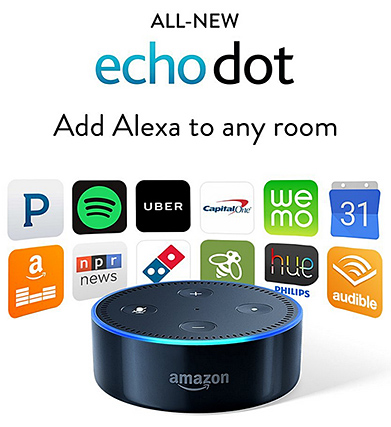
 

amazon-newdot-oct2016


100 bot people to watch #BotWatch #1 — from chatbotsmagazine.com

Excerpt:

100 people to watch in the bot space, in no order.

I’ll publish a new list once a month. This one is #1 October 2016.
…
This is my personal top 100 for people to watch in the bot space.


Should We Give Chatbots Their Own Personalities? — from re-work.com by Sophie Curtis

Excerpt:

Today, we have machines that assemble cars, make candy bars, defuse bombs, and a myriad of other things. They can dispense our drinks, facilitate our bank deposits, and find the movies we want to watch with a touch of the screen.

Automation allows all kinds of amazing things, but it is all done with virtually no personality. Building a chatbot with the ability to be conversational with emotion is crucial to getting people to gain trust in the technology. And now there are plenty of tools and resources available to rapidly create and launch chatbots with the personality customers want and businesses needs.

Jordi Torras is CEO and Founder of Inbenta, a company that specializes in NLP, semantic search and chatbots to improve customer experience. We spoke to him ahead of his presentation at the Virtual Assistant Summit in San Francisco, to learn about the recent explosion of chatbots and virtual assistants, and what we can expect to see in the future.


How I built and launched my first chatbot in hours — from chatbotsmagazine.com by Max Pelzner
From idea to MVB (Minimum Viable Bot), and launched in 24 hours!


Developing a Chatbot? Do Not Make These Mistakes! — from chatbotsmagazine.com Hira Saeed


This is what an A.I.-powered future looks like — from venturebeat.com by Grayson Brulte

Excerpt:

Today, we are just beginning to scratch the surface of what is possible with artificial intelligence (A.I.) and how individuals will interact with its various forms. Every single aspect of our society — from cars to houses to products to services — will be reimagined and redesigned to incorporate A.I.

A child born in the year 2030 will not comprehend why his or her parents once had to manually turn on the lights in the living room. In the future, the smart home will seamlessly know the needs, wants, and habits of the individuals who live in the home prior to them taking an action.

Before we arrive at this future, it is helpful to take a step back and reimagine how we design cars, houses, products, and services. We are just beginning to see glimpses of this future with the Amazon Echo and Google Home smart voice assistants.


Artificial intelligence created to fold laundry for you — from geek.com by Matthew Humphries

Excerpt:

So, Seven Dreamers Laboratories, in collaboration with Panasonic and Daiwa House Industry, have created just such a machine. However, folding laundry correctly turns out to be quite a complicated task, and so an artificial intelligence was required to make it a reliable process.

Laundry folding is actually a five stage process, including:

Grabbing
Spreading
Recognizing
Folding
Sorting/Storing

The grabbing and spreading seems pretty easy, but then the machine needs to understand what type of clothing it needs to fold. That recognizing stage requires both image recognition and AI. The image recognition classifies the type of clothing, then the AI figures out which processes to use in order to start folding.


2 days of global chatbot experts at Talkabot in 12 minutes — from chatbotsmagazine.com by Alec Lazarescu

Excerpt:

During a delightful “cold spell” in Austin at the end of September, a few hundred chatbot enthusiasts joined together for the first talkabot.ai conference.

As a participant both writing about and building chatbots, I’m excited to share a mix of valuable actionable insights and strategic vision directions picked up from speakers and attendees as well as behind the scenes discussions with the organizers from Howdy.

In a very congenial and collaborative atmosphere, a number of valuable recurring themes stood out from a variety of expert speakers ranging from chatbot builders to tool makers to luminaries from adjacent industries.


Addendum:


alexaprize-2016

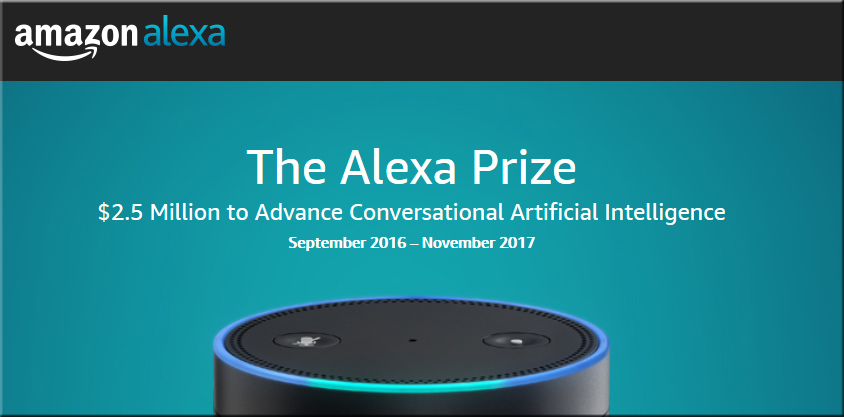
The Alexa Prize (emphasis DSC)

The way humans interact with machines is at an inflection point and conversational artificial intelligence (AI) is at the center of the transformation. Alexa, the voice service that powers Amazon Echo, enables customers to interact with the world around them in a more intuitive way using only their voice.

The Alexa Prize is an annual competition for university students dedicated to accelerating the field of conversational AI. The inaugural competition is focused on creating a socialbot, a new Alexa skill that converses coherently and engagingly with humans on popular topics and news events. Participating teams will advance several areas of conversational AI including knowledge acquisition, natural language understanding, natural language generation, context modeling, commonsense reasoning and dialog planning. Through the innovative work of students, Alexa customers will have novel, engaging conversations. And, the immediate feedback from Alexa customers will help students improve their algorithms much faster than previously possible.
…
Amazon will award the winning team $500,000. Additionally, a prize of $1 million will be awarded to the winning team’s university if their socialbot achieves the grand challenge of conversing coherently and engagingly with humans on popular topics for 20 minutes.
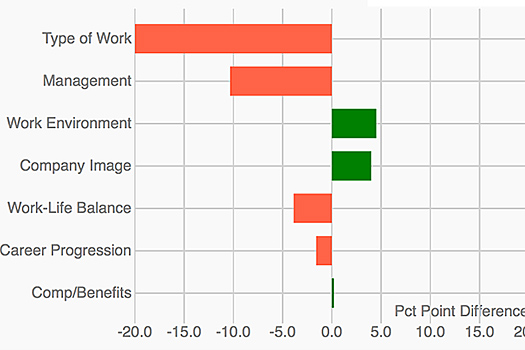


partnershiponai-sept2016


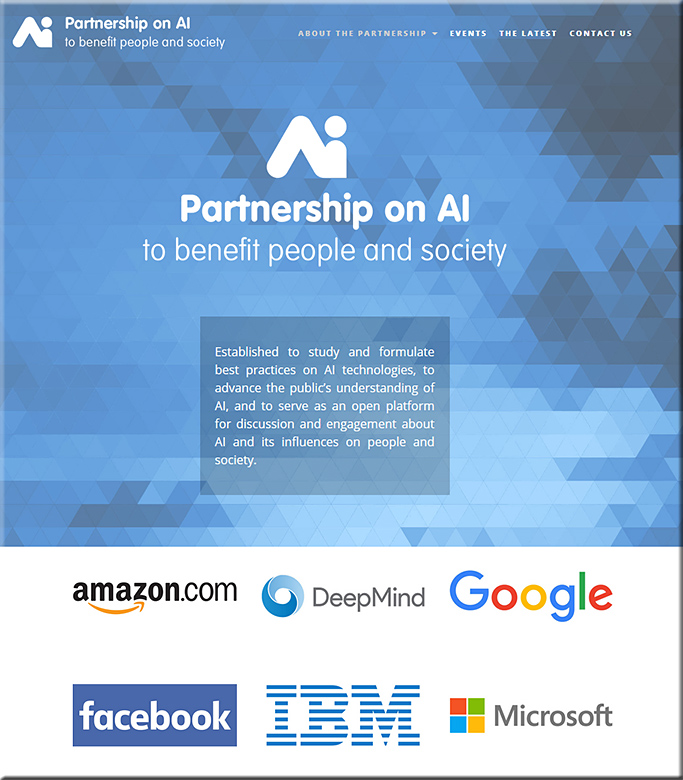
Established to study and formulate best practices on AI technologies, to advance the public’s understanding of AI, and to serve as an open platform for discussion and engagement about AI and its influences on people and society.


GOALS

Support Best Practices
To support research and recommend best practices in areas including ethics, fairness, and inclusivity; transparency and interoperability; privacy; collaboration between people and AI systems; and of the trustworthiness, reliability, and robustness of the technology.

Create an Open Platform for Discussion and Engagement
To provide a regular, structured platform for AI researchers and key stakeholders to communicate directly and openly with each other about relevant issues.

Advance Understanding
To advance public understanding and awareness of AI and its potential benefits and potential costs to act as a trusted and expert point of contact as questions/concerns arise from the public and others in the area of AI and to regularly update key constituents on the current state of AI progress.


From chatbots to Einstein, artificial intelligence as a service — from infoworld.com by Yves de Montcheuil

Excerpt:

The recent announcement of Salesforce Einstein — dubbed “artificial intelligence for everyone” — sheds new light on the new and pervasive usage of artificial intelligence in every aspect of businesses.


Powered by advanced machine learning, deep learning, predictive analytics, natural language processing and smart data discovery, Einstein’s models will be automatically customized for every single customer, and it will learn, self-tune, and get smarter with every interaction and additional piece of data. Most importantly, Einstein’s intelligence will be embedded within the context of business, automatically discovering relevant insights, predicting future behavior, proactively recommending best next actions and even automating tasks.


…
Chatbots, or conversational bots, are the “other” trending topic in the field of artificial intelligence. At the juncture of consumer and business, they provide the ability for an AI-based system to interact with users through a headless interface. It does not matter whether a messaging app is used, or a speech-to-text system, or even another app — the chatbot is front-end agnostic.

Since the user does not have the ability to provide context around the discussion, he just asks questions in natural language to an AI-driven backend that is tasked with figuring this context and looking for the right answer.


IBM is launching a much-awaited ‘Watson’ recruiting tool — from eremedia.com by Todd Raphael

Excerpt:

For many months IBM has gone to recruiting-industry conferences to say that the famous Watson will be at some point used for talent-acquisition, but that it hasn’t happened quite yet.

It’s here.

IBM is first using Watson for its RPO customers, and then rolling it out as a product for the larger community, perhaps next spring. One of my IBM contacts, Recruitment Innovation Global Leader Yates Baker, tells me that the current version is a work in progress like the first iPhone (or perhaps like that Siri-for-recruiting tool).

There are three parts: recruiting, marketing, and sourcing.


watsonrecruitingtool-sept2016


Apple’s Siri: A Lot Smarter, but Still Kind of Dumb — from wsj.com by Joanna Stern
With the new MacOS and Apple’s AirPods, Siri’s more powerful than ever, but still not as good as some competitors

Excerpt:

With the new iOS 10, Siri can control third-party apps, like Uber and WhatsApp. With the release of MacOS Sierra on Tuesday, Siri finally lands on the desktop, where it can take care of basic operating system tasks, send emails and more. With WatchOS 3 and the new Apple Watch, Siri is finally faster on the wrist. And with Apple’s Q-tip-looking AirPods arriving in October, Siri can whisper sweet nothings in your inner ear with unprecedented wireless freedom. Think Joaquin Phoenix’s earpiece in the movie “Her.”

The groundwork is laid for an AI assistant to stake a major claim in your life, and finally save you time by doing menial tasks. But the smarter Siri becomes in some places, the dumber it seems in others—specifically compared with Google’s and Amazon’s voice assistants. If I hear “I’m sorry, Joanna, I’m afraid I can’t answer that” one more time…


IBM Research and MIT Collaborate to Advance Frontiers of Artificial Intelligence in Real-World Audio-Visual Comprehension Technologies — from prnewswire.com
Cross-disciplinary research approach will use insights from brain and cognitive science to advance machine understanding

Excerpt:

YORKTOWN HEIGHTS, N.Y., Sept. 20, 2016 /PRNewswire/ — IBM Research (NYSE: IBM) today announced a multi-year collaboration with the Department of Brain & Cognitive Sciences at MIT to advance the scientific field of machine vision, a core aspect of artificial intelligence. The new IBM-MIT Laboratory for Brain-inspired Multimedia Machine Comprehension’s (BM3C) goal will be to develop cognitive computing systems that emulate the human ability to understand and integrate inputs from multiple sources of audio and visual information into a detailed computer representation of the world that can be used in a variety of computer applications in industries such as healthcare, education, and entertainment.

The BM3C will address technical challenges around both pattern recognition and prediction methods in the field of machine vision that are currently impossible for machines alone to accomplish. For instance, humans watching a short video of a real-world event can easily recognize and produce a verbal description of what happened in the clip as well as assess and predict the likelihood of a variety of subsequent events, but for a machine, this ability is currently impossible.


Satya Nadella on Microsoft’s new age of intelligence — from fastcompany.com by Harry McCracken
How the software giant aims to tie everything from Cortana to Office to HoloLens to Azure servers into one AI experience.

Excerpt:

“Microsoft was born to do a certain set of things. We’re about empowering people in organizations all over the world to achieve more. In today’s world, we want to use AI to achieve that.”

That’s Microsoft CEO Satya Nadella, crisply explaining the company’s artificial-intelligence vision to me this afternoon shortly after he hosted a keynote at Microsoft’s Ignite conference for IT pros in Atlanta. But even if Microsoft only pursues AI opportunities that it considers to be core to its mission, it has a remarkably broad tapestry to work with. And the examples that were part of the keynote made that clear.


If you doubt that we are on an exponential pace of change, you need to check these articles out! [Christian]

exponentialpaceofchange-danielchristiansep2016


From DSC:
The articles listed in
this PDF document demonstrate the exponential pace of technological change that many nations across the globe are currently experiencing and will likely be experiencing for the foreseeable future. As we are no longer on a linear trajectory, we need to consider what this new trajectory means for how we:

  • Educate and prepare our youth in K-12
  • Educate and prepare our young men and women studying within higher education
  • Restructure/re-envision our corporate training/L&D departments
  • Equip our freelancers and others to find work
  • Help people in the workforce remain relevant/marketable/properly skilled
  • Encourage and better enable lifelong learning
  • Attempt to keep up w/ this pace of change — legally, ethically, morally, and psychologically


PDF file here


One thought that comes to mind…when we’re moving this fast, we need to be looking upwards and outwards into the horizons — constantly pulse-checking the landscapes. We can’t be looking down or be so buried in our current positions/tasks that we aren’t noticing the changes that are happening around us.


IdioT InTo IoT — from a2apple.com by Michael Moe, Luben Pampoulov, Li Jiang, Nick Franco, Suzee Han, Michael Bartimer

Excerpt (emphasis DSC):

But an interesting twist to Negroponte’s paradigm is emerging. As we embed chips in physical devices to make them “smart,” bits and atoms are co-mingling in compelling ways. Collectively called the Internet of Things (IoT), connected devices are appearing in our homes, on the highway, in manufacturing plants, and on our wrists. Estimates vary widely but IDC has predicted that the IoT market will surpass $1.7 trillion by 2020.

Here again, Amazon’s arc is instructive. Its “Echo” smart speaker, powered by a digital assistant, “Alexa”, has sold over three million units in a little over a year. Echo enables users to play music with voice commands, as well as manage other integrated home systems, including lights, fans, door locks, and thermostats.


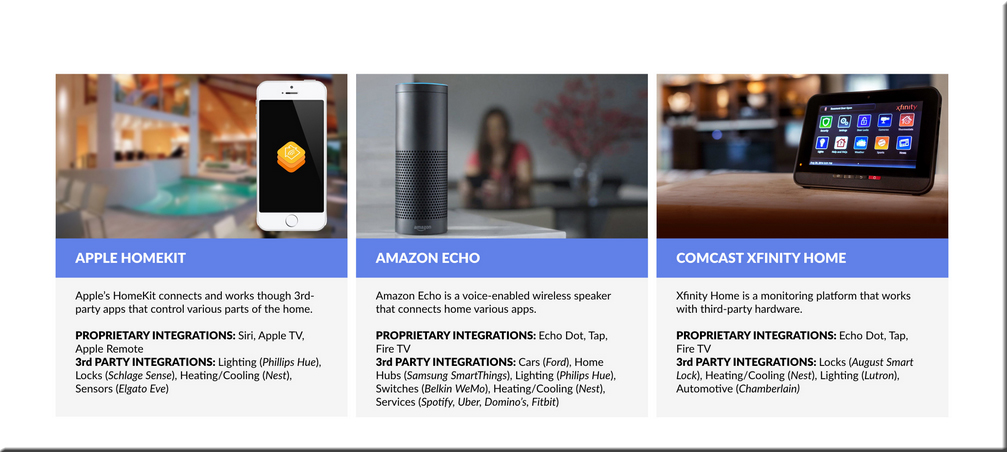
EmergingIOTPlatforms-2016


High-Profile Cyber Attacks on Physical Assets


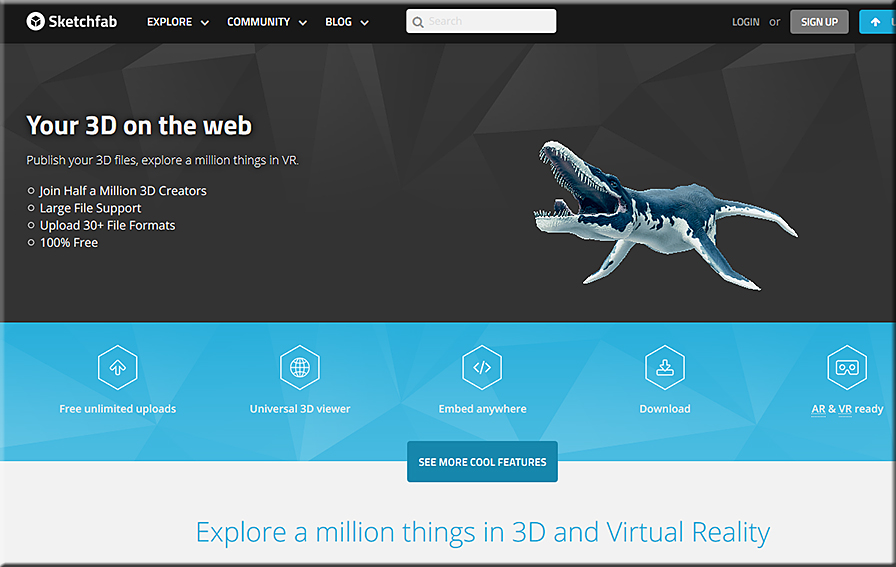
Sketchfab-June2016


Paper 53 is the ‘sketch-iPad’ you always wanted — from edtech4beginners.com

Excerpt:

Paper 53 is a brilliant app which combines drawings, notes, photos and sketches. It is available on the Appstore. The app is simple and user-friendly; just use your finger (or a stylus) to draw, paint, select colours, erase and lots more.


Google’s virtual reality field trips are available to everyone — from engadget.com by Jon Fingas
Students can also use Google Cast to share their screens across the classroom.


10 very good new educational web tools — from educatorstechnology.com

Excerpt:

Below is a collection of some new educational web tools and mobile apps to try out in your instruction.  The purpose is to keep you updated about the new releases in the EdTech world and empower you with the necessary technology to take your teaching and learning to the next level.  Some of the things you can do with these applications include: Learn English pronunciation from native speakers, easily save web content to Google, search YouTube without having to stop the video playing, learn basic math skills through challenging games and activities, unshare sent files in Gmail, create interactive and engaging videos by adding polls, short questions and quizzes, create beautiful presentations and animations  using drawn images and stick figures and many more.


Teaching with digital timelines — from Derek Bruff

Excerpt:

This year the Center for Teaching hosted a few educational technology working groups for faculty, staff, and students interested in exploring ways particular technologies might meet their instructional goals. One of the groups investigated the use of digital timeline tools, like Tiki-Toki and TimelineJS, that facilitate the creation of online, multimedia, interactive, and collaborative timelines. I had used such tools in my own teaching, having asked my 2010 writing seminar students to create a class timeline on the history of cryptography, and I was eager to talk with other instructors about the potential of student-produced timelines.


Top 5 AI virtual assistants: Now and into the future — from interestingengineering.com

Excerpt:

In Silicon Valley and elsewhere there’s currently an AI arms race going on. The first wave of this race is centered around artificial virtual assistants that are poised to become our new digital best friends in the very near future. While many people are familiar with Apple’s popular AI virtual assistant, Siri, there are four other main players in the AI virtual assistant space.


From DSC:
Twitter is also a tool that you should consider putting in your toolbox — or in your students’ toolboxes. Consider how it was used here –> This Henry VIII Twitter Account Is The Best Way To Learn About Brexit | @KngHnryVIII tells it like it is (and like how it was in the 1500s).


TwitterandKingHenryVIII-June2016


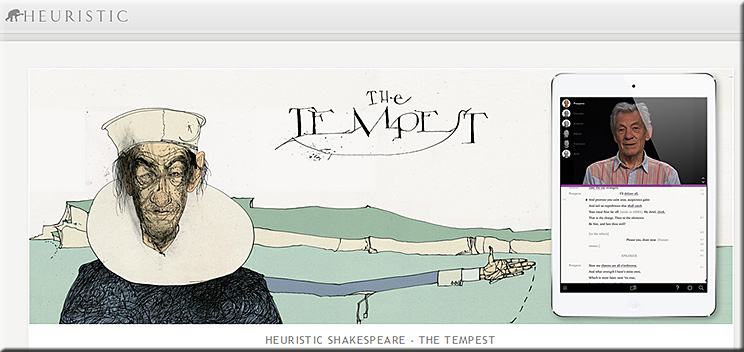
Heuristic Media is working on 37 apps, 1 for each Shakespeare play — with The Tempest as its pilot app.


TheTempest-IanM-Spring2016


Addendum on 6/30/16:


We can do nothing to change the past, but we have enormous power to shape the future. Once we grasp that essential insight, we recognize our responsibility and capability for building our dreams of tomorrow and avoiding our nightmares.

–Edward Cornish


From DSC:
This posting represents Part VI in a series of such postings that illustrate how quickly things are moving (Part I, Part II, Part III, Part IV, Part V, and to ask:

  • How do we collectively start talking about the future that we want?
  • How do we go about creating our dreams, not our nightmares?
  • Most certainly, governments will be involved….but who else should be involved in these discussions? Shouldn’t each one of us participate in some way, shape, or form?


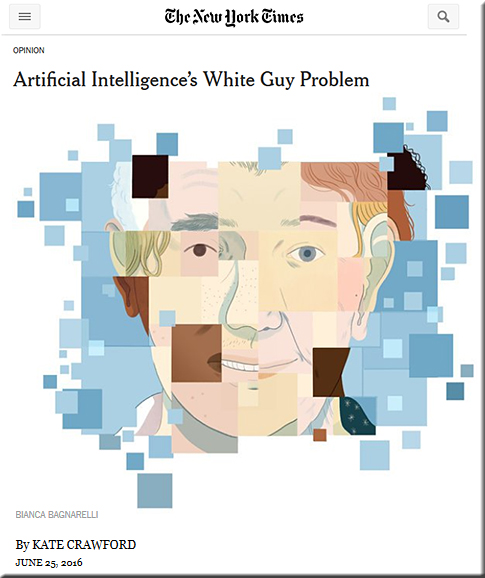
AIsWhiteGuyProblem-NYTimes-June2016


Artificial Intelligence’s White Guy Problem — from nytimes.com by Kate Crawford

Excerpt:

But this hand-wringing is a distraction from the very real problems with artificial intelligence today, which may already be exacerbating inequality in the workplace, at home and in our legal and judicial systems. Sexism, racism and other forms of discrimination are being built into the machine-learning algorithms that underlie the technology behind many “intelligent” systems that shape how we are categorized and advertised to.
…
If we look at how systems can be discriminatory now, we will be much better placed to design fairer artificial intelligence. But that requires far more accountability from the tech community. Governments and public institutions can do their part as well: As they invest in predictive technologies, they need to commit to fairness and due process.


Facebook is using artificial intelligence to categorize everything you write — from futurism.com

Excerpt:

Facebook has just revealed DeepText, a deep learning AI that will analyze everything you post or type and bring you closer to relevant content or Facebook services.


March of the machines — from economist.com
What history tells us about the future of artificial intelligence—and how society should respond

Excerpt:

EXPERTS warn that “the substitution of machinery for human labour” may “render the population redundant”. They worry that “the discovery of this mighty power” has come “before we knew how to employ it rightly”. Such fears are expressed today by those who worry that advances in artificial intelligence (AI) could destroy millions of jobs and pose a “Terminator”-style threat to humanity. But these are in fact the words of commentators discussing mechanisation and steam power two centuries ago. Back then the controversy over the dangers posed by machines was known as the “machinery question”. Now a very similar debate is under way.

After many false dawns, AI has made extraordinary progress in the past few years, thanks to a versatile technique called “deep learning”. Given enough data, large (or “deep”) neural networks, modelled on the brain’s architecture, can be trained to do all kinds of things. They power Google’s search engine, Facebook’s automatic photo tagging, Apple’s voice assistant, Amazon’s shopping recommendations and Tesla’s self-driving cars. But this rapid progress has also led to concerns about safety and job losses. Stephen Hawking, Elon Musk and others wonder whether AI could get out of control, precipitating a sci-fi conflict between people and machines. Others worry that AI will cause widespread unemployment, by automating cognitive tasks that could previously be done only by people. After 200 years, the machinery question is back. It needs to be answered.


As technology changes the skills needed for each profession, workers will have to adjust. That will mean making education and training flexible enough to teach new skills quickly and efficiently. It will require a greater emphasis on lifelong learning and on-the-job training, and wider use of online learning and video-game-style simulation. AI may itself help, by personalising computer-based learning and by identifying workers’ skills gaps and opportunities for retraining.


Backlash-Data-DefendantsFutures-June2016


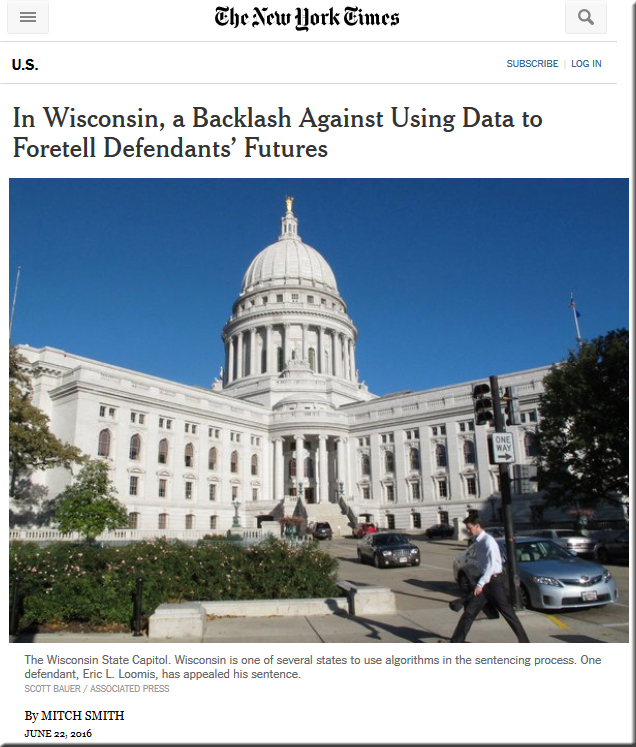
In Wisconsin, a Backlash Against Using Data to Foretell Defendants’ Futures — from nytimes.com by Mitch Smith

Excerpt:

CHICAGO — When Eric L. Loomis was sentenced for eluding the police in La Crosse, Wis., the judge told him he presented a “high risk” to the community and handed down a six-year prison term.

The judge said he had arrived at his sentencing decision in part because of Mr. Loomis’s rating on the Compas assessment, a secret algorithm used in the Wisconsin justice system to calculate the likelihood that someone will commit another crime.
…
Compas is an algorithm developed by a private company, Northpointe Inc., that calculates the likelihood of someone committing another crime and suggests what kind of supervision a defendant should receive in prison. The results come from a survey of the defendant and information about his or her past conduct. Compas assessments are a data-driven complement to the written presentencing reports long compiled by law enforcement agencies.


Google Tackles Challenge of How to Build an Honest Robot — from bloomberg.com by

Excerpt:

Researchers at Alphabet Inc. unit Google, along with collaborators at Stanford University, the University of California at Berkeley, and OpenAI — an artificial intelligence development company backed by Elon Musk — have some ideas about how to design robot minds that won’t lead to undesirable consequences for the people they serve. They published a technical paper Tuesday outlining their thinking.

The motivation for the research is the immense popularity of artificial intelligence, software that can learn about the world and act within it. Today’s AI systems let cars drive themselves, interpret speech spoken into phones, and devise trading strategies for the stock market. In the future, companies plan to use AI as personal assistants, first as software-based services like Apple Inc.’s Siri and the Google Assistant, and later as smart robots that can take actions for themselves.

But before giving smart machines the ability to make decisions, people need to make sure the goals of the robots are aligned with those of their human owners.


Policy paper | Data Science Ethical Framework — from gov.uk
From: Cabinet Office, Government Digital Service and The Rt Hon Matt Hancock MP
First published: 19 May 2016
Part of: Government transparency and accountability

This framework is intended to give civil servants guidance on conducting data science projects, and the confidence to innovate with data.

Detail: Data science provides huge opportunities for government. Harnessing new forms of data with increasingly powerful computer techniques increases operational efficiency, improves public services and provides insight for better policymaking. We want people in government to feel confident using data science techniques to innovate. This guidance is intended to bring together relevant laws and best practice, to give teams robust principles to work with. The publication is a first version that we are asking the public, experts, civil servants and other interested parties to help us perfect and iterate. This will include taking on evidence from a public dialogue on data science ethics. It was published on 19 May by the Minister for Cabinet Office, Matt Hancock. If you would like to help us iterate the framework, find out how to get in touch at the end of this blog.


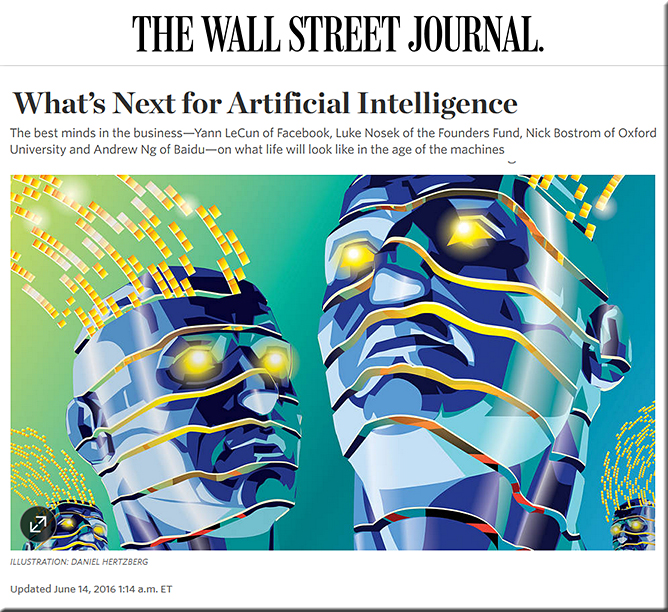
WhatsNextForAI-June2016

Excerpt (emphasis DSC):

We need to update the New Deal for the 21st century and establish a trainee program for the new jobs artificial intelligence will create. We need to retrain truck drivers and office assistants to create data analysts, trip optimizers and other professionals we don’t yet know we need. It would have been impossible for an antebellum farmer to imagine his son becoming an electrician, and it’s impossible to say what new jobs AI will create. But it’s clear that drastic measures are necessary if we want to transition from an industrial society to an age of intelligent machines.
…
The next step in achieving human-level ai is creating intelligent—but not autonomous—machines. The AI system in your car will get you safely home, but won’t choose another destination once you’ve gone inside. From there, we’ll add basic drives, along with emotions and moral values. If we create machines that learn as well as our brains do, it’s easy to imagine them inheriting human-like qualities—and flaws.


DARPA to Build “Virtual Data Scientist” Assistants Through A.I. — from inverse.com by William Hoffman
A.I. will make up for the lack of data scientists.

Excerpt:

The Defense Advanced Research Projects Agency (DARPA) announced on Friday the launch of Data-Driven Discovery of Models (D3M), which aim to help non-experts bridge what it calls the “data-science expertise gap” by allowing artificial assistants to help people with machine learning. DARPA calls it a “virtual data scientist” assistant.

This software is doubly important because there’s a lack of data scientists right now and a greater demand than ever for more data-driven solutions. DARPA says experts project 2016 deficits of 140,000 to 190,000 data scientists worldwide, and increasing shortfalls in coming years.


Robot that chooses to inflict pain sparks debate about AI systems — from interestingengineering.com by Maverick Baker

Excerpt:

A robot built by roboticist Alexander Reben from the University of Berkeley, California has the ability to decide using AI whether or not to inflict pain.

The robot aims to spark a debate on if an AI system can get out of control, reminiscent of the terminator. The robot design is incredibly simple, designed to serve only one purpose; to decide whether or not to inflict pain. The robot was engineered by Alexander Reben of the University of Berkeley and was published in a scientific journal aimed to spark a debate on whether or not artificial intelligent robots can get out of hand if given the opportunity.


The NSA wants to spy on the Internet of Things. Everything from thermostats to pacemakers could be mined for intelligence data. — from engadget.com by Andrew Dalton

Excerpt:

We already know the National Security Agency is all up in our data, but the agency is reportedly looking into how it can gather even more foreign intelligence information from internet-connected devices ranging from thermostats to pacemakers. Speaking at a military technology conference in Washington D.C. on Friday, NSA deputy director Richard Ledgett said the agency is “looking at it sort of theoretically from a research point of view right now.” The Intercept reports Ledgett was quick to point out that there are easier ways to keep track of terrorists and spies than to tap into any medical devices they might have, but did confirm that it was an area of interest.


The latest tool in the NSA’s toolbox? The Internet of Things — from digitaltrends.com by Lulu Chang

Excerpt:

You may love being able to set your thermostat from your car miles before you reach your house, but be warned — the NSA probably loves it too. On Friday, the National Security Agency — you know, the federal organization known for wiretapping and listening it on U.S. citizens’ conversations — told an audience at Washington’s Newseum that it’s looking into using the Internet of Things and other connected devices to keep tabs on individuals.


Addendum on 6/29/16:


Addendums on 6/30/16


Addendum on 7/1/16

  • Humans are willing to trust chatbots with some of their most sensitive information — from businessinsider.com by Sam Shead
    Excerpt:
    A study has found that people are inclined to trust chatbots with sensitive information and that they are open to receiving advice from these AI services. The “Humanity in the Machine” report —published by media agency Mindshare UK on Thursday — urges brands to engage with customers through chatbots, which can be defined as artificial intelligence programmes that conduct conversations with humans through chat interfaces.


How chatbots and deep learning will change the future of organizations — from forbes.com by Daniel Newman

Excerpt (emphasis DSC):

Don’t let the fun, casual name mislead you. Chatbots—software that you can “chat with”—have serious implications for the business world. Though many businesses have already considered their use for customer service purposes, a chatbot’s internal applications could be invaluable on a larger scale. For instance, chatbots could help employees break down siloes and provide targeted data to fuel every department. This digital transformation is happening, even in organizational structures that face challenges with other formats of real-time communication.

Still unclear on what chatbots are and what they do? Think of a digital assistant—such as iPhone’s Siri or Alexa, the Artificial Intelligence within the Amazon Echo. A chatbot reduces or eliminates the need for many mobile apps, as the answers are stored inside the chatbot. Need to know what the weather’s like in LA? Ask your chatbot. Is your flight running on time? Ask your chatbot. Is the package you ordered going to be delivered while you’re away? You get the gist.


From DSC:
How might institutions of higher education as well as K-12 school districts benefit from such internal applications of chatbots? How about external applications of chatbots? If done well, such applications could facilitate solid customer service (i.e., self-service knowledgebases) and aid in communications.


Hold Tight: The Chatbot Era Has Begun — from chatbotsmagazine.com by
Chatbots: What they are, and why they’re so important for businesses

Excerpt:

Imagine being able to have your own personal assistant at your fingertips, who you can chat with, give instructions and errands to, and handle the majority of your online research — both personally and professionally.

That’s essentially what a chatbot does.

Capable of being installed on any messenger platform, such as Facebook messenger or text messages, a chat bot is a basic artificial intelligence computer software program that does the legwork for you — and communicates in a way that feels like an intelligent conversation over text or voice messaging.


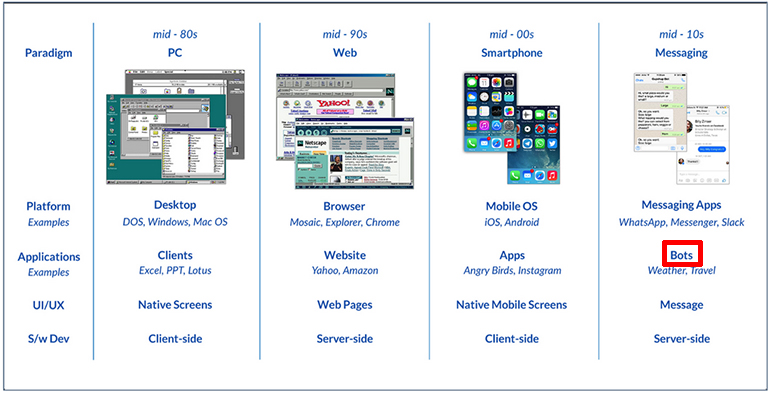
Once-in-a-decade paradigm shift: Messaging — from chatbotsmagazine.com by Beerud Sheth
In the history of the personal computing industry, we have had a paradigm shift about once every decade.


Bots-ChatbotMagazine-June2016


Smart assistants and chatbots will be top consumer applications for AI over next 5 years, poll says — from venturebeat.com by Blaise Zerega

Excerpt:

Virtual agents and chatbots will be the top consumer applications of artificial intelligence over the next five years, according to a consensus poll released today by TechEmergence, a marketing research firm for AI and machine learning.

The emphasis on virtual agents and chatbots is in many ways not surprising. After all, the tech industry’s 800-pound gorillas have all made big bets: Apple with Siri, Amazon with Alexa, Facebook with M and Messenger, Google with Google Assistant, Microsoft with Cortana and Tay. However, the poll’s data also suggests that chatbots may soon be viewed as a horizontal enabling technology for many industries.


From DSC:
Might this eventually affect students’ expectations? Blackboard’s partnership with IBM and Amazon may come into play here.


Some like it bot: Why chatbots could be the start of something big — from business.sprint.com
Chatbots are on the rise. With Google, Facebook and Microsoft competing to be the caring voice your customers turn to, what does this mean for your enterprise?

Excerpt:

The most prevalent indicator that the artificial intelligence-driven future is rapidly  becoming reality is the rise of the chatbot – an  A.I. software program designed to chat with people. Well, more accurately, the re-emergence of the bot. Basically, robots talking to humans talking to robots is the tech vision for the future.


Maybe one of the most obvious uses for this technology would be in service. If you can incorporate your self-service knowledge base into a bot that responds directly to questions and uses customer data to provide the most relevant answers, it’s more convenient for customers…


Chatbot lawyer overturns 160,000 parking tickets in London and New York — from theguardian.com by Samuel Gibbs
Free service DoNotPay helps appeal over $4m in parking fines in just 21 months, but is just the tip of the legal AI iceberg for its 19-year-old creator

Excerpt:

An artificial-intelligence lawyer chatbot has successfully contested 160,000 parking tickets across London and New York for free, showing that chatbots can actually be useful.

Dubbed as “the world’s first robot lawyer” by its 19-year-old creator, London-born second-year Stanford University student Joshua Browder, DoNotPay helps users contest parking tickets in an easy to use chat-like interface.


Addendum on 6/29/16:

A New Chatbot Would Like to Help You With Your Bank Account — from wired.com by Cade Metz

Excerpt:

People in Asia are already using MyKai, and beginning today, you can too. Because it’s focused on banking—and banking alone—it works pretty well. But it’s also flawed. And it’s a bit weird. Unsettling, even. All of which makes it a great way of deconstructing the tech world’s ever growing obsession with “chatbots.”
…
MyKai is remarkably adept at understanding what I’m asking—and that’s largely because it’s focused solely on banking. When I ask “How much money do I have?” or “How much did I spend on food in May?,” it understands. But when I ask who won the Spain-Italy match at Euro 2016, it suggests I take another tack. The thing to realize about today’s chatbots is that they can be reasonably effective if they’ve honed to a particular task—and that they break down if the scope gets to wide.


Blackboard Partners with IBM and Amazon Web Services (AWS) – North America Customer Announcement

Date Published: Jun 27,2016
Product: Collaborate, ANGEL, Learn, CE/Vista, Xythos, Moodlerooms, Analytics, Open Content
Article No.: 000042385

Announcement Details:
We are excited to share some news with you about Blackboard’s new partnership with IBM and Amazon Web Services (AWS) which will have far-reaching and lasting impacts for the education technology industry.  This communication will provide details on how this will benefit our customers and other business partners.

This partnership will enable us to accelerate our focus on developing innovative educational products and services that serve the needs of our customers. And it will open the door for us to develop novel solutions benefiting the education ecosystem.  There are two parts to this partnership that will benefit you:

Selection of AWS as our strategic cloud platform and partnership with IBM for operations and infrastructure management

We will partner with IBM in the operations and infrastructure management of Blackboard’s data centers.  We have also selected AWS as our cloud services provider and entered into an agreement with IBM to manage our cloud services environments. This partnership will enable Blackboard to focus on what we do best – developing innovative educational products and services – while relying on the world-class data hosting and operational capabilities of IBM and AWS.

This partnership does not affect our Transact customers.

This partnership offers customers many benefits. It will enable us to accelerate our focus on developing innovative educational products and services that serve the needs of our customers. Furthermore, we will leverage IBM’s experience, scale, and tools with the goal of  delivering the highest quality of service possible to our customers. This includes stringent service level agreements intended to ensure that Blackboard customers receive the most reliable and resilient hosting services available in the marketplace.  In addition, this partnership allows for enhanced technical, organizational and physical security measures to safeguard Blackboard customer data.  We will also leverage the power of the AWS ecosystem to accelerate product development and deployment; further improving customer experience in the future.

Our relationship with Amazon and IBM is integrated. There are no gaps in accountability for delivering reliable services to our clients.  And its backed by a comprehensive and robust set of service level commitments to deliver highly available and responsive services for you.

Exclusive partnership to co-develop cognitive education solutions utilizing Watson

Blackboard and IBM have entered into an exclusive agreement to develop cognitive educational solutions for the K-12 and higher education markets.  The partnership will combine Blackboard’s expertise in developing innovative education products in use by millions around the world, with the power of IBM Watson’s cognitive computing technology to create exclusive solutions to address some of the most pressing problems in education.

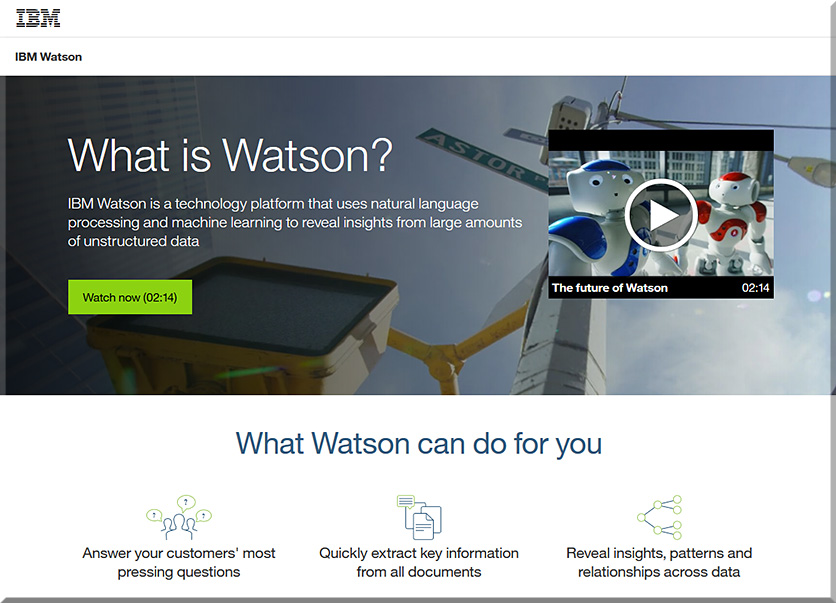
IBM Watson is a technology platform that uses natural language processing and machine learning to reveal insights from large amounts of unstructured data. In short, it can help to ‘hyper personalize’ the educational experience.

To sum it up, we’re tremendously excited about partnering with IBM and Amazon to deliver extraordinary capability to our customers. And we’re excited by what’s on the horizon for Blackboard and our customers as we continue to focus on delivering innovative products that address some of the most pressing challenges in education.

To learn more about our partnership, check out our press release on Blackboard.com. We’ll also provide further details in the weeks ahead through webinars and at BbWorld.


Frequently Asked Questions (FAQs)


1.  Why did Blackboard select IBM and AWS as their partners?
We spent considerable time selecting our partners, and we’re confident in what both IBM and Amazon will deliver for our customers. IBM is one of the world’s top infrastructure management organizations, and is uniquely positioned because of its experience and work in the education space. AWS is the clear leader in cloud services, with the largest global cloud infrastructure footprint, the most well-developed ecosystem, tremendous momentum and rate of innovation.Both companies share our values and dedication to maintaining the privacy of customer data, and both have invested heavily in world-class security programs to keep your data safe in accordance with global standards and regulations.

2.  Will the partnership extend to infrastructure provision and management for Blackboard’s Transact customers?
No.  Transact will continue to operate as today with no changes.

3.  How can I learn more about this partnership between Blackboard and IBM and the benefits to me?
In order to provide you with an opportunity to ask questions and learn more about this partnership and how it will benefit you, we have planned for several sessions at BbWorld, and have scheduled a series of customer webinars.  BbWorld is scheduled for July 12-14 and the webinars will be scheduled  in July and August.

4.  Will this change in responsibility affect who I call if I have a question or issue?
No.  Your support will continue to be handled by the same Blackboard team that exists today.

5.  Will I see any changes as a result of the partnership?  Yes.  We expect that you will see operational improvements starting in the 3-6 month timeframe.  These include improved system availability and accelerated response time to issues.

6.  What does this mean for Security and Privacy?
IBM and AWS share our focus on providing highly secure environments and experiences. This partnership will provide an enhanced data security program and robust technical, organizational and physical security measures to protect customer data, including student data.  Further, our agreement with IBM and AWS contains detailed provisions intended to safeguard data in North American markets in specific consideration of applicable privacy laws and regulations.   These provisions include geographic restrictions on the location and transfer of customer data, and encryption standards, to comply with applicable law.

7.  Does this partnership mean that I will need to move out of my existing Learn hosted environment?
No.  While in time many customers are planning to transition their Learn deployment to our cloud environment, customers who are currently running Learn 9.1 in our managed hosting datacenters will not be required to move.

8.  What about other Blackboard applications besides Learn?
Many other Blackboard applications are already delivered in a software-as-a-service model using Blackboard-managed datacenters. Over the coming years, IBM and Blackboard will work together to move these applications from Blackboard datacenters to AWS. Any migration plan will be developed in full consideration of giving customers an uninterrupted service and user experience.

9.  What about the current SaaS deployment for Blackboard Learn?
There is no impact.  Learn SaaS already runs on AWS.

10.  What is IBM Watson?
IBM Watson is a technology platform that uses natural language processing and machine learning to reveal insights from large amounts of unstructured data. In short, it can help to ‘hyper personalize’ the educational experience.

Watson gained a level of fame in 2011 when the team put their technology up against two of Jeopardy’s greatest champions in the history of the game. It was an exciting two-day match that resulted in Watson beating out the competition – not just from right answers, but also from using the right strategy for wagers to win the game.

See how Watson beat the Jeopardy leaders in this short video.

How does Watson work? Watch this educational video.

11.  Are there any definitive plans for the cognitive education solutions developed with Watson that I need to plan for at my institution?
We are in the early stages of this relationship. Blackboard and the Watson Education team are starting the process of scoping out the solutions that will bring the most value to K-12 and higher education.  We plan to communicate our progress and solicit your input as we move forward.

12.  What if I have more questions about this partnership?
There are three ways you can get answers to your questions:

  • Attend one of the multiple sessions planned for BbWorld.
  • Attend one of the online webinars will be schedule in the coming weeks.
  • Contact your Account Executive or Customer Success Advocate.


Addendum on 6/29/16:

  • Blackboard Inc. and IBM Enter Strategic Relationship to Develop Cognitive Solutions and Manage Infrastructure Operations
    Excerpt:
    IBM and Blackboard will work collaboratively to develop cognitive educational solutions utilizing the capabilities of both companies to advance learner success. The companies will combine Blackboard’s expertise in developing innovative education products used by millions of people around the world with the power of IBM Watson’s cognitive computing technology. The new solutions will offer greater support for teachers and students to address their collaborative needs in the classroom and help students complete and achieve their educational goals.


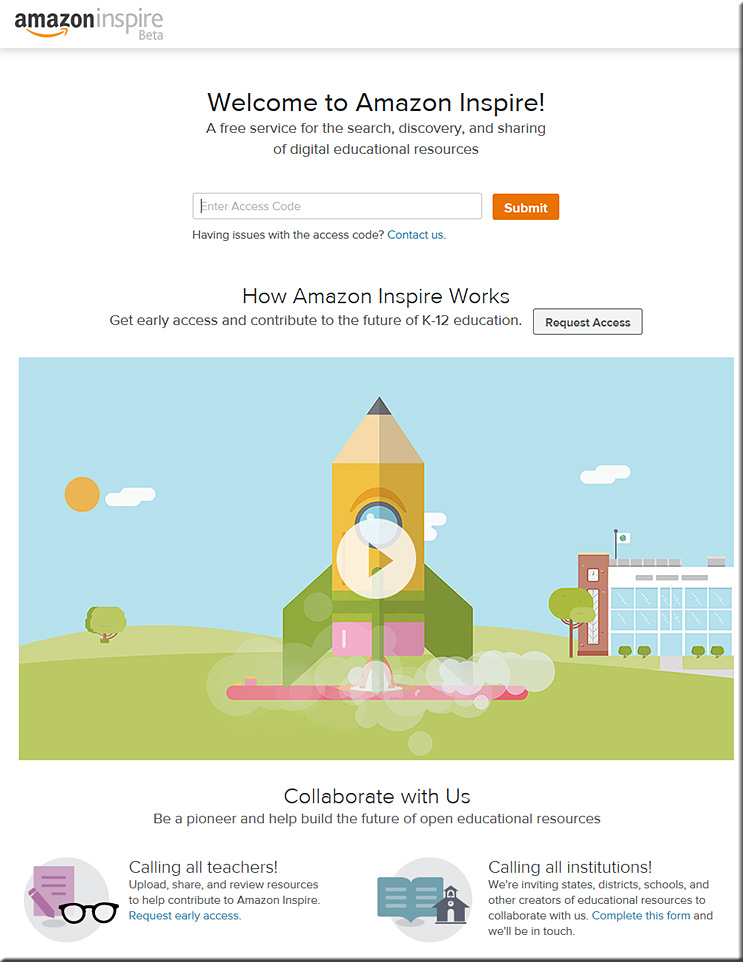
Amazon unveils online education service for teachers — from nytimes.com by Natasha Singer

Excerpt:

Just ahead of the back-to-school season, Amazon is making a major foray into the education technology market for primary and secondary schools, a territory that Apple, Google and Microsoft have heavily staked out.

On Monday morning, Amazon said that it would introduce an online marketplace with tens of thousands of free lesson plans, worksheets and other instructional materials for teachers in late August or early September.

Called Amazon Inspire, the education site has features that may seem quite familiar to frequent Amazon shoppers. Search bar at the top of the page? Check. User reviews? Check. Star ratings for each product? Check.


AmazonInspire-6-27-16


Some relatively recent additions to the education landscape include:


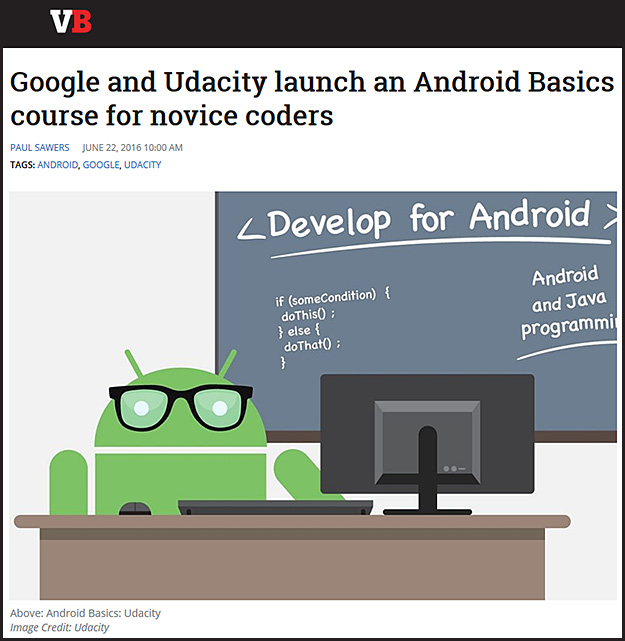
GoogleUdacity-CodingJuly2016


treehouse-2016


Teachable-June2016


FutureLeague-2016


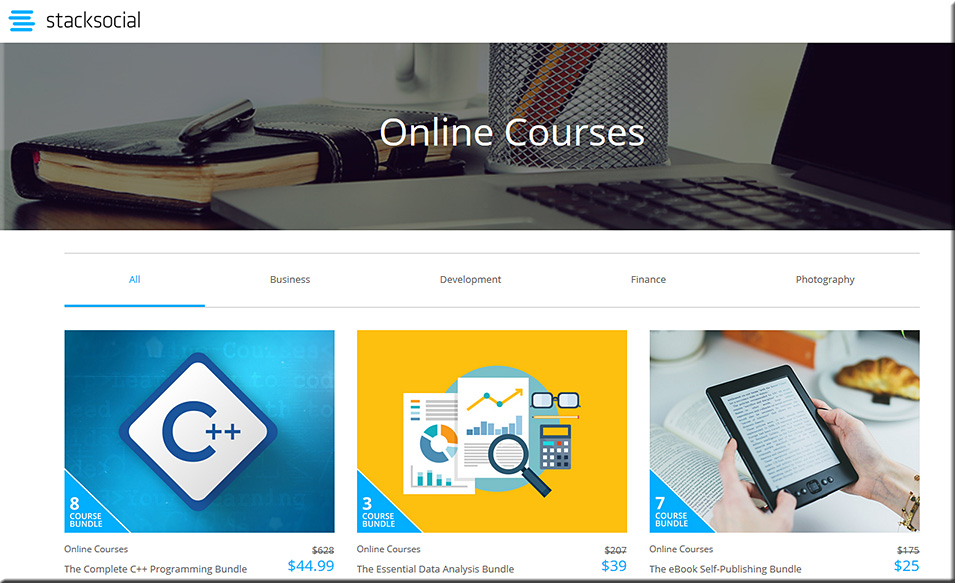
StackSocial-July2016


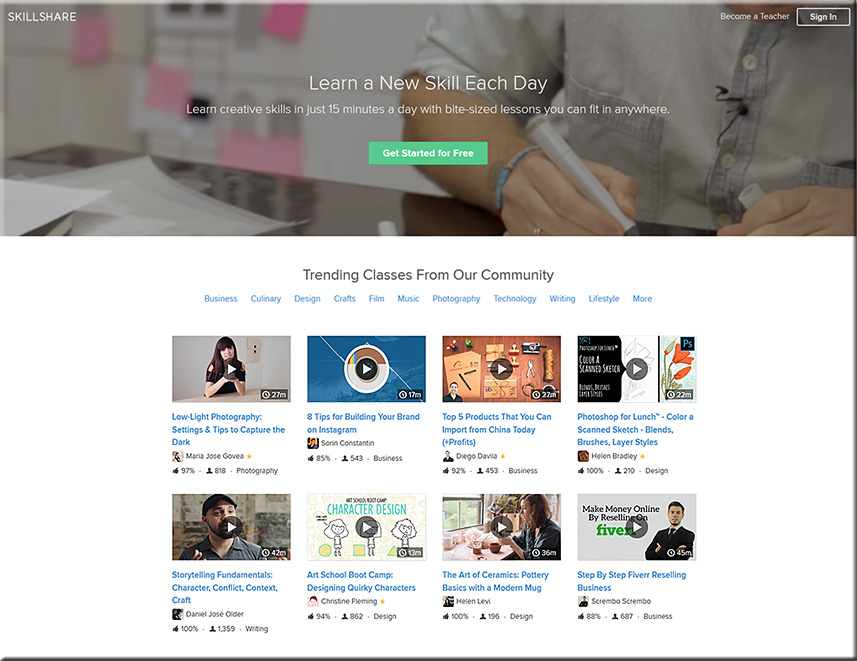
Skillshare-July2016


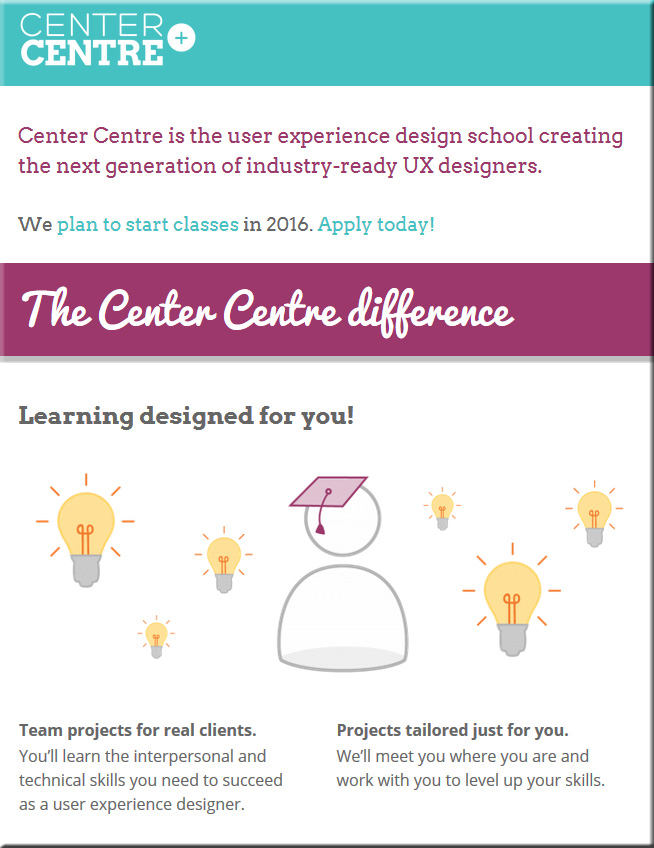
CenterCentre-June2016


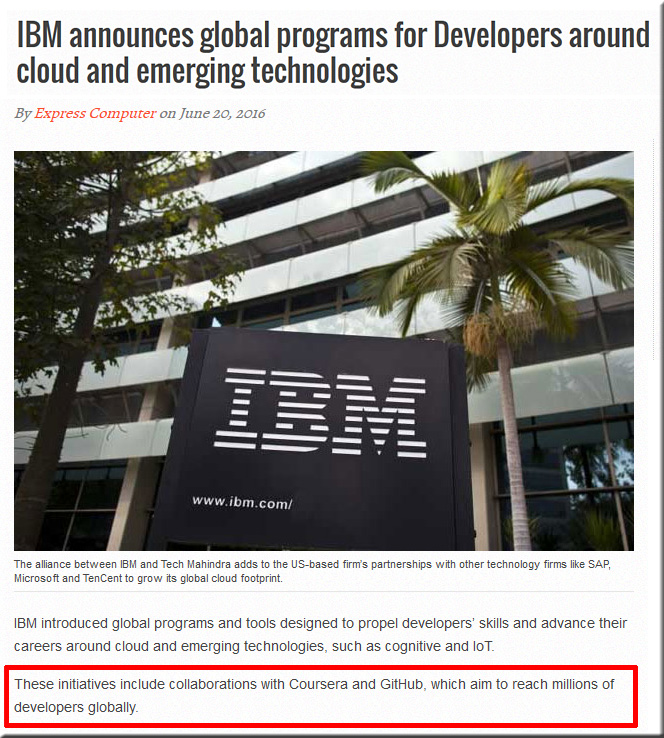
IBMCourseraGitHub-Courses-June2016


AmazonVideoDirect-June2016


Also see:


MillennialsPursuingOtherOptions-Selingo-May2016


Taking competency-based credentials seriously in the workforce — from campustechnology.com by John K. Waters
Companies like AT&T and Google are expanding their partnerships with online education providers, creating new educational pathways to real jobs.

Excerpt:

But in the Age of the Internet, for-profit online education providers such as Udacity and Coursera have tweaked that model by collaborating with companies to develop programs tailored to their specific needs.
…
Together the two companies created the Front-End Web Developer Nanodegree program, Udacity’s first branded microcredential. (“Nanodegree” is trademarked.)

“We worked with Udacity to develop curriculum based on tangible hiring and training needs,” said John Palmer, senior vice president and chief learning officer at AT&T, in an e-mail. “Our teams collaborated on determining what skills we needed now to address the needs of our business, but also what skills would be needed five to 10 years from now — not just at AT&T, but at other tech companies.”


uCertify

uCertify-june2016


Also related:

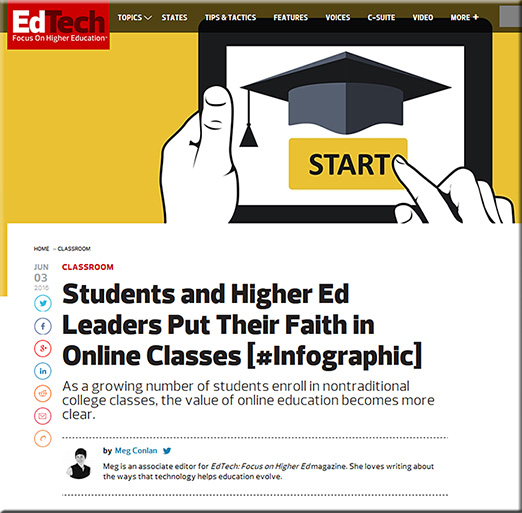
  • Students and higher ed leaders put their faith in online classes [#Infographic] — from edtechmagazine.com by Meg Conlan
    As a growing number of students enroll in nontraditional college classes, the value of online education becomes more clear.
    Excerpt:
    As cost-effective alternatives to traditional college classes, online learning programs continue to gain steam in higher ed.
    According to statistics gathered for an Online Learning Consortium infographic, 5.8 million students are now enrolled in online courses, and the majority put tremendous stock in the quality of their education: 90 percent of students say their online learning experiences are the same or better than in-classroom options.College and university leadership agrees: The infographic states that 71 percent of academic leaders say learning outcomes for online courses are the same or better than that of face-to-face classes.


OnlineLearningAlternativesGrowing-June2016


Related postings:


Acquisitions, mergers and reinvention (not closures) will characterize higher ed’s future — from evolllution.com; an interview with Kenneth Hartman | Past President of Drexel University Online, Drexel University

Excerpts:

We’re going to see a lot of different alternative options popping up at alternative prices with alternative delivery mechanisms offering alternative credentials in the future. I don’t think a lot of institutions will be shutting down. There will be some that close, but it’s more likely that their assets will be acquired by other, stronger institutions.
…
These types of programs are popping up all over the country and I think the market forces tell a story. Colleges that are able to be adaptable and flexible will be the leaders in this new higher education marketplace. Adaptability, vision and flexibility are going to be critical for schools that are not heavily-endowed. If they do not have the will to do that then I think unfortunately Christensen’s prediction will probably come true. However, I’m optimistic that when the pain gets high enough, trustees of these institutions will demand that their senior leadership provide them with the way to prevent closure.


What a Microsoft-owned LinkedIn means for education — from campustechnology.com by Dian Schaffhauser

Excerpt:

Ironically, he suggested, higher ed is also the most vulnerable target of LinkedIn as it continues to work on development of a competency marketplace that could one day replace four-year degrees as the baseline requirement for employment.

The vision of this competency marketplace is that employers can identify candidates who are close matches for positions based on the competencies their jobs require. Likewise, job candidates can get information from LinkedIn about what competencies a given position requires and pursue that through some form of training, whether through a class at a local college, a bootcamp, online learning or some other form of instruction.

“The signal for universities that the world is about to change is when employers begin to drop degree requirements from job descriptions,” said Craig. And by the way, he added, that’s already happening at recognizable companies such as Google, Penguin Random House, EY and PwC, which have either eliminated that requirement from entry-level job descriptions or begun masking a candidate’s degree status from hiring managers because they “think the degrees are actually false or poor or misleading signals of ultimate job performance.”

Not only does LinkedIn have by far the largest collection of candidate profiles, but it has become the leading platform for distributing microcredentials, said Craig.


“You can identify education and training opportunities to remediate gaps between where you are and what the job description says you need to have to qualify. So all the pieces are there,” he said. “Currently, it’s still early, but you can see where this is going. We think that is the story of the next decade in higher education.”


12 promising non-traditional college pathways to attainment — from eddesignlab.org

Excerpt:

We hear a lot about reinventing college and how we might better design the journey from school to work. Some students want faster or more experiential pathways to prosperity, re-entry points after stop-outs or opportunities for lifelong learning. “Non-traditional pathways” is a phrase you’ll hear a lot if you hang around policy and design folks who are thinking about broadening “attainment of degrees” to include meaningful credentials that lead to career readiness. This broader college success definition is not a cop out—it’s a recognition that technology, access to micro-credentials, and access to modular learning generally are blurring the lines between vocational training, liberal arts exploration, and 21st century skill building because, increasingly, students are in a position to order all these off the menu.

Lumina Foundation strategists Holly Zanville and Amber Garrison Duncan are in the thick of these designs, and the Lab caught up with them recently to help us build a list of the most promising ways that institutions, students, and third parties are piecing together non-traditional paths to meaningful credentials. Here’s a take on our “Top 12,” but we welcome your tweaks, additions, and favorite examples.


Top-ranked coding bootcamp, Fullstack Academy, launches first alumni startup investment fund — from prnewswire.com
Will provide seed funding for its graduates to launch their own startups

Excerpt:

NEW YORK, June 15, 2016 /PRNewswire/ — Fullstack Academy, the Y Combinator-backed top coding bootcamp in the U.S.,  today announced  Fullstack Fund, a new initiative to invest in promising startups created by its graduates.  “Students who complete our software engineering program go on to work for great companies like Google and Amazon, but some have opted for the entrepreneurial startup environment,” said David Yang, CEO and co-founder of Fullstack Academy. “So we asked ourselves — how can we better support alumni with a strong entrepreneurial slant? The Fullstack Fund  will empower some of the amazing teams and products that are coming out of our school.”


Addendum on 6/27/16:


Addendum on 6/30/16:


Noodle-June2016


Uncollege-June2016


CodingDojo-June2016


And a somewhat related posting:

More than 90% of institutions offer alternative credentials — from campustechnology.com by Sri Ravipati
The same study to report this statistic also found that millennial students prefer badging and certificates to traditional degrees.

Excerpt:

Millennial students seem to prefer badging and certificate programs to traditional bachelor’s degrees, according to a new study from University Professional and Continuing Education Association (UPCEA), Pennsylvania State University and Pearson that explored the role that alternative credentials play in higher education.

“Demographic Shifts in Educational Demand and the Rise of Alternative Credentials” includes responses from 190 institutions, including community colleges (11 percent), baccalaureate colleges (12 percent), master’s colleges or universities (27 percent) and doctorate-granting universities (50 percent). Of the 190 institutions surveyed, 61 percent were public entities. Across the board, research revealed that programs offering alternative credentialing have become widespread in higher education, with 94 percent of the institutions reporting they offer alternative credentials. Alternative credentials can take the form of digital badges, certificates and micro-credentials.


Addendum on 7/11/16:

A model for higher education where all learning counts — from marketplace.org by Amy Scott

Excerpt:

Imagine it’s 2026, and you’re one of a billion people using a new digital platform called the Ledger.

So begins a new video from the Institute for the Future and ACT Foundation, envisioning a future system that would reward any kind of learning – from taking a course, to reading a book, to completing a project at work.

“Your Ledger account tracks everything you’ve ever learned in units called Edublocks,” the video’s narrator explains. “Each Edublock represents one hour of learning in a particular subject. Anyone can grant Edublocks to anyone else.”

The Ledger would use the same technology that powers bitcoin, the virtual currency, to create a verifiable record of every learning transaction, said Jane McGonigal, director of game research and development at the Institute for the Future, a think tank in Palo Alto, California.


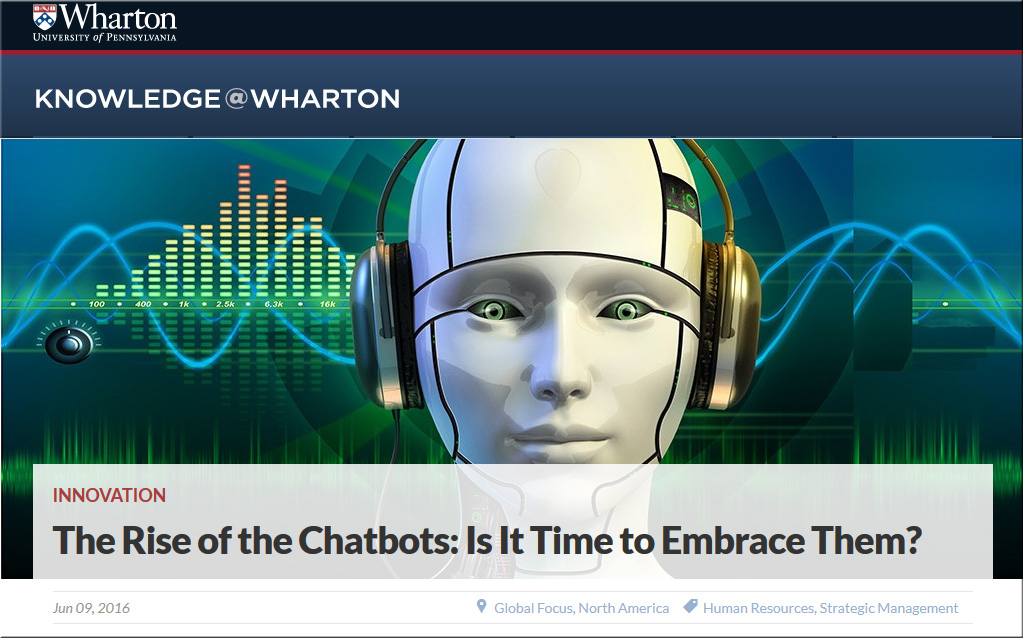
chatbots-wharton-june2016

The rise of the chatbots: Is it time to embrace them? — from knowledge.wharton.upenn.edu

Excerpt:

The tech world is all agog these days about chatbots. These are automated computer programs that simulate online conversations with people to answer questions or perform tasks. While chatbots have been around in various rudimentary forms for years — think of Clippy, Microsoft’s paper clip virtual assistant — they have been taking off lately as advances in machine learning and artificial intelligence make them more versatile than ever. Among the most well-known chatbots: Apple’s Siri.

In rapid succession over the past few months, Microsoft, Facebook and Google have each unveiled their chatbot strategies, touting the potential for this evolving technology to aid users and corporate America with its customer-service capabilities as well as business utility features like organizing a meeting. Yahoo joined the bandwagon recently, launching its first chatbots on a chat app called Kik Messenger.


Bill Gates says the next big thing in tech can help people learn like he does — from businessinsider.com by Matt Weinberger

Excerpt (emphasis DSC):

In a new interview with The Verge, Microsoft cofounder and richest man in the world Bill Gates explained the potential for chatbots — programs you can text with like they’re human — in education.

Gates lauds the potential for what he calls “dialogue richness,” where an chatbot can really hold a conversation with a student, essentially making it into a tutor that can walk them through even the toughest, most subjective topics. 

It’s actually similar to how Gates himself likes to learn, he tells The Verge…


The complete beginner’s guide to chatbots — from chatbotsmagazine.com by Matt Schlicht
Everything you need to know.

Excerpt (emphasis DSC):

What are chatbots? Why are they such a big opportunity? How do they work? How can I build one? How can I meet other people interested in chatbots?

These are the questions we’re going to answer for you right now.
…
What is a chatbot?
A chatbot is a service, powered by rules and sometimes artificial intelligence, that you interact with via a chat interface. The service could be any number of things, ranging from functional to fun, and it could live in any major chat product (Facebook Messenger, Slack, Telegram, Text Messages, etc.).
…

A chatbot is a service, powered by rules and sometimes artificial intelligence, that you interact with via a chat interface.

Examples of Chat Bots
Weather bot. Get the weather whenever you ask.
Grocery bot. Help me pick out and order groceries for the week.
News bot. Ask it to tell you when ever something interesting happens.
Life advice bot. I’ll tell it my problems and it helps me think of solutions.
Personal finance bot. It helps me manage my money better.
Scheduling bot. Get me a meeting with someone on the Messenger team at Facebook.
A bot that’s your friend. In China there is a bot called Xiaoice, built by Microsoft, that over 20 million people talk to.


Chatbots explained: Why Facebook and other tech companies think they’re the biggest thing since the iPhone — from businessinsider.com by Biz Carson

Excerpt:

Chatbots are the future, whether we’re ready for them or not.

On Tuesday (April 5, 2016) , Facebook launched Bots for Messenger, a step that could define the next decade in the same way that the Apple App Store launch paved the path for companies like Uber to build a business off your phone. Its new messaging platform will help businesses build intelligent chatbots to let them communicate in Messenger.

“Today could be the beginning of a new era,” said Facebook Messenger chief David Marcus.

So what are these chatbots, and why is everyone obsessed?


Facebook wants to completely revolutionize the way you talk to businesses — from businessinsider.com by Jillian D’Onfro


Bot wars: Why big tech companies want apps to talk back to you — from fastcompany.com by Jared Newman
Can a new wave of chatbots from Facebook and Microsoft upend apps as we know them, or is that just wishful thinking?

Excerpt:

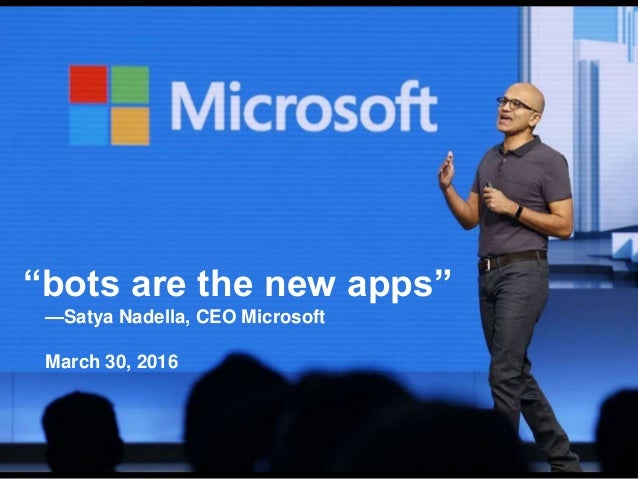
The rise of conversational “chatbots” begins with a claim you might initially dismiss as preposterous. “Bots are the new apps,” Microsoft CEO Satya Nadella declared during the company’s Build developers conference last month. “People-to-people conversations, people-to-digital assistants, people-to-bots, and even digital assistants-to-bots. That’s the world you’re going to get to see in the years to come.”


Microsoft CEO Nadella: ‘Bots are the new apps’

Excerpt:

SAN FRANCISCO – Microsoft CEO Satya Nadella kicked off the company’s Build developers conference with a vision of the future filled with chatbots, machine learning and artificial intelligence.

“Bots are the new apps,” said Nadella during a nearly three-hour keynote here that sketched a vision for the way humans will interact with machines. “People-to-people conversations, people-to-digital assistants, people-to-bots and even digital assistants-to-bots. That’s the world you’re going to get to see in the years to come.”

Onstage demos hammered home those ideas. One involved a smartphone conversing with digital assistant Cortana about planning a trip to Ireland, which soon found Cortana bringing in a Westin Hotels chatbot that booked a room based on the contents of the chat.


Addendums on 6/17/16:


Questions from DSC:

  • Which jobs/positions are being impacted by new forms of Human Computer Interaction (HCI)?
  • What new jobs/positions will be created by these new forms of HCI?
  • Will it be necessary for instructional technologists, instructional designers, teachers, professors, trainers, coaches, learning space designers, and others to pulse check this landscape?  Will that be enough? 
  • Or will such individuals need to dive much deeper than that in order to build the necessary skillsets, understandings, and knowledgebases to meet the new/changing expectations for their job positions?
  • How many will say, “No thanks, that’s not for me” — causing organizations to create new positions that do dive deeply in this area?
  • Will colleges and universities build and offer more courses involving HCI?
  • Will Career Services Departments get up to speed in order to help students carve out careers involving new forms of HCI?
  • How will languages and language translation be impacted by voice recognition software?
  • Will new devices be introduced to our classrooms in the future?
  • In the corporate space, how will training departments handle these new needs and opportunities?  How will learning & development groups be impacted? How will they respond in order to help the workforce get/be prepared to take advantage of these sorts of technologies? What does it mean for these staffs personally? Do they need to invest in learning more about these advancements?

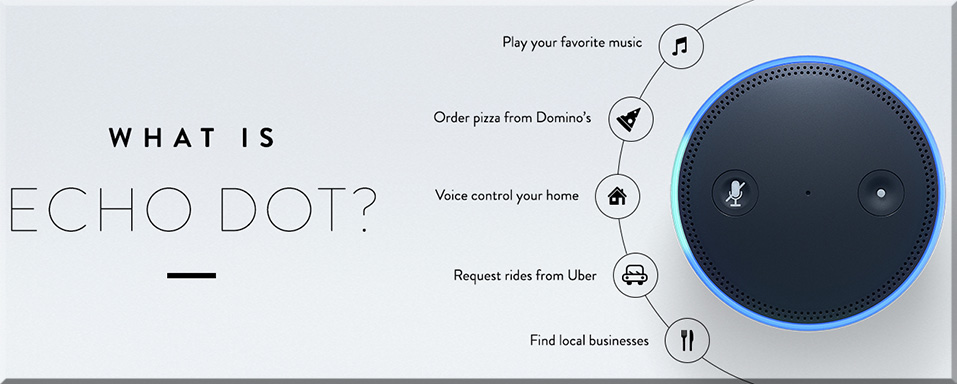
As an example of what I’m trying to get at here, who all might be involved with an effort like Echo Dot?  What types of positions created it? Who all could benefit from it?  What other platforms could these technologies be integrated into?  Besides the home, where else might we find these types of devices?


WhatIsEchoDot-June2016

Echo Dot is a hands-free, voice-controlled device that uses the same far-field voice recognition as Amazon Echo. Dot has a small built-in speaker—it can also connect to your speakers over Bluetooth or with the included audio cable. Dot connects to the Alexa Voice Service to play music, provide information, news, sports scores, weather, and more—instantly.

Echo Dot can hear you from across the room, even while music is playing. When you want to use Echo Dot, just say the wake word “Alexa” and Dot responds instantly. If you have more than one Echo or Echo Dot, you can set a different wake word for each—you can pick “Amazon”, “Alexa” or “Echo” as the wake word.


Or how might students learn about the myriad of technologies involved with IBM’s Watson?  What courses are out there today that address this type of thing?  Are more courses in the works that will address this type of thing? In which areas (Computer Science, User Experience Design, Interaction Design, other)?


WhatIsIBMWatson-June2016


Lots of questions…but few answers at this point. Still, given the increasing pace of technological change, it’s important that we think about this type of thing and become more responsive, nimble, and adaptive in our organizations and in our careers.


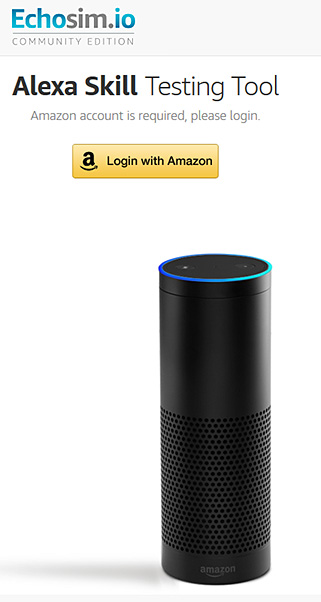
Amazon now lets you test drive Echo’s Alexa in your browser — from by Dan Thorp-Lancaster

Excerpt:

If you’ve ever wanted to try out the Amazon Echo before shelling out for one, you can now do just that right from your browser. Amazon has launched a dedicated website where you can try out an Echo simulation and put Alexa’s myriad of skills to the test.


Echosimio-Amazon-EchoMay2016


From DSC:
The use of the voice and gesture to communicate to some type of computing device or software program represent growing types of Human Computer Interaction (HCI).  With the growth of artificial intelligence (AI), personal assistants, and bots, we should expect to see more voice recognition services/capabilities baked into an increasing amount of products and solutions in the future.

Given these trends, personnel working within K-12 and higher ed need to start building their knowledgebases now so that we can begin offering more courses in the near future to help students build their skillsets.  Current user experience designers, interface designers, programmers, graphic designers, and others will also need to augment their skillsets.


Now you can build your own Amazon Echo at home—and Amazon couldn’t be happier — from qz.com by Michael Coren

Excerpt:

Amazon’s $180 Echo and the new Google Home (due out later this year) promise voice-activated assistants that order groceries, check calendars and perform sundry tasks of your everyday life. Now, with a little initiative and some online instructions, you can build the devices yourself for a fraction of the cost. And that’s just fine with the tech giants.

At this weekend’s Bay Area Maker Faire, Arduino, an open-source electronics manufacturer, announced new hardware “boards”—bundles of microprocessors, sensors, and ports—that will ship with voice and gesture capabilities, along with wifi and bluetooth connectivity. By plugging them into the free voice-recognition services offered by Google’s Cloud Speech API and Amazon’s Alexa Voice Service, anyone can access world-class natural language processing power, and tap into the benefits those companies are touting. Amazon has even released its own blueprint and code repository to build a $60 version of its Echo using Raspberry Pi, another piece of open-source hardware.


From DSC:
Perhaps this type of endeavor could find its way into some project-based learning out there, as well as in:

  • Some Computer Science-related courses
  • Some Engineering-related courses
  • User Experience Design bootcamps
  • Makerspaces
  • Programs targeted at gifted students
  • Other…??


© 2025 | Daniel Christian