Million-dollar babies — from economist.com by
As Silicon Valley fights for talent, universities struggle to hold on to their stars


Excerpt:

THAT a computer program can repeatedly beat the world champion at Go, a complex board game, is a coup for the fast-moving field of artificial intelligence (AI). Another high-stakes game, however, is taking place behind the scenes, as firms compete to hire the smartest AI experts. Technology giants, including Google, Facebook, Microsoft and Baidu, are racing to expand their AI activities. Last year they spent some $8.5 billion on deals, says Quid, a data firm. That was four times more than in 2010.

In the past universities employed the world’s best AI experts. Now tech firms are plundering departments of robotics and machine learning (where computers learn from data themselves) for the highest-flying faculty and students, luring them with big salaries similar to those fetched by professional athletes.


Experts in machine learning are most in demand. Big tech firms use it in many activities, from basic tasks such as spam-filtering and better targeting of online advertisements, to futuristic endeavours such as self-driving cars or scanning images to identify disease.


Also from The Economist, see:

Excerpt:

AI is already starting to generate big financial gains for companies, which helps explain firms’ growing investment in developing AI capabilities. Machine-learning, in which computers become smarter by processing large data-sets, currently has many profitable consumer-facing applications, including image recognition in photographs, spam filtering and those that help to better target advertisements to web surfers. Many of tech firms’ most ambitious projects, including building self-driving cars and designing virtual personal assistants that can understand and execute complex tasks, also rely on artificial intelligence, especially machine-learning and robotics. This has prompted tech firms to try to hire up as much of the top talent as they can from universities, where the best AI experts research and teach. Some worry about the potential of a brain drain from academia into the private sector.

The biggest concern, however, is that one firm corners the majority of the talent in artificial intelligence, creating an intellectual monopoly of sorts.


Amazon Education to launch new website for open education resources — from marketbrief.edweek.org by Michele Molnar

Excerpt:

Amazon Education is working on a new platform that will allow schools to upload, manage, share, and discover open education resources from a home page that in some ways resembles the one shoppers are accustomed to accessing on the massive online retailer’s website.

School administrators learned about the site, to be called Amazon Inspire, during a “Transitioning to OER” session Friday as part of the National Conference on Education of the AASA, the School Superintendents Association, held here.

The new platform is in beta testing now, and is scheduled to be released publicly within the next two to three months, according to Andrew Joseph, vice president of strategic relations for Amazon Education.


Amazon to launch Internet of Things-based artificial intelligence next year

Excerpt:

Amazon has the potential to lead the artificial intelligence and Internet of Things markets, given its current developments in the sector.
…
Given Amazon’s potential in the sphere of IoT and artificial intelligence, it could definitely compete with such companies as Facebook, Google and Apple.


From DSC:
Below are some further items that discuss the need for some frameworks, policies, institutes, research, etc. that deal with a variety of game-changing technologies that are quickly coming down the pike (if they aren’t already upon on).  We need such things to help us create a positive future.

Also see Part I of this thread of thinking entitled, “The need for ethics, morals, policies, & serious reflection about what kind of future we want has never been greater!“  There have been so many other items that came out since that posting, I felt like I needed to add another one here.

What kind of future do we want? How are we going to insure that we get there?

As the saying goes…”Just because we can do something, doesn’t mean we should.” Or another saying comes to my mind…”What could possibly go wrong with this? It’s a done deal.”

While some of the items below should have very positive impacts on society, I do wonder how long it will take the hackers — the ones who are bent on wreaking havoc — to mess up some of these types of applications…with potentially deadly consequences? Security-related concerns must be dealt with here.


5 amazing and alarming things that may be done with your DNA — from washingtonpost.com by Matt McFarland

Excerpt (emphasis DSC):

Venter is leading efforts to use digital technology to analyze humans in ways we never have before, and the results will have huge implications for society. The latest findings he described are currently being written up for scientific publications. Venter didn’t want to usurp the publications, so he wouldn’t dive into extensive detail of how his team has made these breakthroughs. But what he did share offers an exciting and concerning overview of what lies ahead for humanity. There are social, legal and ethical implications to start considering. Here are five examples of how digitizing DNA will change the human experience:


These are the decisions the Pentagon wants to leave to robots — from defenseone.com by Patrick Tucker
The U.S. military believes its battlefield edge will increasingly depend on automation and artificial intelligence.

Excerpt:

Conducting cyber defensive operations, electronic warfare, and over-the-horizon targeting. “You cannot have a human operator operating at human speed fighting back at determined cyber tech,” Work said. “You are going to need have a learning machine that does that.” He did not say  whether the Pentagon is pursuing the autonomous or automatic deployment of offensive cyber capabilities, a controversial idea to be sure. He also highlighted a number of ways that artificial intelligence could help identify new waveforms to improve electronic warfare.


Britain should lead way on genetically engineered babies, says Chief Scientific Adviser — from.telegraph.co.uk by Sarah Knapton
Sir Mark Walport, who advises the government on scientific matters, said it could be acceptable to genetically edit human embryos

Excerpt:

Last week more than 150 scientists and campaigners called for a worldwide ban on the practice, claiming it could ‘irrevocably alter the human species’ and lead to a world where inequality and discrimination were ‘inscribed onto the human genome.’

But at a conference in London [on 12/8/15], Sir Mark Walport, who advises the government on scientific matters, said he believed there were ‘circumstances’ in which the genetic editing of human embyros could be ‘acceptable’.


Cyborg Future: Engineers Build a Chip That Is Part Biological and Part Synthetic — from futurism.com

Excerpt:

Engineers have succeeded in combining an integrated chip with an artificial lipid bilayer membrane containing ATP-powered ion pumps, paving the way for more such artificial systems that combine the biological with the mechanical down the road.


Robots expected to run half of Japan by 2035 — from engadget.com by Andrew Tarantola
Something-something ‘robot overlords’.

Excerpt:

Data analysts Nomura Research Institute (NRI), led by researcher Yumi Wakao, figure that within the next 20 years, nearly half of all jobs in Japan could be accomplished by robots. Working with Professor Michael Osborne from Oxford University, who had previously investigated the same matter in both the US and UK, the NRI team examined more than 600 jobs and found that “up to 49 percent of jobs could be replaced by computer systems,” according to Wakao.


Cambridge University is opening a £10 million centre to study the impact of AI on humanity — from businessinsider.com by Sam Shead

Excerpt:

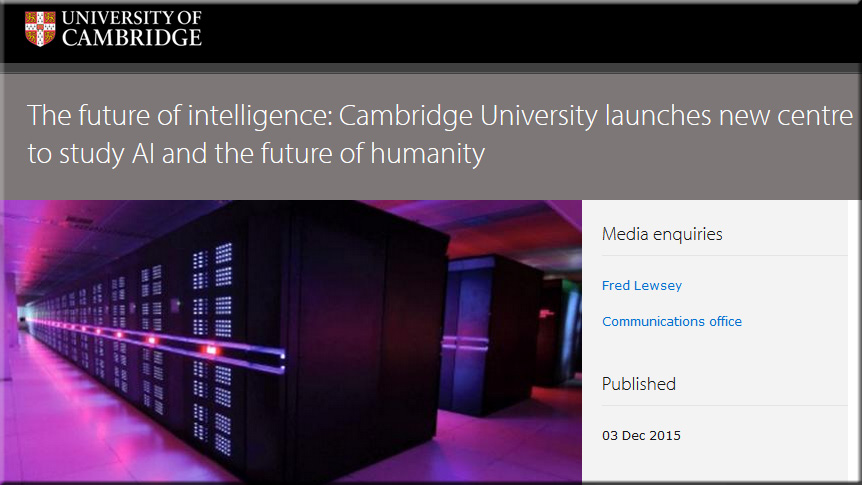
Cambridge University announced on [12/3/15] that it is opening a new £10 million research centre to study the impact of artificial intelligence on humanity.

The 806-year-old university said the centre, being funded with a grant from non-profit foundation The Leverhulme Trust, will explore the opportunities and challenges facing humanity as a result of further developments in artificial intelligence.
 

Cambridge-Center-Dec2015


Tech leaders launch nonprofit to save the world from killer robots — from csmonitor.com by Jessica Mendoza
Elon Musk, Sam Altman, and other tech titans have invested $1 billion in a nonprofit that would help direct artificial intelligence technology toward positive human impact. 


2016 will be a pivotal year for social robots — from therobotreport.com by Frank Tobe
1,000 Peppers are selling each month from a big-dollar venture between SoftBank, Alibaba and Foxconn; Jibo just raised another $16 million as it prepares to deliver 7,500+ units in Mar/Apr of 2016; and Buddy, Rokid, Sota and many others are poised to deliver similar forms of social robots.

Excerpt:

These new robots, and the proliferation of mobile robot butlers, guides and kiosks, promise to recognize your voice and face and help you plan your calendar, provide reminders, take pictures of special moments, text, call and videoconference, order fast food, keep watch on your house or office, read recipes, play games, read emotions and interact accordingly, and the list goes on. They are attempting to be analogous to a sharp administrative assistant that knows your schedule, contacts and interests and engages with you about them, helping you stay informed, connected and active.


IBM opens its artificial mind to the world — from fastcompany.com by Sean Captain
IBM is letting companies plug into its Watson artificial intelligence engine to make sense of speech, text, photos, videos, and sensor data.

Excerpt:

Artificial intelligence is the big, oft-misconstrued catchphrase of the day, making headlines recently with the launch of the new OpenAI organization, backed by Elon Musk, Peter Thiel, and other tech luminaries. AI is neither a synonym for killer robots nor a technology of the future, but one that is already finding new signals in the vast noise of collected data, ranging from weather reports to social media chatter to temperature sensor readings. Today IBM has opened up new access to its AI system, called Watson, with a set of application programming interfaces (APIs) that allow other companies and organizations to feed their data into IBM’s big brain for analysis.


GE wants to give industrial machines their own social network with Predix Cloud — from fastcompany.com by Sean Captain
GE is selling a new service that promises to predict when a machine will break down…so technicians can preemptively fix it.


Foresight 2020: The future is filled with 50 billion connected devices — from ibmbigdatahub.com by Erin Monday

Excerpt:

By 2020, there will be over 50 billion connected devices generating continuous data.

This figure is staggering, but is it really a surprise? The world has come a long way from 1992, when the number of computers was roughly equivalent to the population of San Jose. Today, in 2015, there are more connected devices out there than there are human beings. Ubiquitous connectivity is very nearly a reality. Every day, we get a little closer to a time where businesses, governments and consumers are connected by a fluid stream of data and analytics. But what’s driving all this growth?


Designing robots that learn as effortlessly as babies — from singularityhub.com by Shelly Fan

Excerpt:

A wide-eyed, rosy-cheeked, babbling human baby hardly looks like the ultimate learning machine.

But under the hood, an 18-month-old can outlearn any state-of-the-art artificial intelligence algorithm.

Their secret sauce?

They watch; they imitate; and they extrapolate.

Artificial intelligence researchers have begun to take notice. This week, two separate teams dipped their toes into cognitive psychology and developed new algorithms that teach machines to learn like babies. One instructs computers to imitate; the other, to extrapolate.


Researchers have found a new way to get machines to learn faster — from fortune.com by  Hilary Brueck

Excerpt:

An international team of data scientists is proud to announce the very latest in machine learning: they’ve built a program that learns… programs. That may not sound impressive at first blush, but making a machine that can learn based on a single example is something that’s been extremely hard to do in the world of artificial intelligence. Machines don’t learn like humans—not as fast, and not as well. And even with this research, they still can’t.


Team showcase how good Watson is at learning — from adigaskell.org

Excerpt:

Artificial intelligence has undoubtedly come a long way in the last few years, but there is still much to be done to make it intuitive to use.  IBM’s Watson has been one of the most well known exponents during this time, but despite it’s initial success, there are issues to overcome with it.

A team led by Georgia Tech are attempting to do just that.  They’re looking to train Watson to get better at returning answers to specific queries.


Why The Internet of Things will drive a Knowledge Revolution. — from linkedin.com by David Evans

Excerpt:

As these machines inevitably connect to the Internet, they will ultimately connect to each other so they can share, and collaborate on their own findings. In fact, in 2014 machines got their own ”World Wide Web” called RoboEarth, in which to share knowledge with one another. …
The implications of all of this are at minimum twofold:

  • The way we generate knowledge is going to change dramatically in the coming years.
  • Knowledge is about to increase at an exponential rate.

What we choose to do with this newfound knowledge is of course up to us. We are about to face some significant challenges at scales we have yet to experience.


Drone squad to be launched by Tokyo police — from bbc.com

Excerpt:

A drone squad, designed to locate and – if necessary – capture nuisance drones flown by members of the public, is to be launched by police in Tokyo.


An advance in artificial intelligence rivals human abilities — from todayonline.com by John Markoff

Excerpt:

NEW YORK — Computer researchers reported artificial-intelligence advances [on Dec 10] that surpassed human capabilities for a narrow set of vision-related tasks.

The improvements are noteworthy because so-called machine-vision systems are becoming commonplace in many aspects of life, including car-safety systems that detect pedestrians and bicyclists, as well as in video game controls, Internet search and factory robots.


Somewhat related:

Novo Nordisk, IBM Watson Health to create ‘virtual doctor’ — from wsj.com by Denise Roland
Software could dispense treatment advice for diabetes patients

Excerpt:

Novo Nordisk A/S is teaming up with IBM Watson Health, a division of International Business Machines Corp., to create a “virtual doctor” for diabetes patients that could dispense treatment advice such as insulin dosage.

The Danish diabetes specialist hopes to use IBM’s supercomputer platform, Watson, to analyze health data from diabetes patients to help them manage their disease.


Why Google’s new quantum computer could launch an artificial intelligence arms race — from washingtonpost.com


8 industries robots will completely transform by 2025 — from techinsider.io


Addendums on 12/17/15:

Russia and China are building highly autonomous killer robots — from businessinsider.com.au by Danielle Muoi

Excerpt:

Russia and China are creating highly autonomous weapons, more commonly referred to as killer robots, and it’s putting pressure on the Pentagon to keep up, according to US Deputy Secretary of Defense Robert Work. During a national-security forum on Monday, Work said that China and Russia are heavily investing in a roboticized army, according to a report from Defense One.

Your Algorithmic Self Meets Super-Intelligent AI — from techcrunch.com by Jarno M. Koponen

Excerpt:

At the same time, your data and personalized experiences are used to develop and train the machine learning systems that are powering the Siris, Watsons, Ms and Cortanas. Be it a speech recognition solution or a recommendation algorithm, your actions and personal data affect how these sophisticated systems learn more about you and the world around you.

The less explicit fact is that your diverse interactions — your likes, photos, locations, tags, videos, comments, route selections, recommendations and ratings — feed learning systems that could someday transform into super–intelligent AIs with unpredictable consequences.

As of today, you can’t directly affect how your personal data is used in these systems


Addendum on 12/20/15:


Addendum on 12/21/15:

  • Facewatch ‘thief recognition’ CCTV on trial in UK stores — from bbc.com
    Excerpts (emphasis DSC):
    Face-recognition camera systems should be used by police, he tells me. “The technology’s here, and we need to think about what is a proportionate response that respects people’s privacy,” he says.
    …
    “The public need to ask themselves: do they want six million cameras painted red at head height looking at them?


Addendum on 1/13/16:


Amazon launches new program to fund university research — from seattletimes.com by Jay Greene; via the College Planning & Management Weekly Update

Excerpt:

Amazon.com is getting into the university grant-making business, launching a new program Thursday to fund research into big, world-changing ideas at universities.

The program, Amazon Catalyst, will debut at the University of Washington.

Amazon hopes to fund research into ideas in complex and vexing areas such as climate change and immigration. And the company is keen to put money toward “early-stage ideas” that might not otherwise get grant money.

In announcing the program, Amazon isn’t putting a limit on the amount it will dole out. But Adam Siegel, Amazon Catalyst’s managing director, said the “ballpark” range would run from “tens of thousands of dollars” to $100,000 per grant. He said Amazon hasn’t set a limit on the number of projects it will fund or the duration of Catalyst.


From DSC:
Many times we don’t want to hear news that could be troubling in terms of our futures. But we need to deal with these trends now or face the destabilization that Harold Jarche mentions in his posting below. 

The topics found in the following items should be discussed in courses involving economics, business, political science, psychology, futurism, engineering, religion*, robotics, marketing, the law/legal affairs and others throughout the world.  These trends are massive and have enormous ramifications for our societies in the not-too-distant future.

* When I mention religion classes here, I’m thinking of questions such as :

  • What does God have in mind for the place of work in our lives?
    Is it good for us? If so, why or why not?
  • How might these trends impact one’s vocation/calling?
  • …and I’m sure that professors who teach faith/
    religion-related courses can think of other questions to pursue


turmoil and transition — from jarche.com by Harold Jarche

Excerpts (emphasis DSC):

One of the greatest issues that will face Canada, and many developed countries in the next decade will be wealth distribution. While it does not currently appear to be a major problem, the disparity between rich and poor will increase. The main reason will be the emergence of a post-job economy. The ‘job’ was the way we redistributed wealth, making capitalists pay for the means of production and in return creating a middle class that could pay for mass produced goods. That period is almost over. From self-driving vehicles to algorithms replacing knowledge workers, employment is not keeping up with production. Value in the network era is accruing to the owners of the platforms, with companies such as Instagram reaching $1 billion valuations with only 13 employees.
…
The emerging economy of platform capitalism includes companies like Amazon, Facebook, Google, and Apple. These giants combined do not employ as many people as General Motors did.  But the money accrued by them is enormous and remains in a few hands. The rest of the labour market has to find ways to cobble together a living income. Hence we see many people willing to drive for a company like Uber in order to increase cash-flow. But drivers for Uber have no career track. The platform owners get richer, but the drivers are limited by finite time. They can only drive so many hours per day, and without benefits. At the same time, those self-driving cars are poised to replace all Uber drivers in the near future. Standardized work, like driving a vehicle, has little future in a world of nano-bio-cogno-techno progress.


Value in the network era is accruing to the owners of the platforms, with companies such as Instagram reaching $1 billion valuations with only 13 employees.


For the past century, the job was the way we redistributed wealth and protected workers from the negative aspects of early capitalism. As the knowledge economy disappears, we need to re-think our concepts of work, income, employment, and most importantly education. If we do not find ways to help citizens lead productive lives, our society will face increasing destabilization. 


Also see:

Will artificial intelligence and robots take your marketing job? — from by markedu.com by
Technology will overtake jobs to an extent and at a rate we have not seen before. Artificial intelligence is threatening jobs even in service and knowledge intensive sectors. This begs the question: are robots threatening to take your marketing job?

Excerpt:

What exactly is a human job?
The benefits of artificial intelligence are obvious. Massive productivity gains while a new layer of personalized services from your computer – whether that is a burger robot or Dr. Watson. But artificial intelligence has a bias. Many jobs will be lost.

A few years ago a study from the University of Oxford got quite a bit of attention. The study said that 47 percent of the US labor market could be replaced by intelligent computers within the next 20 years.

The losers are a wide range of job categories within the administration, service, sales, transportation and manufacturing.

…

Before long we should – or must – redefine what exactly a human job is and the usefulness of it. How we as humans can best complement the extraordinary capabilities of artificial intelligence.


This development is expected to grow fast. There are different predictions about the timing, but by 2030 there will be very few tasks that only a human can solve.


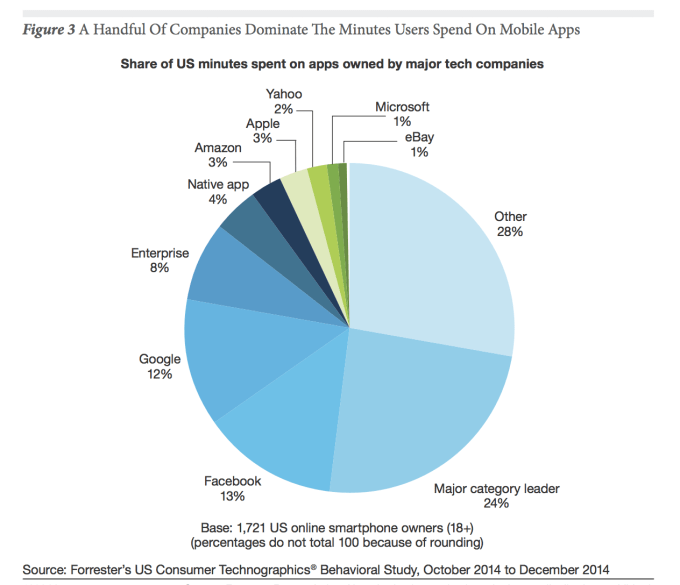
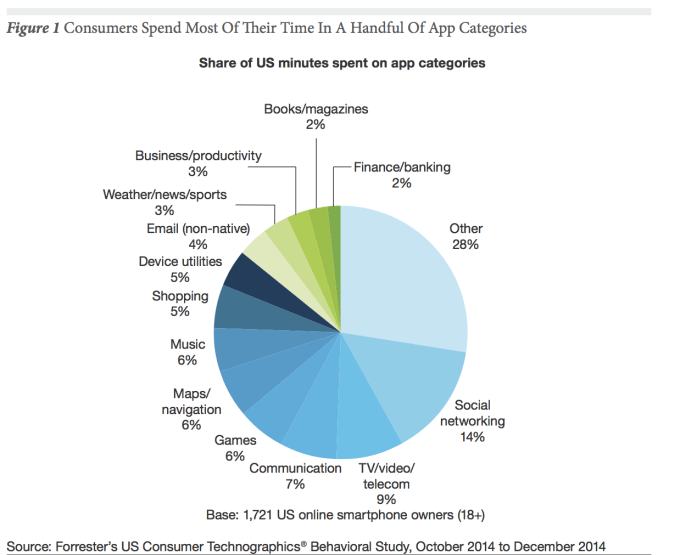
Consumers spend 85% of time on smartphones in apps, but only 5 apps see heavy use — from techcrunch.com by Sarah Perez — with a shout out to @visionmobile for the original heads-up on it; information per Forrester Research

Excerpts:


Screen Shot 2015-06-22 at 12.06.29 PM


Screen Shot 2015-06-22 at 12.06.13 PM


Also see:


AWS wants to put machine learning in reach of any developer — from techcrunch.com by Ron Miller

Excerpt:

Andy Jassy, senior vice president at Amazon Web Services, announced a new machine learning platform today at the AWS Summit in San Francisco.

The Amazon Machine Learning service is designed to give developers without machine learning background the tools to build smart, data-driven applications that can not only analyze what’s happening in real time or what happened in the past, but also predict what’s going to happen in the future (and that’s what’s most interesting here).


Also see this item back from 2/18/15:


Following up on yesterday’s posting, History Channel bringing online courses to higher ed, I wanted to thank Mr. Rob Kingyens, President at Qubed Education, for alerting me to some related work that Qubed Education is doing. Below is an example of that work:

The University of Southern California, Condé Nast and WIRED launch Master of Integrated Design, Business and Technology — from qubededucation.com
New Learning Model Combines Network and Access of WIRED with Academic Strength and Vision of the USC Roski School of Art and Design

Excerpt (emphasis DSC):

MARIN, Calif., October 1, 2014 – The University of Southern California, Condé Nast and WIRED today announced a partnership to create a new online Master’s degree in Integrated Design, Business and Technology. The partnership creates an unprecedented learning experience, combining the expertise of the editors, writers, and designers at WIRED with the academic rigor of USC, a leading research university known for its pioneering interdisciplinary programs. The aim of the 18-24 month degree is to educate creative thinkers and technologists to better equip them to transform the world of industry and enterprise. The first cohort is scheduled to begin in the 2015-2016 academic year.

…

“The pace of technology development requires higher education to continue to respond with programs that are flexible and adaptable, and that meet the needs of future cultural and business leaders,” said Dean Muhl.

“We’ve been thinking for years about what a university curriculum with WIRED would look like, and now we have a chance to build it with a terrific partner,” said Dadich. “Taking the best from USC and WIRED, we can teach discipline and disruption, business fundamentals, and the very latest innovation models from Silicon Valley. This is going to be thrilling.”

…

USC’s program development and build out will be powered by higher education partners Synergis Education and Qubed Education.


From Qubed’s website:

Qubed is the gateway for world-class, global brands to enter the education market with top tier universities.


From DSC:
I’ve long wondered if institutions of higher education will need to pool resources and/or form more partnerships and collaborations — either with other universities/colleges or with organizations outside of higher education. This reflection grows stronger for me when I:

  • Think that team-based content creation and delivery is pulling ahead of the pack
  • Hear about the financial situations of many institutions of higher education today (example1; example2)
  • See the momentum building up behind Competency Based Education (CBE)
  • Witness the growth of alternatives like Ideo Futures, Yieldr Academy, Lessons Go Where, ClassDo, Udemy, C-Suite TV.com and others
  • Hear about the potential advantages of learning analytics
  • See the pace of change accelerating — challenging higher education to keep up

For some institution(s) of higher education out there with deep pockets and a strong reputation, I could see them partnering up with an IBM (Watson), Google (Deepmind), Apple (Siri), Amazon (Echo), or Microsoft (Cortana) to create some next generation learning platforms. In fact, this is one of the areas I see occurring as lifelong learning/self-directed learning opportunities hit our living rooms. The underlying technologies these companies are working on could be powerful allies in the way people learn in the future — doing some heavy lifting to build the foundations in a variety of disciplines, and leaving the higher-order learning and the addressing of gaps to professors, teachers, trainers, and others.


Mobile Megatrends 2014…uncovering major mobile trends in 2014 — from visionmobile.com

Excerpt:

This report examines five major trends that we expect to shape the future of mobile in the coming years:

  1. Apps: The Tip of the Iceberg
  2. Mobile Ecosystems: Don’t Come Late to the Game
  3. OTT Squared: Messaging Apps are the new Platforms
  4. Handset Business Reboot: Hardware is the new Distribution
  5. The Future of HTML5: Beyond the Browser


From DSC:
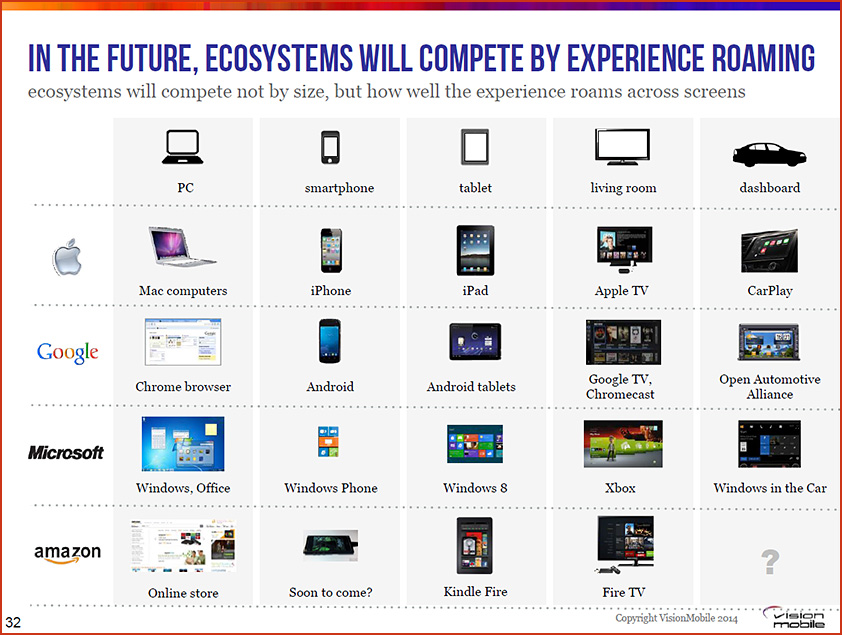
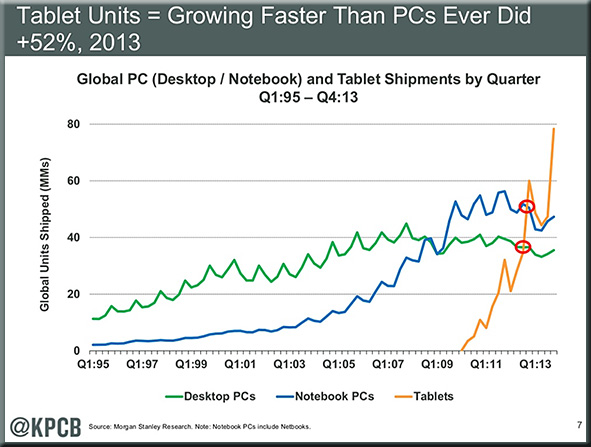
In looking at the below excerpted slide from this solid presentation, I have to ask…

“Does this same phenomenon also apply to educationally-related products/services?”

…

Yes, I think it does.

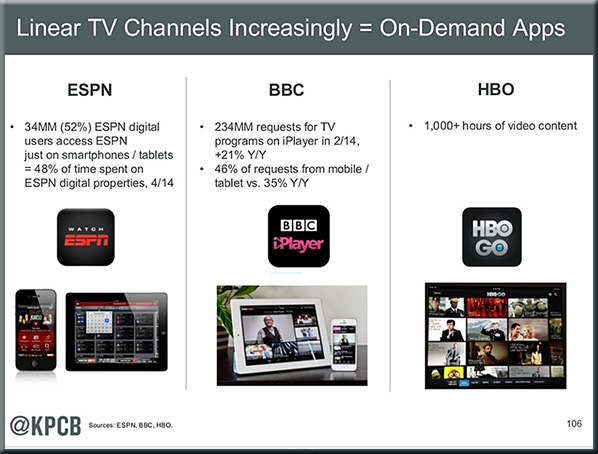
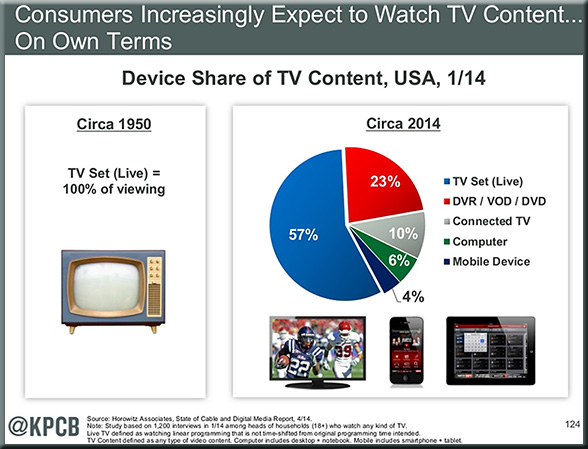
That is, the educationally-related products and services of an organization will compete not by size, but how well the experience roams across screens.  Lifelong learners (who are using well-designed learning experiences) will be able to tap into streams of content on multiple devices and never skip a beat.  The organizations who provide such solid learning experiences across multiple “channels” should do well in the future.  This is due to:

  • The affordances of cloud-based computing
  • The increasing power of mobile computing
  • The convergence of the television, the telephone, and the computer — which is opening up the door for powerful, interactive, multi-directional communications that involve smart/connected televisions
  • Generation Z’s extensive use of screens*


HowEcosystemsWillCompete-VisionMobile-June2014


The Living [Class] Room -- by Daniel Christian -- July 2012 -- a second device used in conjunction with a Smart/Connected TV


* From Here Comes Generation Z — bloombergview.com by Leonid Bershidsky

If Y-ers were the perfectly connected generation, Z-ers are overconnected. They multi-task across five screens: TV, phone, laptop, desktop and either a tablet or some handheld gaming device, spending 41 percent of their time outside of school with computers of some kind or another, compared to 22 percent 10 years ago.


Amazon’s Push in Education [Schaffhauser]

Amazon’s Push in Education — from CampusTechnology.com by Dian Schaffhauser
In this interview with Campus Technology, Amazon Web Services General Manager Steve Halliwell reveals two new AWS services that will have an impact on the education market, explains why long-term data storage is becoming a challenge for researchers and shares his thoughts about the importance of “democratizing” infrastructure for students to transform education.

  1. Workspaces
  2. Kinesis
 
© 2025 | Daniel Christian