‘It’s a mess and I’ve never seen anything like it’: global lost luggage crisis mounts — from theguardian.com by Mattha Busby

From DSC:
After seeing the above article, I wondered:

  • How might the future #AR glasses help with this situation?
  • Could such devices help the relevant employees automatically scan each bar code for where to route (or not) the luggage? (As I’m sure is already happening in many situations that occur away from what’s occurring on the tarmac.)

Will AR glasses be used for such training-related applications in the future?  For such logistical applications? Hmmm…time will tell.


I think we’ve run out of time to effectively practice law in the United States of America [Christian]


From DSC:
Given:

  • the accelerating pace of change that’s been occurring over the last decade or more
  • the current setup of the legal field within the U.S. — and who can practice law
  • the number of emerging technologies now on the landscapes out there

…I think we’ve run out of time to effectively practice law in the U.S. — at least in terms of dealing with emerging technologies. Consider the following items/reflections.


Inside one of the nation’s few hybrid J.D. programs — from highereddive.com by Natalie Schwartz
Shannon Gardner, Syracuse law school’s associate dean for online education, talks about the program’s inaugural graduates and how it has evolved.

Excerpt (emphasis DSC):

In May, Syracuse University’s law school graduated its first class of students earning a Juris Doctor degree through a hybrid program, called JDinteractive, or JDi. The 45 class members were part of almost 200 Syracuse students who received a J.D. this year, according to a university announcement.

The private nonprofit, located in upstate New York, won approval from the American Bar Association in 2018 to offer the three-year hybrid program.

The ABA strictly limits distance education, requiring a waiver for colleges that wish to offer more than one-third of their credits online. To date, the ABA has only approved distance education J.D. programs at about a dozen schools, including Syracuse.

Many folks realize this is the future of legal education — not that it will replace traditional programs. It is one route to pursue a legal education that is here to stay. I did not see it as pressure, and I think, by all accounts, we have definitely proven that it is and can be a success.

Shannon Gardner, associate dean for online education  


From DSC:
It was March 2018. I just started working as a Director of Instructional Services at a law school. I had been involved with online-based learning since 2001.

I was absolutely shocked at how far behind law schools were in terms of offering 100% online-based programs. I was dismayed to find out that 20+ years after such undergraduate programs were made available — and whose effectiveness had been proven time and again — that there were no 100%-online based Juris Doctor (JD) programs in the U.S. (The JD degree is what you have to have to practice law in the U.S. Some folks go on to take further courses after obtaining that degree — that’s when Masters of Law programs like LLM programs kick in.)

Why was this I asked? Much of the answer lies with the extremely tight control that is exercised by the American Bar Association (ABA). They essentially lay down the rules for how much of a law student’s training can be online (normally not more than a third of one’s credit hours, by the way).

Did I say it’s 2022? And let me say the name of that organization again — the American Bar Association (ABA).

Graphic by Daniel S. Christian

Not to scare you (too much), but this is the organization that is supposed to be in charge of developing lawyers who are already having to deal with issues and legal concerns arising from the following technologies:

  • Artificial Intelligence (AI) — Machine Learning (ML), Natural Language Processing (NLP), algorithms, bots, and the like
  • The Internet of Things (IoT) and/or the Internet of Everything (IoE)
  • Extended Reality (XR) — Augmented Reality (AR), Mixed Reality (MR), Virtual Reality (VR)
  • Holographic communications
  • Big data
  • High-end robotics
  • The Metaverse
  • Cryptocurrencies
  • NFTs
  • Web3
  • Blockchain
  • …and the like

I don’t think there’s enough time for the ABA — and then law schools — to reinvent themselves. We no longer have that luxury. (And most existing/practicing lawyers don’t have the time to get up the steep learning curves involved here — in addition to their current responsibilities.)

The other option is to use teams of specialists, That’s our best hope. If the use of what’s called nonlawyers* doesn’t increase greatly, the U.S. has little hope of dealing with legal matters that are already arising from such emerging technologies. 

So let’s hope the legal field catches up with the pace of change that’s been accelerating for years now. If not, we’re in trouble.

* Nonlawyers — not a very complimentary term…
I hope they come up with something else.
Some use the term Paralegals.
I’m sure there are other terms as well. 


From DSC:
There is hope though. As Gabe Teninbaum just posted the resource below (out on Twitter). I just think the lack of responsiveness from the ABA has caught up with us. We’ve run out of time for doing “business as usual.”

Law students want more distance education classes, according to ABA findings — from abajournal.com by Stephanie Francis Ward

Excerpt:

A recent survey of 1,394 students in their third year of law school found that 68.65% wanted the ability to earn more distance education credits than what their schools offered.


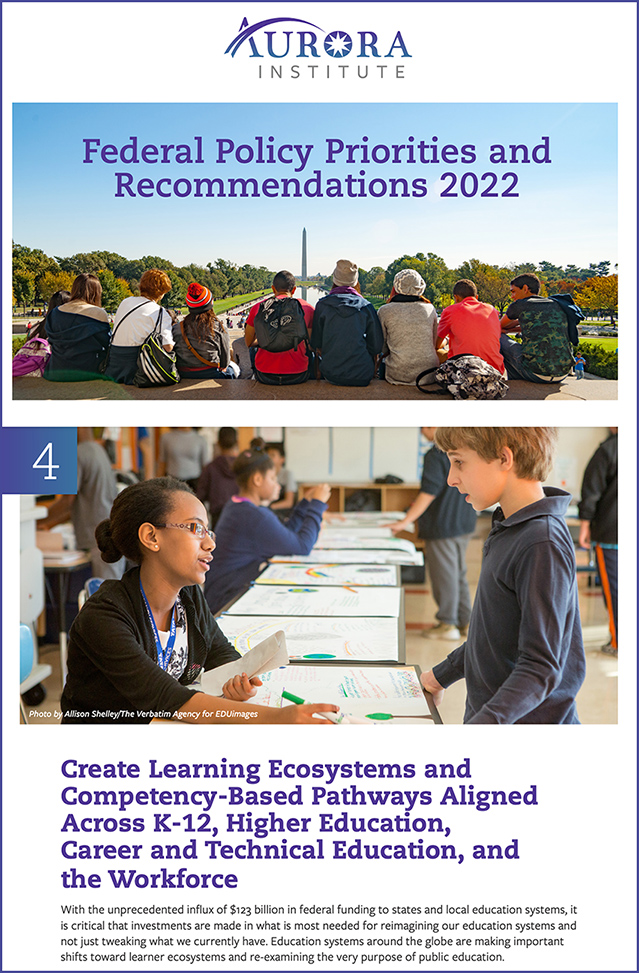
Aurora Institute: Federal Policy Priorities and Recommendations 2022 — from aurora-institute.org

Introduction:

It is critically important for our country to reimagine education and focus on investing in our future, not our past. The current K-12 education system has not produced equitable outcomes for all students. We must change policies and invest in innovation to transform our education systems. Student-centered policies are needed for true systems change and innovations for equity. We must challenge frames and investments that perpetuate tinkering with the existing system, rather than reimagining it. The time is ripe to redesign education to align with future needs and purposes to achieve human flourishing.

To ensure all learners are prepared for life’s uncertainties, as well as a more knowledge-driven workforce and economy, we must restructure the education system to universally recognize anytime, anywhere learning. Many states and districts have taken steps to move in new and improved directions, but more work must be done to meet students where they are and accelerate them to successful futures and prosperity. We must question the fundamental purposes of our education system, align our goals to that purpose, and expand learning to anytime and anyplace, with greater opportunities for next generation learning.

Aurora Institute’s latest Federal Policy Priorities represent an equity-oriented and future-focused set of recommendations designed to ensure that the nation’s education system moves from its current state to a system capable of preparing all learners with the knowledge and skills necessary to achieve lifelong success.


From DSC:
I post this because I like the design thinking exhibited herein. I love the idea of greater collaboration between K-12, higher education, vocational training, and the workforce/workplace. We should consider eliminating — or at least building much better bridges between the — existing silos. These silos seem to be easier to put up than they are to take down.


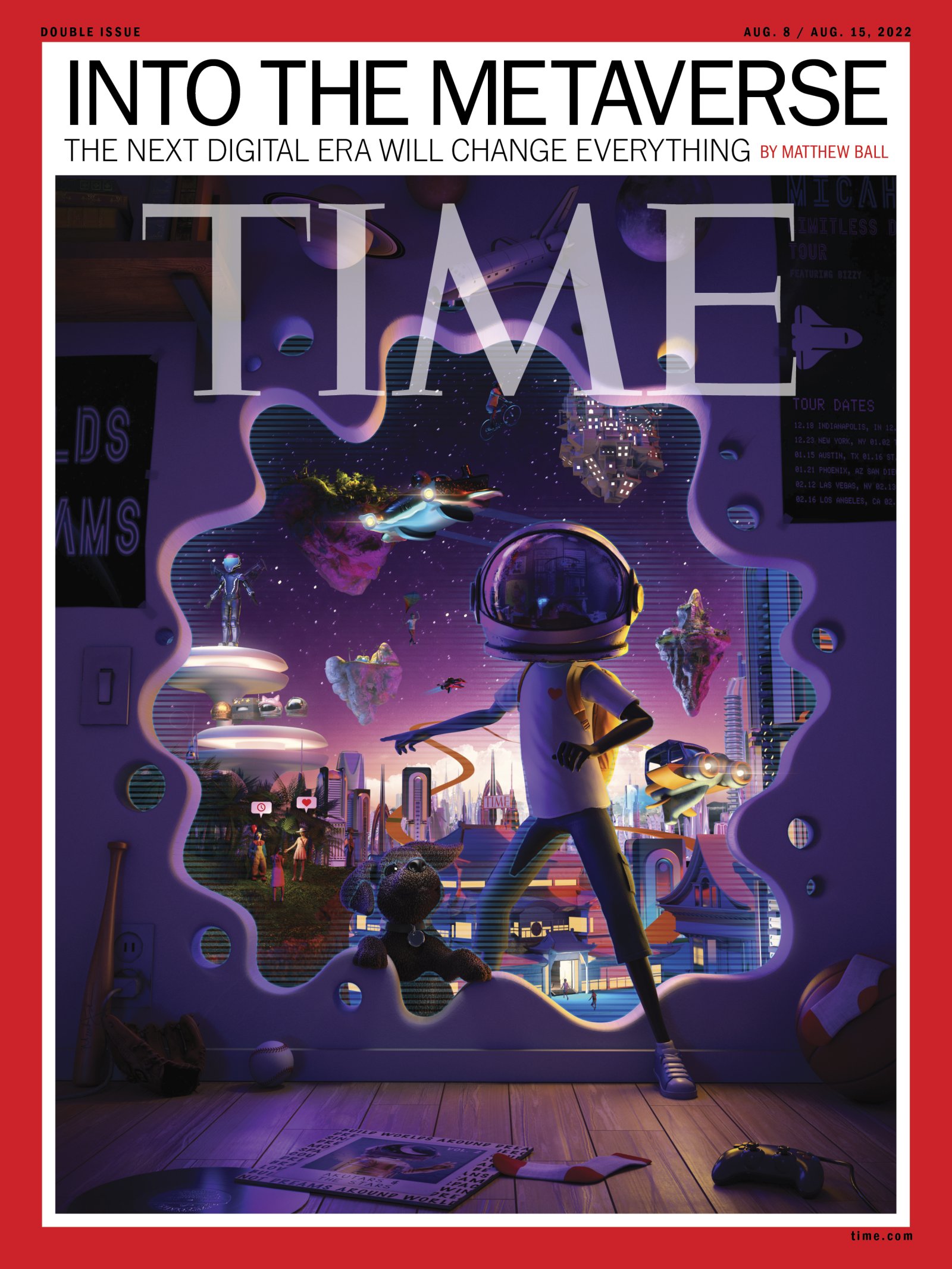
The Metaverse Will Reshape Our Lives. Let’s Make Sure It’s for the Better. — from time.com by Matthew Ball

Excerpts (emphasis DSC):

The metaverse, a 30-year-old term but nearly century-old idea, is forming around us. Every few decades, a platform shift occurs—such as that from mainframes to PCs and the internet, or the subsequent evolution to mobile and cloud computing. Once a new era has taken shape, it’s incredibly difficult to alter who leads it and how. But between eras, those very things usually do change. If we hope to build a better future, then we must be as aggressive about shaping it as are those who are investing to build it.

The next evolution to this trend seems likely to be a persistent and “living” virtual world that is not a window into our life (such as Instagram) nor a place where we communicate it (such as Gmail) but one in which we also exist—and in 3D (hence the focus on immersive VR headsets and avatars).


Ways that artificial intelligence is revolutionizing education — from thetechedvocate.org by Matthew Lynch

Excerpt:

I was speaking with an aging schoolteacher who believes that AI is destroying education. They challenged me to come up with 26 ways that artificial intelligence (AI) is improving education, and instead, I came up with. They’re right here.


AI Startup Speeds Healthcare Innovations To Save Lives — from by Geri Stengel

Excerpt:

This project was a light-bulb moment for her. The financial industry had Bloomberg to analyze content and data to help investors uncover opportunities and minimize risk, and pharmaceutical, biotech, and medical device companies needed something similar.


Trends in State Courts — from ncsc.org

Excerpt:

Trends in State Courts is an annual, peer-reviewed publication that highlights innovative practices in critical areas that are of interest to courts, and often serves as a guide for developing new initiatives and programs and informing and supporting policy decisions. Trends in State Courts is the only publication of its kind and enjoys a wide circulation among the state court community.

Trends in State Courts 2022
External events continue to drive change and innovation in the courts. The 2022 edition of Trends in State Courts highlights post-pandemic eviction courts and eliminating racism and bias in the courts.


Also from ncsc.org:

The key role of non-lawyer practitioners — by Dimarie Alicea-Lozada

Excerpt:

Over the last 20 years, a variety of different states have developed efforts to try to provide for non-lawyer practitioners with varying degrees of success. The intention was simple: provide affordable legal services to those who cannot afford an attorney but need help. With 1 out of 10 people in the United States involved in newly filed cases each year and 3 out of 5 in civil cases not having a lawyer, state courts have been trying to help people who otherwise will not be able to afford access legal representation. Since the COVID-19 pandemic, several states have made changes in this area.


New: Futurist Friday Podcast Interview with Gerd Leonhard: TheGoodFuture? — from futuristgerd.com by Gerd Leonhard

Excerpt:

Over the course of the summer of 2022, DonMacPherson and 12 Geniuses are releasing 12 interviews with futurists and forward thinkers in order to help their global audience of leaders become better visionaries for their organizations and be more prepared for the uncertain future.

In this episode, Gerd Leonhard joins the show. First, he points out that “the future is already here, we just haven’t paid enough attention to it.” He talks about how technology is promising to make us superhuman, that we are in the biggest shift era in recent history as far as energy and climate is concerned, and that machines and artificial intelligence are starting to emulate humanity.


Forget long screen recordings. These tools automate your company’s how-tos. — from protocol.com by Lizzy Lawrence
Scribe and Tango take screen recordings and automatically turn them into step-by-step lists.

Excerpt (emphasis DSC):

If only there were a better way of transferring this knowledge, Smith thought at the time. Later, she worked in venture capital and kept hearing the same thing: How do we efficiently spread the company wisdom that’s trapped inside people’s heads? Without the thick binder or the 45-minute screen recording? Thus began Scribe.

To use Scribe, you record your screen as you go through a standard workplace process. When you finish recording, Scribe automatically generates a step-by-step written guide with screenshots that you can edit and share with whomever you want. It’s a browser extension and a desktop app, meant to be as easy as possible for both the sender and recipient of information.


Matthew Ball on the metaverse: We’ve never seen a shift this enormous — protocol.com by Janko Roettgers
The leading metaverse theorist shares his thoughts on the sudden rise of the concept, its utility for the enterprise and what we still get wrong about the metaverse.

Excerpts:

What are the biggest misconceptions about the metaverse?
First, the idea that the metaverse is immersive virtual reality, such as an Oculus or Meta Quest. That’s an access device. It would be akin to saying the mobile internet is a smartphone.

We should think of the metaverse as perhaps changing the devices we use, the experiences, business models, protocols and behaviors that we enjoy online. But we’ll keep using smartphones, keyboards. We don’t need to do all video conferences or all calls in 3D. It’s supplements and complements, doesn’t replace everything.

Also relevant/see:

A former Amazon exec thinks Disney will win the metaverse — from protocol.com by

Excerpt:

This month, Ball is publishing his book, “The Metaverse: And How It Will Revolutionize Everything.” The work explains in detail what the metaverse is all about and which shifts in tech, business and culture need to fall into place for it to come into existence.

How will the metaverse change Hollywood? In his book, Ball argues that people tend to underestimate the changes new technologies will have on media and entertainment.

  • Instead of just seeing a movie play out in 360 degrees around us, we’ll want to be part of the movie and play a more active role.
  • One way to achieve that is through games, which have long blurred the lines between storytelling and interactivity. But Ball also predicts there will be a wide range of adjacent content experiences, from virtual Tinder dates in the “Star Wars” universe to Peloton rides through your favorite movie sets.

Addendum on 7/24/22:

Neurodiversity, Inclusion And The Metaverse — from workdesign.com by Derek McCallum

Excerpt:

Innovation in virtual and augmented reality platforms and the vast opportunities connected to the metaverse are driving innovation in nearly every industry. In the workplace, future-focused companies are increasingly exploring ways to use this nascent technology to offer workers more choices and better support for neurodiverse employees.

It would be nearly impossible to list all the challenges and opportunities associated with this technology in a single article, so I’ll keep things focused on an area that is top-of-mind right now as many of us start to make our way back into the office—the workplace. The truth is, while we can use our expertise and experience to anticipate outcomes, no one truly knows what the metaverse will become and what the wide-ranging effects will be. At the moment, the possibilities are exciting and bring to mind more questions than answers. As a principal and hands-on designer in a large, diverse practice, my hope is that we will be able to collectively harness the inherent opportunities of the metaverse to support richer, more accessible human experiences across all aspects of the built environment, and that includes the workplace.


Just Because You Can Doesn’t Mean You Should: What Genetic Engineers Can Learn From ‘Jurassic World’ — from singularityhub.com by Andrew Maynard

Excerpt:

Maybe this is the abiding message of Jurassic World: Dominion—that despite incredible advances in genetic design and engineering, things can and will go wrong if we don’t embrace the development and use of the technology in socially responsible ways.

The good news is that we still have time to close the gap between “could” and “should” in how scientists redesign and reengineer genetic code. But as Jurassic World: Dominion reminds moviegoers, the future is often closer than it might appear.


‘Hologram patients’ and mixed reality headsets help train UK medical students in world first — from uk.news.yahoo.com

Excerpts:

Medical students in Cambridge, England are experiencing a new way of “hands-on learning” – featuring the use of holographic patients.

Through a mixed reality training system called HoloScenarios, students at Addenbrooke’s Hospital, part of the Cambridge University Hospitals NHS Foundation Trust, are now being trained via immersive holographic patient scenarios in a world first.

The new technology is aimed at providing a more affordable alternative to traditional immersive medical simulation training involving patient actors, which can demand a lot of resources.

Developers also hope the technology will help improve access to medical training worldwide.


Top Content Providers For Immersive Learning (2022) — from elearningindustry.com by Christopher Pappas

Summary: 

Immersive learning experiences allow learners to interact by simulating real-life scenarios. Are you ready to offer engaging virtual environments and experiences to your workforce? Dive right into this thoroughly curated top list featuring the best content providers for VR training and bring your teams one step closer to the Metaverse.


After an AI bot wrote a scientific paper on itself, the researcher behind the experiment says she hopes she didn’t open a ‘Pandora’s box’ — from insider.com by Hannah Getahun

Excerpt:

  • An artificial-intelligence algorithm called GPT-3 wrote an academic thesis on itself in two hours.
  • The researcher who directed the AI to write the paper submitted it to a journal with the bot’s consent.
  • “We just hope we didn’t open a Pandora’s box,” the researcher wrote in Scientific American.

AI Empowers Scalable Personalized Learning and Knowledge Sharing — from learningsolutionsmag.com by Markus Bernhardt

Excerpt:

AI aids in providing true personalization
Automation through AI is providing us with the tools necessary to deploy fully personalized digital learning, extremely fast and at scale. With the advent of this technology, we will see a revolution in digital training; in addition, I predict that the impact the digital piece will have on human-led efforts will lead to a further revolution of education, training, workshops, mentoring, and coaching.

How A.I. Could Help You Design Your Perfect Office (or Store) — from inc.com by Ben Sherry
Artificial intelligence may soon help fill the gap between your interior design skills and your imagination.

Excerpt:

Boom Interactive is one of several companies attempting to streamline the interior design process using automation. The Salt Lake City-based startup’s free app, Bubbles, which is scheduled to soft launch in the third quarter of 2022, uses artificial intelligence to read floor plans and create a “digital twin” of your real-life space, according to CEO and founder Timber Barker. Once a “twin” has been created, users have full freedom to customize the space by adding doors, erasing walls, and placing furniture.

The Increasing Role of Artificial Intelligence in Our Lives — from rdene915.com by Rachelle Dene Poth

Excerpt:

All of this recent information has made me even more curious about the role artificial intelligence will play over the next few months as we hopefully get back to more of a normal life experience and can engage in work and learning but also in leisure activities. What can we learn from the recent uptick in AI information and how can it help us in the future?

Optical illusions could help us build the next generation of AI — from digitaltrends.com by Luke Dormehl


How Alternative Credentials Can Help You Find Employees — from shrm.org by Kathryn Tyler
Focus on skills, not degrees, to increase your talent pool.

Excerpts:

“Alternative credentials,” such as the ones Brown attained, are increasingly available in the form of micro-credentials, digital badges and industry-recognized certificates. They’re less expensive than a college degree and designed to help prepare workers for better jobs.

IBM is ahead of the game in many respects. Six years ago, the tech giant began revising its job descriptions to focus on skills and not just educational attainment. On average, 50 percent of the company’s posted positions in the U.S. don’t require a bachelor’s degree.

“We call these ‘new-collar jobs,’ and they’re aligned to careers that require the right set of skills and a commitment to lifelong learning,” says Tommy Wenzlau, talent leader for new-collar initiatives at IBM, which employs more than 250,000 workers globally. “New-collar roles are in some of technology’s fastest-growing fields, including data science, cloud computing, application development, cybersecurity and digital design.”


Inside a radical new project to democratize AI — from technologyreview.com by Melissa Heikkilä
A group of over 1,000 AI researchers has created a multilingual large language model bigger than GPT-3—and they’re giving it out for free.

Excerpt:

PARIS — This is as close as you can get to a rock concert in AI research. Inside the supercomputing center of the French National Center for Scientific Research, on the outskirts of Paris, rows and rows of what look like black fridges hum at a deafening 100 decibels.

They form part of a supercomputer that has spent 117 days gestating a new large language model (LLM) called BLOOM that its creators hope represents a radical departure from the way AI is usually developed.

Unlike other, more famous large language models such as OpenAI’s GPT-3 and Google’s LaMDA, BLOOM (which stands for BigScience Large Open-science Open-access Multilingual Language Model) is designed to be as transparent as possible, with researchers sharing details about the data it was trained on, the challenges in its development, and the way they evaluated its performance. OpenAI and Google have not shared their code or made their models available to the public, and external researchers have very little understanding of how these models are trained.

Another item re: AI:

Not my job: AI researchers building surveillance tech and deepfakes resist ethical concerns — from protocol.com by Kate Kaye
The computer vision research community is behind on AI ethics, but it’s not just a research problem. Practitioners say the ethics disconnect persists as young computer vision scientists make their way into the ranks of corporate AI.

For the first time, the Computer Vision and Pattern Recognition Conference — a global event that attracted companies including Amazon, Google, Microsoft and Tesla to recruit new AI talent this year — “strongly encouraged”researchers whose papers were accepted to the conference to include a discussion about potential negative societal impacts of their research in their submission forms.

 
© 2025 | Daniel Christian