From DSC:
Below are some reflections based on an article entitled, Understanding learning transfer through Archwell Academies. It’s from chieflearningofficer.com and was written by Erin Donovan and Keith Keating.

Excerpt:

To capitalize on learning transfer and extend learning beyond traditional training periods, practitioners have established capability academies. According to Josh Bersin, capability academies are the evolution of traditional training and self-directed learning. Bersin posited:

Capability academies are business-driven, collaborative learning environments that facilitate learning retention. . . . Going beyond rote lessons, capability academies help companies prepare for transformation by helping employees develop complex skills and providing guidance on how to apply them in the context of the business.

The core concept of capability academies rests on the importance of collaboration between the trainers and the business. The intention is to provide learners with practice of conceptual understanding and comparative scenarios in the context and environment where they will ultimately apply their skills. Capability academies focus on providing training distinctly aligning with learners’ job responsibilities.

From DSC:
First of all, I have a lot of respect for the people that this article mentions, such as Josh Bersin and Will Thalheimer. So this article caught me eye.

It seems to me that the corporate world is asking for institutions of traditional higher education to deliver such “capability academies.” But that makes me wonder, could this even be done? Surely there aren’t enough resources to develop/deliver/maintain so many environments and contexts, right? It took Archwell, a global mortgage services outsourcing provider, an entire year to systematically design and develop such customized capability academies — just for their clients’ businesses. 

The article goes on:

The core concept of capability academies rests on the importance of collaboration between the trainers and the business. The intention is to provide learners with practice of conceptual understanding and comparative scenarios in the context and environment where they will ultimately apply their skills. Capability academies focus on providing training distinctly aligning with learners’ job responsibilities.

Context. Skills. Acquiring knowledge. Being able to apply that knowledge in a particular environment. Wow…that’s a lot to ask institutions of traditional higher education to deliver. And given the current setup, it’s simply not going to happen. Faculty members’ plates are already jammed-packed. They don’t have time to go out and collaborate with each business in their area (even with more sabbaticals…I don’t see it happening).

I’m sure many at community colleges could chime in here and would likely say that that’s exactly what they are doing. But I highly doubt that they are constantly delivering this type of customized offering for all of the businesses in each major city in their area.

I can hear those in corporate training programs saying that that’s what they are doing for their own business. But they don’t provide it for other businesses in their area.

So, what would it take for higher education to develop/offer such “capability academies?” Is it even possible?

We continue to struggle to design the ultimate learning ecosystem(s) — one(s) whereby we can provide personalized learning experiences for each person and business. We need to continue to practice design thinking here, as we seek to provide valuable, relevant/up-to-date, and cradle-to-grave learning experiences.

The problem is, the pace of change has changed. Institutions of traditional higher education can’t keep up. And frankly, neither can most businesses out there.

I keep wondering if a next-generation learning platform — backed up by AI but delivered with human expertise — will play a role in the future. The platform would offer products and services from teams of individuals — and/or from communities of practices — who can provide customized, up-to-date training materials and the learning transfers that this article discusses.

But such a platform would have to offer socially-based learning experiences and opportunities for accountability. Specific learning goals and learning cohorts help keep one on track and moving forward.
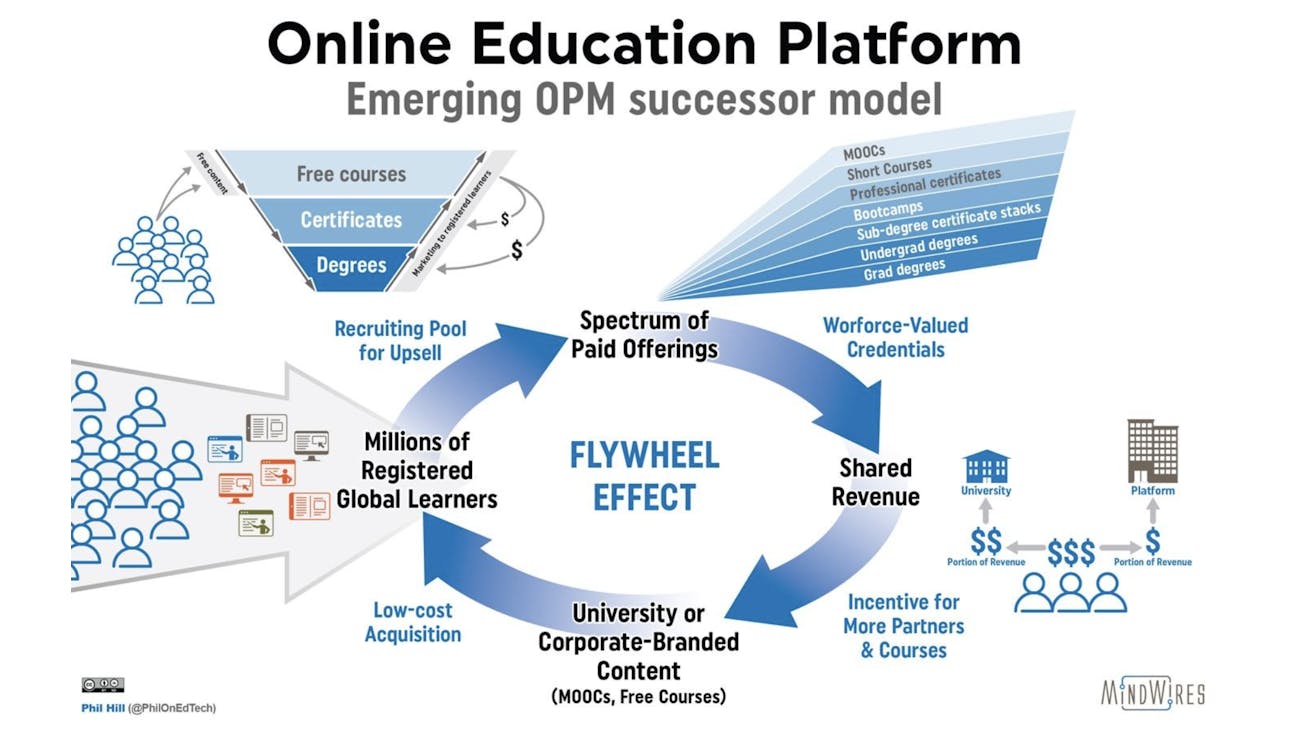

 

What a New Strategy at 2U Means for the Future of Online Higher Education — from edsurge.com by Phil Hill

Excerpt:

The acceleration is that 2U is going all in on the education platform strategy that started with the company’s acquisition of edX last year. The idea at the time was to rely on a flywheel effect, where edX can upsell to its tens of millions of registered learners taking free or low-cost online courses known as MOOCs, thus driving down the marketing costs required for the OPM business, while offering a spectrum of options—from free MOOCs to stackable certificates, to bootcamps and short courses, all the way to full degrees. The flywheel aspect is that the more the strategy succeeds, the more revenue is made by institutional partners and by the company, leading to more free courses and registered learners. It’s a self-reinforcing strategy that is the same one followed by Coursera.
.


Dive Into AI, Avatars and the Metaverse With NVIDIA at SIGGRAPH — from blogs.nvidia.com

Excerpt:

Innovative technologies in AI, virtual worlds and digital humans are shaping the future of design and content creation across every industry. Experience the latest advances from NVIDIA in all these areas at SIGGRAPH, the world’s largest gathering of computer graphics experts, [which ran from Aug. 8-11].

At SIGGRAPH, NVIDIA CEO Jensen Huang Illuminates Three Forces Sparking Graphics Revolution — from blogs.nvidia.com by Rick Merritt
NVIDIA unveils new products and research to transform industries with AI, the metaverse and digital humans.

NVIDIA AI Makes Performance Capture Possible With Any Camera — from blogs.nvidia.com by Isha Salian
Derivative, Notch, Pixotope and others use NVIDIA Vid2Vid Cameo and 3D body-pose estimation tools to drive performances in real time.

How to Start a Career in AI — from blogs.nvidia.com by Brian Caulfield
Four most important steps to starting a career in AI, seven big questions answered.

As Far as the AI Can See: ILM Uses Omniverse DeepSearch to Create the Perfect Sky — from blogs.nvidia.com by Richard Kerris
Omniverse AI-enabled search tool lets legendary studio sift through massive database of 3D scenes.

Future of Creativity on Display ‘In the NVIDIA Studio’ During SIGGRAPH Special Address — from blogs.nvidia.com by Gerardo Degaldo
Major NVIDIA Omniverse updates power 3D virtual worlds, digital twins and avatars, reliably boosted by August NVIDIA Studio Driver; #MadeInMachinima contest winner revealed.

What Is Direct and Indirect Lighting? — from blogs.nvidia.com by JJ Kim
In computer graphics, the right balance between direct and indirect lighting elevates the photorealism of a scene.

NVIDIA Studio Laptops Offer Students AI, Creative Capabilities That Are Best in… Class — from blogs.nvidia.com by Gerardo Degaldo
Designed for creativity and speed, Studio laptops are the ultimate creative tool for aspiring 3D artists, video editors, designers and photographers.

Design in the Age of Digital Twins: A Conversation With Graphics Pioneer Donald Greenberg — from blogs.nvidia.com by Rick Merritt
From his Cornell office, home to a career of 54 years and counting, he shares with SIGGRAPH attendees his latest works in progress.


Nvidia launches new metaverse efforts at SIGGRAPH — from inside.com

Excerpt:

There is an increasing overlap between computer graphics, the metaverse and AI and that overlap is exactly what is on display this week at the SIGGRAPH 2022 conference, where Nvidia is revealing its latest set of software innovations for computer graphics.

[On 8/11/22] at the conference, Nvidia announced a series of technology innovations that bring the metaverse and AI closer together than ever before. Among the announcements is the Nvidia Omniverse Avatar Cloud Engine, which is a set of tools and services designed to create AI-powered virtual assistants.

Also relevant/see:

Nvidia Sees a Metaverse Populated With Lifelike Chatbot Avatars
— from cnet.com by Stephen Shankland

Excerpt:

What’s happening
Nvidia announced technology to let metaverse developers create lifelike avatars that can give an animated human face to the computers that people will interact with online.

Why it matters
The metaverse needs new computing tools if it’s to live up to its potential of new 3D realms for working, learning, socializing and goofing off, and Nvidia’s technology could also eventually give humans a new look online, not just bots.


Augmented Books Are On The Way According To Researchers — from vrscout.com by Kyle Melnick

Excerpt:

Imagine this. You’re several chapters into a captivating novel when a character from an earlier book makes a surprise appearance. You swipe your finger across their name on the page at which point their entire backstory is displayed on a nearby smartphone, allowing you to refresh your memory before moving forward.

This may sound like science fiction, but researchers at the University of Surrey in England say that the technology described above is already here in the form of “a-books” (augmented reality books).

The potential use-cases for such a technology are virtually endless. As previously mentioned, a-books could be used to deliver character details and plot points for a variety of fictional works. The same technology could also be applied to textbooks, allowing students to display helpful information on their smartphones, tablets, and smart TVs with the swipe of a finger.

From DSC:

  • How might instructional designers use this capability?
  • How about those in theatre/drama?
  • Educational gaming?
  • Digital storytelling?
  • Interaction design?
  • Interface design?
  • User experience design?

Also see:


Radar Trends to Watch: August 2022 — from oreilly.com by Mike Loukides
Developments in Security, Quantum Computing, Energy, and More

Excerpt:

The large model train keeps rolling on. This month, we’ve seen the release of Bloom, an open, large language model developed by the BigScience collaboration, the first public access to DALL-E (along with a guide to prompt engineering), a Copilot-like model for generating regular expressions from English-language prompts, and Simon Willison’s experiments using GPT-3 to explain JavaScript code.

On other fronts, NIST has released the first proposed standard for post-quantum cryptography (i.e., cryptography that can’t be broken by quantum computers). CRISPR has been used in human trials to re-engineer a patient’s DNA to reduce cholesterol. And a surprising number of cities are paying high tech remote workers to move there.


The Metaverse Is Not a Place — from oreilly.com by Tim O’Reilly
It’s a communications medium.

Excerpt:

Foundations of the metaverse
You can continue this exercise by thinking about the metaverse as the combination of multiple technology trend vectors progressing at different speeds and coming from different directions, and pushing the overall vector forward (or backward) accordingly. No new technology is the product of a single vector.

So rather than settling on just “the metaverse is a communications medium,” think about the various technology vectors besides real-time communications that are coming together in the current moment. What news from the future might we be looking for?

  • Virtual Reality/Augmented Reality
  • Social media
  • Gaming
  • AI
  • Cryptocurrencies and “Web3”
  • Identity

#metaverse #AI #communications #gaming #socialmedia #cryptocurrencies #Web3 #identity #bots #XR #VR #emergingtechnologies


Women in Tech: A Complete Guide — from techguide.org by Vasilia Niles

Excerpt:

This guide is all about how to get more women in tech. First, we will examine why the gender gap in tech fields exists and what we can do about it. And then, we will take a look at the best way to find opportunities for women interested in science, technology, and engineering — including scholarships, internships, and employment opportunities all geared toward the most cutting edge fields.

Closing the gap in tech is important for many reasons. Firstly, women make up 40 percent of the US workforce. With the tech industry being the fastest growing sector and others rapidly shrinking, there will be a disparity between supply and demand for employees if this continues. This is already the case in some tech sectors like cybersecurity.

Secondly, women-led companies and companies with more female employees historically outperform by 3x ones that are male dominant. In fact, in companies where 50 percent or more of executives are women, there are reported higher job satisfaction, better work culture, equal and higher pay, and less female employee turnover. 


Online Learning, From the Margins to the Center — from insidehighered.com by Ray Schroeder
Online learning has evolved over the past 25 years from a niche position on the margins of higher ed to the leading driver of growth in enrollment and innovation.

Excerpt:

Online learning has grown from a marginal niche of higher ed to the largest provider of postsecondary learning in the world. We are now on the cusp of yet another technological evolution in the delivery of online learning. The advent of the metaverse in higher education is closer than many casual observers may think. By 2025, we will begin to see significant numbers of offerings using avatars and immersive technologies such as virtual reality, augmented reality and extended reality engaging learners at a distance.

Do you have developmental immersion laboratories for your faculty and staff to prepare for 2025? Who at your university is advocating for the integration of VR, AR and XR into online delivery? Are you already collaborating with industry and business in developing the most effective and relevant technology-enhanced online programs that will meet their needs? Those who lead in these ventures will set the standards and gain the recruiting advantage in higher education.


The workforce is changing. Can community colleges change with it? — from workshift.opencampusmedia.org by Bylilah Burke; with thanks to Dr. Paul Czarapata for this resource
Advocates and researchers in education are asking if two-year institutions might transform to reach a fuller potential—serving as community hubs for social and economic mobility.

Excerpt:

Increasingly, they’re also the place students like Plunkett turn to when they find themselves at a dead end in their career and need to retool. And advocates and researchers in education are asking if these institutions might transform to reach a fuller potential—serving as community hubs for social and economic mobility.

That’s certainly the future envisioned by groups like Achieving the Dream, a leader in the student success movement. Karen Stout, president and CEO of the organization, has said that means colleges must take a more active role in bringing career-aligned education and reskilling opportunities—whether their own programs or those developed by industry—to the community.

“In the past, community colleges were lifelong-learning institutions,” Stout told Work Shift earlier this year. “Now we must become lifelong career-matching institutions—a source of upskilling, a rational pathway to career development that weaves together opportunities for students to move in and out of work and school that is designed to progressively lead to a career in a particular field.”

It’s a tall order, as the American workforce from Alabama to Wyoming is set to change drastically over the next few decades. Can community colleges rise to the occasion? Some already are. 

Also from workshift.opencampusmedia.org, see:


It’s Time to Rethink the ‘One Teacher, One Classroom’ Model — from edweek.org by Irene Chen & Stephanie Banchero
How to build a happier and more effective teaching force

Excerpt:

Let’s address this crisis by reenvisioning the traditional school staffing model, which has not changed in generations. We need innovative, differentiated staffing that creatively utilizes educators and plays to their strengths. This means schools must deploy adults to work collaboratively in response to the needs of individual students, rather than asking one teacher to meet the needs of all students in one classroom. This approach can address children’s specific skills gaps, while also diversifying the workforce, retaining the most effective teachers, and extending great teaching.


15 technical skills employers look for in 2022 — from wikijob.co.uk by Nikki Dale

Excerpts:

A technical skill is the ability to carry out a task associated with technical roles such as IT, engineering, mechanics, science or finance. A typical technical skill set might include programming, the analysis of complex figures or the use of specific tools.

Technical skills are sometimes referred to as ‘hard skills’ because you can learn how to do them and, in some cases, get qualified or at least certified.

Some technical skills employers are looking for include:


How will the Metaverse Influence Business and Legal Processes? — from jdsupra.com

Excerpt:

While some will be hesitant to use the metaverse and adoption is difficult to predict, it is not going away and will undoubtedly affect internal processes, business dealings, case strategy, and more. Organizations should start thinking about the possibilities now to be better prepared for future challenges. Below are some predictions on how the metaverse will influence operations, strategy, and investments across different areas of the enterprise.

Lawyers & the Metaverse — from joetechnologist.com by Elizabeth Beattie and Joseph Raczynski

Excerpt:

In a new Q&A interview, Thomson Reuters’ technologist and futurist Joseph Raczynski offers his insight about the Metaverse and how it will impact the legal industry.

I have likely spoken to thousands of lawyers over the last several years. They are extraordinarily bright, but with one limiting factor — their dedication to their craft. This means that they do not have the time to lift their heads to see what is coming. All these emerging technologies will impact their practices in some way, as well as the business of law. At a minimum, lawyers need the opportunity to focus on the big four: AI, blockchain, workflow, and the grab bag of general emerging technology. There are a multitude of places to learn about these things, but I would include some of the classics such as Google Alerts, Twitter threads on these topics, and magazines like Wired, which should be a staple for everyone.

These legal issues should be on college business officers’ radars — from highereddive.com by Rick Seltzer
A panel at the National Association of College and University Business Officers’ annual meeting covered legal questions spanning many offices on campus.

Let’s not presume that virtual hearings are the best solution in family law — from canadianlawyermag.com by John Silvester

Excerpts:

Proponents argue that virtual hearings are less expensive for clients, leading to enhanced access to justice for those who cannot afford to pay for their lawyers to travel to a courthouse and then sit and wait for hearings to commence. Sounds reasonable, right?

Not so fast.

Virtual hearings are advantageous in some scenarios, but there are at least three reasons why moving to an almost entirely virtual legal world may prove problematic.

LawNext Podcast: CALI Executive Director John Mayer on Using Tech to Advance Legal Education and Access to Justice — from lawnext.com by Bob Ambrogi and John Mayer

Excerpt:

In this episode of LawNext, Mayer joins host Bob Ambrogi to discuss the history and mission of CALI and to share his thoughts on the use of technology to enhance legal education. They also talk about how and why A2J Author was developed and how it is used by courts and legal services organizations to help those who are without legal representation. Mayer also shares his thoughts on the future of innovation in law and on the future of CALI.

Louisiana Approves Virtual Custody Services and Proposes Virtual Currency Business Licensing Rules — from natlawreview.com by Moorari Shah and A.J. S. Dhaliwal

Excerpt:

Recently, the Louisiana lawmakers and regulators have taken steps to legalize operations in the state involving virtual currencies. On June 15, the Louisiana governor signed a bill that, effective August 1, 2022, will allow financial institutions and trust companies to provide virtual currency custody services to their customers as long as they satisfy certain requirements on risk-management and compliance. On June 20, the Louisiana Office of Financial Institutions (OFI) published proposed rules on licensing and regulation of virtual currency businesses in the state pursuant to the Louisiana Virtual Currency Business Act, which went into effect on August 1, 2020.


The Future of Futures —  from maried.substack.com by Marie Dollé; with thanks to Robert Ferraro this resource
Anticipating tomorrow, demystifying the hype, making the ambient chaos a little more intelligible… Faced with a world in crisis, the futures industry is experiencing a ‘big bang’!

Excerpt:

As Matt Klein, trend lead at Reddit and author of the Zine newsletter, very wisely explains, “Overwhelmed with data and headlines, we have more opportunities to connect the dots and identify trends. But without a framework or ability to actually differentiate worthy signal versus noise, we become conspirators cooking up meaningless and ephemeral things (…) It’s not enough to just paint a picture of the zeitgeist. Analysts, consultants and service providers need to help their clients decode a trend’s drivers, opportunities and threats, and then strategize.” A view shared by David Mattin: according to the trend expert and former Trendwatching consulting director, the pandemic has accelerated the growing awareness within many organizations of the need for some form of structured thinking around the future. “There is a necessary shift away from tactical trends and toward strategic thinking and transformation of organizations and systems. There is also a need for new and more rigorous ways to combine quantitative and qualitative data with future thinking,” he says.

 
© 2025 | Daniel Christian