


“Learning ecosystems begin with people.” — Getting Smart
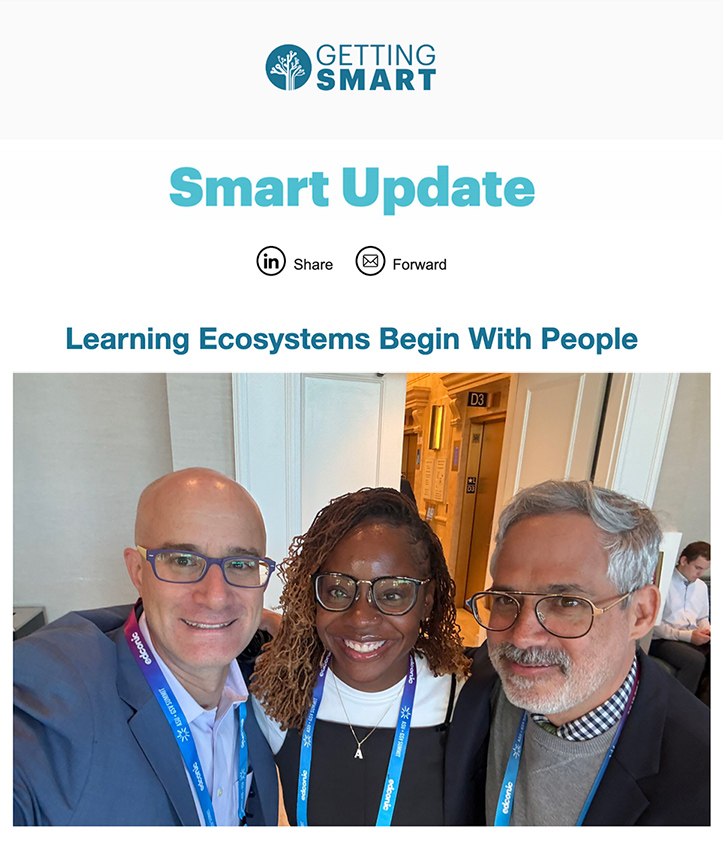
ASU/GSV Summit
There’s something about walking into a space like the ASU+GSV Summit that feels a little like stepping into a living, breathing idea. You hear fragments of possibility in passing conversations, see it in the way people lean in a little closer during sessions, feel it in the quiet moments when something lands and you know it’s going to stay with you. This year, what lingered wasn’t just the talk of innovation; it was a deeper pull toward something more human. A reminder that before we build better systems, we have to create better conditions for dreaming. And there’s a kind of quiet joy that emerges when educators find each other in that work, when ideas connect, and you can feel the bridges across networks and ecosystems getting stronger in real time.
And dreaming is not a given. It requires space, safety, and adults who understand the weight of what they’re holding. The most powerful moments weren’t about what we can do for learners, but how we show up with them. Adults who are still learning, still stretching, still willing to have their thinking reshaped are the ones who make room for young people to imagine beyond what they’ve seen. That kind of space doesn’t happen by accident. It’s protected. It’s intentional. It’s built by people who know their non-negotiables, who draw clear lines around dignity and belonging so learners can take risks without fear of losing themselves in the process.
Across conversations on pathways, experience, and AI, there was a steady undercurrent. Knowledge alone isn’t carrying the day anymore. Young people need chances to test, to try, to wrestle with ideas in real contexts. That’s where wisdom starts to take shape. AI showed up as a partner in that work, not the main character, but a tool that can expand thinking when used well. Still, the heartbeat of it all is human. It’s the relationships, the networks, the shared belief that we don’t have to do this alone. When adults come together to learn, to challenge each other, and to build something bigger than their own corner, they create the kind of ecosystems where young people don’t just prepare for the future, they begin to shape it.
Also from Getting Smart:
- Knowledge is No Longer Enough: Why Experience and Wisdom are Education’s New Priorities — from gettingsmart.com/ by Mason Pashia and Aaron Schorn
- Town Hall: Experience Matters
- Jean-Claude Brizard on the Center for Learner Pathway Innovations
Key Points
* Design pathways as “unbounded” and co-created: Build systems where learners have real agency and visibility into options—without being locked into narrow tracks or regional constraints.
* Modernize credentialing to recognize all learning: Districts should capture and verify learning from internships, projects, and out-of-school experiences (e.g., via learner records/verified experiences) so students can communicate value to employers and colleges.