Sam Altman: CEO of OpenAI calls for US to regulate artificial intelligence — from bbc.com by  James Clayton

Excerpt:

The creator of advanced chatbot ChatGPT has called on US lawmakers to regulate artificial intelligence (AI). Sam Altman, the CEO of OpenAI, the company behind ChatGPT, testified before a US Senate committee on Tuesday about the possibilities – and pitfalls – of the new technology. In a matter of months, several AI models have entered the market. Mr Altman said a new agency should be formed to license AI companies.

Also related to that item, see:
Why artificial intelligence developers say regulation is needed to keep AI in check — from pbs.org

Excerpt:

Artificial intelligence was a focus on Capitol Hill Tuesday. Many believe AI could revolutionize, and perhaps upend, considerable aspects of our lives. At a Senate hearing, some said AI could be as momentous as the industrial revolution and others warned it’s akin to developing the atomic bomb. William Brangham discussed that with Gary Marcus, who was one of those who testified before the Senate.


Are you ready for the Age of Intelligence? — from linusekenstam.substack.com Linus Ekenstam
Let me walk you through my current thoughts on where we are, and where we are going.

From DSC:
I post this one to relay the exponential pace of change that Linus also thinks we’ve entered, and to present a knowledgeable person’s perspectives on the future.


Catastrophe / Eucatastrophe — from oneusefulthing.org by Ethan Mollick
We have more agency over the future of AI than we think.

Excerpt (emphasis DSC):

Every organizational leader and manager has agency over what they decide to do with AI, just as every teacher and school administrator has agency over how AI will be used in their classrooms. So we need to be having very pragmatic discussions about AI, and we need to have them right now: What do we want our world to look like?


Also relevant/see:


That wasn’t Google I/O — it was Google AI — from technologyreview.com by Mat Honan
If you thought generative AI was a big deal last year, wait until you see what it looks like in products already used by billions.


What Higher Ed Gets Wrong About AI Chatbots — From the Student Perspective — from edsurge.com by Mary Jo Madda (Columnist)



Special Education Myth Busting — from gettingsmart.com by Karla Phillips-Krivickas

Excerpts:

  • FACT: 14% of all U.S. students have a disability.
  • FACT: At least 85% of students with disabilities can learn and achieve on grade level.
  • FACT: Students don’t outgrow their disabilities.
  • FACT: The majority of students with disabilities spend most of their day in regular classrooms.
  • FACT – Students with disabilities consistently experience the lowest academic outcomes.

Addendum on 5/22/23:


On a somewhat-related note, see:

What Does Assistive Tech Look Like with One-to-One Programs? — from edtechmagazine.com by Rebecca Torchia
In a recent episode of Focus on EDU, one special education teacher shared tips for working with parents and integrating tech’s assistive benefits into the classroom.

Excerpt:

As K–12 schools adopt one-to-one device programs, they have the opportunity to introduce more assistive technologies into classrooms. These accommodations can help bring equity into schools, and in ways that don’t make students feel singled out.

“When I started teaching, students who needed anything outside of that traditional pen-and-paper environment had to leave the environment in general education to be able to access those things,” Laura Hess, executive director of special education at St. Vrain Valley Schools in Colorado, said on an episode of Focus on EDU. “Now, a lot of districts across the U.S. are one-to-one districts, so all of our students have access to technology. Students don’t need to leave the classroom to access that support.”


Microcredentials Can Make a Huge Difference in Higher Education — from newthinking.com by Shannon Riggs
The Ecampus executive director of academic programs and learning innovation at Oregon State University believes that shorter form, low-cost courses can open up colleges to more people.

That so much student loan debt exists is a clear signal that higher education needs to innovate to reduce costs, increase access and improve students’ return on investment. Microcredentials are one way we can do this.


As the Supreme Court weighs Biden’s student loan forgiveness, education debt swells — from cnbc.com by Jessica Dickler

KEY POINTS

  • As the Supreme Court weighs President Joe Biden’s student loan forgiveness plan, college tuition keeps climbing.
  • This year’s incoming freshman class can expect to borrow as much as $37,000 to help cover the cost of a bachelor’s degree, according to a recent report.

College is only getting more expensive. Tuition and fees plus room and board at four-year, in-state public colleges rose more than 2% to $23,250, on average, in the 2022-23 academic year; at four-year private colleges, it increased by more than 3% to $53,430, according to the College Board, which tracks trends in college pricing and student aid.

Many students now borrow to cover the tab, which has already propelled collective student loan debt in the U.S. past $1.7 trillion.


Access, Outcomes, and Value: Envisioning the Future of Higher Education — from milkeninstitute.org with Jeff Selingo, Gene Block, Jim Gash, Eric Gertler, and Nicole Hurd

Leaders of colleges and universities face unprecedented challenges today. Tuition has more than doubled over the past two decades as state and federal funding has decreased. Renewed debates about affirmative action and legacy admissions are roiling many campuses and confusing students about what it takes to get accepted. Growing numbers of administrators are matched by declining student enrollment, placing new financial pressures on institutions of higher learning. And many prospective students and their parents are losing faith in the ROI of such an expensive investment and asking the simple question: Is it all worth it? Join distinguished leaders from public and private institutions for this panel discussion on how they are navigating these shifts and how they see the future of higher education.


What the New ‘U.S. News’ Law-School Rankings Reveal About the Rankings Enterprise — from chronicle.com by Francie Diep

Excerpt (emphasis DSC):

This year’s lists also offer a hint of how widespread the rankings revolt was. Seventeen medical schools and 62 law schools — nearly a third of the law schools U.S. News ranks — didn’t turn in data to the magazine this year. (It’s not clear what nonparticipation rates have been in the past. Reached by email to request historical context, a spokesperson for U.S. News pointed to webpages that are no longer online. U.S. News ranked law and medical schools that didn’t cooperate this year by using publicly available and past survey data.)


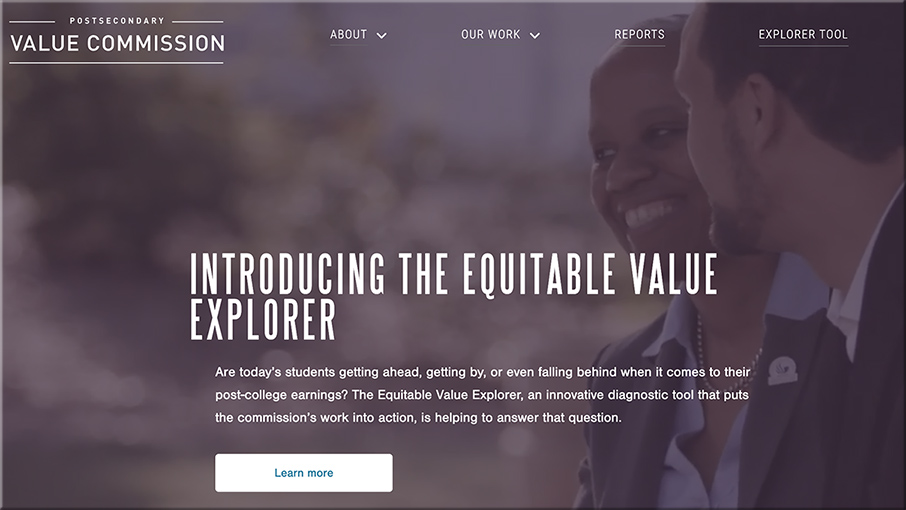
Are today’s students getting ahead, getting by, or even falling behind when it comes to their post-college earnings? The Equitable Value Explorer, an innovative diagnostic tool that puts the commission’s work into action, is helping to answer that question.


Report: Many borrowers who could benefit from income-driven repayment don’t know about it — from highereddive.com by Laura Spitalniak

Dive Brief:

  • Student loan borrowers who would stand to benefit the most from income-driven repayment plans, or IDRs, are less likely to know about them, according to a new report from left-leaning think tank New America.
  • Around 2 in 5 student-debt holders earning less than $30,000 a year reported being unfamiliar with the repayment plans. Under a proposed plan from the U.S. Education Department, IDR minimum monthly loan payments for low-income earners, such as this group, could drop to $0.
  • Just under half of borrowers in default had not heard of IDRs, despite the plans offering a pathway to becoming current on their loans, the report said. Only one-third of currently defaulted borrowers had ever enrolled in IDR.

Addendum on 5/16/23:


I’m a Student. You Have No Idea How Much We’re Using ChatGPT. — from chronicle.com by

Excerpt:

There’s a remarkable disconnect between how professors and administrators think students use generative AI on written work and how we actually use it. Many assume that if an essay is written with the help of ChatGPT, there will be some sort of evidence — it will have a distinctive “voice,” it won’t make very complex arguments, or it will be written in a way that AI-detection programs will pick up on. Those are dangerous misconceptions. In reality, it’s very easy to use AI to do the lion’s share of the thinking while still submitting work that looks like your own.

The common fear among teachers is that AI is actually writing our essays for us, but that isn’t what happens. You can hand ChatGPT a prompt and ask it for a finished product, but you’ll probably get an essay with a very general claim, middle-school-level sentence structure, and half as many words as you wanted. The more effective, and increasingly popular, strategy is to have the AI walk you through the writing process step by step.

.


From DSC:
The idea of personalized storytelling is highly intriguing to me. If you write a story for someone with their name and character in it, they will likely be even more engaged with the story/content. Our daughter recently did this with a substitute teacher, who she really wanted to thank before she left (for another assignment at another school). I thought it was very creative of her.


How Your Students are Using AI — from drphilippahardman.substack.com by Dr. Philippa Hardman

Excerpts:

Here’s are the five biggest lessons we’ve learned:

    1. Many students are already embracing AI in their day to day study
    2. Students need AI education, and fast.
    3. Students have a preference for free or low-cost alternatives to often expensive, paid-for services
    4. Students find value in personalised, dialogue-based learning experiences
    5. Ed Tech companies will need to evolve in order to survive.
      .

Curricular Resources about AI for Teaching (CRAFT) — from craft.stanford.edu
A project from the Stanford Graduate School of Education

Excerpt:

We’re building resources to teach AI literacies for high school and college instructors and assembling them into a full curriculum that will be deployed in a course with the National Educational Equity Lab offered in Fall 2023.
.


Why I’m Excited About ChatGPT — from insidehighered.com by Jennie Young
Here are 10 ways ChatGPT will be a boon to first-year writing instruction, Jennie Young writes.

Excerpt:

But from my perspective as a first-year writing program director, I’m excited about how this emerging technology will help students from all kinds of educational backgrounds learn and focus on higher-order thinking skills faster. Here are 10 reasons I’m excited about ChatGPT.


edX Debuts Two AI-Powered Learning Assistants Built on ChatGPT — from press.edx.org; with thanks to Matthew Tower for this resource
edX plugin launches in ChatGPT plugin store to give users access to content and course discovery
edX Xpert delivers AI-powered learning and customer support within the edX platform

Excerpt:

LANHAM, Md. – May 12, 2023 – edX, a leading global online learning platform from 2U, Inc. (Nasdaq: TWOU), today announced the debut of two AI-powered innovations: the new edX plugin for ChatGPT and edX Xpert, an AI-powered learning assistant on the edX platform. Both tools leverage the technology of AI research and deployment company OpenAI to deliver real-time academic support and course discovery to help learners achieve their goals.


Is It Time to Rethink the Traditional Grading System? — from edsurge.com by Jeffrey R. Young and Robert Talbert

Excerpt:

After that, this professor vowed never to use traditional grades on tests again. But he wasn’t quite sure what to replace them with.

As Talbert soon discovered, there’s a whole world of so-called alternative grading systems. So many, in fact, that he ended up co-writing an entire book about them with a colleague at his university, David Clark. The book, which is due out this summer, is called “Grading for Growth: A Guide to Alternative Grading Practices that Promote Authentic Learning and Student Engagement in Higher Education.

EdSurge connected with Talbert to hear what he uses in his classes now, and why he argues that reforming how grading works is key to increasing student engagement.


Inviting Learners into Work That Matters — from gettingsmart.com by Tom Vander Ark

Key Points

  • We’ve found pockets of excellence in three dozen high school visits this spring.
  • Where we’ve spotted evidence of deeper learning (i.e., engagement, critical thinking, excellent public products) it’s been work that matters to the learner and their community– it’s relevant, purposeful, and consequential work.

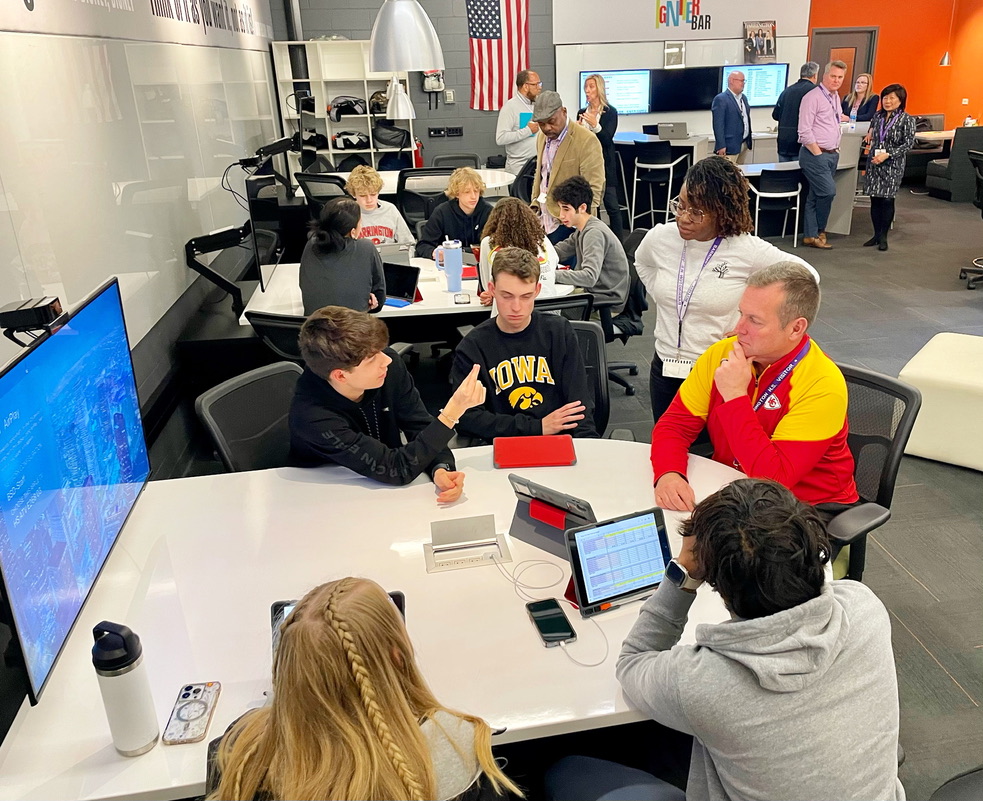
Students and teachers collaborating in a smart, active classroom type of setup at Barrington High's Incubatoredu class


Psalms 57:9-11 NIV — from bible.com

I will praise you, Lord, among the nations; I will sing of you among the peoples. For great is your love, reaching to the heavens; your faithfulness reaches to the skies. Be exalted, O God, above the heavens; let your glory be over all the earth.

Psalms 57:5 NIV— from bible.com

Be exalted, O God, above the heavens; let your glory be over all the earth.

.

Only the LORD can paint a canvas like this!


Sam Altman and Greg Brockman on AI and the Future — from open.spotify.com; for education-related discussion go to the 9 minute mark or so

Podcast description:

How might we develop and deploy beneficial, safe artificial general intelligence for humanity? Reid and Aria are joined by Sam Altman, the CEO of OpenAI, and Greg Brockman, OpenAI co-founder and president. Sam and Greg trace their journey—from articulating their mission to early company projects and decisions to scaling and sharing GPT-4 with the world. They also explore the transformative impact artificial intelligence can have on other industries, like energy, medicine, education, and law. Plus, GPT-4 offers a poetic perspective on a piece of code.
.


How to Continue Learning after College Graduation — from ivypanda.com; with thanks to Yvonne McQuarrie for this resource.

First, a brief note from DSC:
I publish this piece because I’m a firm believer that all of us are now into lifelong learning. Each of us needs to be intentional on enhancing our personal learning ecosystems.

Excerpt:

College graduation often becomes a turning point in students’ lives. Fear, confusion, and self-doubt often affect you at this time. They are likely to impact your interest and motivation for further study. To overcome this, you will have to adopt a lifelong learning mindset.

Our team wants to help you preserve your natural curiosity and interest in studies long after your college years are over. Below you will find reasons why lifelong learning matters and how it can help you live a fulfilling life.

  1. Importance
  2. Reasons to Learn
  3. Keep Learning
  4. Find Motivation
  5. Final Thoughts
  6. References
 

VR system to be used to prepare crime victims for court — from inavateonthenet.net

Excerpt:

An innovative VR system is being used to help victims of crime prepare for giving evidence in court, allowing victims to engage with key members of the judicial process virtually.

The system, designed by Immersonal, is to be rolled out across 52 Scottish courts over the next year, with the technology also being piloted in the Hague as part of the International Criminal Court. The aim is to dissuade the fears and discomfort of victims and witnesses who may be unfamiliar with the court process.
.

VR system to be used to prepare crime victims for court

.


.

Here’s another interesting item for you…one that also may eventually be XR-related:
.


Google I/O 2023: Making AI more helpful for everyone — from by; with thanks to Barsee out at The AI Valley 
Editor’s Note: Here is a summary of what we announced at Google I/O 2023. See all the announcements in our collection.

Keynote here:

100 things we announced at I/O 2023 — from blog.google by Molly McHugh-Johnson
A lot happened yesterday — here’s a recap.


Google partners with Adobe to bring art generation to Bard — from techcrunch.com by Kyle Wiggers

Excerpt:

Bard, Google’s answer to OpenAI’s ChatGPT, is getting new generative AI capabilities courtesy of Adobe.

Adobe announced today that Firefly, its recently introduced collection of AI models for generating media content, is coming to Bard alongside Adobe’s free graphic design tool, Adobe Express. Firefly — currently in public beta — will become the “premier generative AI partner” for Bard, Adobe says, powering text-to-image capabilities.

Also relevant/see:


How Testing Students Twice Can Improve Note-Taking Skills — from edutopia.org by Benjamin Barbour
Allowing students to take a test two times—once from memory and once using their notes—can boost note-taking, study skills, and reading habits, all at once.

Excerpt:

Along the way, Barbour also came up with an ingenious strategy for improving students’ note-taking—he calls it the “test average method.” He tests his students twice, back-to-back: once, when they don’t use their notes (which incentivizes good studying), and a second time, when they use their notes (which incentivizes good note-taking). He then averages their scores.

Getting the Most Out of Your LMS and Instructional Technology — from edutopia.org by Madison Anders
Thinking about the purpose of an activity can help new teachers best use their LMS and other tech tools to boost student engagement.

Strategies for Supporting Students’ Speaking and Listening Skills — from edutopia.org by Lisa Schultz
Many students struggle with these skills, which are tied to academic success. Here are a few ways to teach them explicitly.


AI In Education -from Getting Smart -- May 2023

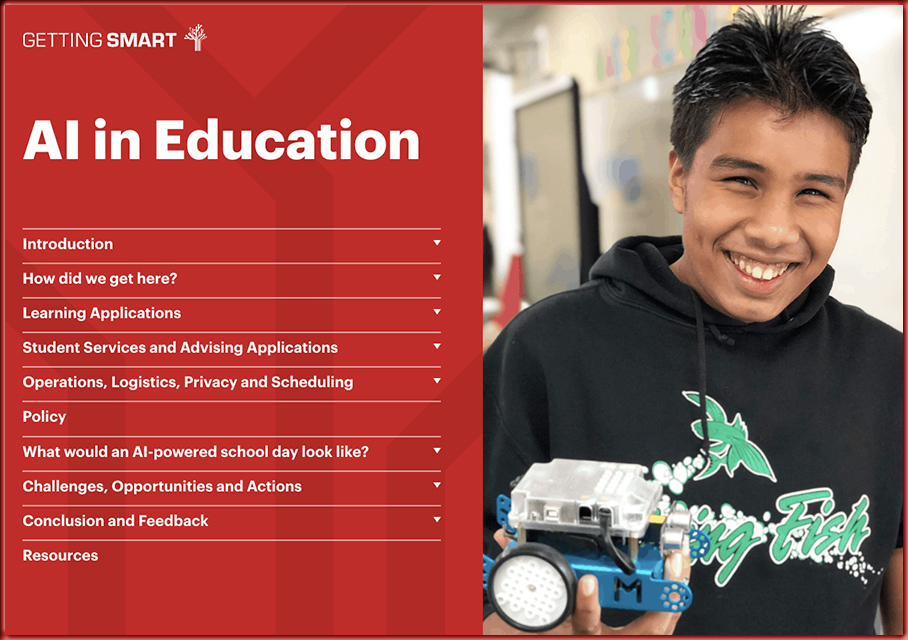
AI in Education — from gettingsmart.com

Some core takeaways for school leaders are:

  • AI has the potential to personalize learning experiences for students, improve student outcomes, and reduce the administrative burden on educators.
  • Addressing issues of data privacy, bias, and equity is crucial for responsible AI integration in education.
  • Collaboration between educators and AI developers is important to ensure that AI tools align with educational goals and values.
  • Professional development for educators is essential to effectively integrate AI tools in the classroom.
 
 
© 2025 | Daniel Christian