So much of the way that we think about education and work is organized into silos. Sure, that’s one way to ensure a depth of knowledge in a field and to encourage learners to develop mastery. But it also leads to domains with strict boundaries. Colleges are typically organized into school sub-domains, managed like fiefdoms, with strict rules for professors who can teach in different schools.
Yet it’s at the intersections of seemingly-disparate domains where breakthrough innovation can occur.
Maybe intersections bring a greater chance of future work opportunity, because that young person can increase their focus in one arena or another as they discover new options for work — and because this is what meaningful work in the future is going to look like.
From DSC: This posting strikes me as an endorsement for interdisciplinary degrees. I agree with much of this. It’s just hard to find the right combination of disciplines. But I supposed that depends upon the individual student and what he/she is passionate or curious about.
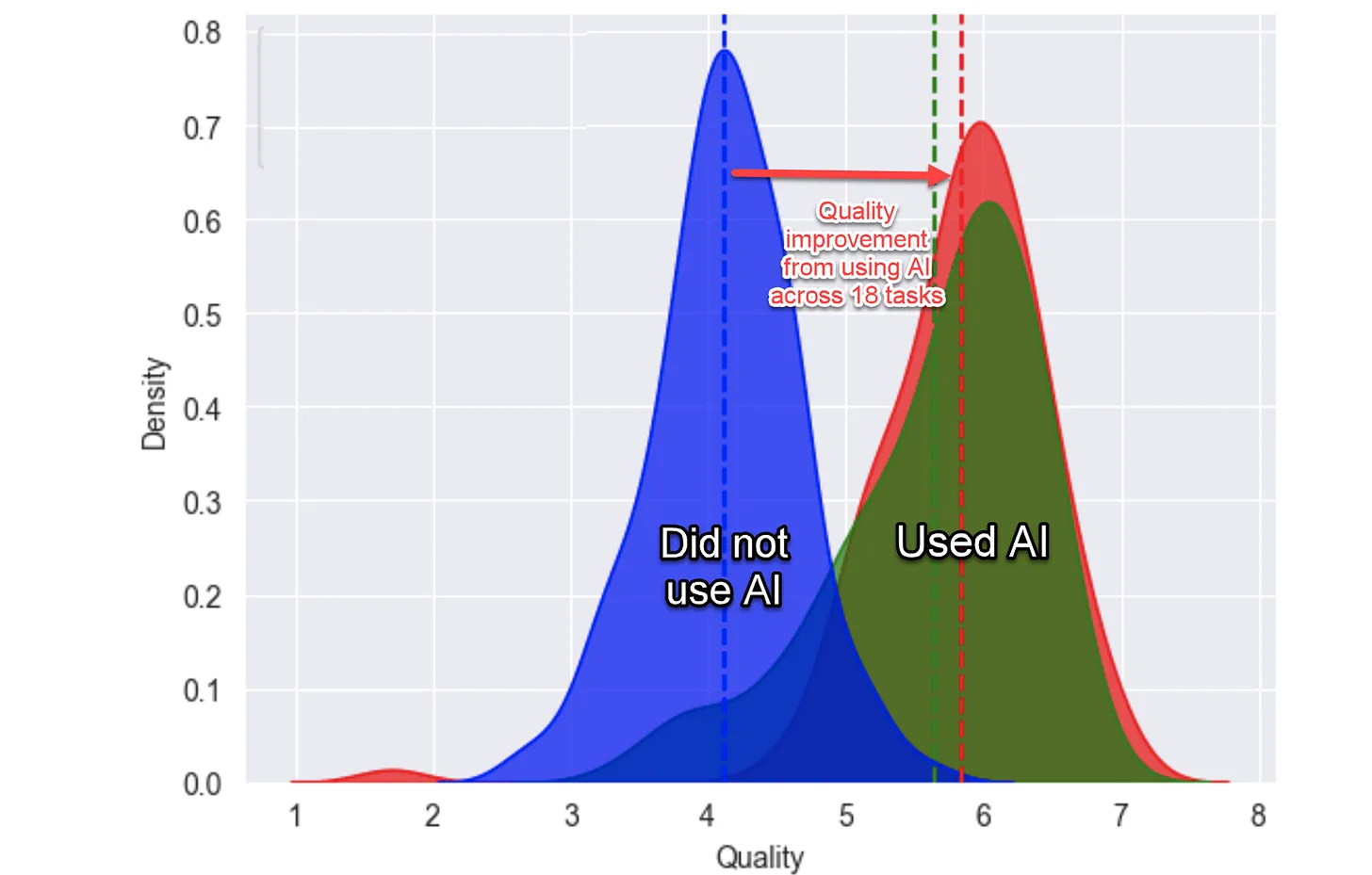
A lot of people have been asking if AI is really a big deal for the future of work. We have a new paper that strongly suggests the answer is YES. .
Consultants using AI finished 12.2% more tasks on average, completed tasks 25.1% more quickly, and produced 40% higher quality results than those without. Those are some very big impacts. Now, let’s add in the nuance.
The bigger picture: Culture is exceedingly hard to change, especially after trust evaporates in a crisis. And crises can be particularly wrenching when institutions haven’t established cultures of transparency and accountability during good times. Instead, trust continues to erode in a vicious cycle.
And I thought to myself, the scope of Rick’s conclusion could likely be expanded/applied to institutions of higher education as a whole.
One of the biggest challenges to navigate now is the fact that more digital tools will come with generative AI already embedded in them, says Annette Vee, director of composition and an associate professor at the University of Pittsburgh. “It’s everywhere in professional writing.”
“We need to be fundamentally rethinking ways we teach writing, so we are thinking about integrating tools mindfully,” says Vee, who helped develop a new resource, TextGenEd, that provides guidance in this area. “The real challenge is how do we teach courses that are preparing students and that are smart about generative AI? We have very few teachers currently equipped to do that work.”
“It’s best if there are real stakes attached to the work, for example, an authentic audience the student is writing to,” he writes. “A subject on which students have both sufficient interest and knowledge in order to feel as though they can write convincingly to this audience also matters a lot.”
Also relevant/see — via Robert Gibson on LinkedIn:
Learnt.ai — Built for Learning Specialists — from learnt.ai Harness the power of artificial intelligence to enhance your learning and development efforts with our easy-to-use platform – no technical expertise required!
Introducing Learnt.ai – a revolutionary collection of AI-powered content generation tools and AI chatbots that are specifically designed to support the common writing tasks of educationalists and learning and development professionals. Imagine being able to generate learning objectives on any topic of your choice, create engaging icebreakers and activities, write assessment questions with ease, and so much more.
Students are using artificial intelligence tools to assist them in their academic careers. Three students share their viewpoints on the tools they use and how using these tools helps them in their coursework and prepares them for the professional world.
Also relevant/see:
Why Professors Are Polarized on AI — from insidehighered.com by Susan D’Agostino Academics who perceive threats to education from AI band together as a survival mechanism. The resulting alliances echo divisions formed during online learning’s emergence.
Ask the Chair: Are Great Chairs Born or Made? — from chronicle.com by Kevin Dettmar (behind a paywall) Higher education is finally getting serious about training new department heads.
Great chairs aren’t born, but made; “trial and error” isn’t actually a professional-development strategy. The provost and deans should recognize that a confident and competent chair makes their job easier, creates a well-functioning department, and buoys faculty, student, and staff morale.
As someone vitally engaged with the chair’s role, I do think we are experiencing a sea-change when it comes to how institutions are preparing chairs. For too long, colleges have treated the position as simply a minor cog in the chain of command. But more and more institutions are now investing in their chairs.
Why do so many students have the impression that they should attend office hours only if they’ve got a question? Here’s my hunch: Well-meaning, supportive professors mention their office hours at various points throughout the course: If you have questions about fill-in-the-blank, come to my office hours. The professors mean, “I am here to help! Come talk to me.” Students hear: “If you have a question.”
It’s a frustrating misunderstanding, because it contributes to the big problem my article focuses on: Many students miss out on the support professors stand to provide.
… ‘Adjunct Faculty 101’
“Sessions offered this year included ‘An Orientation to the Canvas LMS,’ ‘The First Day of Class,’ ‘Creating Student-Centered Course Materials,’ ‘Classroom-Management Tips,’ ‘Academic-Integrity Tips and Processes,’ ‘An Introduction to Our Tutoring Services and Writing Center,’ ‘Writing Across the Disciplines With AI,’ and more.”
From DSC: I like the idea of using “office hours” for building relationships, helping students with their future career decisions, building broader understanding, ongoing mentoring, and for developing potential networking opportunities.
Give praise to the LORD, proclaim his name; make known among the nations what he has done. Sing to him, sing praise to him; tell of all his wonderful acts. Glory in his holy name; let the hearts of those who seek the LORD rejoice. Look to the LORD and his strength; seek his face always.
All this is from God, who reconciled us to himself through Christ and gave us the ministry of reconciliation: that God was reconciling the world to himself in Christ, not counting people’s sins against them. And he has committed to us the message of reconciliation.
In love a throne will be established; in faithfulness a man will sit on it— one from the house of David— one who in judging seeks justice and speeds the cause of righteousness.
6. Create externship programs for faculty. Many college and university faculty have never worked outside of academia. Given a chance to be exposed to modern workplaces and work challenges, faculty will find innovative and creative ways to weave more work-integrated learning into their curriculum.
From DSC: This is a great idea — thanks Brandon!
I might add another couple of thoughts here as well:
And/or treat your Adjunct Faculty Members much better as well!
And/or work with more L&D Departments at local companies (i.e., to develop closer, more beneficial/WIN-WIN collaborations).
Big Ideas is Education Week’s annual special report that brings the expertise of our newsroom—and occasionally those beyond our newsroom—to bear on the challenges you might be facing in your classroom, school, or district. Big Ideas questions the status quo and explores opportunities to help you build a better, more just learning environment for all students. Browse our collection.
What does active learning require from students? There is no secret that PBL and all other active learning approaches are much more demanding from students compared to traditional methods, mainly in terms of skills and attitudes towards learning. Here are some of the aspects where students, especially when first faced to active learning, seem to struggle:
Formulating own learning goals and following through with independent study. While in traditional teaching the learning goals are given to students, in PBL (or at least in some of its purest variants), they need to come up with their own, for each problem they are solving. This requires understanding the problem well but also a certain frame of mind where one can assess what is necessary to solve it and make a plan of how to go about it (independently and as a group). All these seemingly easy steps are often new to students and something they intrinsically expect from us as educators.
From DSC: The above excerpt re: formulating one’s own learning goals reminded me of project management and learning how to be a project manager.
It reminded me of a project that I was assigned back at Kraft (actually Kraft General Foods at the time). It was an online-based directory of everyone in the company at the time. When it was given to me, several questions arose in my mind:
Where do I start?
How do I even organize this project?
What is the list of to-do’s?
Who will I need to work with?
Luckily I had a mentor/guide who helped me get going and an excellent contact with the vendor who educated me and helped me get the ball rolling.
I’ll end with another quote and a brief comment:
Not being afraid of mistakes and learning from them. The education system, at all stages, still penalises mistakes, often with long term consequences. So it’s no wonder students are afraid of making mistakes…
Which Way to the Fitting Room? — from michelleweise.substack.com by Dr. Michelle R. Weise Trying on the Jobs of the Future
What if there was a way in which we could try on different careers and pathways? What if there was such a thing as a career pathway fitting room so that we could better understand the direction we might want to pursue before we make an investment or take out a loan?
One venture-backed company called Springpod has made this challenge its central focus: Helping more people not choose the wrong career or pathway. In its current formation in the UK (Springpod is now branching out to the state of Rhode Island), over 400,000 British middle and high school learners can try a “course taster,” or 10 to 15 hours of a university course from an array of universities (1/3 of the postsecondary institutions in the UK offer a course spotlight on Springpod). Alternatively, a learner can try a one- to two-hour work-based learning experience with one of the 200 employers featured on the platform.
From DSC: Speaking of finding out more about careers, I haven’t yet checked this program out, but we would like our youngest daughter to watch some of its episodes:
Ever wondered what you might want to do for the rest of your life? Have you thought about your “dream” job? Do you have any idea what it takes to get there? Are you headed in the right direction? Real Life 101 takes you “on the job” so you can see for yourself why these professionals love what they do.
The Birmingham Royal Ballet (BRB) has announced the launch of its virtual stage, a tech-focused project designed to bring immersive technologies into ballet.
The BRB has received funding from Bloomberg Philanthropies’ Digital Accelerator Programme, allowing the institution to invest in equipment and staff training to allow its team to explore immersive technologies with its partners Canon and RiVR.
The virtual stage project aims to explore ways in which AR, VR, 3D mapping and motion capture can be used to enhance the BRB’s productions and experiences.
With the advancements in Artificial Intelligence (AI), designers now have access to a wide array of free AI-powered tools that streamline their creative process, enhance productivity, and add a touch of uniqueness to their designs. In this article, we will explore ten such free AI tools websites for graphic designing that have revolutionized the way designers approach their craft.
Generative Art in Motion— from heatherbcooper.substack.com by Heather Cooper Animation and video tools create an explosion of creative expression
Google will soon require that political ads using artificial intelligence be accompanied by a prominent disclosure if imagery or sounds have been synthetically altered.
AI-generated election ads on YouTube and other Google platforms that alter people or events must include a clear disclaimer located somewhere that users are likely to notice, the company said in an update this week to its political content policy.
What we teachers desperately need, though, is an ocean of examples and training. We need to see and share examples of generative AI—any type of artificial intelligence that can be used to create new text, images, video, audio, code, or data—being used across the curriculum. We need catalogs of new lesson plans and new curriculum.
And we need training on theoretical and practical levels: training to understand what artificial intelligence actually is and where it stands in the development timeline and training about how to integrate it into our classes.
So, my advice to teachers is to use any and all the generative AI you can get your hands on. Then experience—for yourself—verification of the information. Track it back to the source because in doing so, you’ll land on the adjustments you need to make in your classes next year.
From DSC: Interesting.
Learners can now seamlessly transition between AI-powered assistance (AI Tutor) and Live Expert support to get access to instant support, whether through AI-guided learning or real-time interactions with a human expert.
ASSIGNMENT MAKEOVERS IN THE AI AGE WITH DEREK BRUFF — from teachinginhighered.com by Bonni Stachowiak Derek Bruff shares about assignment makeovers in the AI age on episode 481 of the Teaching in Higher Ed podcast
Comment on this per Derek Bruff:
Why not ask ChatGPT to write what King or X would say about a current debate and then have the students critique the ChatGPT output? That would meet the same learning goals while also teaching AI literacy.
(Be sure to read Asim’s contribution for a useful take.)
Here’s a closer look at the concurrent AI landscape in schools — and a prediction of what the future holds.
So far, high-profile ventures in the instruction realm, such asKyron Learning, have fused teacher-produced, recorded content with LLM-powered conversational UX. The micro-learning tool Nolej references internet material when generating tasks and tests, but always holds the language model closely to the ground truth provided by teachers. Both are intriguing takes on re-imagining how to deliver core instruction and avoid hallucinations (generated content that is nonsensical).
As a result, real-time 3D jobs are among the most in demand within the tech industry. According to Unity’s vice president of Education and Social Impact, Jessica Lindl, demand is 50% higher than traditional IT jobs—adding that salaries for real-time 3D jobs are 60% greater.
“We want to provide really simple on ramps and pathways that will lead you into entry level jobs so that at any point in your career, you can decide to transfer into the industry,” Lindl says.
University World News continues its exploration of generative AI in our new special report on ‘AI and Higher Education’. In commentaries and features, academics and our journalists around the world investigate issues and developments around AI that are impacting on universities. Generative AI tools are challenging and changing higher education systems and institutions — how they are run as well as ways of teaching and learning and conducting research.
My advice for you today is this: fill your LinkedIn-feed and/or inbox with ideas, inspirational writing and commentary on AI.
This will get you up to speed quickly and is a great way to stay informed on the newest movements you need to be aware of.
My personal recommendation for you is to check out these bright people who are all very active on LinkedIn and/or have a newsletter worth paying attention to.
I have kept the list fairly short – only 15 people – in order to make it as easy as possible for you to begin exploring.
It is crucial to recognize that the intrinsic value of higher education isn’t purely in its ability to adapt to market fluctuations or technological innovations. Its core strength lies in promoting critical thinking, nurturing creativity, and instilling a sense of purpose and belonging. As AI progresses, these traits will likely become even more crucial. The question then becomes if higher education institutions as we know them today are the ony ones, or indeed the best ones, equipped to convey those core strengths to students.
Higher education clearly finds itself caught in a whirlwind of transformation, both in its essence and execution. The juxtaposition of legacy structures and the evolving technological landscape paints a complex picture.
For institutional leaders, the dual challenge lies in proactively seeking and initiating change (not merely adapting to it) without losing sight of their foundational principles. Simultaneously, they must equip students with skills and perspectives that AI cannot replicate.
“They begged, bargained with, and berated their instructor in pursuit of better grades — not “because they like points,” but rather, “because the education system has told them that these points are the currency with which they can buy a successful future.””
36% satisfied with U.S. K-12 education quality, matching record low in 2000
76% of K-12 parents satisfied with own child’s, 41% with U.S., education
Republicans’ satisfaction with K-12 education at new low of 25%
Still, parents of elementary and secondary school students remain quite satisfied with the education their child is getting, and they offer mostly positive reviews of the performance of their children’s teachers. If parental satisfaction wanes, however, parents may choose to move their child to a different school.
Exclusive new polling by The Chronicle suggests Americans still believe that college credentials have value, even as many hold reservations about higher education’s track record of benefiting society and educating students, our Eric Kelderman reports.
People would generally tell a close friend or relative that getting a college degree is worth it, according to a national survey conducted for The Chronicle. Almost eight in 10 respondents said they’d tell a close friend to seek a bachelor’s degree. Even among those who thought their own associate or bachelor’s degree wasn’t worthwhile, 57 percent would tell a friend to go for a bachelor’s.
… But wait. Respondents were tepid when asked how well colleges were fulfilling key parts of their missions.
Only 30 percent said colleges were doing an excellent or very good job leveling the playing field for success.
Just 40 percent said colleges are excellent or very good at educating students.
A flashing red light: Those with more education felt worse about colleges’ ability to educate students than did those with a high-school degree or less.
The bigger picture: Colleges still have reservoirs of public support to tap, but they can’t expect to win more hearts and minds merely by telling their stories better. Higher ed’s skeptics include many people who’ve passed through campuses, suggesting business as usual won’t cut it — even when it comes to the core work of educating students.
Despite enrollment and completion rates declining and Americans’ confidence in higher education falling, the economic case for earning a college degree remains solid. College graduates earn about $1 million more over the course of their working years than U.S. adults with no college degree, on average.
However, a college degree has value beyond financial gain.
…
The results show that additional years of education beyond high school make for a healthier, more civic-minded individual who is more likely to interact with neighbors and family members, and to do work that aligns with their natural talents and interests.
Whilst we typically cover a single ‘prompt’ to use with ChatGPT, today we’re exploring a new feature now available to everyone: custom instructions.
You provide specific directions for ChatGPT leading to greater control of the output. It’s all about guiding the AI to get the responses you really want.
To get started:
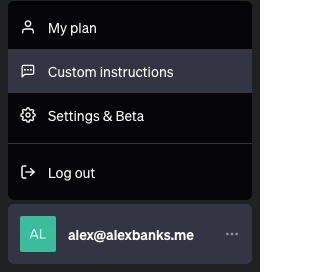
Log into ChatGPT ? Click on your name/email bottom left corner ? select ‘Custom instructions’
We’re excited to introduce you to AI Companion (formerly Zoom IQ), your new generative AI assistant across the Zoom platform. AI Companion empowers individuals by helping them be more productive, connect and collaborate with teammates, and improve their skills.
…
Envision being able to interact with AI Companion through a conversational interface and ask for help on a whole range of tasks, similarly to how you would with a real assistant. You’ll be able to ask it to help prepare for your upcoming meeting, get a consolidated summary of prior Zoom meetings and relevant chat threads, and even find relevant documents and tickets from connected third-party applications with your permission.
From DSC: “You can ask AI Companion to catch you up on what you missed during a meeting in progress.”
And what if some key details were missed? Should you rely on this? I’d treat this with care/caution myself.
That’s because, as it turns out, it’s nearly impossible to remove a user’s data from a trained A.I. model without resetting the model and forfeiting the extensive money and effort put into training it. To use a human analogy, once an A.I. has “seen” something, there is no easy way to tell the model to “forget” what it saw. And deleting the model entirely is also surprisingly difficult.
This represents one of the thorniest, unresolved, challenges of our incipient artificial intelligence era, alongside issues like A.I. “hallucinations” and the difficulties of explaining certain A.I. outputs.
This strategic move aims to make the process of creating visuals such as logos, banners, and more, even more simple for businesses and entrepreneurs.
This latest integration could improve the way users generate visuals by offering a streamlined and user-friendly approach to digital design.
From DSC: This Tweet addresses a likely component of our future learning ecosystems:
Excited to introduce YouPro for Education—your AI study buddy.
Access unlimited AI chat + search, unlimited AI writing generations, unlimited AI art generations, supercharged with GPT-4 and Stable Diffusion XL at just $6.99/month for students and teachers. pic.twitter.com/0t8zf0AaLr
That’s why a growing number of researchers—computer scientists, cognitive scientists, neuroscientists, linguists—want to overhaul the way they are assessed, calling for more rigorous and exhaustive evaluation. Some think that the practice of scoring machines on human tests is wrongheaded, period, and should be ditched.
“There’s a lot of anthropomorphizing going on,” she says. “And that’s kind of coloring the way that we think about these systems and how we test them.”
“There is a long history of developing methods to test the human mind,” says Laura Weidinger, a senior research scientist at Google DeepMind. “With large language models producing text that seems so human-like, it is tempting to assume that human psychology tests will be useful for evaluating them. But that’s not true: human psychology tests rely on many assumptions that may not hold for large language models.”
In concert with the fine folks at Datos, whose opt-in, anonymized panel of 20M devices (desktop and mobile, covering 200+ countries) provides outstanding insight into what real people are doing on the web, we undertook a challenging project to answer at least some of the mystery surrounding ChatGPT.
“In terms of human capital development, for instance, AI can be the teacher that helps the national workforce upskill in both AI-related and other domains.”
With the field of artificial intelligence evolving at near breakneck speed, scammers now have access to tools that can help them execute highly sophisticated attacks en masse, warns the co-founder of Web3 security firm Quantstamp.
Thanks for dropping by my Learning Ecosystems blog!
My name is Daniel Christian and this blog seeks to cover the teaching and learning environments within the K-12 (including homeschooling, learning pods/micro-schools), collegiate, and corporate training spaces -- whether those environments be face-to-face, blended, hyflex, or 100% online.
Just as the organizations that we work for have their own learning ecosystems, each of us has our own learning ecosystem. We need to be very intentional about enhancing those learning ecosystems -- as we all need to be lifelong learners in order to remain marketable and employed. It's no longer about running sprints (i.e., getting a 4-year degree or going to a vocational school and then calling it quits), but rather, we are all running marathons now (i.e., we are into lifelong learning these days).