Regional Colleges Saw Biggest Application Gains After Tuition Resets — from insidehighered.com by Kathryn Palmer
A new report compared post-reset application growth at nationally known and regional institutions. 

Dozens of colleges and universities have dropped their sticker prices for tuition over the past decade, even as research has shown that tuition resets have a nominal influence on long-term enrollment increases. But a report released this week shows that regional colleges were more likely than nationally known institutions to see increases in applications after a reset.

“Students are more focused now on return on investment than they used to be,” said Devon McGee, a principal at Kennedy & Company, the higher education consulting firm that produced the report. Compared to bigger-name colleges, “A lot of these regional institutions are great liberal arts–type institutions, but they are less associated—fairly or unfairly—with preparing students for a job.”


Why hybrid learning needs hybrid faculties — from timeshighereducation.com by An Jacobs & Norma Rossi
Online courses should be integrated into everyday faculty functions to improve remote and in-person classes as well as the overall student experience


The Game-Changer: How Legal Technology is Transforming the Legal Sector — from todaysconveyancer.co.uk by Perfect Portal

Rob Lawson, Strategic Sales Manager at Perfect Portal discussed why he thinks legal technology is so important:

“I spent almost 20 years in private practice and was often frustrated at the antiquated technology and processes that were deployed. It is one of the reasons that I love working in legal tech to provide solutions and streamline processes in the modern law firm. One of the major grumbles for practitioners is the amount of admin that they must do to fulfil the needs of their clients. Technology can automate routine tasks, streamline processes, and help manage large volumes of data more effectively. This then allows legal professionals to focus on more strategic aspects of their work. Ultimately this will increase efficiency and productivity.”


Some gen AI vendors say they’ll defend customers from IP lawsuits. Others, not so much. — from techcrunch.com by Kyle Wiggers

A person using generative AI — models that generate text, images, music and more given a prompt — could infringe on someone else’s copyright through no fault of their own. But who’s on the hook for the legal fees and damages if — or rather, when — that happens?

It depends.

In the fast-changing landscape of generative AI, companies monetizing the tech — from startups to big tech companies like Google, Amazon and Microsoft — are approaching IP risks from very different angles.


Clio Goes All Out with Major Product Announcements, Including A Personal Injury Add-On, E-Filing, and (Of Course) Generative AI — from lawnext.com by Bob Ambrogi

At its annual Clio Cloud Conference in Nashville today, the law practice management company Clio introduced an array of major new products and product updates, calling the series of announcements its most expansive product update ever in its 15-year history.


AI will invert the biglaw pyramid — from alexofftherecord.com by Cece Xie

These tasks that GPT can now handle are, coincidentally, common tasks for junior associates. From company and transaction summaries to legal research and drafting memos, analyzing and drafting have long been the purview of bright-eyed, bushy-tailed new law grads.

If we follow the capitalistic impulse of biglaw firms to its logical conclusion, this means that junior associates may soon face obsolescence. Why spend an hour figuring out how to explain an assignment to a first-year associate when you can just ask CoCounsel in five minutes? And the initial output will likely be better than a first-year’s initial work product, too.

Given the immense cost-savings that legal GPT products can confer, I suspect the rise of AI in legal tech will coincide with smaller junior associate classes. Gone are the days of 50+ junior lawyers all working on the same document review or due diligence. Instead, a fraction of those junior lawyers will be hired to oversee and QC the AI’s outputs. Junior associates will edit more than they do currently and manage more than they do right now. Juniors will effectively be more like midlevels from the get-go.


Beyond Law Firms: How Legal Tech’s Real Frontier Lies With SMBs (small and medium-sized businesses) — from forbes.com by Charles Brecque

Data and artificial intelligence are transforming the legal technology space—there’s no doubt about it. A recent Thomson Reuters Institute survey of lawyers showed that a large majority (82%) of respondents believe ChatGPT and generative AI can be readily applied to legal work.

While it’s tempting to think of legal tech as a playground exclusive to law firms, as technology enables employees without legal training to use and create legal frameworks and documentation, I’d like to challenge that narrative. Being the founder of a company that uses AI to manage contracts, the way I see it is the real magic happens when legal tech tools meet the day-to-day challenges of small and medium-sized businesses (known as “SMBs”).


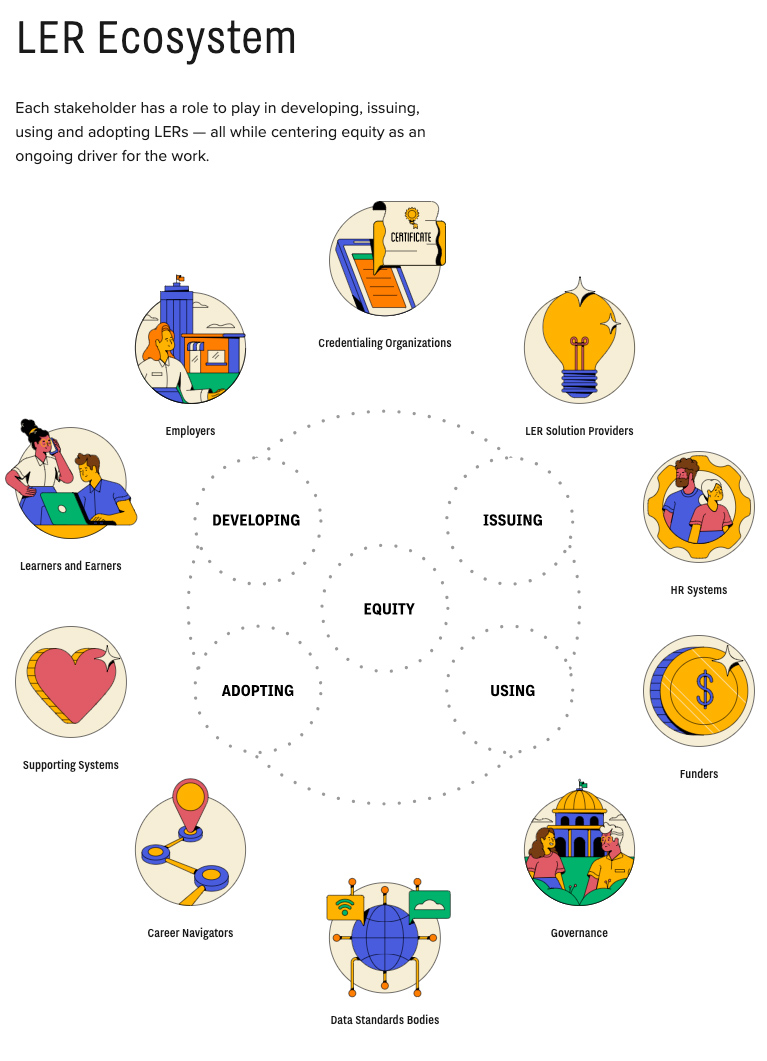
The Learning & Employment Records (LER) Ecosystem Map — with thanks to Melanie Booth on LinkedIn for this resource
Driving Opportunity and Equity Through Learning & Employment Records

The Learning & Employment Records (LER) Ecosystem Map

Imagine A World Where…

  • Everyone is empowered to access learning and earning opportunities based on what they know and can do, whether those skills and abilities are obtained through degrees, work experiences, or independent learning.
  • People can capture and communicate the skills and competencies they’ve acquired across their entire learning journey — from education, experience and service — with more ease, confidence, and clarity than a traditional resume.
  • Learners and earners control their information and can curate their skills to take advantage of every opportunity they are truly qualified to pursue, opening up pathways that help address systemic inequities.
  • Employers can tap into a wider talent pool and better match applicants to opportunities with verifiable credentials that represent skills, competencies, and achievements.

This is the world that we believe can be created by Learning and Employment Records (LERs), i.e. digital records of learning and work experiences that are linked to and controlled by learners and earners. An interoperable, well-governed LER ecosystem has the potential to transform the future of work so that it is more equitable, efficient, and effective for everyone involved— individuals, training and education providers, employers, and policymakers.


Also per Melanie Booth, see:


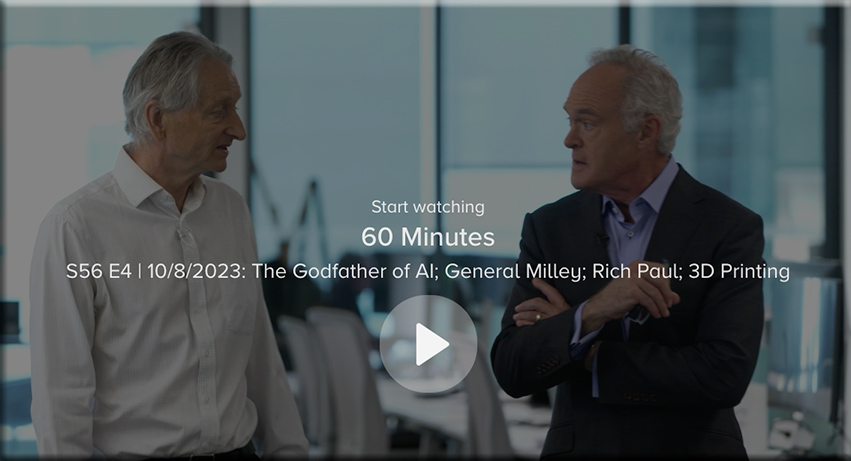
WHAT WAS GARY MARCUS THINKING, IN THAT INTERVIEW WITH GEOFF HINTON? — from linkedin.com by Stephen Downes

Background (emphasis DSC): 60 Minutes did an interview with ‘the Godfather of AI’, Geoffrey Hinton. In response, Gary Marcus wrote a column in which he inserted his own set of responses into the transcript, as though he were a panel participant. Neat idea. So, of course, I’m stealing it, and in what follows, I insert my own comments as I join the 60 Minutes panel with Geoffrey Hinton and Gary Marcus.

Usually I put everyone else’s text in italics, but for this post I’ll put it all in normal font, to keep the format consistent.

Godfather of Artificial Intelligence Geoffrey Hinton on the promise, risks of advanced AI


OpenAI’s Revenue Skyrockets to $1.3 Billion Annualized Rate — from maginative.com by Chris McKay
This means the company is generating over $100 million per month—a 30% increase from just this past summer.

OpenAI, the company behind the viral conversational AI ChatGPT, is experiencing explosive revenue growth. The Information reports that CEO Sam Altman told the staff this week that OpenAI’s revenue is now crossing $1.3 billion on an annualized basis. This means the company is generating over $100 million per month—a 30% increase from just this past summer.

Since the launch of a paid version of ChatGPT in February, OpenAI’s financial growth has been nothing short of meteoric. Additionally, in August, the company announced the launch of ChatGPT Enterprise, a commercial version of its popular conversational AI chatbot aimed at business users.

For comparison, OpenAI’s total revenue for all of 2022 was just $28 million. The launch of ChatGPT has turbocharged OpenAI’s business, positioning it as a bellwether for demand for generative AI.


From 10/13:


New ways to get inspired with generative AI in Search — from blog.google
We’re testing new ways to get more done right from Search, like the ability to generate imagery with AI or creating the first draft of something you need to write.


How Have Schools Improved Since the Pandemic? What Teachers Had to Say — from the74million.org by Cory Beets
Educator’s view: In technology, mental health, and nurturing and solutions-oriented environments, COVID provided lessons schools have taken to heart.

In doing research for my Ph.D. program, I sought out the perspectives of five teachers through informal conversations about how schools have improved since the pandemic. Four themes emerged.

From DSC:
To add another positive to the COVID-19 picture…

Just like COVID-19 did more for the advancement of online learning within our learning ecosystems than 20+ years of online learning development, COVID-19 may have done more to move our younger learners along the flexibility route that will serve them well in their futures. That is, with today’s exponential pace of change, we all need to be more agile and flexible — and be able to reinvent ourselves along the way. The type of learning that our K-12ers went through during COVID-19 may have been the most helpful thing yet for their future success and career development. They will need to pivot, adapt, and take right turn after right turn. 


The Misunderstanding About Education That Cost Mark Zuckerberg $100 Million — from danmeyer.substack.com by Dan Meyer
Personalized learning can feel isolating. Whole class learning can feel personal. This is hard to understand.

Excerpt (emphasis DSC):

Last week, Matt Barnum reported in Chalkbeat that the Chan Zuckerberg Initiative is laying off dozens of staff members and pivoting away from the personalized learning platform they have funded since 2015 with somewhere near $100M.

I have tried to illustrate as often as my subscribers will tolerate that students don’t particularly enjoy learning alone with laptops within social spaces like classrooms. That learning fails to answer their questions about their social identity. It contributes to their feelings of alienation and disbelonging. I find this case easy to make but hard to prove. Maybe we just haven’t done personalized learning right? Maybe Summit just needed to include generative AI chatbots in their platform?

What is far easier to prove, or rather to disprove, is the idea that “whole class instruction must feel impersonal to students,” that “whole class instruction must necessarily fail to meet the needs of individual students.”

From DSC:
I appreciate Dan’s comments here (as highlighted above) as they are helpful in my thoughts regarding the Learning from the Living [Class] Room vision. They seem to be echoed here by Jeppe Klitgaard Stricker when he says:

Personalized learning paths can be great, but they also entail a potential abolishment or unintended dissolution of learning communities and belonging.

Perhaps this powerful, global, Artificial Intelligence (AI)-backed, next-generation, lifelong learning platform of the future will be more focused on postsecondary students and experiences — but not so much for the K12 learning ecosystem.

But the school systems I’ve seen here in Michigan (USA) represent systems that address a majority of the class only. These one-size-fits-all systems don’t work for many students who need extra help and/or who are gifted students. The trains move fast. Good luck if you can’t keep up with the pace.

But if K-12’ers are involved in a future learning platform, the platform needs to address what Dan’s saying. It must address students questions about their social identity and not contribute to their feelings of alienation and disbelonging. It needs to support communities of practice and learning communities.


7thSense powers content on Sphere’s interior and exterior LED displays — from inavateonthenet.net

At 16K x 16K resolution, Sphere’s interior LED display plane is the highest resolution LED screen in the world. Soaring to a height of 240 feet, and with over 3 acres of display surface, the screen wraps up, over, and around the audience to create a fully immersive visual environment.


50-foot-high Hypervsn hologram launches at The Sphere in Las Vegas — from inavateonthenet.net

The pubic atrium of the recently opened MSG Sphere in Las Vegas features Hypervsn’s largest-ever 30 x 50-foot holographic display wall alongside real-life humanoid robots that greet visitors on arrival, a 360-degree avatar capture and a beam-forming sound display.

The 50-foot-high installation project included 420 individual SmartV Hypervsn displays fixed to a secure rack that hangs from the atrium wall.


How can a young person stay on the path of purity?
    By living according to your word.
10 I seek you with all my heart;
    do not let me stray from your commands.
11 I have hidden your word in my heart
    that I might not sin against you.
12 Praise be to you, Lord;
    teach me your decrees.

Proverbs 19:20-21

20 Listen to advice and accept discipline,
and at the end you will be counted among the wise.
21 Many are the plans in a person’s heart,
but it is the Lord’s purpose that prevails.

Jeremiah 18:7-10

If at any time I announce that a nation or kingdom is to be uprooted, torn down and destroyed, and if that nation I warned repents of its evil, then I will relent and not inflict on it the disaster I had planned. And if at another time I announce that a nation or kingdom is to be built up and planted, 10 and if it does evil in my sight and does not obey me, then I will reconsider the good I had intended to do for it.

You have laid down precepts
    that are to be fully obeyed.
Oh, that my ways were steadfast
    in obeying your decrees!
Then I would not be put to shame
    when I consider all your commands.


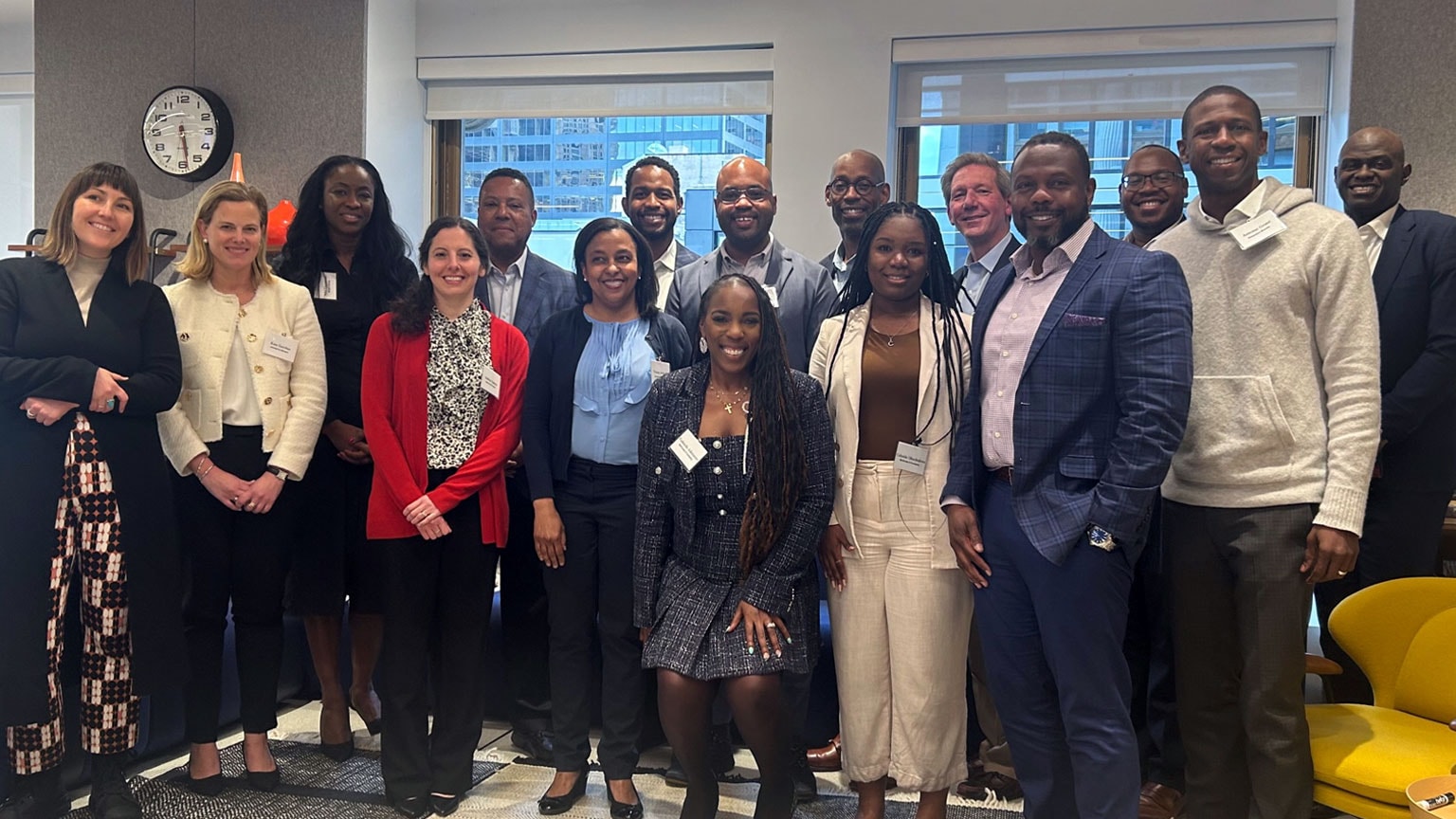
Creating an ‘ecosystem’ to close the Black talent gap in technology — from mckinsey.com (emphasis below from DSC)

Chris Perkins, associate partner, McKinsey: Promoting diversity in tech is more nuanced than driving traditional diversity initiatives. This is primarily because of the specialized hard and soft skills required to enter tech-oriented professions and succeed throughout their careers. Our research shows us that various actors, such as nonprofits, for-profits, government agencies, and educational institutions are approaching the problem in small pockets. Could we help catalyze an ecosystem with wraparound support across sectors?

To design this, we have to look at the full pipeline and its “leakage” points, from getting talent trained and in the door all the way up to the C-suite. These gaps are caused by lack of awareness and support in early childhood education through college, and lack of sponsorship and mentorship in early- and mid- career positions.


Thinking with Colleagues: AI in Education — from campustechnology.com by Mary Grush
A Q&A with Ellen Wagner

Wagner herself recently relied on the power of collegial conversations to probe the question: What’s on the minds of educators as they make ready for the growing influence of AI in higher education? CT asked her for some takeaways from the process.

We are in the very early days of seeing how AI is going to affect education. Some of us are going to need to stay focused on the basic research to test hypotheses. Others are going to dive into laboratory “sandboxes” to see if we can build some new applications and tools for ourselves. Still others will continue to scan newsletters like ProductHunt every day to see what kinds of things people are working on. It’s going to be hard to keep up, to filter out the noise on our own. That’s one reason why thinking with colleagues is so very important.

Mary and Ellen linked to “What Is Top of Mind for Higher Education Leaders about AI?” — from northcoasteduvisory.com. Below are some excerpts from those notes:

We are interested how K-12 education will change in terms of foundational learning. With in-class, active learning designs, will younger students do a lot more intensive building of foundational writing and critical thinking skills before they get to college?

  1. The Human in the Loop: AI is built using math: think of applied statistics on steroids. Humans will be needed more than ever to manage, review and evaluate the validity and reliability of results. Curation will be essential.
  2. We will need to generate ideas about how to address AI factors such as privacy, equity, bias, copyright, intellectual property, accessibility, and scalability.
  3. Have other institutions experimented with AI detection and/or have held off on emerging tools related to this? We have just recently adjusted guidance and paused some tools related to this given the massive inaccuracies in detection (and related downstream issues in faculty-elevated conduct cases)

Even though we learn repeatedly that innovation has a lot to do with effective project management and a solid message that helps people understand what they can do to implement change, people really need innovation to be more exciting and visionary than that.  This is the place where we all need to help each other stay the course of change. 


Along these lines, also see:


What people ask me most. Also, some answers. — from oneusefulthing.org by Ethan Mollick
A FAQ of sorts

I have been talking to a lot of people about Generative AI, from teachers to business executives to artists to people actually building LLMs. In these conversations, a few key questions and themes keep coming up over and over again. Many of those questions are more informed by viral news articles about AI than about the real thing, so I thought I would try to answer a few of the most common, to the best of my ability.

I can’t blame people for asking because, for whatever reason, the companies actually building and releasing Large Language Models often seem allergic to providing any sort of documentation or tutorial besides technical notes. I was given much better documentation for the generic garden hose I bought on Amazon than for the immensely powerful AI tools being released by the world’s largest companies. So, it is no surprise that rumor has been the way that people learn about AI capabilities.

Currently, there are only really three AIs to consider: (1) OpenAI’s GPT-4 (which you can get access to with a Plus subscription or via Microsoft Bing in creative mode, for free), (2) Google’s Bard (free), or (3) Anthropic’s Claude 2 (free, but paid mode gets you faster access). As of today, GPT-4 is the clear leader, Claude 2 is second best (but can handle longer documents), and Google trails, but that will likely change very soon when Google updates its model, which is rumored to be happening in the near future.


Next month Microsoft Corp. will start making its artificial intelligence features for Office widely available to corporate customers. Soon after, that will include the ability for it to read your emails, learn your writing style and compose messages on your behalf.

From DSC:
As readers of this blog know, I’m generally pro-technology. I see most technologies as tools — which can be used for good or for ill. So I will post items both pro and con concerning AI.

But outsourcing email communications to AI isn’t on my wish list or to-do list.


The Public Is Giving Up on Higher Ed — from chronicle.com by Michael D. Smith
Our current system isn’t working for society. Digital alternatives can change that.

Excerpts:

I fear that we in the academy are willfully ignoring this problem. Bring up student-loan debt and you’ll hear that it’s the government’s fault. Bring up online learning and you’ll hear that it is — and always will be — inferior to in-person education. Bring up exclusionary admissions practices and you’ll hear something close to, “Well, the poor can attend community colleges.”

On one hand, our defensiveness is natural. Change is hard, and technological change that risks making traditional parts of our sector obsolete is even harder. “A professor must have an incentive to adopt new technology,” a tenured colleague recently told me regarding online learning. “Innovation adoption will occur one funeral at a time.”

But while our defense of the status quo is understandable, maybe we should ask whether it’s ethical, given what we know about the injustice inherent in our current system. I believe a happier future for all involved — faculty, administrators, and students — is within reach, but requires we stop reflexively protecting our deeply flawed system. How can we do that? We could start by embracing three fundamental principles.

1. Digitization will change higher education.

2. We should want to embrace this change.

3. We have a way to embrace this change.

I fear that we in the academy are willfully ignoring this problem. Bring up student-loan debt and you’ll hear that it’s the government’s fault. Bring up online learning and you’ll hear that it is — and always will be — inferior to in-person education. Bring up exclusionary admissions practices and you’ll hear something close to, “Well, the poor can attend community colleges.”


Proverbs 4:23 

Above all else, guard your heart, for everything you do flows from it.

Psalms 115:1

Not to us, LORD, not to us but to your name be the glory, because of your love and faithfulness.

Psalms 117:1-2

Praise the LORD, all you nations; extol him, all you peoples. For great is his love toward us, and the faithfulness of the LORD endures forever.


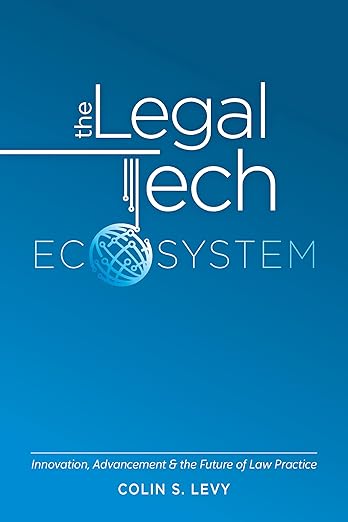
The Legal Tech Ecosystem: Innovation, Advancement & the Future of Law Practice — by Colin Levy (Author), Tatia Gordon-Troy (Editor), Bjarne Tellman (Foreword)

The Legal Tech Ecosystem: Innovation, Advancement & the Future of Law Practice

The legal landscape is evolving at an unprecedented pace, with the seismic shifts of recent years demanding a fresh perspective on the role of technology and innovation within the legal profession. The Legal Tech Ecosystem delves into this essential transformation, shedding light on the crucial interplay between law and technology in today’s complex world.

At its core, this book addresses the profound changes unfolding in the legal domain, driven by macro-economic forces. These changes have placed an ever-increasing burden on legal departments to accomplish more with fewer resources. A quartet of pillars—the explosive growth of regulations, the challenges posed by globalization, the convergence of risk dimensions, and the pressure on corporate profits—has created an environment where legal professionals must adapt swiftly to succeed.


Chatbot hallucinations are poisoning web search — from link.wired.com by Will Knight

The age of generative AI threatens to sprinkle epistemological sand into the gears of web search by fooling algorithms designed for a time when the web was mostly written by humans.


Meta Is Paying Creators Millions for AI Chatbots — from bensbites.beehiiv.com

Meta is shelling out millions to get celebrities to license their likenesses for AI characters in a bid to draw users to its platforms.

Why should I care?
Meta is still all-in on its vision for the metaverse and AI, despite its recent struggles. Meta seems willing to pay top dollar to partner with big names who can draw their massive audiences to use the AI avatars. If the celebrity avatars take off, they could be a blueprint for how creators monetize their brands in virtual worlds. There’s also a chance Meta pulls the plug on funding if user traction is low, just as it did with Facebook Watch originals.


The Post-AI Workplace — from drphilippahardman.substack.com by Dr. Philippa Hartman
SAP SuccessFactors’ new product offers the most comprehensive insight yet into the post-AI workplace & workforce

Skills Maps
AI will be used to categorise, track and analyse employee skills and competencies. This will enable orgs to build a clear idea of pockets of talent and areas in need of focus, providing HR, L&D professionals & managers with the opportunity to take a data-driven approach to talent development and capability building.

Roles Impacted: HR Analysts, Managers, Learning & Development Professionals


More than 40% of labor force to be affected by AI in 3 years, Morgan Stanley forecasts — from cnbc.com by Samantha Subin

Analyst Brian Nowak estimates that the AI technology will have a $4.1 trillion economic effect on the labor force — or affect about 44% of labor — over the next few years by changing input costs, automating tasks and shifting the ways companies obtain, process and analyze information. Today, Morgan Stanley pegs the AI effect at $2.1 trillion, affecting 25% of labor.

“We see generative AI expanding the scope of business processes that can be automated,” he wrote in a Sunday note. “At the same time, the input costs supporting GenAI functionality are rapidly falling, enabling a strongly expansionary impact to software production. As a result, Generative AI is set to impact the labor markets, expand the enterprise software TAM, and drive incremental spend for Public Cloud services.”

Speaking of the changes in the workplace, also see:

 
© 2025 | Daniel Christian