OpenAI announces leadership transition — from openai.com
Chief technology officer Mira Murati appointed interim CEO to lead OpenAI; Sam Altman departs the company. Search process underway to identify permanent successor.

Excerpt (emphasis DSC):

The board of directors of OpenAI, Inc., the 501(c)(3) that acts as the overall governing body for all OpenAI activities, today announced that Sam Altman will depart as CEO and leave the board of directors. Mira Murati, the company’s chief technology officer, will serve as interim CEO, effective immediately.

Mr. Altman’s departure follows a deliberative review process by the board, which concluded that he was not consistently candid in his communications with the board, hindering its ability to exercise its responsibilities. The board no longer has confidence in his ability to continue leading OpenAI.


As a part of this transition, Greg Brockman will be stepping down as chairman of the board and will remain in his role at the company, reporting to the CEO.

From DSC:
I’m not here to pass judgment, but all of us on planet Earth should be at least concerned with this disturbing news.

AI is one of the most powerful set of emerging technologies on the planet right now. OpenAI is arguably the most powerful vendor/innovator/influencer/leader in that space. And Sam Altman is was the face of OpenAI — and arguably for AI itself. So this is a big deal.

What concerns me is what is NOT being relayed in this posting:

  • What was being hidden from OpenAI’s Board?
  • What else doesn’t the public know? 
  • Why is Greg Brockman stepping down as Chairman of the Board?

To whom much is given, much is expected.


Also related/see:

OpenAI CEO Sam Altman ousted, shocking AI world — from washingtonpost.com by Gerrit De Vynck and Nitasha Tiku
The artificial intelligence company’s directors said he was not ‘consistently candid in his communications with the board’

Altman’s sudden departure sent shock waves through the technology industry and the halls of government, where he had become a familiar presence in debates over the regulation of AI. His rise and apparent fall from tech’s top rung is one of the fastest in Silicon Valley history. In less than a year, he went from being Bay Area famous as a failed start-up founder who reinvented himself as a popular investor in small companies to becoming one of the most influential business leaders in the world. Journalists, politicians, tech investors and Fortune 500 CEOs alike had been clamoring for his attention.

OpenAI’s Board Pushes Out Sam Altman, Its High-Profile C.E.O. — from nytimes.com by Cade Metz

Sam Altman, the high-profile chief executive of OpenAI, who became the face of the tech industry’s artificial intelligence boom, was pushed out of the company by its board of directors, OpenAI said in a blog post on Friday afternoon.


From DSC:
Updates — I just saw these items

.
Sam Altman fired as CEO of OpenAI — from theverge.com by Jay Peters
In a sudden move, Altman is leaving after the company’s board determined that he ‘was not consistently candid in his communications.’ President and co-founder Greg Brockman has also quit.


OpenAI Is Slowly Killing Prompt Engineering With The Latest ChatGPT and DALL-E Updates — from artificialcorner.substack.com by
ChatGPT and DALL-E 3 now do most of the prompting for us. Does this mean the end of prompt engineering?

Prompt engineering is a must-have skill that any AI enthusiast should have … at least until OpenAI released GPTs and DALL-E 3.

OpenAI doesn’t want to force users to learn prompt engineering to get the most out of its tools.

It seems OpenAI’s goal is to make its tools as easy to use as possible allowing even non-tech people to create outstanding AI images and tailored versions of ChatGPT without learning prompting techniques or coding.

AI can now generate prompts for us, but is this enough to kill prompt engineering? To answer this, let’s see how good are these AI-generated prompts.

From DSC:
I agree with several others that prompt engineering will be drastically altered…for the majority of us, I wouldn’t spend a lot of time becoming a Prompt Engineer.


.


Don’t Believe the Hype? Practical Thoughts About Using AI in Legal (Stephen Embry – TechLaw Crossroads) — from tlpodcast.com by Stephen Embry

Despite the hype and big promises about AI, if it is used correctly, could it be the differentiator that sets good legal professionals apart from the pack? Stephen Embry offers a good argument for this in the latest episode.

Stephen is a long-time attorney and the legal tech aficionado behind the TechLaw Crossroads blog– a great resource for practical and real-world insight about legal tech and how technology is impacting the practice of law. Embry emphasizes that good lawyers will embrace artificial intelligence to increase efficiency and serve their clients better, leaving more time for strategic thinking and advisory roles.


Be My Eyes AI offers GPT-4-powered support for blind Microsoft customers — from theverge.com by Sheena Vasani
The tech giant’s using Be My Eyes’ visual assistant tool to help blind users quickly resolve issues without a human agent.


From DSC:
Speaking of Microsoft and AI:


Unpacking 3 major trends in ed tech and for-profit education — from highereddive.com by Natalie Schwartz
CEOs of major companies recently told investors how they fared in their most recent financial quarters, offering insight into the broader higher ed sector.

Education companies double down on degree programs

These programs allow Coursera users to count open courses they complete on the platform toward credit for degree programs. Students can also be admitted to degree programs based on their performance in these courses,Maggioncalda said.

Coursera recently announced it had built several of these pathways to master’s degrees offered by Illinois Tech. Coursera users can now complete professional certificates offered on the website — including from Google, IBM and Meta — as credit toward these programs.


Report Finds Students Struggling with Being Prepared for Courses and Increasingly Turning to Generative AI, Social Media to Study — from campustechnology.com by Kate Lucariello

In its second annual 2023 “Study Trends Report,” McGraw Hill found that college students were feeling unprepared for their courses, but also that they have turned to generative AI and social media to study and would like more learning resources in a similar format.

The study, conducted by Morning Consult between July 18 and Aug. 11, 2023, surveyed 500 undergraduate college students and 200 college instructors. Some of the key findings include:


The Plot To Kill Shop Class — by Ryan Craig

I suspect College Board may be trying to repent for its original sin: killing vocational education. Now known as career and technical education (CTE), America’s college-or-bust mentality has long relegated CTE to a shadowy corner of high school.

But make no mistake: the College Board’s fingerprints are on the weapon that killed CTE. College Board launched Advanced Placement courses in 1955 with 500 students across 18 elite schools like Andover, Bronx Science, and Newton High School. The original idea was guiltless: more challenging curricula for gifted and talented students to accelerate the development of leaders and win the Cold War. But it soon became clear that AP’s primary purpose would be to give students a leg up in competitive college admissions; as early as 1960, Exeter worried about “a dangerous tendency to regard advanced placement teachers and students as an elite worthy of special praise.”

When College Board’s primary source of revenue (and profits) is AP courses and demand for AP is driven by a weighted GPA formula that discriminates against all other forms of education, any attempt to create a level playing field between career discovery and college is window dressing: CTE theater. College Board knows which side its bread is buttered on (hint: it’s in its name).


2U, USC Curtail Online Partnership — from insidehighered.com by Doug Lederman
Southern California and the online program manager will part ways on master’s degrees that became a target of scrutiny because of their high price.

Which makes it fitting, perhaps, that Thursday 2U and USC announced that that they would largely wind down their 15-year partnership, which in the eyes of consumer advocates and some journalists had come to exemplify how involving companies intimately in the delivery of education could undermine, rather than expand, access and affordability to higher education.


edX and Jobs for the Future Offer Free MicroBachelors Programs — from campustechnology.com by Kate Lucariello

Three MicroBachelor programs are currently available:

  • Statistics Fundamentals and Mathematics and Statistics Fundamentals from The London School of Economics;
  • Marketing Essentials and Business and Professional Communication for Success from Doane University; and
  • Full Stack Application Development from IBM.

PROOF POINTS: Professors say high school math doesn’t prepare most students for their college majors — from hechingerreport.org


AI Pedagogy Project, metaLAB (at) Harvard
Creative and critical engagement with AI in education. A collection of assignments and materials inspired by the humanities, for educators curious about how AI affects their students and their syllabi

AI Guide
Focused on the essentials and written to be accessible to a newcomer, this interactive guide will give you the background you need to feel more confident with engaging conversations about AI in your classroom.


From #47 of SAIL: Sensemaking AI Learning — by George Siemens

Excerpt (emphasis DSC):

Welcome to Sensemaking, AI, and Learning (SAIL), a regular look at how AI is impacting education and learning.

Over the last year, after dozens of conferences, many webinars, panels, workshops, and many (many) conversations with colleagues, it’s starting to feel like higher education, as a system, is in an AI groundhog’s day loop. I haven’t heard anything novel generated by universities. We have a chatbot! Soon it will be a tutor! We have a generative AI faculty council! Here’s our list of links to sites that also have lists! We need AI literacy! My mantra over the last while has been that higher education leadership is failing us on AI in a more dramatic way than it failed us on digitization and online learning. What will your universities be buying from AI vendors in five years because they failed to develop a strategic vision and capabilities today?


AI + the Education System — from drphilippahardman.substack.com Dr. Philippa Hardman
The key to relevance, value & excellence?


The magic school of the future is one that helps students learn to work together and care for each other — from stefanbauschard.substack.com by Stefan Bauschard
AI is going to alter economic and professional structures. Will we alter the educational structures?

(e) What is really required is a significant re-organization of schooling and curriculum. At a meta-level, the school system is focused on developing the type of intelligence I opened with, and the economic value of that is going to rapidly decline.

(f). This is all going to happen very quickly (faster than any previous change in history), and many people aren’t paying attention.  AI is already here.


Solving the early intervention staffing crisis — from hechingerreport.org by Sarah Carr

Eighty-seven percent of states lack enough speech language pathologists to reach all the infants and toddlers in need. Eighty-two percent suffer from physical therapist shortages. And among the service coordinators who organize critical therapies for America’s youngest children, the turnover rate is a stunning 42 percent, according to information compiled by the IDEA Infant and Toddler Coordinators Association from a survey that had 45 state respondents. (The K-12 teacher turnover rate, by contrast, only reached a mere 10 percent during the pandemic.)

With all the attention recently to the teacher and child care worker shortages in communities across America, the sector facing the most severe crisis has received comparatively little notice from policy makers, the media or the general public: those providing critical early intervention therapies for children under age 3 with developmental delays.


9 Tips for Using AI for Learning (and Fun!) — from edutopia.org by Daniel Leonard; via Donna Norton on X/Twitter
These innovative, AI-driven activities will help you engage students across grade levels and subject areas.

Here are nine AI-based lesson ideas to try across different grade levels and subject areas.

ELEMENTARY SCHOOL

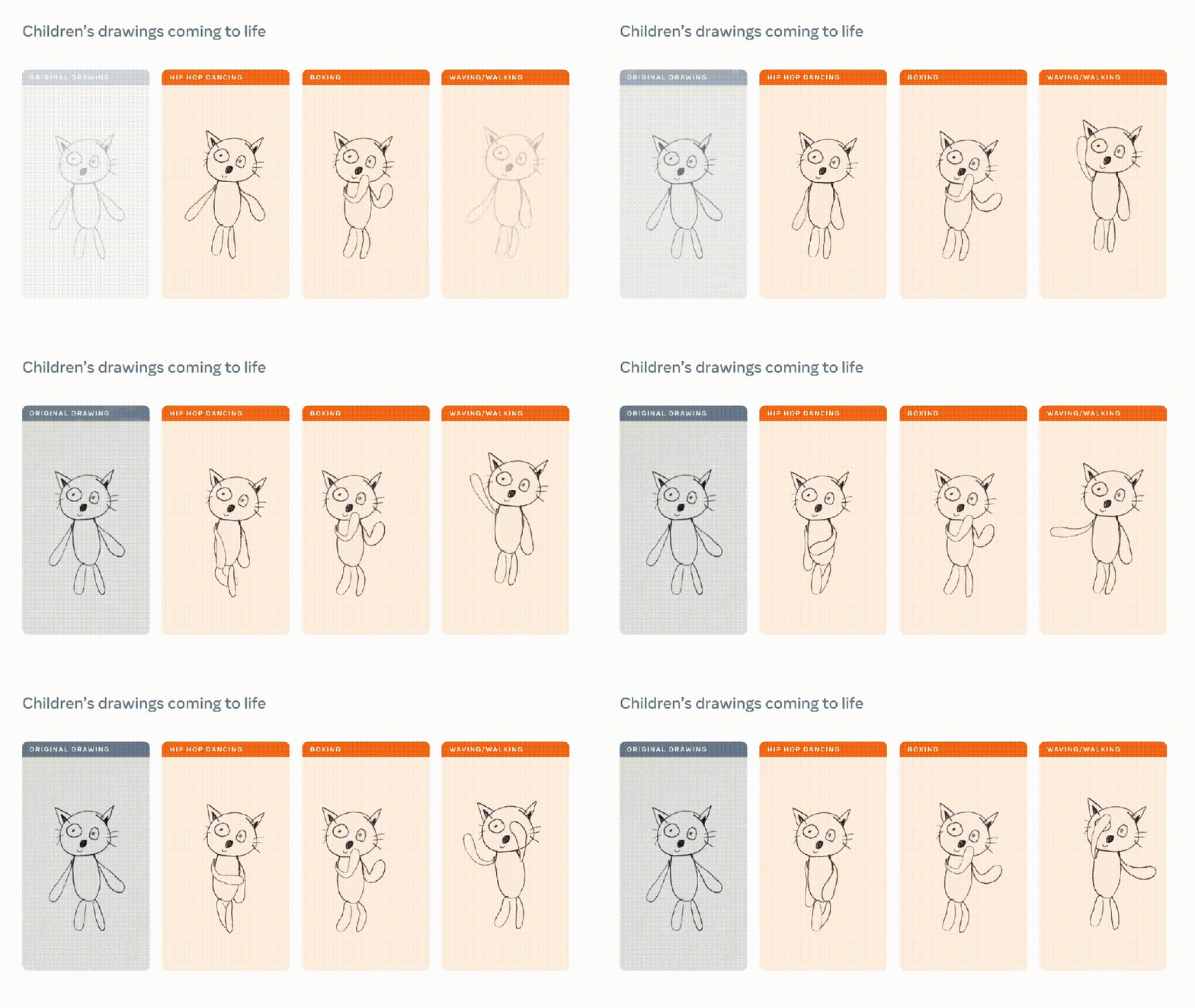
AI-generated Animated Drawing of artwork

Courtesy of Meta AI Research
A child’s drawing (left) and animations created with Animated Drawings.

.

1. Bring Student Drawings to Life: Young kids love to sketch, and AI can animate their sketches—and introduce them to the power of the technology in the process.

HIGH SCHOOL

8. Speak With AI in a Foreign Language: When learning a new language, students might feel self-conscious about making mistakes and avoid practicing as much as they should.


Though not necessarily about education, also see:

How I Use AI for Productivity — from wondertools.substack.com by Jeremy Caplan
In this Wonder Tools audio post I share a dozen of my favorite AI tools

From DSC:
I like Jeremy’s mentioning the various tools that he used in making this audio post:


Where a developing, new kind of learning ecosystem is likely headed [Christian]

From DSC:
As I’ve long stated on the Learning from the Living [Class]Room vision, we are heading toward a new AI-empowered learning platform — where humans play a critically important role in making this new learning ecosystem work.

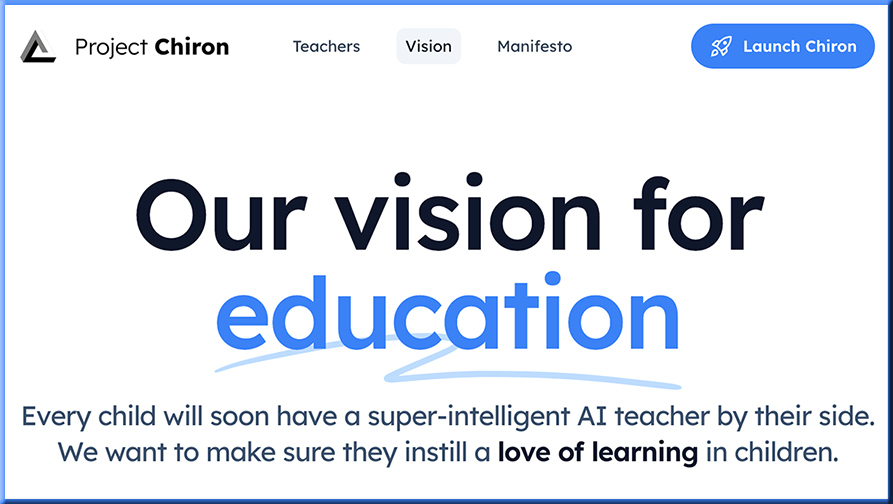
Along these lines, I ran into this site out on X/Twitter. We’ll see how this unfolds, but it will be an interesting space to watch.

Project Chiron's vision: Our vision for education Every child will soon have a super-intelligent AI teacher by their side. We want to make sure they instill a love of learning in children.


From DSC:
This future learning platform will also focus on developing skills and competencies. Along those lines, see:

Scale for Skills-First — from the-job.beehiiv.com by Paul Fain
An ed-tech giant’s ambitious moves into digital credentialing and learner records.

A Digital Canvas for Skills
Instructure was a player in the skills and credentials space before its recent acquisition of Parchment, a digital transcript company. But that $800M move made many observers wonder if Instructure can develop digital records of skills that learners, colleges, and employers might actually use broadly.

Ultimately, he says, the CLR approach will allow students to bring these various learning types into a coherent format for employers.

Instructure seeks a leadership role in working with other organizations to establish common standards for credentials and learner records, to help create consistency. The company collaborates closely with 1EdTech. And last month it helped launch the 1EdTech TrustEd Microcredential Coalition, which aims to increase quality and trust in digital credentials.

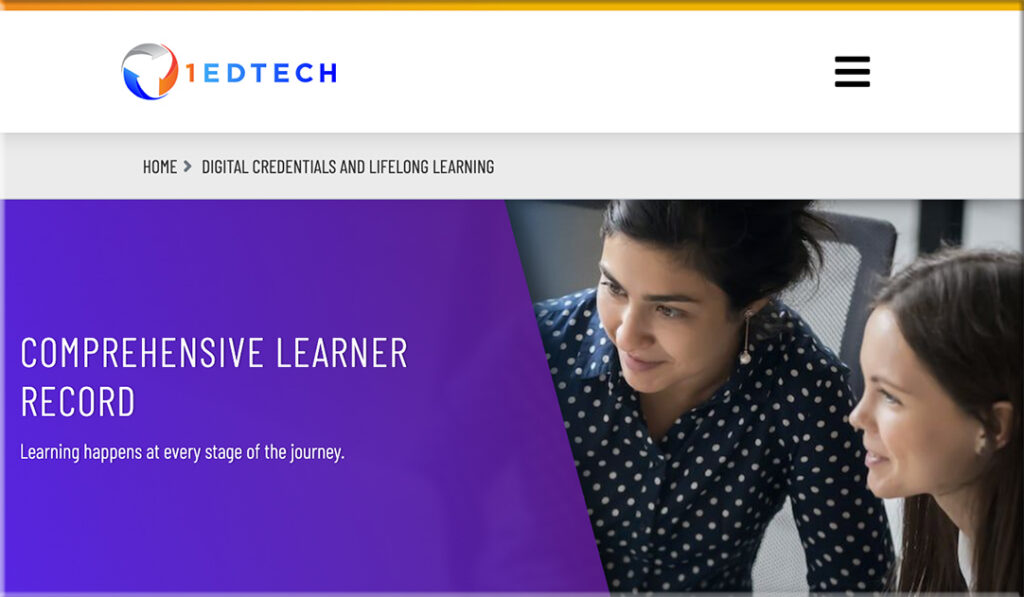
Paul also links to 1EDTECH’s page regarding the Comprehensive Learning Record


“We need more high-impact learning practices in prison” — from college-inside.beehiiv.com by Charlotte West
Internships, apprenticeships, and work learning opportunities allow incarcerated students to keep learning after they graduate.

Maine and other states like Colorado are trying to tackle this issue through internships and employment opportunities that allow incarcerated students and graduates to put their professional knowledge and skills into practice — and in some cases, earn a living wage while doing so.

Employment and professional training opportunities inside were a major theme at the 2023 National Conference for Higher Education in Prison, where 800 educators, administrators, students and alumni from dozens of prison education programs gathered in Atlanta, Georgia last week.


The new apprenticeships — from jordanfurlong.substack.com by Jordan Furlong
Several American states are rewriting the rules of lawyer licensure and bringing the US into line with a key element of lawyer formation worldwide: supervised practice.

Change comes so gradually and fitfully to the legal sector that when something truly revolutionary happens — an actual turning point with an identifiable real-world impact — we have to mark the occasion. One such revolution broke out in the United States last week, opening up fantastic new possibilities for Americans who want to become lawyers.

The Oregon Supreme Court approved a new licensure program that does not require passage of a traditional written bar exam. After graduating from law school, aspiring Oregon lawyers can complete 675 hours of paid legal work under the supervision of an experienced attorney, assembling a portfolio of legal work to be assessed by bar admission officials. Candidates must submit eight samples of legal writing, take the lead in at least two initial client interviews or client counseling sessions, and oversee two negotiations, among other requirements.

Jordan mentions what’s going on in several other states including:

  • Utah
  • Washington
  • Minnesota
  • Nevada
  • California
  • Massachusetts
  • South Dakota

From DSC:
The Bar Exam doesn’t have a good reputation for actually helping get someone ready to practice law. So this is huge news indeed! The U.S. needs more people/specialists at the legal table moving forward. The items Jordan relays in this posting are a huge step forward in making that a reality.


For other innovations within the legal realm, see:

LawSchoolAi — from youtube.com

Picture this: A world where anyone can unlock the doors to legal expertise, no matter their background or resources. Introducing Law School AI – the game-changing platform turning this vision into reality. Our mission? To make legal education accessible, affordable, and tailored to every learner’s unique style, by leveraging the power of artificial intelligence.

As a trailblazing edtech company, Law School AI fuses cutting-edge AI technology with modern pedagogical techniques to craft a personalized, immersive, and transformative learning experience. Our platform shatters boundaries, opening up equal opportunities for individuals from all walks of life to master the intricacies of law.

Embrace a new era of legal education with Law School AI, where the age-old law school experience is reimagined as a thrilling, engaging, and interactive odyssey. Welcome to the future of legal learning.


What is assistive technology?— from understood.org by Andrew M.I. Lee, JD; expert reviewed by Shelley Haven
Assistive technology (AT) are tools that let people with differences work around challenges. They make tasks and activities accessible at school, work, and home. Learn how AT apps and software can help with reading, writing, math, and more.

What you’ll learn

  • Assistive technology devices
  • Assistive technology services
  • Myths about assistive technology
  • Selecting and using assistive technology


From GPTs (pt. 3) — from theneurondaily.com by Noah Edelman

BTW, here are a few GPTs worth checking out today:

  • ConvertAnything—convert images, audio, videos, PDFs, files, & more.
  • editGPT—edit any writing (like Grammarly inside ChatGPT).
  • Grimoire—a coding assistant that helps you build anything!

Some notes from Dan Fitzpatrick – The AI Educator:

Custom GPT Bots:

  • These could help with the creation of interactive learning assistants, aligned with curricula.
  • They can be easily created with natural language programming.
  • Important to note users must have a ChatGPT Plus paid account

Custom GPT Store:

  • Marketplace for sharing and accessing educational GPT tools created by other teachers.
  • A store could offer access to specialised tools for diverse learning needs.
  • A store could enhance teaching strategies when accessing proven, effective GPT applications.

From DSC:
I appreciate Dan’s potential menu of options for a child’s education:

Monday AM: Sports club
Monday PM: Synthesis Online School AI Tutor
Tuesday AM: Music Lesson
Tuesday PM: Synthesis Online School Group Work
Wednesday AM: Drama Rehearsal
Wednesday PM: Synthesis Online School AI Tutor
Thursday AM: Volunteer work
Thursday PM: Private study
Friday AM: Work experience
Friday PM: Work experience

Our daughter has special learning needs and this is very similar to what she is doing. 

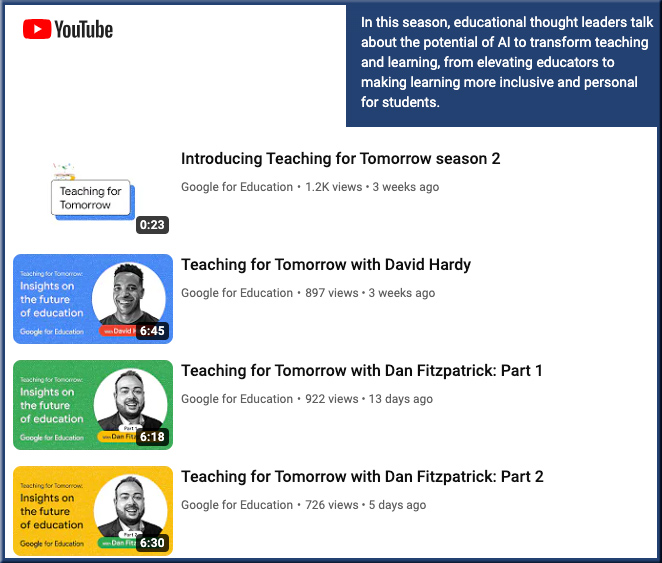
Also, Dan has a couple of videos out here at Google for Education:


Tuesday’s AI Ten for Educators (November 14) — from stefanbauschard.substack.com by Stefan Bauschard
Ten AI developments for educators to be aware of

Two boxes. In my May Cottesmore presentation, I put up two boxes:

(a) Box 1 — How educators can use AI to do what they do now (lesson plans, quizzes, tests, vocabulary lists, etc.)

(b) Box 2 — How the education system needs to change because, in the near future (sort of already), everyone is going to have multiple AIs working with them all day, and the premium on intelligence, especially “knowledge-based” intelligence, is going to decline rapidly. It’s hard to think that significant changes in the education system won’t be needed to accommodate that change.

There is a lot of focus on preparing educators to work in Box 1, which is important, if for no other reason than that they can see the power of even the current but limited technologies, but the hard questions are starting to be about Box 2. I encourage you to start those conversations, as the “ed tech” companies already are, and they’ll be happy to provide the answers and the services if you don’t want to.

Practical suggestions: Two AI teams in your institution. Team 1 works on Box A and Team 2 works on Box B.

 
© 2025 | Daniel Christian