Why Sal Khan’s AI revolution hasn’t happened yet, according to Sal Khan — from chalkbeat.org by Matt Barnum

Three years ago, as Khan Academy founder Sal Khan rolled out an AI-powered tutoring chatbot, he predicted a revolution in learning.

So far, the revolution hasn’t happened, he acknowledges.

“For a lot of students, it was a non-event,” Khan told me recently about his eponymous chatbot, Khanmigo. “They just didn’t use it much.”

Khan gives this analogy: Imagine he walked into a class, sat in the back of the room, and waited for students to seek out help. “Some will; most won’t,” he said. That’s been the experience with AI tutoring, he said. It doesn’t necessarily make students motivated to learn or fill in gaps in knowledge needed to ask questions.

“AI is going to help,” said Khan of this reimagined Khan Academy. “But I think our biggest lever is really investing in the human systems.”


Recording at LegalWeek in New York, Zach sits down with Shlomo Klapper (founder of Learned Hand) and Bridget McCormack, former Chief Justice of the Michigan Supreme Court and now CEO of the American Arbitration Association, to challenge one of the biggest double standards in legal AI: “AI for me, but not for thee.” Lawyers are now widely using AI like #Harvey and #Legora — and now more than ever #claude — but the moment it touches judges or arbitrators, support drops off.

That hesitation comes as courts are under real strain, with judges handling thousands of cases a year and only minutes to decide each one, and no realistic way to keep up. Shlomo describes Learned Hand’s “AI law clerk,” built to support judicial research, analysis, and drafting, while Bridget brings the perspective of someone who has both made decisions on the bench and has pioneered the American Arbitration Association’s AI Arbitrator, a first of its kind. The conversation moves beyond AI as an assistant and into a harder shift: AI as part of decision-making itself, and whether the system can continue to function without it.


Also see:

Are Judges the Next To Adopt AI? Is That a Good Thing? — from legallydisrupted.com by Zach Abramowitz
Episode 46 of Legally Disrupted Has the Two Best Experts on the Topic

This brings us to an admitted, glaring double standard between lawyers and judges. Lawyers are totally fine with lawyers using AI, but those same lawyers become apoplectic at the thought of judges or arbitrators using AI. It is very much “AI for me, but not for thee.” A survey last year from White & Case and Queen Mary University of London School of Law showed that nearly 90% of lawyers were deeply supportive of AI for their own research and analytics, but that support drops to just 23% when it comes to a judge or arbitrator using it to make a decision.

Yet, despite that hullabaloo, there is a massive need for alternative forms of intelligence in our courts. Right now, the system is drowning. We have state court trial judges disposing of 2,500 cases a year, meaning they have barely half an hour to spend on a single case. We are simply not going to lawyer our way out of this 50-year backlog. If we just use humans, we have a massive demand for intelligence but a severely limited supply. AI could step in to give these judges the capacity they desperately need for the courts to actually function.


An Attack on Sam Altman Sends a Terrifying Message — from the nytimes.com; this is a gifted opinion article by Aaron Zamost

Lawless political violence landed on Silicon Valley’s doorstep this month when an attacker hurled a Molotov cocktail at the San Francisco compound of Sam Altman, OpenAI’s chief executive. The incident was a disturbing sign that simmering public anger about A.I. is spilling out of polling data and social media posts and into the real world.

The attack shook many tech employees, who in quiet conversations about safety wondered whether this was a watershed moment for the industry. I believe it should be — the whole thing is disturbing and jarring, but I’m hopeful it will change how some tech leaders deal with the societal consequences of their success.

If these companies sold food, cars, medicine or any other consumer goods, their products would almost certainly be recalled while federal regulators investigated the allegations.

You would think an industry creating this kind of outrage would reflect or recalibrate. Business experts teach us that companies facing customer backlash should acknowledge the failure, change their approach and earn back public trust. But the titans of tech no longer seem interested in convincing the public.

The foundation of Silicon Valley’s appeal has always been the implicit promise that great technology serves you, and that the people behind it understand your problems and want to solve them. That promise is starting to feel broken. Fixing it requires something much of Silicon Valley has forgotten how to do: listen and learn.

A Molotov cocktail is the absolute wrong way to send a message to tech. Its leaders need to hear it anyway.


The Role of Faculty in the University of the Future — from er.educause.edu by Tanya Gamby, David Kil, Rachel Koblic, Paul LeBlanc, Mihnea Moldoveanu, and George Siemens
In the age of AI, the true future of higher education lies not in replacing faculty but in freeing them to do what only humans can—build meaningful relationships, cultivate wisdom, and guide students through the ethical and intellectual challenges machines cannot navigate.

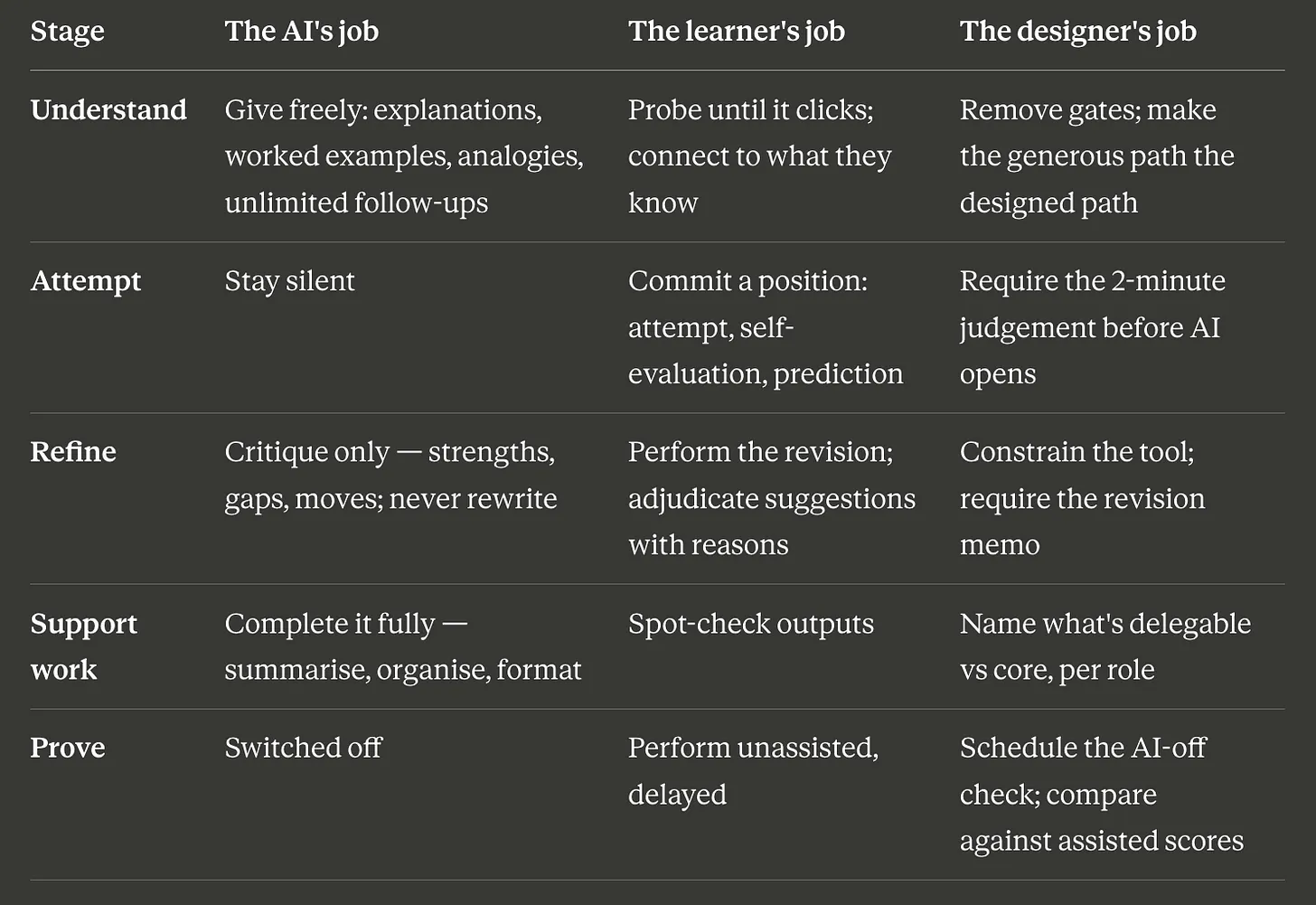
Today, the work of knowledge transfer is often done better, faster, with more precision, and more patiently by AI. These systems can provide nonjudgmental, individualized learning opportunities twenty-four hours a day, seven days a week. Think of AI as a “genius teaching assistant” who assumes much of the work of basic knowledge transfer, unlocking learning when students get stuck and providing real-time assessment. Such a genius TA would offer faculty dashboards that update student progress, flag those who are struggling, and recommend targeted interventions. These tasks free faculty to focus on building genuine relationships with students, using the classroom to foster human skills, and curating community. This may be the great gift of AI to education. But it requires a profound reimagining of faculty roles—perhaps the single biggest hurdle to reimagining higher education, and equally its greatest opportunity.

A concerned faculty member might hear all this and conclude they are becoming obsolete. The opposite is true. The evolution of faculty roles demands more—not less—of what makes a great teacher.

This means intervening in high-impact moments when the genius TA has not unlocked learning; curating class time to lift students from knowing material to applying it in contexts that require critical thinking, judgment, and discernment; and cultivating the human skills that will be most prized in the age of AI: effective communication, constructive dialogue, empathy, creativity, and professional disposition. Most importantly, it means building genuine relationships with students—that make them feel like they matter—the kind that fuels transformation.


From DSC:
A quick comment on one of the sentences in the article, which asserts:

Centers for teaching and learning, which have long supported faculty development at many institutions, will be among the busiest places on campus in the years ahead.

I would change the word will be to should:

Centers for teaching and learning, which have long supported faculty development at many institutions, should be among the busiest places on campus in the years ahead.

For that statement to be true, centers for teaching and learning need to be well-versed in the tools and pedagogies involved, plus in learning science. Those centers need to have credibility for faculty members to value their services. And that’s just it, isn’t it? The faculty members need to see those centers for teaching and learning as having something that they lack…that they need assistance with. Otherwise, if such centers are just viewed as superfluous, nothing much will change.

Also, my experience has been that if those centers for teaching and learning are in an IT group/department, they should be moved to the academic side of the house instead. Many faculty members don’t value people from IT enough to make changes in how they teach — no matter how qualified those people are. They view those people as “IT” only.


You might also be interested in the other articles in that series:


Some Scripture for us

Romans 5:10

For if, while we were God’s enemies, we were reconciled to him through the death of his Son, how much more, having been reconciled, shall we be saved through his life!

Romans 14:11

It is written:

“‘As surely as I live,’ says the Lord,
‘every knee will bow before me;
every tongue will acknowledge God.’”[a]


AI for Your Next Career Move — from wondertools.substack.com by Jeremy Caplan
Free tools to explore, research, and interview better

AI tools can serve as patient assistants when you’re looking for a job. Use them to organize your search. Or to challenge your assumptions about potential jobs. They can also help you present your strengths more persuasively. When you’re changing fields, or trying to move up, AI can help you stand out.

1. Visualize Your Career Options
Try: Google’s
Career Dreamer

What it is: A free tool for exploring jobs adjacent to yours. See a map of professional fields related to your interests.

How to use it: Start by typing in a current or previous role. Or name a job that interests you. Use up to five words. You can also name a specific organization or industry, if you have one in mind.

Career Dreamer asks what work activities interest you, then maps related career paths. Pick one at a time to explore.

You can then browse actual job openings. Refine the search based on location, company size, or other factors you care about.


From DSC:
I wish I had learned about the important financial, legal, and medical things (that are covered in the gifted article below) in high school!


How to Help Your Aging Loved Ones Plan for the Future— a gifted article from nytimes.com by Elie Levine
Learn as much as you can about setting up the financial, legal and medical components of late-in-life care — and do it earlier than you might think.

Making end-of-life plans for your loved ones can feel like a burden. It is, almost by definition, complicated, and it might require having difficult conversations and sorting through a seemingly endless stream of forms and terminology. But it’s essential to your family’s well-being — and it’s worth doing earlier than you might think.

The first thing to know: There’s no one-size-fits-all approach to planning. But think of this as a starter kit that covers how to handle your parents’ current or future health challenges, and how they’ll pay for medical care. (Knowing about their medications, current finances and living situation can also help you prepare for an emergency medical situation.) Below are some of the questions to consider and discuss with your loved ones.


The “Cognitive Offloading” Paradox — from drphilippahardman.substack.com by Dr. Philippa Hardman
New research shows that offloading learning tasks to AI can improve – rather than erode – human thinking and learning

The Rise of the “Offloading Paradox”
In March 2026, the International Journal of Educational Technology in Higher Education published a study that went beyond the question “does offloading hurt?” and asked a harder one: when students form genuine partnerships with AI — treating it as an intellectual collaborator rather than a passive tool — what actually happens to the way they think and learn? Specifically, do two cognitive responses — critical evaluation of AI outputs (what the researchers call cognitive vigilance) and strategic delegation to AI (cognitive offloading) — compete with each other, or can they coexist?

Based on previous research, Wang and Zhang hypothesised that cognitive offloading would hurt transformative learning. They expected the familiar story: delegation reduces cognitive struggle, struggle is where learning happens, therefore delegation undermines learning.

The study — 912 students across China, Europe, and the United States, using a three-wave time-lagged survey design that measured partnership orientation first, cognitive strategies two weeks later, and learning outcomes two weeks after that — found something more interesting than a simple reversal.


Make learning accessible to all in higher education — from The Times Higher Education

When accessibility is placed at the heart of teaching and learning, rather than treated as a bolt-on, every student benefits. This week’s spotlight guide offers advice on designing universally accessible learning, in-person and online. Find out how to ease the burden of disability disclosure with universal design for learning, better support neurodivergent students and students with hearing or vision issues, design more accessible assessments and ensure digital tools work for all.


This Is a Hard Time to Start a Career. These Two Words Can Help. — a gifted article from nytimes.com by Jodi Kantor
Advice on building a rewarding work life, even amid employment gloom.

If you’re sweating about what field to enter, here are a few things you can do now. Buy a cheap, thin notebook. Keep it on you. Every week, make a practice of writing down which actions you enjoy and which ones you hate, whom you like being around and whom you can’t stand. Keep running lists of what you’re good at and what ideas move you. Notice yourself.

Look to your friends instead. Think about what roles you take on with them: math tutor, party planner, psychologist, workout coach. These answers often reveal truths that our résumés do not. In social relationships, we aren’t bound by suffocating expectations about our future. Our friends have needs, and by noticing how we respond to them, we can learn who we are.

There is a wiser way to seize the future, which is to think about need. What is your own assessment of what society will need most during your working years, the next four or five decades? What kind of care; what kind of products; what kind of information?

The people I see thriving at work are the ones who chased some bigger need — not imposed by hollow conventional wisdom, but articulated through independent observation. Craft gives their work authority. Need gives it propulsion.


“Learning ecosystems begin with people.” — Getting Smart


ASU/GSV Summit

There’s something about walking into a space like the ASU+GSV Summit that feels a little like stepping into a living, breathing idea. You hear fragments of possibility in passing conversations, see it in the way people lean in a little closer during sessions, feel it in the quiet moments when something lands and you know it’s going to stay with you. This year, what lingered wasn’t just the talk of innovation; it was a deeper pull toward something more human. A reminder that before we build better systems, we have to create better conditions for dreaming. And there’s a kind of quiet joy that emerges when educators find each other in that work, when ideas connect, and you can feel the bridges across networks and ecosystems getting stronger in real time.

And dreaming is not a given. It requires space, safety, and adults who understand the weight of what they’re holding. The most powerful moments weren’t about what we can do for learners, but how we show up with them. Adults who are still learning, still stretching, still willing to have their thinking reshaped are the ones who make room for young people to imagine beyond what they’ve seen. That kind of space doesn’t happen by accident. It’s protected. It’s intentional. It’s built by people who know their non-negotiables, who draw clear lines around dignity and belonging so learners can take risks without fear of losing themselves in the process.

Across conversations on pathways, experience, and AI, there was a steady undercurrent. Knowledge alone isn’t carrying the day anymore. Young people need chances to test, to try, to wrestle with ideas in real contexts. That’s where wisdom starts to take shape. AI showed up as a partner in that work, not the main character, but a tool that can expand thinking when used well. Still, the heartbeat of it all is human. It’s the relationships, the networks, the shared belief that we don’t have to do this alone. When adults come together to learn, to challenge each other, and to build something bigger than their own corner, they create the kind of ecosystems where young people don’t just prepare for the future, they begin to shape it.


Also from Getting Smart:


From DSC:
It’s great to see this type of good news for a change!


Tiny Traverse City restaurant sells more than 3,000 burgers in one day – all to help a competitor — this is a gifted article (which lasts for 7 days) out at mlive.com, by Tanda Gmiter

TRAVERSE CITY, MI – The long line out the door and down the street of the little Oakwood Proper Burgers shop was a head-turner Saturday as the restaurant invited people to its 1,000 Burger Challenge event.

But the swift sales being rung up inside weren’t benefitting their own business. Instead, they were a heartfelt helping hand to a competitor across town.

The team behind Oakwood Proper – as well as several other restaurant friends from the area – joined together to raise money for “Chef Tim” Bergstrom, the man behind his namesake Bergstrom’s Burgers. He’s been undergoing cancer treatment for some time now, and medical bills are mounting.
.


Which Jobs Are Most at Risk From AI? New Anthropic Data Offers Clues. — from builtin.com by Matthew Urwin
Anthropic set out in its latest study to predict how artificial intelligence could impact the labor market. Instead, its findings raise more questions than answers for tech workers as the U.S. government refuses to regulate the AI industry.

Summary:
In its latest labor market study, Anthropic found that artificial intelligence poses the greatest threat to software jobs, women and younger professionals. As the Trump administration takes a hands-off approach to AI, tech workers may be left to grapple with these findings on their own.


Matthew links to:

Labor market impacts of AI: A new measure and early evidence — from anthropic.com

Key findings

  • We introduce a new measure of AI displacement risk, observed exposure, that combines theoretical LLM capability and real-world usage data, weighting automated (rather than augmentative) and work-related uses more heavily
  • AI is far from reaching its theoretical capability: actual coverage remains a fraction of what’s feasible
  • Occupations with higher observed exposure are projected by the BLS to grow less through 2034
  • Workers in the most exposed professions are more likely to be older, female, more educated, and higher-paid
  • We find no systematic increase in unemployment for highly exposed workers since late 2022, though we find suggestive evidence that hiring of younger workers has slowed in exposed occupations


© 2025 | Daniel Christian