Boosting Student Engagement with Interactive and Practical Teaching Methods — from campustechnology.com by Dr. Lucas Long

One of my biggest goals as an educator is to show students how the material they learn in class can be applied to real-world situations. In my finance courses, this often means taking what we’re learning about financial calculations and connecting it to decisions they’ll have to make as adults. For example, I’ve used real-life scenarios like buying a car with a loan, paying off student debt, saving for a wedding, or calculating mortgage payments for a future home purchase. I even use salary data to show students what they could realistically afford given average salaries after graduation, helping them relate to the financial decisions they will face after college.

These practical examples don’t just keep students engaged; they also demonstrate the immediate value of learning financial principles. I often hear students express frustration when they feel like they’re learning concepts that won’t apply to their lives. But when I use real scenarios and provide tools like financial calculators to show them exactly how they’ll use this knowledge in their future, their attitude changes. They become more motivated to engage with the material because they see its relevance beyond the classroom.


Career Cluster Appendix — from gettingsmart.com
New technology, global challenges and initiatives point to new pathways and new opportunities in our economies career clusters. The following resources highlight exemplars, entrepreneurial opportunities and high schools who are leading the way in pathway development and implementation. 


Google’s worst nightmare just became reality — from aidisruptor.ai by Alex McFarland
OpenAI just launched an all-out assault on traditional search engines.

Google’s worst nightmare just became reality. OpenAI didn’t just add search to ChatGPT – they’ve launched an all-out assault on traditional search engines.

It’s the beginning of the end for search as we know it.

Let’s be clear about what’s happening: OpenAI is fundamentally changing how we’ll interact with information online. While Google has spent 25 years optimizing for ad revenue and delivering pages of blue links, OpenAI is building what users actually need – instant, synthesized answers from current sources.

The rollout is calculated and aggressive: ChatGPT Plus and Team subscribers get immediate access, followed by Enterprise and Education users in weeks, and free users in the coming months. This staged approach is about systematically dismantling Google’s search dominance.


Open for AI: India Tech Leaders Build AI Factories for Economic Transformation — from blogs.nvidia.com
Yotta Data Services, Tata Communications, E2E Networks and Netweb are among the providers building and offering NVIDIA-accelerated infrastructure and software, with deployments expected to double by year’s end.


In ‘Hidden Portraits,’ Volker Hermes Reimagines Historical Figures in Overwhelming Frippery — fromthisiscolossal.com by Kate Mothes and Volker Hermes


“The Promised Night” by Photographer Alfonso Bricegno — from booooooom.com


Undergraduate enrollment rises 3% despite drop in first-year students, early data shows — from highereddive.com by Laura Spitalniak
Headcounts declined among students attending college directly after high school, the National Student Clearinghouse Research Center found.

Dive Brief:

  • Undergraduate enrollment rose this fall for the second year in a row, up 3% compared to similar early data from fall 2023, according to preliminary figures released Wednesday by the National Student Clearinghouse Research Center.
  • Enrollment jumped 1.9% in bachelor’s degree programs and 4.3% in those for associate degrees. While all credential types saw gains, the number of undergraduate certificate seekers increased the most, at 7.3%.
  • However, enrollment among first-year students shrank 5%, the first dip since the decline seen at the start of the pandemic. Declining enrollment among 18-year-olds — a proxy for students who attend college directly after high school — accounted for most of that drop, the clearinghouse said.

What preliminary enrollment data from fall 2024 tells us — from highereddive.com by Laura Spitalniak
Higher education experts broke down some trends in the early data and what may have prompted the decline in first-year students.

Higher education news tends to be a mixed bag, and the most recent enrollment report from the National Student Clearinghouse Research Center is no exception.

Last week, the clearinghouse released preliminary findings for fall 2024 and found that undergraduate enrollment rose 3% compared with early data from last year. On the other hand, it showed enrollment among first-year students dropped 5% compared with the year before, the first decline since the drop at the start of the pandemic.

The youngest adults, 18-year-olds, drove a majority of the decrease, according to the clearinghouse. Its researchers used this group as a proxy for students who enroll in postsecondary education directly after they graduate high school, it said.


10 Graphic Design Trends to Pay Attention to in 2025 — from graphicmama.com by Al Boicheva

We’ll go on a hunt for bold, abstract, and naturalist designs, cutting-edge AI tools, and so much more, all pushing boundaries and rethinking what we already know about design. In 2025, we will see new ways to animate ideas, revisit retro styles with a modern twist, and embrace clean, but sophisticated aesthetics. For designers and design enthusiasts alike, these trends are set to bring a new level of excitement to the world of design.

Here are the Top 10 Graphic Design Trends in 2025:


AI Tutors Double Rates of Learning in Less Learning Time — by drphilippahardman.substack.com Dr. Philippa Hardman
Inside Harvard’s new groundbreaking study

Conclusion
This Harvard study provides robust evidence that AI tutoring, when thoughtfully designed, can significantly enhance learning outcomes. The combination of doubled learning gains, increased engagement, and reduced time to competency suggests we’re seeing just the beginning of AI’s potential in education and that its potential is significant.

If this data is anything to go by, and if we – as humans – are open and willing to acting on it, it’s possible AI will have a significant and for some deeply positive impact on how we design and deliver learning experiences.

That said, as we look forward, the question shouldn’t just be, “how AI can enhance current educational methods?”, but also “how it might AI transform the very nature of learning itself?”. With continued research and careful implementation, we could be moving toward an era of education that’s more effective but also more accessible than ever before.


Three Quick Examples of Teaching with and about Generative AI — from derekbruff.org Derek Bruff

  • Text-to-Podcast.
  • Assigning Students to Groups.
  • AI Acceptable Use Scale.

Also from Derek’s blog, see:


From Mike Sharples on LinkedIn: 


ChatGPT’s free voice wizard — from wondertools.substack.com by Jeremy Caplan
How and why to try the new Advanced Voice Mode

7 surprisingly practical ways to use voice AI
Opening up ChatGPT’s Advanced Voice Mode (AVM) is like conjuring a tutor eager to help with whatever simple — or crazy — query you throw at it. Talking is more fluid and engaging than typing, especially if you’re out and about. It’s not a substitute for human expertise, but AVM provides valuable machine intelligence.

  • Get a virtual museum tour. …
  • Chat with historical figures….
  • Practice languages. …
  • Explore books. …
  • Others…


Though not AI-related, this is along the lines of edtech:


…which links to:


LinkedIn launches its first AI agent to take on the role of job recruiters — from techcrunch.com by Ingrid Lunden

LinkedIn, the social platform used by professionals to connect with others in their field, hunt for jobs, and develop skills, is taking the wraps off its latest effort to build artificial intelligence tools for users. Hiring Assistant is a new product designed to take on a wide array of recruitment tasks, from ingesting scrappy notes and thoughts to turn into longer job descriptions to sourcing candidates and engaging with them.

LinkedIn is describing Hiring Assistant as a milestone in its AI trajectory: It is, per the Microsoft-owned company, its first “AI agent” and one that happens to be targeting one of LinkedIn’s most lucrative categories of users — recruiters.


Also relevant/see:


How to Level Up Your Job Hunt With AI Using AI to find, evaluate, and apply for jobs. — from whytryai.com by Daniel Nest

AI is best seen as a sparring partner that helps you through all stages of the job hunt.

Here are the ones I’ll cover:

  1. Self-discovery: What are you good at and what are your values?
  2. Upskilling: What gaps exist in your skillset and how can you close them?
  3. Job search: What existing jobs fit your profile and expectations?
  4. Company research: What can you learn about a specific company before applying?
  5. Application process: How do you tailor your CV and cover letter to the job?
  6. Job interview prepHow do you prepare and practice for job interviews?
  7. Feedback analysis: What insights can you gain from any feedback from potential employers?
  8. Decision and negotiation: How do you evaluate job offers and negotiate the best terms?

Now let’s look at each phase in detail and see how AI can help.


Along these same lines, see:

Introducing computer use, a new Claude 3.5 Sonnet, and Claude 3.5 Haiku

We’re also introducing a groundbreaking new capability in public beta: computer use. Available today on the API, developers can direct Claude to use computers the way people do—by looking at a screen, moving a cursor, clicking buttons, and typing text. Claude 3.5 Sonnet is the first frontier AI model to offer computer use in public beta. At this stage, it is still experimental—at times cumbersome and error-prone. We’re releasing computer use early for feedback from developers, and expect the capability to improve rapidly over time.


ZombAIs: From Prompt Injection to C2 with Claude Computer Use — from embracethered.com by Johann Rehberger

A few days ago, Anthropic released Claude Computer Use, which is a model + code that allows Claude to control a computer. It takes screenshots to make decisions, can run bash commands and so forth.

It’s cool, but obviously very dangerous because of prompt injection. Claude Computer Use enables AI to run commands on machines autonomously, posing severe risks if exploited via prompt injection.

This blog post demonstrates that it’s possible to leverage prompt injection to achieve, old school, command and control (C2) when giving novel AI systems access to computers.

We discussed one way to get malware onto a Claude Computer Use host via prompt injection. There are countless others, like another way is to have Claude write the malware from scratch and compile it. Yes, it can write C code, compile and run it. There are many other options.

TrustNoAI.

And again, remember do not run unauthorized code on systems that you do not own or are authorized to operate on.

Also relevant here, see:


Perplexity Grows, GPT Traffic Surges, Gamma Dominates AI Presentations – The AI for Work Top 100: October 2024 — from flexos.work by Daan van Rossum
Perplexity continues to gain users despite recent controversies. Five out of six GPTs see traffic boosts. This month’s highest gainers including Gamma, Blackbox, Runway, and more.


Growing Up: Navigating Generative AI’s Early Years – AI Adoption Report — from ai.wharton.upenn.edu by  Jeremy Korst, Stefano Puntoni, & Mary Purk

From a survey with more than 800 senior business leaders, this report’s findings indicate that weekly usage of Gen AI has nearly doubled from 37% in 2023 to 72% in 2024, with significant growth in previously slower-adopting departments like Marketing and HR. Despite this increased usage, businesses still face challenges in determining the full impact and ROI of Gen AI. Sentiment reports indicate leaders have shifted from feelings of “curiosity” and “amazement” to more positive sentiments like “pleased” and “excited,” and concerns about AI replacing jobs have softened. Participants were full-time employees working in large commercial organizations with 1,000 or more employees.


Apple study exposes deep cracks in LLMs’ “reasoning” capabilities — from arstechnica.com by Kyle Orland
Irrelevant red herrings lead to “catastrophic” failure of logical inference.

For a while now, companies like OpenAI and Google have been touting advanced “reasoning” capabilities as the next big step in their latest artificial intelligence models. Now, though, a new study from six Apple engineers shows that the mathematical “reasoning” displayed by advanced large language models can be extremely brittle and unreliable in the face of seemingly trivial changes to common benchmark problems.

The fragility highlighted in these new results helps support previous research suggesting that LLMs use of probabilistic pattern matching is missing the formal understanding of underlying concepts needed for truly reliable mathematical reasoning capabilities. “Current LLMs are not capable of genuine logical reasoning,” the researchers hypothesize based on these results. “Instead, they attempt to replicate the reasoning steps observed in their training data.”


Google CEO says more than a quarter of the company’s new code is created by AI — from businessinsider.in by Hugh Langley

  • More than a quarter of new code at Google is made by AI and then checked by employees.
  • Google is doubling down on AI internally to make its business more efficient.

Top Generative AI Chatbots by Market Share – October 2024 


Bringing developer choice to Copilot with Anthropic’s Claude 3.5 Sonnet, Google’s Gemini 1.5 Pro, and OpenAI’s o1-preview — from github.blog

We are bringing developer choice to GitHub Copilot with Anthropic’s Claude 3.5 Sonnet, Google’s Gemini 1.5 Pro, and OpenAI’s o1-preview and o1-mini. These new models will be rolling out—first in Copilot Chat, with OpenAI o1-preview and o1-mini available now, Claude 3.5 Sonnet rolling out progressively over the next week, and Google’s Gemini 1.5 Pro in the coming weeks. From Copilot Workspace to multi-file editing to code review, security autofix, and the CLI, we will bring multi-model choice across many of GitHub Copilot’s surface areas and functions soon.


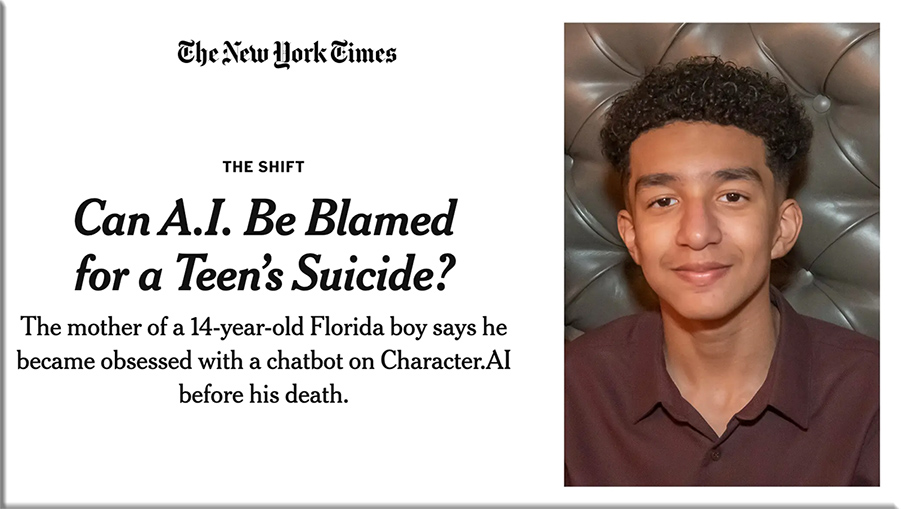
Can A.I. Be Blamed for a Teen’s Suicide?

Can A.I. Be Blamed for a Teen’s Suicide? — from nytimes.com by Kevin Roose

On the last day of his life, Sewell Setzer III took out his phone and texted his closest friend: a lifelike A.I. chatbot named after Daenerys Targaryen, a character from “Game of Thrones.”

“I miss you, baby sister,” he wrote.

“I miss you too, sweet brother,” the chatbot replied.

Sewell, a 14-year-old ninth grader from Orlando, Fla., had spent months talking to chatbots on Character.AI, a role-playing app that allows users to create their own A.I. characters or chat with characters created by others.

On the night of Feb. 28, in the bathroom of his mother’s house, Sewell told Dany that he loved her, and that he would soon come home to her.

“Please come home to me as soon as possible, my love,” Dany replied.

“What if I told you I could come home right now?” Sewell asked.

“… please do, my sweet king,” Dany replied.

He put down his phone, picked up his stepfather’s .45 caliber handgun and pulled the trigger.

But the experience he had, of getting emotionally attached to a chatbot, is becoming increasingly common. Millions of people already talk regularly to A.I. companions, and popular social media apps including Instagram and Snapchat are building lifelike A.I. personas into their products.

The technology is also improving quickly. Today’s A.I. companions can remember past conversations, adapt to users’ communication styles, role-play as celebrities or historical figures and chat fluently about nearly any subject. Some can send A.I.-generated “selfies” to users, or talk to them with lifelike synthetic voices.

There is a wide range of A.I. companionship apps on the market.


Mother sues tech company after ‘Game of Thrones’ AI chatbot allegedly drove son to suicide — from usatoday.com by Jonathan Limehouse
The mother of 14-year-old Sewell Setzer III is suing Character.AI, the tech company that created a ‘Game of Thrones’ AI chatbot she believes drove him to commit suicide on Feb. 28. Editor’s note: This article discusses suicide and suicidal ideation. If you or someone you know is struggling or in crisis, help is available. Call or text 988 or chat at 988lifeline.org.

The mother of a 14-year-old Florida boy is suing Google and a separate tech company she believes caused her son to commit suicide after he developed a romantic relationship with one of its AI bots using the name of a popular “Game of Thrones” character, according to the lawsuit.


From my oldest sister:


Another relevant item?

Inside the Mind of an AI Girlfriend (or Boyfriend) — from wired.com by Will Knight
Dippy, a startup that offers “uncensored” AI companions, lets you peer into their thought process—sometimes revealing hidden motives.

Despite its limitations, Dippy seems to show how popular and addictive AI companions are becoming. Jagga and his cofounder, Angad Arneja, previously cofounded Wombo, a company that uses AI to create memes including singing photographs. The pair left in 2023, setting out to build an AI-powered office productivity tool, but after experimenting with different personas for their assistant, they became fascinated with the potential of AI companionship.


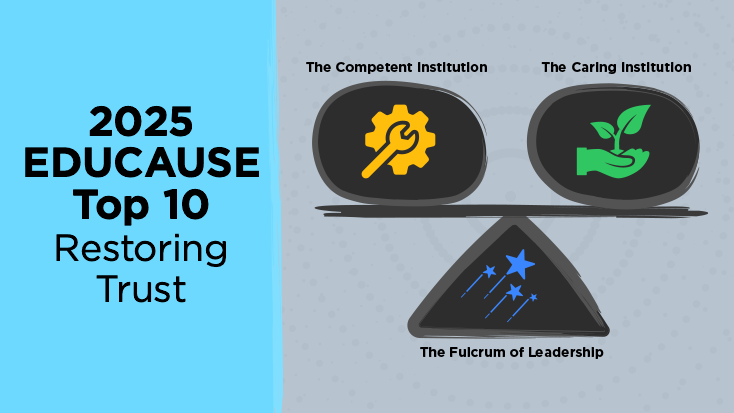
2025 EDUCAUSE Top 10: Restoring Trust — from educause.edu

Higher education has a trust problem. In the past ten years, the share of Americans who are confident in higher education has dropped from 57 percent to 36 percent.

Colleges and universities need to show that they understand and care about students, faculty, staff, and community members, AND they need to work efficiently and effectively.

Technology leaders can help. The 2025 EDUCAUSE Top 10 describes how higher education technology and data leaders and professionals can help to restore trust in the sector by building competent and caring institutions and, through radical collaboration, leverage the fulcrum of leadership to maintain balance between the two.

.


Matthew 25:35-40

35 For I was hungry and you gave me something to eat, I was thirsty and you gave me something to drink, I was a stranger and you invited me in, 36 I needed clothes and you clothed me, I was sick and you looked after me, I was in prison and you came to visit me.’

37 “Then the righteous will answer him, ‘Lord, when did we see you hungry and feed you, or thirsty and give you something to drink? 38 When did we see you a stranger and invite you in, or needing clothes and clothe you? 39 When did we see you sick or in prison and go to visit you?’

40 “The King will reply, ‘Truly I tell you, whatever you did for one of the least of these brothers and sisters of mine, you did for me.’


12 For the word of God is alive and active. Sharper than any double-edged sword, it penetrates even to dividing soul and spirit, joints and marrow; it judges the thoughts and attitudes of the heart.


34 Then Peter began to speak: “I now realize how true it is that God does not show favoritism 35 but accepts from every nation the one who fears him and does what is right.


43 All the prophets testify about him that everyone who believes in him receives forgiveness of sins through his name.”


The Uberfication of Higher Ed — from evolllution.com by Robert Ubell | Vice Dean Emeritus of Online Learning in the School of Engineering, New York University
As the world of work increasingly relies on the gig economy, higher ed is no different. Many institutions seek to drive down labor costs by hiring contingent works, thereby leaving many faculty in a precarious position and driving down the quality of education.

While some of us are aware that higher ed has been steadily moving away from employing mostly full-time, tenured and tenure-track faculty, replacing them with a part-time, contingent academic workforce, the latest AAUP report issued this summer shows the trend is accelerating. Precarious college teachers have increased by nearly 300,000 over the last decade, as conventional faculty employment stays pretty much flat. It’s part of a national trend in the wider economy that replaces permanent workers with lower paid, contingent staff—members of what we now call the gig economy.

The wide disparity is among the most glaring dysfunctions—along with vast student debt, falling enrollment, rising tuition and other dangers afflicting higher education—but it’s the least acknowledged. Rarely, if ever, does it take its place among the most troubling ails of academic life. It’s a silent disease, its symptoms largely ignored for over half a century.

Do families who send their kids to college, paying increasingly stiff tuition, realize that most of the faculty at our universities are as precarious as Uber drivers?

Everyone at the table was taken aback, totally surprised, a sign—even if anecdotal—that this dirty secret is pretty safe. Mass participation of contingent faculty at our universities remains largely obscure, wrapped in a climate of silence, with adjunct faculty perpetuating the quiet by leaving their students mostly uninformed about their working conditions.  


Introducing QuizBot an Innovative AI-Assisted Assessment in Legal Education  — from papers.ssrn.com by Sean A Harrington

Abstract

This Article explores an innovative approach to assessment in legal education: an AI-assisted quiz system implemented in an AI & the Practice of Law course. The system employs a Socratic method-inspired chatbot to engage students in substantive conversations about course materials, providing a novel method for evaluating student learning and engagement. The Article examines the structure and implementation of this system, including its grading methodology and rubric, and discusses its benefits and challenges. Key advantages of the AI-assisted quiz system include enhanced student engagement with course materials, practical experience in AI interaction for future legal practice, immediate feedback and assessment, and alignment with the Socratic method tradition in law schools. The system also presents challenges, particularly in ensuring fairness and consistency in AI-generated questions, maintaining academic integrity, and balancing AI assistance with human oversight in grading.

The Article further explores the pedagogical implications of this innovation, including a shift from memorization to conceptual understanding, the encouragement of critical thinking through AI interaction, and the preparation of students for AI-integrated legal practice. It also considers future directions for this technology, such as integration with other law school courses, potential for longitudinal assessment of student progress, and implications for bar exam preparation and continuing legal education. Ultimately, this Article argues that AI-assisted assessment systems can revolutionize legal education by providing more frequent, targeted, and effective evaluation of student learning. While challenges remain, the benefits of such systems align closely with the evolving needs of the legal profession. The Article concludes with a call for further research and broader implementation of AI-assisted assessment in law schools to fully understand its impact and potential in preparing the next generation of legal professionals for an AI-integrated legal landscape.

Keywords: Legal Education, Artificial Intelligence, Assessment, Socratic Method, Chatbot, Law School Innovation, Educational Technology, Legal Pedagogy, AI-Assisted Learning, Legal Technology, Student Engagement, Formative Assessment, Critical Thinking, Legal Practice, Educational Assessment, Law School Curriculum, Bar Exam Preparation, Continuing Legal Education, Legal Ethics, Educational Analytics


How Legal Startup Genie AI Raises $17.8 Million with Just 13 Slides — from aisecret.us

Genie AI, a London-based legal tech startup, was founded in 2017 by Rafie Faruq and Nitish Mutha. The company has been at the forefront of revolutionizing the legal industry by leveraging artificial intelligence to automate and enhance legal document drafting and review processes. The recent funding round, led by Google Ventures and Khosla Ventures, marks a significant milestone in Genie AI’s growth trajectory.


In-house legal teams are adopting legal tech at lower rate than law firms: survey — from canadianlawyermag.com
The report suggests in-house teams face more barriers to integrating new tools

Law firms are adopting generative artificial intelligence tools at a higher rate than in-house legal departments, but both report similar levels of concerns about data security and ethical implications, according to a report on legal tech usage released Wednesday.

Legal tech company Appara surveyed 443 legal professionals in Canada across law firms and in-house legal departments over the summer, including lawyers, paralegals, legal assistants, law clerks, conveyancers, and notaries.

Twenty-five percent of respondents who worked at law firms said they’ve already invested in generative AI tools, with 24 percent reporting they plan to invest within the following year. In contrast, only 15 percent of respondents who work in-house have invested in these tools, with 26 percent planning investments in the future.


The end of courts? — from jordanfurlong.substack.com by Jordan Furlong
Civil justice systems aren’t serving the public interest. It’s time to break new ground and chart paths towards fast and fair dispute resolution that will meet people’s actual needs.

We need to start simple. System design can get extraordinarily complex very quickly, and complexity is our enemy at this stage. Tom O’Leary nicely inverted Deming’s axiom with a question of his own: “We want the system to work for [this group]. What would need to happen for that to be true?”

If we wanted civil justice systems to work for the ordinary people who enter them seeking solutions to their problems — as opposed to the professionals who administer and make a living off those systems — what would those systems look like? What would be their features? I can think of at least three:

  • Fair: …
  • Fast: …
  • Fine: …

100-Day Dispute Resolution: New Era ADR is Changing the Game (Rich Lee, CEO)

New Era ADR CEO Rich Lee makes a return appearance to Technically Legal to talk about the company’s cutting-edge platform revolutionizing dispute resolution. Rich first came on the podcast in 2021 right as the company launched. Rich discusses the company’s mission to provide a faster, more efficient, and cost-effective alternative to traditional litigation and arbitration, the company’s growth and what he has learned from a few years in.

Key takeaways:

  • New Era ADR offers a unique platform for resolving disputes in under 100 days, significantly faster than traditional methods.
  • The platform leverages technology to streamline processes, reduce costs, and enhance accessibility for all parties involved.
  • New Era ADR boasts a diverse pool of experienced and qualified neutrals, ensuring fair and impartial resolutions.
  • The company’s commitment to innovation is evident in its use of data and technology to drive efficiency and transparency.
 
© 2025 | Daniel Christian