60 Minutes Overtime
Sal Khan wants an AI tutor for every student: here’s how it’s working at an Indiana high school — from cbsnews.com by Anderson Cooper, Aliza Chasan, Denise Schrier Cetta, and Katie Brennan

“I mean, that’s what I’ll always want for my own children and, frankly, for anyone’s children,” Khan said. “And the hope here is that we can use artificial intelligence and other technologies to amplify what a teacher can do so they can spend more time standing next to a student, figuring them out, having a person-to-person connection.”

“After a week you start to realize, like, how you can use it,” Brockman said. “That’s been one of the really important things about working with Sal and his team, to really figure out what’s the right way to sort of bring this to parents and to teachers and to classrooms and to do that in a way…so that the students really learn and aren’t just, you know, asking for the answers and that the parents can have oversight and the teachers can be involved in that process.”


Nectir lets teachers tailor AI chatbots to provide their students with 24/7 educational support — from techcrunch.com by Lauren Forristal

More than 100 colleges and high schools are turning to a new AI tool called Nectir, allowing teachers to create a personalized learning partner that’s trained on their syllabi, textbooks, and assignments to help students with anything from questions related to their coursework to essay writing assistance and even future career guidance.

With Nectir, teachers can create an AI assistant tailored to their specific needs, whether for a single class, a department, or the entire campus. There are various personalization options available, enabling teachers to establish clear boundaries for the AI’s interactions, such as programming the assistant to assist only with certain subjects or responding in a way that aligns with their teaching style.

“It’ll really be that customized learning partner. Every single conversation that a student has with any of their assistants will then be fed into that student profile for them to be able to see based on what the AI thinks, what should I be doing next, not only in my educational journey, but in my career journey,” Ghai said. 


How Will AI Influence Higher Ed in 2025? — from insidehighered.com by Kathryn Palmer
No one knows for sure, but Inside Higher Ed asked seven experts for their predictions.

As the technology continues to evolve at a rapid pace, no one knows for sure how AI will influence higher education in 2025. But several experts offered Inside Higher Ed their predictions—and some guidance—for how colleges and universities will have to navigate AI’s potential in the new year.


How A.I. Can Revive a Love of Learning — from nytimes.com by Anant Agarwal
Modern technology offers new possibilities for transforming teaching.

In the short term, A.I. will help teachers create lesson plans, find illustrative examples and generate quizzes tailored to each student. Customized problem sets will serve as tools to combat cheating while A.I. provides instant feedback.

In the longer term, it’s possible to imagine a world where A.I. can ingest rich learner data and create personalized learning paths for students, all within a curriculum established by the teacher. Teachers can continue to be deeply involved in fostering student discussions, guiding group projects and engaging their students, while A.I. handles grading and uses the Socratic method to help students discover answers on their own. Teachers provide encouragement and one-on-one support when needed, using their newfound availability to give students some extra care.

Let’s be clear: A.I. will never replace the human touch that is so vital to education. No algorithm can replicate the empathy, creativity and passion a teacher brings to the classroom. But A.I. can certainly amplify those qualities. It can be our co-pilot, our chief of staff helping us extend our reach and improve our effectiveness.


Dancing with the Devil We Know: OpenAI and the Future of Education — from nickpotkalitsky.substack.com by Nick Potkalitsky
Analyzing OpenAI’s Student Writing Guide and Latest AI Tools

Today, I want to reflect on two recent OpenAI developments that highlight this evolution: their belated publication of advice for students on integrating AI into writing workflows, and last week’s launch of the full GPTo1 Pro version. When OpenAI released their student writing guide, there were plenty of snarky comments about how this guidance arrives almost a year after they thoroughly disrupted the educational landscape. Fair enough – I took my own side swipes initially. But let’s look at what they’re actually advising, because the details matter more than the timing.


Tutor CoPilot: A Human-AI Approach for Scaling Real-Time Expertise — from studentsupportaccelerator.org by Rose E.Wang, Ana T. Ribeiro, Carly D. Robinson, Susanna Loeb, and Dora Demszky


Pandemic, Politics, Pre-K & More: 12 Charts That Defined Education in 2024 — from the74million.org
From the spread of AI to the limits of federal COVID aid, these research findings captured the world of education this year.

Tutoring programs exploded in the last five years as states and school districts searched for ways to counter plummeting achievement during COVID. But the cost of providing supplemental instruction to tens of millions of students can be eye-watering, even as the results seem to taper off as programs serve more students.

That’s where artificial intelligence could prove a decisive advantage. A report circulated in October by the National Student Support Accelerator found that an AI-powered tutoring assistant significantly improved the performance of hundreds of tutors by prompting them with new ways to explain concepts to students. With the help of the tool, dubbed Tutor CoPilot, students assigned to the weakest tutors began posting academic results nearly equal to those assigned to the strongest. And the cost to run the program was just $20 per pupil.


On Capacity, Sustainability, And Attention — from marcwatkins.substack.com by Marc Watkins

Faculty must have the time and support necessary to come to terms with this new technology and that requires us to change how we view professional development in higher education and K-12. We cannot treat generative AI as a one-off problem that can be solved by a workshop, an invited talk, or a course policy discussion. Generative AI in education has to be viewed as a continuum. Faculty need a myriad of support options each semester:

  • Course buyouts
  • Fellowships
  • Learning communities
  • Reading groups
  • AI Institutes and workshops
  • Funding to explore the scholarship of teaching and learning around generative AI

New in 2025 and What Edleaders Should Do About It — from gettingsmart.com by Tom Vander Ark and Mason Pashia

Key Points

  • Education leaders should focus on integrating AI literacy, civic education, and work-based learning to equip students for future challenges and opportunities.
  • Building social capital and personalized learning environments will be crucial for student success in a world increasingly influenced by AI and decentralized power structures.
 

1-800-CHAT-GPT—12 Days of OpenAI: Day 10

Per The Rundown: OpenAI just launched a surprising new way to access ChatGPT — through an old-school 1-800 number & also rolled out a new WhatsApp integration for global users during Day 10 of the company’s livestream event.


How Agentic AI is Revolutionizing Customer Service — from customerthink.com by Devashish Mamgain

Agentic AI represents a significant evolution in artificial intelligence, offering enhanced autonomy and decision-making capabilities beyond traditional AI systems. Unlike conventional AI, which requires human instructions, agentic AI can independently perform complex tasks, adapt to changing environments, and pursue goals with minimal human intervention.

This makes it a powerful tool across various industries, especially in the customer service function. To understand it better, let’s compare AI Agents with non-AI agents.

Characteristics of Agentic AI

    • Autonomy: Achieves complex objectives without requiring human collaboration.
    • Language Comprehension: Understands nuanced human speech and text effectively.
    • Rationality: Makes informed, contextual decisions using advanced reasoning engines.
    • Adaptation: Adjusts plans and goals in dynamic situations.
    • Workflow Optimization: Streamlines and organizes business workflows with minimal oversight.

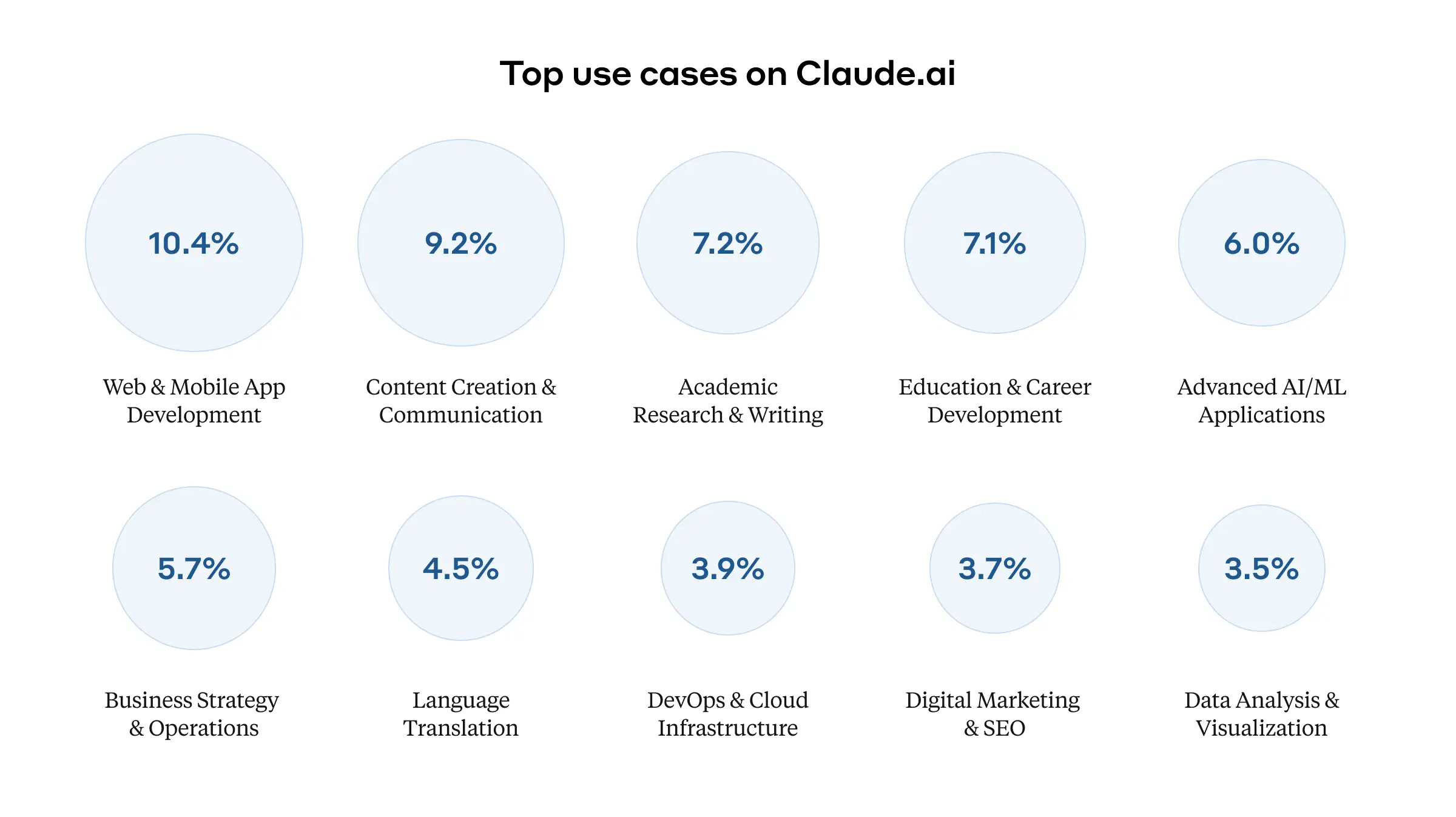
Clio: A system for privacy-preserving insights into real-world AI use — from anthropic.com

How, then, can we research and observe how our systems are used while rigorously maintaining user privacy?

Claude insights and observations, or “Clio,” is our attempt to answer this question. Clio is an automated analysis tool that enables privacy-preserving analysis of real-world language model use. It gives us insights into the day-to-day uses of claude.ai in a way that’s analogous to tools like Google Trends. It’s also already helping us improve our safety measures. In this post—which accompanies a full research paper—we describe Clio and some of its initial results.


Evolving tools redefine AI video — from heatherbcooper.substack.com by Heather Cooper
Google’s Veo 2, Kling 1.6, Pika 2.0 & more

AI video continues to surpass expectations
The AI video generation space has evolved dramatically in recent weeks, with several major players introducing groundbreaking tools.

Here’s a comprehensive look at the current landscape:

  • Veo 2…
  • Pika 2.0…
  • Runway’s Gen-3…
  • Luma AI Dream Machine…
  • Hailuo’s MiniMax…
  • OpenAI’s Sora…
  • Hunyuan Video by Tencent…

There are several other video models and platforms, including …


A Three-Phase, Rational System of Education — from petergray.substack.com by Peter Gray; with thanks to Dr. Kate Christian for this resource
What will replace k-12 and college?

A Three-Phase, Rational System of Education
I don’t know just how or how fast the change will happen, but I think the days of K-12 and four years of college are numbered and sanity will begin to prevail in the educational world. I envision a future with something like the following three-phase approach to education:

Phase I. Discovery: Learning about your world, your self, and how the two fit together.
Phase II. Exploring a career path.
Phase III. Becoming credentialed for specialized work.


College operating costs rose 3.4% in fiscal 2024 — from highereddive.com by Ben Unglesbee
Commonfund Institute’s latest Higher Education Price Index shows that cost spikes slowed — but that doesn’t make them any less painful.

Dive Brief:

  • Costs for operating a college rose 3.4% in fiscal 2024, according to the latest Higher Education Price Index from the Commonfund Institute.
  • The price increases outpaced Commonfund’s preliminary projections this spring of 3% for the year. However, the HEPI showed that inflation has slowed more than half a percentage point from fiscal 2023 and is down nearly 2 percentage points from 2022’s 5.2% inflation rate.
  • Utility prices and those for supplies and materials slowed the most significantly, after recent years of volatility in those areas. While costs for institutions are cooling, “there is an ongoing trend of inflation rates remaining elevated compared with the previous decade,” Commonfund said.

Speaking of higher education, also see:

  • 25 Stats for 2025 — from insidehighered.com by Ashley Mowreader
    Inside Higher Ed compiled two dozen–plus data points to help guide strategic decision-making and student success initiatives on college campuses.
 

Best of 2024 — from wondertools.substack.com by Jeremy Caplan
12 of my favorites this year

I tested hundreds of new tools this year. Many were duplicative. A few stuck with me because they’re so useful. The dozen noted below are helping me mine insights from notes, summarize meetings, design visuals— even code a little, without being a developer. You can start using any of these in minutes — no big budget or prompt engineering PhD required.


Side Hustles for Educators — from drlukehobson.com by Luke Hobson

Anyway, let’s say you work in education, and you want to start a side hustle. What are your options? I’ve seen folks take a few different approaches with this so, let’s go over a few options:

  • Adjunct Positions…
  • Presentations and Workshops…
  • Consulting and Client Work…
  • Digital Courses and Coaching…
 

Incorporating Financial Literacy into Your Classroom Curriculum — from edcircuit.com by EdCircuit Staff
Teaching Beyond the Textbook

Table of Contents

  • The Importance of Teaching Financial Literacy
  • Incorporating Financial Literacy into Your CurriculumUse Real-Life Examples
  • Integrate it into Other Subjects
  • Use Technology
  • Make it Interactive
  • Start Early
  • Conclusion
 

How many students do microschools serve? — from microschoolingcenter.org by Ashley Soifer

Our 2024 Sector Analysis shows the median average for number of children served by a microschool at launch is 9, at the end of the first year is 12 and currently serving is 16.

What this doesn’t show is all of the ups and downs in between.

It’s not uncommon for first year microschooling founders to see a dip in enrolled students between the start of the year and the end of the year. October and November can be two of the most stressful months for new microschool founders as numbers either dip or don’t grow as anticipated. There are a few things that can be helpful for microschool founders during this time:


Your Map to the Future: New Book! — from medicalfuturist.com by Dr. Bertalan Mesko, PhD
Your Map To The Future lays out tools and techniques futurists have been using for decades so you can start using them immediately to shape your personal and professional futures.

Futures thinking shouldn’t be reserved for experts. Whether you’re a leader, a professional, or simply someone striving to make sense of a complex world, this book is for you.

The futures methods I’ve used as The Medical Futurist for decades in analyzing the future of medicine and healthcare have, for some reason, not become widely accessible.

However, everyone can obtain these methods to approach the future with confidence, clarity, and control.

While the future is believed to be a fixed, singular path, in fact, multiple futures exist, and Your Map To The Future gives you the science-based tools to explore and prepare for them. With fresh perspectives, I illustrate why looking forward is crucial in addressing today’s most pressing issues, from climate change to artificial intelligence.


From DSC:
I haven’t read this book and I hesitate to post this…as it leans heavily into an advertisement for this particular book. But I DO post it because I also believe that future thinking shouldn’t be reserved for experts. In fact, I assert that all K-12 students — and college/vocational students as well — should have some exposure to futures thinking. We need to be looking up and around and pulse-checking the trends. We need to posit future scenarios and our plans to address those potential scenarios.

Also, I have read Dr. Mesko’s postings for years and he’s solid.


The legal tech trends that defined 2024 — from abajournal.com by Nicole Black

The year 2024 was one of change. In the midst of a largely unpopular back-to-office push, technological innovation and development occurred at a rapid clip. Legal professionals approached technology with a newfound curiosity and appreciation gained as a result of pandemic-era remote work experimentation. The increasing demand for generative artificial intelligence tools fueled heavy investments in the legal technology industry.

Simultaneously, law firm technology adoption was supported by a flurry of guidance released by ethics committees across the country. As technology upended traditional ways of working, some state bars reconsidered bar exam requirements and others experimented with loosening licensing regulations.

No matter where you looked, change was occurring at a breakneck pace as technology’s impact on the practice of law became inescapable. Through it all, a few key trends emerged that offer clues on where we’re headed in the coming year.

Meanwhile, some states, including Oregon, Washington and Nevada, explored allowing unlicensed professionals to practice law in limited areas, such as family law and small claims. These efforts seek to improve access to justice, representing a revised perspective on long-standing rules about who can —and cannot—deliver legal services.


What to Expect in 2025: AI Legal Tech and Regulation (65 Expert Predictions) — from natlawreview.com by Oliver Roberts

As 2024 comes to a close, it’s time to look ahead to how AI will shape the law and legal practice in 2025. Over the past year, we’ve witnessed growing adoption of AI across the legal sector, substantial investments in legal AI startups, and a rise in state-level AI regulations. While the future of 2025 remains uncertain, industry leaders are already sharing their insights.

Along with 2025 predictions from The National Law Review’s Editor-in-Chief Oliver Roberts, this article presents 65 expert predictions on AI and the law in 2025 from federal judges, startup founders, CEOs, and leaders of AI practice groups at global law firms.


The Potential of GenAI to Promote Access to Justice — from law.com by Joanne Sprague
GenAI-assisted legal support is not a substitute for lawyers, but may help legal aid professionals serve more clients efficiently and effectively.

Generative AI (GenAI) has been heralded as a transformative force, poised to revolutionize everything from medicine to education to law. While GenAI won’t perform surgery or earn diplomas, it holds the promise of enabling lawyers to get due process for more of their clients or even empowering individuals to represent themselves in court. The harsh reality is that low-income individuals do not receive sufficient legal help for 92% of their civil legal problems, and legal aid organizations must turn away one of every two requests they get, according to the 2022 Justice Gap Report. GenAI-assisted legal support is not a substitute for lawyers, but may help legal aid professionals serve more clients efficiently and effectively.

If implemented equitably, GenAI could democratize legal knowledge and empower individuals to navigate the complexities of the justice system more easily.

In her new book “Law Democratized,” Renee Knake Jefferson says that GenAI “has the potential to become the single most important tool in solving the legal justice crisis … if harnessed to do so ethically.” With GenAI, we can envision a possible future of informed self-representation and legal decision-making regardless of ability to pay.


Experimenting in the sandbox — from nationalmagazine.ca by Julie Sobowale
Ontario Bar Association launches AI platform for lawyers to learn tech

The Ontario Bar Association has launched a new, free interactive learning platform for lawyers looking to learn about generative AI.

The new learning platform, created to clarify some of that and help lawyers navigate this technology, is part of OBA’s Real Intelligence on AI project. It is being spearheaded by Colin Lachance, the association’s innovator-in-residence.

Users can ask questions to LawQI, an AI assistant specializing in Canadian law, and work through learning modules about prompt engineering, different generative AI tools and best practices. The portal is free for OBA members and Ontario law students.

“Lawyers need to know how AI works,” says Lachance, principal at PGYA Consulting and former president and CEO of the Canadian Legal Information Institute (CanLII).

“I wanted to create an environment where lawyers can experiment. By using the technology, you learn how to use it.”


The Innovation Strategist: Nicole Black — from substack.com by Tom Martin and Nicole Black
Where I interview Nicole Black about how she merged her legal expertise with her passion for technology to become a leading voice in legal innovation

Excerpt from Key Takeaways:

  • Her role as employee #1 at MyCase in 2012 allowed her to combine her legal expertise with her passion for technology, leading to her current position as Principal Legal Insight Strategist at Affinipay
  • She believes generative AI will fundamentally transform the legal profession, potentially more significantly than previous technological innovations like PCs and the internet
  • Her advice for new lawyers includes actively experimenting with AI tools like ChatGPT and preparing for significant changes in legal education and entry-level legal work

Legal Liabilities of AI for Attorneys and Small Firms — from ethicalailawinstitute.org by Trent Kubasiak

Many small firms and solo attorneys could be in for a nasty shock when it comes to the use of AI. A detailed report from NYU’s Journal of Legislation and Public Policy is shedding light on the potential legal liabilities of using generative AI. Co-authored by EqualAI CEO Miriam Vogel, former Homeland Security Secretary Michael Chertoff, and others, the report underscores a widespread misconception—that liability for AI-related outcomes rests solely with the developers of these technologies.

For attorneys and small business owners, this misconception can be dangerous. As Vogel explains, “There are so many laws on the books that people need to know are applicable.” From lending and housing regulations to employment law, the use of AI—even indirectly—can expose firms to significant risks.


Challenges And Opportunities Of Digital Transformation In US Law Firms — from forbes.com by Chad Sands

So, what is driving the transformation?

Some adoption of new “legal tech” is literally being forced by legacy software companies who are shutting down older, server-based technology platforms. But most law firms are now increasingly becoming more proactive in planning and executing their digital transformation strategies on their own.

This is no longer a choice or matter of “Why should we?”

It’s a question of “When will we?”

There are several factors driving this shift, one being client expectations.


Fresh Voices On Legal Tech with Ilona Logvinova — from legaltalknetwork.com by Dennis Kennedy, Tom Mighell, and Ilona Logvinova

The world of AI and legal tech is evolving ever more rapidly, and it is all too common for lawyers to feel intimidated at the thought of keeping up with the constant barrage of change. How should lawyers maintain their tech competence? Dennis and Tom talk with Ilona Logvinova about her work in tech and AI innovations for lawyers. She shares her career journey and offers perspectives on leveraging technology to create new and better opportunities for attorneys to thrive in their work.


AI Insights for Legal: Ten Key Takeaways from Summit AI New York — from techlawcrossroads.com by Stephen Embry

Despite the shortcomings, it still was a good Conference. (i.e., the Summit AI New York). I learned some things and confirmed that many of the AI related issues being faced by legal are also being faced by many other businesses. What were my top ten takeaways? Here they are in no particular order:


Teacher Shortage: Is Hybrid or Remote Teaching the Answer? — from edtechmagazine.com by Adam Stone
In these uncertain times, K–12 schools use technology to better support students and teachers.

How Can Remote or Hybrid Teaching Help?
A shift to virtual learning can help close the gaps.

First, remote work can draw more people into the field. “For some folks, particularly with the pandemic and teaching for a year or more online, they found that model appealing to them from a professional and personal standpoint,” Carbaugh says.

While many educators still prefer face-to-face interactions, he says, others may find the ability to work from home appealing.

Virtual learning can also broaden the candidate pool in hard-to-fill roles. In STEM, for instance, “you might have someone who is willing to teach a class for you in addition to their normal job,” Speegle says. “They can teach computer science, biology or calculus for an hour a day, and they’re done.”


What Happens When Public School Districts Embrace Hybrid Schools? — from asthe74million.org by Eric Wearne & Tom Loud
With a fifth of its school-age children engaged in homeschooling, one Tennessee district found a way to connect them to the public system

With one in five school-age children engaged in homeschooling, Blount County Schools decided in 2018 to offer an option aimed at bridging the best of both homeschooling and public school, while offering a flexible schedule and college preparatory academics.

While the hybrid schooling model is not necessarily new, two developments have emerged in recent years. First, interest in attending, founding, and working at these schools has increased since the Covid pandemic; and second, conventional public-school systems are starting to get into the game.


Launchpad Jobs — from burningglassinstitute.org; via Paul Fain’s Education Pipeline posting

Launchpad Jobs highlights how nondegree workers can achieve career success through strategic job choices. It reveals that nearly 2 million workers without college degrees earn six-figure salaries, demonstrating that fulfilling and well-paying careers are accessible without a traditional four-year education.

The report identifies key 73 roles, termed “Launchpad Jobs,” that offer a combination of strong wages, job stability, and upward mobility. These include positions such as EMTs, electricians, and bank tellers, which often serve as steppingstones to long-term success. Using big data analysis of career histories this report maps the trajectories of workers starting in various roles, showcasing how initial job choices influence future earnings and advancement potential.


Why College Freshman Enrollment Declined and What it Could Mean for Students — from usnews.com by Sarah Wood
Experts cite possible reasons for the 5% overall enrollment drop in fall 2024 and implications for the current admission cycle.


From DSC:
Speaking of learning ecosystems, this next piece is absolutely incredible in terms of learning ecosystems from other nations!!!

China leads world in massive open online courses: Ministry of Education — from globaltimes.cn by  Chen Xi; via GSV

China has established the world’s largest online education system, according to a document sent by the Ministry of Education to the Global Times on Wednesday.

As of now, the country has developed over 30 various online course platforms, with more than 97,000 massive open online courses (MOOCs) made available, 483 million registered users, and 1.39 billion learning instances. Additionally, 440 million instances of students obtaining course credits have been recorded, making China’s number of MOOCs and learners the highest in the world, according to the document.

Furthermore, a national smart education platform – the Smart Education of China in Higher Education – has launched 31,000 high-quality online courses, with 78,000 teachers participating in teaching and over 16.82 million users visiting, with more than 93 million visits, covering 183 countries and regions worldwide.

Many of these courses have garnered high praise among global students. 


2025 Job Skills Report — from coursera.org

Uncover the fastest-growing skills with the Job Skills Report 2025. This practical resource draws on data from Coursera’s 5 million enterprise learners to highlight the skills and learning experiences that employees, students, and job seekers will prioritize for career success* in 2025.

This year’s report reveals that generative AI (GenAI) is the most in-demand skill, with enterprise course enrollments soaring by 866% year-over-year. By upskilling learners globally, industry, higher education, and governments can unlock AI’s potential $15.7 trillion in global economic value ?by 2030.**

Access the report to:

  • Identify the fastest-growing skills in AI, business, data science, and technology.
  • Compare skill priorities of students, employees, and job seekers.
  • Understand how learners engage with AI learning experiences.

Break the monopoly on higher education pathways — from fastcompany.com by Antonio Gutierrez; via GSV
New models prove that younger and underserved populations are finding success with skills-based programs and hybrid educational models.

The Duet-SNHU model proves that accessible, flexible, and cost-effective alternatives are possible and scalable. Meanwhile, the explosion of nondegree credentials offers additional pathways to skills-focused career readiness, reflecting a growing appetite for innovation in education. To remain competitive in the global economy, the U.S. must embrace these alternatives while reforming traditional institutions.

Policymakers must prioritize funding based on performance metrics like graduation rates and job placements, and accreditors must hold institutions accountable for real-world outcomes. Business leaders, educators, and community stakeholders must champion scalable models that deliver equity and opportunity. The stakes are too high to cling to an outdated system. By disrupting the status quo, we can create an education system that serves all Americans and strengthens the economy for generations to come.


The State of Flexible Work: Statistics from The Flex Index — from flexindex.com

Flex Report Q4 2024
Hybrid and Remote Work by the Numbers

And you thought return to office policy was settled! For a while, it looked like 2-3 days per week in the office would be the future of work in America.

Yet this quarter has brought significant changes to the landscape. Major companies like Amazon, Dell, and The Washington Post announced their plans for a full return to office. Then came a shift in the political atmosphere, with Trump’s victory and potential incoming changes requiring full-time office work for government employees.

These developments raise important questions about where workplace flexibility is headed. Are we witnessing the beginning of a broader shift back to Full Time In Office? Is the era of fully flexible work coming to an end? Or is this simply another evolution in how companies structure their workplace policies?

In this report, we dig into US-wide trends to see if the high-profile shifts toward Full Time In Office reflect broader market movement or just isolated cases. We examine how different industries are approaching flexibility, from Technology’s continued embrace to the challenges faced by sectors dependent on physical presence. Plus, we explore the divide in how companies of different sizes approach workplace flexibility. Are we truly heading back to the office full time, or is the future of work more nuanced than the headlines suggest?


Episode 302: A Practical Roadmap for AI in K-12 Education with Mike Kentz & Nick Potkalitsky, PhD

In this episode of My EdTech Life, I had the pleasure of interviewing Mike Kentz and Nick Potkalitsky, PhD, to discuss their new book, AI in Education: The K-12 Roadmap to Teacher-Led Transformation. We dive into the transformative power of AI in education, exploring its potential for personalization, its impact on traditional teaching practices, and the critical need for teacher-driven experimentation.


Striking a Balance: Navigating the Ethical Dilemmas of AI in Higher Education — from er.educause.edu by Katalin Wargo and Brier Anderson
Navigating the complexities of artificial intelligence (AI) while upholding ethical standards requires a balanced approach that considers the benefits and risks of AI adoption.

As artificial intelligence (AI) continues to transform the world—including higher education—the need for responsible use has never been more critical. While AI holds immense potential to enhance teaching and learning, ethical considerations around social inequity, environmental concerns, and dehumanization continue to emerge. College and university centers for teaching and learning (CTLs), tasked with supporting faculty in best instructional practices, face growing pressure to take a balanced approach to adopting new technologies. This challenge is compounded by an unpredictable and rapidly evolving landscape. New AI tools surface almost daily. With each new tool, the educational possibilities and challenges increase exponentially. Keeping up is virtually impossible for CTLs, which historically have been institutional hubs for innovation. In fact, as of this writing, the There’s an AI for That website indicates that there are 23,208 AIs for 15,636 tasks for 4,875 jobs—with all three numbers increasing daily.

To support college and university faculty and, by extension, learners in navigating the complexities of AI integration while upholding ethical standards, CTLs must prioritize a balanced approach that considers the benefits and risks of AI adoption. Teaching and learning professionals need to expand their resources and support pathways beyond those solely targeting how to leverage AI or mitigate academic integrity violations. They need to make a concerted effort to promote critical AI literacy, grapple with issues of social inequity, examine the environmental impact of AI technologies, and promote human-centered design principles.1


5 Free AI Tools For Learning & Exploration — from whytryai.com by Daniel Nest
Have fun exploring new topics with these interactive sites.

We’re truly spoiled for choice when it comes to AI learning tools.

In principle, any free LLM can become an endlessly patient tutor or an interactive course-maker.

If that’s not enough, tools like NotebookLM’s “Audio Overviews” and ElevenLabs’ GenFM can turn practically any material into a breezy podcast.

But what if you’re looking to explore new topics in a way that’s more interactive than vanilla chatbots and more open-ended than source-grounded NotebookLM?

Well, then you might want to give one of these free-to-try learning tools a go.


How to adopt GenAI within your legal department or law practice — from legaldive.com by Justin Bachman
Capital spending and ROI will be top of mind for legal executives moving forward with AI legal tools in 2025. Here are some best practices.

Dive Brief:

  • Debate about whether to use artificial intelligence in legal practice has ended. Discussions today are focused on costs, returns and how to best incorporate the technology into departments and outside law firms, according to an expert panel of legal tech specialists.
  • Buyers of generative AI solutions will encounter “a lot of confusion and a lot of opacity” on pricing, with multiple commercial models, George Socha, senior vice president of brand awareness at legal tech firm Reveal, said on a recent webinar. Long-term or firm contracts are best avoided for most legal tech customers, said Lee Wielenga, chief information officer at U.S. Legal Support.
  • Legal executives should consider small-group pilot projects for AI tools, focused on areas where routine, mundane tasks would benefit from automation, according to the panel. Software used in a business setting typically comes with permissioning access for employees, and generative AI adoption is likely to follow similar models.

Along the lines of legaltech, also see:

 
© 2025 | Daniel Christian