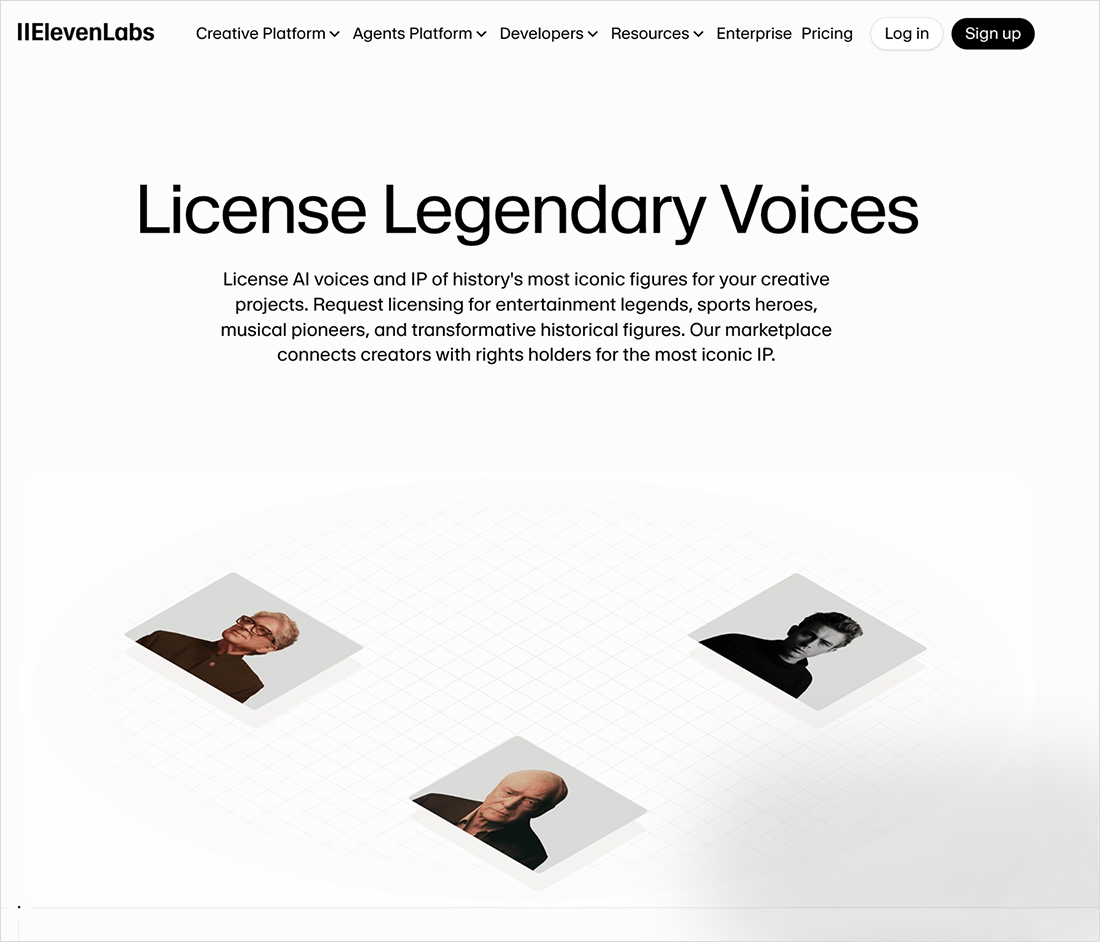
ElevenLabs just launched a voice marketplace — from elevenlabs.io; via theaivalley.com

Via the AI Valley:

Why does it matter?
AI voice cloning has already flooded the internet with unauthorized imitations, blurring legal and ethical lines. By offering a dynamic, rights-secured platform, ElevenLabs aims to legitimize the booming AI voice industry and enable transparent, collaborative commercialization of iconic IP.
.

ElevenLabs just launched a voice marketplace

ElevenLabs just launched a voice marketplace


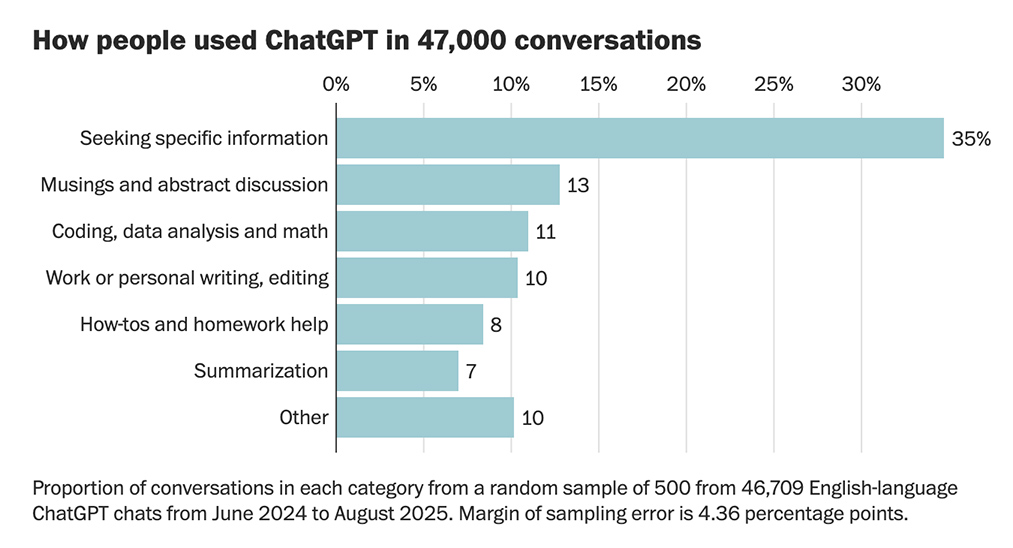
[GIFTED ARTICLE] How people really use ChatGPT, according to 47,000 conversations shared online — from by Gerrit De Vynck and Jeremy B. Merrill
What do people ask the popular chatbot? We analyzed thousands of chats to identify common topics discussed by users and patterns in ChatGPT’s responses.
.
Data released by OpenAI in September from an internal study of queries sent to ChatGPT showed that most are for personal use, not work.

Emotional conversations were also common in the conversations analyzed by The Post, and users often shared highly personal details about their lives. In some chats, the AI tool could be seen adapting to match a user’s viewpoint, creating a kind of personalized echo chamber in which ChatGPT endorsed falsehoods and conspiracy theories.

Lee Rainie, director of the Imagining the Digital Future Center at Elon University, said his own research has suggested ChatGPT’s design encourages people to form emotional attachments with the chatbot. “The optimization and incentives towards intimacy are very clear,” he said. “ChatGPT is trained to further or deepen the relationship.”


Per The Rundown: OpenAI just shared its view on AI progress, predicting systems will soon become smart enough to make discoveries and calling for global coordination on safety, oversight, and resilience as the technology nears superintelligent territory.

The details:

  • OpenAI said current AI systems already outperform top humans in complex intellectual tasks and are “80% of the way to an AI researcher.”
  • The company expects AI will make small scientific discoveries by 2026 and more significant breakthroughs by 2028, as intelligence costs fall 40x per year.
  • For superintelligent AI, OAI said work with governments and safety agencies will be essential to mitigate risks like bioterrorism or runaway self-improvement.
  • It also called for safety standards among top labs, a resilience ecosystem like cybersecurity, and ongoing tracking of AI’s real impact to inform public policy.

Why it matters: While the timeline remains unclear, OAI’s message shows that the world should start bracing for superintelligent AI with coordinated safety. The company is betting that collective safeguards will be the only way to manage risk from the next era of intelligence, which may diffuse in ways humanity has never seen before.

Which linked to:

  • AI progress and recommendations — from openai.com
    AI is unlocking new knowledge and capabilities. Our responsibility is to guide that power toward broad, lasting benefit.

From DSC:
I hate to say this, but it seems like there is growing concern amongst those who have pushed very hard to release as much AI as possible — they are NOW worried. They NOW step back and see that there are many reasons to worry about how these technologies can be negatively used.

Where was this level of concern before (while they were racing ahead at 180 mph)? Surely, numerous and knowledgeable people inside those organizations warned them about the destructive/downside of these technologies. But their warnings were pretty much blown off (at least from my limited perspective). 


The state of AI in 2025: Agents, innovation, and transformation — from mckinsey.com

Key findings

  1. Most organizations are still in the experimentation or piloting phase: Nearly two-thirds of respondents say their organizations have not yet begun scaling AI across the enterprise.
  2. High curiosity in AI agents: Sixty-two percent of survey respondents say their organizations are at least experimenting with AI agents.
  3. Positive leading indicators on impact of AI: Respondents report use-case-level cost and revenue benefits, and 64 percent say that AI is enabling their innovation. However, just 39 percent report EBIT impact at the enterprise level.
  4. High performers use AI to drive growth, innovation, and cost: Eighty percent of respondents say their companies set efficiency as an objective of their AI initiatives, but the companies seeing the most value from AI often set growth or innovation as additional objectives.
  5. Redesigning workflows is a key success factor: Half of those AI high performers intend to use AI to transform their businesses, and most are redesigning workflows.
  6. Differing perspectives on employment impact: Respondents vary in their expectations of AI’s impact on the overall workforce size of their organizations in the coming year: 32 percent expect decreases, 43 percent no change, and 13 percent increases.

Marble: A Multimodal World Model — from worldlabs.ai

Spatial intelligence is the next frontier in AI, demanding powerful world models to realize its full potential. World models should reconstruct, generate, and simulate 3D worlds; and allow both humans and agents to interact with them. Spatially intelligent world models will transform a wide variety of industries over the coming years.

Two months ago we shared a preview of Marble, our World Model that creates 3D worlds from image or text prompts. Since then, Marble has been available to an early set of beta users to create 3D worlds for themselves.

Today we are making Marble, a first-in-class generative multimodal world model, generally available for anyone to use. We have also drastically expanded Marble’s capabilities, and are excited to highlight them here:
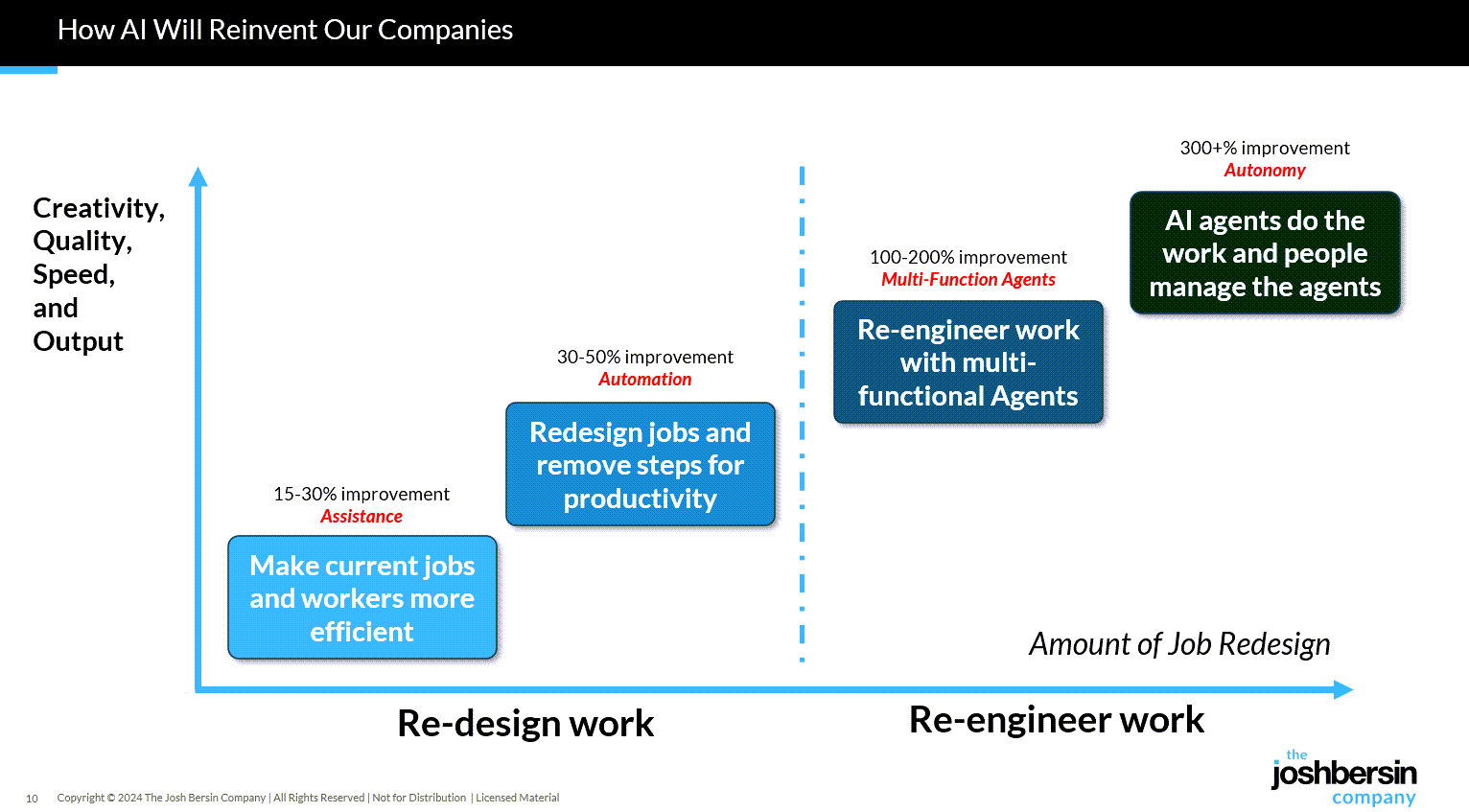


Gen AI Is Going Mainstream: Here’s What’s Coming Next — from joshbersin.com by Josh Bersin

I just completed nearly 60,000 miles of travel across Europe, Asia, and the Middle East meeting with hundred of companies to discuss their AI strategies. While every company’s maturity is different, one thing is clear: AI as a business tool has arrived: it’s real and the use-cases are growing.

A new survey by Wharton shows that 46% of business leaders use Gen AI daily and 80% use it weekly. And among these users, 72% are measuring ROI and 74% report a positive return. HR, by the way, is the #3 department in use cases, only slightly behind IT and Finance.

What are companies getting out of all this? Productivity. The #1 use case, by far, is what we call “stage 1” usage – individual productivity. 

.


From DSC:
Josh writes: “Many of our large clients are now implementing AI-native learning systems and seeing 30-40% reduction in staff with vast improvements in workforce enablement.

While I get the appeal (and ROI) from management’s and shareholders’ perspective, this represents a growing concern for employment and people’s ability to earn a living. 

And while I highly respect Josh and his work through the years, I disagree that we’re over the problems with AI and how people are using it: 

Two years ago the NYT was trying to frighten us with stories of AI acting as a romance partner. Well those stories are over, and thanks to a $Trillion (literally) of capital investment in infrastructure, engineering, and power plants, this stuff is reasonably safe.

Those stories are just beginning…they’re not close to being over. 


“… imagine a world where there’s no separation between learning and assessment…” — from aiedusimplified.substack.com by Lance Eaton, Ph.D. and Tawnya Means
An interview with Tawnya Means

So let’s imagine a world where there’s no separation between learning and assessment: it’s ongoing. There’s always assessment, always learning, and they’re tied together. Then we can ask: what is the role of the human in that world? What is it that AI can’t do?

Imagine something like that in higher ed. There could be tutoring or skill-based work happening outside of class, and then relationship-based work happening inside of class, whether online, in person, or some hybrid mix.

The aspects of learning that don’t require relational context could be handled by AI, while the human parts remain intact. For example, I teach strategy and strategic management. I teach people how to talk with one another about the operation and function of a business. I can help students learn to be open to new ideas, recognize when someone pushes back out of fear of losing power, or draw from my own experience in leading a business and making future-oriented decisions.

But the technical parts such as the frameworks like SWOT analysis, the mechanics of comparing alternative viewpoints in a boardroom—those could be managed through simulations or reports that receive immediate feedback from AI. The relational aspects, the human mentoring, would still happen with me as their instructor.

Part 2 of their interview is here:


Seeing The Unseen Students: The Invisible Strength of Teachers — from teachthought.com by Tasneem Tazkiya
One afternoon, I asked a different question: “What would make school feel worth showing up for again?”

A Moment That Changed My View of Teaching
I’ll never forget a student I’ll call Jalen. He was bright and quick with answers, sharp in debate, but he had built a wall around himself after a difficult year at home. He’d stopped turning in work and began sitting silently in the back of the room, disengaged and defiant.

One afternoon, instead of lecturing him about missing assignments, I asked a different question: “What would make school feel worth showing up for again?”

That simple question opened a door. Over the following weeks, Jalen began sharing ideas for projects connected to his interests, designing sneakers and exploring how geometry applies to shoe patterns. I adapted lessons to let him create, design, and analyze. Slowly, his confidence returned. Months later, he told me, “You made me feel like my ideas mattered.”

That moment reminded me that teaching isn’t just about delivering content; it’s about restoring belief in learning, and in oneself.


Also see:

The Power of Play — from barbarabray.net by Barbara Bray

Play brings joy and happiness to learning. Infusing play in schools prepares kids as future citizens.
When you play a game with your friends, how do you feel?

When you see children playing with other children, what do you notice?

Ask a child if they remember the worksheet they filled out last week.
Did they have fun?

Do they remember what they learned?

Let’s play more and discover how learning unfolds.
Schools can invest in more play through games, interactive experiences, and just making learning fun. Providing engaging activities through play creates learners who become critical thinkers, researchers, and designers.


Also re: teaching and learning:


Acts 10:34-35

34 Then Peter began to speak: “I now realize how true it is that God does not show favoritism 35 but accepts from every nation the one who fears him and does what is right.

Isaiah 1:18

 “Come now, let us settle the matter,”
says the Lord.
“Though your sins are like scarlet,
they shall be as white as snow;
though they are red as crimson,
they shall be like wool.

Psalm 40:1-5

For the director of music. Of David. A psalm.
1 I waited patiently for the Lord;
he turned to me and heard my cry.
2 He lifted me out of the slimy pit,
out of the mud and mire;
he set my feet on a rock
and gave me a firm place to stand.
3 He put a new song in my mouth,
a hymn of praise to our God.
Many will see and fear the Lord
and put their trust in him.
4 Blessed is the one
who trusts in the Lord,
who does not look to the proud,
to those who turn aside to false gods.
5 Many, Lord my God,
are the wonders you have done,
the things you planned for us.
None can compare with you;
were I to speak and tell of your deeds,
they would be too many to declare.


How Coworking Spaces Are Becoming The Learning Ecosystems Of The Future — from hrfuture.net

What if your workspace helped you level up your career? Coworking spaces are becoming learning hubs where skills grow, ideas connect, and real-world education fits seamlessly into the workday.

Continuous learning has become a cornerstone of professional longevity, and flexible workspaces already encourage it through workshops, talks, and mentoring. Their true potential, however, may lie in becoming centers of industry-focused education that help professionals stay adaptable in a rapidly changing world of work.
.


.

What if forward-thinking workspaces and coworking centers became hubs of lifelong learning, integrating job-relevant training with accessible, real-world education?

For coworking operators, this raises important questions: Which types of learning thrive best in these environments, and how much do the design and layout of a space influence how people learn?

By exploring these questions and combining innovative programs with cutting-edge technology aligned to the future workforce, could coworking spaces ultimately become the classrooms of tomorrow?


BIG unveils Suzhou Museum of Contemporary Art topped with ribbon-like roof — from dezeen.com by Christina Yao
.

Also from Dezeen:

MVRDV designs giant sphere for sports arena in Tirana — from dezeen.com by Starr Charles
.


Breaking News: Law Firm’s AI Pilot Lets New Lawyers Step Away from Billable Hours — from jdjournal.com

In a groundbreaking move that may redefine how law firms integrate technology training into daily practice, Ropes & Gray LLP has introduced a new pilot program allowing its first-year associates to dedicate a significant portion of their work hours to artificial intelligence (AI) learning—without the pressure of billing those hours to clients.

The initiative, called “TrAIlblazers,” marks one of the first formal attempts by a major law firm to give attorneys credit toward their billable-hour requirements for time spent exploring and developing AI skills. The firm hopes the move will both prepare young lawyers for a rapidly evolving profession and signal a new era of flexibility in how law firms evaluate performance.


A New AI Career Ladder — from ssir.org (Stanford Social Innovation Review) by Bruno V. Manno; via Matt Tower
The changing nature of jobs means workers need new education and training infrastructure to match.

AI has cannibalized the routine, low-risk work tasks that used to teach newcomers how to operate in complex organizations. Without those task rungs, the climb up the opportunity ladder into better employment options becomes steeper—and for many, impossible. This is not a temporary glitch. AI is reorganizing work, reshaping what knowledge and skills matter, and redefining how people are expected to acquire them.

The consequences ripple from individual career starts to the broader American promise of economic and social mobility, which includes both financial wealth and social wealth that comes from the networks and relationships we build. Yet the same technology that complicates the first job can help us reinvent how experience is earned, validated, and scaled. If we use AI to widen—not narrow—access to education, training, and proof of knowledge and skill, we can build a stronger career ladder to the middle class and beyond. A key part of doing this is a redesign of education, training, and hiring infrastructure.

What’s needed is a redesigned model that treats work as a primary venue for learning, validates capability with evidence, and helps people keep climbing after their first job. Here are ten design principles for a reinvented education and training infrastructure for the AI era.

  1. Create hybrid institutions that erase boundaries. …
  2. Make work-based learning the default, not the exception. …
  3. Create skill adjacencies to speed transitions. …
  4. Place performance-based hiring at the core. 
  5. Ongoing supports and post-placement mobility. 
  6. Portable, machine-readable credentials with proof attached. 
  7. …plus several more…
 

Net tuition rises at colleges, but costs are far below their peaks — from highereddive.com by Ben Unglesbee
The prices students and their families paid after aid at four-year public colleges and private nonprofits ticked up in 2025-26, per College Board estimates.

Dive Brief:

  • The average tuition and fees paid by students and their families after aid rose slightly for the 2025-26 academic year but remain well below historic peaks, according to the latest higher education pricing study from the College Board.
  • At public four-year colleges, net tuition and fees for first-time, full-time students increased just 1.3% to $2,300 from last year, when adjusted for inflation, according to the College Board’s estimates. That figure is down 48.3% from the peak in 2012-2013.
  • At private nonprofits, net tuition and fees for first-time, full-time students rose 3.7% annually to $16,910 in the 2025-26 year, when adjusted for inflation. By comparison, that’s down 14.6% from the peak for private colleges in 2006-07.

Class of 2025 says they see the effects of a tough job market — from hrdive.com by Kathryn Moody
Young workers have been particularly exposed to the changes brought by artificial intelligence tools, some research has indicated.

The Class of 2025 faced a particularly tough job market, searching for jobs earlier, submitting more applications — averaging 10 applications to the Class of 2024’s six — and receiving fewer offers on average, a National Association of Colleges and Employers study said in a recent report, in partnership with Indeed.

Graduates were more likely to accept those offers, however, even amid uncertainty; 86.7% of those offered a job had accepted in 2025, compared to 81.2% of 2024 graduates.

“Compared to earlier classes, they were more likely to say they were unsure about their plans, and more were planning to enter the military, suggesting they were unsure about private-sector employment,” NACE said in an Oct. 30 announcement regarding the report.


An addendum from DSC:
While we’re talking the workplace, careers, jobs, and such involving higher education, also see:

Careers in Educational Development with Leslie Cramblet Alvarez and Chris Hakala — from intentionalteaching.buzzsprout.com by Derek Bruff

On the show today I talk with Leslie Cramblet Alvarez and Chris Hakala, authors of the new book Understanding Educational Developers: Tales from the Center from Routledge Press. The book blends scholarship and personal narratives to explore the career trajectories of the professionals who work at CTLs (Centers for Teaching & Learning). How do academics move into these careers? And what can these careers look like over time?

Leslie Cramblet Alvarez is assistant vice provost and director of the Office of Teaching and Learning at the University of Denver. Chris Hakala is director for the Center for Excellence in Teaching, Learning, and Scholarship and professor of psychology at Springfield College.

I wanted to talk with Chris and Leslie about what they discovered while writing their book. I also wanted to know what advice they had for navigating educational development careers here in the U.S. in 2025, with higher education under attack from the federal government, a looming demographic cliff affecting enrollment and tuition, and a budget situation that for more institutions is not rosy. Leslie and Chris offer advice for faculty considering a move into a faculty development role, as well as for those of us current working at CTLs trying to plan our careers.


News deserts hit new high and 50 million have limited access to local news, study finds — from medill.northwestern.edu
Federal funding cuts to public broadcasting may accelerate local news crisis

EVANSTON, ILL. — The number of local news deserts in the U.S. jumped to record levels this year as newspaper closures continued unabated, and funding cuts to public radio could worsen the problem in coming months, according to the Medill State of Local News Report 2025 released today.

While the local news crisis deepened overall, Medill researchers found cause for optimism — more than 300 local news startups have launched over the past five years, 80% of which were digital-only outlets.

For the fourth consecutive year, the Medill Local News Initiative at Northwestern University’s Medill School of Journalism, Media, Integrated Marketing Communications conducted a months-long, county-by-county survey of local news organizations to identify trends in the rapidly morphing local media landscape. Researchers looked at local newspapers, digital-only sites, ethnic media and public broadcasters.


How Local Newsrooms Are Rethinking Political Coverage — from adigaskell.org

For decades, election reporting in the U.S. has leaned heavily on the “horse race”—who’s up, who’s down, and who’s raising the most money. But new research from the University of Kansas suggests that this approach is starting to shift, thanks to a national training program aimed at helping journalists better engage with their communities.

The program, called Democracy SOS, encourages reporters to move beyond headline polls and campaign drama. Instead, it asks them to focus on the issues people care about and explain how those issues are being tackled. In other words: less spectacle, more substance.


Addendum on 11/13/25:

Why Losing Local Newspapers Costs More Than We Think — from adigaskell.org

So why can’t digital journalism fill the gap?
The researchers argue that online media isn’t a true replacement for local reporting. “If you’re in New York writing about San Francisco, you just don’t know the area,” they say. “You don’t have the context. You’re not there.”

Even local online reporters face pressure to chase clicks. “Every journalist now has a global audience,” they explain. “That means the stories that matter most—ones that require digging, patience, and a deep knowledge of the community—often get ignored.”

The takeaway: local newspapers may seem like an old-fashioned idea, but they play a key role in how communities function. And when they vanish, the costs go beyond the news.


The Other Regulatory Time Bomb — from onedtech.philhillaa.com by Phil Hill
Higher ed in the US is not prepared for what’s about to hit in April for new accessibility rules

Most higher-ed leaders have at least heard that new federal accessibility rules are coming in 2026 under Title II of the ADA, but it is apparent from conversations at the WCET and Educause annual conferences that very few understand what that actually means for digital learning and broad institutional risk. The rule isn’t some abstract compliance update: it requires every public institution to ensure that all web and media content meets WCAG 2.1 AA, including the use of audio descriptions for prerecorded video. Accessible PDF documents and video captions alone will no longer be enough. Yet on most campuses, the conversation has been understood only as a buzzword, delegated to accessibility coordinators and media specialists who lack the budget or authority to make systemic changes.

And no, relying on faculty to add audio descriptions en masse is not going to happen.

The result is a looming institutional risk that few presidents, CFOs, or CIOs have even quantified.


Six Transformative Technology Trends Impacting the Legal Profession — from americanbar.org

Summary

  • Law firm leaders should evaluate their legal technology and decide if they are truly helping legal work or causing a disconnect between human and AI contributions.
  • 75% of firms now rely on cloud platforms for everything from document storage to client collaboration.
  • The rise of virtual law firms and remote work is reshaping the profession’s culture. Hybrid and remote-first models, supported by cloud and collaboration tools, are growing.

Are we truly innovating, or just rearranging the furniture? That’s the question every law firm leader should be asking as the legal technology landscape shifts beneath our feet. There are many different thoughts and opinions on how the legal technology landscape will evolve in the coming years, particularly regarding the pace of generative AI-driven changes and the magnitude of these changes.

To try to answer the question posed above, we looked at six recently published technology trends reports from influential entities in the legal technology arena: the American Bar Association, Clio, Wolters Kluwer, Lexis Nexis, Thomson Reuters, and NetDocuments.

When we compared these reports, we found them to be remarkably consistent. While the level of detail on some topics varied across the reports, they identified six trends that are reshaping the very core of legal practice. These trends are summarized in the following paragraphs.

  1. Generative AI and AI-Assisted Drafting …
  2. Cloud-Based Practice Management…
  3. Cybersecurity and Data Privacy…
  4. Flat Fee and Alternative Billing Models…
  5. Legal Analytics and Data-Driven Decision Making…
  6. Virtual Law Firms and Remote Work…
 

Psalm 56:3

When I am afraid, I put my trust in you.

Philippians 4:8

Finally, brothers and sisters, whatever is true, whatever is noble, whatever is right, whatever is pure, whatever is lovely, whatever is admirable—if anything is excellent or praiseworthy—think about such things.

1 Peter 1:24-25

24For,

“All people are like grass,
and all their glory is like the flowers of the field;
the grass withers and the flowers fall,
but the word of the Lord endures forever.”

And this is the word that was preached to you.

2 Chronicles 7:14

…if my people, who are called by my name, will humble themselves and pray and seek my face and turn from their wicked ways, then I will hear from heaven, and I will forgive their sin and will heal their land.

Psalm 57:9-11

9 I will praise you, Lord, among the nations;
I will sing of you among the peoples.
10 For great is your love, reaching to the heavens;
your faithfulness reaches to the skies.
11 Be exalted, O God, above the heavens;
let your glory be over all the earth.

24 How many are your works, Lord!
In wisdom you made them all;
the earth is full of your creatures.
25 There is the sea, vast and spacious,
teeming with creatures beyond number—
living things both large and small.
26 There the ships go to and fro,
and Leviathan, which you formed to frolic there.

27 All creatures look to you
to give them their food at the proper time.
28 When you give it to them,
they gather it up;
when you open your hand,
they are satisfied with good things.
29 When you hide your face,
they are terrified;
when you take away their breath,
they die and return to the dust.
30 When you send your Spirit,
they are created,
and you renew the face of the ground.

31 May the glory of the Lord endure forever;
may the Lord rejoice in his works—

 
© 2025 | Daniel Christian