Could Coursera become as prestigious as Harvard? This expert thinks so. — from edsurge.com by Jeffrey R. Young

Excerpt:

Big changes are coming to higher education, and those changes will be bigger and more disruptive than many college leaders realize as online education grows in both size and prestige.

That’s the view of Arthur Levine, in a new book called “The Great Upheaval: Higher Education’s Past, Present, and Uncertain Future,” which he co-wrote with Scott Van Pelt, a lecturer and associate director of the Communication Program for the University of Pennsylvania’s Wharton School.

As more students turn to these degrees for their credentials, they may come to see these corporate platforms as the provider of learning rather than worry about which college is the one behind the scenes doing the teaching, Levine says.

 

Constitution Day 2021: An Inspiring and Incomplete Civil Justice System — from legaltechmonitor.com by David Yellen

Excerpts:

Constitution Day, September 17, commemorates that date in 1787 when the delegates to the Constitutional Convention signed the U.S. Constitution in Philadelphia. Clearly, this date and this holiday do not attract nearly as much attention as July 4, the holiday marking the signing of the other foundational document of the United States, the Declaration of Independence. That is somewhat lamentable, however, because all Americans should take the time to celebrate and reflect on the Constitution each year.

I say celebrate because the Constitution was remarkable when it was written, and has served as the basic architecture for our system of government, law, and individual liberty for over 200 years. Not only has it remained the steadfast backbone of our country’s system of government, it has influenced new and evolving democracies around the world.

Despite the challenges, we believe the American legal system is still the best approach—and we believe all of us share a responsibility to embrace its ideals, expand access, and improve delivery. 


From DSC:
My answer to the question “Is Accreditation a Barrier to Innovation?” would be “Yes, it is.” But admittedly, maybe that’s because I work for a law school these days…and in the legal education realm (as controlled by the American Bar Association), there is YET to be a fully 100% online-based Juris Doctor (JD) degree that I’m aware of. There are some schools that have applied for “variances,” but we’re talking 20+ years after institutions of higher education introduced online-based learning! Those programs who have applied for variances are under an incredible amount of scrutiny by the American Bar Association, that’s for sure. So the legal realm is NOT doing well with innovation.

But in regards to other areas of higher ed and its accrediting bodies…I’m sorry, but you can’t tell me that the run-up in the price of higher education over the last several decades had nothing to do with HE’s accrediting bodies and either their support of — or their lack of support of — those organizations who were trying to introduce something new.

But along these lines, I’d like to hear from folks like:

  • Burck Smith from Straighterline on his perspectives and his company’s experiences with the various accrediting bodies that Straighterline has had to deal with. His insights here would carry a significant impact/weight for me.
  • Or perhaps someone like James DeVaney from University of Michingan’s Center for Academic Innovation or Joshua Kim who writes about higher education and edtech/online learning
  • Or folks like Mary Grush or Rhea Kelly at CampusTechnology.com
  • Surveying organizations who could speak for a massive group of students/learners/employees
  • …and/or other folks who are either trying to innovate within the existing systems, have heard from both sides of the table here, and/or have tried and failed to innovate within the existing structures

We’ll see if institutions of traditional higher education can reinvent themselves in order to stay relevant and survive (especially colleges and universities…not so much the community colleges). The accreditation bodies will have a large part in whether this happens…or not.

Along these lines…let’s see what happens to the growth of alternatives to those types of institutions as well.


Justice, Equity, And Fairness: Exploring The Tense Relationship Between Artificial Intelligence And The Law With Joilson Melo — from forbes.com by Annie Brown

Excerpt:

The law and legal practitioners stand to gain a lot from a proper adoption of AI into the legal system. Legal research is one area that AI has already begun to help out with. AI can streamline the thousands of results an internet or directory search would otherwise provide, offering a smaller digestible handful of relevant authorities for legal research. This is already proving helpful and with more targeted machine learning it would only get better.

The possible benefits go on; automated drafts of documents and contracts, document review, and contract analysis are some of those considered imminent.

Many have even considered the possibilities of AI in helping with more administrative functions like the appointment of officers and staff, administration of staff, and making the citizens aware of their legal rights.

A future without AI seems bleak and laborious for most industries including the legal and while we must march on, we must be cautious about our strategies for adoption. This point is better put in the words of Joilson Melo; “The possibilities are endless, but the burden of care is very heavy[…]we must act and evolve with [caution].”


Living With a Learning Disability: Challenges, Helpful Advice & Improvements — from inclusionhub.com by Meredith Kreisa

Excerpts:

While it is critical to remember that symptoms, comorbidities, and coping mechanisms vary, we’ll outline some of the challenges individuals with learning disabilities may face and highlight common strategies utilized by community members to address them.

Also see:

Improving Digital Inclusion & Accessibility for Those With Learning Disabilities — from inclusionhub.com by Meredith Kreisa
This comprehensive guide outlines common learning disabilities, associated difficulties, accessibility barriers and best practices, and more.


Artificial intelligence is taking over real estate – here’s what that means for homebuyers— from cnbc.com by Diana Olick

Excerpt:

  • Real estate companies are increasingly using artificial intelligence in every aspect of buying, selling and home financing.
  • Algorithms can now go through millions of documents in seconds, looking through property values, debt levels, home renovations, and even some of a homeowner’s personal information.
  • “The traditional agent would go knock on the doors of a lot of homes. Now AI helps you find the homes that are most likely to sell in the next 12 months,” said Compass’ chief technology officer.

For those searching to buy a home, all the data available can also help them to find exactly what they’re looking for, rather than touring house after house.


What is a Smart Contract Audit? — from 101blockchains.com by Gwyneth Iredale

Excerpt:

Blockchain applications use smart contracts for interacting with the blockchain, and smart contracts have profound security vulnerabilities. This is where you need a smart contract audit. You might be wondering about the definition of auditing a smart contract and the resources you need for the same. The following discussion offers you a detailed guide on smart contract auditing with an outline of its definition, types, and processes.


Defining the skills citizens will need in the future world of work — from McKinsey & Company; with thanks to Ryan Craig for this resource

Excerpts:

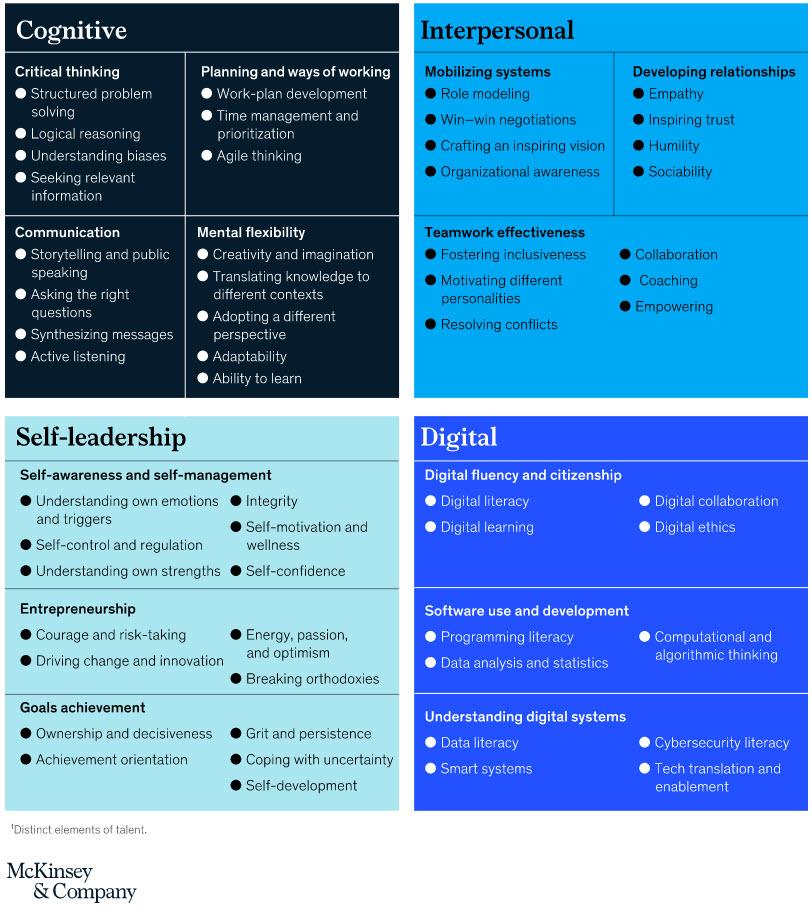
Our findings help define the particular skills citizens are likely to require in the future world of work and suggest how proficiency in them can influence work-related outcomes, namely employment, income, and job satisfaction. This, in turn, suggests three actions governments may wish to take.

  1. Reform education systems
  2. Reform adult-training systems
  3. Ensure affordability of lifelong education

Establish an AI aggregator of training programs to attract adult learners and encourage lifelong learning. AI algorithms could guide users on whether they need to upskill or reskill for a new profession and shortlist relevant training programs. 

Foundational skills that will help citizens thrive in the future of work


From DSC:
No one will have all 56 skills that McKinsey recommends here. So (HR) managers, please don’t load up your job postings with every single skill listed here. The search for purple unicorns can get tiring, old, and discouraging for those who are looking for work.

That said, much of what McKinsey’s research/data shows — and what their recommendations are — resonates with me. And that’s why I keep adding to the developments out at:

Learning from the living class room

A powerful, global, next-generation learning platform — meant to help people reinvent themselves quickly, safely, cost-effectively, conveniently, & consistently!!!


OPINION: Meet certificates and “microcredentials” — they could be the future of higher education — from hechingerreport.org by Arthur Levine and Scott Van Pelt
In years to come, they will become prevalent — and possibly preferred — to college degrees

Excerpt:

What is new is that we are calling them badges and microcredentials and using them primarily to certify specific skills, such as cross-cultural competency, welding and conversational Spanish.

So what are they? Microcredentials are certifications of mastery; badges verify the attainment of specific competencies.

No matter what we are calling them, they may be here to stay.

We now live in a time that is more open to rethinking college and university credentials. We are witnessing experimentation with competency-based education, through which students earn credits by demonstrating skills instead of spending time in courses. We are also seeing discussion of free or reduced tuition, along with subscription pricing that lets students take as many courses as they like for one low cost.

Also see:

Can an AI tutor teach your child to read? — from hechingerreport.org by Jackie Mader
Some AI reading programs are boosting early literacy skills

Excerpt:

Artificial intelligence has been used for years in education to monitor teaching quality, teach classes, grade assignments and tailor instruction to student ability levels. Now, a small but growing number of programs are attempting to use AI to target reading achievement in the early years — a longstanding struggle for America’s schools.


What Will Online Learning Look Like in 10 Years? Zoom Has Some Ideas — from edsurge.com by Stephen Noonoo

Excerpt:

This week at Zoom’s annual conference, Zoomtopia, a trio of education-focused Zoom employees (er, Zoomers?) speculated wildly about what hybrid Zoom learning might look like 10 years from now, given the warp speed advances in artificial intelligence and machine learning expected. Below are highlights of their grandiose, if sometimes vague, vision for the future of learning on Zoom.

Zoom very much sees itself as one day innovating on personalized learning in a substantial way, although beyond breakout rooms and instant translation services, they have few concrete ideas in mind. Mostly, the company says it will be working to add more choices to how teachers can present materials and how students can display mastery to teachers in realtime. They’re bullish on Kahoot-like gamification features and new ways of assessing students, too.

Also see:

An Eighth Grader Was Tired of Being Late to Zoom School. So He Made an App for That. — from edsurge.com by Nadia Tamez-Robledo

“I could not find anything else that exists like this to automatically join meetings at the right times,” says Seth, a high school freshman based in Walnut Creek, Calif. “Reminders are just really easy to ignore. I’ll get a notification maybe five minutes before my meeting, and it’ll just sit there and not do anything. [LinkJoin] interrupts whatever you’re doing and says, ‘Join this meeting. In fact it’s already opening, so better get on it.’”


The Importance of Using a Legal Videographer in Remote Proceedings — from lawtechnologytoday.org by Dave DaSilva

Excerpt:

Depositions and trials have changed drastically in recent years, as have the jurors who hear cases. The analog days of reading deposition testimony into the trial record have increasingly given way to video clips of witness testimony.

While videography was once a luxury, it’s now a necessity if you want to present the best case for your client. The importance of videography has only increased in the past year as depositions went remote during the pandemic. Professional legal videographers are not only integral to creating the best possible evidence, they’re essential for preserving your case record in a secure and admissible way.

Also see:


Zoom product updates showcase the art of the possible for hybrid work — from diginomica.com by Derek du Preez
Zoom’s annual conference – Zoomtopia – kicked off with a number of impressive product updates that highlight how we should be thinking about the future of hybrid work.

Excerpt:

Zoom CEO Eric Yuan kicked off the collaboration vendor’s annual conference – Zoomtopia – with a swathe of product updates that effectively showcase how we should be thinking about the future of hybrid work.

What’s clear is that Zoom is thinking well beyond its video call roots and is creating a platform that’s an effective place for people to get work done. Upcoming integrations with the likes of Google Drive and Dropbox are just part of this.

Features such as being able to continuously access and collaborate on content in a meeting, whether that be chats or files, whilst also having call transcriptions instantly accessible within the Zoom client after a call is completed, and having access to Zoom Whiteboard to create visual presentations – and being able to do this wherever you are – gives you an idea of how the vendor is thinking about making remote work as seamless and productive as possible.

From DSC:
The intense competition between vendors like Zoom, Cisco, Microsoft, and others will only benefit all of us in the longer term. Here’s to innovation! Online learning may never be the same again. For that matter, learning may never be the same again.


Active Learning: 5 Tips for Implementing the Approach — from techlearning.com by Erik Ofgang
Active learning provides ways to get your students engaged without needing to revamp how you teach.

Excerpts:

However, neither listening to a lecture or reading a textbook is the most efficient way to learn or what active learning is truly about. “What exactly do we mean by active learning?” Deslauriers says.  “We mean that first, you have to be engaged. Obviously, that’s number one. Number two, you have to be engaged productively. And number three, the productivity has to be toward a goal that is deemed worthwhile*.”

— Louis Deslauriers, Director of Science Teaching and Learning
in the Faculty of Arts and Sciences at Harvard University


From DSC:
I appreciated seeing/reading this solid article. Just a couple of reflections and highlights here…


* But worthwhile for whom? For the faculty members? The teachers? The trainers? Or for the learners, the students, or the employees? Where is agency here? Where does more choice and control come into play here? Where’s the motivation for me to learn something if someone keeps telling me what’s important to THEM? What’s relevant to THEM? Why should I care about this topic? How is it relevant? How will it help me get a job and/or make a positive difference in this world? Can I choose how deep I want to dive in?

Later…Deslauriers goes on to make a great point when urging a pause for students to practice some metacognition:

  • Does this make sense to me?
  • How is this relevant? <– DSC: There it is.
  • Does it connect with something I already know? And if so, how do I integrate with what I already know?
  • What sort of questions do I have right now?
  • Can I repeat what the instructor just did? Or is it going to require a lot of practice?

“There’s no way you can undergo these mental processes when someone keeps talking,”  Deslauriers says. But if educators pause during their lectures and encourage this type of focus, they can help their students learn more efficiently.


 Instructors can hand out electronic clickers, use web-based tools such as Google forms, or even go completely low-tech by giving color-coded cards to students that correspond to different answers. 


Also see:

 
© 2025 | Daniel Christian