How corporate universities fit into hybrid learning strategies of the future — from chieflearningofficer.com by Andie Burjek
While the onset of the pandemic challenged many organizations’ learning strategies, many companies have learned the true value of their brick-and-mortar facilities.

Excerpt:

Part of what KPMG did to accomplish this was break down its learning programs into component parts, he added. For example, one of their popular audit programs was broken down into parts like readings, coaching sessions, guided practices and more. These are known as “road maps.” The learning organization found that this was an effective way to convert in-person learning and maintain the quality and effectiveness of the learning.

“We will continue to leverage those roadmaps for a more holistic learning experience [and] to deliver on the promise of a blended learning experience,” Muñoz says.

“[Deloitte University] will continue to be an important part of our strategy, but our total mix will change in how we leverage the other modalities going forward,” Dingler says. “It will be a more purposeful, strategic and integrated mix than what they were in the past.”


 

Can colleges compete with companies like Coursera? — from highereddive.com by Rick Seltzer
Arthur Levine discusses how trends like personalized education are unfolding, what’s driving them, and what can go right or wrong for colleges.

Excerpt:

They say colleges will see their control over the market slip while consumers increase their power. New content producers like companies and museums are entering the postsecondary market. Students will often prioritize personalized education and low prices. Measuring learning by time in seats will transition to outcome-based education. Degrees won’t necessarily be the dominant form of credential anymore as students turn to “just-in-time education” that quickly teaches them the skills for microcredentials they need for the labor market.

For higher education to be successful, you have to have its feet in two worlds. One world is the library, and that’s human heritage. And the other is the street. That’s the real world, what’s happening now. It’s jobs, it’s the workplace.

What happens when we change quickly is we continue as institutions to keep our hold on the library, but we lose traction in the street.

Institutions have to reestablish their traction. They have to prepare students for careers. They have to prepare students for the world…

From DSC:
I also like the part where is says, “So you’ve got to ask yourself, what are they offering that would draw people there? One thing they are offering is 24/7. Another thing that they’re offering is unbundled. Another thing they’re offering is low cost, and that’s very appealing.”


Five Tips for Launching an Online Writing Group — from scholarlyteacher.com by Kristina Rouech,  Betsy VanDeuesen, Holly Hoffman, & Jennifer Majorana — who are all from Central Michigan University

Excerpt:

Making time for writing can be difficult at any stage of your career. Pushing writing aside for grading, lesson planning, meeting with students, and committee work is too easy. However, writing is a necessary part of our careers and has the added benefit of helping us stay current with our practice and knowledge in our field. Lee and Boud (2003) stress that groups should focus on developing peer relationships and writing identity, increasing productivity, and sharing practical writing. Online writing groups can help us accomplish this. With the impact of the COVID-19 pandemic, working online has become a necessity, but it can take time to figure out what works best for you and your writing colleagues. We recommend five tips to help you establish an online writing group that is productive and enjoyable for all participants.


Best Wireless Keyboard and Mouse for Teachers 2021 — from techlearning.com by Luke Edwards
The best wireless keyboard and mouse for teachers can give freedom to move without losing ease of input

The following don’t focus much on Apple’s products, but you can also see:


National Disability Employment Awareness Month 2021 — from dol.gov

Excerpt:

The theme for NDEAM 2021, “America’s Recovery: Powered by Inclusion,” reflects the importance of ensuring that people with disabilities have full access to employment and community involvement during the national recovery from the COVID-19 pandemic.

NDEAM is held each October to commemorate the many and varied contributions of people with disabilities to America’s workplaces and economy. Browse our website for ideas and resources for employers, community organizations, state and local governments, advocacy groups and schools to participate in celebrating NDEAM through events and activities centered around the theme of “America’s Recovery: Powered by Inclusion.”

The 2021 NDEAM poster is available now!


Artist Spotlight: Kohshin Finley

Artist Spotlight: Kohshin Finley — from booooooom.com

Artist Spotlight -- Kohshin Finley


150 learning theorists… 2500 years of learning theory… from Greeks to Geeks! — from onaldclarkplanb.blogspot.com by Donald Clark

Excerpt:

These were written as quick, readable introductions to the many theorists who have shaped the world of learning. For Greeks to Geeks! Note that this is a personal selection, not a definitive list.


Millionaire Mastermind Academy dot org -- for minority women

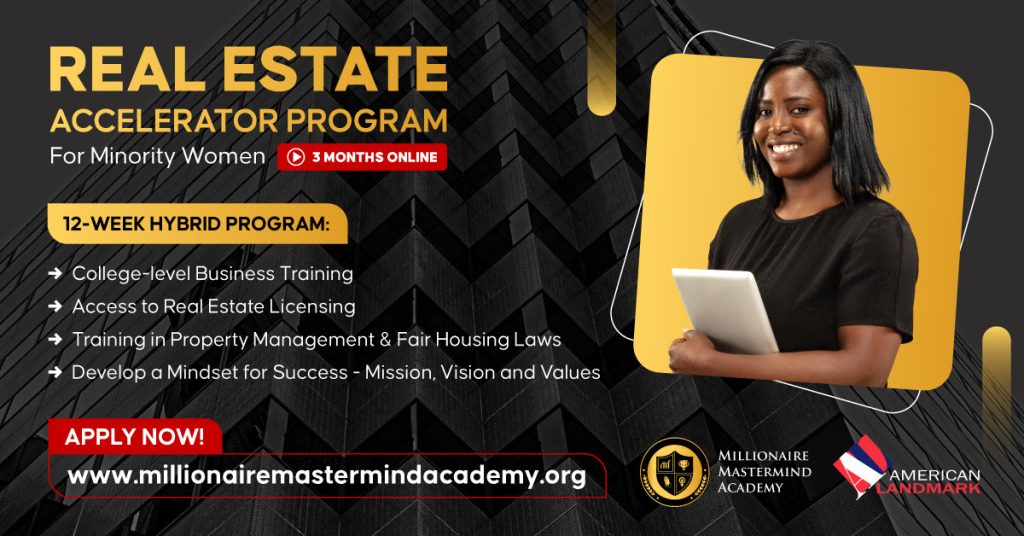
The Millionaire Mastermind Academy, a nonprofit organization that aims to end poverty through entrepreneurship for minority women worldwide, and American Landmark Apartments, one of the country’s fastest-growing multifamily owner-operators in the country, are teaming up to help minority women entrepreneurs develop career skills in real estate and property management while further diversifying the industry.

The newly launched Millionaire Mastermind Academy Real Estate Accelerator Program is a 12-week program that equips and empowers minority women to combat poverty by equipping them with sustainable real estate and property management skills and experience. The program includes college-level business training, access to real estate licensing, training in property management and Fair Housing laws, as well as apprenticeship and mentorship opportunities.

Newly launched -- Millionaire Mastermind Academy Real Estate Accelerator Program

Through its application process, Millionaire Mastermind Academy will select approximately 25 qualifying women to participate in the program, which runs from September 28th to December 21st, 2021, and consists of both virtual education and two in-person weekend intensives. The in-person training will be held at the American Landmark Training facility in Tampa, Fla.


From DSC:
For IDs, trainers, teachers, faculty members, & teams who are working on creating and delivering online-based learning……the following article is a good one for us to check out and reflect upon:

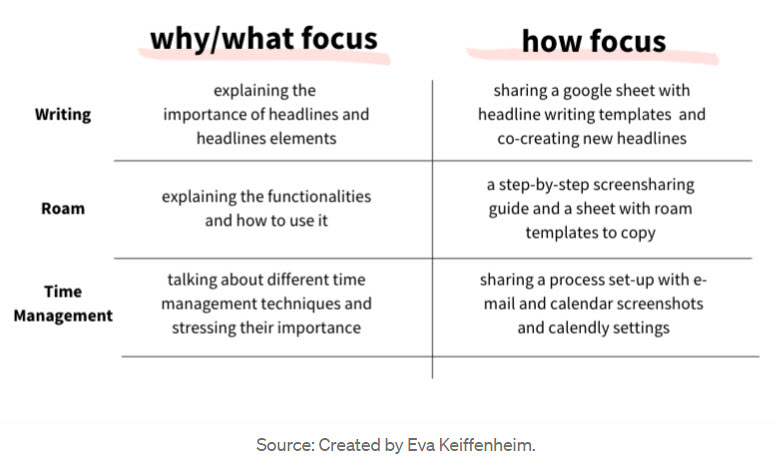
Most Online Courses Are a Waste of Your Time — Here’s How You Know — from medium.com by Eva Keiffenheim
A quick guide that helps you find the worthy ones.

Excerpts:

Not all learning investments are created equal. People who’ve excelled at their craft are often not the best teachers. Likewise, creators who write the best sales copy don’t offer the most value.

Here’s precisely how you can spot bad online courses so that you won’t waste your time and money.


Could AR and/or VR enable a massive 3D-based type of “Voicethread?” [Christian]

From DSC:
What if we could quickly submit items for a group to discuss, annotate, and respond to — using whichever media format is available/preferable for a person — like a massive 3D-based Voicethread? What if this type of discussion could be contributed to and accessed via Augmented Reality (AR) and/or via Virtual Reality (VR) types of devices?

It could be a new 3D format that a person could essentially blow all the way up into the size of a billboard. Think, “Honey, I shrunk the kids” type of stuff.  

Input devices might include:

  • Augmented Reality (AR) glasses
  • Virtual Reality (VR) headsets/glasses
  • Scanners
  • Smartphones
  • Tablets
  • Desktops and laptops
  • SmartTVs
  • Other types of input devices

For example, a person could take a picture of a document or something else and then save that image into a new file format that would be vector-based. I say a vector-based file format so that the image could be enlarged to the size of a billboard without losing any resolution (i.e., wouldn’t become grainy; the image would remain crystal clear regardless of how big the image is). I’m thinking here along the lines of “Honey, I shrunk the kids!”

Other thoughts here:

  • The files could be accessible online for attendees of classes or for audiences of presentations/webinars
  • The files could be displayed on the walls of learning/presentation spaces for marking them up
  • One could manipulate the 3D image if that person was using a virtual/immersive environment
  • Users should be able to annotate on those images and/or be able to save such annotations and notes

A question for phase II:
Could this concept also be used if virtual courts take off?

Hmmmm…just thinking out loud.


Feynman – Don’t lecture and Feynman Technique — from donaldclarkplanb.blogspot.com by Donald Clark

Excerpt from the Feynman Technique section

  1. Write down everything you think you know about the topic from the top of your head
  2. Teach it to someone much younger
  3. Identify the gaps and fill them out
  4. Simplify, clarify and use analogies

Learning this way is iterative, as you must go back to sources to fill in any gaps uncovered by your attempts to recall what you think you know. The act of writing, teaching, simplification and analogising, is a form of retrieval practice that increases understanding and retention.

Also see:

The Feynman Technique Can Help You Remember Everything You Read — from medium.com by Eva Keiffenheim
How to use this simple principle for you.

Excerpts:

Social climber Dale Carnegie used to say knowledge isn’t power until it’s applied. And to apply what you read, you must first remember what you learned.

Nobel Prize-winning physicist Richard Feynman (1918–1988) was an expert for remembering what he learned.

Most people confuse consumption with learning. They think reading, watching, or hearing information will make the information stick with them.

Unless you’ve got a photographic memory, no idea could be further from the truth.

Teaching is the most effective way to embed information in your mind. Plus, it’s an easy way to check whether you’ve remembered what you read. Because before you teach, you have to take several steps: filter relevant information, organize this information, and articulate them using your own vocabulary.


Holt (1923 – 85) homeschooling and unschooling — from donaldclarkplanb.blogspot.com by Donald Clark

Excerpt:

John Holt graduated from Yale in 1943 but signed up to be a submariner in WW2. On discharge, he eventually became a teacher, in various schools. This led to a disillusionment with the US education system so deep that he became an advocate for homeschooling and unschooling. This emerged from his belief that education was so deeply embedded, structurally and culturally, that it was unreformable. Neither did he believe that alternative schools were the answer. He retains his reputation as the founding father of homeschooling.

National Home Education Research Institute (NHERI)

Excerpt:

NHERI is the National Home Education Research Institute. NHERI conducts and collects research about homeschooling (home-based education, home schooling), and publishes the research journal called the Home School Researcher. The institute has hundreds of research works documented and catalogued on home schooling, many of which were done by NHERI. Simply put, NHERI specializes in homeschool research, facts, statistics, scholarly articles, and information.

For those interested in home-schooling -- NHERI

Homeschooling – home education or home-based education – has grown from nearly extinct in the United States in the 1970s to just over 2 million school-age students. NHERI focuses on homeschooling research, homeschool facts, homeschool fast facts, and in-depth scholarly articles.

The Home School Legal Defense Association


Just for fun…

Classical Music Mashup IV — from theawesomer.com


ANALYSIS: Break Down Barriers to Legal Tech Usage With Training — from news.blooberlaw.com by Francis Boustany

Excerpt:

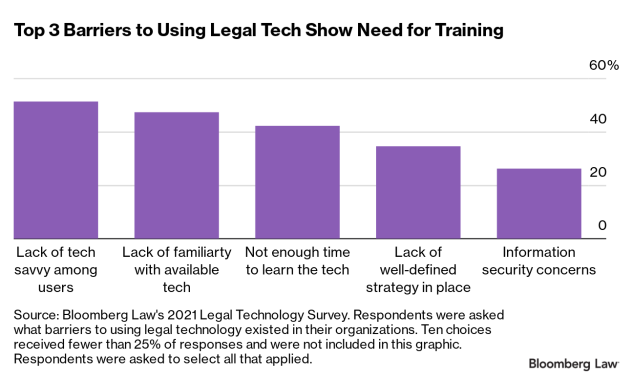
Many law firms and legal departments report barriers to using legal technology, and insufficient training may be a root cause. To help break down these barriers, organizations should consider creating more opportunities for their lawyers and staff to train on legal technology.

When asked to select what barriers to using legal technologies exist at their organizations, respondents to Bloomberg Law’s 2021 Legal Technology Survey indicated that the top obstacles are a lack of tech savvy, a lack of familiarity with available technology, and not enough time to learn the technology.


From DSC:
If it’s not already in place, all law schools should be offering curricula in this area from here on out.


Discovery Education Collaborates with AWS to Enhance Recommendation Engine — from discoveryeducation.com

Excerpt:

SILVER SPRING, MD [On Monday,?September 27, 2021] — Discovery Education—a worldwide edtech leader supporting learning wherever it takes place — announced that it has enhanced its K-12 learning platform with Amazon Web Services (AWS) machine learning capabilities. The pioneering use of machine learning within the Discovery Education platform helps educators spend less time searching for digital resources and more time teaching.

Several months of planning and deep collaboration with AWS enabled Discovery Education to innovatively integrate Amazon Personalize technology into the “Just For You” area of its K-12 platform. The “Just For You” row connects educators to a unique, personalized set of resources based on the grade level taught, preferences, and assets used in the past.

“For some time, educators have desired more resources to help personalize teaching and learning. ML technology is already being used to curate our entertainment experiences, help with workforce productivity, and more, and it’s exciting to see this innovation is being integrated into classrooms,” said Alec Chalmers, Director, EdTech and GovTech Markets at AWS.

From DSC:
It looks like Amazon continues to make inroads into the education space. Team up this type of recommendation engine with an AI that’s pulling the latest skills that are needed for — and embedded within — job descriptions and you have a learning powerhouse. 

Disruption ahead…?


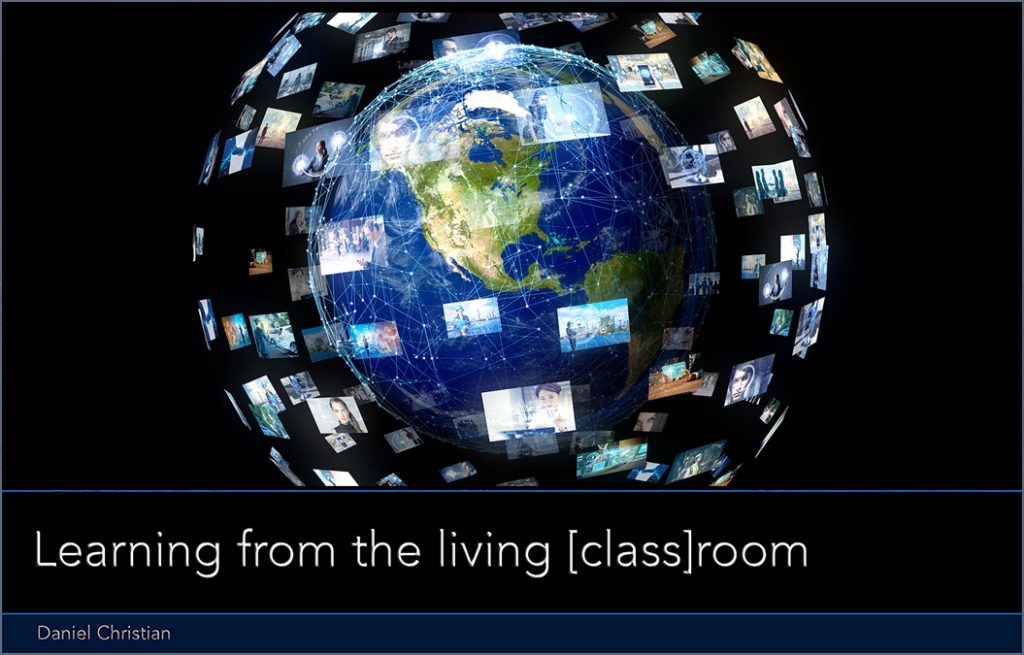
Learning from the living class room
Also see:

  • How Machine Learning Is Having an Impact on Education — from techlearning.com by Erik Ofgang
    Discovery Education has partnered with Amazon Web Services to enhance its platform with machine learning. It’s one of many ways machine learning is being used in K-12 today.
 
© 2025 | Daniel Christian