3 Promising Opportunities to Teach Your Kids From Home — from medium.com by Eva Keiffenheim
These organizations innovate homeschooling.

Excerpt:

What follows are three organizations that rethink the way children learn from home.


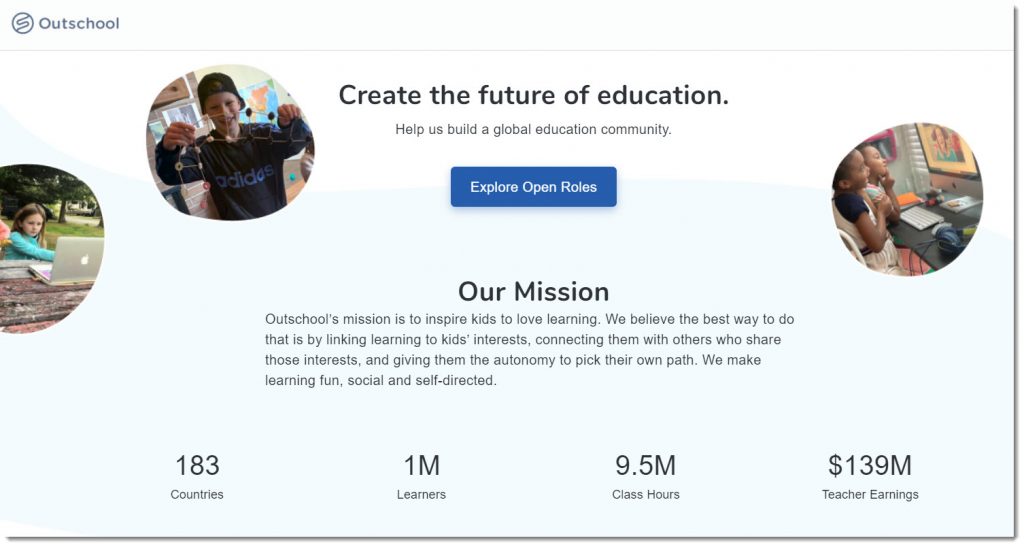
Outschool is one of the three organizations highlighted in this article.


From DSC:
My wife teaches for Outschool and really enjoys it! She develops solid relationships with her students and is able to personalize things (as she deals with 1-3 students at a time). She doesn’t charge much at all, but she enjoys it.


Why inexperienced workers can’t get entry-level jobs — from bbc.com by Kate Morgan; with thanks to Ryan Craig for this resource

Excerpt:

As anyone who’s graduated from university or applied for their first job in recent years can attest to, something new – and alarming – has happened to entry-level jobs: they’ve disappeared.

A recent analysis of close to 4 million jobs posted on LinkedIn since late 2017 showed that 35% of postings for “entry-level” positions asked for years of prior relevant work experience. That requirement was even more common in certain industries. More than 60% of listings for entry-level software and IT Services jobs, for instance, required three or more years of experience. In short, it seems entry-level jobs aren’t for people just entering the workforce at all.

“Internships are now the entry level,” he says. “Most of the students in college are doing or trying to do internships, and now it’s increasingly common to do more than one.”

From DSC:
I love the idea of internships. (In my days in college, internships were reserved mainly for engineers; few of us had them back then.)

But with an eye on the cost of obtaining a degree, internships should be PAID internships. That is, interns should receive decent/proper compensation. I’m concerned that businesses will take advantage of free labor here (though that’s less likely given the tight labor market I suppose). But businesses have taken advantage of free labor in the past. “It takes a village…”

Also see:


3 Tips for Making Passion-Based Learning Work Successfully — from thejournal.com by Dennis Pierce

Excerpt:

Passion-based learning, a form of self-directed learning in which students pursue projects of interest to them, is becoming more popular in schools — and for good reason: Educators who have set aside time for passion-based learning have discovered that students become highly engaged and motivated when learning about topics that intrigue them, while taking their learning much deeper than they would in a traditional lesson.

Passion-based learning initiatives include Genius Hour and 20time, both inspired by Google’s program that lets employees spend 20% of their time on projects of their choosing to spark innovation.

Giving all students the option to explore their interests can be challenging on a large scale. To overcome this hurdle and make the process easier for teachers, Sonora Elementary uses a new peer-to-peer learning platform called Tract, which is a collection of video content organized into self-directed learning paths.

tract.app allows students to be creative and practice their storytelling and multimedia skills

From DSC:
I love the type of tool/app like Tract — as students can work on a variety of skills:

  • multimedia development
  • music
  • acting
  • writing/composing
  • digital storytelling
  • …and more

Such projects/tools can unleash a great deal of creativity, engagement, and positive energy. Learning becomes more relevant, enjoyable, and interesting when we can provide more choice and control to our students.


Legal Technology: Why the Legal Tech Boom is Just Getting Started — from nasdaq.com by Casey Flaherty and Jae Um of LexFusion; with thanks to Gabe Teninbaum for this resource via his Lawtomatic Newsletter, Issue #136

Excerpt:

In quick succession, legal technology finally saw its first IPOs:

With private money pouring into legal tech startups and based on our own conversations inside the industry, we at LexFusion expect more IPOs on the horizon. Thus, a primer on legal tech as a category to watch. This Part I summarizes the legal market fundamentals driving unprecedented investment in enabling tech—much of which extends beyond the boundaries implied by “legal” as a descriptor.

A pivot point appears to be upon us. Considered unthinkable a decade ago, US states and Canadian provinces—following similar reforms in the UK and Australia that have resulted in the first publicly traded law firms—are rapidly creating regulatory sandboxes to expand current rules limiting (a) who can provide legal services and (b) who can own those businesses.

From DSC:
One can see why #AI will become key. “…the projected CAGR for global data volumes is 26%—to pt where ‘the amount of data created over the next three years will be more than the data created over the past 30 years.’ This data explosion complicates even standard legal matters.”

Gabe also mentioned the following Tweet, which is relevant for this posting:


The Metaverse is Taking Over the Physical World — from interestingengineering.com by Rupendra Brahambhatt; with thanks to Dan Lejerskar for this resource
The virtual world is expanding with real world avatars and digital economy.

Excerpt:

The advent of AR, blockchain, and VR devices in the last few years has sparked the development of the metaverse. Moreover, the unprecedented growth of highly advanced technologies in the gaming industry, which offer immersive gameplay experiences, not only provides us a glimpse of how the metaverse would look like but also indicates that we are closer than ever to experience a virtual world of our own.

What is the metaverse?

The Metaverse is Taking Over the Physical WorldSource: Kelvin Han/Unsplash

A metaverse is a group of persistent, shared 3D virtual environments where you (in the form of your digital avatar) can visit places, shop for products, subscribe to services, work with your colleagues, play games, and even customize the scenes around you to meet your personal tastes and requirements, and the digital assets you own. So essentially, a metaverse is a virtual world or worlds, that would allow you to go inside the digital world — to be in rather than on the digital space.


From DSC:
Again I wonder….on the legal side of things…how will this impact what lawyers, judges, legislators, general counsels, and more need to know? Along these lines see:

To do this well, legal department heads and the lawyers and professionals in the department will have to learn, and practice, some new skills: embracing technology, project management, change management, and adaptability.

The first, and likely most obvious, skill an attorney needs in a rapidly evolving business environment is a firm grasp on existing and emerging technology. There are two important categories of technology to consider—the first is legal technology and the second is broader technology trends.


Ideas are easily snuffed out...like this small plant. But when an idea takes root and grows...lookout!


Twitter for Teachers’ Professional Development: A Guide to Advanced Search Tips — from educatorstechnology.com

Excerpt:

Twitter is one of the most popular microblogging platform among educators. More and more teachers are drawing on its communicative and social networking powers to connect, share, and grow professionally. As such, Twitter embeds tons of educational resources buried deep into its Tweetosphere. In today’s post, I am sharing with a host of practical search tips that will enable you to easily locate resources and grow your PLN. More specifically, you will learn how to search for Tweets that contain specific words, phrase, hashtags, or mentions; how to search Tweets sent from or sent in reply to a given user; how to access Tweets that embed links in them, how to search for Tweets shared during a particular period of time, and many more.


From DSC:
What if you were working in the law office that these folks came into for help, representation, and counsel…what would you do?

Or if someone “stole” your voice for a bit:

You can see the critical role that the American Bar Association plays in helping our nation deal with these kinds of things. They are the pace-setters on the [legal] track.


8 ways to keep learning and developing new skills while at home — from babbel.com by Alice Austin
Being stuck inside doesn’t have to mean an end to personal development. Here’s how to keep learning new things while staying at home.

Excerpt:

Free Code Camp has been assembling a long list of courses that span multiple disciplines, from Data Science and Business to Personal Development and Art. They’re all Massive Open Online Courses (MOOCs), and they allow you to take university-created online classes through providers such as Coursera or Udacity.

So that class you missed out your first time going to college? Now would be the time to go back and really enjoy it.

There are tons of online tutorials on YouTube and many apps that can help you hone your skills. Yousician is an app that provides video tutorials to learn piano, guitar, bass and ukulele. There are other apps that specialize in one area, like Flowkey for piano, or SingTrue for vocals. Whatever instrument you have lying around, there are definitely resources out there for you to improve your skills.


Common Anxieties in Beginning HyFlex: Learning to Teach a HyFlex Class — from hyflexlearning.org by Brian Beatty

Excerpt:

Not surprisingly, one of the biggest anxieties – FEARS – for many faculty considering or implementing a HyFlex approach for the first time is learning how to do so, and to do so effectively the very first time. No one likes to feel like they aren’t equipped to do the work they are required (or challenged) to do; perhaps especially teachers who are normally in full control of their classrooms and the activities that take place in them. When you are planning to teach HyFlex, it may seem like you are planning for CHAOS, or at least planning to lose control over the class environment(s), the teaching process, and ultimately student learning. Let’s address those concerns one at a time, but briefly.

If we assume you are an effective classroom teacher, then a common design path that I usually recommend is to start with your plans for an effective classroom experience and work to translate those to the other modes, accessing expert guidance as needed (such as, instructional designers, online course design books, your colleagues). What are the learning outcomes (or instructional objectives) for the classroom? How will those translate into the online mode(s) you are planning? What about the instructional content and associated activities for the classroom? How do those translate? What about plans for assessment? Start with what you know, and are confident with, and then layer in approaches for the other modes. 


Think-Pair-Share: The Basics! — from lillyconferences.com by The Scholarly Teacher Team
Think-Pair-Share is a collaborative learning strategy that promotes critical thinking and peer learning. This is an excellent place to start if you want to add active learning to your lecture-based course without taking much class time.

From DSC:
The ability of many videoconferencing systems to automatically create breakout groups/sessions for you can be very helpful here. 


Talking About Forgetting with Students — from theeffortfuleducator.com by Blake Harvard

Excerpt:

Over the course of 24 hours, students are going to forget a lot of what we cover in class. So, when they show up to class and I provide a review, I shouldn’t expect them to necessarily do too well. The students’ mindset should not be ‘I should be getting all of this correct’, but ‘let me see what I remember and what I don’t so I better know what to review later’. But that’s not the mentality we approach most assessment opportunities with…they’re seen more as a ‘gotcha’ for students or, at least, students believe they’re supposed to remember all of this because it’s on the review.

We need to work to change this mindset. Let the students in on the ‘secret’ of memory and forgetting. Tell them forgetting is normal and expected. And the reason we’re doing these formative assessments is to simply indicate what you do remember and what you’ve forgotten so future studying can be more efficient and effective.

Also see:

 
© 2025 | Daniel Christian