Americans’ retirement accounts – and hardship withdrawals – hit new highs. Here’s what to know — from weforum.org by Spencer Feingold

  • Last year, US retirement account balances rose at double-digit rates, driven by strong market performance and steady contributions.
  • At the same time, hardship withdrawals increased, highlighting growing short-term financial stress.
  • The trend underscores the importance of financial education and resilience to support long-term retirement security.

From DSC:
I’m hoping that we are doing a better job in the United States on educating our youth on investing, saving, and developing better legal knowledge (i.e., the need for wills, estate planning, trusts, etc.).


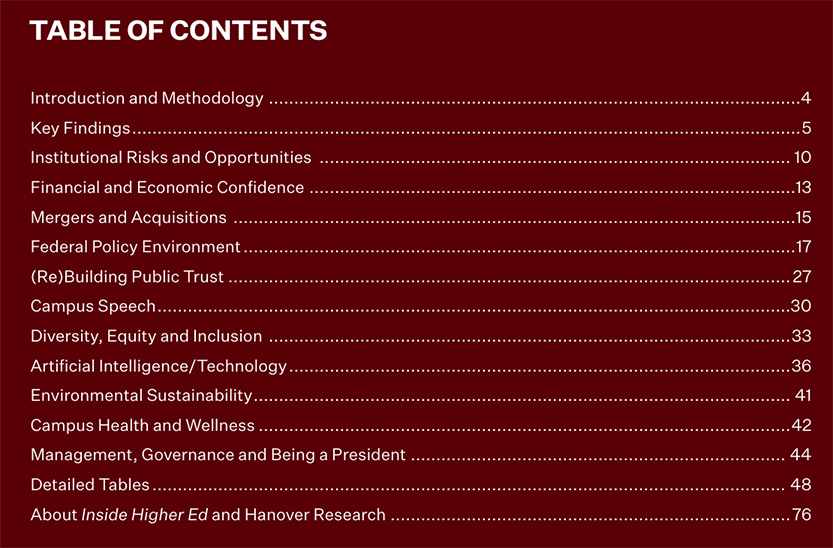
2026 Survey of College and University Presidents — from insidehighered.com, Liaison, & Jenzabar
Download and explore exclusive insights from the 2026 Survey of College and University Presidents to see how these campus leaders are responding to financial volatility, political interference, rapid advances in AI, and where they believe the biggest risks and opportunities lie as they look toward 2030.

In this year’s survey, presidents share perspectives on:

  • How presidents assess the second Trump administration’s impact on higher education
  • Which emerging or evolving educational models they plan to add or expand in the coming years
  • How effective they believe higher education has been in shaping national conversations arout AI
  • The issues presidents expect will have the greatest impact on higher education by 2030


An Unconventional Seating Plan Designed to Benefit Focus and Learning — from edutopia.org by Tyler Rablin
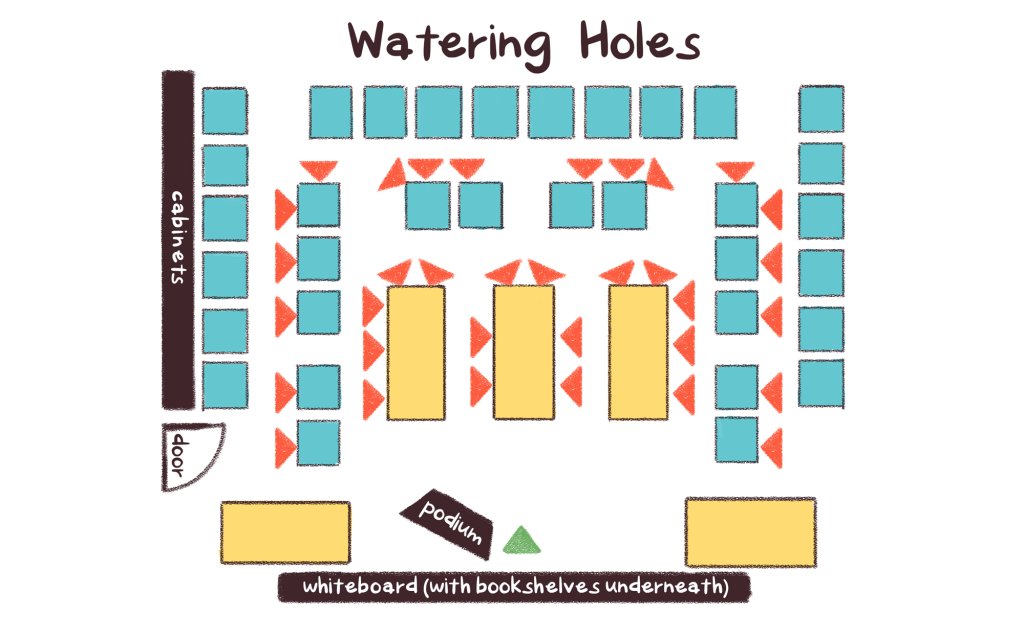
After years of search and experimentation, this teacher finally hit on a room layout that allowed for efficient shifting between whole class, small group, and independent work.

I used to be an obsessive classroom rearranger—every six weeks or so I would find myself looking for a new desk arrangement that would improve some aspect of our work in the room. So when I finally found a desk arrangement that I didn’t want to change for the rest of the year, I knew I was on to something good.

The idea started developing when I stumbled across an article about an Australian classroom arrangement based on three “archetypal learning spaces”: campfires, caves, and watering holes. Essentially, the idea is that students need a physical space to work independently (a cave), spaces to gather informally (campfires), and a space to gather as a whole to learn from an expert (the watering hole).


Using Trauma-Informed Practices in Early Elementary Classrooms — from edutopia.org by Emily Barbour
Small changes in language and classroom routines can increase connection and improve learning for young students.

Trauma-informed practices invite a shift from reactive to proactive systems. To design classrooms that are grounded in safety and care, teachers need to embed predictability, co-regulation, and relationship-building into daily routines. Seemingly small changes like morning choice, intentional language, and shared commitments can transform the environmental conditions for students to properly regulate, feel connected, and fully access learning.

Replacing Morning Work With Morning Choice
The largest positive shift in my classroom culture occurred when I replaced traditional morning work with morning choice bins. When I began our day with worksheets, it felt like I started each day with an uphill battle. The mornings began with redirecting behavior instead of building meaningful relationships.


Reducing the Cognitive Load of Math Tasks With Strategy Cards — from edutopia.org by Katherine Efremkin
When students create a visual resource to scaffold problem-solving, they can approach independent work with more confidence and focused attention.

All three of these areas of the brain need to be activated and work together in order for a student to be successful with independent math work. To help ensure that students are able to successfully shift between their problem-solving ability, thinking, and actions to attack different parts of a problem, I teach students to create strategy cards.

These cards help reduce the cognitive load, enabling students not only to become more successful and independent within their arithmetic work, but also to dive deeper into the conceptual understanding of math concepts.


How to Get Consistent, On-Brand Course Images from Any AI Image Tool — from drphilippahardman.substack.com by Dr. Philippa Hardman
A 3-step workflow that works every time — whatever AI tool you’re using

Most designers try to describe their way to an image. That’s the wrong approach. The goal is to show the tool the world it should be working in, then give it the minimum it needs to place your subject inside that world.

Every long, over-specified prompt is a sign that your visual inputs aren’t doing enough work.

The fix is an 3-step process which gives you superpowers in AI image generation…


How AI Could Transform, or Replace, the LMS — from futureupodcast.com by Jeff Selingo, Michael Horn, and Matthew Pittinsky

Tuesday, March 10, 2026 – For 30 years now, colleges have relied on the Learning Management System, or LMS, as a key portal for professors and students to teach and learn. It’s a tool that has helped colleges adapt to online learning and bring digital tools to classroom teaching. But generative AI seems poised to disrupt the LMS. And it’s unclear whether the LMS will evolve—or be replaced altogether. For this episode, Jeff and Michael talk with a pioneer of the technology, Matthew Pittinsky, about the lessons of past moments of tech disruption like the smartphone and cloud computing and about what could be different this time. This episode is made with support from Ascendium Education Group.


Gemini, Explained — from wondertools.substack.com by Jeremy Caplan
5 features worth your time — tested and compared

Google’s AI, Gemini, has quickly become one of the AI tools I rely on most. It builds dashboards and creates remarkable infographics. It spins out comprehensive research reports in minutes that would once have taken days to assemble.

It’s improving every month. On March 13, Google announced Ask Maps, so you can query Gemini about things like “Which nearby tennis courts are open with lights so I can play tonight?” On March 10, Gemini added new integrations to build, summarize, and analyze your Google Docs, Sheets, and Slides.

In today’s post below: catch up on the Gemini features worth your time, candid comparisons with other AI tools, and answers to the questions I hear most.


How we’re reimagining Maps with Gemini — from blog.google
Ask Maps answers your real-world questions with a conversation, and Immersive Navigation makes your route more intuitive.

Today, Google Maps is fundamentally changing what a map can do. By bringing together the world’s freshest map with our most capable Gemini models, we’re transforming exploration into a simple conversation and making driving more intuitive than ever with our biggest navigation upgrade in over a decade.

Ask anything about any place
We’re introducing Ask Maps, a new conversational experience that answers complex, real-world questions a map could never answer before. Now you can ask for things like, “My phone is dying — where can I charge it without having to wait in a long line for coffee?” or “Is there a public tennis court with lights on that I can play at tonight?” Previously, finding this information meant lots of research and sifting through reviews. But now, you can just tap the “Ask Maps” button and get your questions answered conversationally, with a customized map to help you visualize your options.


Dueling Hares and Leaping Toads Top the 2026 British Wildlife Photography Awards — from thisiscolossal.com by Kate Mothes & various photographers


Also see:

Spectral Birds Endemic to New Zealand Find New Life in Fiona Pardington’s Portraits — from thisiscolossal.com by Kate Mothes and Fiona Pardington


U.S. Department of Labor Defines 5 Key Areas of AI Literacy — from campustechnology.com by Rhea Kelly

Key Takeaways

  • Department of Labor releases AI Literacy Framework: The framework defines AI literacy as competencies for using and evaluating AI responsibly, with a primary focus on generative AI in the workplace.
  • Framework outlines five core AI literacy areas: These include understanding AI principles, exploring real-world uses, directing AI effectively, evaluating AI outputs, and using AI responsibly.
  • Guidance for workforce and education systems: The framework also provides training principles and recommendations for workers, employers, education providers, and government agencies to expand AI education and training.
 

The Rungs of the Career Ladder We Removed — from by Dr. Michelle Weise
On the slow, quiet disappearance of learning HOW to work

There used to be a time when starting a job meant being a little lost. You sat in on meetings you didn’t run. You watched someone else handle the difficult client, draft the tricky email, navigate the room when the room shifted. You made your first draft of something, and someone returned it bleeding red ink. And somehow — through the mess and the margin notes — you learned.

That time is vanishing.

In just the first seven months of 2025, generative AI adoption was linked to thousands of job cuts. But the headline number misses the quieter, more consequential story: it’s not just fewer jobs. It’s the disappearance of the work that teaches you how to work.

So here’s the uncomfortable question: if genAI is absorbing the entry-level doing, where does that formation happen now?

We have to answer that. Not theoretically. Practically. Because the ladder hasn’t disappeared — but we’ve removed the bottom rungs. And no employer is going to drop a newly minted graduate into a mid-career role and hope they figure it out.


Cinematic Prompting Without IP — from heatherbcooper.substack.com by Heather Cooper
Stop saying “Blade Runner” style.

Beginner Prompt Structure
If you’re new to prompting, start with this framework:
[Subject] + [Description] + [Setting] + [Lighting] + [Style/Medium]

The advanced framework adds three layers:
[Lens] + [Subject + Action] + [Environment + Atmosphere] + [Lighting + Colour] + [Mood/Emotion] + [Technical Detail]


Rediscover a Rembrandt After More than Six Decades in Hiding — from thisiscolossal.com by Kate Mothese and Rembrandt Harmenszoon van Rijn (Rembrandt)

In 1898, Amsterdam’s Stedelijk Museum staged an exhibition of paintings by renowned Dutch Golden Age artist Rembrandt (1606-1669). Included in this show was a 23-by-19-inch oil painting titled “Vision of Zacharias in the Temple,” which was completed in 1633, relatively early in the artist’s career. Fast-forward to 1960, and the work was deemed to have not actually been made by Rembrandt. Despite that in the past it had been catalogued as part of his oeuvre, that was no longer the case. So, a private collector purchased it in 1961, from which point on, it remained out of sight—until now.


Also from thisiscolossal.com, see:

Scale the Dramatic Verticality of Grundtvigs Kirke in David Altrath’s Dreamy Photos — from thisiscolossal.com by Kate Mothes and David Altrath


The Future of Learning Looks Like Workforce Infrastructure — from workshift.org by Bruno V. Manno

For years, “ed tech” was an umbrella term grouping schools, online platforms, courses, credentials, and software under one idea: technology applied to education. That shorthand made it easier for investors, policymakers, and institutions to talk about innovation without rethinking how learning fits into the economy. Today, it no longer explains what’s happening.

That’s the central insight of “The European Learning & Work Funding Report” by Brighteye Ventures, a research and advisory firm tracking investment at the intersection of learning, work, and productivity. The report’s seventh edition shows that learning is no longer funded primarily as education. It is increasingly funded as part of how work gets done.

Across Europe, and increasingly the U.S., capital is flowing not toward courses or credentials but toward systems that are closer to production, including hiring platforms, staffing firms, clinical decision tools, payroll systems, and compliance software. These are not educational products, though learning is embedded throughout them.

In these systems, learning is not the point. Outcomes are.

Build hybrid institutions that erase boundaries. Stop forcing learners to navigate disconnected systems. Create partnerships that blend K-12 schools, community colleges, training providers, and employers into one integrated system, so students move through one coherent system, not four separate bureaucracies.


Teach Smarter with AI — from wondertools.substack.com by Jeremy Caplan and Lance Eaton
10 tested strategies from two educators who actually use them

I recently talked with Lance Eaton, Senior Associate Director of AI and Teaching & Learning at Northeastern University and writer of AI + Education = Simplified. We traded ideas about what’s actually working. We came up with 10 specific, practical ways anyone who teaches, coaches, or leads can put AI to work.

Watch the full conversation above, or read highlights below.


Beyond Audio Summaries: How to Use NotebookLM to *Actually* Design Better Learning — from drphilippahardman.substack.com by Dr. Philippa Hardman
Five methods to maximise the value of NotebookLM’s features

In practice, what makes NotebookLM different for learning designers is four things:

  • Answers grounded in your sources (with citations):
  • Source toggling:
  • Multi-format studio & multi-source summaries:
  • Persistent workspace:

…
5 Evidence-Based Methods NotebookLM Operationalises…


Shadow AI Isn’t a Threat: It’s a Signal — from campustechnology.com by Damien Eversmann
Unofficial AI use on campus reveals more about institutional gaps than misbehavior.

Key Takeaways

  • Shadow AI is widespread in higher education: Faculty, researchers, students, and staff are using AI tools outside official IT channels, including consumer platforms and public cloud services that may involve sensitive data.
  • Unauthorized AI use creates data, compliance, and cost risks: Consumer AI tools may store or reuse user data, while uncoordinated adoption drives redundant licenses, unpredictable cloud costs, and weaker security oversight.
  • Institutions are shifting from restriction to enablement: Some campuses are making approved paths easier by offering ready-to-use research environments, campus-managed AI tools, clear guidance on data and vendors, and streamlined approval processes.

How L&D Can Lead in the Age of AI Even If Your Company’s Not Ready — from learningguild.com

How to lead even when your company doesn’t allow AI
Even if your corporation isn’t ready for AI, you can still research tools personally to stay ahead of the curve, so when organizational restrictions lift, you are ready to use AI for learning right away. Here are some tools you can test at home if they’re restricted in your workplace:

  • Content generation – Start testing text-based tools to get a taste of how AI can accelerate content creation. Then take it to the next level by exploring tools that generate voices, music, and sound effects.
  • AI coaching tools – Have AI pose as a customer co-worker or customer to get a taste of what it’s like to use it as a conversation coach. Next, use the voice and video capabilities in an app like ChatGPT to explore how AI can coach someone through tasks.
  • In-the-flow learning assistants – Test turning documents into a conversational avatar and interacting with it to see how it feels. Then think about how the technology could potentially transform static content into dynamic learning experiences for employees.
  • Vibe-coded simulations – Experiment with this technology by creating a simple, fun game. Afterwards, brainstorm some ideas on how it could quickly create simulations for your learners in the future.

The Higher Ed Playbook for AI Affordability — from campustechnology.com by Jason Dunn-Potter

Key Takeaways

  • Affordable AI adoption focuses on evolving existing systems: Universities are embedding AI into current devices, workflows, and legacy systems rather than rebuilding infrastructure or investing in new data centers.
  • Edge AI reduces costs and improves access: Running AI models on local devices or networks lowers cloud processing costs, enhances security, and supports learning use cases such as tutoring, translation, transcription, and adaptive learning.
  • Enterprise integration and governance drive impact: Institutions are applying AI across admissions, advising, facilities, and research workflows, supported by shared resource hubs, data governance, AI literacy, and outcome-driven implementation.
 

Psalm 119:4-6

4 You have laid down precepts
that are to be fully obeyed.
5 Oh, that my ways were steadfast
in obeying your decrees!
6 Then I would not be put to shame
when I consider all your commands.

Psalm 119:9

How can a young person stay on the path of purity?
By living according to your word.

1 John 1:8-9

8 If we claim to be without sin, we deceive ourselves and the truth is not in us. 9 If we confess our sins, he is faithful and just and will forgive us our sins and purify us from all unrighteousness.

Psalm 30:4-5

4 Sing the praises of the Lord, you his faithful people;
praise his holy name.
5 For his anger lasts only a moment,
but his favor lasts a lifetime;
weeping may stay for the night,
but rejoicing comes in the morning.

Psalm 143:8

 Let the morning bring me word of your unfailing love,
for I have put my trust in you.
Show me the way I should go,
for to you I entrust my life.


Sharif El-Mekki on Growing Educators of Color Through Pleasure, Duty and Honor — from gettingsmart.com by Shawnee Caruthers and Sharif El-Mekki, Founder and CEO of the Center for Black Educator Development.

Key Points

  • Aspiring educators should have the requisites to spend time in their community as a part of their education.
  • Educators should be asking: how do we build cultures of cooperation and collaboration?
  • Investigate your intellectual genealogy to see where you are getting the ideas you have to question assumptions.

His mantra, “We Need Black Teachers” is more than a rallying cry, but a deep desire to give voice to the over 8 million black learners that need to see themselves in their classrooms and community.


Find Fantastic Books [Caplan]

Find Fantastic Books — from wondertools.substack.com by Jeremy Caplan
My favorite free resources for reading

Books get my eyes off screens, and my brain welcomes that break from news, vitriol, and ads. Read on for my updated guide to finding great reads this year.

 
© 2025 | Daniel Christian