Meta, YouTube found negligent in landmark social media addiction trial — from by Ian Duncan
A Los Angeles jury awarded $3 million in compensation to a young woman who alleged she had become addicted to the platforms as a child.

A Los Angeles jury found social media giant Meta and video platform YouTube negligent in a landmark trial, awarding $3 million in compensation to a young woman who alleged she had become addicted to the companies’ platforms as a child.

The verdict came at the end of a month-long trial that featured testimony by Facebook founder Mark Zuckerberg and a day after a jury in New Mexico ordered Meta to pay $375 million in penalties for endangering children. The twin verdicts are signs that legal protections which for decades made tech companies seem almost impervious are beginning to crack, as lawyers accuse the platforms of putting addictive or otherwise harmful features into their platforms.

With the armor of Silicon Valley companies fractured, they will now have to size up their appetite for future courtroom battles. There are thousands more lawsuits waiting to be heard, with young internet users, parents, school districts and state attorneys general all seeking to hold the industry accountable.


Legal AI Access at 83%, But Trust Issues Remain — from artificiallawyer.com

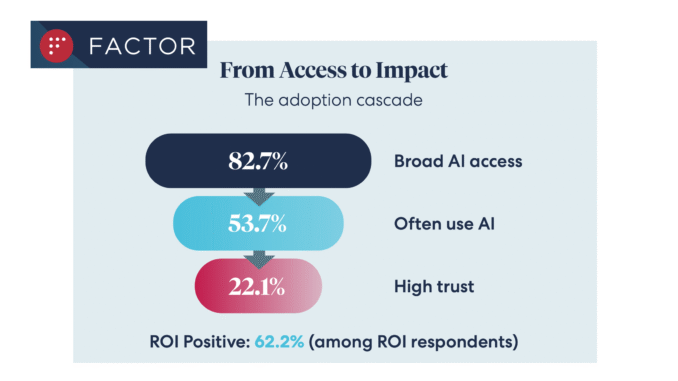
A new survey of over 200 inhouse and law firm leaders provides solid evidence that while AI tools are now ‘standard’ across our sector, that trust in AI outputs fundamentally drives usage, along with ROI – and vice versa.

The data, from ALSP Factor, shows that 83% had ‘broad AI access’, which is up from 61% in 2025, and in itself is a very positive development that tells us legal AI is now becoming ubiquitous for commercial lawyers, with around 54% using such tools ‘often’.


From DSC:
I have been proposing that the AI-based learning platform of the future will be constantly doing this — every single day. It will know what the in-demand skills are — at any given moment in time. It will then be able to direct you to resources that will help you gain those skills. Though in my vision, the system is querying actual/open job descriptions, not analyzing learning data from enterprise learners. Perhaps I should add that to the vision.


Coursera’s Job Skills Report 2026: Top skills for your students — from coursera.org

The Job Skills Report 2026 analyzes learning data from more than 6 million enterprise learners to identify the future job skills organizations need most. It’s designed for HR and L&D leaders; data, IT, and software & product development leaders; higher education administrators; and government agencies seeking actionable insights on workforce skills trends and AI-driven transformation.
…
Drawing on data from 6 million enterprise learners across nearly 7,000 organizations, the Job Skills Report 2026 guides you through the skills reshaping the global economy. This year’s analysis spans Data, IT, and Software & Product Development—and the Generative AI skills becoming essential for every role.


From DSC:
The types of postings/articles (such as the one below) make me ask, are we not shooting ourselves in the foot with AI and recent college graduates? If the bottom rungs continue to disappear, internships and apprenticeships can only go so far. There aren’t enough of them — especially valuable ones. So as this article points out, there will be threats to the long-term health of our talent pipelines unless we can take steps to thwart those impacts — and to do so fairly soon.

To me…vocational training and jobs are looking better all the time — i.e., plumbers, carpenters, electricians, mechanics, and more.


Can New Graduates Compete With AI? — from builtin.combyRichard Johnson
The increasing adoption of AI automation is compressing early-career jobs. How should new graduates get a foothold in the economy now?

Summary: AI is hollowing out entry-level roles by automating routine tasks, eliminating a rung on the career ladder. New graduates face intense competition and a rising skill floor. While firms gain short-term productivity, they risk a long-term talent shortage by eliminating junior training grounds.

Conversations about AI have covered all grounds: hype, fear and slop. But while some roll their eyes at yet another automation headline, soon?to?be graduates are watching the labor market with a very different level of urgency. They’re entering a world where the old paradox of needing experience to get experience is colliding with a new reality: AI is absorbing the standardized, routine tasks that once defined entry?level work. The result isn’t just a shift in job descriptions or skill-requirements, but rather a structural reshaping of the career pipeline.

Entry-level workers face an outsized disruption to their long-term career trajectories. They have the least buffer to adapt given their lack of relevant job market experience and heightened financial pressure to secure a job quickly with the student-debt repayment periods for recent graduates looming.

Momentum early in one’s career matters, and the first job on a resume shapes future compensation bands and opportunities. It also serves as a signal for perceived specialization or, at minimum, interest. Losing that foothold has compounding effects to one’s career ladder.


Also relevant/see:

New Anthropic Institute to Study Risks and Economic Effects of Advanced AI — from campustechnology.com by John K. Waters

Key Takeaways

  • Anthropic has launched the Anthropic Institute, a new research effort focused on the biggest societal challenges posed by more powerful AI systems.
  • The institute will study how advanced AI could affect the economy, the legal system, public safety, and broader social outcomes.
  • Anthropic co-founder Jack Clark will lead the institute in a new role as the company’s head of public benefit.
  • The new unit brings together Anthropic’s existing red-teaming, societal impacts, and economic research work, while adding new hires and new research areas.
 

Proverbs 3:27

Do not withhold good from those to whom it is due,
when it is in your power to act.

2 Peter 1:5-8

5 For this very reason, make every effort to add to your faith goodness; and to goodness, knowledge; 6 and to knowledge, self-control; and to self-control, perseverance; and to perseverance, godliness; 7 and to godliness, mutual affection; and to mutual affection, love. 8 For if you possess these qualities in increasing measure, they will keep you from being ineffective and unproductive in your knowledge of our Lord Jesus Christ.

Psalm 40:9-11

9 I proclaim your saving acts in the great assembly;
I do not seal my lips, Lord,
as you know.
10 I do not hide your righteousness in my heart;
I speak of your faithfulness and your saving help.
I do not conceal your love and your faithfulness
from the great assembly.
11 Do not withhold your mercy from me, Lord;
may your love and faithfulness always protect me.


Here is Chris Martin’s posting on LinkedIn.com:


Here is Dominik Mate Kovacs’ posting on LinkedIn.com:


The AI ‘hivemind’: Why so many student essays sound alike — from hechingerreport.org by Jill Barshay
A study of more than 70 large language models found similar answers to brainstorming and creative writing prompts

The answers were frequently indistinguishable across different models by different companies that have different architectures and use different training data. The metaphors, imagery, word choices, sentence structures — even punctuation — often converged. Jiang’s team called this phenomenon “inter-model homogeneity” and quantified the overlaps and similarities. To drive the point home, Jiang titled her paper, the “Artificial Hivemind.” The study won a best paper award at the annual conference on Neural Information Processing Systems in December 2025, one of the premier gatherings for AI research.


AI Has No Moral Compass. Do You? — from michelleweise.substack.com by Michelle Weise & Dana Walsh
Why the Age of AI Demands We Take Character Formation Seriously

Here’s something to chew on:

Anthropic, the company behind Claude — a chatbot used by 30 million users per month — has exactly one person (whom we know of) working on AI ethics. One. A young Scottish philosopher is doing the vital work of training a large language model to discern right from wrong.

I don’t say this to shame Anthropic. In fact, Anthropic appears to be the only company (that we know of) being explicit about the moral foundations and reasoning of its chatbot. Hundreds of millions of users worldwide are leveraging tools from other LLMs that do not appear to have an explicit moral compass being cultivated from within.

I raise this because this is yet another example of where we are: extraordinary technical power advancing without an equally strong moral infrastructure to support it.

Why do we keep producing people who are skilled but not wise?


Across the divide: reimagining faculty-staff collaboration in higher education — from timeshighereducation.com by Saskia van de Gevel
Academic units do best when they harness different viewpoints – from field scientists and curriculum designers to extension professionals – to drive innovation and relevance. Saskia van de Gevel offers proactive advice

Universities are not sustained by individual leaders or isolated units. They are sustained by teams of people who bring different kinds of expertise to a shared mission. When faculty and professional staff collaborate as genuine partners – aligned around outcomes, clear about roles and committed to mutual respect – institutions become more resilient, innovative and effective.

Also from timeshighereducation.com, see:

Again, we don’t send them 200 CVs. We might send 20, but they’re meticulously shortlisted. The employer saves time, the student feels they are being taken seriously and trust builds quickly on both sides.

And because we work closely with employers, we learn something universities often struggle to find out early enough: what the market is asking for now.

What academics need to know: we can’t do this without you
If I could say one thing to academic colleagues anywhere, it’s that employability can’t sit next to the curriculum. It has to live with it.


The Surprising Power Of A Degreeless Career — from forbes.com by Mark C. Perna
Fueled by ballooning tuition and disillusionment with higher education, degreeless careers are on the rise. Here’s how to thrive in today’s workplace without a college degree.

“We are beginning to break down the national narrative that you have to go to college to get a ‘good job’,” says Kathleen deLaski, author of “Who Needs College Anymore?” and founder and chairman of The Education Design Lab. “The fastest growing form of college enrollment is actually short term certificates and certifications at community colleges, rather than degrees.”

But the real dealbreaker is the fast-rising cost of college, especially for the debt-averse Generation Z. “Most folks know someone who is saddled by student debt,” says deLaski. “So they have more of a ‘buyer-beware’ view when considering a four year degree.”

This presents a challenge especially to younger workers, who simply haven’t had the time yet to gain that experience. It’s a catch-22: to land the entry-level job, you must have experience, but to gain that experience, you have to have that entry-level job.

The answer is to expand our definition of work experience. It doesn’t have to be gained in the exact field where you want to be hired, nor does it strictly have to be in an employment setting. “Earning certifications, doing internships and apprenticeships, even volunteering, and leading a team or a project really add authenticity to your resume,” says deLaski.

In other words, work skills gained via personal experience are usually highly transferable to other industries. Work, learning and volunteer experience of any kind—if you can make the case for its relevance—is the new litmus test.


5 Tech Strategies to Enhance Student-Led Learning — from edutopia.org by Rachelle Dené Poth
While technology has potential to distract students, it can also boost engagement and help them actively demonstrate their learning.

Over the years, I have learned that engagement doesn’t happen simply by adding technology. It increases when we give students more ownership by designing experiences that allow them to build, collaborate, reflect, and teach one another. Depending on how we use it, technology can either amplify engagement or distract from it. Technology can help build students’ confidence in learning, but it can also lead to passivity. When technology is used to amplify students’ voice, choice, and ownership in learning, their engagement will naturally increase.

Here are five strategies and some digital tools that can be used across grade levels and content areas to boost student engagement, build confidence, foster collaboration, and support meaningful learning experiences.


Project-Based Learning (PBL)
Implementing a PBL Design Challenge in Your School — from edutopia.org by Lisa Beck & Kim Mishkin
A weeklong, schoolwide project-based learning challenge encourages students to try to tackle meaningful problems.

For the past five years, Hudson Lab School (HLS), a K–8 progressive school committed to project?based learning (PBL), has kicked off each school year with an exciting tradition: Design Challenge Week. In five days, students take on a real?world problem, explore each phase of the design process, and present what they created and learned to an authentic audience. Design Challenge Week introduces concepts that students will revisit all year and offers a model for how any educational setting could experiment with PBL on a smaller scale. Even short, well?designed challenges can lead to deeply engaged learning experiences.


How to Give Students Directions They Actually Understand — from edutopia.org by Mary Davenport
Making small changes in your instructions can have a significant impact on students’ understanding and engagement.

No more than a minute after you’ve provided instruction on the day’s targeted content and given students directions for their next task, some brave soul utters the line that brings tired teachers to their knees: “What are we supposed to be doing?”

None of us want this. As teachers, we all want students to fully understand what they’re supposed to be doing so that they can be successful as they do it.

Good news: A few small changes in how we give directions can be the lever that boosts student understanding and engagement.


Law Firm AI Adoption: So Many Choices — from abovethelaw.com by Stephen Embry
Firms need to recognize reality, define what their legal professionals need, and then determine how to adopt and govern the use of AI tools.

It’s tough to be a law firm managing partner in the age of AI. So many choices, so little time. It’s like the proverbial kid in the candy store who has so many choices that they either can’t pick out anything or reach for too much. We see evidence of the first option in 8am’s recent outstanding Legal Industry Report, authored by Niki Black.

8am’s Legal Industry Report
One thing that stood out in the report was the discrepancy between use of AI by individual legal professionals and what firms are doing when it comes to AI adoption and guidance.  Almost 75% of those who responded said they were using general purpose AI tools like ChatGPT and Claude for work purposes. That’s pretty significant.


Legalweek: It’s time to re-engineer how legal work is delivered — from legaltechnology.com by Caroline Hill

AI for good
While focusing on the risks of AI going wrong, it is only fair to mention the conversations I had around using AI for good.  Two in particular stand out.

The first is the news from Everlaw that its Everlaw for Good Program has, over the past year, supported more than 675 active cases across 235 organisations, and expanded its support to a growing network of non-profit organisations.

The program extends Everlaw’s technology to organisations working to advance access to justice. In a recent survey by Everlaw, 88% of legal aid professionals said they are optimistic about AI’s potential to help narrow the justice gap.

“Mission-driven organizations are increasingly handling complex investigations and litigation with limited resources,” said Joanne Sprague, head of Everlaw for Good. “Expanding access to powerful, easy-to-use technology helps level the playing field so these teams can uncover critical evidence, take on more complex matters, and yield stronger results for the communities they serve.”


LawNext on Location: Visiting Everlaw’s Headquarters For A Conversation with AJ Shankar, Founder and CEO — from lawnext.com by Bob Ambrogi

The bulk of our conversation focuses on generative AI, and how Everlaw has approached it differently than much of the market. Rather than bolting on a chatbot, AJ says, Everlaw embedded AI deliberately throughout the platform — document summarization, coding suggestions, deposition analysis, fact extraction — always grounding responses in the actual documents at hand and citing sources so users can verify the work. The December launch of Deep Dive, which lets litigators pose a question and get a synthesized, cited answer drawn from an entire document corpus in about a minute, is the feature AJ calls a “new era” for discovery — one he genuinely believes represents a categorical shift.


Faster, thinner: Colleges are swiftly trimming a B.A. degree to three years — from hechingerreport.org by Jon Marcus
Needing to fill seats and facing demands for faster routes to jobs, more colleges are shortening degree programs

That’s an option being made available by colleges and universities with astonishing speed — especially in the notoriously slow-moving world of higher education: an entirely new kind of bachelor’s degree muscling into the space between the traditional four-year version and the two-year associate degree. Three-year degrees have existed, but they simply jammed those 120 credits into fewer semesters.

At least one school, Ensign College in Utah, will convert all of its bachelor’s degrees into the new, reduced-credit, three-year kind, it announced in February. Nearly 60 other universities and colleges are planning, considering or have already launched them in some disciplines. States including Indiana have required or are considering requiring their public universities to add reduced-credit bachelor’s degrees. Even graduate and professional schools are being pressed to shorten the duration of degrees.

Even more than employers, consumers have lost patience with the time and expense it takes to get a four-year bachelor’s degree, according to the advocates and politicians pushing schools to offer them. More than half of students who start down the conventional four-year path today take even longer than four years, according to the Department of Education.

Also from Jon Marcus, see:


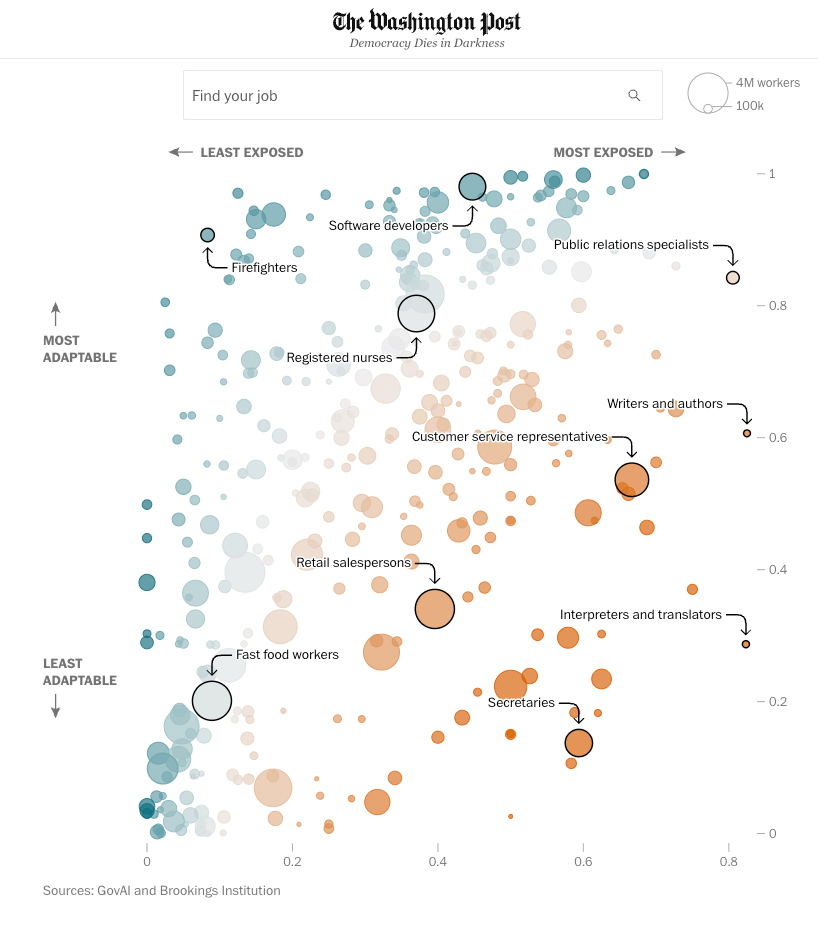
See which jobs are most threatened by AI and who may be able to adapt — this is a gifted article from washingtonpost.com by Kevin Schaul and Shira Ovide
It’s the most urgent question about artificial intelligence — and one of the hardest to answer.


The Future of College in an AI World — from linkedin.com by Jeff Selingo
In today’s issue: The tension over AI in higher ed; application inflation continues and testing is back; what’s the future of the original classroom technology, the learning management system. 
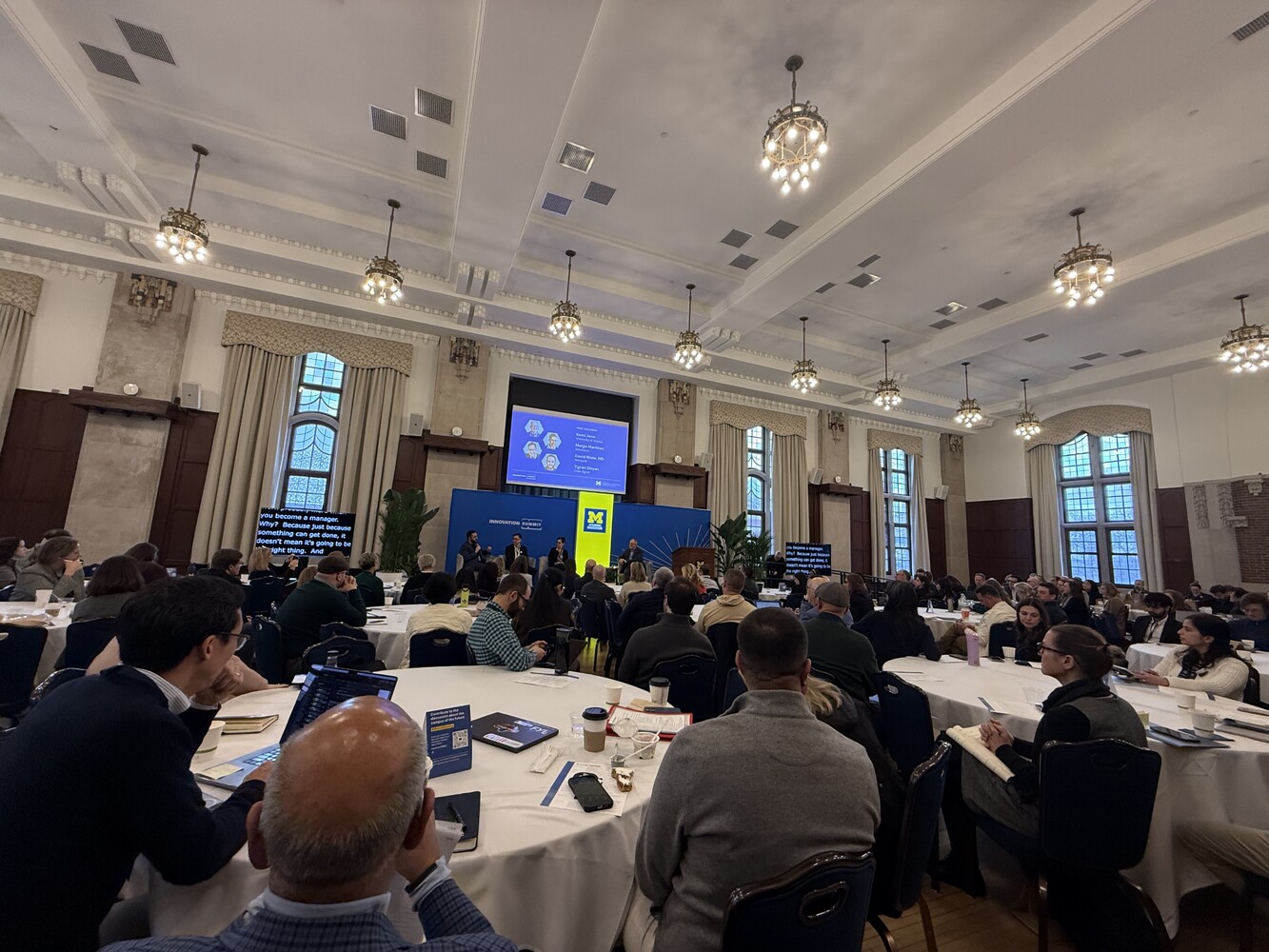

Hundreds of higher ed and industry leaders gathered Tuesday for a summit
on AI and the future of learning at the University of Michigan.
.

Conversations like the one we had at Michigan this week are necessary, but the action rarely matches the ambition.

  • We say the humanities are the operating system of an AI world, yet students and parents don’t believe it. They’re voting with their feet toward STEM, business, and narrowly tailored majors they believe will lead to a job.
  • Meanwhile, colleges are quietly eliminating the very humanities degrees the panelists were championing, employers are cutting the entry rungs off the career ladder for new graduates, and as Podium Education co-founder Christopher Parrish reminded us yesterday, there’s a yawning gap between demand for experience and the internships that actually exist.


AI Music Generators: Teaching With These Catchy AI Tools — from techlearning.com by Erik Ofgang
AI music generators are getting better and better, and there are more applications in the classroom as a result.

Are All AI Music Generators More Or Less The Same?
No. After experimenting with a few various free ones, I found a wide range of quality with the same prompts.

Gemini is the only one I’d currently recommend. It’s user-friendly but limited and only creates 30-second clips. Other music generators could potentially outperform Gemini with prompt adjustments. The ones I tried did better with the instrumentals but struggled more with the lyrics, and that kind of defeated the purpose of the tool for me.


ChatDOC: Teaching With The AI Summarizing Tool — from techlearning.com by Erik Ofgang
ChatDOC lets users turn any PDF into an AI chatbot that can summarize the text, answer questions, and generate quizzes.

What Is ChatDOC?
ChatDOC is an AI designed to help users interact with PDFs of various types, be it research papers, short stories, or chapters from larger works. Users upload a PDF and then have the opportunity to “chat” with that document, that is speak with a chatbot that bases its answers off of the uploaded text.

ChatDOC can perform tasks such as provide a short summary, search for specific terms, explain the overall theme if it’s a work of literature, or unpack the science in a research paper.

Other similar tools are out there, but ChatDOC is definitely one of the better PDF readers I’ve used. Its free version is quick and easy-to-use, and delivers on its promise of providing an AI that can discuss a given document with users and even quiz them on it.


From AI access to workforce readiness — from chieflearningofficer.com by Johnny Hamilton, Amy Stratbucker, & Brad Bigelow
Is your workforce using the right tool with an outdated mindset and playbook? Why old playbooks fall short — and what learning leaders must do next.

The leadership opportunity
Organizations do not need to predict every future AI capability. They need systems that allow people to explore with curiosity, practice safely, reflect deeply and adapt continuously — starting with what they already have and extending as capabilities evolve.

For CLOs, this is a moment to lead from the center of change — designing workforce readiness that keeps pace with accelerating technology while making work more rewarding for employees and more valuable for the organization. That is how AI moves from the promise of transformation to demonstrated readiness and, ultimately, from promise to performance.


Addendums on 3/19/26:
How to Build Practice-Based Learning Activities with AI — from drphilippahardman.substack.com by Dr Philippa Hardman
Four evidence-based methods for designing, building & deploying active learning activities with your favourite LLM

Most L&D teams are using AI to make content faster. The real opportunity is using it as a practice engine.

The Synthesia 2026 AI in L&D Report f2026 AI in L&D Report found that the fastest-growing areas of planned AI adoption aren’t in content creation — they’re in assessments and simulations (36%), adaptive pathways (33%), and AI tutors (29%). In other words: L&D teams are starting to realise that the most powerful use of AI isn’t producing learning materials. It’s creating environments where learners actually practise.

And you can build these right now — no dev team, no custom platform, no code. Each method below includes a prompt you can paste into your preferred AI tool to generate a working interactive prototype: a self-contained practice activity with a briefing screen, a live AI interaction, and a debrief — all running in the browser, ready to share with stakeholders or deploy to learners.

OpenAI Adds Interactive Math and Science Learning Tools to ChatGPT — from campustechnology.com by Rhea Kelly

Key Takeaways

  • ChatGPT adds interactive learning tools: OpenAI introduced interactive math and science visualizations that allow users to explore formulas, variables, and relationships in real time.
  • The tool currently covers over 70 core math and science topics and is aimed initially at high school and college-level learners.
  • Users can adjust variables, manipulate formulas, and immediately see how changes affect graphs and outcomes.
 
© 2025 | Daniel Christian