Summary: Accessible AI has killed traditional signals of legitimacy.
…
Experiments show $20 consumer tools can easily bypass verification. The solution is shifting toward contextual proof that verifies human uniqueness without exposing identity.


After Hours 1: The legal profession’s new value proposition — from jordanfurlong.substack.com by Jordan Furlong
The days of selling legal tasks by the hour are ending. Lawyers’ future value lies in safeguarding clients’ legal journeys by overcoming the most challenging obstacles on the way. Part 1 of 2.

As a result, legal work is dividing into two spheres, the first larger than the second: what Gen AI can satisfactorily address, and what it can’t.

  • Sphere 1: Legal Production. This is all the specialized intellectual work involved in generating legal solutions: researching, issue-spotting, summarizing, synthesizing, drafting, revising, reasoning, and analyzing. This is the bulk of lawyers’ traditional activity and billed hours. In future, it will be done faster, cheaper, and increasingly better with machines — either by clients themselves, or embedded in systems and platforms that reduce the need for lawyer involvement.
  • Sphere 2: Legal Judgment. This is higher-value work defined by the unpredictability, complexity, and impact of its challenges. In this sphere, you’ll find hard-decision advice, guidance under uncertainty, systematic dispute avoidance, strategic counsel, critical advocacy, risk prioritization, and high-stakes accountability. It’s likely (but far from certain) that this work will remain outside the reach of Gen AI. This is the sphere that holds the potential to support a future legal profession.

…

But not every legal journey is so simple or safe that the client can go it alone. Many times, Point B is more like Point F or Point R: a long and tortuous distance away. Many AI-generated maps will suggest a clear and direct route that bears little resemblance to the messy tangles of reality. On even moderately complex legal journeys, the unwelcome and the unexpected are always lurking. Something arises that was nowhere on the map, and until it gets resolved, the client can’t move any further towards their destination.


Below are some items from Jordan’s article — or by following a rabbit trail from his posting:


AI-Native Firms, Built by Private Equity, Will Strain Legacy Model — from news.bloomberglaw.com by Eric Dodson Greenberg

The emergence of AI-native law firms reveals the limits of a fixed binary that has characterized the legal market over the last year.
…

The straightest path to AI law firms isn’t innovation within the legacy model, or capital investing around it, but external capital being deployed to build competitors to legacy firms. These firms use AI and narrow regulatory openings to create from scratch tech-enabled law firms.

Not acquire them. Not invest around them.

Build them.

This third path is no longer theoretical.

The $3,500 Hour vs. The $500 Contract — from legaltechnologyhub.com by Brandi Pack

While rates at the top continue climbing, the operational foundation of legal work is being rebuilt.
…
Its pricing reflects that structure. Contract review between three and 50 pages costs $500. Short agreements are $250. Longer contracts are billed per page. Drafting from scratch is offered at a fixed fee. 

There is no running clock.

The premise is straightforward. If generative AI materially reduces the time required for standardized work, the cost base changes. And when the cost base changes, pricing models eventually follow.

.


From DSC:
This next item is not from Jordan, but may also be useful to some of you out there:

Want to Work at Legora, Harvey or Another Legal AI Startup? — from legallydisrupted.com by Zach Abramowitz
Podcast with a Biglaw Partner Who Now Occupies a Senior Role at Legora

In Episode 45 of Zach Abramowitz is Legally Disrupted, Kyle and dive into why building tech workflows and writing AI prompts should absolutely be considered billable work. We also explore why AI commoditizing the legal “grinders” and “minders” means old-school social skills are about to become your single biggest competitive advantage. Finally, Kyle goes into great detail about how exactly how he landed a top role at Legora and how others can do the same (hint: merely dropping your resume into a web portal is not enough).
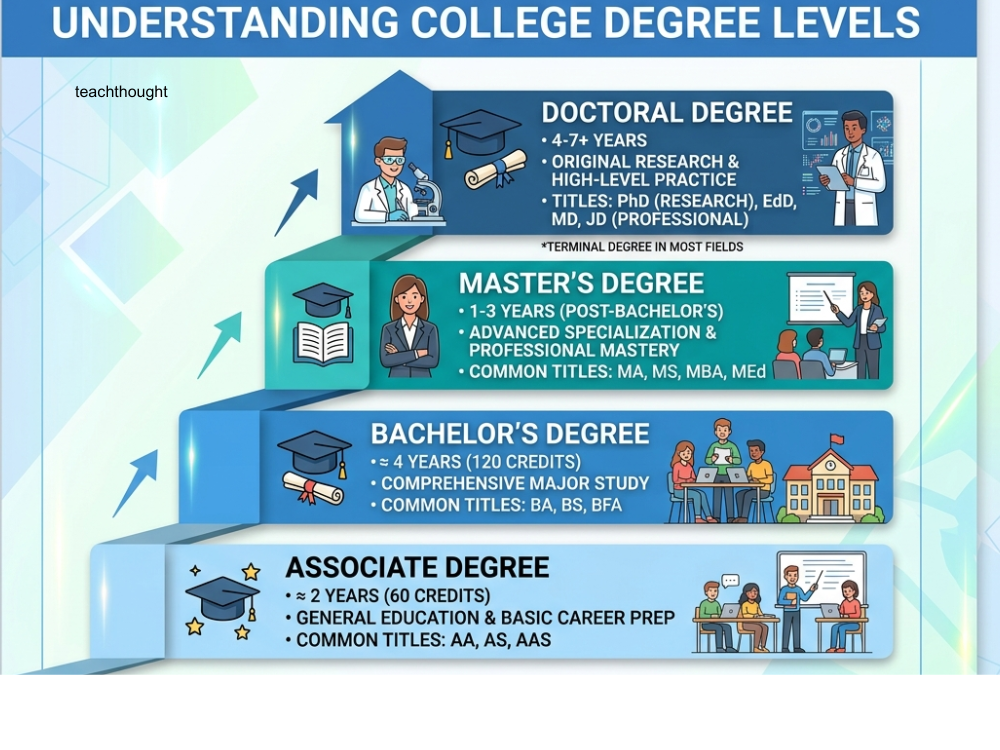


What Are The College Degree Levels? — from teachthought.com
Overview of associate, bachelor’s, master’s, doctoral, and professional degrees: definitions, and typical length/credit requirements.


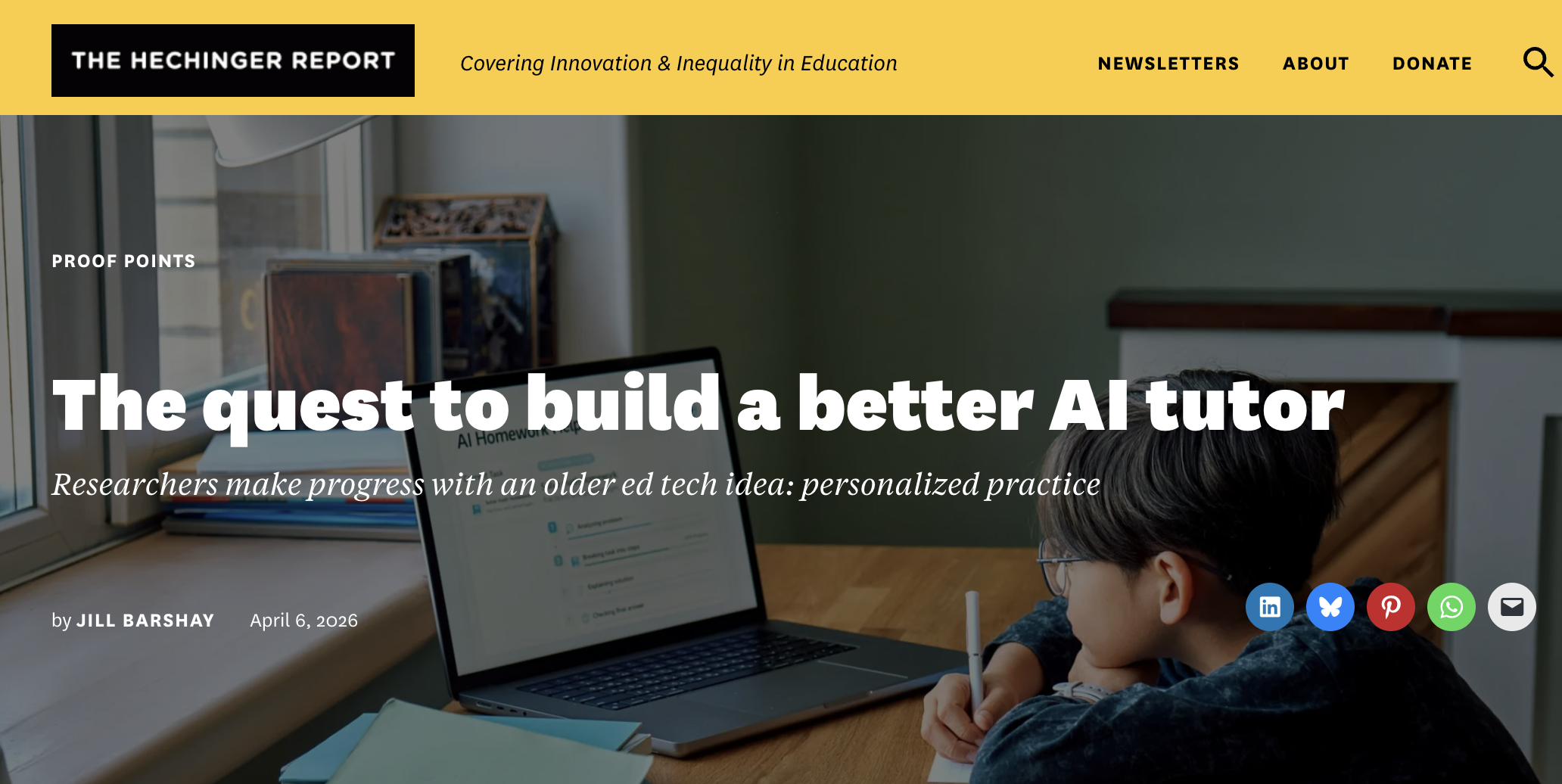
The quest to build a better AI tutor — from hechingerreport.org by Jill Barshay
Researchers make progress with an older ed tech idea: personalized practice

One promising idea has less to do with how an AI tutor explains concepts and more with what it asks students to practice next.

A team at the University of Pennsylvania, which included some AI skeptics, recently tested this approach in a study of close to 800 Taiwanese high school students learning Python programming. All the students used the same AI tutor, which was designed not to give away answers.

But there was one key difference. Half the students were randomly assigned to a fixed sequence of practice problems, progressing from easy to hard. The other half received a personalized sequence with the AI tutor continuously adjusting the difficulty of each problem based on how the student was performing and interacting with the chatbot.

The idea is based on what educators call the “zone of proximal development.” When problems are too easy, students get bored. When they’re too hard, students get frustrated. The goal is to keep students in a sweet spot: challenged, but not overwhelmed.

The researchers found that students in the personalized group did better on a final exam than students in the fixed problem group. The difference was characterized as the equivalent of 6 to 9 months of additional schooling, an eye-catching claim for an after-school online course that lasted only five months.
…

To address this, Chung’s team combined a large language model with a separate machine-learning algorithm that analyzes how students interact with the online course platform — how they answer the practice questions, how many times they revise or edit their coding, and the quality of their conversations with the chatbot — and uses that information to decide which problem to serve up next.


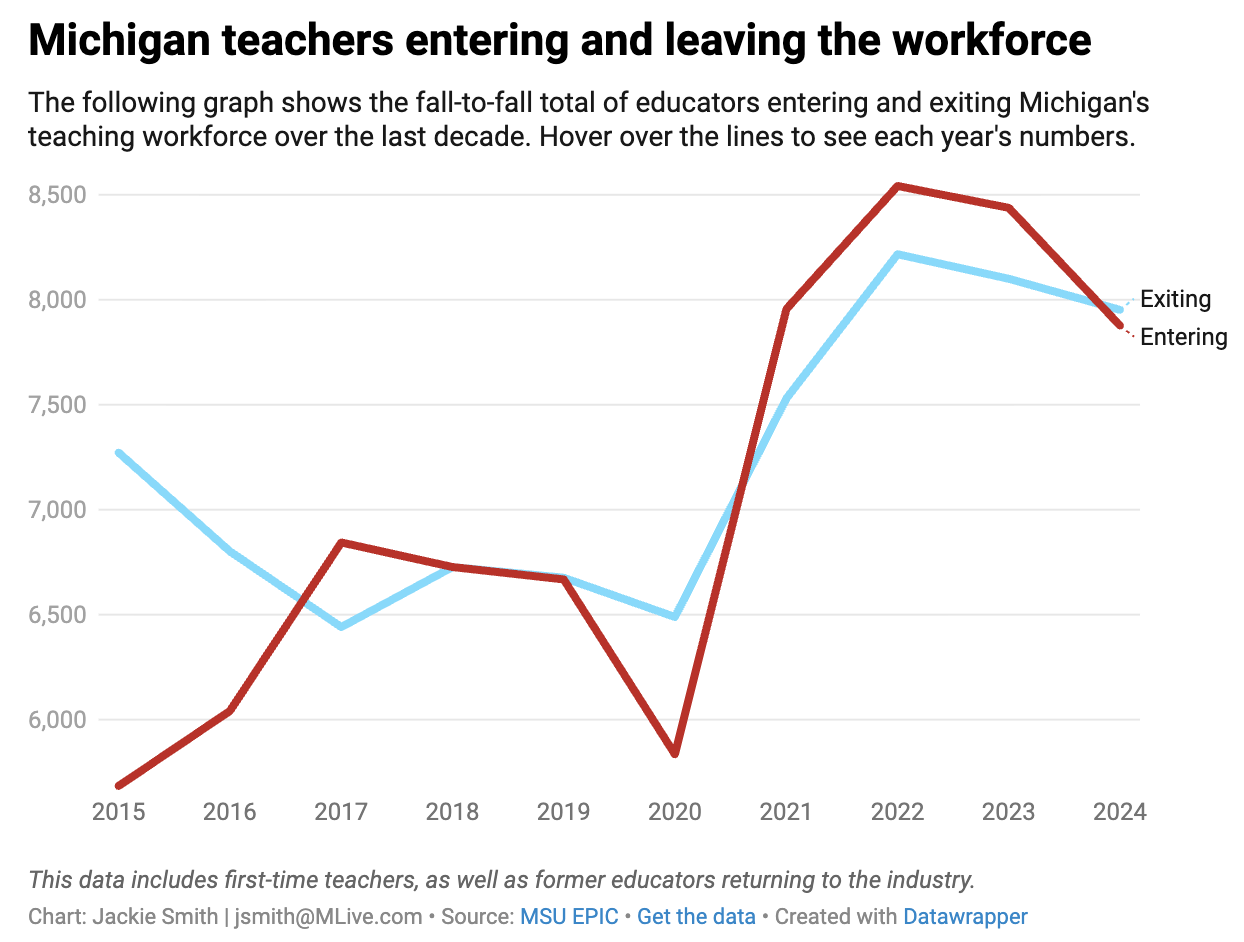
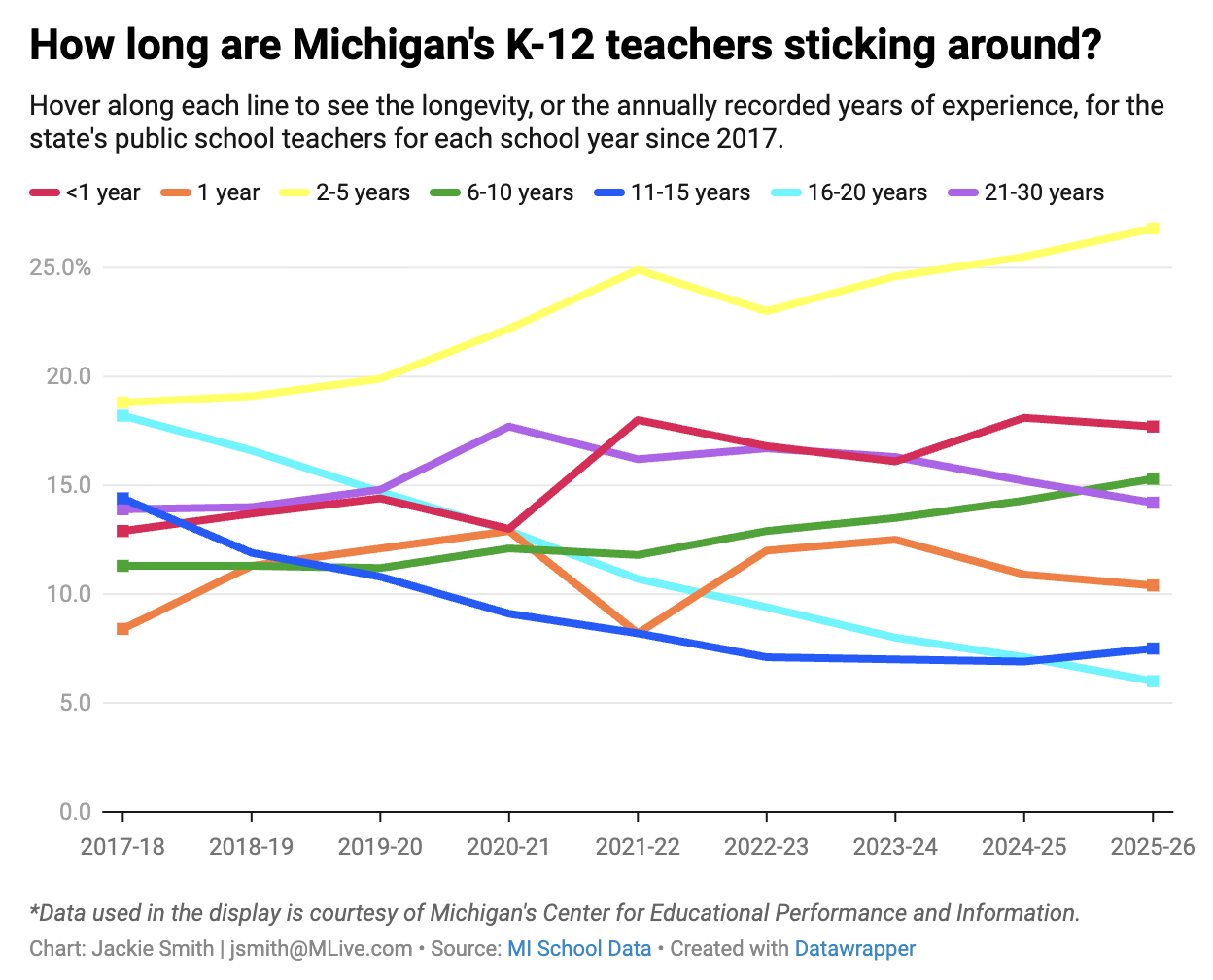
Michigan schools may be leaning harder on subs. See your district’s shift in teaching staff. — from mlive.com by Jackie Smith

School districts across Michigan could be increasingly leaning on new and substitute teachers in the classroom, according to the latest K-12 staffing data tracked by the state.

Michigan’s Center for Educational Performance and Information updated staffing counts for districts through the current 2025-26 school year in late March, and the numbers largely confirm trends illustrated in other datasets.

The total number of teachers is on the rise ? with fewer sticking around more than a handful of years ? even as student enrollment goes down, and districts are continuing to use subs to fill in the gaps.

.


From DSC:
One of our daughters obtained the credentials to teach in the elementary schools of Michigan. She was a very relational teacher and she taught at several schools over several years, but the straw that broke the camel’s back was when she taught at a school where:

  • They would have to evacuate the classrooms at times if a student was going through the roof (emotion-wise)
  • The students hit the principal
  • The students often didn’t listen to or obey her instructions — which constantly tested her patience and drained her energy
  • Many of the parents were not on the same team as the teachers — for a variety of complex reasons
  • …and for other reasons as well.

The system was discouraging. It was too much to bear. So the system lost another good teacher. 


Also see:

Michigan’s teacher shortage could be stabilizing, but data shows there’s a catch — from mlive.com by Jackie Smith

Michigan’s K-12 teacher workforce could be stabilizing, but schools across the state may be increasingly relying on educators working virtually or across multiple districts and those who are not fully certified, according to the latest data.

The Education Policy Innovation Collaborative (EPIC) at Michigan State University released its 2026 teacher shortage report earlier this month, which tracks hiring and vacancy trends, as well as what subjects are particularly impacted by fluctuations.

.

.

Special education positions see the biggest vacancy rates
The vacancy rate for special education teachers is nearly double is nearly double the statewide average overall.

According to the report, more than 5% of special ed full-time equivalent positions were vacant in fall 2024.

MSU’s Education Policy Innovation Collaborative attributed at least some of that to the higher attrition from teachers that special ed positions see compared to other disciplines.


Street Artists Take On Monumental Infrastructure in ‘Impossible’ Photos — from thisiscolossal.com by Kate Mothes and Joseph Ford


Also see:

2025 Photo Awards Winner: Jonah Reenders — from booooooom.com by Jonah Reenders


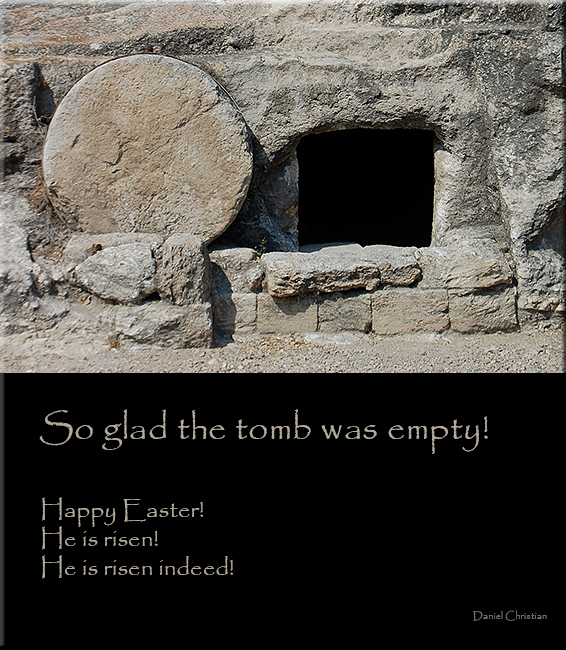
To those who celebrate it: Happy Easter to you! He is risen! He is risen indeed!


Matthew 28:6

He is not here; he has risen, just as he said. Come and see the place where he lay.


The Campus Crisis No One’s Talking About — from linkedin.com by Jeff Selingo

Sports Betting Is Now a Campus-Wide Habit

The headline number: About 60% of 18-to-22-year-olds are engaging in sports betting, a figure that climbs to two-thirds among college students specifically, according to an NCAA-commissioned study.

  • “It’s sort of a learned behavior for them at a very young age,” Clint Hangebrauck, the NCAA’s managing director of enterprise risk management, told us on the latest episode of Future U. “I do think this could be the next big public health crisis that we’re facing as a country and particularly within higher ed.”
  • College-age individuals are 3x more likely to develop problematic gambling behaviors than the general population. Gambling often co-exists with other behaviors now prevalent in colleges, such as sleeplessness, binge drinking, drug use, anxiety and depression.

Gambling among college students isn’t confined to athletes. Rather, it’s embedded across campus life, and with athletes often most visible in Division III, where oversight is lighter. Gambling often coexists with—and can exacerbate—other student challenges, from mental health struggles to substance use. If this is the next public health issue on campus, it’s arriving without the same level of attention.


From DSC:
I don’t mean to be self-righteous here. But shame on the older adults who are promoting gambling in any fashion — marketing, advertising, sales, and/or whatever. It’s a cancer in our society, and it’s impacting our youth in a big way (and also older folks as well). I’m not a gambler, but I’m well acquainted with weakness. And the Bible confirms that we all are acquainted with weakness:

Isaiah 53:6

 We all, like sheep, have gone astray,
    each of us has turned to our own way;
and the Lord has laid on him
    the iniquity of us all.

The adults out there know it. We are well acquainted with our sins and shortcomings.

Parents want the best for their kids. They don’t want dangerous habits being formed in their children. “Coping skills” that are majorly busted, and can lead to incredibly negative events. And the parents don’t want these habits to be formed at colleges and universities across the nation.

I wish those involved with promoting gambling could be at the dinner tables, or in the bedrooms, or in the living rooms, or in the vehicles out there when a spouse finds out that the other spouse (or significant other) has gambled away a significant amount of the couple’s savings. They no longer have rainy-day funds. They can no longer pay their bills. They no longer have the college funds for their other kids. Emotions erupt, fights begin. Relationships are threatened — and divorces sometimes occur because of this issue/habit. 

So if you are involved with promoting gambling, consider reading this article from Jeff Selingo…then go take a long look in the mirror. 


1 Timothy 2:5-6

5 For there is one God and one mediator between God and mankind, the man Christ Jesus, 6 who gave himself as a ransom for all people. This has now been witnessed to at the proper time.

John 1:29

John (The Baptist) Testifies About Jesus
29 The next day John saw Jesus coming toward him and said, “Look, the Lamb of God, who takes away the sin of the world!

Isaiah 53:3-6

3 He was despised and rejected by mankind,
a man of suffering, and familiar with pain.
Like one from whom people hide their faces
he was despised, and we held him in low esteem.
4 Surely he took up our pain
and bore our suffering,
yet we considered him punished by God,
stricken by him, and afflicted.
5 But he was pierced for our transgressions,
he was crushed for our iniquities;
the punishment that brought us peace was on him,
and by his wounds we are healed.
6 We all, like sheep, have gone astray,
each of us has turned to our own way;
and the Lord has laid on him
the iniquity of us all.

Luke 19:38

“Blessed is the king who comes in the name of the Lord!”
“Peace in heaven and glory in the highest!”

Matthew 20:28

“…just as the Son of Man did not come to be served, but to serve, and to give his life as a ransom for many.”

Matthew 20:17-19

Jesus Predicts His Death a Third Time
17 Now Jesus was going up to Jerusalem. On the way, he took the Twelve aside and said to them, 18 “We are going up to Jerusalem, and the Son of Man will be delivered over to the chief priests and the teachers of the law. They will condemn him to death 19 and will hand him over to the Gentiles to be mocked and flogged and crucified. On the third day he will be raised to life!”


The Most Obvious Fix in Education — from michelleweise.substack.com by Michelle Weise
The No-Brainer Nobody’s Doing 

We know what better learning looks like. We have known for a while.

Real problems. Real roles. Built-in conflict. Conditions that simulate the messiness of actual work. Reflection that asks not just what did you do but who are you becoming? These are not radical ideas. They are not untested theories. The research is clear, employers are asking for exactly this, and students consistently report that the closest they got to real work was the most valuable part of their education.

So why aren’t universities doing more of it?

That is the question worth sitting with — because the gap between what we know and what we do is not a knowledge problem. It is a design problem, an incentive problem, and if we’re being candid, a courage problem.

Because in the meantime, learners are paying the price. They graduate credentialed but untested. They enter labor markets that want proof of performance and experience, not transcripts. They lack the networks, the exposure, and the scar tissue that comes from navigating real work.


Also relevant, see:

The Apprenticeship (R)Evolution — from insidehighered.com by Sara Weissman and Colleen Flaherty
Once synonymous with hard hats and tool belts, apprenticeships are branching into health care, artificial intelligence, business services, advanced manufacturing and more.

Such programs also challenge stereotypes about apprenticeships—namely that they’re only in construction, an earn-and-learn catchall for traditionally apprenticeable occupations such as bricklayer, plumber, carpenter and electrician. In integrating robotics, automation, machining and logistics, the manufacturing development program is a bridge to understanding how apprenticeships are evolving to support some of the nation’s fastest-growing industries. These include advanced manufacturing, but also health care, information technology and other business services.


Building a Thriving Organizational Culture: Strategies for Success — from learningguild.com by Genevieve Caplette

Characteristics of Strong Culture
Although each organization’s culture is unique, strong cultures share several common traits. They communicate openly, maintain trust across all levels, and reinforce their values through daily actions rather than slogans. Recognition is frequent and meaningful. Collaboration is encouraged over competition, and employees feel psychologically safe expressing ideas or concerns. These cultures evolve as the organization grows, ensuring alignment between stated values and lived behavior.
…
How to Strengthen Culture
A thriving environment is built through everyday habits: transparent communication, active listening, constructive feedback, and ensuring employees have the resources to grow. Embedding values into hiring, onboarding, recognition, and decision-making reinforces culture at every level. Sustaining culture requires ongoing attention—listening regularly, adjusting to evolving needs, and ensuring leaders continue to model the behaviors the organization expects.


Why Educators Must Become AI Literate, And How to Start  — from edmentum.com by Priten Soundar-Shah

Much of our focus these few years has been spent helping students learn how to use AI responsibly, especially to combat cheating and plagiarism, and also with consideration given to productive learning, critical thinking, and online safety. But we are still behind on building fundamental literacy for teachers. Recent data supports this literacy gap. For example, Microsoft Education found that 80% of teachers say they are using AI, but 60% have received no or little training. We cannot continue to expect teachers to build student AI literacy without defining what success looks like for educator literacy, and there we’re falling short.

In some instances, AI literacy in the classroom is being defined as the ability to use chat tools to produce some sort of outcome. By that standard, we’re doing much better than we were three years ago. Students and teachers are increasingly turning to AI tools to produce study aids, outlines, drafts, and other content. And, some schools do provide training that is often concentrated on a particular vendor’s tool and how to use it effectively in the classroom.

However, we are leaving out the training that is necessary to help educators learn how to decide when to use or not use the technology and what the implications of that are. For example, I’ve spoken to teachers who have access to a variety of AI tools, have received training on how to use them, but still don’t incorporate them into their workflow, because they don’t know if it’s “right.”


AI and the Law: What Educators Need to Know About Responsible Use in a Rapidly Changing Landscape — from rdene915.com by Dr. Rachelle Dené Poth, JD

As both an attorney and educator who has spent more than eight years researching, teaching, presenting, and writing about AI, I have worked with schools across K–12 and higher education that are navigating these exact questions. The legal implications of AI are not barriers to innovation, but I consider them to serve as guardrails that assist schools with adopting technology responsibly. The key is protecting students, educators, and institutions and staying informed. Understanding the legal landscape and any potential legal implications as a result of the use of AI in classrooms helps schools move forward with confidence rather than hesitation.

Sections of Rachelle’s posting include:

  • Why AI and the Law Matter in Education
  • Key Laws That Shape AI Use in Schools
  • Data Privacy and Vendor Responsibility
  • Transparency Builds Trust With Students and Families
  • Accessibility, Equity, and Emerging Legal Considerations
  • Teaching Digital Citizenship With AI Literacy
  • Supporting Schools and Organizations Through AI and Legal Guidance
  • Moving Forward With Confidence
 

Google expands Search Live globally with voice and camera AI — from digitaltrends.com by Varun Mirchandani
The feature is now available in 200+ countries with multilingual support

Think of it as Google Search… but you talk to it. Search Live lets users ask questions using voice or even their phone’s camera, both on Android and iOS, via the Google App, and get spoken responses along with relevant web links.

This is a pretty big shift. Google isn’t just improving search, but it’s also slowly replacing the whole “type and scroll” experience. With Search Live, users can talk, ask follow-ups, and interact naturally, making it feel more like a conversation than a query. It’s basically ChatGPT-style interaction, but baked right into Google Search.

.


Proverbs 17:9

Whoever would foster love covers over an offense,
but whoever repeats the matter separates close friends.

3 You will keep in perfect peace
    those whose minds are steadfast,
    because they trust in you.
4 Trust in the Lord forever,
    for the Lord, the Lord himself, is the Rock eternal.

Psalm 25:11

For the sake of your name, Lord,
forgive my iniquity, though it is great.

Proverbs 17:3

The crucible for silver and the furnace for gold,
but the Lord tests the heart.

Philippians 2:5-11

5 In your relationships with one another, have the same mindset as Christ Jesus:

6 Who, being in very nature[a] God,
did not consider equality with God something to be used to his own advantage;
7 rather, he made himself nothing
by taking the very nature[b] of a servant,
being made in human likeness.
8 And being found in appearance as a man,
he humbled himself
by becoming obedient to death—
even death on a cross!
9 Therefore God exalted him to the highest place
and gave him the name that is above every name,
10 that at the name of Jesus every knee should bow,
in heaven and on earth and under the earth,
11 and every tongue acknowledge that Jesus Christ is Lord,
to the glory of God the Father.

Psalm 25:15

My eyes are ever on the Lord,
for only he will release my feet from the snare.


Hidden in Plain Sight: How Microschools Can Unlock the Power of Public Libraries — from microschoolingcenter.org by Tiffany Blassingame & Erin Flynn

The Library as a Learning Campus
Many microschool founders are wrestling with the same core challenge: how do you provide students with enriching, hands-on experiences when you’re working with a small team and a lean budget? Erin’s answer is deceptively simple — walk through the library’s front door.

Modern public libraries are far more than book repositories. Most educators walk past an entire ecosystem of free resources without realizing what’s available. Need printing, computers, or digital tools? Libraries offer them at little or no cost. Looking for hands-on science programming? Many branches host makerspaces and science stations built for exactly that kind of exploration. Need a space to hold a small class, workshop, or seminar? Bookable collaboration rooms are often just a phone call away.

Beyond the physical infrastructure, libraries frequently offer life skills programming — resume writing, financial literacy, job readiness — that can support the families surrounding a microschool, not just its students. And in some branches, social workers are embedded on site, providing the kind of wraparound support that few microschools could ever access on their own.

Libraries are also deeply invested in expanding their community reach. A microschool brings exactly the kind of engaged, mission-driven partnership that many branches are actively seeking. The relationship benefits both sides from day one.

 
© 2025 | Daniel Christian