WayRay’s AR Car Display Could Change Driving Forever — from vrscout.com by Kyle Melnick

How One Hospital Is Using An AR Bear To Calm Young Patients — from vrscout.com by Kyle Melnick

Excerpt:

Children’s Health of Orange County (CHOCK), a children’s hospital located in Orange County, California, has transformed its lovable mascot ‘Choco’ into an AR (augmented reality) experience that walks children through the steps of a standard MRI scan. The idea is that by familiarizing younger patients with the process, they’ll feel more comfortable during the actual procedure.

Arizona State Launching New VR/AR Classes, Nonny De La Peña To Helm — by Darragh Dandurand

Excerpt:

The Center for Narrative and Emerging Media (NEM) will be housed in Downtown Los Angeles in the Herald Examiner Building, newly renovated to welcome faculty, staff, and students. NEM’s goal is to teach and support students, from reporters to artists to entrepreneurs and engineers, who are pursuing careers across the burgeoning creative technology sector.

Why Meta decided against an open VR app store — from protocol.com by Janko Roettgers and Nick Statt


The AR Roundup: March 2022 — from linkedin.com by Tom Emrich

Excerpt:

Every month I round up what you may have missed in Augmented Reality including the latest stats, funding news and launch announcements and more. Here is what happened in augmented reality between March 1-31, 2022.

“The metaverse is no longer a single virtual world or even a cluster of virtual worlds. It’s the entire system of virtual and augmented worlds,” Chalmers tells me over Zoom. “Where the old metaverse was like a platform on the internet, the new metaverse is more like the internet as a whole, just the immersive internet.”

~ David Chalmers, Philosopher and Author of Reality+


This might be the best iPhone feature you never knew existed — from fastcompany.com by Doug Aamoth
Why doesn’t ‘Back Tap’ have its own ad? Or billboards? It’s amazing! And there are counterparts available for Android, too.

Excerpt (emphasis DSC):

Did you know that you could tap the back of your phone to make it quick-launch apps, settings, and shortcuts?

Although I feel mild shame for not knowing such a feature existed until now, I feel even greater joy that it’s part of my life. It’s life-changing, friends. Here’s how it works on an iPhone—and two ways to get something similar on an Android phone.


The Argos Education Blog is Up — from eliterate.us by Michael Feldstein

Per Michael:

I’m trying to maintain some separation between my writing on e-Literate and content about Argos (the startup I co-founded with Curtiss Barnes). It won’t be perfect because I write about what I think about and right now I’m thinking about Argos-related stuff a lot. But I’m going to post about Argos-centric topics—the design, the thinking behind the company, etc.—on the new Argos blog. You can read my posts, posts by my colleagues (like the great one by Anita Delahay that’s up now), and news updates.

Read and subscribe here.


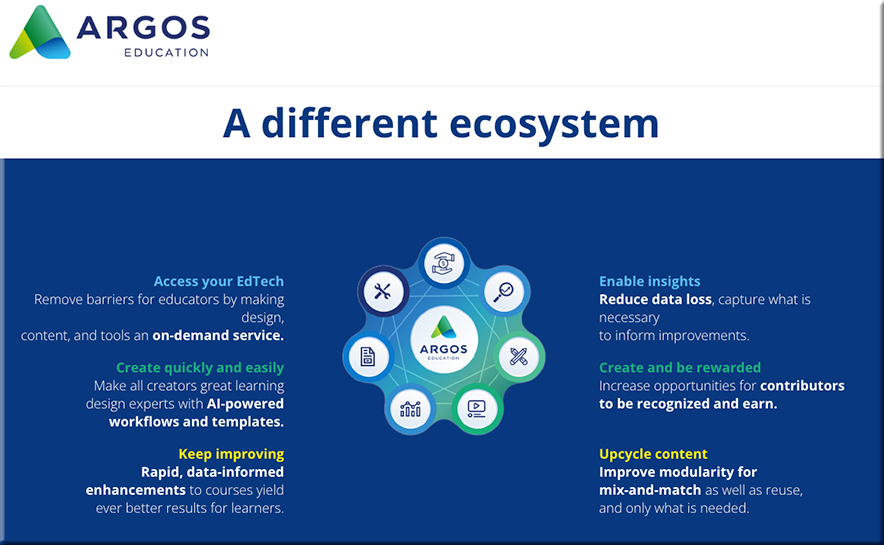
A different kind of ecosystem from Argos Education

From Argos Education:

Retaking textbooks
Several disruptive teams at Carnegie Mellon University and Arizona State University have been designing, building, and distributing next-generation digital textbook replacements.

Their products are provably effective, sell for significantly less than digital products from textbook publishers, and can generate more money for the programs creating them than they cost to create.

Argos believes this model is the future. We exist to bring that future into being.


Best Drones for Education: Building, Flying, and Coding — from eduporium.com

Excerpt:

Teaching with drones in education holds a number of possibilities that range from introducing piloting basics to helping students explore drone uses and careers as well as how coding ties in. Whether in a STEM program, a dedicated drone class, or in CTE courses, students can explore practical STEM concepts, gain hands-on experience, and more. When it comes to the best drones for education, however, knowing what you’re looking for is incredibly important. There are some big names, like the Parrot Mambo Fly and the Sky Viper line, but our team has certain requirements when it comes to our recommendations


From Instructional Design to Learning Experience Design: Understanding the Whole Student — a podcast out at campustechnology.com by Rhea Kelly, Mark Milliron, and Kim Round

Excerpt:

These days, we hear a lot about the “new normal” in higher education. Remote and hybrid learning is here to stay, offering students more flexibility in their learning journeys. But what if the new normal is not enough? It’s time to go beyond the new normal and consider the “new possible” — how to put together the best of face-to-face, online and hybrid to create powerful learning experiences based on a deep understanding of the whole student. We spoke to Mark Milliron, senior vice president of Western Governors University and executive dean of the Teachers College, and Kim Round, academic programs director and associate dean of the Teachers College, about their vision for reimagining education and why learning experience design is essential to student success.

Another interesting podcast:


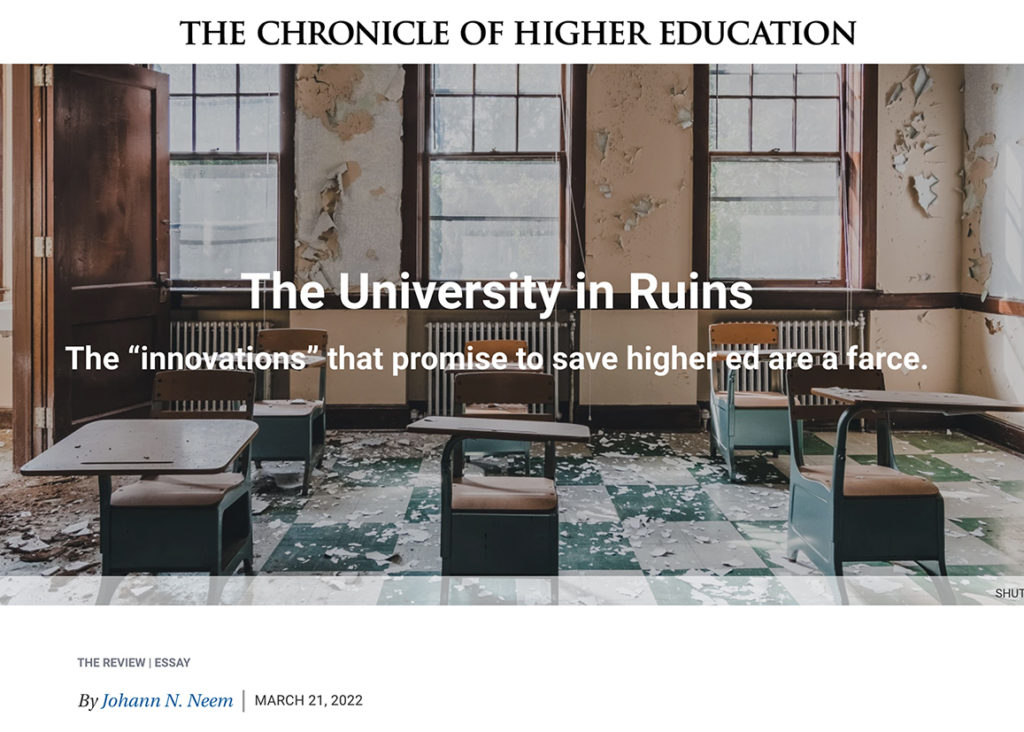
Per Johann Neem, the innovations that promise to save higher ed are a farce.

The University in Ruins — from chronicle.com by Johann N. Neem
The “innovations” that promise to save higher ed are a farce.

From DSC:
First of all,
I appreciated Johann Neem mentioning and/or discussing several books in one posting:

  • Ronald G. Musto’s The Attack on Higher Education (2021)
  • Arthur Levine’s and Scott J. Van Pelt’s The Great Upheaval (2021)
  • Bill Readings’ The University in Ruins (1996)
  • Ronald J. Daniels’ What Universities Owe Democracy (2021)

And as a disclosure here, I have not read those books. 

Below are excerpts with some of my comments:

It’s already happening. Today, we walk among the ruins of an institution that once had a larger purpose. It’s not clear what role universities should play in society, and to what or to whom they are accountable, other than their corporate interests.

To some, that’s not a problem, at least according to Arthur Levine and Scott J. Van Pelt in The Great Upheaval (2021). They see higher education undergoing the same transformation that reshaped the music, film, and newspaper industries. Rather than place-based education overseen by tenured professors, they anticipate “the rise of anytime, anyplace, consumer-driven content and source agnostic, unbundled, personalized education paid for by subscription.”

Between Musto’s existential fears of disruption and Levine and Van Pelt’s embrace of it lies a third path. It takes the form of a wager — outlined by Ronald J. Daniels in What Universities Owe Democracy (2021) — that universities can and should continue to matter because of their importance in civic democratic life.

The article covers how the learning ecosystems within higher education have morphed from their religious roots to being an apparatus of the nation-state to then becoming a relatively independent bureaucratic system to other things and to where we are today.

Along the journey discussing these things, one of the things that caught my eye was this statement:

Hopkins, in this sense, lived up to its founding president Daniel Coit Gilman’s 19th-century aspiration that universities be places that acquire, conserve, refine, and distribute knowledge.

From DSC:
While I completely agree with that aspiration, I think more institutions of higher education could follow what John Hopkins University did with their efforts concerning the Covid-19 situation, as Neem mentioned. Generally speaking, institutions of higher education are not distributing knowledge to the levels that Gilman envisioned years ago.

In fact, these days those working within K12 are doing a whole lot better at sharing information with society than those who work within higher education are. For example, when I search Twitter for K12 educators who share content on Twitter, they are out there all over the place — and many with tens of thousands of followers. They share information with parents, families, fellow educators, students, school boards, and others. Yet this is not the case for those working in higher education. Faculty members normally:

  • aren’t out on Twitter
  • don’t blog
  • don’t have a podcast
  • don’t write for society at large. Instead, their expertise is often locked up — existing behind paywalls in academic journals. In other words, they talk to each other.

Later on…

As Daniels intuits, without a larger purpose to hold them fast, there is nothing to prevent universities from being buffeted by winds until they have lost direction. That is what Readings foresaw: Globalization liberates universities from national fetters, but at the risk of ruin.

From DSC:
While globalization may have something to do with universities becoming unanchored from their original purposes, globalization isn’t at the top of my mind when I reflect upon what’s been happening with colleges and universities these last few decades.

To see but one area of massive change, let’s take a brief look at college sports. There are now multimillion-dollar stadium projects, enormous coaches’ salaries, and numerous situations where tax-paying citizens can’t even watch sporting events without tons of advertisements being thrown into their faces every few seconds. Personally speaking, on numerous occasions, I couldn’t even access the games at all — as I wasn’t paying for the subscriptions to the appropriate providers.

Also, as another example of becoming anchored — and going back to the 1980’s — I attended Northwestern University for my undergraduate degree in Economics. While I have several wonderful lifelong friends from that experience for whom I’m deeply grateful, even back then NU had already moved far away from its motto which is based on Philippians 4:8.

Instead, please allow me to tell you what that learning community taught me and strongly encouraged me to think about:

  • You are only successful if you have the corner office, drive the higher numbered BMW’s, and have many people reporting to you.
  • If you make a lot of money.
  • You are supposed to compete against others vs. being in relationships with others. As but one example here, our test scores were published — by our Social Security numbers — outside our professors’ offices for all to see how we measured up to our classmates.

In fact, I’m not even sure that I would use the word “community” at all when I reflect upon my years at Northwestern. Instead, a WIIFM approach was encouraged (i.e., What’s In It For Me? where you are supposed to look out for #1). It took me years to unlearn some of those “lessons” and “learnings.”

But I realize that that’s not the case with all learning communities.

As Neem alluded to, I love the idea that an institution of higher education can — and often does — impact students’ hearts as well as minds. That was the focus at Calvin College (now Calvin University). Our oldest daughter went there and she was profoundly and positively influenced by her experiences there. In that context, students were encouraged to be in relationships with one another. There was plenty of hugging, praying for one another, etc. going on in that setting. There truly was community there.

***

Neem doesn’t think much of Levine’s and Van Pelt’s perspectives. He claims there’s nothing new in their book. He seems to discard the arguments being made about the cost of higher ed and, like many others, clings to the intellectual roots/purpose of higher ed.

While I’m not against intellect or pursuing knowledge — in fact, I’m all for it — I just have a problem when the price of doing so continues to become out of reach for soooooo many people.

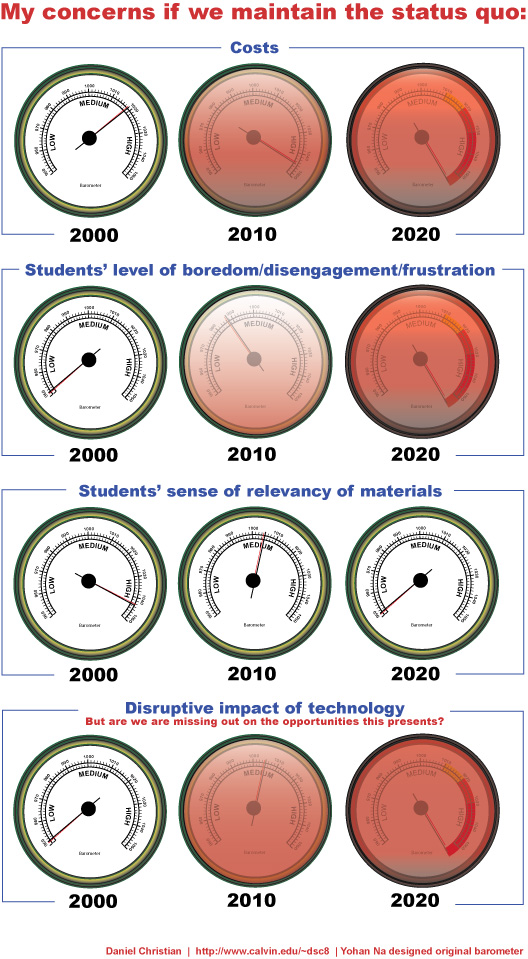
Personally, I’ve tried to lower the cost of obtaining a degree within higher education for many years…but I was/we were only successful in doing so for a few years (and that was during a pilot of online-based learning). Yohan Na and I created the graphic below in 2008 for example — as I was trying to raise awareness of the dangers of the status quo:
.
.

So from a cost/access perspective, Levine’s and Van Pelt’s perspectives here sound pretty good to me. It appears to be much more affordable and realistic for the masses. Otherwise, the image/reality of the ivory tower is maintained…allowing “intellectuals” to continue to live and operate within their own sphere/hive/tribe.

Also, we need an AI-backed system of presenting which skills are needed and then how to get them. The ways things are set up today, institutions of traditional higher education have not been able to deal with the current pace of change out there.

As a final comment here…
The changing directions/purposes of institutions of higher education present a good example of why I entitled this blog Learning Ecosystems — as the systems that we use to learn and grow in are constantly morphing:

  • People come and go
  • Tools and vendors come and go
  • Purposes, focuses, and/or mission statements change
  • Our sources of information (i.e., our streams of content) come and go
  • Etc.
 

Groups call for college trustees to learn more about accreditation — from highereddive.com by Rick Seltzer
“Board members lack a solid understanding of what accreditation is,” says a report issued by AGB and CHEA in the face of stress on the system.

Excerpts:

Much has changed since 2009, the report says, as colleges now face heightened problems stemming from declining enrollment, constrained state funding and sometimes shaky finances.

Institutions also face challenges that don’t show up on balance sheets: pandemic-related stresses, remote instruction, public skepticism, threats to freedom of speech, tensions over diversity, equity and inclusion — and external influences.

Many of the people who sit on colleges’ governing boards are not from the academy and might not be familiar with processes like accreditation, said Cynthia Jackson-Hammond, CHEA’s president.

“It’s about trust,” Stoever said. “What accreditation is intended to do, it’s not only around academic quality and financial integrity, but trust — public trust that these institutions of higher education are trustworthy.”

From DSC:
But maybe that’s part of the problem institutions of higher education face today. They’ve lost the trust of the public. When faculty teach what they want to teach — and presidents, deans, faculty councils, trustees, boards, etc. allow that to occur — then students graduate without the skills and knowledge that the workplace is hiring for. By the way, I realize that’s too general and not true in many cases. I still believe that the liberal arts are very important — and the communications skills and the ability to reason, think critically, etc. will likely always be important and beneficial (regardless of the job). 

But when you are a student who has gone to school for 4-6+ years, you finally graduate, and then you find out that you don’t have the skills or knowledge that the employers are hiring for, that will likely impact one’s trust level in one’s alma mater as well as in higher education in general. When you graduate with a gorilla of debt on your back, that may also impact your trust levels (though it may not in some cases).


A Conversation with Ken Robinson’s Daughter about Their New Book on Transforming Education — from betterhumans.pub by Eva Keiffenheim
Kate Robinson and Co-Author of Imagine if — Creating a Future for us All

Excerpt:

In writing the book, we highlighted ten “Manifesto Statements” that really summarize the key points the book is making.

The main themes of them are:

  • we are all born with immense creative capacities
  • our incredible powers of imagination are what separates us from the rest of life on Earth
  • Education systems are based on conformity
  • real life thrives on diversity
  • we are in the midst of two climate crises: the crisis of the Earth’s natural resources, and the crisis of our human resources
  • and no matter who you are, you are the system — if you change your behavior, you have changed the system, and when enough people commit to changing the system, we have a revolution that will change the world

According to Imagine if…, the future will be grim unless we take action to change the course where we’re heading. What actions need to be taken and what needs to be done and how? Where do we start?

The first and most important step is to embrace a richer conception of human intelligence. Like any ecosystem, our cultural ecosystems depend on a wide variety of talents, interests, and capabilities to thrive. Therefore, we must actively encourage each person to connect with and make the most of their own abilities and passions.


Gamifying Workplace Learning the Right Way, with Karl Kapp -- by Amit Garg

Gamifying Workplace Learning the Right Way, with Karl Kapp — from upsidelearning.com by Amit Garg
In this podcast, Amit Garg, a business leader focused on building impactful workplace learning solutions, speaks with L&D experts from across the globe. Together, they explore topics aimed at enabling L&D professionals to stay ahead and go beyond the ordinary. If you are constantly intrigued by how workplace learning can be leveraged to help people develop in an organization, this podcast is for you.


Bitcoin’s proof-of-work mechanism is a climate disaster. Environmental groups have a fix. — from protocol.com by Sarah Roach
Ending proof of work would cut bitcoin’s carbon footprint by an estimated 99%.

Excerpt:

If bitcoin could just cool it with the whole “using copious amounts of energy to mine magic internet money” thing, that’d be great. That’s the message some environmental groups are putting out there as part of a new campaign pressuring the bitcoin community to clean up its act with a code change.

Greenpeace USA, Environmental Working Group and other organizations began a campaign called #ChangeTheCode this week in an attempt to turn up the heat on bitcoin investors. The cryptocurrency currently relies on a proof-of-work process that puts miners in competition with each other. That mechanism is used by miners to confirm and record crypto transactions, providing a greater level of security, but it also takes a heavy climate toll due to the amount of energy used and the associated carbon emissions. There are other options, including proof of stake, that use vastly less energy.


L&D is going through an identity crisis — here’s why that’s a good thing — from chieflearningofficer.com by Linda Cai
We’re in a new situation, and we need to do something different. Our employees are hungry for growth and purpose amidst the Great Reshuffle, and companies need to respond and act or risk watching their talent walk out the door.

Excerpt:

That’s why organizations need our expertise more than ever. The demand for L&D specialists increased by 94 percent between July and September of 2021 compared to the previous three month period, according to our just-released 2022 Workplace Learning Report.

At the same time, our research also revealed that we have work to do. The report reveals L&D professionals spent 35 percent less time learning than their HR colleagues in 2021. It is not surprising, since a lot of them are overwhelmed by workload, and well-being has decreased. But the L&D function is going through what might be its most consequential transformation to date, and our success depends on whether we can learn the skills that this new world of work requires of us. Are we prepared to take on this increasingly strategic role for years to come?

It will not be easy. But we can start this important work by doing two things: loosening up how we think about ourselves, and going back to why many of us got into this business — to help people do their best work and be their best selves.

Here’s a relevant quote from the 2022 Workplace Learning Report:

“We really need to change and think about more productive and sustainable ways to help connect talent to opportunity, and our view is that that’s going to be done through a skills-based approach.”

Ryan Roslansky
CEO, LinkedIn


Ontario Bar Association backs proposed guidelines for remote court hearings — from lawtimesnews.com by Katrina Eñano

Excerpt:

According to the OBA, resorting to remote hearings can promote efficiency and cost-effectiveness and ensure the appropriate allocation of judicial resources.

In addition, the OBA provided a list of matters that should presumptively proceed remotely. These matters include:

    • Procedural matters, chambers appointments, and scheduling appearances;
    • Pre-trials;
    • Short motions or applications;
    • Motions that do not require witness attendance and are comprised of argument by counsel only;
    • Summary trials.

Also relevant/see:

Lawyers increasingly concerned about interplay between virtual and in-person court operations — from lawtimesnews.com by Annabel Oromoni

Excerpt:

As civil proceedings prepare to return to in-person hearings for discoveries, mandatory mediations, and trials, litigation lawyer Eric Sherkin says lawyers are wondering about the interplay of online and in-person arguments.

Certain hearings like pre-trials and case conferences will remain remote but how it works in practice beyond that is still unknown, Sherkin says.

All parties can agree to a virtual hearing, but “how often will all counsel say, ‘let’s agree to do this on Zoom,’ or will there be fights where five lawyers want to proceed on Zoom, and one insists on doing it in person?”


A Skills-First Blueprint to Better Job Outcomes — from linkedin.com by Karin Kimbrough
As Chief Economist at LinkedIn, I lead a team of economists and data scientists that unearth the most interesting insights from over 800M global members. Every month I’ll share a snapshot of key trends to help shed light on where the world of work is headed. This month, we’re looking at new findings around the shift to a skills-first talent ecosystem. 

An excerpt from that last link/posting which is entitled “A Skills-First Blueprint for Better Job Outcomes”:

A few key findings:

  • Skills are Changing
  • The Pandemic Pulled the Future Forward
  • Skills-First Hiring Can Work for Both Job Seekers and Hiring Managers
  • Identifying Similar Skills Helps Workers Pivot to New Roles
  • Amidst the Great Reshuffle, Investing in Skills is a Key to Retention
 

I Analyzed 13 TED Talks on Improving Your Memory — Here’s the Quintessence — from learntrepreneurs.com by Eva Keiffenheim
How you can make the most out of your brain.

Excerpt:

In her talk, brain researcher and professor Lara Boyds explains what science currently knows about neuroplasticity. In essence, your brain can change in three ways.

Change 1 — Increase chemical signalling
Your brain works by sending chemicals signals from cell to cell, so-called neurons. This transfer triggers actions and reactions. To support learning your brain can increase the concentration of these signals between your neurons. Chemical signalling is related to your short-term memory.

Change 2 — Alter the physical structure
During learning, the connections between neurons change. In the first change, your brain’s structure stays the same. Here, your brain’s physical structure changes — which takes more time. That’s why altering the physical structure influences your long-term memory.

For example, research shows that London taxi cab drivers who actually have to memorize a map of London to get their taxicab license have larger brain regions devoted to spatial or mapping memories.

Change 3 — Alter brain function
This one is crucial (and will also be mentioned in the following talks). When you use a brain region, it becomes more and more accessible. Whenever you access a specific memory, it becomes easier and easier to use again.

But Boyd’s talk doesn’t stop here. She further explores what limits or facilitates neuroplasticity. She researches how people can recover from brain damages such as a stroke and developed therapies that prime or prepare the brain to learn — including simulation, exercise and robotics.

Her research is also helpful for healthy brains — here are the two most important lessons:

The primary driver of change in your brain is your behaviour.

There is no one size fits all approach to learning.


From DSC:
This is so important. It’s the underlying cognitive science/psychology involved in the posting I recently created that was entitled, “What are the ramifications of having cognitive “highways in our minds?” It occurs to me that patience, grace, forgiveness, work, new habits, and more are required here.


© 2025 | Daniel Christian