Also relevant/see:

What is Norton Rose Fulbright’s LX Studio? — from artificiallawyer.com

Excerpts:

‘From tiny acorns, mighty oak trees grow’ so the saying goes, and it’s fair to say that US-based LX Studio, the new innovation project of global firm Norton Rose Fulbright (NRF), is very much still an acorn – but it has plenty of potential.

Artificial Lawyer spoke to Jeff Cody, Managing Partner for the US side of 3,700-lawyer NRF, which was formed by the merger of the UK’s Norton Rose and America’s Fulbright & Jaworski in 2013, to find out some more.

But, with a more optimistic outlook one might say that this is a beginning; and that although the US is home to many pioneering legal tech companies and ALSPs, the reality is that few law firms in the US have dedicated innovation groups which mirror the full range of what NRF has in the UK, for example.
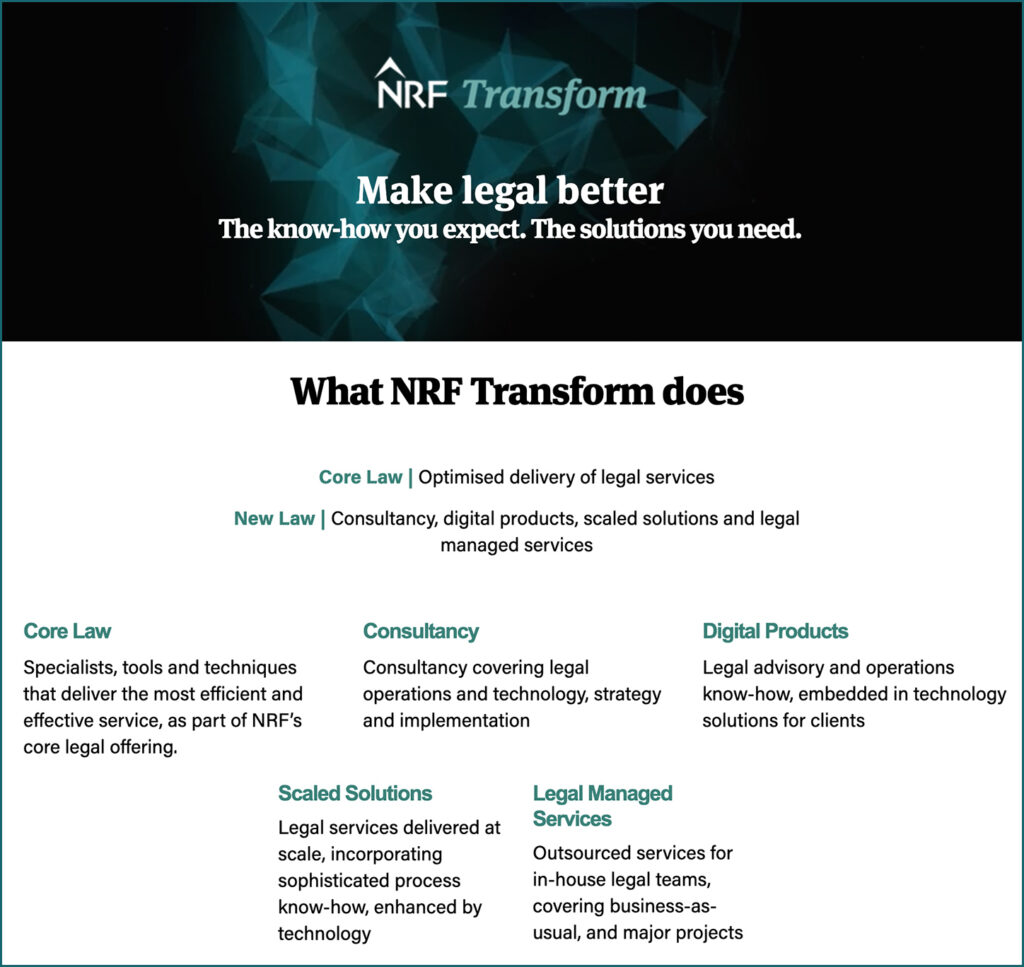
NRF Transform -- global legal operations


‘Hologram patients’ and mixed reality headsets help train UK medical students in world first — from uk.news.yahoo.com

Excerpts:

Medical students in Cambridge, England are experiencing a new way of “hands-on learning” – featuring the use of holographic patients.

Through a mixed reality training system called HoloScenarios, students at Addenbrooke’s Hospital, part of the Cambridge University Hospitals NHS Foundation Trust, are now being trained via immersive holographic patient scenarios in a world first.

The new technology is aimed at providing a more affordable alternative to traditional immersive medical simulation training involving patient actors, which can demand a lot of resources.

Developers also hope the technology will help improve access to medical training worldwide.


What’s the current state of OPM and UK university partnerships? — from neilmosley.com by Neil Mosley

Excerpt:

One of the big changes of the past couple of years has been the number of universities getting serious about what they are doing in the online distance education space.

Whilst the number of online distance education courses on offer in UK higher education has been steadily growing, the events of the last couple of years have spurred some universities to more intentionally consider what they are doing in this space.

For universities looking to develop an online distance education portfolio there has tended to be two main choices – make the necessary investment to do this themselves or partner with an online programme management (OPM) company.

In the UK, OPM partnerships tend to go under the radar and there’s not much widespread knowledge about who they are and what they do. I think more people in UK higher education should have an understanding of these types of partnership, not least because the number of new partnerships are accelerating.

Also from Neil, check out:

What role will MOOC platforms play in UK universities online futures?

Excerpt:

Nevertheless, as we enter a new era for online education, one in which there seems to be more universities developing partnerships to offer an online portfolio of courses, it will be interesting to observe whether MOOC platform partnerships will play a role in that and what this ultimately begins to look like.


Top Content Providers For Immersive Learning (2022) — from elearningindustry.com by Christopher Pappas

Summary: 

Immersive learning experiences allow learners to interact by simulating real-life scenarios. Are you ready to offer engaging virtual environments and experiences to your workforce? Dive right into this thoroughly curated top list featuring the best content providers for VR training and bring your teams one step closer to the Metaverse.


After an AI bot wrote a scientific paper on itself, the researcher behind the experiment says she hopes she didn’t open a ‘Pandora’s box’ — from insider.com by Hannah Getahun

Excerpt:

  • An artificial-intelligence algorithm called GPT-3 wrote an academic thesis on itself in two hours.
  • The researcher who directed the AI to write the paper submitted it to a journal with the bot’s consent.
  • “We just hope we didn’t open a Pandora’s box,” the researcher wrote in Scientific American.

AI Empowers Scalable Personalized Learning and Knowledge Sharing — from learningsolutionsmag.com by Markus Bernhardt

Excerpt:

AI aids in providing true personalization
Automation through AI is providing us with the tools necessary to deploy fully personalized digital learning, extremely fast and at scale. With the advent of this technology, we will see a revolution in digital training; in addition, I predict that the impact the digital piece will have on human-led efforts will lead to a further revolution of education, training, workshops, mentoring, and coaching.

How A.I. Could Help You Design Your Perfect Office (or Store) — from inc.com by Ben Sherry
Artificial intelligence may soon help fill the gap between your interior design skills and your imagination.

Excerpt:

Boom Interactive is one of several companies attempting to streamline the interior design process using automation. The Salt Lake City-based startup’s free app, Bubbles, which is scheduled to soft launch in the third quarter of 2022, uses artificial intelligence to read floor plans and create a “digital twin” of your real-life space, according to CEO and founder Timber Barker. Once a “twin” has been created, users have full freedom to customize the space by adding doors, erasing walls, and placing furniture.

The Increasing Role of Artificial Intelligence in Our Lives — from rdene915.com by Rachelle Dene Poth

Excerpt:

All of this recent information has made me even more curious about the role artificial intelligence will play over the next few months as we hopefully get back to more of a normal life experience and can engage in work and learning but also in leisure activities. What can we learn from the recent uptick in AI information and how can it help us in the future?

Optical illusions could help us build the next generation of AI — from digitaltrends.com by Luke Dormehl


10 ways to deal with stakeholders’ beliefs in learning — from 3starlearningexperiences.wordpress.com by Mirjam Neelen & Paul A. Kirschner

From DSC:
I thought the skit below was funny. But there’s some truth in here as well.

Excerpts:

Don’t we all have stakeholders – including bosses! – like this? We know we do! Our expertise isn’t always taken seriously – and we’re not the only ones:


Encourage Learning Over the Summer with Buncee & PebbleGo Create — from rdene915.com by Rachelle Dene Poth

Excerpts:

In each of these, there are opportunities for students to take a close look at the world around them and become curious about learning. Students can connect with things that are happening in the real world.

Another item from Rachelle:

Enhanced Learning with IPEVO!

From DSC:
In my last position, we used IPEVO devices as well. I purchased one for my sister last year as well. They do the job quite well — at a very decent price.


7 Surprising Ways ADHD Shows Up in the Classroom — from additudemag.com by Mark Bertin, M.D., Beverley Holden Johns, Kathy Kuhl
ADHD in the classroom is easy to mistake for carelessness, defiance, laziness, or a learning difference. Here are the 7 ADD symptoms that educators seldom recognize at school — and solutions for each.

Excerpt:

ADHD sometimes manifests in obvious ways — like when a second grader blurts out an answer (again) or when a high school student forgets her completed assignment at home (again). Just as often, though, signs of ADHD in the classroom are more subtle and easily overlooked because they don’t align with stereotypes. Here are seven less-recognized ways ADHD symptoms show up at school, and productive ways to address each one.


Also relevant/see:


How Alternative Credentials Can Help You Find Employees — from shrm.org by Kathryn Tyler
Focus on skills, not degrees, to increase your talent pool.

Excerpts:

“Alternative credentials,” such as the ones Brown attained, are increasingly available in the form of micro-credentials, digital badges and industry-recognized certificates. They’re less expensive than a college degree and designed to help prepare workers for better jobs.

IBM is ahead of the game in many respects. Six years ago, the tech giant began revising its job descriptions to focus on skills and not just educational attainment. On average, 50 percent of the company’s posted positions in the U.S. don’t require a bachelor’s degree.

“We call these ‘new-collar jobs,’ and they’re aligned to careers that require the right set of skills and a commitment to lifelong learning,” says Tommy Wenzlau, talent leader for new-collar initiatives at IBM, which employs more than 250,000 workers globally. “New-collar roles are in some of technology’s fastest-growing fields, including data science, cloud computing, application development, cybersecurity and digital design.”


James 1:19

James 1:19

Listening and Doing

19 My dear brothers and sisters, take note of this: Everyone should
be quick to listen, slow to speak and slow to become angry…


Quiet People in Meetings Are Incredible — from medium.com by Tim Denning
Knowing when not to talk is an art.

Excerpts:

But it’s not all bad. Meetings have taught me one valuable lesson: watch the quiet people.

Job titles make people do stupid things. One of those misdemeanors is talking too much. You can have a title today and have it gone tomorrow.

What ruins business is people that don’t listen. They think they know the market but actually they don’t know anything at all.

The brightest spark in the room says nothing at all. They are there taking notes and paying attention to what is going on. They watch the duel of egos and see no room to interrupt.


From DSC:
The following two items make me wonder how Extended Reality (XR)-related techs will impact theatre, gaming, opera, & other forms of entertainment.


AR Opera Glasses Could Change Broadway Forever — from vrscout.com by Kyle Melnick

Excerpt:

Immersive technology brings the stage to life like never before.

Students from the South Korean Hongik University have developed a pair of reimagined 19th-century opera glasses that utilize AR technology to immerse spectators in Broadway shows in a variety of unique and imaginative ways. The device is compatible with popular shows such as Wicked, Aladdin, Cats, Mamma Mia, and Frozen.

Reddot_Rene from ???/??????? on Vimeo.


What ‘Shakespeare Karaoke’ Teaches About the Virtual Reality Future — from edsurge.com by Rebecca Koenig
Does technology work better as a solo encounter or a group experience?

Excerpt:

To immerse, or not to immerse?

For professors designing virtual reality versions of Shakespeare’s plays, that is the question. The answer(s) may have implications for designing new edtech tools—and VR technology intended to be used beyond the classroom, too.

The Bard’s masterpieces, plays written in the late 1500s and early 1600s, have received all kinds of digital makeovers in the 21st century. Two current efforts designed by academics for use in teaching draw on extended reality tools that invite users to actively participate in scenes from works like “Romeo and Juliet.”

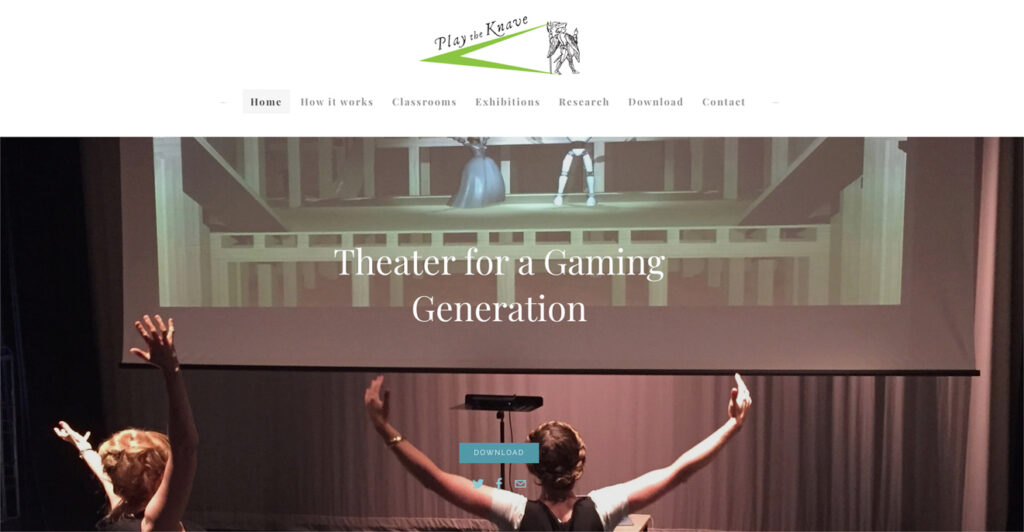
Play the Knave is a video game that helps users design actor-avatars they can direct with their bodies around virtual theater spaces. Shakespeare-VR is a project-in-development that will enable users to don a VR headset, step on to a virtual Elizabethan stage and perform alongside avatars voiced by professional actors.

Play the Knave* is a mixed reality video game that enables virtual design and performance of dramatic scenes from Shakespeare--or any text you choose


Dead Malls and Future Campuses — from insidehighered.com by Joshua Kim
Thoughts on Meet Me by the Fountain: An Inside History of the Mall.

Excerpt:

Can we learn anything about the future of the university from the history of the shopping mall?

If any lessons connecting malls to colleges are to be found, the starting place is Meet Me by the Fountain. It is hard to imagine a more complete social, architectural, cultural, economic or cross-national comparison of shopping malls than this book provides.

For some, all the detail, theorizing and analysis of the mall’s history, relevancy and meaning might be a bit too much. For those looking for clues about how the university might evolve post-pandemic, the deep dive into malls that Meet Me by the Fountain provides is helpful.


Survey Shows Teachers See Play and Choice in Learning Methods As Key to Student Engagement — from thejournal.com by Kristal Kuykendall

Excerpt:

A recent survey of teachers by Kahoot reveals that educators see playful learning and student choice in learning methods as vital to helping boost student engagement and outcomes, according to a new report from the ed tech company.

Kahoot’s May survey of over 8,000 K–16 educators nationwide found that teachers are still concerned about drops in student engagement during the pandemic, and they consider more student-centered approaches as the path forward.

 
© 2025 | Daniel Christian