An Overseas Ed-Tech Firm Wants to Buy 2U. What Could That Mean for Colleges? — from chronicle.com by Taylor Swaak

Excerpt (emphasis DSC):

What happens to a college’s online programs if the company operating them changes hands? It’s a question on the minds of higher-ed leaders as an overseas ed-tech company attempts to buy 2U. 

Byju’s, an ed-tech behemoth based in India, has put more than $1 billion on the table to acquire the online program manager, Bloomberg first reported late last month. 2U is one of the largest online-program managers, or OPMs, in the United States, known for scaling up online-degree programs and teaming up with more than 130 American colleges, including large institutions such as Arizona State, New York, and Syracuse Universities. It’s also the parent company of the online-course provider edX.


SDNY and SEC bring first cryptocurrency insider trading case — from nortonrosefulbright.com by [Celia Cohen, Kevin J. Harnisch, Andrew James Lom, Matthew Niss, Rachael Browndorf]

Excerpt:

In the midst of the “crypto winter,” cryptocurrency enforcement activity is heating up. On July 21, 2022 the US Attorney’s Office for the Southern District of New York (SDNY) and Securities and Exchange Commission (SEC) brought the first insider trading case involving cryptocurrency against a former cryptocurrency exchange employee and his brother and friend, following last month’s first ever indictment for insider trading involving non-fungible tokens. In a prior New York Law Journal article, we discussed the mounting prevalence of frauds and other crimes utilizing cryptocurrency, how these crimes often resemble conventional crimes with which the public is all too familiar, and enforcement agencies’ response: funneling resources to the cryptocurrency space to address such crimes. These insider trading charges are the latest example of traditional crimes being committed through cryptocurrencies and, given the continued direction of enforcement efforts towards the cryptocurrency space, they are unlikely to be the last.


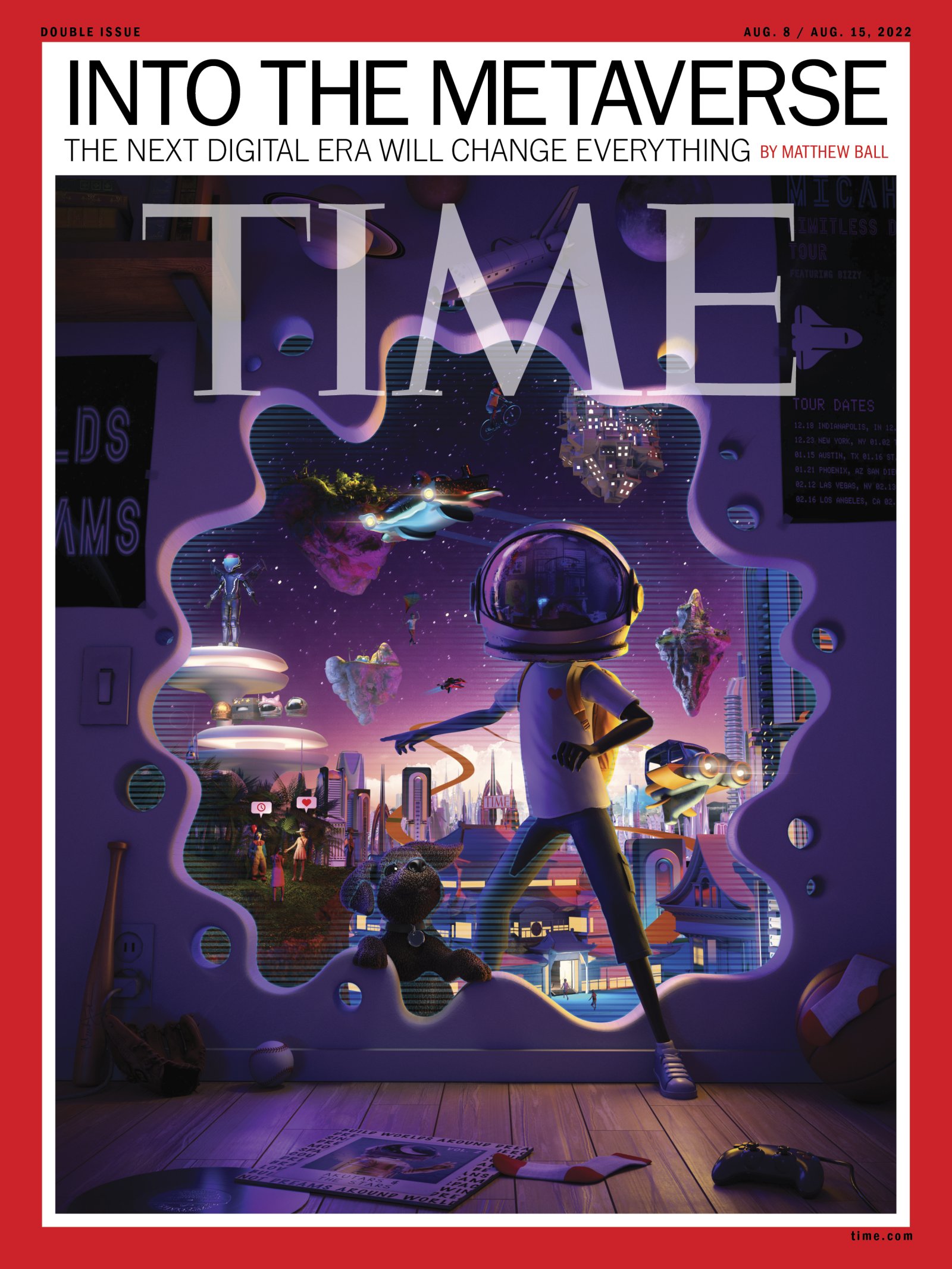
The Metaverse Will Reshape Our Lives. Let’s Make Sure It’s for the Better. — from time.com by Matthew Ball

Excerpts (emphasis DSC):

The metaverse, a 30-year-old term but nearly century-old idea, is forming around us. Every few decades, a platform shift occurs—such as that from mainframes to PCs and the internet, or the subsequent evolution to mobile and cloud computing. Once a new era has taken shape, it’s incredibly difficult to alter who leads it and how. But between eras, those very things usually do change. If we hope to build a better future, then we must be as aggressive about shaping it as are those who are investing to build it.

The next evolution to this trend seems likely to be a persistent and “living” virtual world that is not a window into our life (such as Instagram) nor a place where we communicate it (such as Gmail) but one in which we also exist—and in 3D (hence the focus on immersive VR headsets and avatars).


These Professors Were Thinking About Quitting. So They Turned to Social Media. — from chronicle.com by Wyatt Myskow

Excerpts:

One pointed him to a Facebook group, “The Professor Is Out,” dedicated to academics who are quitting. It helped him realize that “it’s not impossible for me to shift out of this thing.”

“The Professor Is Out” allows people to post anonymously, an important feature for academics who are still on the fence about quitting. When Kelsky created the group, she expected around 1,000 people to join. Now it has more than 24,000 members.

Another popular forum for maybe-quitters is the subreddit r/Professors, which has more than 100,000 members — dubbed “Guardians of Academe.”


Related postings:

Over half of higher ed employees likely to seek another job, survey finds — from highereddive.com by Jeremy Bauer-Wolf

Dive Brief:

  • More than half of college employees reported they are likely to leave their jobs in the next year in a new survey from the College and University Professional Association for Human Resources, CUPA-HR.
  • The most common reason workers gave for seeking new employment was the prospect of higher pay, followed by an opportunity to work remotely, and more flexible work hours.
  • Nearly two-thirds of respondents reported they’re working mostly or completely on campus, but almost 70% wanted to work remotely at least part time.

More Than Half of Campus Staff Members Are Thinking About Quitting, Survey Finds — from chronicle.com by Megan Zahneis

Excerpt:

Results of a new survey paint a grim picture for higher ed’s hopes of retaining staff members: More than half of them are considering leaving their job in the next year.

That’s according to staff members polled in May by the College and University Professional Association for Human Resources; initial results of the survey were released this month.

Survey: More Than Half of Higher Ed Workers Plan to Leave — from insidehighered.com by Josh Moody

Excerpt:

Many higher education employees are headed for the exits, according to a new survey from the College and University Professional Association for Human Resources, which found that more than half of respondents said they were likely to look for other employment within the next 12 months.


Why Infosys’s cofounder Nilekani is urging leaders to use tech for good

Why Infosys’s cofounder Nilekani is urging leaders to use tech for good  — from mckinsey.com by Gautam Kumra
The cofounder of the multinational IT company believes Indian start-ups will soon develop technologies to transform education, healthcare, and other social challenges.

Excerpts:

McKinsey: The world has also become a more complex place, with recent geopolitics, inflation complexity, rocketing energy prices, excessive liquidity, and digitization challenges. How do you personally keep adapting and learning?

Nandan Nilekani: In the last 40 years, I think we have gone through every transition: mainframes to minicomputers to LANs [local area networks] to internet to smartphones to AI. It has been fun understanding and riding these waves.

In my view, if a billion people can use something, then that’s a benefit. A billion people can learn using technology. A billion people can get better healthcare using technology. A billion people can move around and change jobs using technology.

From DSC:
I hope I can meet Nandan Nilekani someday. I feel that he is a kindred spirit. Several things that he said really resonated with me.


Why my school is putting music education front and centre — from educationhq.com by Justin Garrick

Excerpt (emphasis DSC):

Music education must not be only for those already with the background or the early talent or the pre-existing motivation to access it.

Music education must be for all, because music itself is for all.

Just like language and literature, which are at the compulsory core of the curriculum, music is the expression of culture and is pervasive to our daily experience. It surrounds us on the airwaves of radio, television and streaming in all the glory and diversity of its genres.

It influences our thoughts and moods and choices. We exercise, drive, shop, eat and celebrate with music. It’s intrinsic to our wellbeing, our social interaction, our spiritual and sensual experience, and to our religious, national and cultural rites.

From DSC:
I’m very grateful for the choir-related classes and experiences that I’ve had throughout my lifetime. I’m grateful for learning the basics of playing the piano and the drums. Although I didn’t stick with either instrument, I’m glad that I can read some (basic) music. But beyond that, music hosts so many memories for me. I’m instantly taken back to various times, places, people, and emotions — depending on the song(s) that I’m listening to.


Ways that artificial intelligence is revolutionizing education — from thetechedvocate.org by Matthew Lynch

Excerpt:

I was speaking with an aging schoolteacher who believes that AI is destroying education. They challenged me to come up with 26 ways that artificial intelligence (AI) is improving education, and instead, I came up with. They’re right here.


AI Startup Speeds Healthcare Innovations To Save Lives — from by Geri Stengel

Excerpt:

This project was a light-bulb moment for her. The financial industry had Bloomberg to analyze content and data to help investors uncover opportunities and minimize risk, and pharmaceutical, biotech, and medical device companies needed something similar.


Trends in State Courts — from ncsc.org

Excerpt:

Trends in State Courts is an annual, peer-reviewed publication that highlights innovative practices in critical areas that are of interest to courts, and often serves as a guide for developing new initiatives and programs and informing and supporting policy decisions. Trends in State Courts is the only publication of its kind and enjoys a wide circulation among the state court community.

Trends in State Courts 2022
External events continue to drive change and innovation in the courts. The 2022 edition of Trends in State Courts highlights post-pandemic eviction courts and eliminating racism and bias in the courts.


Also from ncsc.org:

The key role of non-lawyer practitioners — by Dimarie Alicea-Lozada

Excerpt:

Over the last 20 years, a variety of different states have developed efforts to try to provide for non-lawyer practitioners with varying degrees of success. The intention was simple: provide affordable legal services to those who cannot afford an attorney but need help. With 1 out of 10 people in the United States involved in newly filed cases each year and 3 out of 5 in civil cases not having a lawyer, state courts have been trying to help people who otherwise will not be able to afford access legal representation. Since the COVID-19 pandemic, several states have made changes in this area.


From DSC:
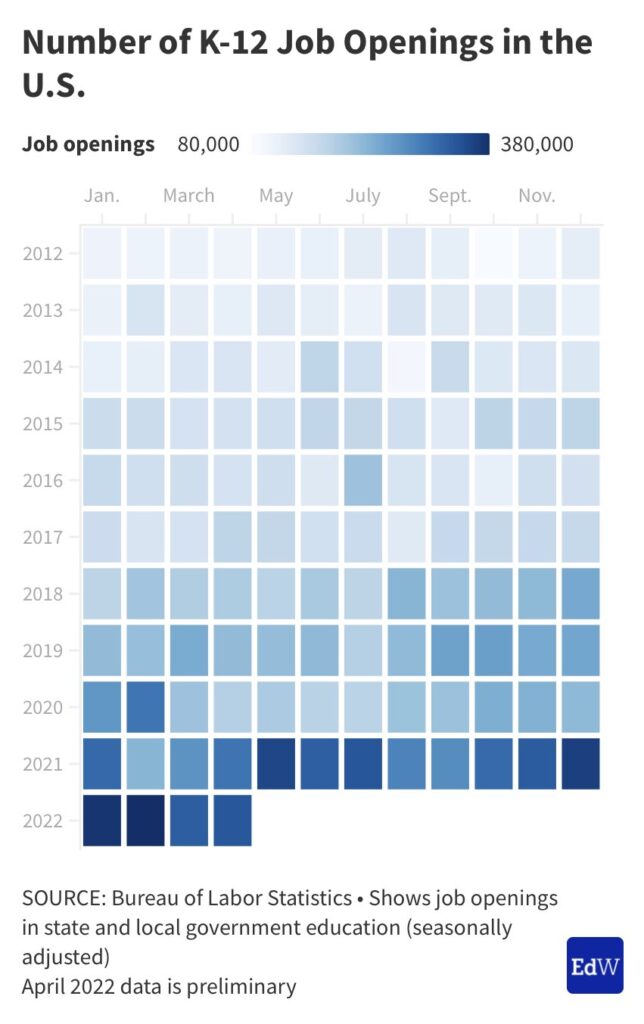
Is the use of virtual instructors going to be used more to fill vacancies within K12? Hmmm…time will tell. 

By the way, I think online-based learning works for many people, but certainly it isn’t for everyone (even with the likely unfair assumption that everyone has Internet access and the equipment/setup that they need). From what I’ve observed, it works best for very disciplined, motivated students — they need to be a bit more independent in their learning. But school systems should have backup plans in place if the exodus continues.


Education tech companies bring virtual teaching to the table as solution to teacher shortage — from thedenverchannel.com by Chloe Nordquist

Excerpts:

Education technology companies like Elevate K-12, which is a live streaming instruction platform, are growing. Especially in areas where hiring a teacher can be tough.

The company is seeing more interest from teachers in joining their platform. One is for schedule flexibility.


New: Futurist Friday Podcast Interview with Gerd Leonhard: TheGoodFuture? — from futuristgerd.com by Gerd Leonhard

Excerpt:

Over the course of the summer of 2022, DonMacPherson and 12 Geniuses are releasing 12 interviews with futurists and forward thinkers in order to help their global audience of leaders become better visionaries for their organizations and be more prepared for the uncertain future.

In this episode, Gerd Leonhard joins the show. First, he points out that “the future is already here, we just haven’t paid enough attention to it.” He talks about how technology is promising to make us superhuman, that we are in the biggest shift era in recent history as far as energy and climate is concerned, and that machines and artificial intelligence are starting to emulate humanity.


7 Amazing Ways Technology Is Changing Higher Education for the Better — from innotechtoday.com by Emily Newton

Excerpt:

As society has stepped decidedly into the digital age, there’s been a lot of debate about how technology is changing higher education. Some people believe there are benefits of technology in education, while others are concerned about tech’s impact on learning and motivation. Technology in higher education can be a major distraction or an incredibly helpful resource.

Technology is only as good or as bad as what you do with it. In education, AI, coding, and media creation are tools that teachers can use to motivate their students and help them grasp new ideas. Keeping pace with everyday tech is important for modern students. Here are seven amazing ways technology is changing higher education for the better.

 
© 2025 | Daniel Christian