The Finalists of the American Legal Technology Awards Are…! — from artificiallawyer.com

Excerpt:

After receiving 225 submissions across eight categories, the American Legal Technology Awards have today announced the lucky finalists. They include a wide range of companies and individuals, ranging from judges, to law firms, to startups and larger legal tech businesses. So, without further ado, here are the finalists in the table below, with three finalists in each category.

Looking For Trouble And Finding It: The ABA Resolution To Condemn Non-Lawyer Ownership — from professionalresponsibility.fkks.com by Ron Minkoff

Excerpt:

At the ABA Annual Meeting last week, the Illinois State Bar Association (“ISBA”), the New York State Bar Association (“NYSBA”), and several ABA entities sponsored Local Resolution 402 (hereafter, the “ISBA Resolution”) in an effort to stop the entire ABA – if not the entire American legal profession – from permitting non-lawyer ownership of law firms, in any form.  The ISBA Resolution read as follows:

Teaching (and Pressuring) Law Professors to Teach Technology – Katie Brown (TGIR Ep. 171) — from legaltechmonitor.com by

Excerpt (emphasis DSC):

In her view, law professors “are required to educate people so that they can go out into the practice and successfully do that. And so beyond just, rule 1.1 with legal technology and having that competency, for us as law schools, I think we have an ethical obligation to be teaching legal technology.” This approach needs to be embedded into the Law School’s culture, because it costs money, time, and effort to do correctly.

From DSC:
Agree. I completely agree.

Understanding The Justice Gap — from medium.com by Kevin Golembiewski

Excerpt:

The law is a language. Pleading, cause of action, discovery, hearsay, res judicata, statute of limitations, civil procedure. To understand and protect your legal rights, you must learn this language and the complex rules that govern it. Or you must find an interpreter — that is, a lawyer. No different than if you were in a foreign country without an interpreter, if you have a legal problem but no lawyer, you cannot advocate for yourself.

That is the reality for millions of low-income Americans, according to a recent study by the Legal Services Corporation (LSC). About 50 million Americans have household incomes below 125% of the poverty threshold, and 92% of them do not have any, or enough, legal help for their civil legal issues — issues that range from eviction to domestic violence to disability benefits. Those Americans are stranded in the land of the law without an interpreter.

Litera releases The Changing Lawyer Report 2022 at ILTACON — from legalitprofessionals.com

Key takeaways

The five trends to watch, with some representative data points from the report include:

  1. Allied professionals (process managers, technologists, data analysts, etc.) play a more significant role in supporting law firms and lawyers and enhancing legal service delivery. 83% of lawyers believe that allied professionals make their job easier.
  2. Automation is everywhere, as law firms turn to AI and other technologies to enhance the speed and accuracy of legal processes across all practice areas. 91% of lawyers expect AI-based document review to become a standard part of most M&A due diligence processes.
  3. Technology and data improve client service delivery by providing real-time insights about law firm performance, pricing and budgeting, and work allocation. 78% of lawyers agree that technology helps them offer a better client experience.
  4. Cloud-based solutions are taking over, driven partly by the obvious need for remote and blended workplace access to law firm applications that arose during the pandemic. Leading types of cloud applications that have been moved to the cloud include financial and practice management (64% of firms), document management (53%), portals and intranets (35%), and business intelligence platforms (31%).
  5. Changing work expectations are a significant driver of technology adoption when lawyer recruitment and retention are challenges for law firms. A new generation of lawyers sees technology as a path to better work/life balance. 53% of lawyers ‘strongly agree’ or ‘agree’ with the statement technology makes my job more enjoyable.

 

From DSC:
Below are some reflections based on an article entitled, Understanding learning transfer through Archwell Academies. It’s from chieflearningofficer.com and was written by Erin Donovan and Keith Keating.

Excerpt:

To capitalize on learning transfer and extend learning beyond traditional training periods, practitioners have established capability academies. According to Josh Bersin, capability academies are the evolution of traditional training and self-directed learning. Bersin posited:

Capability academies are business-driven, collaborative learning environments that facilitate learning retention. . . . Going beyond rote lessons, capability academies help companies prepare for transformation by helping employees develop complex skills and providing guidance on how to apply them in the context of the business.

The core concept of capability academies rests on the importance of collaboration between the trainers and the business. The intention is to provide learners with practice of conceptual understanding and comparative scenarios in the context and environment where they will ultimately apply their skills. Capability academies focus on providing training distinctly aligning with learners’ job responsibilities.

From DSC:
First of all, I have a lot of respect for the people that this article mentions, such as Josh Bersin and Will Thalheimer. So this article caught me eye.

It seems to me that the corporate world is asking for institutions of traditional higher education to deliver such “capability academies.” But that makes me wonder, could this even be done? Surely there aren’t enough resources to develop/deliver/maintain so many environments and contexts, right? It took Archwell, a global mortgage services outsourcing provider, an entire year to systematically design and develop such customized capability academies — just for their clients’ businesses. 

The article goes on:

The core concept of capability academies rests on the importance of collaboration between the trainers and the business. The intention is to provide learners with practice of conceptual understanding and comparative scenarios in the context and environment where they will ultimately apply their skills. Capability academies focus on providing training distinctly aligning with learners’ job responsibilities.

Context. Skills. Acquiring knowledge. Being able to apply that knowledge in a particular environment. Wow…that’s a lot to ask institutions of traditional higher education to deliver. And given the current setup, it’s simply not going to happen. Faculty members’ plates are already jammed-packed. They don’t have time to go out and collaborate with each business in their area (even with more sabbaticals…I don’t see it happening).

I’m sure many at community colleges could chime in here and would likely say that that’s exactly what they are doing. But I highly doubt that they are constantly delivering this type of customized offering for all of the businesses in each major city in their area.

I can hear those in corporate training programs saying that that’s what they are doing for their own business. But they don’t provide it for other businesses in their area.

So, what would it take for higher education to develop/offer such “capability academies?” Is it even possible?

We continue to struggle to design the ultimate learning ecosystem(s) — one(s) whereby we can provide personalized learning experiences for each person and business. We need to continue to practice design thinking here, as we seek to provide valuable, relevant/up-to-date, and cradle-to-grave learning experiences.

The problem is, the pace of change has changed. Institutions of traditional higher education can’t keep up. And frankly, neither can most businesses out there.

I keep wondering if a next-generation learning platform — backed up by AI but delivered with human expertise — will play a role in the future. The platform would offer products and services from teams of individuals — and/or from communities of practices — who can provide customized, up-to-date training materials and the learning transfers that this article discusses.

But such a platform would have to offer socially-based learning experiences and opportunities for accountability. Specific learning goals and learning cohorts help keep one on track and moving forward.


Test proctoring room scans violated college student’s privacy, judge rules — from highereddive.com by Natalie Schwartz

Excerpt from Dive Brief: 

  • Cleveland State University violated the Fourth Amendment’s protection against unreasonable government searches and seizures by scanning rooms via online proctoring software before students took exams, a federal judge ruled Monday.


Teens Have Changed Their Higher Ed Plans — Survey Shows They May Never Go Back — from the74million.org by John Kristof & Colyn Ritter
Kristof & Ritter: COVID-19 forced HS students to re-evaluate their learning plans. If colleges want enrollment to recover, they must adapt

Excerpt:

Each of the nearly 4 million students who graduated high school this spring faces major decisions this summer. Do they want to pursue further education? If so, what do they want to study and where? How will they afford it? Will they begin working immediately? If so, are they moving out of their family home? Are they prepared for the hassles of adulthood?

According to a recent survey we at EdChoice conducted in conjunction with Morning Consult, teenagers are embracing their agency in an increasingly broad array of choices. What they told us might worry institutions of higher education — because the next generation appears less interested in the traditional college pipeline.


Brandon Hall Group to Launch Study on Transforming L&D — from globenewswire.com
Just over one-third of the organizations in Brandon Hall Group’s Transforming Learning for the Future of Work study say that their approach to learning is positioning them well for the future of work. This upcoming study explores how and why organizations need to make learning much more personalized in order to meet the rapidly changing needs of both learners and the business.

Excerpts (emphasis DSC):

Boca Raton, FL, Aug. 24, 2022 (GLOBE NEWSWIRE) — Brandon Hall Group, the leading independent HCM research and analyst firm, is launching a study on August 30 to determine and understand the impact personalized learning has on individual and organizational outcomes.

To participate in this study, go to https://www.research.net/r/HTBD85F. Participants will receive summary results of the survey six to eight weeks after the survey launch and will get immediate download access to Brandon Hall Group’s eBook, Personalization for Performance.

Along the lines of research about our learning ecosystems, also see:

Technology Access in Higher Education in Prison Programs — from by Steve Pokornowski, Kurtis Tanaka
New Survey Launch

Excerpts (emphasis DSC):

We are excited to announce the launch of a new survey on the landscape of technology access in higher education in prison programs. This survey is a part of Ithaka S+R’s larger work on access to information for incarcerated students and the role of media review in higher education in prisons.

This survey launches today, August 23, and will remain open for responses until September 30, 2022. We will conduct follow-up interviews with a select number of programs that demonstrate particularly expansive or interesting implementations of technology.

If you direct or coordinate a higher education in prison program and would like to make sure that someone from your program has the opportunity to take the survey, please email surveys@ithaka.org for more information.


Nurses to trial VR to free up time with patients — from inavateonthenet.net

Excerpt:

UK nurses are set to trial “virtual reality style” goggles to free up time with patients in home visits, transcribing appointments in real time and sharing footage for second opinions.

Nurses from the Northern Lincolnshire and Goole NHS Foundation Trust will trial the technology and be able to transcribe appointment notes directly to electronic records. This will allow nurses to cut down on administrative paperwork and free up more time for home visits.

From DSC:
I wonder if AR will be used in applications like these in the near future…?


Future of Higher Education: Fully Shift to Hybrid Model by 2025 — from fierceeducation.com by Susan Fourtané, with thanks to Ray Schroeder for this resource out on LinkedIn

Excerpt:

The full shift to a blended teaching and learning model for higher education will become effective by 2025, according to a new report.

The pandemic acted as a catalyst to change the higher education landscape accelerating online learning adoption. Chief Online Officers (COOs) who took part in the CHLOE 7: Tracking Online Learning from Mainstream Acceptance to Universal Adoption, The Changing Landscape of Online Education report indicated that student interest in online learning has increased substantially in the past two years. The majority of COOs predict that is a trend that will continue to grow in the next several years.


Democratizing Digital Transformation with Communities of Practice — from er.educause.edu by Faby Gagne, Anthony Siciliano, Jennifer Harris, Christine Souza, and Mandy Miller
Encouraging communities of practice may help higher education institutions democratize their digital transformation efforts. Working in a community of practice scales transformative work by diffusing learning across an institution.

Excerpts:

Leveraging ecosystems may be one possible way to help scale the impact needed for a digital transformation and inspire passion while minimizing the fears associated with change and progress. Ecosystems are composed of networks (informal and formal groups of individuals) and links between individuals in different networks. One type of network is a community of practice (CoP).


Writing Effective Learning Objectives — from facultyecommons.com

Excerpt:

When you are writing course- or module-level objectives or outcomes, remember to always be “SMART!” SMART stands for specific, measurable, attainable, relevant, and time-bound.
.


20 ways to build classroom community and relationships — from ditchthattextbook.com by Matt Miller

Excerpt:

Many of these were suggested by educators through EfficienTEACH, our FREE collaborative project to share research-based and best practice-based teaching ideas. The goal: help teachers teach better and save time for what matters most … so they can get home quicker AND they’ll want to stay in the teaching profession! Find all of our FREE resources at EfficienTEACH.com.


Add BookWidgets To Your Next Google Classroom Assignment! — from teachercast.net by Jeffrey Bradbury

Excerpt:

One of the Google Classroom Add-ons that you can now select and include in your Assignments section is BookWidgets and I’m extremely excited to share my latest video tutorial demonstrating how to easily create a Google Classroom Assignment using BookWidgets.

Regarding tools, also see:


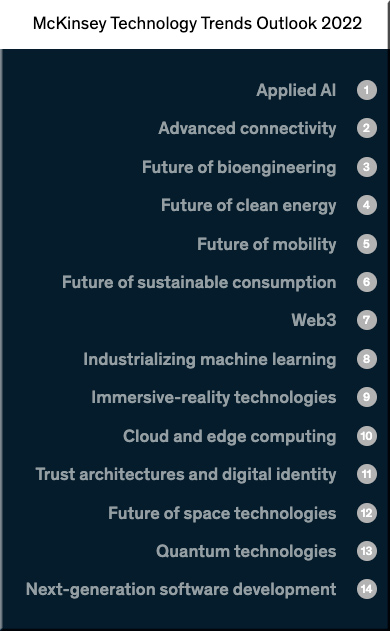
McKinsey Technology Trends Outlook 2022

Excerpt:

Which technology trends matter most for companies in 2022? New analysis by the McKinsey Technology Council highlights the development, possible uses, and industry effects of advanced technologies.

McKinsey Technology Trends Outlook 2022


#ILTACON22 Day One Roundup: News from DISCO, Docket Alarm, LexFusion, Relativity and Reveal — from legaltechmonitor.com by Bob Ambrogi

Excerpt:

[8/22/22] kicks off the first full day of ILTACON22, the annual conference of the International Legal Technology Association. Already, the day has brought a slew of news announcements from legal technology companies.

Here is a roundup of news announced this morning.

 
© 2025 | Daniel Christian