This Uncensored AI Art Tool Can Generate Fantasies—and Nightmares — from wired.com by Will Knight
Open source project Stable Diffusion allows anyone to conjure images with algorithms, but some fear it will be used to create unethical horrors.

Excerpt:

Image generators like Stable Diffusion can create what look like real photographs or hand-crafted illustrations depicting just about anything a person can imagine. This is possible thanks to algorithms that learn to associate the properties of a vast collection of images taken from the web and image databases with their associated text labels. Algorithms learn to render new images to match a text prompt in a process that involves adding and removing random noise to an image.

Also relevant/see:

There’s a text-to-image AI art app for Mac now—and it will change everything — from fastcompany.com by Jesus Diaz
Diffusion Bee harnesses the power of the open source text-to-image AI Stable Diffusion, turning it into a one-click Mac App. Brace yourself for a new creativity Big Bang.


Speaking of AI, also see:


Online Learning Pioneer Acquires Leading Training Provider for the Early Childhood Education Workforce — from prnewswire.com by StraighterLine

Excerpt:

BALTIMORE and WASHINGTON, Sept. 20, 2022 /PRNewswire/ — StraighterLine, a creator of affordable, flexible and career-aligned postsecondary courses, today announced the acquisition of ChildCare Education Institute (CCEI), one of the largest online training providers for early childhood education professionals. The addition of the early childhood education learning platform, which served more than 87,000 teachers and staff across more than 6,200 childcare centers in 2021, reflects StraighterLine’s commitment to expanding access to training that closes persistent talent gaps and creates pathways to economic mobility.

“There is an urgent need for qualified early care and education workers across the nation,” said Maria Taylor, president of CCEI. “This acquisition is about building more lifelong learning opportunities that give passionate individuals flexible pathways to careers. We are excited to join the StraighterLine family and further expand the potential entry points into this meaningful profession.”


Top 5 Developments in Web 3.0 We Will See in the Next Five Years — from intelligenthq.com

Excerpt:

Today, websites have turned highly engaging, and the internet is full of exciting experiences. Yet, web 3.0 is coming with noteworthy trends and things to look out for.

Here are the top 5 developments in web 3.0 expected in the coming five years.
.


European telco giants collaborate on 5G-powered holographic videocalls — from inavateonthenet.net

Excerpt:

Some of Europe’s biggest telecoms operators have joined forces for a pilot project that aims to make holographic calls as simple and straightforward as a phone call.

Deutsche Telekom, Orange, Telefónica and Vodafone are working with holographic presence company Matsuko to develop an easy-to-use platform for immersive 3D experiences that could transform communications and the virtual events market

Advances in connectivity, thanks to 5G and edge computing technology, allow smooth and natural movement of holograms and make the possibility of easy-to-access holographic calls a reality.
.

Top XR Vendors Majoring in Education for 2022 — from xrtoday.com

Excerpt:

Few things are more important than delivering the right education to individuals around the globe. Whether enlightening a new generation of young students, or empowering professionals in a complex business environment, learning is the key to building a better future.

In recent years, we’ve discovered just how powerful technology can be in delivering information to those who need it most. The cloud has paved the way for a new era of collaborative remote learning, while AI tools and automated systems are assisting educators in their tasks. XR has the potential to be one of the most disruptive new technologies in the educational space.

With Extended Reality technology, training professionals can deliver incredible experiences to students all over the globe, without the risks or resource requirements of traditional education. Today, we’re looking at just some of the major vendors leading the way to a future of immersive learning.


New Directory of Innovative School Models Aims to Encourage Experimentation — from edsurge.com by Daniel Mollenkamp

Excerpt:

A new online library called the “Innovative Models Exchange,” unveiled Monday, hopes to give educators an easy place to quickly consider some possibilities. The exchange—developed by the nonprofit Transcend Education with funding from the Gates Foundation—allows schools to search through a database of “innovative” models that Transcend says are ready to be adopted by schools.

The nonprofit hopes that the database will shake up the education system.


Keynote Wrap-Up: NVIDIA CEO Unveils Next-Gen RTX GPUs, AI Workflows in the Cloud — from blogs.nvidia.com by Brian Caulfield
Kicking off GTC, Jensen Huang unveils advances in natural language understanding, the metaverse, gaming and AI technologies impacting industries from transportation and healthcare to finance and entertainment.

Excerpt (emphasis DSC):

New cloud services to support AI workflows and the launch of a new generation of GeForce RTX GPUs featured [on 9/20/22] in NVIDIA CEO Jensen Huang’s GTC keynote, which was packed with new systems, silicon, and software.

“Computing is advancing at incredible speeds, the engine propelling this rocket is accelerated computing, and its fuel is AI,” Huang said during a virtual presentation as he kicked off NVIDIA GTC.

Again and again, Huang connected new technologies to new products to new opportunities – from harnessing AI to delight gamers with never-before-seen graphics to building virtual proving grounds where the world’s biggest companies can refine their products.

Driving the deluge of new ideas, new products and new applications: a singular vision of accelerated computing unlocking advances in AI, which, in turn will touch industries around the world.

Also relevant/see:


Legal technology trends – insights from 751 legal professionals — from wolterskluwer.com
Future Ready Lawyer Survey: new and improved legal technology capabilities are driving greater resilience, improved client relations and higher performance for many organizations in the industry across Europe and the U.S. 63% of technology leading law firms report their profitability increased over the past year – more than any other firms.

Excerpt:

Legal technology report

The 2022 Survey identified industry trends across Europe and the U.S. that show:

  • The increasing importance of technology is escalating across law firms and corporate legal departments;
  • Technology is a critical factor to legal departments in firm selection and retention; and
  • The greater use of technology is among the leading changes expected in both legal departments and law firms.

The need for technology as a key driver of improved performance, efficiency and productivity is undisputed. Yet organizations struggle to optimize their use of technology, signaling improvements are still needed in change management and training on new tools.

Also relevant/see:

Legal trends report – the top 5 trends expected to impact most legal organizations — from wolterskluwer.com

Excerpt:

Challenges include complexity of compliance requirements, higher performance expectations, growing talent tensions and the escalated demand of emerging areas such as Environmental, Social and Governance (ESG).

Also relevant/see:

Why Successful Law Firms Choose Legal Technology — from natlawreview.com

Excerpt:

What it takes to manage a successful law firm has shifted. A firm’s accolades and long-standing tradition are now just a drop in the bucket for prospective clients.

While some law firms still aren’t sold on the use of legal technology, the top-performing firms today embrace legal technology by aligning their business operations with the digital processes that influence their clients’ daily lives. By implementing modern processes these firms experience predictable cash flow, increased visibility, improved productivity, and increased client satisfaction, to name a few.


Five Impossible Figure Illusions — from theawesomer.com

Speaking of creativity, check these other ones out as well!

Everyday Objects and Buildings Float Atmospherically in Cinta Vidal’s Perception-Bending Murals — from by Kate Mothes and Cinta Vidal

“Public Space” (August 2022) in Toftlund, Denmark, curated by Kunstbureau Kolossal. All images © Cinta Vidal


Artist Spotlight: Arthur Maslard a.k.a. Ratur — from booooooom.com


Bring Real-Time 3D Into the Classroom, and Teach for the Future — from edsurge.com by Melissa Oldrin and Davis Hepnar

Excerpt:

Real-time 3D (RT3D) is redefining interactive content. No longer confined to the realm of video games, this technology now plays key roles in industries as wide-ranging as architecture, medicine, automotive, aerospace and film.

Demand is growing rapidly for developers, programmers and artists skilled in working with Unity—the leading platform for creating and operating real-time 3D content. As use cases expand, and the much-discussed metaverse takes shape, educators today have an opportunity to prepare their students for the technology careers of tomorrow.

Real-time 3D is a technology that creates three-dimensional models, environments and complete virtual worlds that can be rendered instantly. This content goes far beyond traditional formats like film, television and print because it isn’t static; it’s both immersive and interactive. And it offers incredibly lifelike graphics while giving users precise, immediate control over their experience. In doing so, RT3D creates endless possibilities for media production and engagement.


What 4 Atypical Shocks Are Coming in Education? — from techlearning.com by Susan Gentz
Preparing for a potential wild ride in education over the next few years

Excerpt:

What are the 4 Atypical Shocks on the Horizon?
None of these atypical shocks should come to a surprise to anyone who understands how the market works. The team at Edunomics Lab did an excellent job succinctly predicting what these shocks will be (the extent of each shock will be unknown for some time):

* Federal funding will end: Fiscal Cliff (September 2024)
* Enrollment is declining
* Inflation and labor
* Economic slowdown (recession)

Also relevant/see:

Attendance rates drop 4% in Michigan schools compared to pre-pandemic numbers — from mlive.com

Excerpt:

As Michigan schools continue to rectify the effects the COVID-19 pandemic had on students, the Michigan Department of Education (MDE) recently announced that attendance rates have also taken a hit when compared to pre-pandemic levels.

School attendance for Michigan’s approximately 1.4 million K-12 students dropped to under 89% in the 2021-22 school year, down from 93% in the 2019-20 school year when the pandemic began.

‘Wake-up Calls’: New Parent Survey Shows 9% Enrollment Drop in District Schools — from the74million.org by Linda Jacobson
Experts urge treating the results with caution, but several of the nation’s largest districts are already reporting huge losses

Excerpt:

“These are wakeup calls,” said Jenn Bell-Ellwanger, CEO of the Data Quality Campaign. “Is there something bigger happening here that we need to understand?”

The results, she said, should prompt district leaders to “interrogate” their own enrollment data, especially at key transition points like kindergarten and middle school. If families aren’t coming back, she said, officials should ask why.


Moving from program effectiveness to organizational implications — from chieflearningofficer.com by Rachel Walter

Excerpt:

To summarize, begin by ensuring that you are able to add business value. Do this by designing solutions specific to the known business problem to achieve relevance through adding value. Build credibility through these successes and expand your network and business acumen. Use the expanding business knowledge to begin gathering information about leading and lagging indicators of business success. Build some hypotheses and start determining where to find data related to your hypotheses.

More than looking at data points, look for trends across the data and communicate these trends to build upon them. It’s critical to talk about your findings and communicate what you are seeing. By continuing to drive business value, you can help others stop looking at data that does not truly matter in favor of data that directly affects the organization’s goals.

Also, from the corporate learning ecosystem:

Creating Better Video For Learning, Part 1 — from elearningindustry.com by Patti Shank

Summary: 

This is the first article in a series about what evidence (research) says about creating better video for learning. It discusses the attributes of media and technologies for digital or blended instruction, selecting content and social interactions, and the strengths and challenges of video.


Boosting High School Students’ Sense of Agency and Motivation — from edutopia.org by Mary Davenport
Providing students with greater voice and choice in the classroom can build their desire to learn and do well academically.

Excerpt:

This year, instead of repeating essay after essay, we included project-based, performative, and creative assessments. The variety allowed for every student to shine at some point in a way unique to themselves.

More than anything, creating opportunities for autonomy has necessitated a shift in my perspective. Our field likes to talk about everything standards-based, but there are dangers to that: When the standard becomes more important than the student in front of us, we have lost the true meaning of education.

I offer students choice by giving them options regarding

    • learning content (which texts to read, videos to watch, podcasts to listen to);
    • communication and processing (written, verbal, or visual);
    • assessments (choosing topics, choosing texts, choosing supports, choosing structures); and
    • work time (independent, collaborative, location).

Learners need: More voice. More choice. More control. -- this image was created by Daniel Christian


Microschools: What Are They, What Do They Cost and Who’s Interested? — from edchoice.org by Ed Tarnowski

Excerpt:

Microschools are gaining steam.

Microschools, sometimes referred to as learning pods, is the reimagining of the one-room schoolhouse, where class sizes are usually fewer than 15 students of varying ages, and the schedule and curriculum is tailored to fit the needs of each class. This model of schooling can operate in either public, private or charter schools or separately on its own. Many describe microschools as a “mid-point” between traditional schooling and homeschooling. Most microschools are independently parent-led, but some are affiliated with a formal microschool network offering paid, in-person instructors. Lessons are taught in a range of approachable environments, such as homes, libraries and other community centers.


Course Awareness in HyFlex: Managing unequal participation numbers — from hyflexlearning.org by Candice Freeman

Excerpt:

How do you teach a HyFlex course when the number of students in various participation modes is very unequal? How do you teach one student in a mode – often in the classroom? Conversely, you could ask how do you teach 50 asynchronous students with very few in the synchronous mode(s)? Answers will vary greatly depending from teacher to teacher. This article suggests a strategy called Course Awareness, a mindfulness technique designed to help teachers envision each learner as being in the instructor’s presence and engaged in the instruction regardless of participation (or attendance) mode choice.
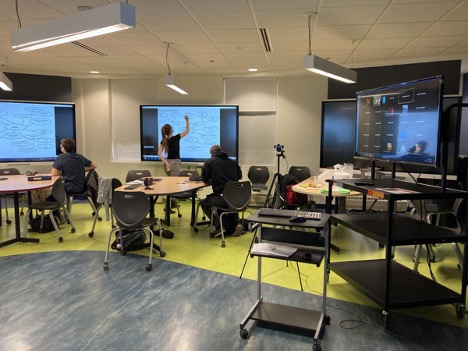
Teaching HyFlex in an active learning classroom

From DSC:
I had understood the hyflex teaching model as addressing both online-based (i.e., virtual/not on-site) and on-site/physically-present students at the same time — and that each student could choose the manner in which they wanted to attend that day’s class. For example, on one day, a student could take the course in room 123 of Anderson Hall. The next time the class meets, that same student could attend from their dorm room.

But this article introduces — at least to me — the idea that we have a third method of participating in the hyflex model — asynchronously (i.e., not at the same time). So rather than making their way to Anderson Hall or attending from their dorm, that same student does not attend at the same time as other students (either virtually or physically). That student will likely check in with a variety of tools to catch up with — and contribute to — the discussions. As the article mentions:

Strategically, you need to employ web-based resources designed to gather real-time information over a specified period of time, capturing all students and not just students engaging live. For example, Mentimeter, PollEverywhere, and Sli.do allow the instructor to pose engaging, interactive questions without limiting engagement time to the instance the question is initially posed. These tools are designed to support both synchronous and asynchronous participation. 

So it will be interesting to see how our learning ecosystems morph in this area. Will there be other new affordances, pedagogies, and tools that take into consideration that the faculty members are addressing synchronous and asynchronous students as well as online and physically present students? Hmmm…more experimentation is needed here, as well as more:

  • Research
  • Instructional design
  • Design thinking
  • Feedback from students and faculty members

Will this type of model work best in the higher education learning ecosystem but not the K-12 learning ecosystem? Will it thrive with employees within the corporate realm? Hmmm…again, time will tell.


And to add another layer to the teaching and learning onion, now let’s talk about multimodal learning. This article, How to support multimodal learningby Monica Burns, mentions that:

Multimodal learning is a teaching concept where using different senses simultaneously helps students interact with content at a deeper level. In the same way we learn through multiple types of media in our own journey as lifelong learners, students can benefit from this type of learning experience.

The only comment I have here is that if you think that throwing a warm body into a K12 classroom fixes the problem of teachers leaving the field, you haven’t a clue how complex this teaching and learning onion is. Good luck to all of those people who are being thrown into the deep end — and essentially being told to sink or swim.


Why Some Teachers Don’t Want to Go ‘Back to Normal’ — from edsurge.com by Daniel Lempres

Excerpts:

“My school did not drive me out of education. My students did not drive me out of education,” Aion says. Instead, he says he left because the lack of support and the deep systemic flaws in education had finally become too much. Aion says he was tired of pretending things were back to their pre-pandemic “normal,” and tired of pretending that “normal” had been working for students in the first place.

For educators like Aion and Bowyer, the expectation that public education would “return to normal” is one of the factors that pushed them out of the profession.

Her students were excited for her, and enthusiastically asked about what she would do instead of teaching them math. “I started crying in the middle of class,” Bowyer says. “And I said, ‘I don’t know, I don’t actually want to leave, I want to be here and I want to do this. But I don’t think I can anymore.’”


Paying for Outcomes [fs.blog]

Paying for Outcomes — from fs.blog; with thanks to Roberto Ferraro for this resource

Excerpt:

A lot of clients like to buy process. It’s like they think they are not getting their money’s worth because I solved it too fast.

[…]

How can it be that you talk to someone and it’s done in a second? But it IS done in a second — it’s done in a second and 34 years. It’s done in a second and every experience, and every movie, and everything in my life that’s in my head.


© 2025 | Daniel Christian