Nikolas Badminton – Elevate Festival 2022 Keynote — futurist.com by Nikolas Badminton

Excerpts/words/phrases:

  • Shifting from “What is?” to “What if? (i.e., paradigm shifts)
  • Megatrends
  • Potential futures
  • Signals of change
  • Scenarios
  • Trajectories
  • Think about the good as well as the bad
  • Telling stories
  • Black swans/elephants
  • Making your organization more profitable and resilient


Tearing the ‘paper ceiling’: McKinsey supports effort driving upward mobility for millions of workers — from mckinsey.com

Excerpt:

September 23, 2022There’s a hidden talent pool that most employers overlook—the more than 70 million workers in the US who are STARs, or workers ‘skilled through alternative routes.’ Whether through community college, workforce training, bootcamp or certificate programs, military service, or on-the-job learning, STARs have the skills for higher-wage jobs but often find themselves blocked from consideration.

This week, nonprofit Opportunity@Work and the Ad Council have launched a nationwide campaign to ‘Tear the Paper Ceiling’ and encourage employers to change hiring practices. McKinsey is providing pro bono support to the effort through data and analytics tools that enable recruiters to recognize STARs and their skills.

“While companies scramble to find talent amid a perceived skills gap, many of their job postings have needlessly excluded half of the workers in the country who have the skills for higher-wage work,” says Byron Auguste, founder of Opportunity@Work and a former senior partner at McKinsey. “Companies like the ones we’re proud to call partners in this effort—and those we hope will join—can lead the way by tapping into skilled talent from a far wider range of backgrounds.”

There are lots of reasons why someone might not begin or complete a degree that have nothing to do with their intrinsic abilities or potential. We know there are better ways to screen for talent and now we have the research and tools to back that up.

Carolyn Pierce, McKinsey partner

Also from McKinsey, see:

Latest McKinsey tech outlook identifies 14 key trends for business leaders

Excerpt:

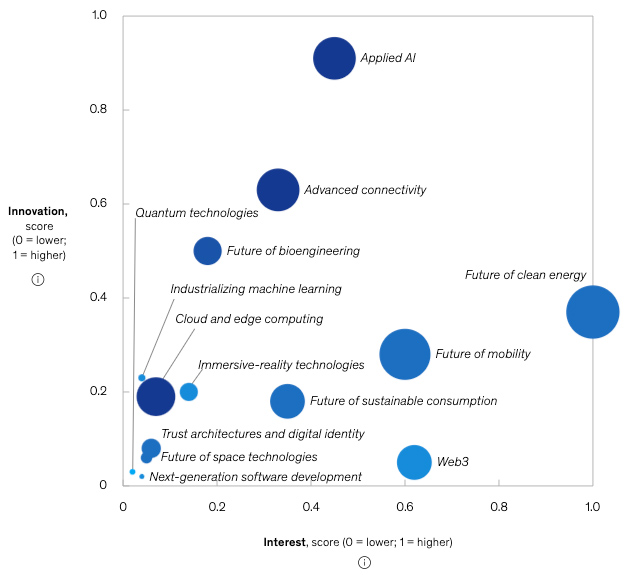
October 4, 2022 The McKinsey Technology Council—a global group of over 100 scientists, entrepreneurs, researchers, and business leaders—has published its second annual Technology Trends Outlook. By assessing metrics of innovation, interest, investment, and adoption, the council has prioritized and synthesized 40 technologies into 14 leading trends.

Following on from last year, applied AI once again earned the highest score for innovation in the report. Sustainability, meanwhile, emerged as a major catalyst for tech around the world, with clean energy and sustainable consumption drawing the highest investment from private-equity and venture-capital firms. And five new trends were added to this year’s edition: industrializing machine learning, Web3, immersive-reality technologies, the future of mobility, and the future of space.

In this post, McKinsey senior partner Lareina Yee, expert partner Roger Roberts, and McKinsey Global Institute partner Michael Chui share their thoughts about what the findings may mean for leaders over the next few years.
 

Radar Trends to Watch: October 2022 — from oreilly.com by Mike Loukides
Developments in Machine Learning, Metaverse, Web3, and More

Excerpt:

September was a busy month. In addition to continued fascination over art generation with DALL-E and friends, and the questions they pose for intellectual property, we see interesting things happening with machine learning for low-powered processors: using attention, mechanisms, along with a new microcontroller that can run for a week on a single AA battery. In other parts of the technical universe, “platform engineering” has been proposed as an alternative to both DevOps and SRE. We’ve seen demonstrations of SQL injection-like attacks against GPT-3; and companies including Starbucks, Chipotle, and Universal Studios are offering NFT-based loyalty programs. (In addition to a Chipotle’s steak grilling demo in the Metaverse.)

Also relevant/see:

General AI News — from essentials.news


Disabled Americans Reap Remote-Work Reward in Record Employment — from bloomberg.com by Molly Smith
Adults with disabilities have rarely been employed in such high numbers

Excerpt:

Anardi is part of the second-largest minority group in the US — adults with disabilities. The 42.5 million disabled Americans make up 13% of the civilian population, compared with the nearly 19% that is Hispanic and the almost 12% that’s African American, according to 2021 Census data released on Sept. 15. After suffering some of the worst job losses during the initial phase of the pandemic, people with disabilities are now benefiting from the remote-work trend it triggered. Advocates hope they will continue to reap such rewards, even as companies demand that employees return to the office.


8 Ways to Use QR Codes in Higher Education Classrooms — from er.educause.edu by Tolulope (Tolu) Noah

Excerpt:

QR codes open up a world of possibility in the higher education setting. They provide a quick and easy way for students to access instructional materials, and they complement the design of more interactive and engaging learning experiences.

From DSC:
QR codes can bridge the physical world with the digital world — which is something about to take an exponential leap as more AR and MR-based hardware and software solutions hit the marketplace in the near future.


Utah’s reforms offer model for serving low-income and indigent people, report suggests — from abajournal.com by Matt Reynolds

Excerpt:

The Utah model of reform allowing nonlawyers to offer legal services could be “critical” to serving people who can’t afford them, according to a Stanford Law School study published Tuesday.

The 59-page report by the school’s Deborah L. Rhode Center on the Legal Profession offers an early look at how regulatory changes in Arizona and Utah have impacted the delivery of legal services. It also examined who is being served by innovations in those states.


Also relevant, see this upcoming webinar:

Upcoming webinar -- licensing legal paraprofessionals

Two neighboring states — Oregon and California — have recently come to different conclusions on whether to license paralegals to provide some legal services.

In July, the Oregon Supreme Court, with the support of the Oregon State Bar’s Board of Governors, approved a proposal to allow licensed paralegals to provide limited legal services in family law and landlord/tenant cases — two areas of law with large numbers of self-represented litigants. In August, the California legislature, after opposition from some lawyers’ groups, prohibited the State Bar of California from implementing, or even proposing, any loosening of existing restrictions on the unauthorized practice of law before 2025, effectively killing a proposal to permit licensing of paraprofessionals to provide limited legal services.

This webinar will explore how and why Oregon and California reached conflicting results and identify lessons learned from both experiences.

Register >>


Also relevant/see:

IAALS Panel Explores Alternative Paths to Legal Licensure — from iaals.du.edu

Redesigning Legal: Redesigning How We License New Lawyers from IAALS on Vimeo.


Also see the following items from Natalie Anne Knowlton (@natalalleycat) on Twitter


A $500 Million International Project Will Create the Most Detailed Map of the Brain Ever — from singularityhub.com by Edd Gent

Excerpt:

That’s why the National Institutes of Health’s BRAIN Initiative has just announced $500 million in funding over five years for an effort to characterize and map neuronal and other types of cells across the entire human brain. The project will be spearheaded by the Allen Institute in Seattle, but involves collaborations across 17 other institutions in the US, Europe, and Japan.

“These awards will enable researchers to explore the multifaceted characteristics of the more than 200 billion neurons and non-neuronal cells in the human brain at unprecedented detail and scale,” John Ngai, director of the NIH BRAIN Initiative, said in a statement.

From DSC:
The LORD does awesome work. I wonder how many of these scientists and researchers will become believers while doing this project.

Proverbs 27:1

I praise you because I am fearfully and wonderfully made; your works are wonderful, I know that full well.


OpenAI Says DALL-E Is Generating Over 2 Million Images a Day—and That’s Just Table Stakes — from singularityhub.com by Jason Dorrier

Excerpt:

The venerable stock image site, Getty, boasts a catalog of 80 million images. Shutterstock, a rival of Getty, offers 415 million images. It took a few decades to build up these prodigious libraries.

Now, it seems we’ll have to redefine prodigious. In a blog post last week, OpenAI said its machine learning algorithm, DALL-E 2, is generating over two million images a day. At that pace, its output would equal Getty and Shutterstock combined in eight months. The algorithm is producing almost as many images daily as the entire collection of free image site Unsplash.

And that was before OpenAI opened DALL-E 2 to everyone.


From DSC:
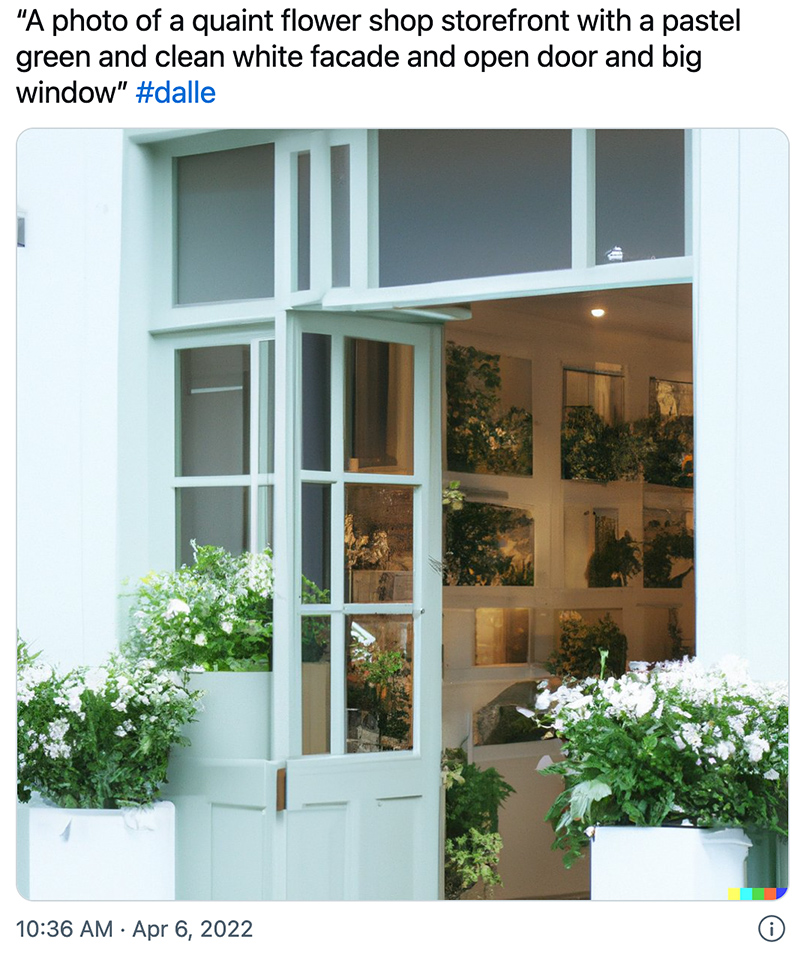
Further on down that Tweet is this example image — wow!
.

A photo of a quaint flower shop storefront with a pastel green and clean white facade and open door and big window

.


On the video side of things, also relevant/see:

Meta’s new text-to-video AI generator is like DALL-E for video — from theverge.com by James Vincent
Just type a description and the AI generates matching footage

A sample video generated by Meta’s new AI text-to-video model, Make-A-Video. The text prompt used to create the video was “a teddy bear painting a portrait.” Image: Meta


From DSC:
Hmmm…I wonder…how might these emerging technologies impact copyrights, intellectual property, and/or other types of legal matters and areas?


More adults, low-income students enroll when community colleges offer bachelor’s degrees, study suggests — from highereddive.com by Natalie Schwartz

Dive Brief:

  • Community colleges that begin offering bachelor’s degrees see enrollment increases, including among low-income students and those who are age 25 and older, according to new research published in Community College Review, a peer-reviewed journal.
  • However, the research is inconclusive on whether community college baccalaureate degrees increase enrollment of students of underrepresented races, which include those who are African American, Hispanic, Native American and multiracial.
  • Opponents of community colleges offering bachelor’s degrees often argue that these programs cause institutions to drift away from their missions of serving underrepresented students. But the new research suggests that the programs actually reinforce community colleges’ commitments to certain disadvantaged student populations.
 

5 college recruiting lessons from a mom and a marketer — from highereddive.com by Denise Lamphier
The executive director of communications and marketing at Central College, in Iowa, shares what she learned from her own child’s college search.

Excerpt:

Just after that first piece arrived, I proposed the idea to E.J. to collaborate on a four-year project together, reviewing admission materials. As part of the project, he wrote some journal entries about the mailings. Then I took the pieces to my office at Central and taped them on the wall. This allowed my team to see the four-year progression of materials that a high school student receives from colleges. E.J. also offered me access to his school email account so I could read all the college emails he amassed.

The following statistics reflect his recruitment experience in a numbers nutshell:

One student. Four years. Ninety different colleges and universities. A total of 5,228 emails. Four military recruitment brochures, 23 handwritten notes, 302 postcards, and 162 viewbooks and pamphlets mailed alone. That’s in addition to 130 letters, often including viewbooks, applications or other materials. And we mustn’t forget one yellow flying disc mailed as an irregular parcel.

All to elicit one decision.


Addendum on 10/10/22:

  • 4 more insights from a mom and a marketer — from highereddive.com by Denise Lamphier
    The executive director of communications and marketing at Central College, in Iowa, shares more of what she learned from her child’s college search.


The Key To Becoming A Lifelong Learner, With Amrit Ahluwalia Editor In Chief At The EvoLLLution Episode 79 — from thefutureofwork.libsyn.com

From Pasadena City College:
We are leading the conversation of how to begin closing the gap between what our students are learning and what the demands of the workforce will be once they enter. Listen Now.


Our Teachers Are Leaving — What Now? — from medium.com by Amanda Beaudoin
A look at the problem and potential solutions

Excerpt:

As a result, teacher shortages have persisted. After the start of the COVID-19 pandemic, the shortage became larger and more urgent. Now, nearly half of public schools across all 50 states report teaching vacancies, up from 30% pre-pandemic and over half of educators are thinking of leaving the profession earlier than they had planned. The vacancies include educators across ages, years in the profession, and roles within schools. Made worse, a disproportionate percent of Black (62%) and Latinx (59%) educators are looking to leave, a population already underrepresented in the field. Today’s shortages create a vicious circle; according to a National Education Association survey, 80% of educators report that unfilled job openings have led to more work obligations for the educators who remain and 90% of educators say they are experiencing burnout, perpetuating a cycle of overwhelm and attrition. Not only are teachers leaving and thinking of leaving in record numbers, but enrollment in education preparation programs at both the undergraduate and graduate level are declining.


Excerpt from this article from GSV Ventures

  • Multimodal — CoRise’s suite of learning modalities — synchronous instruction, asynchronous instruction, peer-to-peer learning, TA-supported learning, project-based learning — combined together deliver a unique and rich learning experience.

From DSC:
This nicely outlines another reason why I call this blog Learning Ecosystems — as there are many forms for learning and things are constantly changing/morphing.


Also from GSV Ventures:


Infographic -- 21st-Century Skills That Every Learner Needs

From DSC:
The Ultimate List of 21-Century Skills – 2022 that’s on that page lists fifty skills. Whew! That’s a lot of skills. I doubt anyone will have them all. But the posting/infographic has a lot of fodder for further reflection and growth.


Digital Learning Definitions — from wcet.wiche.edu

Excerpt:

Higher education uses many variations of terms to describe slightly different digital learning modalities,  such as: “in-person,” “online,” “hybrid,” “hyflex,” “synchronous,” “asynchronous,” and many more. These variations have long confused students, faculty, administrators, and the general public,

WCET has worked on this issue in the past, and continues to advocate for simple, easy to understand terms that can bring consistent agreement to the use of these phrases. The WCET Steering Committee has made it a priority to attack this issue.

In 2022, WCET sponsored and led a partnership with Bay View Analytics and the Canadian Digital Learning Research Association to conduct a survey to explore the use of the terms by higher education professionals. The Online Learning Consortium (OLC), Quality Matters (QM), and the University Professional and Continuing Education Association (UPCEA) assisted with survey participation and promotion. The works published below highlight the findings of the study.

Also relevant/see:

 
© 2025 | Daniel Christian