Artist Spotlight: Shuyang Zhou

Artist Spotlight: Shuyang Zhou — from booooooom.com

An open door with reflection


10 Must Read Books for Learning Designers — from linkedin.com by Amit Garg

Excerpt:

From the 45+ #books that I’ve read in last 2 years here are my top 10 recommendations for #learningdesigners or anyone in #learninganddevelopment

Speaking of recommended books (but from a more technical perspective this time), also see:

10 must-read tech books for 2023 — from enterprisersproject.com by Katie Sanders (Editorial Team)
Get new thinking on the technologies of tomorrow – from AI to cloud and edge – and the related challenges for leaders
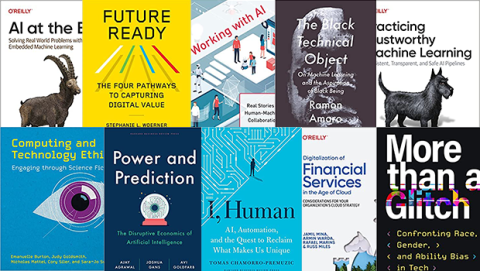
10 must-read tech books for 2023 -- from enterprisersproject.com by Katie Sanders


Empty Classrooms, Abandoned Kids: Inside America’s Great Teacher Resignation— from nytimes.com; video by Agnes Walton and Nic Pollock

Excerpt:

A survey of National Education Association members at the beginning of the year revealed an unsettling truth: More than half of the respondents said they were looking for a way out. That’s an astounding number of unhappy teachers. If they all quit, it would leave millions of students in the lurch.

But were these just empty threats? At the start of this school year, we spoke to over 50 educators in almost 20 states to find out. The picture they painted was far bleaker than we could have imagined: Empty classrooms, kids in crisis, and teachers who can’t survive another day on the job — that’s the reality of American education today.

And from the UK, see the following:
The word OUCH! comes to my mind here — for this item from the UK and from the above item from the US. The politicians are going to need to back off and let the teachers do their jobs. Or we may not have many people who want to go into teaching anymore. The current situation is not only bad for the teachers, it’s bad for the youth/students.


How the University of California Strike Could Reshape Higher Education — from news.yahoo.com by Katie Reilly

Excerpts:

“To have this many workers on strike is really something new in higher education,” says Rebecca Givan, an associate professor of labor studies at Rutgers, who is also president of the union for graduate workers and faculty at her university. “The willingness of these workers to bring their campuses to a standstill is demonstrating that the current model of higher education can’t continue, and that the current system really rests on extremely underpaid labor.”

The striking workers argue that their current pay makes it challenging to afford housing near their universities, in a state with one of the highest costs of living in the country. Jaime, the Ph.D. candidate, says he makes $27,000 per year as a teaching fellow and pays $1,200 in monthly rent for an apartment he shares with two roommates. (Median rent in the Los Angeles metropolitan area is about $3,000, according to Realtor.com.) “We are the ones who do the majority of teaching and research,” he says. “But nevertheless, the university doesn’t pay us enough to live where we work.”

Also relevant/see:

Hundreds of UC Faculty Members Stop Teaching as Strike Continues — from chronicle.com by  Grace Mayer

Excerpt:

The strike is shining a spotlight on a longstanding problem within higher education: Today, tenured, full-time faculty members make up a smaller percentage of university employees than they did 50 years ago, in part due to the financial pressures facing universities amid funding cuts. The proportion of other university employees, who receive less job security and lower pay, “has grown tremendously,” says Tim Cain, an associate professor at the University of Georgia’s Institute of Higher Education, who studies campus activism and unionization.

“There’s such stratification between the tenured full professor and a graduate student employee or a postdoc or a tutor,” says Cain. “They’re doing a great deal of the work, and the work that they’re doing in the classroom is often very similar to the work of others who are getting paid substantially more.”


Speaking of schools in California, also see:


A bot that watched 70,000 hours of Minecraft could unlock AI’s next big thing — from technologyreview.com by Will Douglas Heaven
Online videos are a vast and untapped source of training data—and OpenAI says it has a new way to use it.

Excerpt:

OpenAI has built the best Minecraft-playing bot yet by making it watch 70,000 hours of video of people playing the popular computer game. It showcases a powerful new technique that could be used to train machines to carry out a wide range of tasks by binging on sites like YouTube, a vast and untapped source of training data.

The Minecraft AI learned to perform complicated sequences of keyboard and mouse clicks to complete tasks in the game, such as chopping down trees and crafting tools. It’s the first bot that can craft so-called diamond tools, a task that typically takes good human players 20 minutes of high-speed clicking—or around 24,000 actions.

The result is a breakthrough for a technique known as imitation learning, in which neural networks are trained to perform tasks by watching humans do them.

The team’s approach, called Video Pre-Training (VPT), gets around the bottleneck in imitation learning by training another neural network to label videos automatically.

Speak lands investment from OpenAI to expand its language learning platform — from techcrunch.com by Kyle Wiggers

Excerpts:

“Most language learning software can help with the beginning part of learning basic vocabulary and grammar, but gaining any degree of fluency requires speaking out loud in an interactive environment,” Zwick told TechCrunch in an email interview. “To date, the only way people can get that sort of practice is through human tutors, which can also be expensive, difficult and intimidating.”

Speak’s solution is a collection of interactive speaking experiences that allow learners to practice conversing in English. Through the platform, users can hold open-ended conversations with an “AI tutor” on a range of topics while receiving feedback on their pronunciation, grammar and vocabulary.

It’s one of the top education apps in Korea on the iOS App Store, with over 15 million lessons started annually, 100,000 active subscribers and “double-digit million” annual recurring revenue.


Is AI Generated Art Really Coming for Your Job? — from edugeekjournal.com by Matt Crosslin

Excerpt:

So, is this a cool development that will become a fun tool for many of us to play around with in the future? Sure. Will people use this in their work? Possibly. Will it disrupt artists across the board? Unlikely. There might be a few places where really generic artwork is the norm and the people that were paid very little to crank them out will be paid very little to input prompts. Look, PhotoShop and asset libraries made creating company logos very, very easy a long time ago. But people still don’t want to take the 30 minutes it takes to put one together, because thinking through all the options is not their thing. You still have to think through those options to enter an AI prompt. And people just want to leave that part to the artists. The same thing was true about the printing press. Hundreds of years of innovation has taught us that the hard part of the creation of art is the human coming up with the ideas, not the tools that create the art.

A quick comment from DSC:
Possibly, at least in some cases. But I’ve seen enough home-grown, poorly-designed graphics and logos to make me wonder if that will be the case.


How to Teach With Deep Fake Technology — from techlearning.com by Erik Ofgang
Despite the scary headlines, deep fake technology can be a powerful teaching tool

Excerpt:

The very concept of teaching with deep fake technology may be unsettling to some. After all, deep fake technology, which utilizes AI and machine learning and can alter videos and animate photographs in a manner that appears realistic, has frequently been covered in a negative light. The technology can be used to violate privacy and create fake videos of real people.

However, while these potential abuses of the technology are real and concerning that doesn’t mean we should turn a blind eye to the technology’s potential when using it responsibly, says Jaime Donally, a well-known immersive learning expert.

From DSC:
I’m still not sure about this one…but I’ll try to be open to the possibilities here.


Educators Are Taking Action in AI Education to Make Future-Ready Communities — from edsurge.com by Annie Ning

Excerpt:

AI Explorations and Their Practical Use in School Environments is an ISTE initiative funded by General Motors. The program provides professional learning opportunities for educators, with the goal of preparing all students for careers with AI.

Recently, we spoke with three more participants of the AI Explorations program to learn about its ongoing impact in K-12 classrooms. Here, they share how the program is helping their districts implement AI curriculum with an eye toward equity in the classroom.


Stealth Legal AI Startup Harvey Raises $5M in Round Led By OpenAI — from lawnext.com by Bob Ambrogi

Excerpt (emphasis DSC):

A hitherto stealth legal AI startup emerged from the shadows today with news via TechCrunch that it has raised $5 million in funding led by the startup fund of OpenAI, the company that developed advanced neural network AI systems such as GPT-3 and DALL-E 2.

The startup, called Harvey, will build on the GPT-3 technology to enable lawyers to create legal documents or perform legal research by providing simple instructions using natural language.

The company was founded by Winston Weinberg, formerly an associate at law firm O’Melveny & Myers, and Gabriel Pereyra, formerly a research scientist at DeepMind and most recently a machine learning engineer at Meta AI.


The Justice Gap: The Unmet Civil Legal Needs of Low-income Americans — from the Legal Services Corporation

Legal Services Corporation’s 2022 Justice Gap Report provides a comprehensive look at the differences between the civil legal needs of low-income Americans and the resources available to meet those needs. LSC’s study found that low-income Americans do not get the help they need for 92% of their civil legal problems, even though 74% of low-income households face at least one civil legal issue in a single year.

The consequences that result from a lack of appropriate counsel can be life-altering – low-income Americans facing civil legal problems can lose their homes, children and healthcare, among other things. Help can be hard to access, so LSC is working to bridge this “justice gap” by providing pro bono civil legal aid for those in need. Find out more about LSC’s work to ensure equal justice for all by tuning in to the rest of the Justice Gap video series.

For more information on the Justice Gap, visit https://justicegap.lsc.gov/.

Also relevant/see:

.
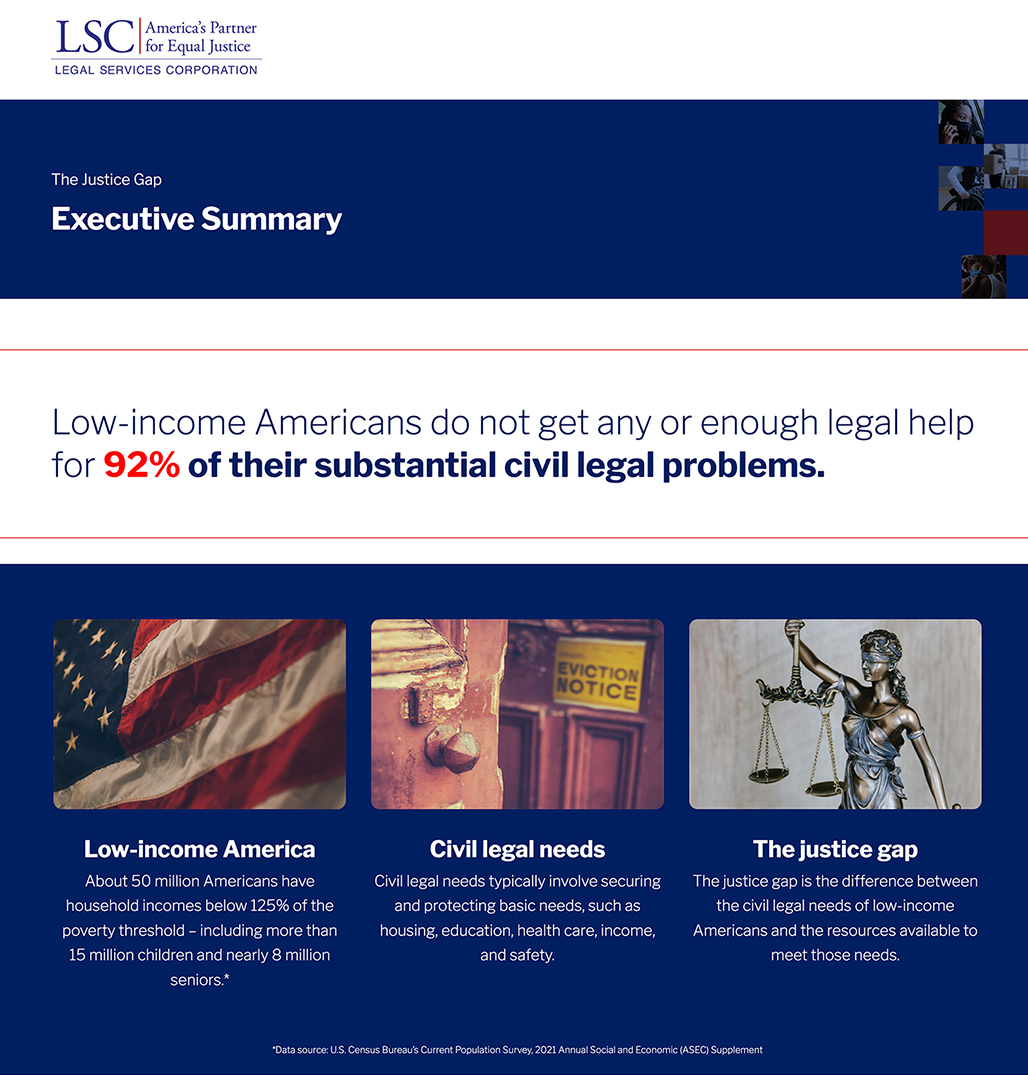
Legal Services Corporation’s 2022 Justice Gap Report provides a comprehensive look at the differences between the civil legal needs of low-income Americans and the resources available to meet those needs.


Principals Give Thanks—and Shoutouts—to School Support Staff — from edweek.org by Denisa R. Superville

Excerpt:

Schools run, in part, on the elbow grease of custodians, the gentle nudge of a crossing guard, and the encouraging smile of a paraprofessional and teacher’s assistant silently indicating to a student that, “Yes, you’ve got this.”


This Copyright Lawsuit Could Shape the Future of Generative AI — from wired.com by Will Knight
Algorithms that create art, text, and code are spreading fast—but legal challenges could throw a wrench in the works.

Excerpts:

A class-action lawsuit filed in a federal court in California this month takes aim at GitHub Copilot, a powerful tool that automatically writes working code when a programmer starts typing. The coder behind the suit argues that GitHub is infringing copyright because it does not provide attribution when Copilot reproduces open-source code covered by a license requiring it.

Programmers have, of course, always studied, learned from, and copied each other’s code. But not everyone is sure it is fair for AI to do the same, especially if AI can then churn out tons of valuable code itself, without respecting the source material’s license requirements. “As a technologist, I’m a huge fan of AI ,” Butterick says. “I’m looking forward to all the possibilities of these tools. But they have to be fair to everybody.”

Whatever the outcome of the Copilot case, Villa says it could shape the destiny of other areas of generative AI. If the outcome of the Copilot case hinges on how similar AI-generated code is to its training material, there could be implications for systems that reproduce images or music that matches the style of material in their training data. 

Also legal-related, see:


Also related to AI and art/creativity from Wired.com, see:


Learning in the brain — from sites.google.com by Efrat Furst; with thanks to 3-Star Learning Experiences for this resource

Excerpts:

Think of working memory as the reception counter to a huge archive.

To summarize, working memory processing resources are highly limited, and yet meaningful processing is essential for storage in long-term memory. It is therefore important to use these resources effectively when learning. There are many tested and proven effective teaching strategies, but a question that often comes up is when to apply each strategy for the best results?
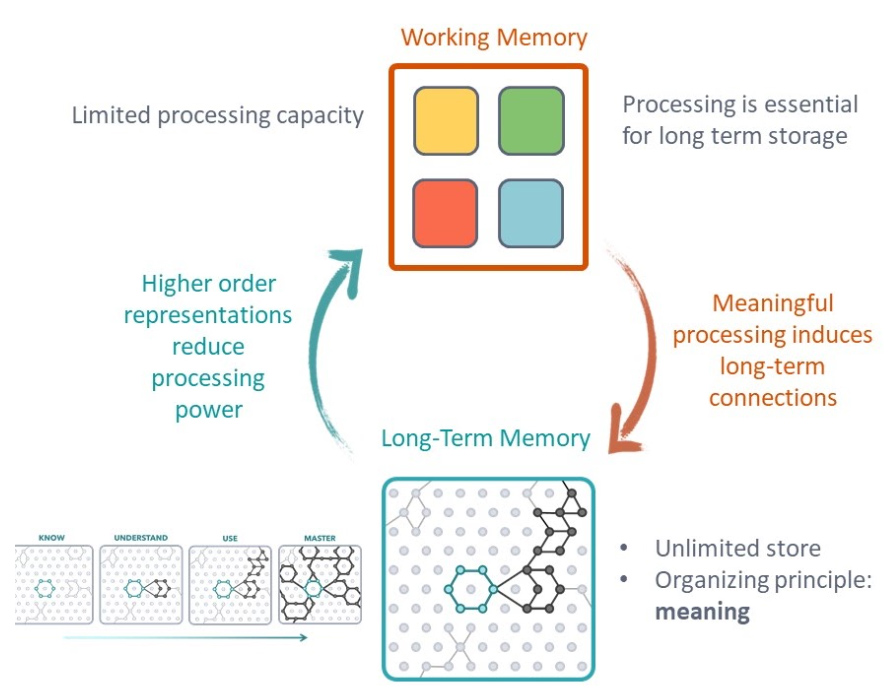
Long-term memory and working memory interactions


Table of Experts: Trends in Higher Education — from bizjournals.com by Holly Dolezalek. The Minneapolis-St. Paul Business Journal held a panel discussion recently about trends in higher education.

Excerpts (which focus on law schools/the legal profession):

Anthony Niedwiecki: The legal profession and legal education are very conservative. Covid showed they can, and we as institutions can, change. At Mitchell Hamline, we were the first law school in the country to offer a partially online JD degree. We’ve had that experience since 2015, which has really helped us through Covid. But I think the biggest thing I’ve learned from our students through this process is the need for flexibility. We thought students would want to go back into the classroom at some point and be around people. No! They voted by the classes they signed up for: They signed up for the classes that were online. Some students want to be on campus, some online. So we’ve had to develop our program around different types of modalities we may not have given any thought to before. The students in the online program range in age all the way up to 73 years old. They’ve been in careers, they’re accountants, they’re doctors, they’re health care professionals, elected officials. The other thing is office hours — students like online office hours because it’s convenient, and they can be in an office where other people are talking and learn from it.

 The lesson I take from that, in some ways, even applying it to the law school, is having that partnership with people who want to hire students to make sure that they’re actually involved with the students. We’re finding they help mentor those students, help us make sure we have the right courses in place, and give them opportunities to do internships and externships. So we’ve been starting to partner with some national professional organizations that are attached to the law.
 

Forget About Setting Goals. Focus on This Instead. — from jamesclear.com by James Clear; with thanks to Robert Talbert on LinkedIn for this resource.

Excerpt:

The goal in any sport is to finish with the best score, but it would be ridiculous to spend the whole game staring at the scoreboard. The only way to actually win is to get better each day. In the words of three-time Super Bowl winner Bill Walsh, “The score takes care of itself.” The same is true for other areas of life. If you want better results, then forget about setting goals. Focus on your system instead.

What do I mean by this? Are goals completely useless? Of course not. Goals are good for setting a direction, but systems are best for making progress. A handful of problems arise when you spend too much time thinking about your goals and not enough time designing your systems.

Also from Robert Talbert out on LinkedIn see:

Government’s $18.5 million microcredential pilot aims to inject workers into sectors suffering from talent shortages — from smartcompany.com.au by Melissa Coade

Excerpt:

Jason Clare has announced $18.5 million for a higher education initiative to inject new skills into the workforce using small courses.

The government will fund higher-education institutions to develop microcredentials targeting national priority areas, which include teaching, engineering, health, and technology.

The Education Minister said the pilot would parachute workers with particular skills into industries that were “crying out” for talent.


Psalm 100:4-5

Enter his gates with thanksgiving
    and his courts with praise;
    give thanks to him and praise his name.
For the Lord is good and his love endures forever;
    his faithfulness continues through all generations.

From DSC:
Thank you for you LORD!!! And thank you for your patience with me, and for your mercy, forgiveness, and love (which it has taken me a long time to realize/embrace). Thank you for being active (most likely, mind-blowingly so).

Thank you for your creativity. Thank you for my/our senses of sight, hearing, taste, smell, and touch — and for all that our bodies can do. We truly are fearfully and wonderfully made. Thank you for our minds and our hearts — may they be inclined towards doing right by you and by others.


To Combat Learning Loss, Schools Need to Overhaul the Industrial-Age Paradigm — from educationnext.org by Frederick Hess
The decline in academic gains may be steeper, but it’s not a new phenomenon

Excerpt:

Why did movements over the last two decades to raise standards, improve educator quality, upgrade curriculum, enable choice, leverage assessment, instill accountability, and increase funding appear to have such a limited impact on college and career readiness?

One potential answer: Nearly all of these reforms left the basic tenets of the industrial-paradigm classroom intact.

The above article links to:

Out of the Box -- How Innovative Learning Models Can Transform K-12 Education

It’s Time to Rethink the ‘One Teacher, One Classroom’ Model — from edweek.org by Irene Chen & Stephanie Banchero
How to build a happier and more effective teaching force

Excerpt:

The last few years have taken a toll on our teachers. The COVID-19 pandemic, ongoing cultural divisions, and the Uvalde, Texas, massacre all weigh heavily. Morale is at an all-time low. Now is the time to rethink the teaching profession.


Addendum; also relevant/see:


Buyer Beware: First-Year Earnings and Debt for 37,000 College Majors at 4,400 Institutions — from cew.georgetown.edu

Summary:

Did you know that in the first year after graduation you can make more money with an associate’s degree in nursing from Santa Rosa Junior College in California than with a graduate degree from some programs at Harvard University? Data from the College Scorecard reveal many more surprising details of post-college outcomes for students and families about that all-important first year after graduation. Buyer Beware: First-Year Earnings and Debt for 37,000 College Majors at 4,400 Institutions finds that first-year earnings for the same degree in the same major can vary by $80,000 at different colleges and universities. It also reveals that workers with less education can often make more than workers with more education, and that higher levels of education do not always result in higher student loan payments.

Speaking of Georgetown, also see:

In the U.S. alone, more than 39 million students leave college without a degree. Black, Latino, and Native American students are overrepresented in this population.

SCS’s program is designed to help students of all backgrounds complete their degrees and unlock their earning potential. The degree’s most recent on-campus cohort is composed of 62% students of color and 40% military-connected learners. SCS is introducing this fully online degree to scale this program to learners worldwide.

 
© 2025 | Daniel Christian