Principals Give Thanks—and Shoutouts—to School Support Staff — from edweek.org by Denisa R. Superville

Excerpt:

Schools run, in part, on the elbow grease of custodians, the gentle nudge of a crossing guard, and the encouraging smile of a paraprofessional and teacher’s assistant silently indicating to a student that, “Yes, you’ve got this.”


This Copyright Lawsuit Could Shape the Future of Generative AI — from wired.com by Will Knight
Algorithms that create art, text, and code are spreading fast—but legal challenges could throw a wrench in the works.

Excerpts:

A class-action lawsuit filed in a federal court in California this month takes aim at GitHub Copilot, a powerful tool that automatically writes working code when a programmer starts typing. The coder behind the suit argues that GitHub is infringing copyright because it does not provide attribution when Copilot reproduces open-source code covered by a license requiring it.

Programmers have, of course, always studied, learned from, and copied each other’s code. But not everyone is sure it is fair for AI to do the same, especially if AI can then churn out tons of valuable code itself, without respecting the source material’s license requirements. “As a technologist, I’m a huge fan of AI ,” Butterick says. “I’m looking forward to all the possibilities of these tools. But they have to be fair to everybody.”

Whatever the outcome of the Copilot case, Villa says it could shape the destiny of other areas of generative AI. If the outcome of the Copilot case hinges on how similar AI-generated code is to its training material, there could be implications for systems that reproduce images or music that matches the style of material in their training data. 

Also legal-related, see:


Also related to AI and art/creativity from Wired.com, see:


Learning in the brain — from sites.google.com by Efrat Furst; with thanks to 3-Star Learning Experiences for this resource

Excerpts:

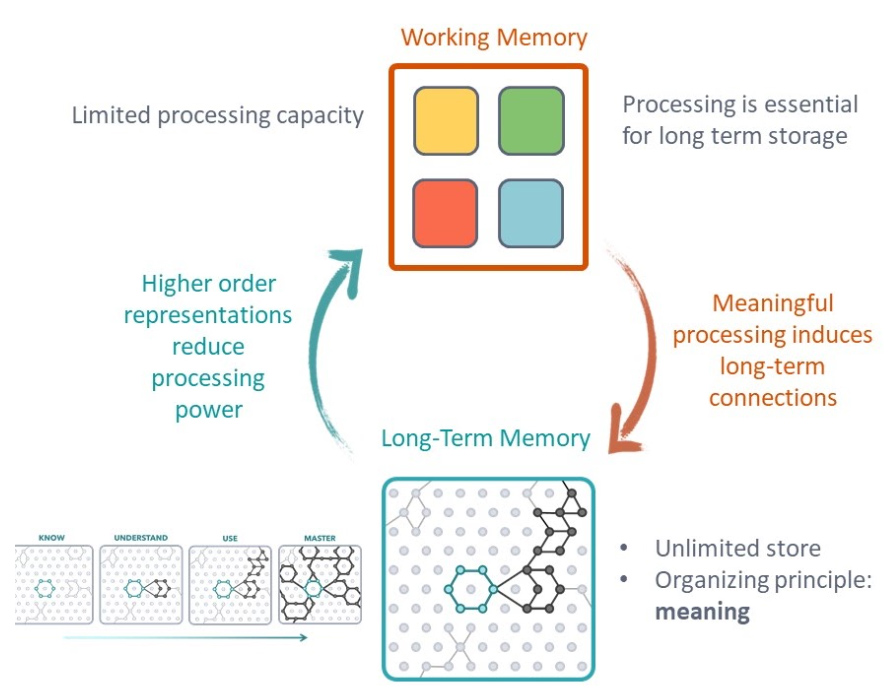
Think of working memory as the reception counter to a huge archive.

To summarize, working memory processing resources are highly limited, and yet meaningful processing is essential for storage in long-term memory. It is therefore important to use these resources effectively when learning. There are many tested and proven effective teaching strategies, but a question that often comes up is when to apply each strategy for the best results?

Long-term memory and working memory interactions


Table of Experts: Trends in Higher Education — from bizjournals.com by Holly Dolezalek. The Minneapolis-St. Paul Business Journal held a panel discussion recently about trends in higher education.

Excerpts (which focus on law schools/the legal profession):

Anthony Niedwiecki: The legal profession and legal education are very conservative. Covid showed they can, and we as institutions can, change. At Mitchell Hamline, we were the first law school in the country to offer a partially online JD degree. We’ve had that experience since 2015, which has really helped us through Covid. But I think the biggest thing I’ve learned from our students through this process is the need for flexibility. We thought students would want to go back into the classroom at some point and be around people. No! They voted by the classes they signed up for: They signed up for the classes that were online. Some students want to be on campus, some online. So we’ve had to develop our program around different types of modalities we may not have given any thought to before. The students in the online program range in age all the way up to 73 years old. They’ve been in careers, they’re accountants, they’re doctors, they’re health care professionals, elected officials. The other thing is office hours — students like online office hours because it’s convenient, and they can be in an office where other people are talking and learn from it.

 The lesson I take from that, in some ways, even applying it to the law school, is having that partnership with people who want to hire students to make sure that they’re actually involved with the students. We’re finding they help mentor those students, help us make sure we have the right courses in place, and give them opportunities to do internships and externships. So we’ve been starting to partner with some national professional organizations that are attached to the law.
 

Forget About Setting Goals. Focus on This Instead. — from jamesclear.com by James Clear; with thanks to Robert Talbert on LinkedIn for this resource.

Excerpt:

The goal in any sport is to finish with the best score, but it would be ridiculous to spend the whole game staring at the scoreboard. The only way to actually win is to get better each day. In the words of three-time Super Bowl winner Bill Walsh, “The score takes care of itself.” The same is true for other areas of life. If you want better results, then forget about setting goals. Focus on your system instead.

What do I mean by this? Are goals completely useless? Of course not. Goals are good for setting a direction, but systems are best for making progress. A handful of problems arise when you spend too much time thinking about your goals and not enough time designing your systems.

Also from Robert Talbert out on LinkedIn see:

Government’s $18.5 million microcredential pilot aims to inject workers into sectors suffering from talent shortages — from smartcompany.com.au by Melissa Coade

Excerpt:

Jason Clare has announced $18.5 million for a higher education initiative to inject new skills into the workforce using small courses.

The government will fund higher-education institutions to develop microcredentials targeting national priority areas, which include teaching, engineering, health, and technology.

The Education Minister said the pilot would parachute workers with particular skills into industries that were “crying out” for talent.


Psalm 100:4-5

Enter his gates with thanksgiving
    and his courts with praise;
    give thanks to him and praise his name.
For the Lord is good and his love endures forever;
    his faithfulness continues through all generations.

From DSC:
Thank you for you LORD!!! And thank you for your patience with me, and for your mercy, forgiveness, and love (which it has taken me a long time to realize/embrace). Thank you for being active (most likely, mind-blowingly so).

Thank you for your creativity. Thank you for my/our senses of sight, hearing, taste, smell, and touch — and for all that our bodies can do. We truly are fearfully and wonderfully made. Thank you for our minds and our hearts — may they be inclined towards doing right by you and by others.


To Combat Learning Loss, Schools Need to Overhaul the Industrial-Age Paradigm — from educationnext.org by Frederick Hess
The decline in academic gains may be steeper, but it’s not a new phenomenon

Excerpt:

Why did movements over the last two decades to raise standards, improve educator quality, upgrade curriculum, enable choice, leverage assessment, instill accountability, and increase funding appear to have such a limited impact on college and career readiness?

One potential answer: Nearly all of these reforms left the basic tenets of the industrial-paradigm classroom intact.

The above article links to:

Out of the Box -- How Innovative Learning Models Can Transform K-12 Education

It’s Time to Rethink the ‘One Teacher, One Classroom’ Model — from edweek.org by Irene Chen & Stephanie Banchero
How to build a happier and more effective teaching force

Excerpt:

The last few years have taken a toll on our teachers. The COVID-19 pandemic, ongoing cultural divisions, and the Uvalde, Texas, massacre all weigh heavily. Morale is at an all-time low. Now is the time to rethink the teaching profession.


Addendum; also relevant/see:


Buyer Beware: First-Year Earnings and Debt for 37,000 College Majors at 4,400 Institutions — from cew.georgetown.edu

Summary:

Did you know that in the first year after graduation you can make more money with an associate’s degree in nursing from Santa Rosa Junior College in California than with a graduate degree from some programs at Harvard University? Data from the College Scorecard reveal many more surprising details of post-college outcomes for students and families about that all-important first year after graduation. Buyer Beware: First-Year Earnings and Debt for 37,000 College Majors at 4,400 Institutions finds that first-year earnings for the same degree in the same major can vary by $80,000 at different colleges and universities. It also reveals that workers with less education can often make more than workers with more education, and that higher levels of education do not always result in higher student loan payments.

Speaking of Georgetown, also see:

In the U.S. alone, more than 39 million students leave college without a degree. Black, Latino, and Native American students are overrepresented in this population.

SCS’s program is designed to help students of all backgrounds complete their degrees and unlock their earning potential. The degree’s most recent on-campus cohort is composed of 62% students of color and 40% military-connected learners. SCS is introducing this fully online degree to scale this program to learners worldwide.


Your iPhone Has 26 New Accessibility Tools You Shouldn’t Ignore — from ios.gadgethacks.com by Jovana Naumovski

Excerpt (emphasis DSC):

Magnifier has a new Door Detection option on iOS 16, which helps blind and low-vision users locate entryways when they arrive at their destination. The tool can tell you how far away the door is, if the door is open or closed, how to open it (push it, turn the knob, pull the handle, etc.), what any signs say (like room numbers), what any symbols mean (like people icons for restrooms), and more.

From DSC:
By the way, this kind of feature would be great to work in tandem with devices such as the Double Robotics Telepresence Robot — i.e., using Machine-to-Machine (M2M) communications to let the robot and automatic doors communicate with each other so that remote students can “get around on campus.”
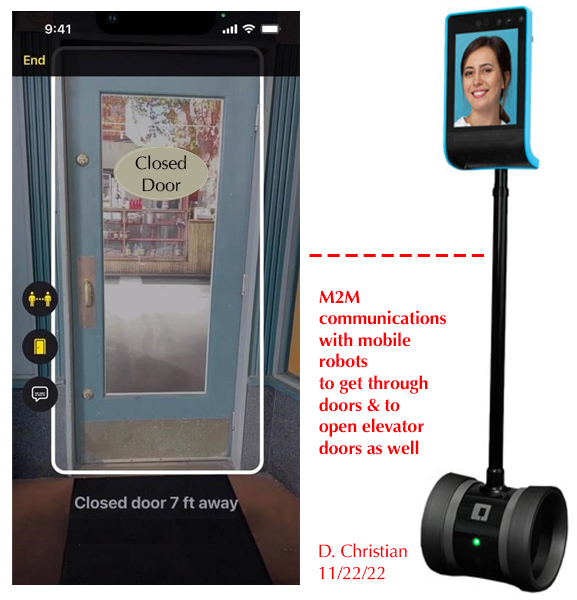
 

It would be great to have M2M communications with mobile robots to get through doors and to open elevator doors as well


Along the lines of accessibility-related items, also relevant/see:

Microsoft introduces sign language for Teams — from inavateonthenet.net

Excerpt:

Microsoft has announced a sign language view for Teams to help signers and others who use sign language. The information on screen will be prioritised on centre stage, in a consistent location, throughout every meeting.

When sign language view is enabled, the prioritised video streams automatically appear at the right aspect ratio and at the highest available quality. Like pinning and captioning, sign language view is personal to each user and will not impact what others see in the meeting.


70% Aren’t Prepared For The Future Of Work: Demands For Upskilling Surge — from forbes.com by Tracy Brower, PhD; with thanks to Ray Schroeder out on LinkedIn for this resource

Excerpt:

Unprepared for the Future
Fully 70% of people don’t feel prepared for the future of work, according to a study of 3,000 people conducted by Amazon and Workplace Intelligence. In addition, research by Adobe involving almost 10,000 people across eight global markets found 80% of people are concerned by at least one global issue, upsetting them enough to impact negatively on their productivity and job satisfaction.

Big Implications
The implications for employers are significant as well, with 64%-66% of people saying they are likely to leave their employer because there aren’t enough opportunities for skills development or career advancement.


Psalm 95: 1-7 — from biblegateway.com

Come, let us sing for joy to the Lord;
    let us shout aloud to the Rock of our salvation.
Let us come before him with thanksgiving
    and extol him with music and song.

For the Lord is the great God,
    the great King above all gods.
In his hand are the depths of the earth,
    and the mountain peaks belong to him.
The sea is his, for he made it,
    and his hands formed the dry land.

Come, let us bow down in worship,
    let us kneel before the Lord our Maker;
for he is our God
    and we are the people of his pasture,
    the flock under his care.


2022 Winners of the LegalTech Breakthrough Awards — from legaltechbreakthrough.com

Categories include:

  • Case Management
  • Client Relations
  • Data & Analytics
  • Documentation
  • Legal Education
  • Practice Management
  • Legal Entity Management
  • Legal Research
  • Online Dispute Resolution
  • Contract Management
  • eDiscovery
  • Marketplaces
  • RegTech
  • Leadership

Also see:

With the cost of international air travel rising sharply, remote hearings are a practical alternative to in-person proceedings. International travel is expensive, and the virtual option means that it is no longer necessary to count travel as a “cost of doing business” when pursuing an international dispute. The widespread use of technology in global dispute resolution proceedings gives attorneys and their clients the option to participate remotely, which is a compelling cost saver for all parties. 

  • Most debt lawsuits get decided without a fight. Michigan leaders want to change the rules. — from mlive.com by Matthew Miller
    Excerpt:
    Most of the 1.9 million debt collection cases filed in Michigan’s district courts over the past decade or so never went to trial. Usually, the defendants don’t show up to court, and debt collectors win by default, according to data compiled by the Michigan Justice for All Commission. In most cases, the courts end up garnishing defendants’ wages, income tax returns or other assets, sometimes on the basis of complaints that include little more than the name of the creditor, an account number and the balance due.

And both debt lawsuits and garnishment are more common for people living in primarily Black neighborhoods, regardless of their income.

Members of the Commission say Michigan’s rules around debt collection lawsuits don’t do enough to protect regular people, who sometimes don’t find out they’ve been sued until they see money coming out of their paychecks.

They say those rules need to change.

An early participant in the Law Society of BC’s Innovation Sandbox, the Clinic offers the in-person and virtual help of 25 articling students located in 15 different BC communities —from Tofino to Cranbrook— with the support of 15 supervising lawyers, four staff and dozens of local mentors. Together, they provide fixed-fee services in a wide range of areas covering everyday legal problems.


edX Announces 2022 edX Prize Finalists for Innovation in Online Teaching — from prnewswire.com by 2U, Inc.

Excerpt:

The 2022 finalists include (sorted alphabetically by institution):

Other recent items from GSV:

“The reason TikTok is so popular is because it’s short-form and engaging; the opposite to the usual two-hour training course.

“Spacing out micro-learning chunks across the course of a year gives you a much better chance of retaining it and actually acting on it. That’s why GoodCourse is built to engage a Gen Z workforce.”


Homeschooling High School With Interest-Led Learning — from raisinglifelonglearners.com by Colleen Kessler

Excerpt:

Think of an interest-led homeschool as one that functions more as a college than a high school. Just as a college student declares a major and the bulk of their study is in that topic area with supplemental general education, your interest-led high school can function the same way.

Also relevant/see:

This approach allows you to help them develop their interests, communicate that you see their interests as valuable, and it gives your child the chance to follow their own paths of interest. It’s an outstanding way to facilitate a self-motivated, self-directed learner and thinker. 


Stephen Downes’ reflection on “Every Student Needs a Learning Coach” — from by Nate McClennen

Excerpt (from Stephen):

The key to making this happen, I think, is to reorganize local schooling to take advantage of online (and increasingly, AI-generated) learning services, allowing in-person educators to adopt this coaching function.

Key points from Nate’s article:

  • As learning becomes more personalized, learning opportunities expanded and unbounded, and learning science research more robust, an updated and revised advisory role is more important than ever.
  • Redefining the coaching/mentor/advisor role as the educational landscape shifts is critical to ensure success for every learner.

Also relevant to using AI in education/see:


© 2025 | Daniel Christian