ChatGPT as a teaching tool, not a cheating tool — from timeshighereducation.com by Jennifer Rose
How to use ChatGPT as a tool to spur students’ inner feedback and thus aid their learning and skills development

Excerpt:

Use ChatGPT to spur student’s inner feedback
One way that ChatGPT answers can be used in class is by asking students to compare what they have written with a ChatGPT answer. This draws on David Nicol’s work on making inner feedback explicit and using comparative judgement. His work demonstrates that in writing down answers to comparative questions students can produce high-quality feedback for themselves which is instant and actionable. Applying this to a ChatGPT answer, the following questions could be used:

  • Which is better, the ChatGPT response or yours? Why?
  • What two points can you learn from the ChatGPT response that will help you improve your work?
  • What can you add from your answer to improve the ChatGPT answer?
  • How could the assignment question set be improved to allow the student to demonstrate higher-order skills such as critical thinking?
  • How can you use what you have learned to stay ahead of AI and produce higher-quality work than ChatGPT?
 

…which links to openai.com/research/gpt-4


Also relevant/see:

See the recording from the GPT-4 Developer Demo

See the recording from the GPT-4 Developer Demo

About GPT-4
GPT-4 can solve difficult problems with greater accuracy, thanks to its broader general knowledge and advanced reasoning capabilities.

You can learn more through:

  • Overview page of GPT-4 and what early customers have built on top of the model.
  • Blog post with details on the model’s capabilities and limitations, including eval results.

From DSC:
I do hope that the people building all of this are taking enough time to ask, “What might humans do with these emerging technologies — both positively AND negatively?” And then put some guard rails around things.


Also relevant/see:


Psalms 32:3-5

When I kept silent, my bones wasted away through my groaning all day long. For day and night your hand was heavy on me; my strength was sapped as in the heat of summer. Then I acknowledged my sin to you and did not cover up my iniquity. I said, “I will confess my transgressions to the LORD.” And you forgave the guilt of my sin.


From DSC:
I’m very grateful for the LORD’s grace, forgiveness, love/friendship, faithfulness, mercy, wisdom, guidance, and patience. Thank you LORD! And thank you for being *active* in my life. As you know, I need that.

It’s taken me years…no…decades to better understand and connect my mind and my heart with some of these things. For example, I used to see the LORD as a toe-tapping heavenly Being…looking down scornfully at me from above and saying, “Get your *(&^ together Daniel!” For years, I didn’t see Him as being on my team. 

As my spiritual journey continued — and after many years, trials, and failures had passed — I came to see that He actually WAS on my team. I had had an incorrect view of Him. 

Over time, his toe stopped tapping in my mind. I discovered that He did want what was best for me. At times, my trust levels weren’t what I thought they were. By demonstrating His faithfulness, my trust levels have risen. Thanks again LORD.

I realize that I still have a long ways to go yet.


Exploring generative AI and the implications for universities — from universityworldnews.com

Excerpt:

This is part of a weekly University World News special report series on ‘AI and higher education’. The focus is on how universities are engaging with ChatGPT and other generative artificial intelligence tools. The articles from academics and our journalists around the world are exploring developments and university work in AI that have implications for higher education institutions and systems, students and staff, and teaching, learning and research.

AI and higher education -- a report from University World News


Teaching: A University-Wide Language for Learning — from chronicle.com by Beckie Supiano

Excerpt (emphasis DSC):

Last week, as I was interviewing Shaun Vecera about a new initiative he directs at the University of Iowa, he made a comment that stopped me in my tracks. The initiative, Learning at Iowa, is meant to create a common vocabulary, based on cognitive science, to support learning across the university. It focuses on “the three M’s for effective learning”: mind-set, metacognition, and memory.

“Not because those are the wrong ways of talking about that. But when you talk about learning, I think you can easily see how these skills transfer across not just courses, but also transfer from the university into a career.”


From DSC:
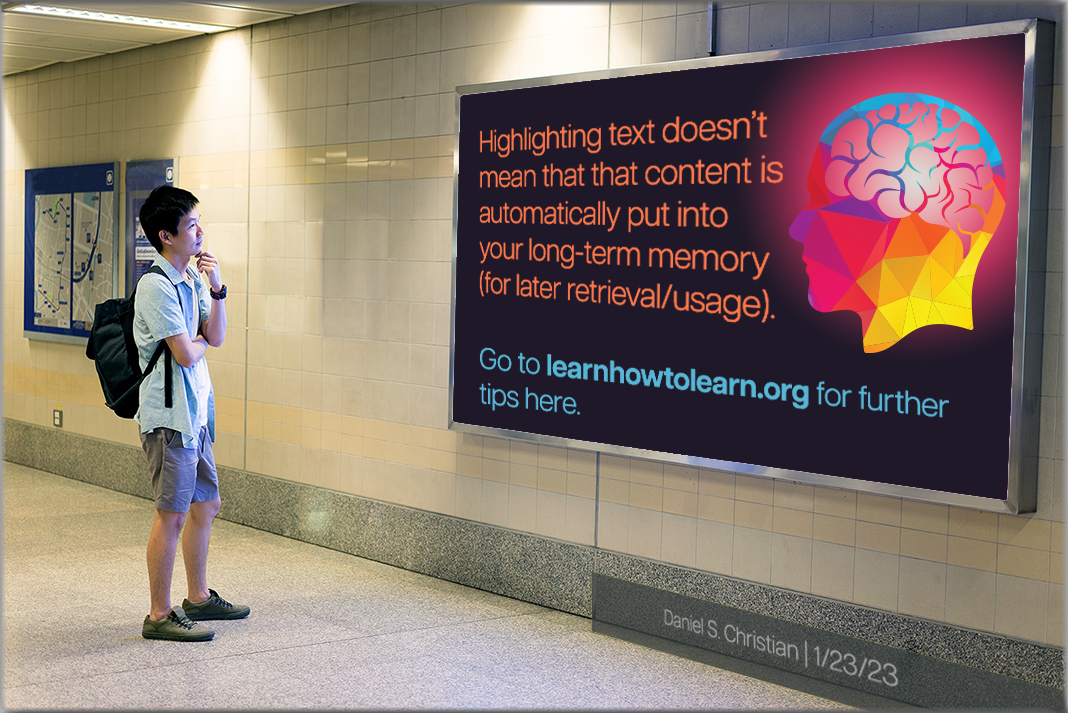
This reminds me of what I was trying to get at here — i.e., let’s provide folks with more information on learning how to learn.

Lets provide folks with more information on learning how to learn

Lets provide folks with more information on learning how to learn

Lets provide folks with more information on learning how to learn


Also relevant/see:

Changing your teaching takes more than a recipe — — from chronicle.com by Beckie Supiano
Professors have been urged to adopt more effective practices. Why are their results so mixed?

Excerpts:

When the researchers asked their interview subjects how they first learned about peer instruction, many more cited informal discussions with colleagues than cited more formal channels like workshops. Even fewer pointed to a book or an article.

So even when there’s a really well-developed recipe, professors aren’t necessarily reading it.

In higher ed, teaching is often seen as something anyone who knows the content can automatically do. But the evidence suggests instead that teaching is an intellectual exercise that adds to subject-matter expertise.

This teaching-specific math knowledge, the researchers note, could be acquired in teacher preparation or professional development, however, it’s usually created on the job.

“Now, I’m much more apt to help them develop a deeper understanding of how people learn from a neuroscientific and cognitive-psychology perspective, and have them develop a model for how students learn.”

Erika Offerdahl, associate vp and director of the Transformational Change Initiative at WSU

From DSC:
I love this part too:

There’s a role here, too, for education researchers. Not every evidence-based teaching practice has been broken into its critical components in the literature,


Challenging ‘Bad’ Online Policies and Attitudes — from insidehighered.com by Susan D’Agostino
Academic and industry leaders spoke with conviction at the SXSW EDU conference this week about approaches that impede educational access to motivated, capable learners.

Excerpts:

“It’s driven by artificial intelligence,” Barnes said of IBM’s training and reskilling effort. “It’s a Netflix-like interface that pushes content. Or an employee can select content…

The leaders discussed the ways in which colleges, policymakers, and employers might work together to help more Americans find or advance in viable employment, while also addressing the workforce skills gap. But some “bad” policies and attitudes about online learning undermine their efforts to work together, expand access and deliver outcomes to motivated, capable learners.

“Employers were saying, ‘We have job openings we can’t fill, and we want to work with the education system, but it is so unbelievably frustrating because they’re very rigid, and they don’t want to customize to our needs,’” Hansen said. These employers sought workforce training that could produce a pipeline of learners-turned-employees, and Hansen said they told him, “If you can do that, I’ll pay you.”


Fostering sustainable learning ecosystems — from linkedin.com by Patrick Blessinger

Excerpt (emphasis DSC):

Learning ecosystems
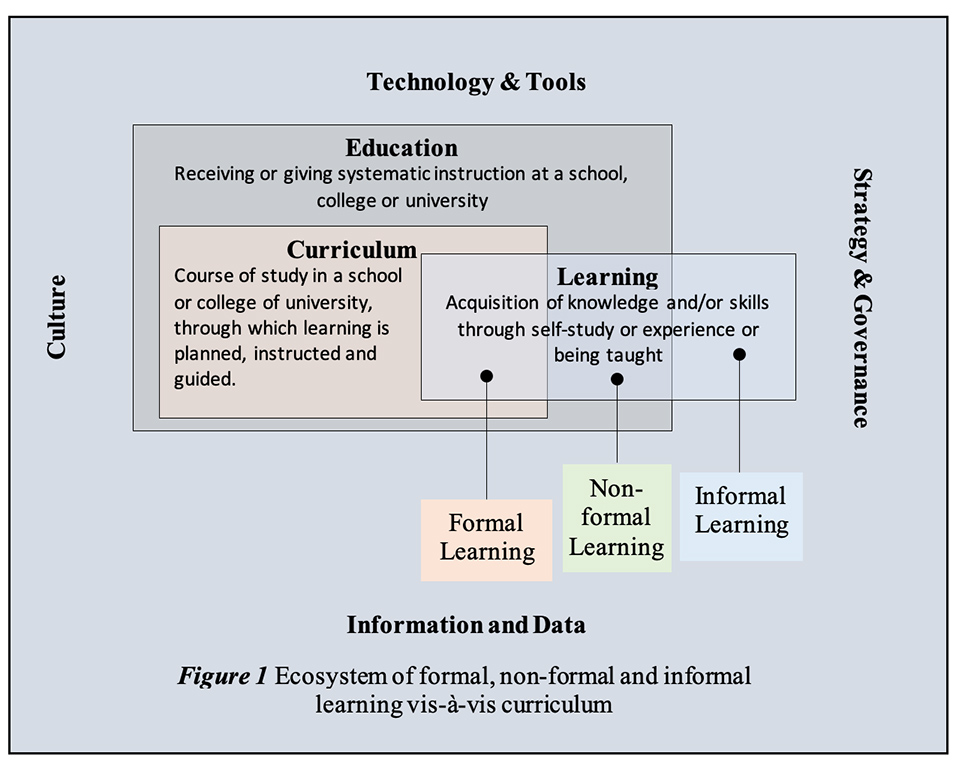
As today’s global knowledge society becomes increasingly interconnected and begins to morph into a global learning society, it is likely that formal, nonformal, and informal learning will become increasingly interconnected. For instance, there has been an explosion of new self-directed e-learning platforms such as Khan Academy, Open Courseware, and YouTube, among others, that help educate billions of people around the world.

A learning ecosystem includes all the elements that contribute to a learner’s overall learning experience. The components of a learning ecosystem are numerous, including people, technology platforms, knowledge bases, culture, governance, strategy, and other internal and external elements that have an impact on learning. Therefore, moving forward, it is crucial to integrate learning across formal, nonformal, and informal learning processes and activities in a more strategic way.

Learning ecosystems -- formal, informal, and nonformal sources of learning will become more tightly integrated in the future


What’s It Like to Leave the Classroom for a Job in Edtech? — from edsurge.com by Nadia Tamez-Robledo

Excerpt:

Our recent analysis of teacher representation in edtech leadership revealed that former educators held a variety of top roles in the companies we sampled, heading teams that handled pedagogy, curriculum, product, marketing and sales.

Former educators told us they had moved on to become UX designers, part of sales teams and founders of their own edtech companies.

Transitioning to edtech would have been much harder about five years ago, she believes, because there weren’t as many resources available to help teachers get started. Now job seekers can turn to podcasts or TikTok’s #transitioningteachers community for advice on approaching the edtech job search.


Deuteronomy 7:9 — from biblegateway.com

Know therefore that the Lord your God is God; he is the faithful God, keeping his covenant of love to a thousand generations of those who love him and keep his commandments.

Leviticus 19:35-36 NIV — from bible.com

Do not use dishonest standards when measuring length, weight or quantity. Use honest scales and honest weights, an honest ephah and an honest hin. I am the LORD your God, who brought you out of Egypt.


Working To Incorporate Legal Technology Into Your Practice Isn’t Just A Great Business Move – It’s Required — from abovethelaw.com by Chris Williams

Excerpt:

According to Model Rule 1.1 of the ABA Model Rules of Professional Conduct: “A lawyer shall provide competent representation to a client. Competent representation requires the legal knowledge, skill, thoroughness and preparation reasonably necessary for the representation.”

In 2012, the ABA House of Delegates voted to amend Comment 8 to Model Rule 1.1 to include explicit guidance on lawyers’ use of technology.

If Model Rule 1.1 isn’t enough of a motivator to dip your feet in legal tech, maybe paying off that mortgage is. As an extra bit of motivation, it may benefit you to pin the ABA House of Delegate’s call to action on your motivation board.

Also relevant/see:

While courts still use fax machines, law firms are using AI to tailor arguments for judges — from cbc.ca by Robyn Schleihauf

Excerpt (emphasis DSC):

What is different with AI is the scale by which this knowledge is aggregated. While a lawyer who has been before a judge three or four times may have formed some opinions about them, these opinions are based on anecdotal evidence. AI can read the judge’s entire history of decision-making and spit out an argument based on what it finds. 

The common law has always used precedents, but what is being used here is different — it’s figuring out how a judge likes an argument to be framed, what language they like using, and feeding it back to them.

And because the legal system builds on itself — with judges using prior cases to determine how a decision should be made in the case before them — these AI-assisted arguments from lawyers could have the effect of further entrenching a judge’s biases in the case law, as the judge’s words are repeated verbatim in more and more decisions. This is particularly true if judges are unaware of their own biases.

Cutting through the noise: The impact of GPT/large language models (and what it means for legal tech vendors) — from legaltechnology.com by Caroline Hill

Excerpts:

Given that we have spent time over the past few years telling people not to get to overestimate the capability of AI, is this the real deal?

“Yeah, I think it’s the real thing because if you look at why legal technologies have not had the adoption rate historically, language has always been the problem,” Katz said. “Language has been hard for machines historically to work with, and language is core to law. Every road leads to a document, essentially.”

Katz says: “There are two types of things here. They would call general models GPT one through four, and then there’s domain models, so a legal specific large language model.

“What we’re going to see are large-ish, albeit not the largest model that’s heavily domain tailored is going to beat a general model in the same way that a really smart person can’t beat a super specialist. That’s where the value creation and the next generation of legal technology is going to live.”

Fresh Voices in Legal Tech with Kristen Sonday — from legaltalknetwork.com by Dennis Kennedy and Tom Mighell with Kristen Sonday

In a brand new interview series, Dennis and Tom welcome Kristen Sonday to hear her perspectives on the latest developments in the legal tech world.


5 Ideas To Incorporate AI In Your eLearning Course — from elearningindustry.com by Christopher Pappas

Summary: 

Artificial Intelligence is now taking the world of learning by storm. Here are 5 ways you can successfully incorporate AI in online learning.

Let’s say you’re training sales reps on handling different customer personalities. You can use this technology to diversify your branching scenarios so that trainees can also speak and not only type. This way, not only will the training become more realistic, but you’ll also be able to assess and work on additional elements, such as tone of voice, volume, speech tempo, etc.


Transfers From Community College Continue to Fall — from insidehighered.com by Sara Weissman
Despite the decline in transfers, a new report also says six-year college completion rates among transfer students improved.

Excerpt:

Transfers between community colleges and four-year institutions continued to drop last fall, an ongoing trend since the onset of the COVID-19 pandemic, according to a new report from the National Student Clearinghouse Research Center. But the report also contains some good news, including that six-year college completion rates among transfer students improved, despite the disruptive nature of the pandemic.

“Upward transfer has continued to decline pretty steadily at this point in every year since the pandemic,” Shapiro said during a media briefing Wednesday. “This suggests that baccalaureate attainment is beginning to appear increasingly out of reach for community college students,” particularly for students enrolled in urban and suburban community colleges, which saw steeper declines in transfers to universities than community colleges in towns or rural areas.


These 20 jobs are the most “exposed” to AI, ChatGPT, researchers say — from cbsnews-com.cdn.ampproject.org

Excerpt:

New research examining the effects of language modeling AI like ChatGPT on different occupations and industries finds that certain jobs, like telemarketers and teachers, are more “exposed” to the technology than others, such as psychologists and counselors.

Also relevant/see:

Must read: the 100 most cited AI papers in 2022  — from zeta-alpha.com by Sergi Castella i Sapé; with titles, citation counts, and affiliations.

How will Language Modelers like ChatGPT Affect Occupations and Industries? — from papers.ssrn.com by Edward W. Felten, Manav Raj, and  Robert Seamans


An inside look at a 5th grade classroom using ChatGPT — from abcnews.go.com
Kentucky teacher Donnie Piercey uses ChatGPT with his fifth frade students.

Excerpt:

“Like every other educator, I had that concern. Is this something that students are only going to use to cheat? So I started to think about like, ‘OK, what role is AI — artificial intelligence — going to play in the classroom?'” Piercey, the 2021 Kentucky Teacher of the Year, told “Good Morning America.” “And the more that I thought about it, I realized that there’s a lot more good that can come about through AI as opposed to negative things that can come in the classroom.”

 
© 2025 | Daniel Christian