


Jane Hart’s “Top 100 Tools for Learning 2025” is now available
On 09/03/2025,
in adjunct faculty, Artificial Intelligence/Agents/LLMs/and Related, bots, change, changing business models, cloud-based computing / apps / other cloud-related, colleges, communities of practice, community colleges, content development, aggregation, repositories, curriculum, digital learning, education, education reform, education technology, emerging technologies, engagement / engaging students, experimentation, faculty/staff, higher education, homeschooling/homeschoolers, human-computer interaction (HCI), innovation, instructional design, intelligent systems, intelligent tutoring, IT in HE, K-12 related, languages and translation, learning, learning agents, learning ecosystem, Learning Experience Design, learning preferences, learning spaces, liberal arts, lifelong learning, new business models, online media, personalized/customized learning, productivity / tips and tricks, professional development, skills, student-related, teachers, teaching & learning, tools, trends, United States, universities, vendors,
by Daniel Christian
Midoo AI Launches the World’s First AI Language Learning Agent, Redefining How People Learn Languages — from morningstar.com
SINGAPORE Sept. 3, 2025 /PRNewswire/ — Today, Midoo AI proudly announces the launch of the world’s first AI language learning agent, a groundbreaking innovation set to transform language education forever.
For decades, language learning has pursued one ultimate goal: true personalization. Traditional tools offered smart recommendations, gamified challenges, and pre-written role-play scripts—but real personalization remained out of reach. Midoo AI changes that. Here is the >launch video of Midoo AI.
Imagine a learning experience that evolves with you in real time. A system that doesn’t rely on static courses or scripts but creates a dynamic, one-of-a-kind language world tailored entirely to your needs. This is the power of Midoo’s Dynamic Generation technology.
“Midoo is not just a language-learning tool,” said Yvonne, co-founder of Midoo AI. “It’s a living agent that senses your needs, adapts instantly, and shapes an experience that’s warm, personal, and alive. Learning is no longer one-size-fits-all—now, it’s yours and yours alone.”
Midoo AI Review: Meet the First AI Language Learning Agent — from autogpt.net
Language learning apps have traditionally focused on exercises, quizzes, and progress tracking. Midoo AI introduces a different approach. Instead of presenting itself as a course provider, it acts as an intelligent learning agent that builds, adapts, and sustains a learner’s journey.
This review examines how Midoo AI operates, its feature set, and what makes it distinct from other AI-powered tutors.
Midoo AI in Context: Purpose and Position
Midoo AI is not structured around distributing lessons or modules. Its core purpose is to provide an agent-like partner that adapts in real time. Where many platforms ask learners to select a “level” or “topic,”
Midoo instead begins by analyzing goals, usage context, and error patterns. The result is less about consuming predesigned units and more about co-constructing a pathway.
AI Isn’t Replacing Teachers — It’s Helping Us Teach Better — from rdene915.com by guest author Matthew Mawn
Turning Time Saved Into Better Learning
AI can save teachers time, but what can that time be used for (besides taking a breath)? For most of us, it means redirecting energy into the parts of teaching that made us want to pursue this profession in the first place: connecting with our students and helping them grow academically.
Differentiation
Every classroom has students with different readiness levels, language needs, and learning preferences. AI tools like Diffit or MagicSchool can instantly create multiple versions of a passage or assignment, differentiated by grade level, complexity, or language. This allows every student to engage with the same core concept, moving together as one cohesive class. Instead of spending an evening retyping and rephrasing, teachers can review and tweak AI drafts in minutes, ready for the next lesson.
Mass Intelligence — from oneusefulthing.org by Ethan Mollick
From GPT-5 to nano banana: everyone is getting access to powerful AI
When a billion people have access to advanced AI, we’ve entered what we might call the era of Mass Intelligence. Every institution we have — schools, hospitals, courts, companies, governments — was built for a world where intelligence was scarce and expensive. Now every profession, every institution, every community has to figure out how to thrive with Mass Intelligence. How do we harness a billion people using AI while managing the chaos that comes with it? How do we rebuild trust when anyone can fabricate anything? How do we preserve what’s valuable about human expertise while democratizing access to knowledge?
AI Is the Cognitive Layer. Schools Still Think It’s a Study Tool. — from stefanbauschard.substack.com by Stefan Bauschard

By the time today’s 9th graders and college freshman enter the workforce, the most disruptive waves of AGI and robotics may already be embedded into part society.
What replaces the old system will not simply be a more digital version of the same thing. Structurally, schools may move away from rigid age-groupings, fixed schedules, and subject silos. Instead, learning could become more fluid, personalized, and interdisciplinary—organized around problems, projects, and human development rather than discrete facts or standardized assessments.
AI tutors and mentors will allow for pacing that adapts to each student, freeing teachers to focus more on guidance, relationships, and high-level facilitation. Classrooms may feel less like miniature factories and more like collaborative studios, labs, or even homes—spaces for exploring meaning and building capacity, not just delivering content.
…
If students are no longer the default source of action, then we need to teach them to:
-
- Design agents,
- Collaborate with agents,
- Align agentic systems with human values,
- And most of all, retain moral and civic agency in a world where machines act on our behalf.
We are no longer educating students to be just doers.
We must now educate them to be judges, designers, and stewards of agency.
Meet Your New AI Tutor — from wondertools.substack.com by Jeremy Caplan
Try new learning modes in ChatGPT, Claude, and Gemini

AI assistants are now more than simple answer machines. ChatGPT’s new Study Mode, Claude’s Learning Mode, and Gemini’s Guided Learning represent a significant shift. Instead of just providing answers, these free tools act as adaptive, 24/7 personal tutors.
AI Tools for Instructional Design (September, 2025) — from drphilh.gumroad.com by Dr Philippa Hardman
That’s why, in preparation for my next bootcamp which kicks off September 8th 2025, I’ve just completed a full refresh of my list of the most powerful & popular AI tools for Instructional Designers, complete with tips on how to get the most from each tool.
The list has been created using my own experience + the experience of hundreds of Instructional Designers who I work with every week.
It contains the 50 most powerful AI tools for instructional design available right now, along with tips on how to optimise their benefits while mitigating their risks.
Addendums on 9/4/25:
AI Companies Roll Out Educational Tools — from insidehighered.com by Ray Schroeder
This fall, Google, Anthropic and OpenAI are rolling out powerful new AI tools for students and educators, each taking a different path to shape the future of learning.
Rethinking My List of Essential Job Skills in the Age of AI — from michellekassorla.substack.com by Michelle Kassorla
So here’s the new list of essential skills I think my students will need when they are employed to work with AI five years from now:
- They can follow directions, analyze outcomes, and adapt to change when needed.
- They can write or edit AI to capture a unique voice and appropriate tone in sync with an audience’s needs
- They have a deep understanding of one or more content areas of a particular profession, business, or industry, so they can easily identify factual errors.
- They have a strong commitment to exploration, a flexible mindset, and a broad understanding of AI literacy.
- They are resilient and critical thinkers, ready to question results and demand better answers.
- They are problem solvers.
And, of course, here is a new rubric built on those skills:
On 09/03/2025,
in Daniel S. Christian, Emotion, ethics, faith, global / globalization, hearts -- matters of the heart, morals/values, relationships, religion, society, youth,
by Daniel Christian
Jesus answered, “The work of God is this: to believe in the one he has sent.”
Be kind and compassionate to one another, forgiving each other, just as in Christ God forgave you.
Jesus Calms the Storm
35 That day when evening came, he said to his disciples, “Let us go over to the other side.” 36 Leaving the crowd behind, they took him along, just as he was, in the boat. There were also other boats with him. 37 A furious squall came up, and the waves broke over the boat, so that it was nearly swamped. 38 Jesus was in the stern, sleeping on a cushion. The disciples woke him and said to him, “Teacher, don’t you care if we drown?”
39 He got up, rebuked the wind and said to the waves, “Quiet! Be still!” Then the wind died down and it was completely calm.
40 He said to his disciples, “Why are you so afraid? Do you still have no faith?”
41 They were terrified and asked each other, “Who is this? Even the wind and the waves obey him!”
This is what the Lord says— your Redeemer, the Holy One of Israel: “I am the Lord your God, who teaches you what is best for you, who directs you in the way you should go.
3 When I kept silent, my bones wasted away through my groaning all day long. 4 For day and night your hand was heavy on me; my strength was sapped as in the heat of summer. 5 Then I acknowledged my sin to you and did not cover up my iniquity. I said, “I will confess my transgressions to the Lord.” And you forgave the guilt of my sin. 6 Therefore let all the faithful pray to you while you may be found; surely the rising of the mighty waters will not reach them. 7 You are my hiding place; you will protect me from trouble and surround me with songs of deliverance. 8 I will instruct you and teach you in the way you should go; I will counsel you with my loving eye on you.
On 08/28/2025,
in Artificial Intelligence/Agents/LLMs/and Related, creativity, design, experimentation, Google, graphics, multimedia, platforms, productivity / tips and tricks, tools, United States, vendors,
by Daniel Christian
Introducing Gemini 2.5 Flash Image, our state-of-the-art image model — from developers.googleblog.com

Today [8/26/25], we’re excited to introduce Gemini 2.5 Flash Image (aka nano-banana), our state-of-the-art image generation and editing model. This update enables you to blend multiple images into a single image, maintain character consistency for rich storytelling, make targeted transformations using natural language, and use Gemini’s world knowledge to generate and edit images.
When we first launched native image generation in Gemini 2.0 Flash earlier this year, you told us you loved its low latency, cost-effectiveness, and ease of use. But you also gave us feedback that you needed higher-quality images and more powerful creative control.
Google’s new image model is BANANAS… — from theneurondaily.com by Grant Harvey
Here’s what makes nano-banana special:
- Character consistency that actually works: Google built a template app showing how you can keep characters looking identical across scenes.
- Edit photos (or drawings) with just words: Their photo editing demo lets you remove people, blur backgrounds, or colorize photos using natural language…and this co-drawing demo lets you draw and ask AI to fix it.
- Actual world knowledge: Unlike other image models, this one knows stuff—like how the co-drawing demo turns doodles into learning experiences.
- Multi-image fusion: You can now merge multiple images; fx, you can drag and drop objects between images seamlessly with their home canvas template.
On 08/28/2025,
in digital audio, digital learning, digital video, education, education technology, experimentation, global / globalization, Google, higher education, homeschooling/homeschoolers, innovation, instructional design, learning, learning ecosystem, Learning from the Living [Class] Room, learning hubs & pods & microschooling, learning preferences, learning spaces, liberal arts, lifelong learning, student-related, teachers, teaching & learning, technologies for your home, tools, training / L&D, TVs, United States, universities, user experience (UX), vendors, vision/possibilities,
by Daniel Christian
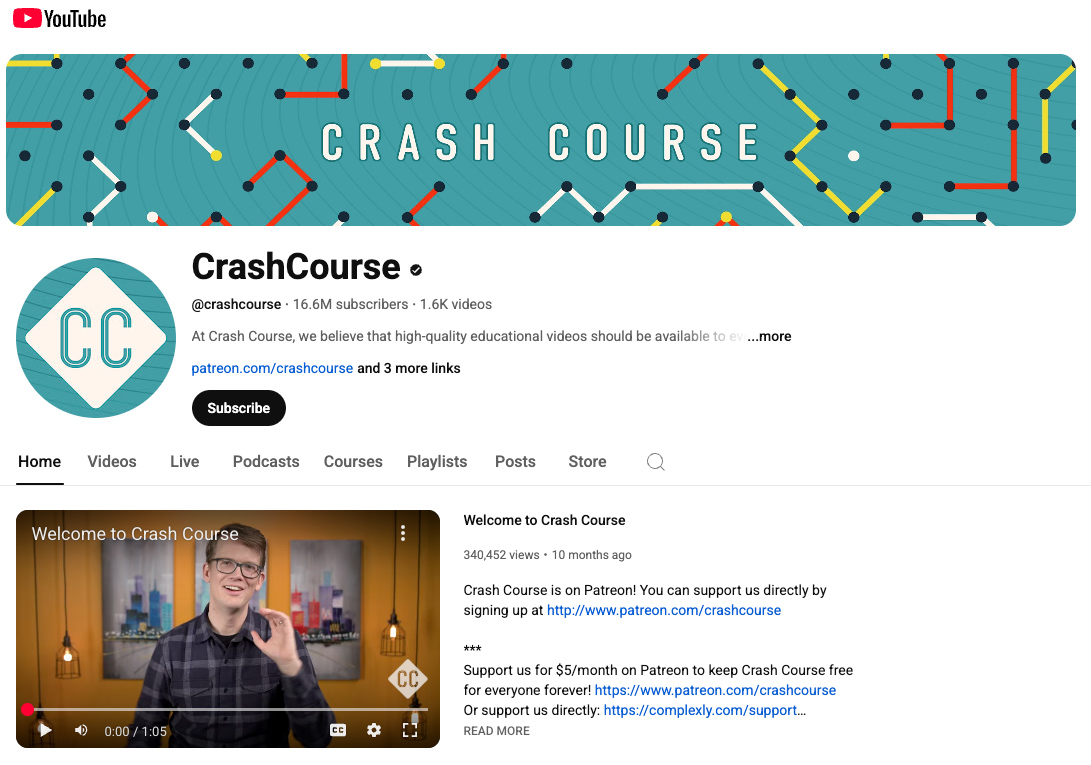
CrashCourse on YouTube — via Matt Tower’s The EdSheet Vol. 18
Description:
At Crash Course, we believe that high-quality educational videos should be available to everyone for free! Subscribe for weekly videos from our current courses! The Crash Course team has produced more than 50 courses on a wide variety of subjects, ranging from the humanities to sciences and so much more! We also recently teamed up with Arizona State University to bring you more courses on the Study Hall channel.
And as Matt stated:
- Hank Green’s 16M+ subscriber Crash Course Youtube channel is one the largest educational content providers in the world. Last week we learned that Green’s platform partnership with ASU generated 13,000 course enrollments and 2,000+ credits earned.
From DSC:
I wasn’t familiar with this “channel” — but I like their mission to help people learn…very inexpensively! Along these lines, I, too, pray for the world’s learning ecosystems — especially those belonging to children.

On 08/28/2025,
in Adobe, Artificial Intelligence/Agents/LLMs/and Related, Asia, bots, business, corporate / business world, design, digital audio, digital photography, digital storytelling, digital video, Europe, future, game-changing environment, global / globalization, Google, graphics, innovation, intelligent systems, media/film, Microsoft, multimedia, Natural Language Processing (NLP), NVIDIA, Open AI, platforms, productivity / tips and tricks, technologies for your home, tools, TVs, United States, vendors, voice recognition / voice enabled interfaces,
by Daniel Christian
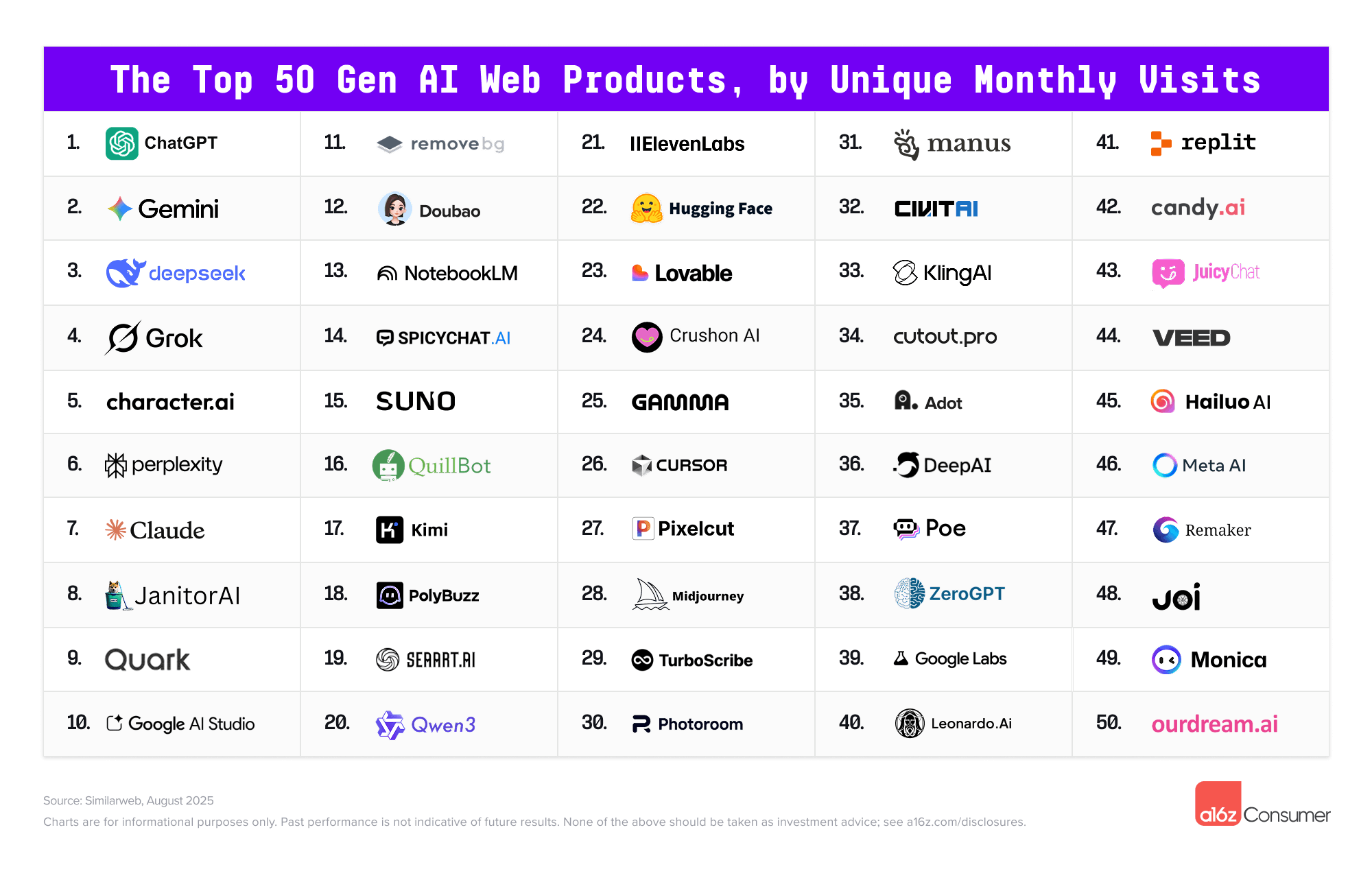
The Top 100 [Gen AI] Consumer Apps 5th edition — from a16z.com
And in an interesting move by Microsoft and Samsung:
A smarter way to talk to your TV: Microsoft Copilot launches on Samsung TVs and monitors — from microsoft.com
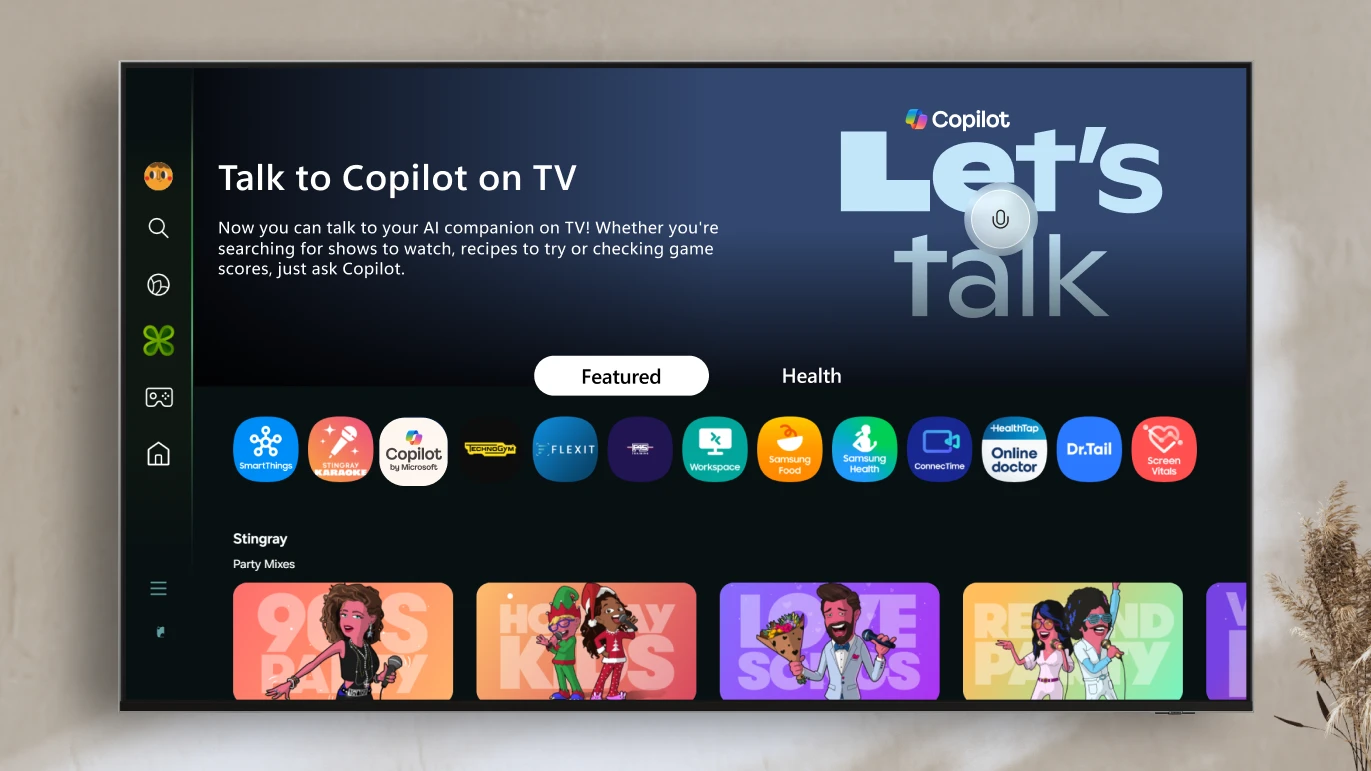
Voice-powered AI meets a visual companion for entertainment, everyday help, and everything in between.
Redmond, Wash., August 27—Today, we’re announcing the launch of Copilot on select Samsung TVs and monitors, transforming the biggest screen in your home into your most personal and helpful companion—and it’s free to use.
Copilot makes your TV easier and more fun to use with its voice-powered interface, friendly on-screen character, and simple visual cards. Now you can quickly find what you’re looking for and discover new favorites right from your living room.
Because it lives on the biggest screen in the home, Copilot is a social experience—something you can use together with family and friends to spark conversations, help groups decide what to watch, and turn the TV into a shared space for curiosity and connection.
On 08/28/2025,
in adjunct faculty, Artificial Intelligence/Agents/LLMs/and Related, business side of he, change, changing business models, collaboration, colleges, communications, communities of practice, community colleges, content development, aggregation, repositories, credentialing, culture, digital learning, education technology, face-to-face, faculty/staff, higher education, instructional design, IT in HE, law schools, leadership, learning, learning ecosystem, Learning Experience Design, learning preferences, learning spaces, liberal arts, new business models, online learning, online media, online tutoring, organizational change, policy, strategy, student-related, teaching & learning, teaching online, traditional / tradition, trends, United States, universities, vision/possibilities,
by Daniel Christian
The 2025 Changing Landscape of Online Education (CHLOE) 10 Report — from qualitymatters.org; emphasis below from DSC
Notable findings from the 73-page report include:
- Online Interest Surges Across Student Populations: …
- Institutional Preparedness Falters Amid Rising Demand: Despite accelerating demand, institutional readiness has stagnated—or regressed—in key areas. …
- The Online Education Marketplace Is Increasingly Competitive: …
- Alternative Credentials Take Center Stage: …
- AI Integration Lacks Strategic Coordination: …
Just 28% of faculty are considered fully prepared for online course design, and 45% for teaching. Alarmingly, only 28% of institutions report having fully developed academic continuity plans for future emergency pivots to online.
Also relevant, see:
Great Expectations, Fragile Foundations — from onedtech.philhillaa.com by Glenda Morgan
Lessons about growth from the CHLOE & BOnES reports
Cultural resistance remains strong. Many [Chief Online Learning Officers] COLOs say faculty and deans still believe in-person learning is “just better,” creating headwinds even for modest online growth. As one respondent at a four-year institution with a large online presence put it:
Supportive departments [that] see the value in online may have very different levels of responsiveness compared to academic departments [that] are begrudgingly online. There is definitely a growing belief that students “should” be on-ground and are only choosing online because it’s easy/ convenient. Never mind the very real and growing population of nontraditional learners who can only take online classes, and the very real and growing population of traditional-aged learners who prefer online classes; many faculty/deans take a paternalistic, “we know what’s best” approach.
…
Ultimately, what we need is not just more ambition but better ambition. Ambition rooted in a realistic understanding of institutional capacity, a shared strategic vision, investments in policy and infrastructure, and a culture that supports online learning as a core part of the academic mission, not an auxiliary one. It’s time we talked about what it really takes to grow online learning , and where ambition needs to be matched by structure.
From DSC:
Yup. Culture is at the breakfast table again…boy, those strategies taste good.
I’d like to take some of this report — like the graphic below — and share it with former faculty members and members of a couple of my past job families’ leadership. They strongly didn’t agree with us when we tried to advocate for the development of online-based learning/programs at our organizations…but we were right. We were right all along. And we were LEADING all along. No doubt about it — even if the leadership at the time said that we weren’t leading.
The cultures of those organizations hurt us at the time. But our cultivating work eventually led to the development of online programs — unfortunately, after our groups were disbanded, they had to outsource those programs to OPMs.

Arizona State University — with its dramatic growth in online-based enrollments.
On 08/28/2025,
in Artificial Intelligence/Agents/LLMs/and Related, Australia, bots, career development, creativity, design, education, graphics, health, multimedia, passions, skills, social learning / networks, social media, student-related, teachers, vocational / trades, workplace, youth,
by Daniel Christian
Artificial Intelligence in Vocational Education — from leonfurze.com by Leon Furze

The vocational education sector is incredibly diverse, covering everything from trades like building and construction, electrical, plumbing and automotive through to allied health, childcare, education, the creative arts and the technology industry. In Canberra, we heard from people representing every corner of the industry, including education, retail, tourism, finance and digital technologies. Every one of these industries is being impacted by the current AI boom.
…
A theme of the day was that whilst the vocational education sector is seen as a slow-moving beast with its own peculiar red tape, it is still possible to respond to emerging technologies like artificial intelligence, and there’s an imperative to do so.
Coming back to GenAI for small business owners, a qualified plumber running their own business, either as a solo operator or as manager of a team, probably doesn’t have many opportunities to keep up to date with the rapid developments of digital technologies. They’re far too busy doing their job.
So vocational education and training can be an initial space to develop some skills and understanding of the technology in a way which can be beneficial for managing that day-to-day job.
And speaking of the trade schools/vocational world…
Social media opens a window to traditional trades for young workers — from washingtonpost.com by Taylor Telford; this is a gifted article
Worker influencers are showing what life is like in fields such as construction, plumbing and manufacturing. Trade schools are trying to make the most of it.
Social media is increasingly becoming a destination for a new generation to learn about skilled trades — at a time when many have grown skeptical about the cost of college and the promise of white-collar jobs. These posts offer authentic insight as workers talk openly about everything from their favorite workwear to safety and payday routines.
The exposure is also changing the game for trade schools and employers in such industries as manufacturing and construction, which have long struggled to attract workers. Now, some are evolving their recruiting tactics by wading into content creation after decades of relying largely on word of mouth.
On 08/28/2025,
in corporate / business world, credentialing, education, education technology, higher education, K-12 related, learning ecosystem, policy,
by Daniel Christian
How to build trust in digital credentials? We offer some insights — from eddesignlab.org

Three key insights emerge:
Trust requires simplicity. Users need clear visual indicators (like the lock icon for secure websites) that their credentials meet technical standards without understanding the complexity behind them.
Standards matter for real people. Technical compliance with open standards directly impacts whether someone can access their own achievements and share them where needed.
Human experience drives adoption. Even the most sophisticated technical infrastructure fails if people can’t easily understand and use it.
Our insights and recommendations provide a roadmap for building credential systems that serve real human needs while meeting rigorous technical requirements.
On 08/26/2025,
in collaboration, dangers of the status quo, Daniel S. Christian, ideas, innovation, leadership, productivity / tips and tricks, strategy,
by Daniel Christian

Collaborative innovation — from marketoonist.com
Disney alum Paul Williams once shared the brainstorming method developed by Walt Disney. Disney used to separate the act of coming up with and executing ideas into three distinct steps (and associated mindsets): The Dreamer, The Realist, and The Spoiler.
As Paul wrote:
“By compartmentalizing the stages, Walt didn’t let reality get in the way of the dream step. The realist was allowed to work without the harsh filter of a spoiler. And, the spoiler spends time examining a well-thought idea… something with a bit more structure.
“When we brainstorm alone and in groups – too often – we tend to fill the room with a dreamer or two, a few realists, and a bunch of spoilers. In these conditions, dream ideas don’t stand a chance.”
The Dreamer mentality specializes in blue sky thinking without constraints, the Realist mentality puts practical structure to the ideas, and the Spoiler asks the hard questions and kicks the tires. We need all three mindsets. But we need those mindsets at the right time and in the right way.
From DSC:
How true this is! I’m the Dreamer in the room…and have been shut down more times than I can count. For all of you Visionaries and Dreamers out there, keep trying! And consider establishing something like Walt Disney did.